Theory of Change
A Theory of Change is a strategic planning tool that maps out how and why you expect a desired change to happen. It connects your activities to your outcomes, showing the logical path from what you do to the impact you want to create.
Get this template
What is a Theory of Change?
A Theory of Change (ToC) is a comprehensive description and illustration of how and why a desired change is expected to happen in a particular context. It's a strategic planning tool that helps organisations map out the logical sequence of an initiative from inputs to outcomes. This framework is particularly useful for nonprofits, charities and purpose-led organisations as it allows them to articulate their vision for social change and the steps required to achieve it.

At its core, a Theory of Change is about making explicit the underlying assumptions about how change occurs. It's a way of thinking about how your organisation's activities contribute to a chain of results that lead to your intended impact. By developing a ToC, you're essentially creating a roadmap for your organisation's work, showing how short-term outcomes connect to long-term goals.
Just like most strategic tools - a ToC is not just a static document, but a dynamic process that encourages continuous learning and adaptation. As you implement your strategies and gather data, you can refine your Theory of Change, ensuring that your organisation stays on track and remains effective in pursuing its mission.
Why is a theory of change an essential strategic tool for nonprofits and charities
For nonprofits and charities, a Theory of Change is more than just a planning tool – it's an important component of strategic thinking and operational effectiveness. From my experience of working with charities and nonprofits, here are some of the ways they’ve found a Theory of Change useful in delivering effectively and consistently:
- Clarity of Purpose: A ToC helps you articulate your organisation's mission and vision in concrete terms. It forces you to think critically about what you're trying to achieve and how you plan to get there.
- Strategic Alignment: By mapping out your activities, outcomes, and impact, you can ensure that all parts of your organisation are working towards the same goals.
- Resource Allocation: With a clear understanding of how your activities contribute to your desired outcomes, you can make more informed decisions about where to allocate your limited resources.
- Stakeholder Communication: A well-developed ToC provides a clear and compelling narrative about your work, which can be invaluable when communicating with donors, partners, and beneficiaries.
- Measurement and Evaluation: The ToC serves as a foundation for developing meaningful indicators to measure your progress and impact.
By using a Theory of Change as a foundational strategic tool, nonprofits and charities can enhance their effectiveness, improve their decision-making, and ultimately increase their impact on the communities they serve.
How to use a theory of change
A Theory of Change is a tool that can be used by nonprofits to improve their operations and impact. It is a versatile tool, meaning it can be used in different ways depending on the specific needs of the organisation. The main goal of using a Theory of Change is to create a clear and logical framework that outlines the steps and activities needed to achieve the desired outcomes and impact. Using a ToC can help nonprofits better understand how their activities contribute to their overall goals and make informed decisions to improve their effectiveness.
Here's how you can leverage this framework:
Defining Organisational Purpose
Your ToC helps clarify your organisation's raison d'être. By articulating the problem you're addressing and the change you want to see, you're essentially defining your purpose. This clarity can inspire your team and attract supporters who share your vision.
Setting Strategic Direction
The ToC provides a roadmap for your organisation. It outlines the logical steps from your activities to your ultimate impact, helping you identify the most effective strategies to achieve your goals. This can guide your decision-making at all levels of the organisation.
Prioritising Activities
With a clear ToC, you can assess which activities are most crucial to achieving your desired outcomes. This allows you to prioritise your efforts and resources, focusing on the initiatives that will have the greatest impact.
Measuring Success and Impact
Your ToC serves as a framework for developing meaningful indicators of success. By clearly outlining your expected outcomes and impact, you can identify appropriate metrics to track your progress and demonstrate your effectiveness to stakeholders.
Establishing a Unique Selling Position
Through the process of developing your ToC, you'll articulate what makes your approach unique. This can help you differentiate your organisation in a crowded nonprofit landscape, making it easier to attract funding and support.
Maintaining Focus
In the day-to-day bustle of nonprofit work, it's easy to lose sight of your ultimate goals. Your ToC serves as a constant reminder of what you're working towards, helping you stay focused and avoid mission drift.
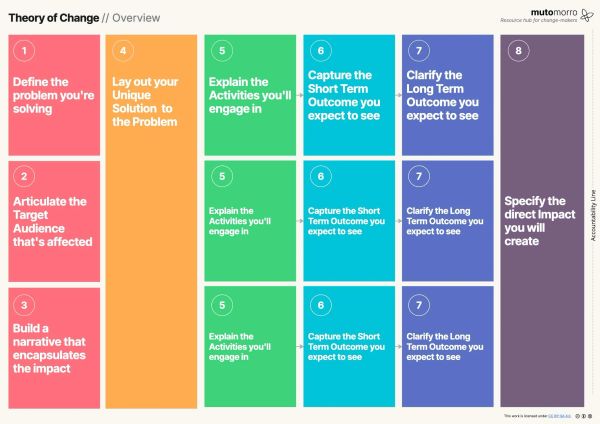
Theory of Change: Overview
Every theory of change looks a little different, visualising the change that an organisation wants to create in a unique way. But a comprehensive Theory of Change is generally made up of a few key elements that work together to create a logical and coherent framework - and how each flows into the next. Let's break down these essential elements:

- Problem Statement
- Target Audiences
- Impact of Problem on Target Audiences
- Unique Answer / Solution to the Problem
- Key Activities
- Short-term Outcomes
- Long-term Outcomes
- Expected Impact
The components above form a logical sequence, starting with the problem you're addressing and ending with the ultimate impact you aim to achieve. Each of these elements plays a vital role in constructing a complete story of your organisation's desired change process. You might also notice an overlap between the elements above and those used in a Business Model and Operating Model - this is quite deliberate.
Theory of Change: Problem Statement
The Problem Statement is the foundation of your Theory of Change. It's a clear, concise description of the issue your organisation is trying to address. This statement sets the stage for everything that follows in your ToC. Developing a clear, articulate and specific problem statement is, an often overlooked but, critical step in developing an effective Theory of Change.

What’s a problem statement?
A Problem Statement is a brief explanation of the specific problem or challenge that your nonprofit aims to solve. It should be evidence-based, drawing on research and data to substantiate the existence and scope of the problem.
Developing effective problem statements is a crucial skill for leaders and organisations, but one that is often bypassed in pursuit of finding solutions quickly. In general, the clearer the problem statement, the clearer and more effective the solution development is - so it’s worth investing the time and energy in getting it right.
Why it's important
The Problem Statement is important because it:
- Provides context for your work
- Justifies the need for your organisation's intervention
- Helps focus your efforts on a specific issue
- Serves as a starting point for developing your strategy
What should a good problem statement contain?
A good Problem Statement should define:
- The nature of the problem (what's going wrong)
- The scope of the problem (who is affected and to what extent)
- The consequences of not addressing the problem
- Any relevant contextual factors that contribute to or exacerbate the problem
And, what should it exclude?
When crafting your Problem Statement, avoid:
- Proposing solutions (that comes later in the ToC)
- Using jargon or overly technical language
- Making unsupported claims or assumptions
- Being too broad or vague - the more specific your problem statement the better
Remember, your Problem Statement should be specific enough to guide your work, but not so narrow that it limits your ability to address related issues. It's about striking a balance between focus and flexibility.
Theory of Change: Target Audience
After defining the problem, the next step in your Theory of Change is identifying your Target Audience. This section focuses on who you're trying to help or influence through your work.

Defining your target audience
Target Audiences are the specific groups of people or entities that your nonprofit aims to serve or impact. These could be direct beneficiaries of your services, as well as other stakeholders whose behaviour or circumstances you're trying to change.
What to Call Your Target Audience: Different charities and nonprofits use different terms to refer to their audiences. In various sectors, there is a wide range of nomenclature to define audiences. They might be referred to as service users, clients, stakeholders, or even customers. Some sectors prefer certain terms over others, so it can be confusing if you introduce a new term so stick with whatever you have! For the purpose of this exercise, let's consider them as the direct recipients of your activities, regardless of what those activities may be.
Why a clear target audience is important
Clearly defining your Target Audiences is essential because it:
- Defines the needs you’re trying to fulfil and the value/pain your audience experiences
- Helps you tailor your interventions to the specific needs of your beneficiaries
- Allows you to measure your impact more accurately
- Guides your outreach and communication strategies
- Ensures that your resources are directed towards those who need them most
What to include in your target audience
Your Target Audiences section should define:
- The primary groups you aim to serve or influence
- Any secondary audiences that may be indirectly impacted by your work
- Relevant characteristics of these groups (e.g., age, location, socioeconomic status)
- Specific needs and pain points your audience are experiencing
- How these audiences are connected to the problem you're addressing
What to include
When describing your Target Audiences, include:
- Demographic information
- Relevant behavioural or attitudinal characteristics
- The size of each audience group (if known)
- Any subgroups within your main target audiences
What to exclude
Avoid including:
- Audiences that are not directly related to your mission
- Overly broad or vague audience descriptions
- Assumptions about your audiences without supporting evidence
Remember, your Target Audiences should be specific enough to guide your strategy, but not so narrow that they limit your potential impact. Be sure to consider both the primary beneficiaries of your work and any secondary audiences that may be crucial to achieving your goals.
Theory of Change: Impact on Audience
Having identified your Target Audiences, the next step is to articulate how the problem you've defined affects these groups. This section of your Theory of Change is where we establish the affect of the problem, and reinforce the urgency and importance of your work.

Defining impact effectively
The way we define impact plays an important role in explaining how we plan to address the issues we’ve identified. We want to create a clear link between this impact and the way we plan to address it - so it’s useful to paint as clear a picture as possible. Statistics and quantitative insight are essential here, it’s also useful to think about how we want to tell a rich story too. Storytelling is a powerful tool to bring context and depth to your mission, so consider ways that you can structure a compelling story that defines your purpose through the impact of your target audience.
Why it's important
It should be fairly obvious why impact forms part of your ToC, and it’s often an area where organisations are clear. However, it’s also worth investing the time in getting it pin sharp - both in statistics and story - because it can be a useful tool in fundraising, stakeholder engagement and alignment of your organisation.
Defining the impact of the problem on your Target Audiences is useful because it:
- Justifies the need for your intervention
- Helps prioritise which aspects of the problem to address first
- Informs the design of your programmes and services
- Provides a baseline against which to measure your impact
What to include in your impact statement
At a minimum, your impact statement should define:
- The direct effects of the problem on your Target Audiences
- Any indirect or secondary impacts
- How the problem affect different subgroups within your Target Audiences
- The scale and severity of these impacts
Useful ideas to include in your impact statement
When describing the impact, include:
- Specific examples of how the problem manifests in people's lives
- Quantitative data on the extent of the impact (e.g., statistics, survey results)
- Qualitative information that illustrates the human side of the problem
- Any trends or patterns in how the problem affects your Target Audiences
What to exclude from your impact statement
Avoid including:
- Impacts that are not directly related to the problem you've identified
- Speculative or unsubstantiated claims about the impact
- Overly technical language that might obscure the human element of the problem
Clearly articulating the impact of the problem on your Target Audiences will set the stage for explaining why your organisation's intervention is necessary - and how it can make a meaningful difference in people's lives.
Theory of Change: Your Unique Solution
Ok, so we’ve articulated the problem we want to solve, defined our target audience and created a clear and compelling picture of the impact of the problem. The next step is to articulate your solution to the problem that aligns with the needs and preferences of your Target Audiences.

This section is an opportunity to define the specific activities or programmes that support your unique solution. Clearly articulating your organisation's unique solution helps you demonstrate the value and effectiveness of your intervention. This will help stakeholders understand why your approach is necessary and how it can make a meaningful difference in people's lives.
Developing your unique solution
Your unique answer or solution is the specific approach your nonprofit takes to address the problem. It's what sets your organisation apart from others working in the same field and forms the core of your intervention strategy. While having a competative advantage isn’t always necessary, it is worth considering the “why us” to your solution over others trying to solve similar problems.
Why your unique solution is important
A unique solution gives your organisation meaning to exist in its current format with its chosen services/approach. Tools like a Business Model Canvas or Operating Model will also draw from this unique solution to define how you want to run your organisation.
Defining your unique solution is useful because it:
- Differentiates your organisation from others in the sector
- Provides a clear rationale for your activities and programs
- Helps stakeholders understand your approach and value proposition
- Forms the basis for your key activities and expected outcomes
What your unique solution should define
When developing your unique solution, consider including these as a minimum:
- Your organisation's specific approach to addressing the problem
- The key principles or theories that underpin your solution
- How your solution differs from or complements existing approaches
- Why you believe your approach will be effective
What to include in your unique solution
When describing your unique solution, include:
- A clear, concise statement of your approach
- The rationale behind your chosen strategy
- Any evidence or research that supports your approach
- How your solution addresses the specific needs of your Target Audiences
Useful things to avoid
Your unique solution should be clear, specific and a compelling reason to exist. When you’re developing your own avoid including:
- Vague or generic statements that could apply to any organisation
- Detailed descriptions of specific activities (these come later in the ToC)
- Claims of uniqueness or effectiveness without supporting evidence
- Solutions that don't directly address the problem you've identified
Your unique solution should be a bridge between the problem you've identified and the activities you'll undertake. It should clearly communicate your organisation's distinctive approach and set the stage for explaining how you'll implement this solution through specific activities and programs.
Theory of Change: Key Activities
Now that we’ve outlined the unique solution, the next step is to detail the specific activities your organisation will undertake to implement this solution. This section forms the operational core of your Theory of Change. This is the work you plan to do to address the problem, using your chosen solution - so it’s time to get into the detail of specific activities.

What are your key activities?
Key Activities are the concrete actions, programmes, and initiatives that your nonprofit will carry out to address the problem and achieve your desired outcomes. These are the practical manifestations of your unique solution.
In this template we’ve chosen to use 3 activities. While it’s tempting to add more (and you may well need to) it’s also worth asking whether spreading your capacity/people-power more thinly will enable you to achieve as much impact. A few well thought-out interventions can often be more effective than a broader range of less well-resourced activities. So before you add anymore activities ask if this will ultimately allow you to achieve your mission as effectively.
Reasons to define your key activities
Defining your key activities is a great opportunity to showcase your work, and the kind of activity your organisaiton plans to do. While your ToC isn’t a place to go into a huge amount of depth it is a great way to demonstrate the highlights of your work.
Defining your Key Activities is important because it:
- Translates your strategy into actionable steps
- Provides a clear roadmap for your organisation's work
- Helps in resource allocation and planning
- Forms the basis for measuring your outputs and outcomes
What your Key Activities should define
Your Key Activities should define, as a minimum:
- The specific programmes or services you'll provide
- The methods or approaches you'll use in these activities
- How these activities relate to your unique solution and target audiences
What should your Key Activities include?
When describing your Key Activities, try to include:
- A comprehensive list of your main programmes or initiatives
- Brief descriptions of how each activity will be implemented
- The target audience for each activity (if they differ between each activity)
- The expected outputs of each activity (e.g., number of people served, services provided)
What to exclude in your Key Activities
Avoid including:
- Activities that don't directly contribute to your solution or outcomes
- Overly detailed operational plans (these belong in separate documents)
- Activities that are beyond your current capacity or resources
- Vague or poorly defined activities
Consider presenting your Key Activities in the following format for clarity. For example:
- Activity: Weekly literacy workshops
Target: Low-income adults
Method: Small group sessions led by trained volunteers
Output: 50 participants complete the programme annually - Activity: Online resource library
Target: Teachers and educators
Method: A curated collection of literacy teaching materials
Output: 1000 resources accessed monthly
By clearly defining your Key Activities, you provide a concrete picture of how your organisation will work towards its goals, setting the stage for the outcomes and impact you expect to achieve.
Theory of Change: Short-Term Outcomes
After outlining your Key Activities, the next step is to identify the short-term outcomes you expect these activities to produce. This section bridges the gap between your immediate outputs and your long-term goals.

Breaking down expected outcomes into short-term and long-term gives you space to consider the immediate results you expect to have and longer-term, systemic improvements that your intervention will have.
What are Short Term Outcomes?
Short-term outcomes are the immediate or near-immediate changes that result from your activities. These are typically changes in knowledge, attitudes, skills, or behaviours that occur within a relatively short timeframe (e.g., weeks to months). They should generally be quantifiable and measurable in a realistic and consistent way and give you a baseline for your activities success.
Why Short Term Outcomes are important to define
While it’s tempting to focus on broader, lofty goals for your work, the more immediate outcomes are important to keep track of and define early. They can be a helpful indicator of the day-to-day results you can expect to have. Defining short-term outcomes is important because it:
- Provides early indicators of your programme's effectiveness
- Helps you track progress towards your long-term goals
- Allows for timely adjustments to your activities if needed
- Demonstrates immediate value to stakeholders and funders
What your Short Term Outcomes should define
Your Short Term Outcomes should define:
- The specific changes you expect to see in your target audiences
- The timeframe in which you expect these changes to occur
- How these outcomes relate to your activities and long-term goals
- Indicators you'll use to measure these outcomes
Useful things to include in your Short Term Outcomes
When describing your Short-Term Outcomes, include:
- Clear, measurable statements of expected change
- The relationship between each outcome and its corresponding activity
- Realistic timeframes for achieving these outcomes
- Indicators or metrics for measuring each outcome
What to avoid in your Short Term Outcomes
Avoid including:
- Outcomes that are not directly related to your activities
- Long-term changes that are unlikely to occur in the short term
- Vague or unmeasurable outcomes
- Outcomes that are beyond your sphere of influence (more on this later)
Useful ways to measure Short Term Outcomes
To effectively measure your short-term outcomes:
- Develop specific indicators for each outcome
- Establish baseline data before implementing your activities
- Use appropriate data collection methods (e.g., surveys, interviews, observations, tracking)
- Set realistic targets for each indicator
- Regularly collect and analyse data to track progress
Consider presenting your short-term outcomes in a table format for clarity:
Activity | Short-term Outcome | Indicator | Timeframe
Weekly literacy workshops | Improved reading skills | 80% of participants show a 1-grade level improvement in reading | 3 months
Online resource library | Increased use of evidence-based teaching methods | 50% of users report implementing new methods in their classrooms | 6 months
Clearly defining and measuring your short-term outcomes helps you create a foundation for understanding and demonstrating your organisation's immediate impact, while paving the way for achieving your long-term goals.
Theory of Change: Long-Term Outcomes
Building on your short-term outcomes, the next element of your Theory of Change is defining the long-term outcomes you expect your activities to achieve. This section focuses on the sustained, significant changes that your work aims to create over time.

What are your Long Term Outcomes?
Long-term outcomes are the enduring changes or improvements that result from your activities and short-term outcomes. These typically occur over an extended period (e.g., years) and represent substantial shifts in conditions, systems, or behaviours. System change has become a popular topic in recent years, and this is where you can start considering the longer systemic change you might expect to see through the sustained delivery of your Short Term Outcomes.
Why defining your Long Term Outcomes is important
Defining long-term outcomes is vital because it:
- Provides a clear vision of the lasting change you aim to create
- Helps align your activities with your overall mission and goals
- Guides strategic planning and resource allocation
- Demonstrates the potential for sustainable impact to stakeholders and funders
What to define in your Long Term Outcomes
This section should define:
- The significant, lasting changes you expect to see in your target audiences or broader society
- How these outcomes relate to your short-term outcomes and activities
- The timeframe over which you expect these changes to occur
- The broader implications of achieving these outcomes
What to include in your Long Term Outcomes
When describing your long-term outcomes, include:
- Clear, measurable statements of expected change
- The logical progression from short-term to long-term outcomes
- Realistic timeframes for achieving these outcomes
- Indicators or metrics for measuring each outcome
- Any assumptions about external factors that may influence these outcomes
What to exclude in your Long Term Outcomes
Avoid including:
- Outcomes that are not logically connected to your activities and short-term outcomes
- Overly ambitious or unrealistic outcomes (and those that encourage mission creep)
- Vague or unmeasurable outcomes, or ones you can’t directly link to your Short Term Outcomes
- Outcomes that are entirely dependent on factors outside your control
Measuring Long Term Outcomes
Measuring long-term outcomes can be challenging due to the extended timeframes involved. It can also involve a different approach which is more aligned to System Thinking. However, you can:
- Develop specific, long-term indicators for each outcome
- Establish systems for longitudinal data collection and analysis
- Use a mix of quantitative and qualitative methods to capture complex changes
- Collaborate with research institutions or external evaluators for rigorous assessment
- Regularly review and update your long-term outcome measures as your understanding evolves
Consider presenting your long-term outcomes in a format that shows their connection to your activities and short-term outcomes:
Activity | Short-term Outcome | Long-term Outcome | Indicator | Timeframe
Weekly literacy workshops | Improved reading skills | Increased educational attainment | 70% of participants completed secondary education | 5-7 years
Online resource library | Increased use of evidence-based teaching methods | Improved overall literacy rates in target communities | 25% increase in community literacy rates | 10 years
By clearly articulating your long-term outcomes, you provide a compelling vision of the lasting change your organisation aims to create, guiding your strategic decisions and demonstrating your commitment to sustainable impact.
Theory of Change: Expected Impact
Ok, we’ve reached the last section of your Theory of Change. The Expected Impact is the ultimate change you aim to create (or contribute to creating) in society. This is the culmination of all your activities, short-term outcomes, and long-term outcomes.

An important point here is to consider the impact before your Line of Accountability (which we’ll cover a little later). Essentially, we want to define the impact you specifically intend to create - rather than broader systemic changes which might be out of your control.
What is an Expected Impact?
Expected Impact is the overarching, transformative change that your organisation aspires to bring about. It's the big-picture vision of how the world will be different as a result of your work. Whenever I develop ToCs with clients, I try to avoid lofty aspirations which can be hard to link to the organisaiton’s work but it’s up to you how you want to look at your own Expected Impact. A question worth asking is whether this impact would still be felt if you didn’t exist.
Why your Expected Impact is important
Defining your Expected Impact is useful because it:
- Provides a clear, inspiring vision for your organisation and stakeholders
- Helps align all your activities and outcomes towards a common goal
- Demonstrates the broader significance of your work
- Guides long-term strategic planning and decision-making
What your Expected Impact should define
Your Expected Impact should define:
- The ultimate change you hope to see in society or your field
- How this impact relates to the problem you initially identified
- The broad, systemic changes that would indicate you've achieved your impact
- The potential ripple effects or indirect impacts of your work
What to include in your Expected Impact
When describing your Expected Impact, include:
- A clear, concise statement of the ultimate change you aim to create
- How this impact addresses the root causes of the problem you're tackling
- The potential scale of this impact (e.g., local, national, global)
- Any long-term indicators that could measure this impact
- How your impact contributes to broader social or development goals (e.g., UN Sustainable Development Goals) - but you might want to include this outside your Line of Accountability
What to exclude in your Expected Impact
Avoid including:
- Impacts that are not logically connected to your activities and outcomes
- Unrealistic or overly grandiose claims about your impact
- Impacts that are entirely dependent on factors outside your influence
- Vague or unmeasurable impact statements
Consider framing your Expected Impact as a powerful, inspiring statement that encapsulates your organisation's ultimate goal. For example:
"Our expected impact is a world where literacy is universal, empowering individuals to fully participate in society, access opportunities, and lead fulfilling lives. We envision communities where the cycle of poverty is broken through education, where every person has the tools to reach their full potential, and where knowledge and learning are valued as fundamental human rights."
By clearly articulating your Expected Impact, you provide a compelling vision that can inspire your team, attract supporters, and guide your organisation's efforts towards creating meaningful, lasting change in the world.
Assumptions - keeping track of your decision-making
As you develop your Theory of Change, it's important to identify and document the assumptions underlying each component. These assumptions are the beliefs or hypotheses about how and why certain changes will occur in your model.
Why documenting assumptions is important:
- Transparency: By making your assumptions explicit, you increase the transparency of your Theory of Change, allowing others to understand the reasoning behind your model.
- Critical thinking: Identifying assumptions encourages you to question your logic and consider alternative perspectives, leading to a more robust Theory of Change.
- Risk management: Recognising assumptions helps you identify potential risks or weaknesses in your model, allowing you to develop contingency plans.
- Continuous learning: As you implement your programs, you can test your assumptions, learn from the results, and refine your Theory of Change accordingly.
- Stakeholder alignment: Documenting assumptions helps ensure that all stakeholders share a common understanding of how change is expected to occur.
Key areas to document assumptions
Consider documenting assumptions in the following areas of your Theory of Change:
- Problem statement: Assumptions about the nature, causes, and scope of the problem you're addressing.
- Target audiences: Assumptions about the characteristics, needs, and behaviours of your target groups.
- Unique solution: Assumptions about why your approach will be effective and how it differs from other solutions.
- Key activities: Assumptions about how your activities will lead to the desired outputs and outcomes.
- Short-term outcomes: Assumptions about the immediate changes that will result from your activities and how quickly they will occur.
- Long-term outcomes: Assumptions about how short-term changes will lead to more significant, lasting impacts over time.
- Expected impact: Assumptions about how your work contributes to broader societal changes and the scale of impact you can achieve.
- External factors: Assumptions about the broader context in which you're working, including political, economic, or social factors that may influence your success.
Carefully documenting and regularly reviewing these assumptions helps you create a more dynamic and responsive Theory of Change that can adapt to new information and changing circumstances.
Accountability Line
The Accountability Line is a crucial concept in the Theory of Change framework that helps organisations distinguish between outcomes they can directly influence and those that are beyond their direct control.
What is the Accountability Line?
The Accountability Line is an imaginary boundary in your Theory of Change that separates:
- Outcomes for which your organisation can be held directly accountable
- Outcomes that your organisation contributes to but cannot fully control
Typically, this line is drawn between your Expected Impact and broader System Impact, though its exact placement can vary depending on your organisation's scope and context.
Why is the Accountability Line important?
- Clarity of responsibility: It helps define what your organisation can realistically be held responsible for achieving.
- Focus: It encourages you to concentrate your efforts and resources on outcomes within your direct sphere of influence.
- Realistic expectations: It helps set appropriate expectations for stakeholders about what your organisation can achieve.
- Risk management: By identifying outcomes beyond your direct control, you can better anticipate and manage potential risks.
- Strategic planning: It guides resource allocation and strategic decision-making by highlighting where you have the most direct impact.
How the Accountability Line helps focus organisational activity
- Prioritisation: It helps you prioritise activities and outcomes that fall within your direct sphere of influence.
- Measurement: It guides the development of appropriate metrics, focusing on outcomes you can directly measure and attribute to your work.
- Communication: It helps you articulate to stakeholders what specific changes your organisation is directly responsible for achieving.
- Collaboration: By identifying outcomes beyond your Accountability Line, you can seek partnerships to address these broader changes.
- Continuous improvement: It encourages regular review and refinement of your activities to ensure they're effectively contributing to outcomes within your control.
A helpful approach to develop your own Theory of Change
Developing your own Theory of Change can seem daunting, but by following a structured approach based on the eight sections we've discussed, you can create a robust and effective framework. Here's a step-by-step guide to help you get started:
- Gather your team: Involve key stakeholders, including staff, board members, and beneficiaries, to ensure diverse perspectives.
- Problem Statement:
Conduct research to understand the issue thoroughly
Define the problem clearly and concisely
Ensure it aligns with your organisation's mission - Target Audiences:
Identify who is affected by the problem
Describe their characteristics and needs
Prioritise primary and secondary audiences - Impact of Problem on Target Audiences:
Research how the problem affects each audience
Use data and personal stories to illustrate the impact
Consider both direct and indirect effects - Unique Solution:
Brainstorm potential approaches to address the problem
Evaluate existing solutions in your field
Articulate what makes your approach unique and effective - Key Activities:
List the specific programs or services you'll provide
Ensure each activity logically connects to your solution
Consider resource requirements for each activity - Short-term Outcomes:
Identify immediate changes you expect from each activity
Make these outcomes specific, measurable, and time-bound
Consider how you'll measure these outcomes - Long-term Outcomes:
Envision the lasting changes you aim to create
Show how these build on your short-term outcomes
Be realistic about the timeframe for these changes - Expected Impact:
Articulate the ultimate change you hope to see in society
Ensure this aligns with your initial problem statement
Consider how this contributes to broader social goals - Document Assumptions:
For each section, identify underlying assumptions
Discuss and challenge these assumptions as a team
Consider how you might test or validate these assumptions - Draw the Accountability Line:
Determine where your direct influence ends
Discuss implications for measurement and reporting - Create a visual representation:
Develop a diagram or flowchart of your Theory of Change
Show the logical flow from activities to impact - Review and refine:
Share your draft with stakeholders for feedback
Revise based on input and further discussion
Plan for regular reviews and updates of your Theory of Change
Developing a Theory of Change is an iterative process. Don't aim for perfection in your first draft. Instead, view it as a living document that will evolve as you learn and grow. By following these steps and involving diverse perspectives, you'll create a powerful tool to guide your organisation's work and demonstrate your impact.
Using your Theory of Change as a strategic tool
Your Theory of Change should be a guiding framework that informs various aspects of your nonprofit's operations. Here's some ways you can use it to influence different areas of your organisation:
- Strategic Planning:
Guides long-term goal-setting
Informs strategic priorities and resource allocation
Helps identify areas for growth or improvement - Program Design and Implementation:
Ensures activities align with your overall goals
Helps identify gaps in your current programs
Informs the development of new initiatives - Monitoring and Evaluation:
Provides a framework for what to measure
Helps define key performance indicators (KPIs)
Guides the development of data collection tools - Fundraising and Grant Writing:
Articulates your impact model to potential funders
Demonstrate the logic behind your approach
Helps align funding requests with specific outcomes - Communication and Marketing:
Informs messaging about your organisation's work and impact
Helps create compelling narratives for different stakeholders
Guides the development of annual reports and impact stories - Partnerships and Collaborations:
Identifies areas where partnerships could enhance impact
Helps articulate your unique value proposition to potential partners
Guides decisions about which collaborations to pursue - Staff Development and Training:
Helps employees understand how their work contributes to the bigger picture
Informs training needs based on required skills and knowledge
Guides performance evaluations and goal-setting - Board Governance:
Provides a framework for board oversight and decision-making
Helps board members understand and communicate the organisation's work
Guides discussions about strategic direction and priorities - Innovation and Adaptation:
Identifies assumptions that can be tested and refined
Highlights areas where new approaches might be needed
Provides a framework for incorporating learning into your model - Risk Management:
Helps identify potential risks or challenges to achieving your goals
Informs the development of contingency plans
Guides decisions about which risks to accept, mitigate, or avoid
Summary
The Theory of Change (ToC) stands as a cornerstone document for nonprofits, offering far more than a mere planning tool. It serves as a strategic compass, guiding organisations through the complex landscape of social change with clarity and purpose. Here's why creating and utilising a Theory of Change is crucial for nonprofit success:
- Strategic Clarity: A well-crafted ToC provides a clear roadmap, aligning an organisation's activities with its long-term goals and mission.
- Enhanced Decision-Making: By outlining the causal links between actions and outcomes, the ToC empowers nonprofits to make informed, strategic decisions about resource allocation and program design.
- Improved Communication: It serves as a powerful communication tool, helping nonprofits articulate their vision and strategy to stakeholders, donors, and partners.
- Measurable Impact: The ToC framework encourages the development of concrete, measurable indicators, enabling nonprofits to track progress and demonstrate impact effectively.
- Adaptive Management: As a living document, the ToC facilitates continuous learning and adaptation, allowing organisations to refine their strategies in response to changing contexts and new insights.
- Donor Confidence: A robust Theory of Change enhances credibility with funders, showcasing a nonprofit's thoughtful approach to achieving social impact.
- Team Alignment: It fosters a shared understanding among staff and volunteers, ensuring everyone works cohesively towards common goals.
By investing time and effort in creating and regularly revisiting their Theory of Change, nonprofits can equip themselves with a powerful tool for navigating the complexities of social change. It enhances operational effectiveness and also maximises your potential for creating lasting, meaningful impact in the communities you serve.
We regularly share thinking on organisational change and development on LinkedIn - ideas, practical approaches, and useful tools for people working on making their organisations better.
Get this template
Fill in your details and the PDF will appear right here - no email, no waiting.
Want to put these ideas into practice?
Whether you're diagnosing root causes, redesigning for the future, or building on what already works well - we'd love to hear about your organisation.