The change management work leaders bring us in for
These are the situations that most often bring people to us - you'll likely recognise one or two.
- A transformation that's stalled halfway through
- A restructure that needs to land well
- Change fatigue across your teams
- A new system that people aren't adopting
- A merger that overlooked the people side
- Old habits creeping back after the change
- Change that ticked every box but changed nothing
- Building the muscle for continuous change
Change management in practice
No two organisations face the same change management challenge. These examples draw on experience helping leaders create the conditions for change that lasts, working with the whole system rather than just the rollout.


From change plan to change that lasts
Change rarely stalls for lack of a plan. It stalls in the doing - so that's usually where we start.
Recognise your situation?
Let’s talk about what this could look like for your organisation.















How we manage change
Most change doesn't fail on the technical side - the new system, the new structure, the new process. It fails on the people side: the part where everyone actually has to work differently. That's the side we handle.
Our change management runs through four stages - seeing how ready you really are, building a plan that fits, supporting people through the change, and leaving you able to run the next one yourselves. They're not rigid. Some organisations need all four; others just need help at the point where things have stalled. We start wherever you are.
See how ready you really are
Before you commit to a change, it's worth knowing how ready you really are for it. We run a change readiness assessment that looks past the project plan to the human reality - whether people have the appetite and the capacity, what past change has taught them to expect, and where the support and the resistance actually sit. We look at the technical side too, but it's the people side that usually decides whether change lands.

- A clear read on appetite, capacity and your history with change
- Mapping who's affected, and how much
- Finding where resistance and support really sit
- Weighing the people side and the technical side together
What you get
An honest picture of how ready you are - so you go in knowing where the change will meet friction, and where it won't.
Build a plan that fits
A change management plan written in a project office and handed down rarely survives contact with the actual organisation. So we build yours with the people who'll have to live it - an approach that fits how the place really works, not how the org chart says it should. And we build in room to adapt, because the plan will need to flex once it meets reality.

- A plan shaped with the people who'll live the change, not just for them
- An approach that fits how the organisation really works
- Clear roles and milestones, plus the people-side detail most plans skip
- Built-in flexibility to adapt as you learn
What you get
A change plan the organisation owns rather than one imposed on it - practical, realistic, and ready to flex.
Support it through the messy middle
This is where change actually happens - and where it gets messy. We stay alongside your teams through implementation, not just at the launch: helping people adopt the new ways of working, having the difficult conversations the change surfaces, and catching old habits before they creep back. We help your leaders stay visible and hold their nerve, while staying genuinely responsive to what they're learning along the way.

- Staying with your teams through the change, not just the launch
- Supporting real adoption - the difficult conversations and the surprises
- Catching old habits before they reassert themselves
- Keeping leaders visible and responsive as things unfold
What you get
Change that's genuinely adopted, not just announced - supported through the hardest stretch rather than abandoned to it.
Leave you able to do the next one yourselves
The real goal isn't to land this one change well - it's to leave you better at change, full stop. We build that capability across the organisation rather than parking it in a change team: leaders who can read a situation and adapt, managers who can carry their teams through a transition, and people who can work through uncertainty without it grinding everything to a halt. We call it change fluency - and it's what means you don't have to call us for the next one.

- Building change capability across the organisation, not just one team
- Leaders who can read a change and adapt their approach
- Managers equipped to carry their teams through transitions
- The tools and habits to handle the next change yourselves
What you get
An organisation that's genuinely better at change - able to take on whatever comes next without needing us in the room.
With the system, not against it
We design change around how your organisation actually works, not how the plan says it should.
Collaborative, not imposed
The people who'll live with the change help design how it happens.
Adaptive, not rigid
The approach flexes as you learn what's working and what isn't.
Built to last, not to depend
Every stage transfers capability. You keep navigating change without us.
Change takes root when the conditions support it. We help you create the environment where it does.
Our change management consultancy is about bringing everyone with you. It works with the conditions a change is landing in - not a plan pushed onto the organisation, but a change to the environment that decides whether it takes root.
The success of any change is shaped by the conditions inside the organisation - and that's where we start
Think of it like soil - the same change produces completely different results depending on the conditions it is planted in, so we start by understanding the ground.
We design and facilitate change that works with your organisation's conditions, not against them
We design and facilitate change around the real conditions - the trust, agency, resilience and energy people need to engage - not just the project plan.
Create the right conditions and change becomes something people grow through
When the conditions support it, people stop complying and start engaging - and you build the capability to navigate whatever change comes next.
Change rarely runs in a straight line
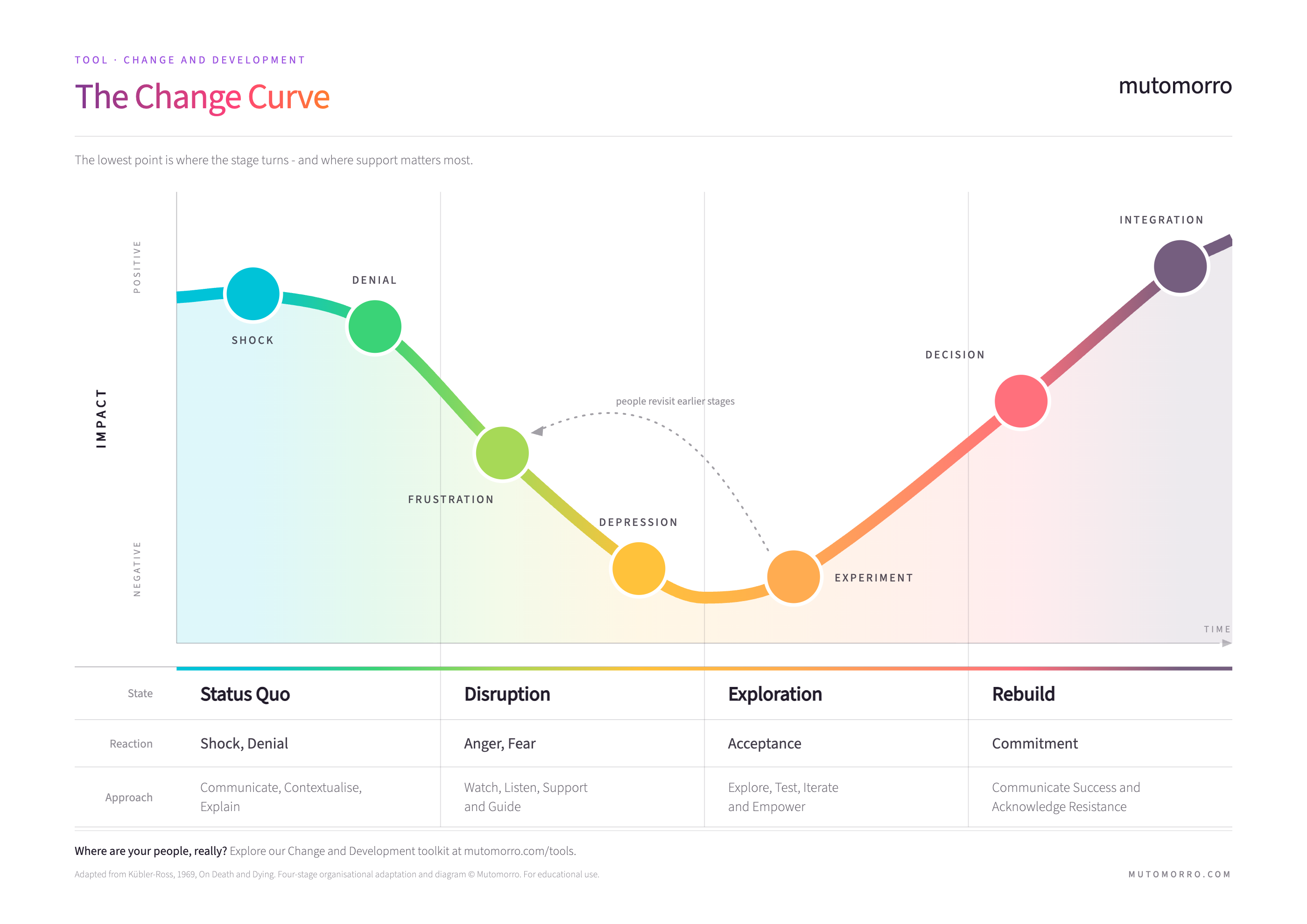
Our approach to change management grows from something broader: a conviction that organisations work more like living systems than machines. Change rarely moves in a straight line from plan to outcome. An organisation responds, adapts, pushes back - so the work is less about pushing a sequence through and more about reading how the system answers, and adjusting as it does.
It's a way of seeing, and it shapes how we approach change management - not as an isolated fix, but as something shaped by the whole organisation, and shaping it in turn. Our philosophy page is where the fuller picture comes together.
What the evidence says about creating the right conditions for change
80%
of organisations are near, at or past the point of change saturation
Prosci, Best Practices in Change Management, 12th Edition, 2023
79%
of employees have low trust in change
Gartner HR Research, July 2025
32%
of leaders say the last change they led achieved healthy adoption
Gartner HR Research, July 2025
7x
more likely to meet objectives with excellent change management
Prosci, Best Practices in Change Management, 12th Edition, 2023
Common questions about change management
Prosci's Best Practices in Change Management study (12th Edition, 2023) puts numbers on it: 88% of initiatives with excellent change management meet or exceed their objectives, against 13% of those with poor change management. The reasons vary, but a pattern we see consistently is that organisations invest heavily in planning the change itself - the new structure, the new system, the new process - and underinvest in the conditions that determine whether people can engage with it.
When trust is low, when people feel the change is being done to them rather than with them, when there's no space to raise concerns or adapt the approach as things unfold - resistance isn't surprising. It's a rational response to the environment.
The organisations that navigate change well tend to be the ones that work on both: the change itself and the conditions inside the organisation that shape how it's received.
Change management is typically the structured approach - the plans, the communications, the training, the stakeholder engagement. It's about making a specific change happen effectively.
Change leadership is about setting direction, building belief, and creating the energy for change across the organisation. It's less about the process and more about the people leading it.
Both matter. In our experience, the most effective change happens when leaders aren't just sponsoring a plan but genuinely shaping the conditions that help people engage - creating safety, giving people agency, and staying connected to why the change matters. That's where management and leadership meet.
We don't treat resistance as a problem to solve. Resistance is information - it's telling you something about the conditions inside your organisation that the change plan needs to account for.
Sometimes resistance signals that people don't understand why the change matters. Sometimes it means the change was designed without the people who'll live with it. Sometimes it means people are simply exhausted from the last round of changes and don't have the capacity for another one.
We help you listen to what resistance is telling you, address the underlying conditions, and design an approach that works with people's concerns rather than pushing past them. Where resistance points to deeper cultural patterns rather than the specific change in front of you, our culture change consultancy is often the better starting place.
Yes - and this is one of the most common starting points. Many organisations come to us because a change initiative has stalled, met unexpected resistance, or isn't working the way they expected.
We can step in at any point - whether you need help understanding why things have stalled, redesigning the approach, supporting implementation through a difficult patch, or building your team's capability to see it through. We don't need to start from scratch. We start wherever you are.
It depends entirely on the scope and complexity. A focused change to how one team works might take a few months. A large-scale transformation across an entire organisation typically takes 12 to 24 months to embed properly.
What we've found is that the timeline depends less on the size of the change and more on the conditions it's entering. Organisations with high trust, strong purpose connection, and existing capability for adaptation can move faster. Organisations where those conditions need building first take longer - but the result is more sustainable.
We're always honest about what's realistic, and we build the approach around what your organisation can absorb rather than what a project plan says it should.
This is one of the most important questions. Our approach is specifically designed so that you don't need us indefinitely. Every stage of the work transfers capability to your people - leaders who can read the system and adapt, managers who can support their teams through transitions, teams that can work through uncertainty productively.
The goal isn't to manage this one change well. It's to build your organisation's ability to navigate whatever comes next. We call this change fluency - and it's what makes each subsequent change easier than the last.
Explore change management





Why the organisational side is the hard part
Most of what stops a good plan is not the plan. It is the join between it and the organisation - who decides what, how work moves between teams, what people believe is really being asked of them. That is the part we work on, and it is what makes a change hold once we have gone.
Want to explore how this could work for your organisation?
Every organisation is different, so we always start with a conversation. No pitch, no obligation - just an honest discussion about where you are and whether our approach feels right.