Where operational effectiveness is found
These are the situations that most often bring people to us - you'll likely recognise one or two.
- Solving the same problems in new forms
- More time spent on process than delivery
- A new system people are working around
- Short-lived gains from past improvement work
- Functions quietly working against each other
- People blocked from fixing what they can see
- Inconsistent performance no one can quite explain
- Lean and six sigma helped, but only so far
Operational effectiveness in practice
No two organisations face the same operational effectiveness challenge. These examples draw on experience helping leaders improve how the whole system performs, not one process at a time.
Operations designed around how value gets created
Effectiveness rarely improves by pushing harder. It improves by finding where the work gets stuck.
- MapOperational Effectiveness AssessmentSee how work really works - not just how it's supposed toExplore more
- RedesignWays of Working DesignDesign improvements that work at the conditions levelExplore more
- EmbedWays of Working RolloutMake improvements real in the rhythm of daily workExplore more
- SustainContinuous ImprovementBuild the capability to keep improving independentlyExplore more
Recognise your situation?
Let’s talk about what this could look like for your organisation.









How we improve operations
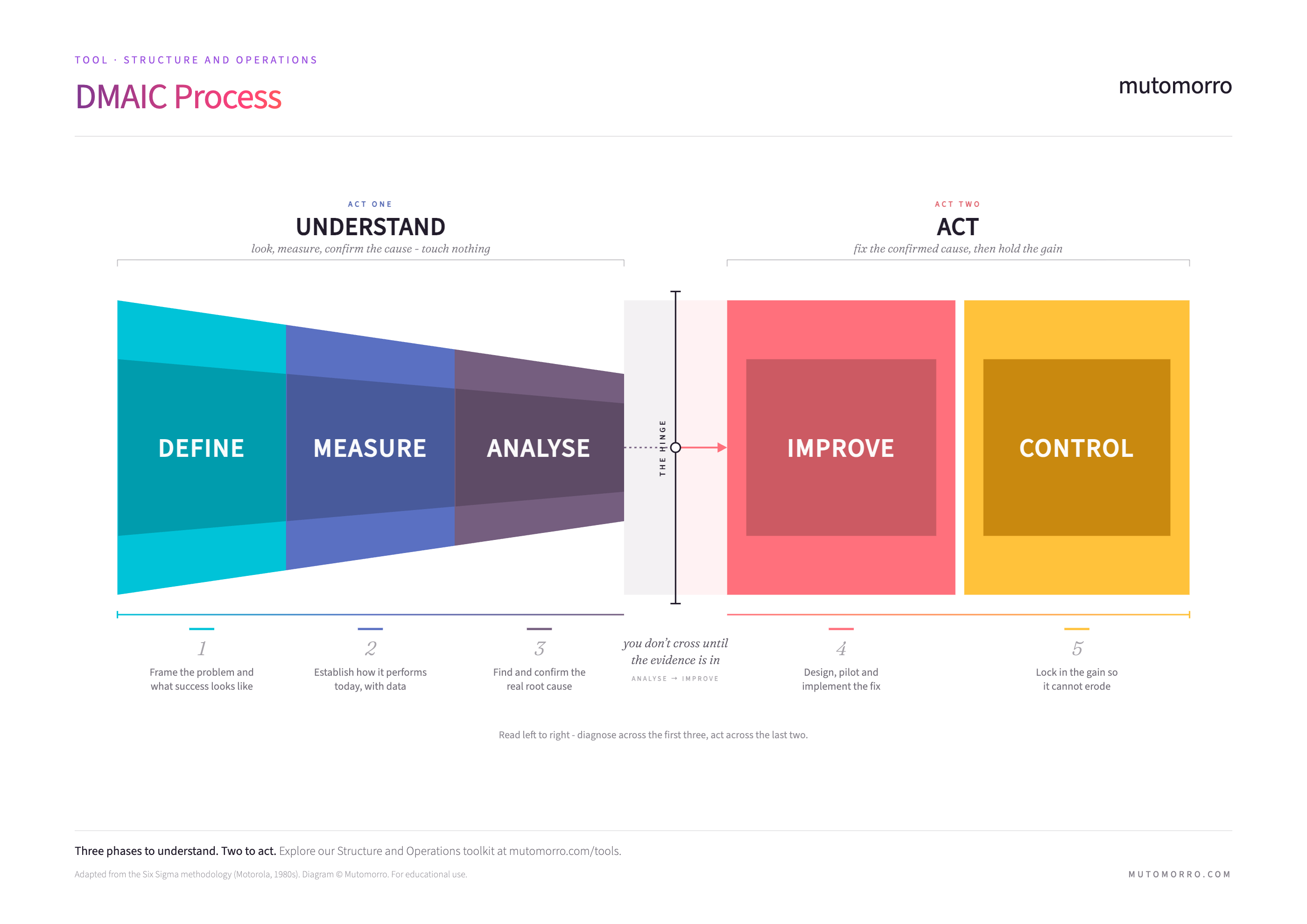
We don't arrive with a fixed methodology and bend your operation to fit it. The breadth is the point: we bring the right approach to the problem in front of us, rather than running everything through Lean or Six Sigma because that's the hammer we happen to own. The work decides the tool, not the other way round.
Our work runs through four stages - seeing how the work really flows, redesigning where it's getting stuck, making the changes stick on the ground, and leaving you with the habit of improving. They're not rigid. Some organisations need all four; others just need help where the work has stalled. We start wherever you are.
See how work actually flows
To improve how an organisation runs, you have to start by seeing how the work actually flows - not how the documented process says it should. So we map the real thing: where work moves smoothly, where it gets stuck, where it doubles back, and where it sits waiting on someone else. This kind of operational assessment reads the whole journey end to end, rather than fixating on one obvious bottleneck while the real drag sits elsewhere.

- Mapping how work really moves, not the documented version
- Finding where it stalls, doubles back or waits
- Reading the whole flow end to end
- Spotting the real drag, not just the obvious bottleneck
What you get
A clear, honest picture of how work actually moves - so you fix what's really slowing things down, not what looks busy.
Redesign where it's getting stuck
Once you can see the whole flow, you can fix the parts that actually matter. We target the constraints holding everything else up - not every imperfection, just the ones with real leverage - and redesign the process around them with the people who do the work. We're not wedded to one method. The right tool depends on the problem in front of us, so we bring what fits rather than forcing your operation through a fixed methodology.

- Targeting the constraints that hold everything else up
- Process redesign built with the people who do the work
- The right tool for this problem, not a one-size method
- Improving the operating model, not just patching symptoms
What you get
A redesigned way of working that fits how the place actually runs - aimed at the constraints that matter most.
Make the changes stick on the ground
A redesigned process only counts once it's running in daily practice - not sitting in a slide deck. So we stay with your teams as the operational improvements land, helping them settle into new ways of working and ironing out the snags that only show up once real work hits. And we keep a learning loop running as it rolls out, so the design adjusts to what the floor is actually telling you.

- Improvements landing in daily practice, not just process docs
- Supporting teams through the new ways of working
- Ironing out the snags real work exposes
- Learning loops running as the change rolls out
What you get
Changes that actually take hold in the day-to-day work - adopted by the teams, not just signed off on paper.
Build the habit of improving
The aim is for improvement to outlast us. We help spotting and fixing flow problems become something your own people just do - part of the normal rhythm of the week, not a special project that needs outside help to start. That's what continuous improvement really means: small fixes happening all the time, owned by the teams closest to the work, long after we've gone.

- Your teams spotting and fixing flow problems themselves
- Improvement as a normal rhythm, not a one-off project
- Small fixes happening continuously, close to the work
- A capability that stays in place after we leave
What you get
An organisation that keeps getting better on its own - improving as a habit, long after we've left the building.
Operations that flow, because the conditions underneath are designed for it
Our operational effectiveness consultancy works with the conditions beneath your processes - how decisions travel, how information flows, how problems get solved - not just the visible workflow, but the system that decides whether it works.
Operational performance is shaped by conditions most improvement programmes don't touch
Beneath every process sits the organisation's metabolism - how decisions travel, how information flows, how problems get solved at source - and that is what decides whether the process actually works.
We work with the patterns that shape how well work actually works
We go beneath the process maps to shift the conditions constraining performance - decision pathways, team autonomy, information flow, and the capability to solve problems at source.
Operations that improve themselves
When the conditions are right, work flows with less friction and continuous improvement becomes a natural property of how the organisation operates - not a programme it has to run.
Good processes need good connections
Our approach to operational effectiveness grows from something broader: a conviction that organisations work more like living systems than machines. Effectiveness rarely improves by pushing each part harder. The drag usually lives between the parts - in handoffs, waiting, work that loops back - so the gains tend to come from how the system flows, not how fast any one piece runs.
It's a way of seeing, and it shapes how we approach operational effectiveness - not as an isolated fix, but as something shaped by the whole organisation, and shaping it in turn. Our philosophy page is where the fuller picture comes together.
75%
of organisations struggle to build high-performance cultures
McKinsey State of Orgs 2026
43%
of executives cite productivity as their top priority in 2026
McKinsey State of Orgs 2026
46%
cite lack of time as the biggest barrier to developing organisational capabilities
McKinsey
20%
of employees are engaged worldwide - and engagement is falling
Gallup 2025/2026
Common questions about operational effectiveness
Lean and six sigma are valuable disciplines - they bring rigour to waste reduction and variation control. We're not a replacement for that work. The difference is where we focus. Lean and six sigma typically work on the visible operational system - processes, workflows, measurement. We work on the conditions underneath that determine whether process improvements hold: how decisions get made, how information flows, how much autonomy teams have to solve problems, and whether the organisation learns from what goes wrong. Often, the most effective approach combines process-level improvement with conditions-level change.
It depends on scope. A focused engagement addressing specific operational friction in one part of the organisation might take two to three months. A broader programme working across multiple operational areas typically runs six to twelve months. What matters is that improvement continues after we leave - which is why building internal capability for continuous improvement is part of every engagement.
Always. The people who navigate the operations every day understand them better than any external review. We work with operational teams AND leaders - combining the strategic view with ground-level intelligence. The best operational improvements are designed by the people who'll make them work.
Not necessarily. Operational challenges sometimes have structural roots - but often the issue is the conditions within the existing structure rather than the structure itself. If structural questions do emerge, our organisational design work addresses how the architecture of the organisation shapes how work flows. But many organisations see significant operational improvement without any structural change - by shifting the conditions that determine how well the current structure functions.
Change management helps organisations navigate specific transitions - a new system, a restructure, a strategic shift. Operational effectiveness works with how the organisation performs on an ongoing basis. There's overlap when operational improvement requires significant changes to how people work, but the focus is different: change management is about navigating a transition; operational effectiveness is about improving the ongoing metabolism of how work gets done.
That's one of the most common reasons organisations come to us. Improvement programmes often don't stick because they worked on the visible system - processes and tools - without addressing the conditions that determine whether improvements hold. If the decision-making patterns, information flow, team autonomy, and learning practices don't shift, the organisation tends to revert. We work at both levels simultaneously, which is why the changes sustain.
Explore operational effectiveness







Why the organisational side is the hard part
Most of what stops a good plan is not the plan. It is the join between it and the organisation - who decides what, how work moves between teams, what people believe is really being asked of them. That is the part we work on, and it is what makes a change hold once we have gone.
Want to explore how this could work for your organisation?
Every organisation is different, so we always start with a conversation. No pitch, no obligation - just an honest discussion about where you are and whether our approach feels right.