The EMERGENT Framework
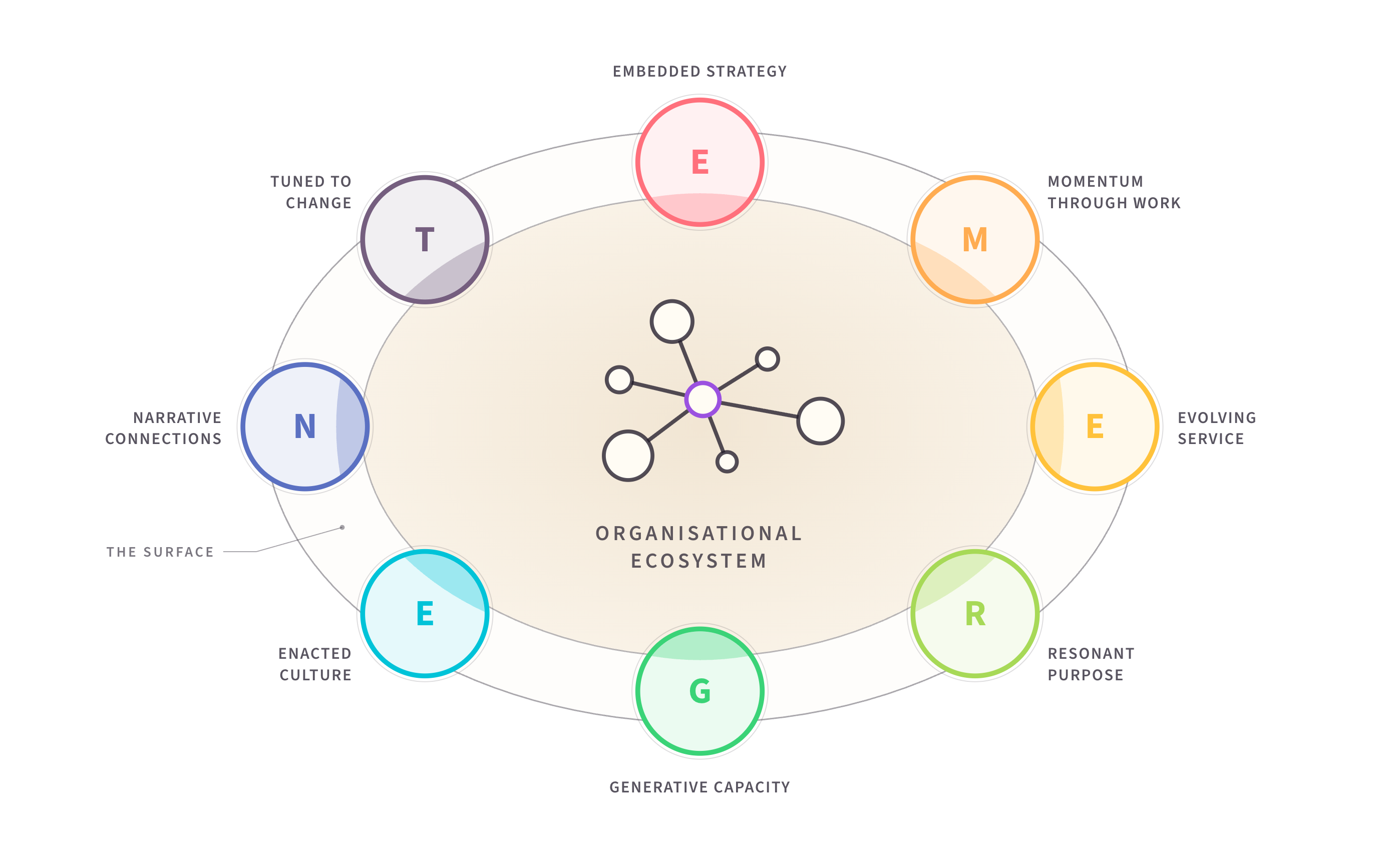
Some organisations move as one. Choices made in different corners cohere, energy reaches the work, purpose travels under its own power. That's alignment. And it matters - organisations that work as one are stronger, more resilient, and happier places to be.
The catch is that alignment is hard to see. It doesn't live on the org chart or in the strategy deck. It lives in the organisation beneath the organisation - the one made of a hundred small decisions about where time goes, what gets finished, and what people quietly treat as true. Strengthening an organisation often starts there.
The EMERGENT Framework is eight lenses for looking at exactly that. Each one is turned on something you already live with. Six of them show where your organisation is pulling together - and where it's less so; two show whether it has the energy and capacity to change. Pick up any lens below. Each comes with a question you can start answering today - and once a pattern comes into focus, you'll notice it everywhere. That's the point.
Embedded Strategy
Pick something someone needed to work on this morning. Could you draw a line from it back to your strategic goals?
Most organisations have a strategy, and many have a good one. What varies is the distance between where the strategy lives and where decisions happen. When that distance is small, choices made independently in different corners still quietly pull the same way - the thread from ambition to action holds all the way down to what someone chose to work on this morning. What matters has become embedded in how people reason.
Momentum through Work
When your people finish a day's work, have they spent their energy on the work itself - or on everything that surrounds it?
You can tell a lot about an organisation from where a day's energy goes. In some places, finishing one piece of work naturally sets up the next - the work generates its own momentum. In others, the energy people brought for the work gets spent on everything around it: chasing, coordinating, waiting for permission. Speed can be forced; momentum carries.
Evolving Service
When did what you deliver last change because of something you learned from the people you serve?
Organisations that keep getting better at what they do tend to share one habit: what they learn from the people they serve actually changes what happens next. The service evolves because the relationship is alive - delivery and learning feeding each other, getting better year on year at the thing you exist to do.
Resonant Purpose
Does your purpose travel through the organisation under its own power - or does it need to be carried?
Purpose does its best work when it resonates - when people can feel it in where they put their time and in the decisions they see being made around them. In those organisations, purpose doesn't need carrying. It travels under its own power, because it connects to something people already care about.
Generative Capacity
Think of someone who's just finished a demanding year here. Are they more capable and more energised for it - or just more tired?
Some organisations build their people as a natural byproduct of how the work happens - teams come out of projects more capable than they went in. Others quietly consume capability, and people end up a little more depleted than when they arrived. The difference is whether the system itself is generative: whether working here builds you up or uses you up.
Enacted Culture
If a new starter spent their first week just watching what happens - never reading a single document - what would they conclude this organisation actually values?
Culture is built on what people do, not what they say it is. And it builds in chains, not moments: someone acts, everyone sees what happens next, and the organisation quietly learns what's really true here. Whatever the values claim, culture is what people watch being enacted, day after day.
Narrative Connections
Listen in on the stories your organisation tells itself - in meetings, in corridors, over coffee. What is it thinking about?
Organisations run on stories - not just the big ones, but the everyday accounts of what happened and what it meant. Those stories form a web across an organisation, and the web shapes things: how people read events, who they trust, whether teams pull together or quietly apart. Where the narratives connect, understanding moves faster than any channel could carry it - and no one has to manage the message.
Tuned to Change
When change arrives, does it feel like a natural part of the daily rhythm - or a shock to the system?
Change is the medium every organisation moves through, whether it's ready or not. Some organisations are tuned to it: they sense shifting conditions early and respond as a natural part of how they operate, so the unexpected produces adjustment rather than alarm. That's the difference between adapting and surviving.
The eight dimensions shape each other constantly. Strengthen purpose and strategy lands more easily. Improve how work flows and the service starts evolving almost as a side effect. Health isn't a property of any single dimension - it emerges from how they interact. Which is why the framework doesn't tell you where to begin. It helps you see where beginning would make the most difference.
When you want to know where your organisation stands across all eight, that's the job of States of Vitality.