When your customer experience is ready for its next step
These are the situations that most often bring people to us - you'll likely recognise one or two.
- Experience that varies by channel and location
- Closing the gap between promise and delivery
- Satisfaction scores stuck despite real investment
- Joining up an experience fragmented across departments
- Equipping front-line teams to deliver
- A customer-centred culture, not just a strategy
- Moving from measuring experience to improving it
- An experience that genuinely sets you apart
Customer experience in practice
No two organisations face the same customer experience challenge. These examples draw on experience helping leaders join up the customer experience across every part of the organisation that shapes it.
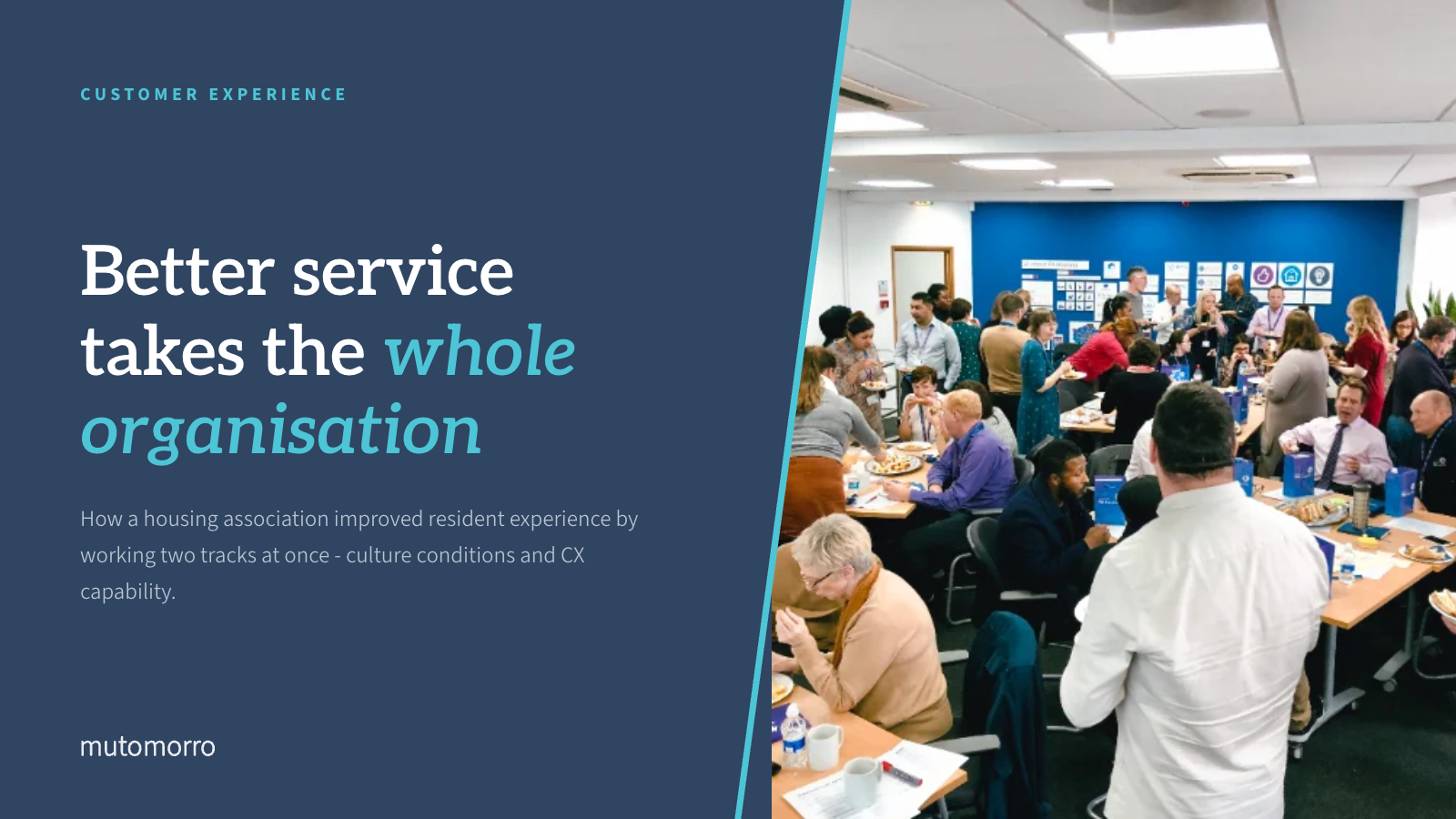
Customer experience shaped from the inside out
When experience plateaus, the answer is rarely one broken moment. It's usually in how the moments connect.
- UnderstandCustomer Experience AuditSee the experience from both sidesExplore more
- DesignJourney and Experience DesignDesign the experience and the conditions togetherExplore more
- ImplementCustomer Journey RolloutMake the change realExplore more
- SustainCustomer-Led ImprovementMake the practice yoursExplore more
Recognise your situation?
Let’s talk about what this could look like for your organisation.


































How we improve customer experience
We don't start with the touchpoints. We start by understanding the experience from both sides - what people outside actually feel, and what's happening inside the organisation that produces it.
Our work runs through four stages - seeing the experience from both sides, designing improvements on both sides, making them land in practice, and building the capability to keep improving. They're not rigid. Some organisations need all four; others just need help where the experience has plateaued. We start wherever you are.
See the experience from both sides
Before you can improve the customer experience, you need to understand it honestly, from both directions: what people experience when they deal with you, and what's happening inside the organisation that produces it. The gap between the two is where the real insight lives. So we research both - not just satisfaction scores and journey maps, but how information reaches front-line teams, how departments coordinate (or don't), how much room people have to respond in the moment, and whether internal priorities support or fight what customers need.

- Customer experience research - journey mapping, interviews, audits
- Internal conditions: how the organisation supports or constrains the experience
- Gap analysis: where the promised and delivered experience diverge, and why
- Cross-boundary mapping: how the experience travels across teams
What you get
A clear, shared picture of the experience from both sides - what people feel, what produces it, and where the leverage for improvement is.
Design improvements on both sides
Improving customer experience means working on two levels at once: the experience itself (what people see, hear and feel) and what produces it (how the organisation works behind the scenes). Change one without the other and it won't hold. So we work with your teams on both - redesigning how information reaches front-line staff, improving coordination between the departments that own different parts of the journey, building feedback loops from customer insight to operational change, and giving teams more room to respond in the moment.

- Improvements to the experience, grounded in what produces it
- Cross-functional sessions with customer-facing and supporting teams
- Feedback loops that connect customer data to operational learning
- Focusing on the few changes with the greatest impact
What you get
An improvement approach that connects what people experience to how the organisation works - designed to shift both, together.
Make them land in practice
Experience improvement is felt, not just measured - in how front-line teams interact, how quickly things get resolved, and whether people feel understood. That kind of change takes time and support, so we stay alongside your teams as the new ways of working take hold, keeping the focus on what people actually experience (the real test of whether the changes are working) as well as the conditions behind it.

- Phased rollout with real-time learning and adaptation
- Support for teams working in new ways across boundaries
- Tracking what people actually experience, alongside internal metrics
- Coaching leaders to connect the experience to the conditions behind it
What you get
A measurable improvement in customer experience - grounded in changes to how the organisation actually works.
Build the capability to keep improving
The goal is an organisation that keeps improving the experience as a normal part of how it works - not through occasional CX programmes. So we build that capability throughout the engagement. By the time we step back, your teams understand how internal conditions shape the external experience, have the tools to measure both, and have the habits to keep improving. The experience keeps getting better because the organisation is set up to make it better.

- Building CX capability in customer-facing and operational teams
- Frameworks and tools that stay with you
- Building feedback and improvement into your everyday rhythm
- A handover that makes sure the practice sticks when we leave
What you get
An organisation with the internal capability to understand, improve, and sustain the customer experience on its own terms.
Outside-in and inside-out
We understand the experience from the customer's perspective and work with the conditions that produce it.
Connected, not siloed
CX improvement that works across the whole organisation, not just the customer-facing teams.
Capability-building
We build your organisation's ability to keep improving the experience without depending on us.
Evidence-led
We measure what matters and connect external experience data to internal conditions.
Experience that resonates, because the conditions inside the organisation produce it
Our customer experience consultancy works with the conditions inside the organisation that actually produce the experience - not just the touchpoints where it becomes visible, but the way the whole organisation works behind them.
Customer experience is an emergent property
The experience people have does not come from the touchpoints - it comes from the internal conditions that resonate outward, so optimising touchpoints alone never fixes the dissonance.
We work both sides - and the connection between them
We do the CX work - journeys, measurement, touchpoints - but also the internal conditions that produce the experience, because the connection between them is where the leverage is.
An experience that's genuine all the way through
When the internal conditions and the external experience align, consistency stops being scripted and starts being genuine - even when things go wrong.
Customers experience the joins
Our approach to customer experience grows from something broader: a conviction that organisations work more like living systems than machines. Customers don't experience your org chart - they experience the joins. So when experience plateaus, the answer is rarely one broken moment. It's usually in how the moments connect, across teams that may not see each other's part.
It's a way of seeing, and it shapes how we approach customer experience - not as an isolated fix, but as something shaped by the whole organisation, and shaping it in turn. Our philosophy page is where the fuller picture comes together.
43%
of buyers will pay more for a better experience
PwC
73%
say experience is a key factor in purchasing decisions
PwC
65%
of customers find a positive experience more persuasive than advertising
PwC
4-8%
higher revenue in CX-leading organisations
Bain
Common questions about customer experience
Customer experience is about how people experience what your organisation delivers - the lived reality of being on the receiving end. Service design is about how the organisation designs and delivers its services - the architecture behind the experience. They're connected but distinct. If your challenge is about designing or redesigning a specific service, our service design work addresses that directly. If it's about the overall experience people have when they interact with you, you're in the right place.
Measurement is essential - you can't improve what you can't see. What we add is the internal dimension: understanding what's producing the scores you're seeing. If your NPS is plateauing, measurement tells you it's stuck. Working with the internal conditions tells you why - and what to change. We don't replace your measurement. We connect it to the things that will actually shift it.
Most CX consultancies focus on the experience itself - measuring it, mapping it, optimising the touchpoints. We do that too, but we also work with the organisational conditions that produce the experience. The difference is that touchpoint improvements without conditions work tend to plateau. Conditions work without experience measurement flies blind. We do both, and the connection is where the real leverage is.
Not necessarily. Sometimes the biggest improvements come from relatively focused changes to internal conditions - improving how information reaches front-line teams, giving staff more discretion to resolve things, or fixing how departments coordinate around the customer. We always start with understanding where the real leverage is before designing the scope of the work.
Some changes show up quickly - particularly when front-line teams get better information or more autonomy. Others take longer, especially where the improvement depends on how different parts of the organisation learn to work together differently. We typically see meaningful shifts in experience metrics within 3-6 months, with deeper, sustained improvement unfolding over 6-18 months as the conditions embed.
The experience keeps improving - because the capability to improve it stays with you. Everything we do is designed to build internal capability: teams who understand the connection between conditions and experience, practices that keep feedback flowing, and the confidence to keep improving without external support. If you still need us after we've done our work, we haven't done our work properly.
Explore customer experience




Why the organisational side is the hard part
Most of what stops a good plan is not the plan. It is the join between it and the organisation - who decides what, how work moves between teams, what people believe is really being asked of them. That is the part we work on, and it is what makes a change hold once we have gone.
Want to explore how this could work for your organisation?
Every organisation is different, so we always start with a conversation. No pitch, no obligation - just an honest discussion about where you are and whether our approach feels right.