Wicked Problems
Wicked Problems are complex challenges that resist straightforward solutions - where the problem itself shifts as you try to solve it. Understanding wicked problems helps organisations stop looking for simple fixes and start working with the complexity instead.
Get the free template
Some problems refuse to stay still. You define them, and the definition shifts. You solve one part, and two new complications surface. Different people in the room see entirely different problems - and they're all partially right.
These are wicked problems. They show up whenever you're working at the intersection of people, systems, history, and competing priorities - which, in most organisations, is most of the time.
What are wicked problems?
The term comes from Horst Rittel and Melvin Webber, two urban planners who published a landmark paper in 1973. They weren't using "wicked" to mean evil. They meant it the way an engineer might describe a particularly stubborn knot - something that resists all the usual approaches.
Rittel and Webber were frustrated that traditional planning methods kept failing when applied to social policy challenges. Build a motorway to reduce congestion, and it generates new traffic. Redesign a benefits system to reduce dependency, and it creates new barriers for vulnerable people. The problems didn't just resist solutions - they actively shifted in response to them.
Their insight was that some problems are fundamentally different from the kind of problems that science and engineering solve well. They called those straightforward ones "tame problems" - not because they're easy, but because they're definable. A tame problem has a clear formulation, a set of possible solutions, and a way to know when you've solved it. Fixing a bridge, debugging code, calculating a tax liability - these are tame problems. Difficult, sometimes, but bounded.
Wicked problems are the opposite. They're unbounded, entangled, and context-dependent. And they're everywhere in organisational life: culture change, digital transformation, service redesign across complex systems, post-merger integration, diversity and inclusion. If you've ever led something where the harder you worked, the more complicated it seemed to get - you were probably navigating a wicked problem.
The Cynefin Framework is a useful companion here. It helps you recognise which domain you're operating in - simple, complicated, complex, or chaotic - and adjust your approach accordingly. Wicked problems live firmly in the complex domain.
The ten characteristics
Rittel and Webber identified ten characteristics that together define what makes a problem wicked. No single one makes a problem wicked on its own - it's the combination of all ten being present at once that creates the distinctive difficulty.
It helps to think about them in three groups: what makes the problem hard to define, what makes solutions elusive, and what makes the consequences so high-stakes.
Group | Characteristic | In short |
|---|---|---|
Defining the problem | No definitive formulation | The problem keeps evolving; the more you learn, the more the definition shifts. |
Essentially unique | Context makes each one different - you can learn from others, but not copy their answers. | |
Heavily interconnected | Tangled with other problems and systems; you can't change one without affecting the rest. | |
Finding solutions | No clear solutions | No menu, no algorithm, no proven method - new approaches are always possible. |
Framing determines solution | How you define the problem shapes which solutions you even consider. | |
Solutions are only better or worse | No objectively correct answer; responses are judged against differing values and interests. | |
Consequences and pressure | No immediate or ultimate test | You can't quickly check whether it worked - effects ripple out over time. |
A one-shot operation | No risk-free sandbox; every intervention has real consequences and may change the problem. | |
No stopping rule | No clear point at which it's solved; the work is ongoing and adaptive. | |
No right to be wrong | Accountability for consequences, even unintended ones - which creates pressure to appear certain. |
Defining the problem

1. No definitive formulation. You can't write a clean problem statement because the problem keeps evolving. The more you learn, the more the definition changes. An organisation trying to address staff retention discovers it's also a workload problem, which is also a leadership problem, which is also a resourcing problem. Where does "the problem" begin and end?
7. Essentially unique. Even if another organisation has faced something that looks similar, the context makes each wicked problem different. The political dynamics, the history, the culture, the people involved - these all mean that what worked there may not work here. You can learn from others, but you can't copy their answers.
8. Heavily interconnected. Wicked problems don't exist in isolation. They're tangled up with other problems and systems, which makes it difficult to address one without affecting others. Try to improve customer experience and you'll find it's connected to staff capability, which connects to recruitment, which connects to budget, which connects to strategy. The Iceberg Model is a practical way to trace these connections - looking beneath surface events to find the patterns, structures, and mental models that hold the problem in place.
Finding solutions

6. No clear solutions. Unlike a technical problem where there's a defined set of possible answers, wicked problems have no solution menu. There's no algorithm, no formula, no proven method. New approaches are always possible, and which direction you take depends on how you see the problem.
9. Framing determines solution. How you define the problem shapes what solutions you consider. If falling sales are framed as a marketing problem, you get marketing solutions. If framed as a product problem, you get product solutions. If framed as a market-shift problem, you get strategic solutions. Different people in different roles will frame the same situation differently - and each frame leads somewhere different.
3. Solutions are only better or worse. There's no objectively correct answer. Responses are judged against values, priorities, and interests that differ across the people involved. What looks like progress to one group may look like a step backwards to another. This is why Force Field Analysis can be useful - mapping the forces driving and restraining change helps surface these competing perspectives rather than pretending they don't exist.
Consequences and pressure

4. No immediate or ultimate test of a solution. You can't quickly check whether what you've done has worked. Effects ripple outward over time and through interconnected systems, making it difficult to attribute outcomes to specific actions. A restructure might look successful after six months and disastrous after two years - or the other way around.
5. Every solution is a one-shot operation. You can't run experiments in a risk-free sandbox. Every intervention has real consequences and may change the problem itself. Roll out a new operating model and you can't simply undo it if things go wrong - the organisation has already adapted, relationships have shifted, and the starting conditions no longer exist.
2. No stopping rule. There's no clear point at which the problem is solved. Work can always continue, be extended, or be reframed. This is particularly challenging in organisational settings where people expect projects to have endpoints. With wicked problems, the work is ongoing, adaptive, and iterative.
10. No right to be wrong. People working on wicked problems are expected to get things right, often under significant scrutiny. Unlike a scientist who can fail forward through experiments, leaders navigating wicked problems carry accountability for consequences - even unintended ones. This creates pressure to appear certain, which is exactly the wrong response to genuine complexity.
How to work with wicked problems
The shift with wicked problems is recognising that you're not trying to solve them. You're trying to make progress with them. That's not a consolation prize - it's a fundamentally different orientation that changes how you plan, how you lead, and how you judge success.
Recognise them early. The first step is simply noticing that you're dealing with a wicked problem rather than a tame one. The clues are there: if different people keep disagreeing about what the problem even is, if previous solutions haven't stuck, if the situation feels more complex the more you learn about it - you're probably in wicked territory. Stop looking for the answer and start looking for better ways to navigate.
Bring diverse perspectives together. Because how you frame the problem determines the solutions you'll consider, you need multiple framings on the table. This means involving people from different roles, levels, and backgrounds - not just to consult them, but to genuinely shape the direction. The most dangerous thing you can do with a wicked problem is let a single perspective dominate.
Work iteratively. Plan-then-execute doesn't work when the problem shifts in response to your actions. Instead, take small steps, learn from them, and adjust. Treat each intervention as an experiment that teaches you something about the system. Theory of Change can help you map your assumptions about what will lead to what - making it easier to spot where your reasoning breaks down as new information surfaces.
Make your thinking visible. Because wicked problems involve so many interconnections and competing framings, the reasoning behind decisions matters as much as the decisions themselves. Use tools like Service Blueprints and systems maps to make the invisible visible. When everyone can see the same picture of how things connect, the conversation becomes more productive.
Design for learning, not for certainty. Build feedback loops into your approach. Check in regularly on whether your interventions are having the effects you expected. Be willing to change course when they're not. The organisations that navigate wicked problems well aren't the ones that get it right first time - they're the ones that learn fastest.
Example
A local authority is redesigning its children's services after a critical inspection. On the surface it looks like a straightforward improvement programme: fix the processes, retrain staff, tighten quality assurance.
But the reality is far more tangled. Social workers are leaving because of unmanageable caseloads. Caseloads are high because recruitment can't keep up with demand. Demand is rising because of cuts to early intervention services five years ago. Those cuts were driven by budget pressures that still haven't eased. Meanwhile, different parts of the council disagree about whether the problem is really about social work practice, management oversight, or systemic underfunding.
Every characteristic of a wicked problem is present. There's no clean problem statement - it depends on who you ask. There's no complete solution - just better and worse directions. Each intervention changes the system: invest in recruitment and you draw resources from retention; tighten procedures and you increase the administrative burden that's driving people away.
The authority that navigates this well doesn't try to "fix" children's services in one go. It works on multiple fronts simultaneously, learns from what's working and what isn't, brings different perspectives together regularly, and accepts that progress will be non-linear and sometimes contradictory. It measures success not by whether the problem is solved, but by whether things are moving in a better direction.
Limitations
Wicked problems is a lens, not a method. It tells you what kind of problem you're facing, but it doesn't tell you what to do about it. You'll need other tools and approaches for the actual work of navigating.
The concept can become a get-out clause. If every hard problem is labelled "wicked," it can create a sense of inevitability that undermines action. Some problems that feel wicked are actually complicated but tractable - they just need better analysis or clearer leadership. Use the ten characteristics to genuinely assess whether you're dealing with wickedness, not as a reason to avoid making decisions.
The framework focuses on why problems are hard, not on the power dynamics that often make them harder. Wicked problems in organisations are usually shaped by who has authority, who controls resources, and whose perspective gets prioritised. The ten characteristics don't address this directly.
The original context was public policy and urban planning. While the concept translates well to organisational challenges, some characteristics (like "no right to be wrong") apply more directly in public-sector settings where accountability is formal and scrutiny is external.
Getting started
Start with a problem your team is currently struggling with - one that keeps resisting clean solutions. Write down the ten characteristics and, for each one, note whether and how it applies. If you find that most of them are present, you're dealing with a wicked problem.
Then have an honest conversation with your team about what this means for how you're approaching it. Are you still trying to "solve" something that can't be solved in the traditional sense? Are you allowing a single framing to dominate? Are you designing for learning, or for getting it right first time?
That conversation alone - simply recognising the nature of what you're working with - often changes how a team approaches the work. It takes the pressure off finding the perfect answer and redirects energy toward making thoughtful progress.
Leading in the face of wicked problems requires a different set of capabilities - our guide to adaptive leadership explores what that looks like in practice.
We share thinking on organisational change and development on LinkedIn - practical ideas for people doing this work inside their own organisations.
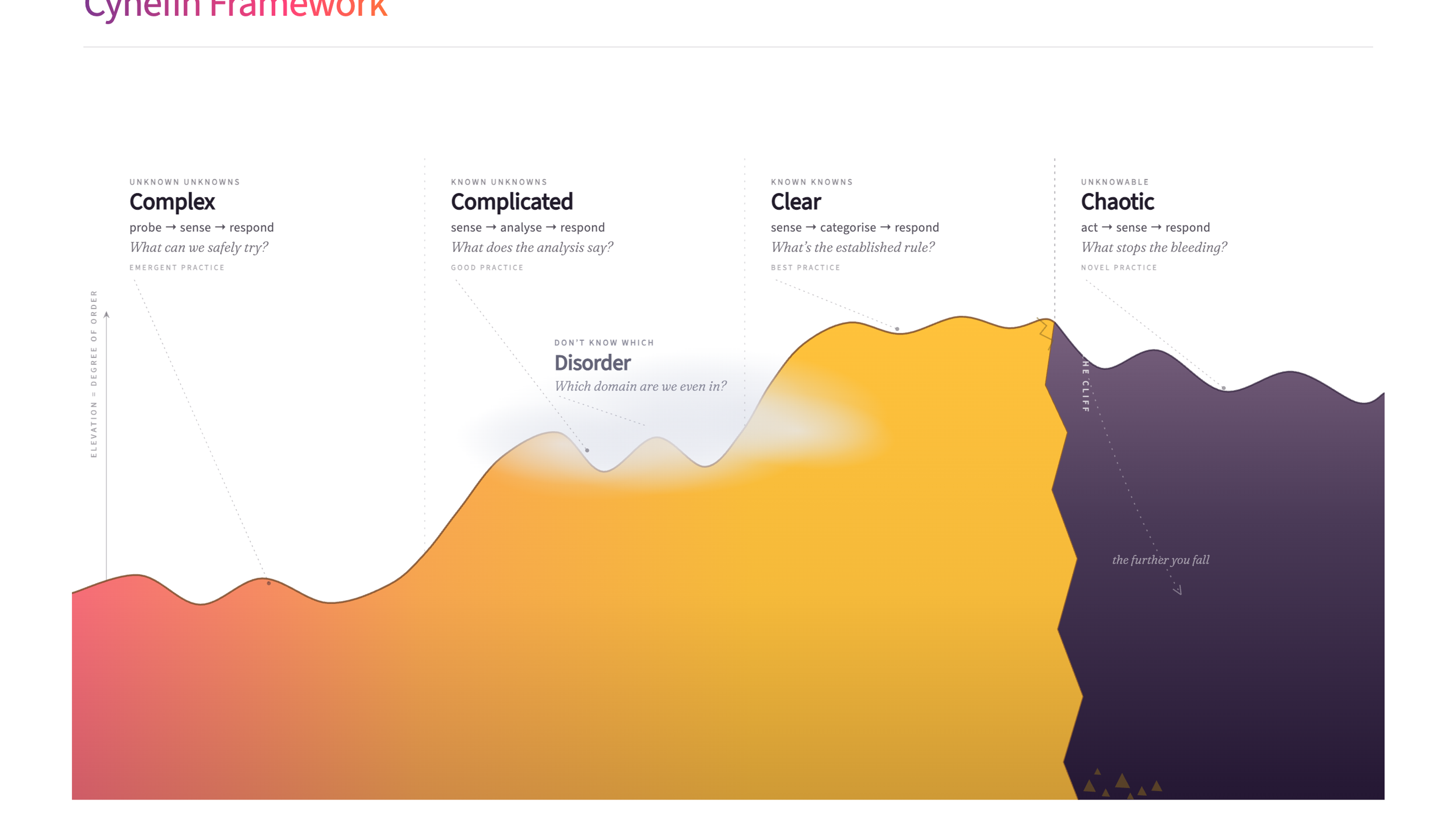
The Cynefin Framework is a decision-making model that helps leaders understand what kind of situation they're dealing with - clear, complicated, complex, chaotic, or confused. The right approach depends on the context, and this framework helps you match the two.
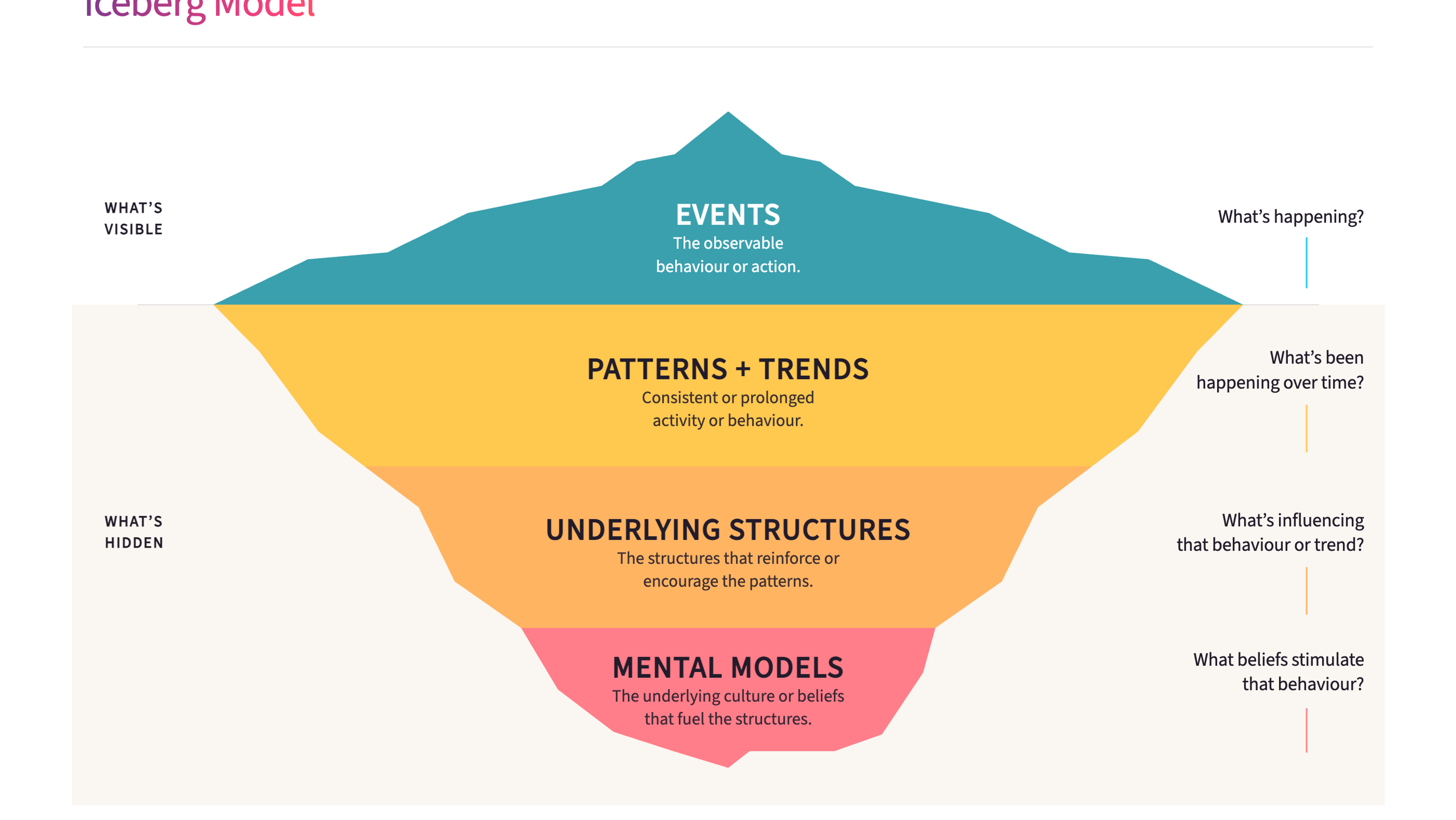
The Iceberg Model is a systems thinking tool that helps you look beneath surface-level events to find the patterns, structures, and mental models driving them. It's a way of seeing the deeper causes behind what's happening in your organisation.
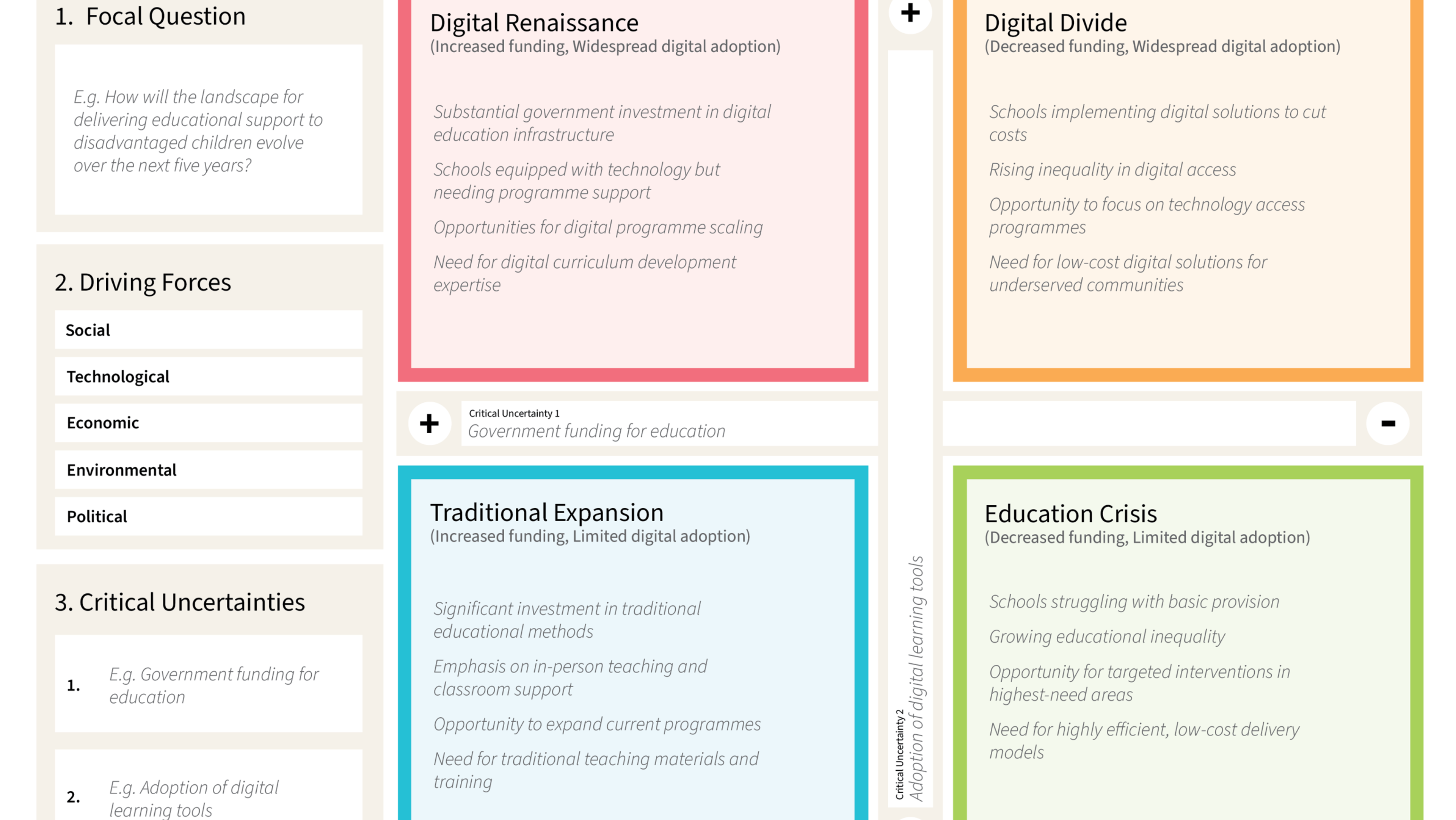
The 2x2 Scenario Matrix is a strategic planning tool that helps organisations explore different possible futures. By mapping two key uncertainties against each other, it creates four distinct scenarios you can plan and prepare for.
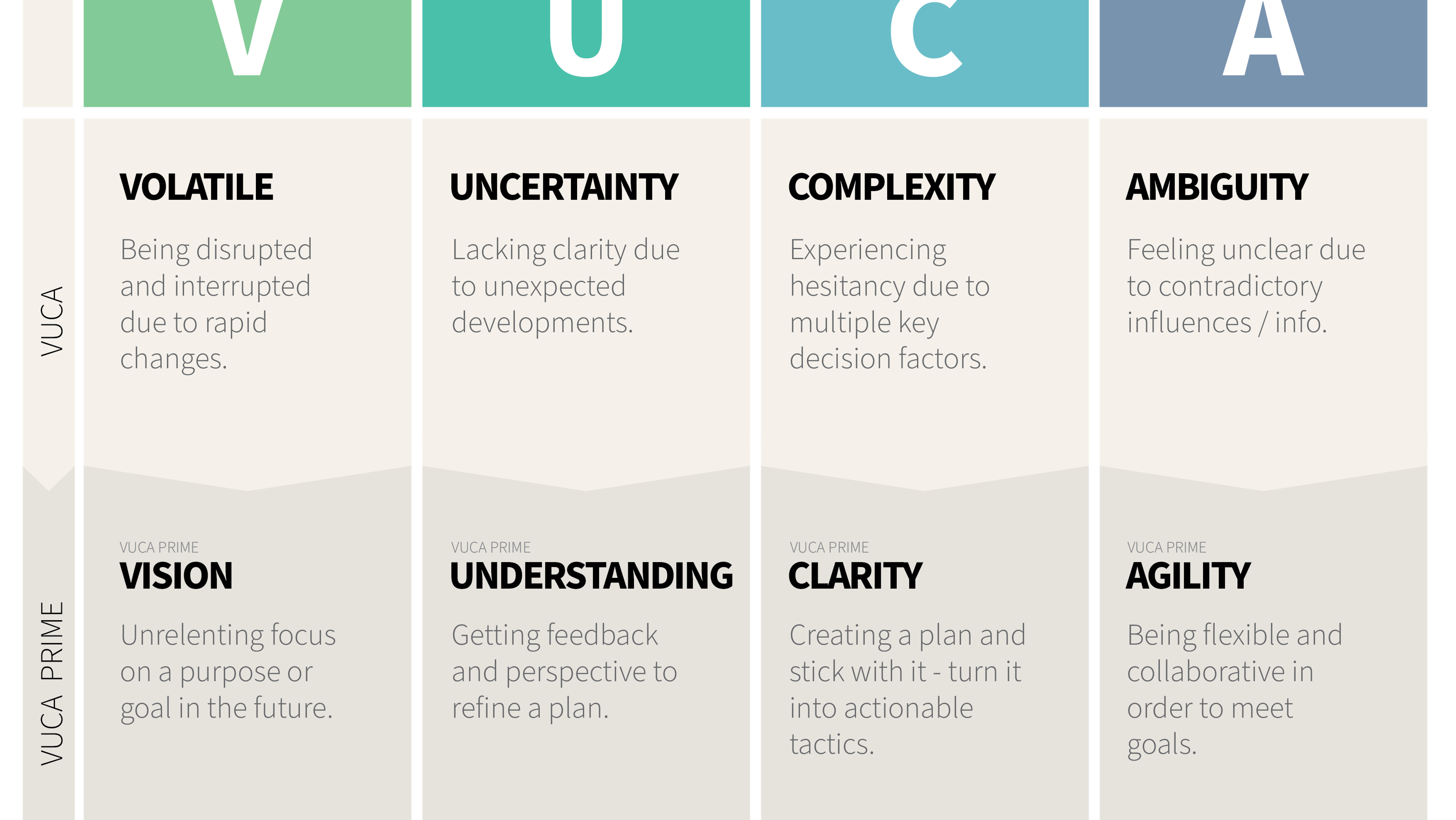
VUCA Prime is a leadership response framework for navigating Volatility, Uncertainty, Complexity, and Ambiguity. It pairs each challenge with a counter-strategy - Vision, Understanding, Clarity, and Agility - to help leaders act effectively in turbulent environments.
Adaptive leadership is what's needed when the usual approaches stop working - when the problems are complex, the answers aren't obvious, and the organisation needs to learn its way forward rather than execute a plan. This article explores what it means in practice.

Resilience isn't about bouncing back to where you were. It's about developing the capacity to adapt, learn, and come through difficulty stronger than before. This article explores what organisational resilience actually looks like and what leaders can do to build it.

Why the most reasonable solutions so often become next year's problem. Drawing on systems thinking, a 1930s sociologist, and MIT research on why the real cure gets abandoned just before it works - this piece traces the two ways a good fix turns on you, and the single habit that catches both.
Why anti-fragility isn't a programme you build - it's what emerges when the right conditions exist inside an organisation. A living systems perspective on how some organisations get stronger under stress while others crack.
Systems Thinking Training
Wicked problems are exactly the kind of tangle our Systems Thinking training is built for, where teams learn to work with complexity rather than against it.
James Freeman-Gray is the founder of Mutomorro. He's an organisational development practitioner who has spent over twenty years working with leaders across public, private and nonprofit sectors - helping organisations pull together around a common purpose, joined up in how they work. More about who we are and what it's like to work with us.
Understanding the concept of wicked problems has been transformative in my work. When I introduce this to leaders, it often explains years of frustration - they've been trying to solve a problem that, by its nature, can't be solved in the traditional sense. It reframes the work from "finding the answer" to "making progress in the right direction."
Last reviewed: June 2026
Ready to use Wicked Problems?
Download the free template - includes practical guidance for workshops and team sessions.
Get the free template
Want to put these ideas into practice?
Whether you're navigating a merger, rethinking how you're structured, or trying to shift a culture that isn't working - underneath, it's the same job: getting the whole organisation pulling in the same direction. Start with a conversation.