Iceberg Model
The Iceberg Model is a systems thinking tool that helps you look beneath surface-level events to find the patterns, structures, and mental models driving them. It's a way of seeing the deeper causes behind what's happening in your organisation.
Get the free template
The Iceberg Model is a systems thinking tool for looking beneath the surface of a problem. Most of what shows up day to day - the missed target, the team that keeps clashing, the complaint that lands again - is only the tip. The model gives you a simple way to see what sits underneath, so you can work on the causes rather than the symptoms.
What is the Iceberg Model?
The Iceberg Model is a systems thinking tool that helps you look past visible events to the forces producing them. Like an iceberg, where most of the mass sits below the waterline, the real drivers of an organisation's problems are usually hidden from view.
It has four layers, each one sitting deeper than the last:
- Events - what just happened
- Patterns and trends - what keeps happening over time
- Underlying structures - the systems, rules and incentives shaping things
- Mental models - the beliefs and assumptions driving behaviour
Each layer explains the one above it. Events are produced by patterns; patterns are held in place by structures; structures grow out of mental models. So when you only respond to events, you treat symptoms. When you reach the structures and mental models, you start changing what produces the problem in the first place - and that's the change that holds.
That's the heart of it: the Iceberg Model is a way of finding root causes. It traces a thread from what people believe, through what gets built, to what happens on any given Tuesday.
How the Iceberg Model works
You work through the four layers in order, from the visible surface down to the hidden foundations. Each layer answers a different question, and each one reveals something the layer above it can't explain on its own. The further down you go, the more leverage you have - a change at a deeper layer shifts everything sitting above it. That's the whole point of looking.
Layer | The question it asks | Example: rising staff turnover | Where the leverage is |
|---|---|---|---|
Events | What just happened? | Three good people left this quarter | Lowest - you treat the symptom |
Patterns and trends | What keeps happening? | People keep leaving within their first year | Some - you see the recurring shape |
Underlying structures | What holds the pattern in place? | Onboarding is rushed and under-resourced | High - shift the structure and the pattern shifts with it |
Mental models | What beliefs drive it? | “Good people should hit the ground running” | Highest - and the hardest to change |
1. Events

The top layer is the visible one - the events and symptoms you can see and measure. These are the tip of the iceberg: the things everyone can point to. A spike in staff turnover, a missed deadline, a customer complaint, a project over budget.
The Cultural Web is a useful companion here - it helps you read what's visible at the surface: the stories, rituals, symbols and routines that shape how an organisation behaves day to day. A clear problem statement can also help you frame what you're seeing before you go any deeper.
The risk of staying at this level is that you spend your time treating symptoms. A quick fix addresses the event, but if nothing changes underneath, the same kinds of problems keep returning.
2. Patterns and Trends

The second layer asks: is this a one-off, or part of a pattern? Step back from the individual event and you start to see trends - things that keep happening, cycles that repeat, trajectories heading in a particular direction.
You find patterns through history, observation and conversation. Look for the relationships between events: when one thing happens, does another tend to follow? What has been getting gradually better or worse? This is also where you look for feedback loops - reinforcing cycles where one factor feeds another and keeps a problem alive despite repeated attempts to fix it.
3. Underlying Structures

The third layer looks at the structures shaping how things work - policies, reporting lines, how resources are allocated, how decisions get made, what gets measured and rewarded, and the formal and informal rules that govern behaviour.
This is often where the greatest leverage sits: shift a structure and the whole pattern above it can change, rather than fixing one symptom at a time. It's worth looking at how structures interact, too: a reward system that quietly contradicts the stated strategy creates a tension no amount of communication will resolve.
4. Mental Models

The deepest layer is the beliefs, assumptions and values that shape how people think and act. These are often invisible to the people who hold them, which is exactly what makes them so powerful.
Surface a mental model and you can understand why people behave the way they do - even when that behaviour looks odd from the outside. This is the highest-leverage layer of all, and the hardest to shift: lasting change tends to start here, not by changing what people do but by changing how they see the situation. It's also the layer where Enacted Culture lives - the assumptions that quietly decide how things are really done around here.
This layer means turning the lens on yourself, as well. What are you bringing? The most useful Iceberg conversations are the ones where people are willing to examine their own thinking alongside the system they're studying. Edgar Schein's Culture Model works at a similar depth, and the Cynefin Framework is a good partner for working out what kind of situation you’re dealing with before you decide how to respond.
How to use the Iceberg Model
The Iceberg Model works best as a shared conversation rather than a solo desk exercise. The hidden layers tend to surface when several people who know the situation look at it together - so gather a few of them and give yourselves an honest hour.
A simple way to run it:
- Start with one real event everyone recognises. Name it plainly, with no explanation attached yet. "We lost three good people this quarter."
- Work downward, one layer at a time. At each layer, ask its question. Patterns: what keeps happening, or has been shifting? Structures: what's holding that pattern in place - which rules, incentives or ways of working? Mental models: what would have to be true for this to make sense to the people involved?
- Expect to move back and forth. You won't always travel in a straight line down. Some problems sit mainly at the structural level; others are rooted in assumptions. Follow the thread.
- Listen for the moment someone names an assumption out loud. That's usually where the conversation turns - the thing nobody had said before suddenly explains a lot.
- Turn the lens on yourselves. Your own assumptions are part of the system you're looking at, not separate from it.
- Capture what surfaces at the bottom two layers. The structures and mental models are where the work to follow will sit.
The 5 Whys is a handy partner at any layer - each "why" drops you down a level, which makes it a quick way to test whether you’ve reached far enough. This is the kind of conversation we often run as a facilitated session, but a team can get a long way with a whiteboard and a willingness to look honestly at what’s underneath.
Examples of the Iceberg Model in practice
Take a common one. The visible event is rising staff turnover. Step back and a pattern appears: people are leaving within their first year, not across the board. Look at the structures and you find an onboarding process that's rushed and under-resourced, with new starters left to find their own feet. Underneath sits a mental model: a belief that good people should be able to hit the ground running without much support. Fix only the event and you keep hiring into the same gap. Change the onboarding structure and challenge the belief beneath it, and the turnover has somewhere else to go.
The same shape plays out across very different situations:
- Service delivery. A community programme isn't reaching the people who need it most (event). Attendance data shows the same neighbourhoods underrepresented every time (pattern). Referral routes and transport favour those already connected to services (structure). And an assumption that some groups are simply "hard to reach" puts the responsibility on the community rather than the system (mental model).
- Cross-team friction. A project keeps stalling (event). The same two teams clash whenever they have to work together (pattern). They report to different directors with competing priorities and separate budgets (structure). Each believes the other doesn't understand how things really work (mental model).
- A micromanaging manager. A leader keeps hearing their team feels micromanaged (event). Reviews show they routinely take work back at the final stage (pattern). No delegation framework exists and their role was never clearly scoped (structure). And underneath: a belief that if anything goes wrong, it's ultimately their personal failure (mental model).
Notice how, each time, the obvious fix at the top gives way to a higher-leverage one as you go down.
Where the Iceberg Model fits in systems thinking
The Iceberg is often the first systems thinking tool people meet, and it's a good place to start, because it builds a single habit: looking for the structure beneath the event. That habit is most of what systems thinking is. Once you're used to asking what pattern an event belongs to, and what structure holds that pattern in place, you're already thinking in systems.
It connects to the wider ideas, too - feedback loops, mental models, and Donella Meadows' idea of leverage points: the places in a system where a small, well-chosen change produces an outsized shift. The deeper layers of the iceberg are pointing at exactly those. It's also a reminder that an organisation behaves like a living system rather than a machine: change one part and the rest responds, often in ways you didn't plan.
If you want to go further into systems thinking, we gather ideas and tools for it over at Fieldmarks.
Limitations of the Iceberg Model
The Iceberg Model has its boundaries. A proper analysis takes time - working through each layer means gathering information, having conversations and making sense of what you find. When you need to act in the next ten minutes, a full Iceberg conversation isn't the tool.
It can also be hard to know how deep to go, and easy to assume there's a single cause waiting at the bottom. Complex problems usually have several, tangled together - so hold the model loosely and resist forcing a tidy answer. For problems that genuinely resist clean analysis, the wicked problems framework is a better-suited companion.
And the iceberg points you at the causes; it doesn't change them for you. It's a way of seeing, not a method for acting - it works best alongside the tools and conversations that turn what you find into something different.
Run your own iceberg analysis
When you are ready to work through the layers yourself, the free Iceberg Model template puts the whole model into a three-page printable PDF - a visual overview of the four layers, prompting questions at every level with space to capture what you find, and a summary card of practical tips for spotting where the leverage sits.
It pairs with the walkthrough above - start from one concrete, observable event rather than a general concern, work down one layer at a time, and give the mental-model layer the most attention, because that is usually where the highest-leverage insight lives.
Download the Iceberg Model template (PDF)
Getting started
Pick one problem that keeps coming back despite your efforts to fix it. Draw the four layers on a whiteboard, start with the event everyone recognises, and work down one layer at a time with a few people who know the situation well. Pay most attention to what surfaces at the structure and mental-model layers - that's usually where the real shift needs to happen.
You don't need the perfect answer in one sitting. What you're really building is the habit of looking deeper before acting - and that habit is useful long after this particular problem is solved. If you'd like to take it further, our systems thinking training works through the Iceberg Model and other tools for making sense of complex organisational situations.
We share thinking on organisational change and development on LinkedIn - practical ideas for people doing this work inside their own organisations.
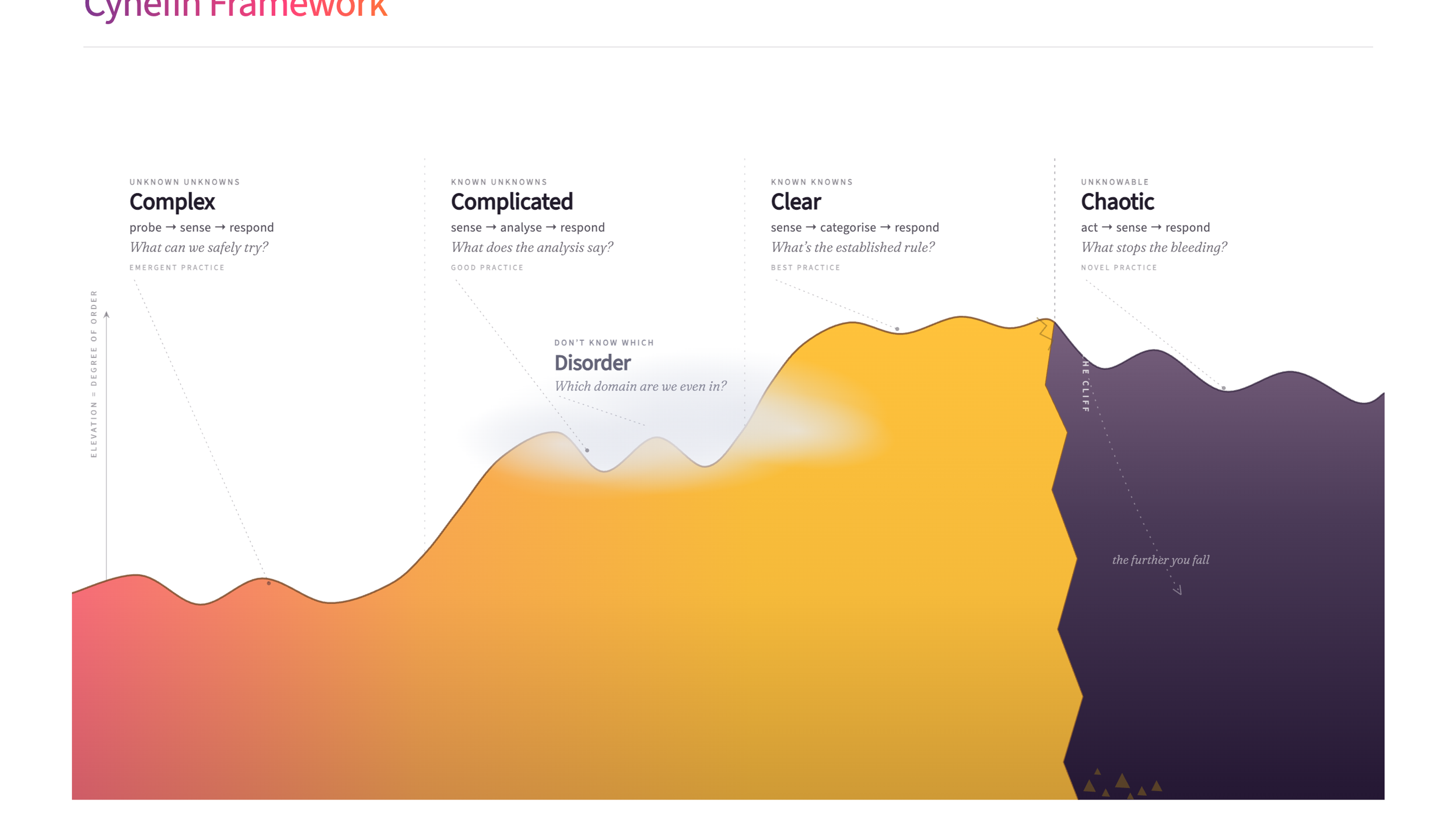
The Cynefin Framework is a decision-making model that helps leaders understand what kind of situation they're dealing with - clear, complicated, complex, chaotic, or confused. The right approach depends on the context, and this framework helps you match the two.
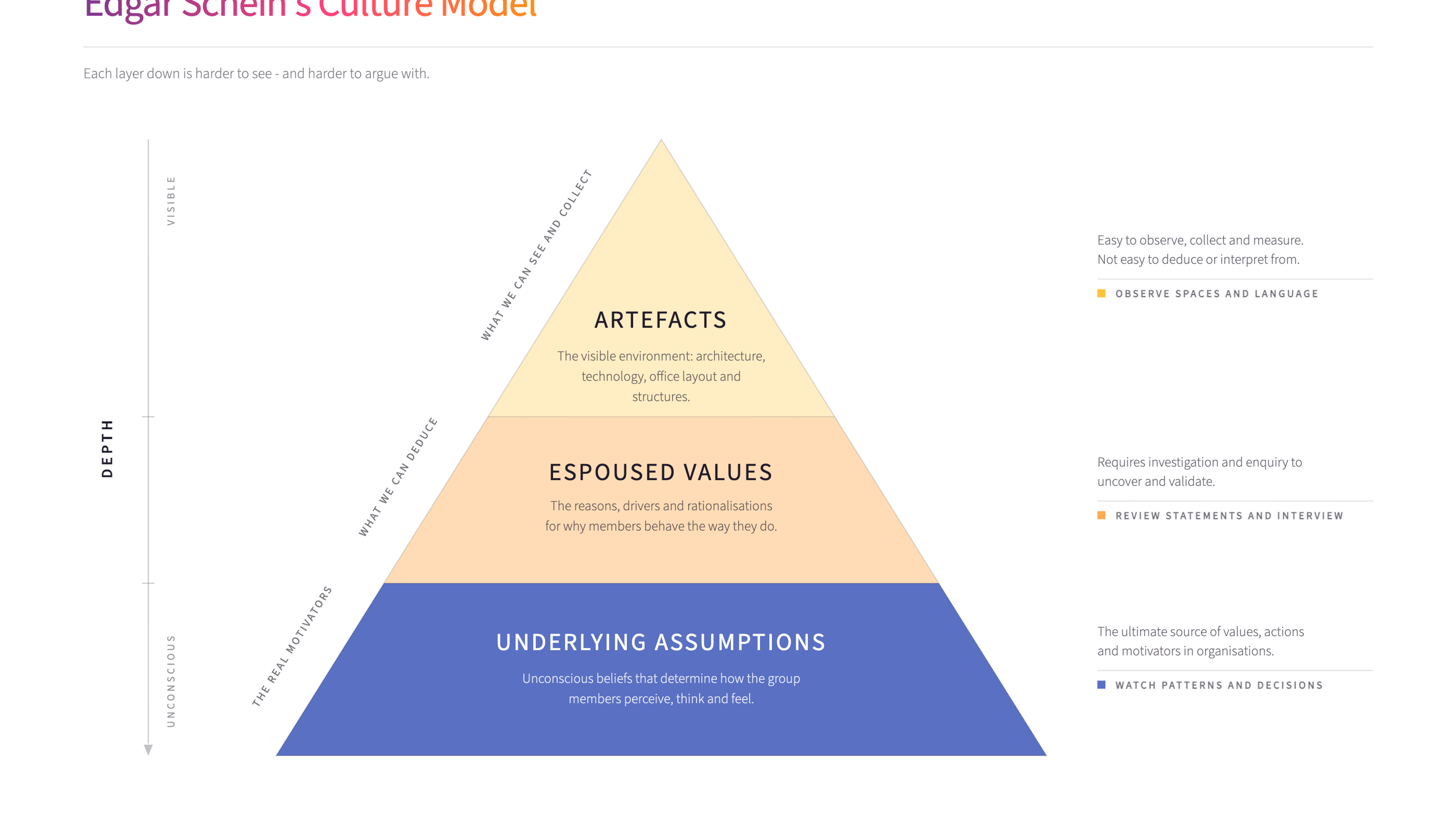
Edgar Schein's Culture Model explores organisational culture at three levels - visible artefacts, stated values, and the deeper underlying assumptions that really drive behaviour. It helps organisations get beneath the surface of what their culture actually is.
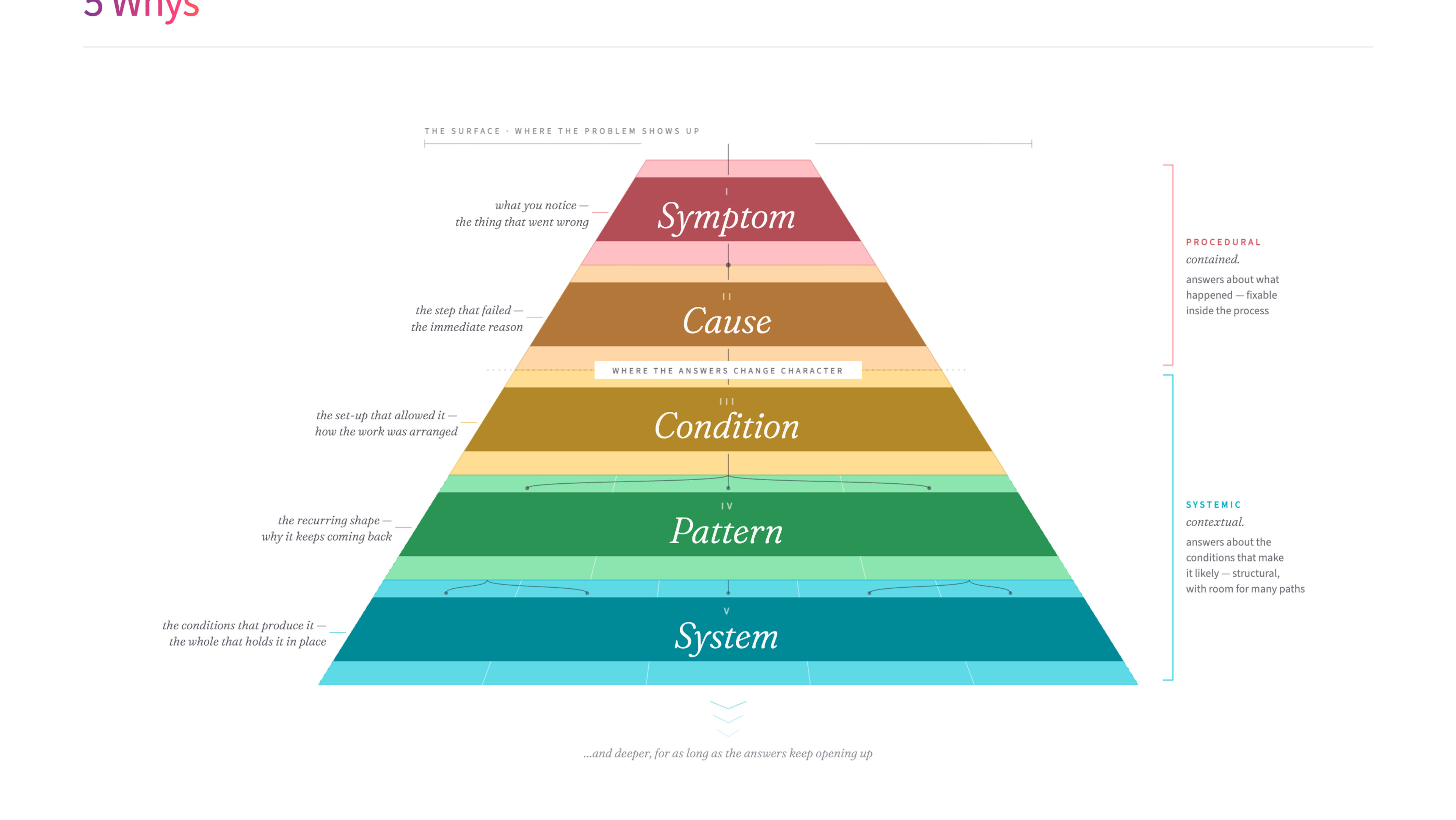
The 5 Whys is a simple root-cause analysis technique that drills into problems by asking "why?" repeatedly. It helps teams get past surface-level symptoms to find the real cause of an issue.
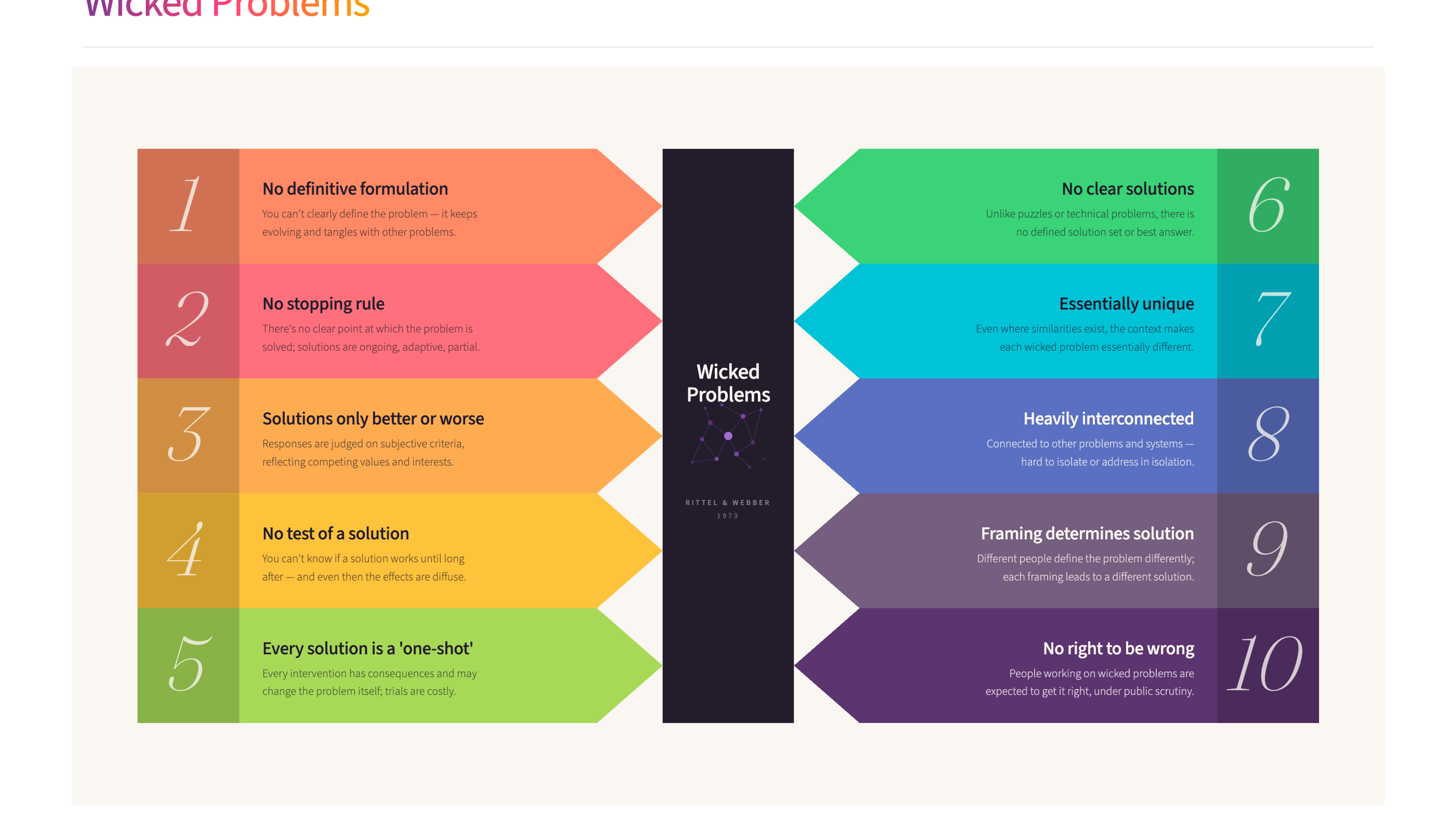
Wicked Problems are complex challenges that resist straightforward solutions - where the problem itself shifts as you try to solve it. Understanding wicked problems helps organisations stop looking for simple fixes and start working with the complexity instead.
A practical guide to developing organisational culture. Cuts through the theory to explain what culture actually is, why most culture change programmes fail, and how to develop culture in a way that lasts - by working with your organisation as a living system, not a machine.

Resilience isn't about bouncing back to where you were. It's about developing the capacity to adapt, learn, and come through difficulty stronger than before. This article explores what organisational resilience actually looks like and what leaders can do to build it.

Why the most reasonable solutions so often become next year's problem. Drawing on systems thinking, a 1930s sociologist, and MIT research on why the real cure gets abandoned just before it works - this piece traces the two ways a good fix turns on you, and the single habit that catches both.

How organisations change without anyone deciding to change them. Drawing on decades of research - from NASA's Challenger disaster to military friendly fire incidents - this article explores why standards erode gradually, why the erosion always moves in one direction, and why the question that matters isn't 'who let this happen?' but 'how far have we travelled from what we intended?'
Systems Thinking Training
The Iceberg Model is one of the core lenses in our Systems Thinking training, where teams learn to look beneath events to the structures underneath.
James Freeman-Gray is the founder of Mutomorro. He's an organisational development practitioner who has spent over twenty years working with leaders across public, private and nonprofit sectors - helping organisations pull together around a common purpose, joined up in how they work. More about who we are and what it's like to work with us.
The Iceberg Model is a foundational tool for systems thinking - it helps people see that what's visible on the surface is driven by structures, patterns, and mental models underneath. I use it with leadership teams to open up conversations about the deeper forces shaping behaviour in their organisation. The "aha" moment usually comes when they realise the behaviours they're trying to change are symptoms of something nobody's ever named out loud.
Last reviewed: June 2026
Ready to use Iceberg Model?
Download the free template - includes practical guidance for workshops and team sessions.
Get the free template
Want to put these ideas into practice?
Whether you're navigating a merger, rethinking how you're structured, or trying to shift a culture that isn't working - underneath, it's the same job: getting the whole organisation pulling in the same direction. Start with a conversation.