Customer Experience in Social Housing
Customer experience shaped by how the whole organisation works, not just the frontline
A housing association with around 9,000 homes had invested in journey mapping, customer profiles and resident research - but the data pointed to something the CX toolkit couldn't fix alone. Culture work without CX capability would produce good intentions and no change. CX capability without the culture shift would produce better-mapped journeys that still fell through the same gaps. They needed both.

When the customer experience data points somewhere unexpected
Every housing association in England is now measured on how residents experience their services. The Regulator of Social Housing's Tenant Satisfaction Measures require annual reporting on satisfaction, complaint handling, communication and respect - and the sector-wide numbers make sobering reading. Overall satisfaction among housing association renters sits at around 75%. Satisfaction with complaint handling is just 34.5%.
Those numbers matter because they measure something that sits deeper than process efficiency or channel availability. They measure how residents feel about the organisation they rely on for their home. And that feeling is shaped by every interaction - a phone call about a repair, a letter about rent, the way a handover happens between teams, whether someone has to repeat themselves when they're passed from one department to another.
Paragon Community Housing (now part of PA Housing) cared for residents across around 9,000 homes in South East England. They'd already begun their customer experience journey - commissioning resident research, starting to map customer journeys, building customer profiles and identifying the pain points that created friction for the people they served. They'd also been through a service restructure. There was real energy and commitment behind the work.
The early research told them things they expected to hear. Residents wanted repairs handled well. They wanted to feel listened to. They wanted to sort things out without being passed around. Standard findings that any housing association would recognise, and a solid foundation for improving services.
But as the work progressed, a more complex picture started to emerge. The journey maps and resident feedback weren't just pointing at process issues that could be fixed one by one. They were revealing something underneath - patterns that cut across the whole organisation. Different departments saw themselves as separate functions, not as part of a single experience. Frontline staff wanted to do the right thing but didn't have a shared understanding of what "the right thing" looked like. Leadership had a vision for customer experience, but it hadn't yet reached the people who spoke to residents every day.
Paragon recognised that achieving the customer experience improvements they wanted meant looking at the challenge more broadly. It wasn't just about mapping more journeys or redesigning more touchpoints. It was about how the whole organisation related to its customers. That's where we came in - to work across both the organisational culture and the practical CX capability, because the two were inseparable.

Reframing the customer's role across the organisation
Paragon's goal wasn't to bolt on a customer service programme. It was to run two tracks in parallel - one that addressed the culture and mindset that shaped customer experience, and another that built the practical capability to improve it.
The first track meant creating greater customer centricity across the whole housing association. Not as a slogan or a set of posters, but as a genuine shift in how teams thought about their work and the people it affected. Every team - from income management to repairs, from lettings to the contact centre - needed to see their role through the lens of the resident experience.
The second track meant equipping people with the tools and skills to act on that shift. Journey mapping, customer effort analysis, touchpoint design, end-to-end service thinking - these were the methods that would deliver tangible improvements. But they would only land properly once the organisation had a shared understanding of why they mattered.
Both tracks needed each other. Culture work without CX capability would produce good intentions and no change. CX capability without the culture shift would produce better-mapped journeys that still fell through the same gaps.

Creating the conditions, then building the capability
The work started with two things at once: understanding what mattered most to residents, and defining the kind of culture that would serve them well.
What residents were already telling them
Paragon already had a wide range of feedback from their earlier customer experience work - journey mapping, research with residents, and service improvement projects. We didn't need to start from scratch. What we needed was to read the existing data differently - looking for the cultural patterns underneath the service issues, not just the service issues themselves.
Themes from that research determined where the work started, what it focused on and where it would have the greatest impact. We kept coming back to the customer voice throughout the programme - not as a one-off input at the beginning, but as a constant reference point that stopped the work from drifting into internal navel-gazing.
Defining the culture through leadership
Changing an organisation's relationship with its customers isn't something a leadership team can work through on their own. It takes structured facilitation - sessions designed to surface honest perspectives, work through tensions, and arrive at commitments people genuinely own.
We worked with the leadership team through a series of facilitated sessions, drawing on what had been learned from residents and the realities of how the organisation operated day to day.
Out of this came a manifesto - a set of commitments that the leadership team signed and owned:
We want to create a culture where...
We will treat everyone as an individual, being mindful of their needs, background and perspective. We never take the impact we have lightly. We will make customers' experience with us as effortless as possible. We will be mindful and conscious of the way we are being - both with each other and the people who rely on us in the community. We will be a resourceful family of individuals, each playing a part in caring for the communities, people and families we touch. We will be inventive in every challenge we face, being open to change, taking ownership and working together to pass the baton, not the buck. We will show people the respect we would want ourselves - recognising our differences are what make us special. We will celebrate the impact we have and take time to remind each other of the ways we make a difference.

The manifesto mattered because leaders' teams scrutinised everything they said and did for signals about how to behave. If customer centricity was going to be real, it had to be visibly led - not just communicated.
The Culture Club gave the leadership team a regular forum to work through the practical challenges of changing organisational culture - always grounded in what was being learned from residents and from frontline teams, rather than operating in the abstract.
The Paragon Person
We knew from the leadership sessions that a manifesto on its own wouldn't reach the whole organisation. What was needed was something that belonged to everyone - not a set of values handed down, but a shared identity that people had helped shape. So alongside the leadership work, we ran sessions across the organisation asking staff to share their own stories about why they worked in housing and what it meant to them:
"I get the chance to help people who have been through sometimes awful circumstances to get a fresh start and sometimes secure a home for the first time in their lives."
What struck us was how consistent the themes were, even across very different roles. People cared about the same things. They just hadn't had the language or the permission to make that visible in how they worked. We distilled these stories, ideas and insights into the "Paragon Person" - a set of guiding characteristics that captured what it meant to act in the spirit of Paragon's customer experience values. It wasn't imposed from above. It emerged from people across the organisation and gave teams something tangible to unite behind.
A Paragon Person:
- Takes ownership - a responsibility to each other and our customers
- Is resourceful - using what we have at our disposal to achieve
- Celebrates the impact we have - and recognises when we could do better
- Treats everyone as an individual - embracing their individuality
- Is empowered to be honest - not over-promising
- Passes the baton, not the buck - so we can all win

The Paragon Person became a practical shorthand. When someone was unsure how to handle a situation, they had a quick reference point for what good looked like - not a policy document, but a set of principles that felt like their own because they'd helped create them.
Team Promises
The Paragon Person gave individuals a shared identity. But we also needed something that worked at the team level - particularly because one of the clearest patterns from the CX data was that residents experienced the organisation as a collection of separate departments, not a single service. We needed teams to make visible commitments to each other, not just to residents.
Each team developed their own Team Promises - clear commitments about how they'd work with both residents and colleagues. We deliberately designed this so teams wrote their own, creating genuine ownership rather than top-down instructions.
When every team had visible promises about how they'd support other teams - and how their part connected to the wider resident journey - it shifted the dynamic from departments operating independently to people who understood their role in the overall experience.


Customer Champions
We knew from experience that this kind of work stalls the moment the formal programme ends - unless the organisation has people inside it who keep the energy going. So we built the Customer Champions programme: a network of individuals across the organisation with a shared purpose to be a platform for positive disruption and ongoing improvement.
Champions supported each other, solved problems collaboratively and brought energy into the organisation long after the initial programme activity. This was the mechanism for sustaining momentum without depending on external support.
Removing the grit from the engine
While the bigger culture work was underway, we could see that frontline teams were dealing with a separate problem. They were closest to residents but often struggling because of unnecessary friction in processes, systems and everyday ways of working. Small things having a big impact - like grit in an engine. We needed quick, visible wins that would build confidence in the programme while we worked on the longer-term shifts.
So we brought groups of frontline staff together and asked one question: what small changes would you make to have a big impact for residents? Then we sent them back to their teams with the backing of their leaders to make those changes - things like tweaking processes, raising sign-off limits, removing unnecessary steps.
This was powerful for two reasons. It demonstrated that the organisation genuinely valued frontline knowledge. And it created quick, visible improvements that built confidence in the programme and showed people that things were changing.

Building customer experience capability across every team
With the culture shift underway, we could see the organisation was ready for the second track. People now had a shared understanding of why customer experience mattered and how their role connected to it. That meant the practical CX tools - which would have felt like just another training programme six months earlier - now had somewhere to land.
This started with a baseline. We ran sessions across the organisation introducing teams to customer experience concepts - customer journeys, customer effort, touchpoints, moments of truth - and showed them how to assess their own services against these. The aim wasn't to turn everyone into a CX specialist. It was to give every team, regardless of function, the ability to look at the experience they delivered through the eyes of the people receiving it.
The sessions covered how customer relationships go wrong and how to prevent it, how people communicate and understand beyond the obvious, the dangers of expertise when you're dealing with someone who isn't an expert, handling emotion and complaints and sensitive situations, saying no without destroying the relationship, and checking understanding rather than assuming what residents already know.

On top of this baseline, specific journey work focused on areas where the impact would be greatest. Targeted work mapped and optimised journeys in areas including finance, homeownership and repairs - looking at how to reduce effort, design services end to end, and close the gaps where things fell between teams. This was done collaboratively with the teams involved, building on the shared language and cross-departmental relationships that the culture work had established.
The collaborative approach mattered. Teams who had already worked together through the Paragon Person sessions and Team Promises now had both the relationships and the tools to redesign how their services connected. End-to-end service design became practical rather than theoretical, because people understood each other's pressures and priorities.
Two tracks reinforcing each other
Tenant satisfaction scores improved following the programme. But the numbers were a surface signal of something that ran deeper.
The culture track had given the organisation a shared language, a common identity and cross-departmental relationships that hadn't existed before. The Paragon Person and Team Promises gave every department a practical framework for daily decisions. Leadership had tools and forums for sustaining the shift. And frontline staff had both the permission and the confidence to do the right thing for residents.
The CX track had given teams the ability to see their services from the outside in, map where effort was wasted, and redesign how things worked across boundaries. Journey optimisation in areas like repairs, homeownership and finance reduced friction for residents and created the kind of joined-up experience that individual departments couldn't deliver alone - the mark of an organisation working as one.
What made this work was that the two tracks reinforced each other. The culture shift meant that when teams sat down to map a journey or redesign a touchpoint, they already shared a common understanding of what they were trying to achieve and why it mattered. And the CX improvements gave people tangible evidence that the culture shift was producing real change - which in turn strengthened their commitment to it.
The Customer Champions and the "little ideas" approach meant the work didn't stop when the formal programme ended. The organisation had built its own mechanisms for continuous improvement - people with the mandate, the relationships and the practical tools to keep improving customer experience from the inside.
Why the CX playbook needs something underneath it
Most housing associations working to improve tenant satisfaction start with what feels logical - journey mapping, touchpoint analysis, customer effort scores, complaint handling reviews. These are sound methods and they surface real problems. But they're diagnostic tools, not the full treatment.
What this project showed is that customer experience is an emergent outcome of how an organisation works, not something that can be optimised in isolation. It emerges from how teams relate to each other, what leaders model, whether frontline staff feel empowered, how knowledge flows between departments, and whether the culture genuinely supports putting residents first.
Paragon's earlier CX work had done exactly what good CX work should do - it had mapped the problems accurately. But the solutions weren't in the maps. They were in a different layer entirely: the shared understanding, the cross-departmental relationships, the practical tools and the organisational identity that shaped how people approached their work.
Once that layer shifted, the traditional CX methods started working properly. Journey optimisation landed because teams understood each other's pressures. End-to-end service design became possible because people had already broken out of their silos. Touchpoint improvements stuck because they were owned by the teams who'd designed them, not imposed from above.

An Empathy Map is a practical starting point for building this kind of understanding - capturing what residents think, feel, say and do at each stage of their experience.
For any housing association staring at its Tenant Satisfaction Measures and wondering where to start, the lesson is worth sitting with. The CX playbook is right. The methods work. But they work best when the organisation has done the harder, less visible work of creating the conditions for them to land.
The question isn't whether to invest in customer journey mapping or culture change. It's whether you've recognised that one without the other rarely delivers what residents need.
About this work
James Freeman-Gray was principal consultant on this programme. He developed the approach, facilitated the leadership sessions and Culture Club, designed the capability building programme, and worked with teams across the organisation.
Paragon Community Housing is now part of PA Housing, formed in 2017 through the merger of Paragon Community Housing and asra Housing Group.
See more of our work across social housing, including the PA Housing merger integration that followed and customer-led service improvement at Paradigm.
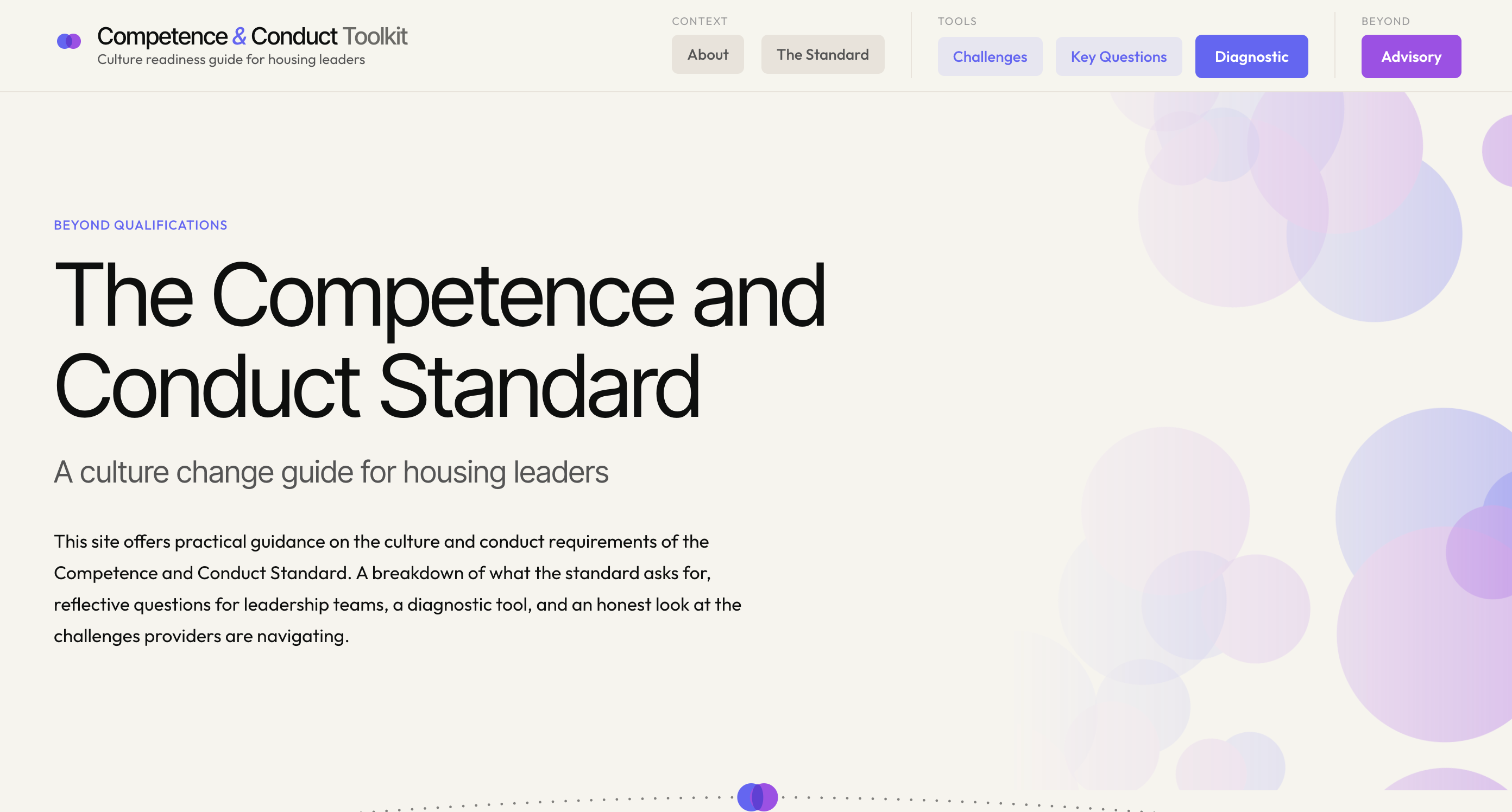
Competence and Conduct Standard - free culture readiness toolkit
The Competence and Conduct Standard applies from October 2026. The qualification requirements are well documented elsewhere. The culture and behaviour side - how your organisation evidences conduct, gives residents real influence, and shows that training leads to better outcomes - is the harder leadership work.
We built a free toolkit for housing leadership teams preparing for this side of the standard. It includes a breakdown of the culture requirements, six practical challenges providers are working through, reflective questions for leadership teams, and a diagnostic you can complete in five minutes.
Facing something similar in housing?
From culture under the consumer standards to merger integration and service improvement, the hardest part is usually the organisational side - connecting strategy to how the work actually gets done. If that's where you are, we'd like to hear about it.

Let's talk about what you're working on
Whether you're navigating a merger, rethinking how you're structured, or trying to shift a culture that isn't working - underneath, it's the same job: getting the whole organisation pulling in the same direction. Start with a conversation.