Systems Thinking Training
Your organisation is a system, and most problems are connected to more than they first appear. We help your people see those connections - and find the points where a small change shifts the whole pattern - with training designed around your organisation.
Why systems thinking training matters
Your teams are capable and working hard. The plans are sound and the people are committed - and yet some problems keep coming back, and improving one thing somehow makes another worse. That is not a sign anyone is failing. It is a sign you are dealing with a system.
Every organisation is one - not a machine with separate parts, but a living whole where everything connects. How teams work together shapes how services get delivered; how decisions flow shapes how quickly things change. Systems thinking is the skill of seeing those connections - the feedback loops, the knock-on effects, and the few points where a small change shifts the whole pattern. This training builds that skill in your people.
How our systems thinking training works
Every course here runs the same way - in-house, shaped to you, built around the real challenges your people are facing.
In-house, for your group. In person at your place or online. We don’t run open courses with seats to fill; we bring the training to you.
Shaped before we arrive. Every course starts with a conversation: what keeps recurring, what’s changing, what’s already been tried? The day your people get works on your organisation’s real challenges - not a textbook system none of you have met.
Built for the people who shape how things work. Leaders, managers, strategists and change practitioners - anyone making decisions about how the organisation runs. Some organisations mix the groups in one room; others run the same course for each. Both work.
The courses
Systems thinking training
A practical one-day grounding in systems thinking - learning to see your organisation not as a set of separate departments and processes, but as a connected system. It’s for leaders, managers and change practitioners who want to understand how their organisation really works and use that to make better decisions. It’s especially useful if you keep meeting problems that come back, initiatives that don’t deliver what was expected, or improvements in one area that create problems in another. No prior knowledge needed.
You leave with a practical systems thinking toolkit - causal loop diagrams, systems maps and pattern recognition - already applied to a real challenge from your own organisation, so you know it works in your context.
What you’ll work on
You’ll spend the day learning to see your organisation differently - not as a collection of departments and processes, but as an interconnected system - and applying that lens to real challenges from your own work. The day covers three areas.
Seeing the system. Most problems look simple until you see what’s connected to them. You’ll learn to map the system around a challenge - the feedback loops, the delays, the connections that aren’t obvious from inside the problem. A team struggling with delivery might have a workload issue, or it might be a symptom of something structural three levels away. Systems thinking helps you tell the difference. The Iceberg Model is one of the core tools here, helping you see how surface events connect to deeper patterns, structures and assumptions.
Understanding patterns. Organisations tend to fall into recognisable patterns - growth that creates its own constraints, quick fixes that make the underlying problem worse, success in one area that quietly undermines another. You’ll learn to recognise these using system archetypes, the diagnostic patterns covered in more depth in the archetypes course further down this page.
Finding leverage. In any system there are points where a small, well-placed intervention shifts the whole pattern. Systems thinking helps you find them - so instead of pushing harder on something that isn’t working, you change the thing that produces it. That’s the difference between solving a problem and changing the system that creates it. The Cynefin Framework helps you read how complex a challenge really is, so you can choose the right kind of response.
How the day works
The day alternates between short input on systems thinking concepts and hands-on exercises applying them to your real challenges. You work in small groups - mapping systems, spotting patterns and finding leverage points together. The facilitator draws on a wide range of systems thinking approaches, adapted to fit your context.
What you’ll take away
A practical systems thinking toolkit you can use straight away - causal loop diagrams, systems maps and archetype recognition. A different way of seeing your organisation that makes complex problems feel more navigable. And, because you’ll have applied the tools to a real challenge during the day, the confidence that they work in your context.
What makes this different
Systems thinking earns its keep when it’s applied, so every concept here is taught through a real challenge from your organisation - you won’t just learn about feedback loops, you’ll map the ones running in your organisation right now. We also connect seeing to doing: understanding the system isn’t enough, you need to know where to act, so we help you move from diagnosis to the leverage points where change actually shifts the pattern. That makes systems thinking a foundational skill for building organisational resilience - and where your organisation needs deeper support, our organisational development consultancy works alongside leadership teams to put it into practice.
System archetypes training
A practical one-day course on the recurring patterns - the system archetypes - that organisations fall into again and again: fixes that backfire, success that creates its own limits, the quick fix that quietly becomes the problem. It’s for leaders, strategists and change practitioners who want a deeper understanding of why their organisation behaves the way it does, and it’s particularly valuable if you’re frustrated by problems that keep returning, initiatives that fizzle out, or improvements that don’t stick. It builds on the systems thinking fundamentals above, but works as a standalone day - the essential concepts are covered as you go.
You leave able to recognise the most common archetypes in organisational life, with a diagnosis of at least one operating in your own organisation and a practical strategy designed to shift it - plus a shared language with your colleagues for naming these patterns, which is surprisingly powerful in itself.
What you’ll work on
You’ll spend the day learning to see the hidden patterns that shape how your organisation behaves - and working out what to do about them, applying archetype thinking to real challenges from your own work. The day covers three areas.
Recognising the patterns. A handful of archetypes explain a remarkable number of organisational problems: fixes that backfire, success that creates its own limits, shifting the burden from the real problem to a symptomatic fix. You’ll learn to recognise these not as abstract diagrams, but as living dynamics you can see in your own organisation. The Iceberg Model is a useful way in, connecting recurring surface problems to the deeper structures underneath.
Diagnosing your challenges. Armed with the archetypes, you’ll look at real challenges through a new lens. That initiative that lost momentum might be a ‘limits to growth’ pattern; that quick fix that made things worse, a classic ‘fixes that fail’. You’ll map the archetype behind a real challenge - which often reveals that the solution everyone’s been pursuing is actually feeding the problem.
Designing archetype-aware interventions. Once you can see the pattern, you can design interventions that work with it rather than against it. Each archetype has known leverage points - places where action breaks the pattern rather than reinforcing it. You’ll learn these strategies and apply them to your own challenges, designing practical actions that address the systemic pattern, not just the visible symptom.
How the day works
The day combines conceptual input with hands-on diagnosis and design. Each archetype is introduced with real-world examples, then you look for it in your own organisation. The afternoon focuses on designing interventions - practical actions that target the leverage points in your specific archetype. You work in small groups throughout.
What you’ll take away
The ability to recognise the most common system archetypes, a diagnosis of at least one operating in your own organisation, and a practical intervention strategy designed to shift it. You’ll also leave with a shared language for talking about systemic patterns with your colleagues - a quiet but powerful thing to have in common.
What makes this different
Archetypes are most useful when you can see them in your own work, so this course is built entirely around application. Every archetype is taught through your real organisational challenges - by the end of the day you won’t just understand them in theory, you’ll have used one to diagnose a real problem and design a real intervention. Recognising a pattern is only the first step, though; changing it means working with the wider system - the culture, the structure, the incentives, the leadership behaviours that hold the pattern in place. That’s where our organisational development consultancy can help, and there’s more on leading when familiar solutions stop working in our guide to adaptive leadership.
Systems thinking for organisational change
A practical, in-depth two-day course for the people leading significant change - senior leaders, change directors, transformation leads and organisational development practitioners. Where a change plan maps the steps, this course maps the system those steps move through: how every part of the organisation connects, how change in one area ripples into others, and how the system will respond to what you’re doing. It works best when the core team leading the change attends together, so you build your shared picture of the system as a group. It builds on the two courses above, but works as a standalone.
You leave with a systems map of your organisation built around your specific change, a change approach designed around how the system actually works, and a plan for sustaining the change once the initial push is over.
What you’ll work on
Over two days, your team builds a systems-informed approach to a real change in your organisation - something that matters, so you leave with a framework you’ll actually use. The course covers four connected areas.
Mapping the organisational system. Before you can change a system, you need to see it. You’ll map your organisation as an interconnected whole - the formal structures, the informal networks, the cultural patterns, the decision-making flows, and the feedback loops that keep things the way they are. This map shows where the real dynamics sit, not just where the org chart says they do, and it becomes the foundation for everything else. The Iceberg Model helps connect the visible events and behaviours to the deeper structures driving them.
Understanding how the system responds. Organisations aren’t passive - they respond to change, sometimes as you expect, often not. You’ll look at resistance as a systemic phenomenon rather than a people problem, at the delays between action and effect, and at the unintended consequences that catch most change programmes off guard. Understanding these in advance changes how you design your approach. The Cynefin Framework helps you tell apart the parts of the change that can be planned for from the parts that have to be explored.
Designing systems-aware change. With a clear picture of the system and how it’s likely to respond, you’ll design an approach that works with its dynamics rather than against them - sequencing interventions wisely, building coalitions around leverage points, managing feedback loops, and creating the conditions for change to be absorbed rather than rejected.
Sustaining change in a living system. Many change programmes declare victory at implementation and stop too early. A systems view shows that lasting change means the system settling into a new equilibrium - which takes time, attention and adaptive leadership. You’ll plan for the long game, designing practices that keep the change alive and deepening after the initial push. Some changes throw up genuinely knotty, no-clean-answer problems along the way; our guide to wicked problems is a useful companion when they do.
How the two days work
Day one is mapping and understanding - seeing the system as it is and working out how it will respond to change. Day two is designing and planning - building an approach that works with the system, and sustaining it over time. Across both days you alternate between systems thinking input, facilitated mapping exercises, and design sessions focused on your real change.
What you’ll take away
A systems map of your organisation relevant to your specific change, a change approach designed around how the system actually works, and a plan for sustaining the change over time. And a different way of thinking about organisational change - one that sees the whole system, not just the parts being changed.
What makes this different
Where a change plan focuses on the steps, this course starts from the system those steps move through - a different starting point that leads to different decisions. It sits alongside our change management training, which focuses on the craft of leading change; this is its systems-thinking counterpart, and many people find the two complement each other. We draw on widely recognised change frameworks as well as systems thinking, for a richer and more realistic approach than any single method offers - change leadership informed by how organisations actually work as living systems, not how we wish they worked. There’s more on the long-term view in our guide to building organisational resilience, and where the change needs ongoing support, our organisational development consultancy works alongside leadership teams throughout.
The systems thinking tools behind it - many lenses, free to explore
Systems thinking isn’t a single model - it’s a way of seeing, supported by a set of tools that each bring a different part of the picture into focus. The Iceberg Model looks beneath surface events to the structures driving them. Causal loop diagrams make feedback visible. System archetypes name the patterns that recur. The Cynefin Framework helps you read how complex a challenge really is before you choose how to respond.
We draw on all of them - and publish free guides to each - because the useful question isn’t ‘which tool is best?’ but ‘which one helps you see this situation clearly?’ That judgement is what the training builds. The guides, incidentally, are among the most-visited pages on this site, and the Iceberg Model is our single most-downloaded tool - the thinking is already out there and free; the training is where it gets applied to your organisation.
If you’d like to explore before we talk, Fieldmarks is our free field guide to systems thinking - a connected map of the concepts, with guided pathways built around things you might be noticing right now (‘why the same issues keep recurring’, ‘the change keeps sliding back’). It’s a good warm-up for any of these courses, and a deeper reference if the territory grabs you.
Bespoke systems thinking training
The observation. The same systems concepts land differently in different organisations - because the systems are different. A school, a housing association and a manufacturer face different dynamics, and the examples that make systems thinking click are the ones drawn from your own world.
What we do about it. So we design around your context. Before any course runs, we learn the challenges you’re wrestling with, the shape of your organisation, the language you use - and build the day around them. The tools stay; the day they live in is yours.
What that makes possible. People who don’t just understand systems in theory, but can see the one they work in - and act on it, on the challenges in front of them.
And if none of these courses is quite the shape you need, we design from scratch - that’s bespoke training.
Part of a bigger picture
Systems thinking isn’t just a course we run - it’s the way we see organisations, and it sits behind everything we do. The belief underneath it is a simple one: the conditions you create inside an organisation shape what it’s able to do. Strengthen the connections between strategy, structure, culture and people and capability grows; ignore them and effort leaks away in the gaps. Training builds your people’s ability to see and work with those connections; there’s more on the thinking in our philosophy.
And if what you need is partners in the work itself, not just the capability to do it, our organisational development consultancy works alongside leadership teams to develop the organisation as a whole.
Systems thinking training FAQs
How is the course shaped to our organisation?
Every course starts with a conversation about your organisation - the challenges that keep recurring, what’s changing, what’s already been tried. We then shape the examples, exercises and emphasis around your real situation, so the day works on your system rather than a generic one.
Who delivers it, and where?
In person at your offices or a venue you choose, anywhere in the UK - or fully online, wherever your people are. The practitioner who shapes the course with you is the one who delivers it.
Do we need any background in systems thinking?
No. The fundamentals course assumes no prior knowledge - the concepts are powerful but accessible, and we teach them through practical application rather than theory. The archetypes and organisational-change courses build on the fundamentals but cover the essentials as they go, so they work as standalone days too.
What group size works?
These courses run best in small groups, so everyone gets time on their own challenges - the deeper diagnostic work especially. The fundamentals day can take a few more. If your group is larger, talk to us; we can usually adapt the format or run more than one cohort.
Do participants get a certificate?
These courses build capability rather than accreditation - you leave able to see and work with your organisation as a system, not with letters after your name. If formal certification is what your people need, an accredited or academic provider is the right route. What you get here is the practical skill, applied to your real challenges.
Can you combine courses into a programme?
Yes - and it’s a natural fit. A common path is the fundamentals day to build a shared lens, the archetypes day to go deeper on diagnosis, and the two-day organisational change course for the team leading a specific change - run as a connected programme with a consistent thread. We’ll help you work out which combination fits.
What if we want help with the work itself, not just training?
That’s our organisational development consultancy - working alongside your leadership team to develop the organisation itself, rather than building your people’s capability to do it. Plenty of organisations use both: consultancy for the work, training so the capability stays when we step back.
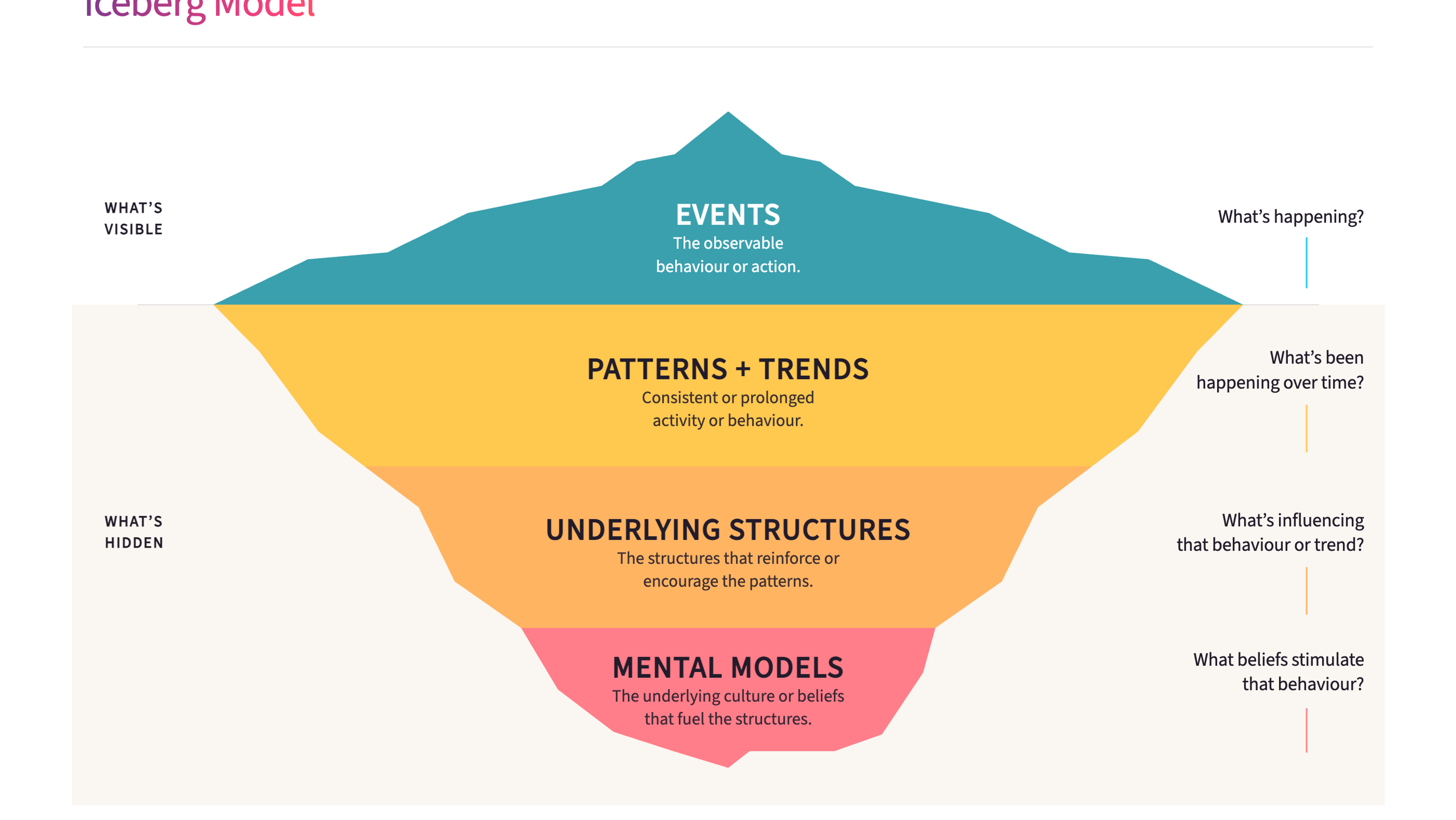
The Iceberg Model is a systems thinking tool that helps you look beneath surface-level events to find the patterns, structures, and mental models driving them. It's a way of seeing the deeper causes behind what's happening in your organisation.
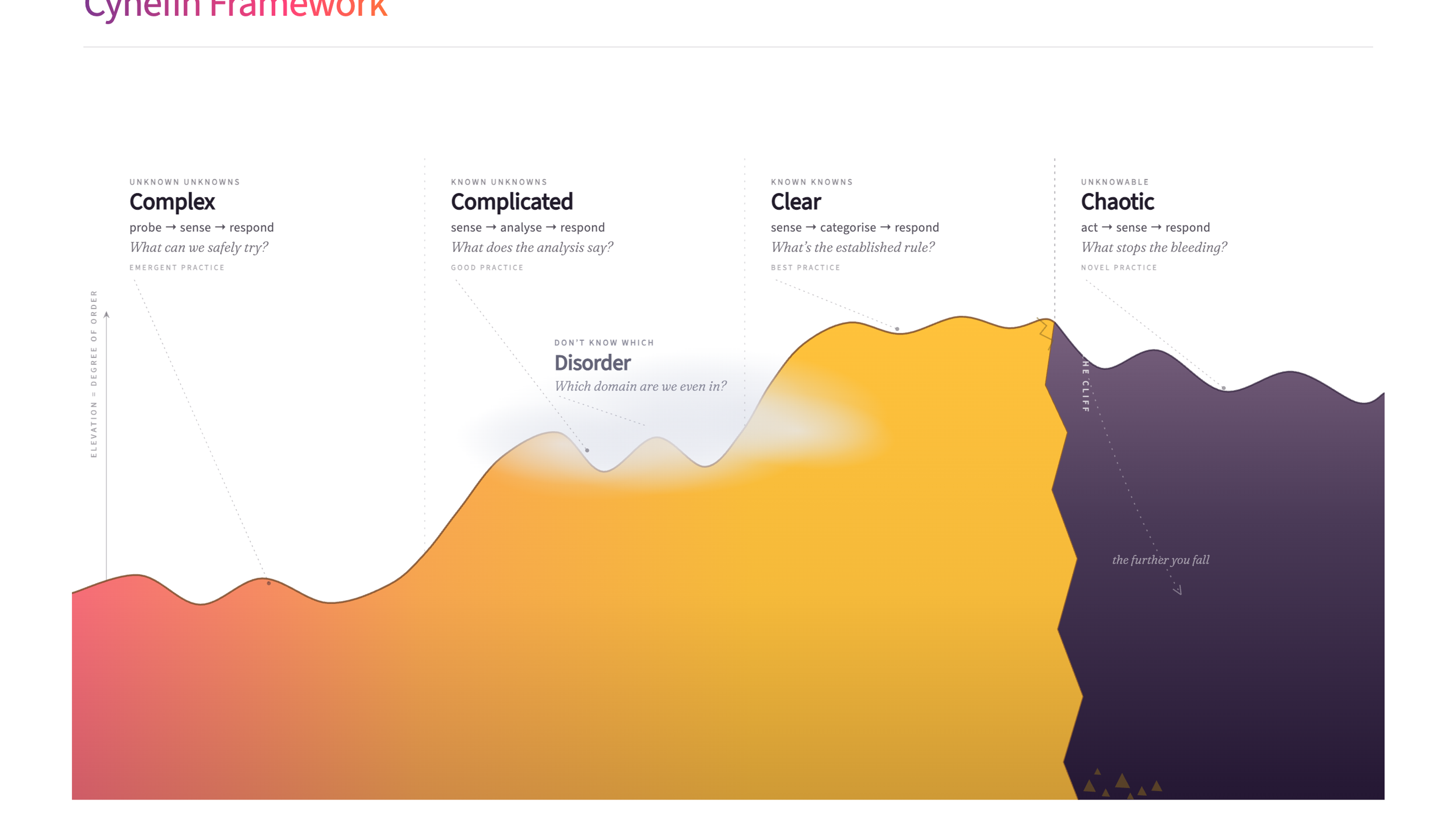
The Cynefin Framework is a decision-making model that helps leaders understand what kind of situation they're dealing with - clear, complicated, complex, chaotic, or confused. The right approach depends on the context, and this framework helps you match the two.
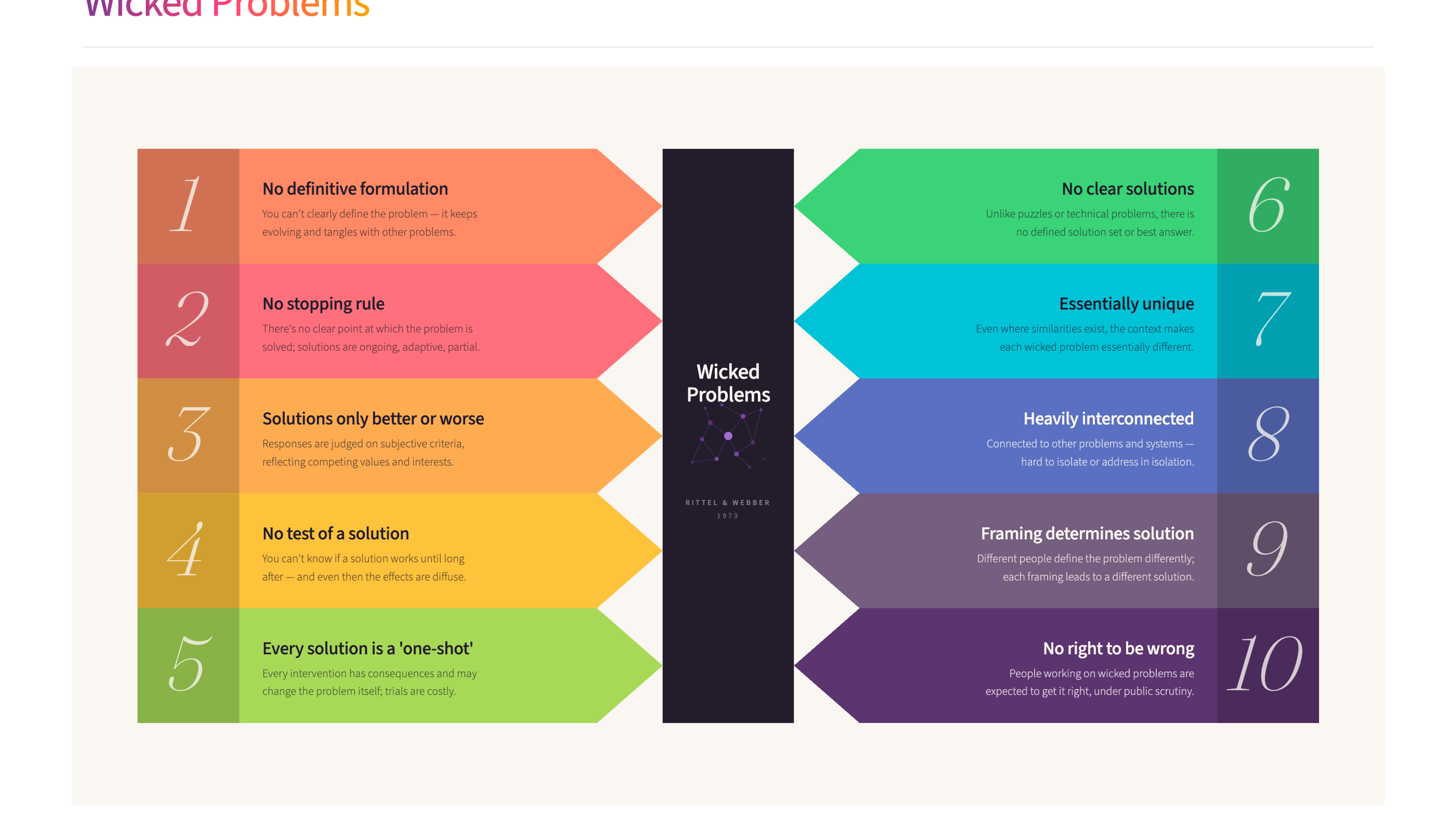
Wicked Problems are complex challenges that resist straightforward solutions - where the problem itself shifts as you try to solve it. Understanding wicked problems helps organisations stop looking for simple fixes and start working with the complexity instead.
Wrestling with problems that keep coming back?
Tell us what you’re seeing and we’ll help you find the right way in.