LogFrame (Logical Framework)
A LogFrame is a structured planning and evaluation tool that helps organisations set clear goals, define how they'll measure progress, and track what's actually being achieved. It's widely used in the nonprofit sector for programme management and impact reporting.
Get the free template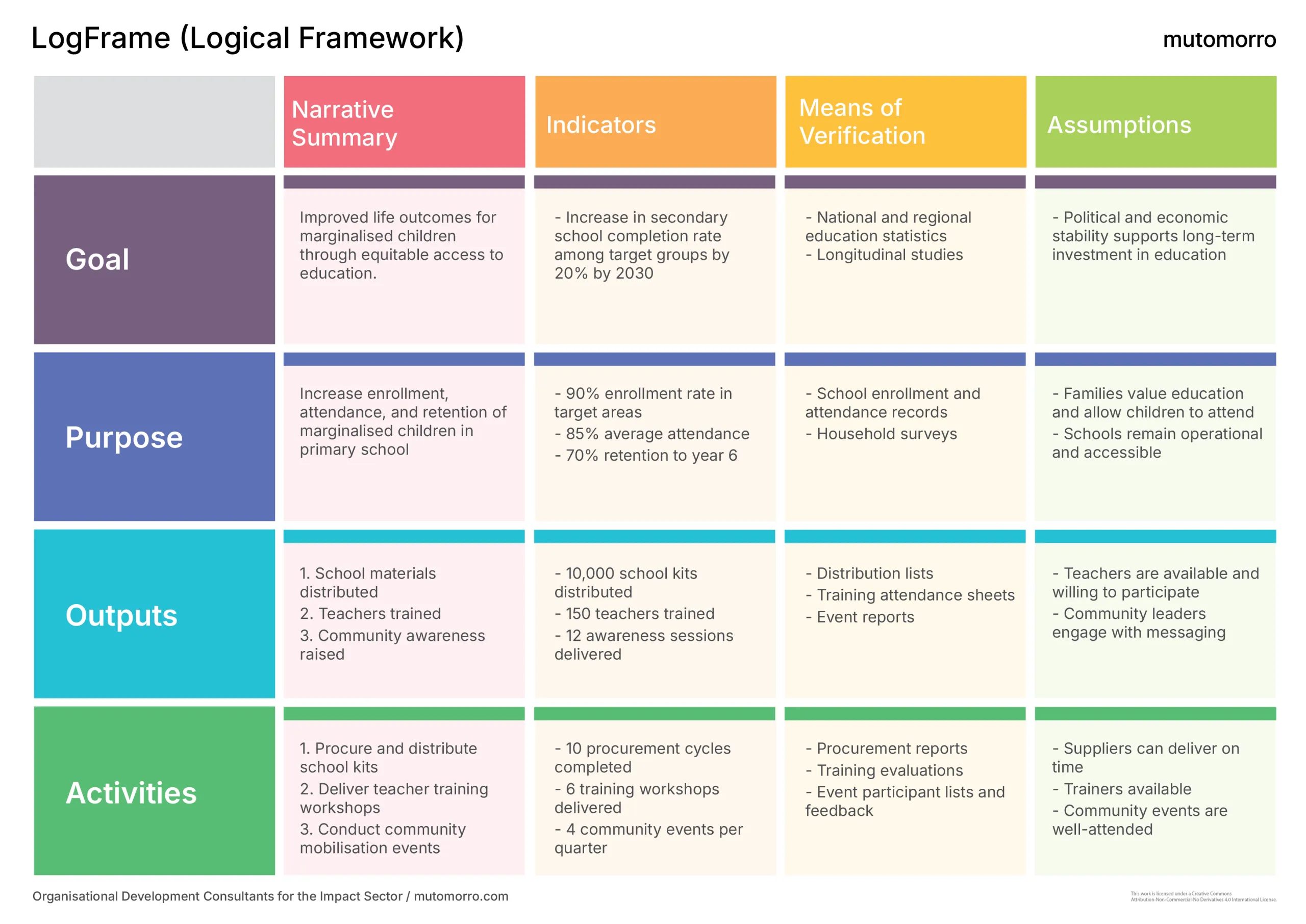
LogFrames, or Logical Frameworks, are essential tools for nonprofits to efficiently manage programmes and projects - and assess their impact. By providing a structured approach to planning, implementing, and evaluating activities, LogFrames help organisations achieve their goals more effectively. They serve as a visual representation of a programme's objectives, outcomes, and the resources required to attain them.
Understanding the core components of LogFrames can significantly enhance your ability to manage complex projects. They enable you to break down intricate objectives into manageable parts, ensuring clarity and focus throughout the project lifecycle. This structured method not only improves communication within your team but also with stakeholders, as everyone can easily grasp the project's overarching goals and specific actions needed to achieve them.
Using LogFrames can lead to increased accountability, as they require you to define clear indicators of success. This ensures that everyone involved in the project is aware of what success looks like and can measure progress accordingly. By incorporating LogFrames into your project management toolkit, you can streamline your processes and enhance the impact of your programmes and projects.
Background to LogFrames
The concept of LogFrames originated in the 1960s as a response to the increasing complexity of development projects. Initially developed by USAID, they were designed to improve planning and evaluation processes. Over the years, their use has expanded beyond development agencies to include a wide range of organisations, including nonprofits, governments, and international NGOs.
The LogFrame works best when built from a clear Theory of Change - the narrative logic that explains how your activities lead to the outcomes you're aiming for.
LogFrames were developed to address the need for a systematic approach to project planning and evaluation. Before their introduction, projects often lacked clear objectives and measurable outcomes, making it challenging to assess their success. By providing a structured framework, LogFrames allow organisations to define their goals, identify necessary resources, and evaluate progress against predefined indicators.
Today, LogFrames are widely used by organisations around the world. They are particularly popular in sectors such as international development, humanitarian aid, and social services. Nonprofits, in particular, benefit from LogFrames as they provide a clear and concise way to communicate their objectives, activities, and expected outcomes to donors, partners, and other stakeholders.
Who is a LogFrame Useful For?
LogFrames are valuable tools for a variety of users. Here are some key groups that can benefit from using LogFrames:
- Nonprofit Managers: They can use LogFrames to plan, implement, and evaluate projects, ensuring that resources are used effectively and objectives are met.
- Project Planners: LogFrames help planners break down complex projects into manageable components, providing clarity on tasks, responsibilities, and timelines.
- Donors and Funders: With LogFrames, they gain a clear understanding of a project's goals, expected outcomes, and how funds will be utilised, enhancing transparency and accountability.
- Stakeholders and Partners: LogFrames offer a straightforward way to communicate project objectives and progress, fostering collaboration and alignment among all parties involved.
- Evaluators and Researchers: By defining specific indicators and outcomes, LogFrames provide a structured approach for assessing project success and identifying areas for improvement.
By catering to these diverse users, LogFrames ensure that all aspects of project management are addressed, from initial planning to final evaluation.
A LogFrame is a Temporal Logic Model
A LogFrame is fundamentally a temporal logic model, which means it is designed to illustrate the causal relationships between different project components over time. This approach helps you understand how specific activities lead to desired outcomes and how various elements of a project are interconnected.
Understanding the temporal nature of LogFrames is crucial for effective project management. It allows you to anticipate how changes in one part of the project may impact other areas, enabling proactive adjustments to keep the project on track. This foresight is particularly valuable in dynamic environments where conditions can change rapidly.
The Iceberg Model supports this kind of thinking - it helps you look beneath surface-level events to the structures and patterns that a LogFrame needs to account for.
The use of if/then logic flows within LogFrames further enhances their utility. By clearly defining the conditions under which certain outcomes will be achieved, you can better plan for contingencies and ensure that your project remains adaptable. This logical approach ensures that all project activities are aligned with the overarching goals, improving the chances of success.
What's the Difference Between LogFrame and Theory of Change?
While both LogFrames and Theory of Change (ToC) are tools used in project planning and evaluation, they serve different purposes and are used in distinct ways. Understanding the differences between them can help you decide which tool is more appropriate for your needs.
LogFrames are primarily focused on the operational aspects of a project. They provide a structured framework that outlines the project's components, such as goals, activities, and indicators. This makes them particularly useful for managing day-to-day operations and ensuring that all team members are aligned with the project's objectives.
On the other hand, a Theory of Change is more conceptual and strategic. It focuses on the broader changes that a project aims to achieve and the underlying assumptions that influence its success. ToC requires you to articulate the long-term impact you hope to achieve and the pathways to get there, making it ideal for strategic planning and communication with stakeholders.
In summary, LogFrames are best suited for projects requiring detailed operational planning and monitoring, while Theories of Change are more appropriate for strategic planning and understanding the broader context of a project's impact.
The ‘Logical Framework Approach’ (LFA)
The Logical Framework Approach (LFA) is an established methodology for developing LogFrames. It is a participatory process that involves stakeholders in the planning and design of projects, ensuring that all perspectives are considered and integrated into the framework.
LFA begins with a thorough analysis of the project's context, including the identification of key problems, stakeholders, and objectives. This analysis forms the foundation for developing a LogFrame matrix, which outlines the project's goals, activities, and expected outcomes.
By involving stakeholders in the LFA process, you can ensure that the LogFrame is comprehensive and reflects the needs and priorities of all parties involved. This collaborative approach enhances buy-in and commitment to the project's success, as everyone has a clear understanding of their role and the expected outcomes.
Key Components of a LogFrame Matrix
A LogFrame matrix consists of several key components, each serving a distinct purpose in the planning and evaluation process. Understanding these components is essential for effectively using LogFrames in your projects.
The Four Key Rows:
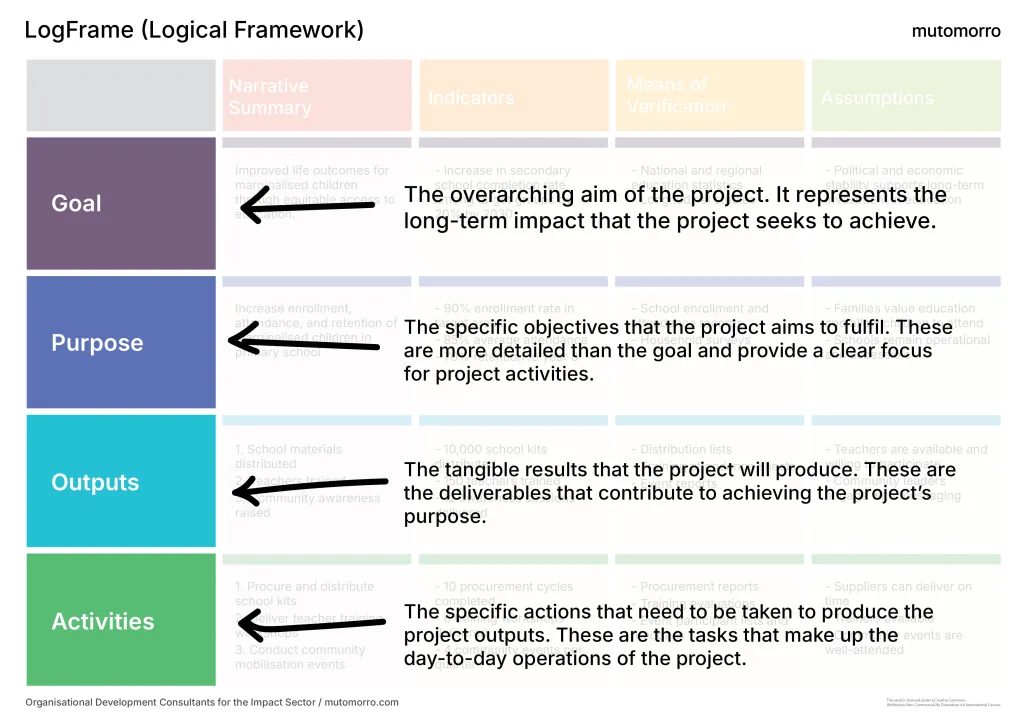
- Goal: The overarching aim of the project. It represents the long-term impact that the project seeks to achieve.
- Purpose: The specific objectives that the project aims to fulfil. These are more detailed than the goal and provide a clear focus for project activities.
- Project Outputs: The tangible results that the project will produce. These are the deliverables that contribute to achieving the project's purpose.
- Activities: The specific actions that need to be taken to produce the project outputs. These are the tasks that make up the day-to-day operations of the project.
The Four Key Columns:
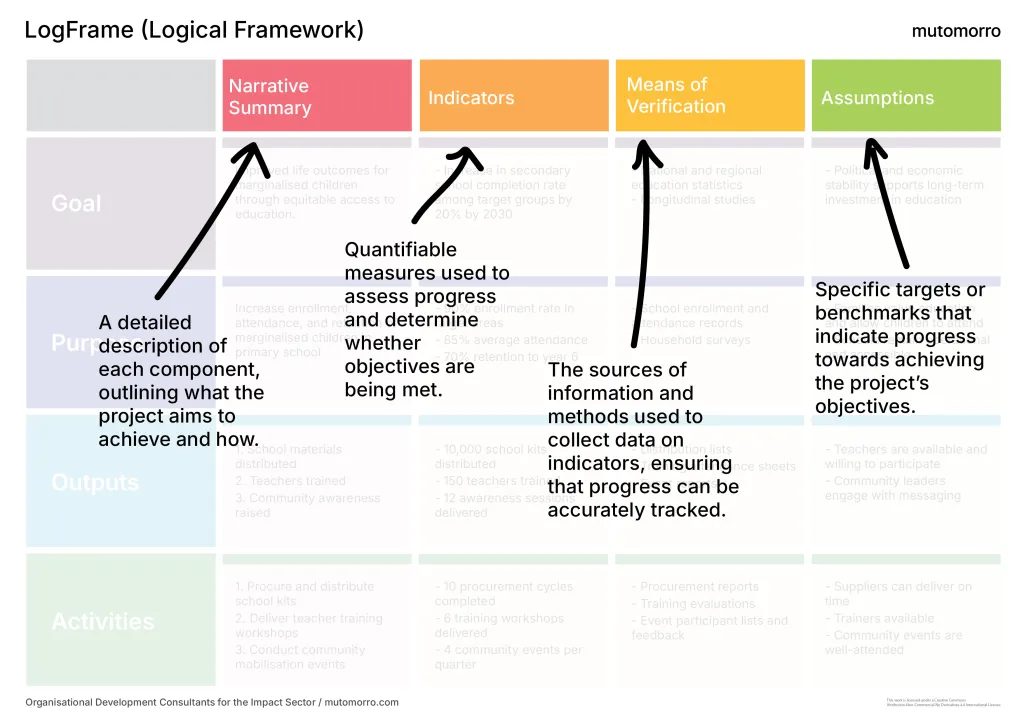
- Narrative Summary: A detailed description of each component, outlining what the project aims to achieve and how.
For a broader view of how your programme connects to your operating model, the Nonprofit Business Model Canvas maps the full picture from mission to revenue.
- Indicators: Quantifiable measures used to assess progress and determine whether objectives are being met.
- Means of Verification: The sources of information and methods used to collect data on indicators, ensuring that progress can be accurately tracked.
- Assumptions: The external conditions, outside the project's control, that must hold for each level of the LogFrame to lead to the next.
By understanding these components, you can develop a comprehensive LogFrame that clearly outlines your project's objectives, activities, and expected outcomes, ensuring that all team members and stakeholders are aligned with the project's goals.
Row 1: Goal
The goal in a LogFrame represents the ultimate aim or desired impact of your project. It is the broad, long-term change you wish to effect in your target area or population. A well-defined goal provides a clear direction and serves as a guiding light for all project activities.
When defining the goal, ensure it is aligned with broader organisational or societal priorities. It should be aspirational yet achievable, providing a vision that motivates and inspires stakeholders and team members alike. Avoid being too vague or overly ambitious, as this can lead to confusion and unrealistic expectations.
Before setting the goal, it helps to be precise about the problem you're addressing. A well-crafted Problem Statement gives the LogFrame a sharper foundation to build from.
- How it's used in a LogFrame:
Sets the overarching direction for the project.
Guides the development of objectives and activities.
Serves as a point of alignment for all stakeholders. - What to include:
A clear and concise statement of the desired impact.
Long-term benefits for the target population or area.
Alignment with organisational or sectoral priorities. - Examples:
Reducing poverty in a specific region.
Improving access to education for underserved communities.
Enhancing environmental sustainability. - Common mistakes to avoid:
Defining goals that are too broad or vague.
Failing to align the goal with the needs of stakeholders.
Overlooking the long-term implications of the goal.
Row 2: Purpose
The purpose in a LogFrame is the specific change the project aims to achieve. It serves as the bridge between the broader goal and the tangible outputs. A clear purpose statement ensures that all project activities are aligned and contribute directly to achieving this objective.
When defining the purpose, it should be realistic and achievable within the project's timeframe and resources. It should also be specific enough to provide a clear focus for project activities. Avoid vague or overly broad statements, as these can lead to misalignment and inefficiencies.
- How it's used in a LogFrame:
Provides a clear focus for project activities.
Guides the development of outputs and activities.
Aligns with the overall goal of the project. - What to include:
Specific, measurable objectives that contribute to the goal.
A clear link between the purpose and the goal.
Realistic and achievable targets. - Examples:
Increasing literacy rates among children in a community.
Expanding access to clean water for rural households.
Reducing greenhouse gas emissions in a city. - Common mistakes to avoid:
Defining objectives that are too ambitious or unrealistic.
Failing to link the purpose to the overall goal.
Overlooking the needs of the target population.
Row 3: Project Outputs
Project outputs in a LogFrame are the tangible products, services, or results generated by the project's activities. They are specific, measurable, and time-bound, providing concrete evidence of progress towards the purpose and goal.
When defining outputs, ensure they are directly linked to the project's purpose and contribute to achieving the goal. They should be realistic and achievable within the project's resources and timeframe. Avoid setting too many outputs or those that are not clearly measurable.
- How it's used in a LogFrame:
Defines the tangible results that the project will deliver.
Provides a basis for measuring progress and success.
Guides the development of activities. - What to include:
Specific, measurable outputs that contribute to the purpose.
A clear link between outputs and activities.
Realistic and achievable deliverables. - Examples:
Training workshops are conducted for community leaders.
Educational materials were distributed to schools.
Solar panels are installed in residential areas. - Common mistakes to avoid:
Defining outputs that are too vague or broad.
Failing to link outputs to the project's purpose.
Overestimating the project's capacity to deliver outputs.
Row 4: Activities
Activities in a LogFrame are the specific tasks or actions undertaken to produce the project's outputs. They are the operational steps that drive the project forward, providing the bridge between planning and execution.
When defining activities, ensure they are clearly linked to the outputs they support. Each activity should be specific, time-bound, and feasible within the project's resources. Avoid vague or overly complex activities, as these can lead to confusion and inefficiencies.
- How it's used in a LogFrame:
Defines the specific actions needed to achieve outputs.
Provides a basis for project planning and implementation.
Guides resource allocation and management. - What to include:
Detailed, actionable steps that contribute to outputs.
A clear link between activities and outputs.
Realistic and achievable tasks. - Examples:
Conducting training sessions for teachers.
Installing water filtration systems in rural areas.
Organising community awareness campaigns. - Common mistakes to avoid:
Defining activities that are too vague or broad.
Failing to link activities to the project's outputs.
Underestimating the resources required for activities.
Column 1: Narrative Summary
The narrative summary in a LogFrame provides a concise yet comprehensive description of the project's objectives and activities. It serves as an overview, helping stakeholders and team members understand the project's scope and direction.
When crafting a narrative summary, ensure it is clear, concise, and aligned with the project's goals, purpose, outputs, and activities. Avoid unnecessary jargon or overly complex language, as this can lead to misunderstandings and misinterpretations.
- How it's used in a LogFrame:
Provides a clear and concise explanation of the project's objectives.
Serves as a basis for communication with stakeholders.
Guides project planning and implementation. - What to include:
A detailed description of each component.
A clear link between components and overall goal.
A concise explanation of the project's objectives and activities. - Examples:
Describing the project's goal to improve health outcomes in a community.
Outlining the purpose of increasing access to healthcare services.
Detailing the outputs of training healthcare workers. - Common mistakes to avoid:
Providing vague or unclear descriptions.
Failing to link components to the overall goal.
Overlooking the needs of the target population.
Column 2: Indicators
Indicators in a LogFrame (sometimes called Objectively Verifiable Indicators or OVIs) are the specific criteria used to measure progress and success. They provide a quantitative or qualitative basis for assessing whether the project's objectives are being met.
When defining indicators, ensure they are specific, measurable, achievable, relevant, and time-bound (SMART). Avoid setting too many indicators or those that are not clearly linked to the project's objectives.
- How it's used in a LogFrame:
Provides a basis for evaluating project success.
Guides data collection and analysis.
Ensures accountability and transparency. - What to include:
Specific, measurable indicators for each component.
A clear link between indicators and objectives.
Realistic and achievable targets. - Examples:
Number of children enrolled in school.
Percentage of households with access to clean water.
Reduction in carbon emissions in a city. - Common mistakes to avoid:
Defining indicators that are too vague or broad.
Failing to link indicators to the project's objectives.
Overestimating the project's capacity to achieve targets.
Column 3: Means of Verification
The means of verification in a LogFrame are the data sources or methods used to collect and analyse information against the indicators. They provide the evidence needed to assess progress and validate the project's achievements.
When defining means of verification, ensure they are reliable, accessible, and appropriate for the indicators. Avoid using data sources that are not credible or difficult to access, as this can undermine the validity of the assessment.
- How it's used in a LogFrame:
Provides a basis for data collection and analysis.
Ensures accuracy and reliability of data.
Guides monitoring and evaluation processes. - What to include:
Specific sources of information for each indicator.
A clear link between means of verification and indicators.
Reliable and accessible data sources. - Examples:
School enrolment records.
Water quality test results.
Emission monitoring data. - Common mistakes to avoid:
Failing to identify reliable data sources.
Overlooking the accessibility of data.
Relying on incomplete or inaccurate data.
Column 4: Assumptions
Assumptions in a LogFrame are the external factors and conditions that may impact the project's success but are beyond the project's control. They are critical elements that must be considered to ensure the project's objectives, outputs, and activities are achievable. Assumptions should be realistic, relevant, and clearly defined.
When identifying Assumptions, it's important to ensure they are specific and aligned with the project's objectives. This involves considering the external factors that may influence the project's success and how they will be managed. Assumptions should also be realistic and feasible, reflecting the project's context and environment.
A PESTLE Analysis can help you identify the external factors that belong in this column - political, economic, social, and other forces that sit outside your control but shape whether your assumptions hold.
- How it's used in a LogFrame:
Names the external conditions each level depends on to lead to the next.
Flags the risks that sit outside the project's control.
Gives the team something to check against as conditions change. - What to include:
The conditions that must hold for each level to lead to the next.
Only factors the project can't control - anything it can control belongs in its activities.
Conditions that are likely enough to plan around, but not so certain they aren't worth writing down. - Examples:
Local partners stay engaged.
Funding arrives on schedule.
The policy environment stays stable. - Common mistakes to avoid:
Listing things within the project's control as assumptions.
Writing assumptions so vague they can't be checked.
Setting assumptions once and never revisiting them as the project runs.
Example LogFrame
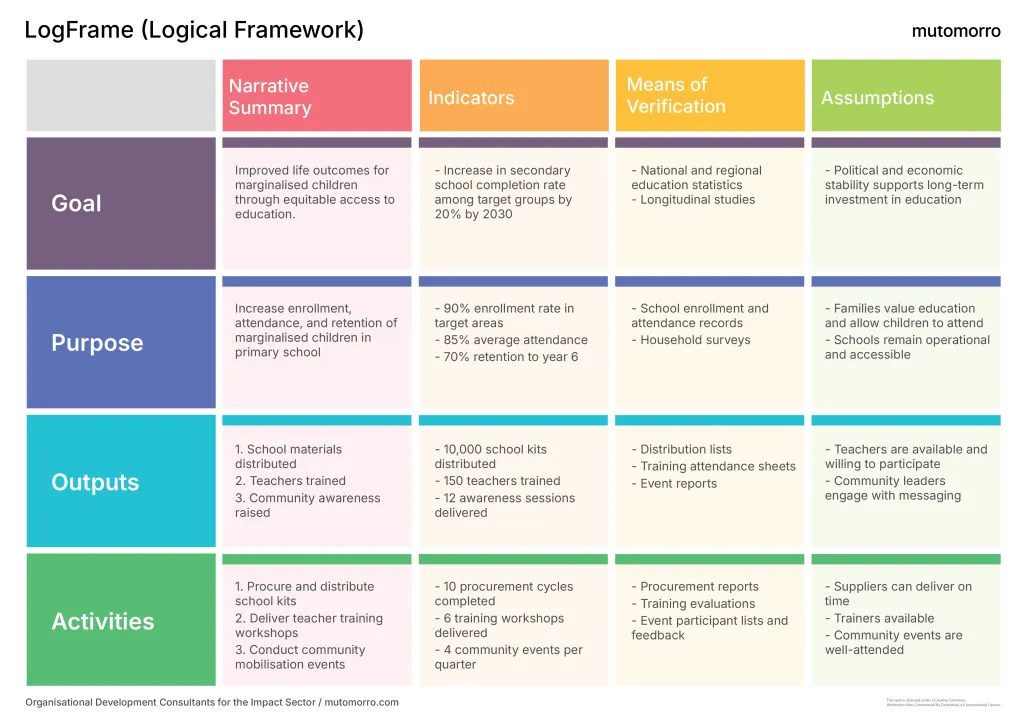
Below is an example of a LogFrame populated for a fictional nonprofit focusing on giving marginalised children access to education.
Level | Narrative Summary | Indicators | Means of Verification | Assumptions
1. Goal | Improved life outcomes for marginalised children through equitable access to education | - Increase in secondary school completion rate among target groups by 20% by 2030 | - National and regional education statistics- Longitudinal studies | - Political and economic stability supports long-term investment in education
2. Purpose | Increase enrolment, attendance, and retention of marginalised children in primary school | - 90% enrolment rate in target areas- 85% average attendance- 70% retention to year 6 | - School enrolment and attendance records- Household surveys | - Families value education and allow children to attend- Schools remain operational and accessible
3. Outputs | 1. School materials distributed2. Teachers trained3. Community awareness raised | - 10,000 school kits distributed- 150 teachers trained- 12 awareness sessions delivered | - Distribution lists- Training attendance sheets- Event reports | - Teachers are available and willing to participate- Community leaders engage with messaging
4. Activities | 1. Procure and distribute school kits2. Deliver teacher training workshops3. Conduct community mobilisation events | - 10 procurement cycles completed- 6 training workshops delivered- 4 community events per quarter | - Procurement reports- Training evaluations- Event participant lists and feedback | - Suppliers can deliver on time- Trainers available- Community events are well-attended
Key Tips for Using a LogFrame Effectively
To use a LogFrame effectively, consider the following tips:
- Engage Stakeholders: Involve stakeholders in the development process to ensure the LogFrame reflects their needs and expectations.
- Be Specific: Ensure all components are clearly defined and aligned with the project's objectives.
- Monitor Regularly: Use the LogFrame as a dynamic tool for monitoring progress and making adjustments as needed.
- Ensure Flexibility: Be prepared to adapt the LogFrame to changing circumstances and new information.
- Communicate Clearly: Use the LogFrame to communicate the project's objectives and progress to stakeholders.
Example Uses of a LogFrame for Programmes and Projects
LogFrames can be used for a wide range of programmes and projects, providing a structured approach to planning, implementation, and evaluation. Here are some examples:
- Education Projects: LogFrames can be used to plan and evaluate projects aimed at improving educational outcomes, such as increasing literacy rates or expanding access to education.
- Health Initiatives: LogFrames can guide the planning and evaluation of health initiatives, such as improving access to healthcare services or reducing disease incidence.
- Environmental Projects: LogFrames can be used to plan and evaluate environmental projects, such as reducing carbon emissions or improving water quality.
By using LogFrames in these and other contexts, you can ensure that your projects are well-planned, efficiently implemented, and effectively evaluated, maximising their impact and success.
Conclusion
Incorporating LogFrames into your project management practices can significantly enhance your ability to plan, implement, and evaluate programmes and projects. By providing a structured framework that outlines objectives, activities, and expected outcomes, LogFrames ensure that all team members and stakeholders are aligned with the project's goals.
Whether you are managing a small nonprofit initiative or a large-scale development project, LogFrames offer a valuable tool for improving planning, implementation, and evaluation processes. By understanding and applying the principles of LogFrames, you can enhance the effectiveness and impact of your projects, ensuring that they achieve their intended goals and make a measurable difference.
For a comprehensive approach to tracking what difference you're making, see our guide to building an impact measurement framework.
For a broader view of how your programme connects to your operating model, the Nonprofit Business Model Canvas maps the full picture from mission to revenue.
We share thinking on organisational change and development on LinkedIn - practical ideas for people doing this work inside their own organisations.
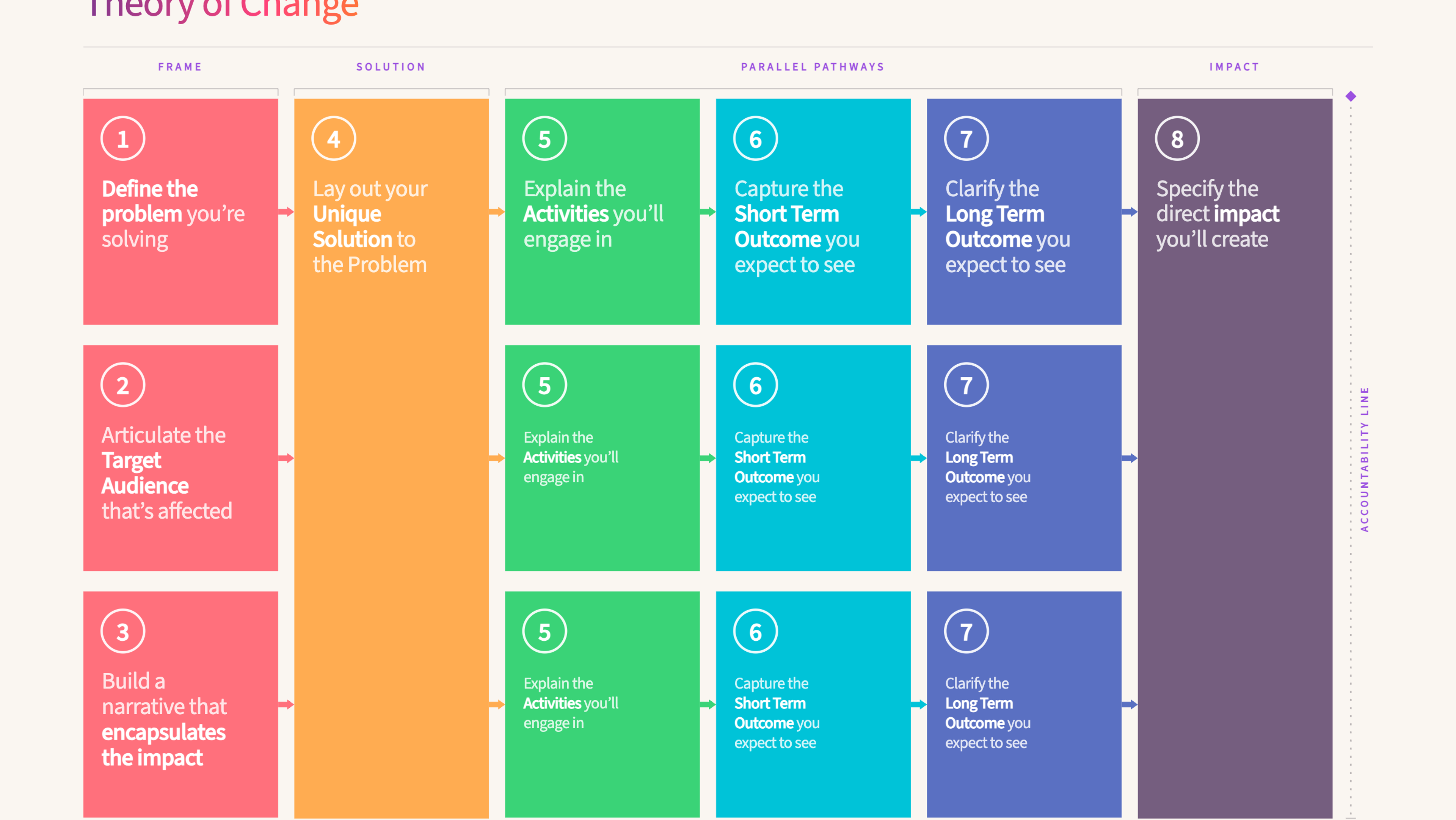
A Theory of Change is a strategic planning tool that maps out how and why you expect a desired change to happen. It connects your activities to your outcomes, showing the logical path from what you do to the impact you want to create.
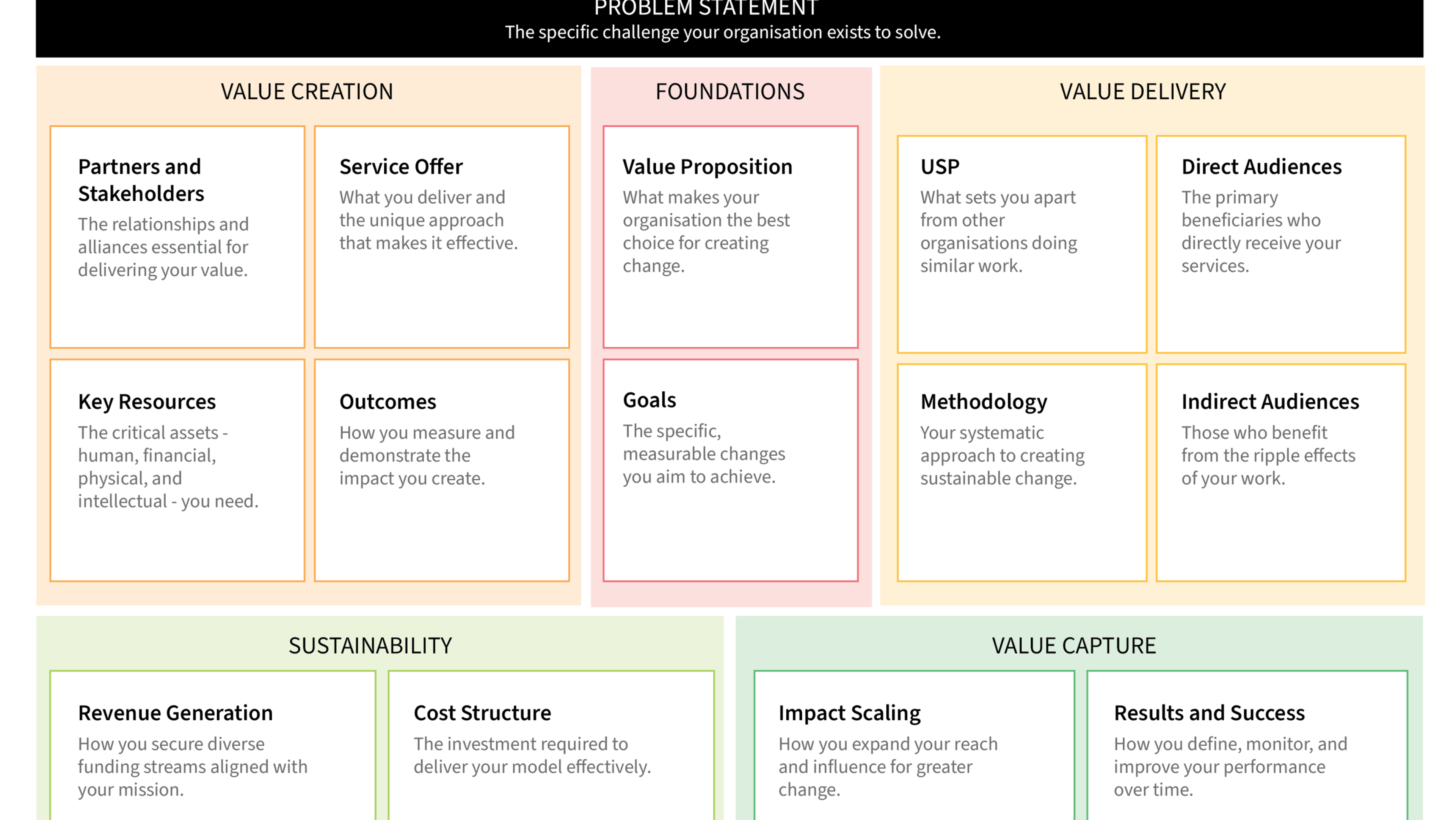
The Nonprofit Business Model Canvas is a visual planning tool that helps charities and social enterprises map out how they create, deliver, and sustain impact. It adapts the traditional business model canvas for organisations driven by mission rather than profit.

Most organisations know they should measure their impact. Fewer know how to do it in a way that's genuinely useful rather than just generating reports. This article explores how to build an impact measurement framework that helps you understand what's working, learn from what isn't, and make better decisions.

Most organisations have a stated purpose. Far fewer have one that shapes how people actually work. This article explores why purpose gets stuck at leadership level and what it takes to embed it into daily decisions, team dynamics, and organisational culture.
When you need more than the template
The free template is a good start. If you want to take the next step and map a full Theory of Change with your team - the difference you're working towards and how your work gets you there - that is what we built the Theory of Change Toolkit for - a rapid primer, assessment tools for gathering stakeholder input, a slide deck, worksheets and discussion guides, facilitator notes, and a Miro board blueprint. Everything is editable, so you can fit it to your own branding and timings.
It's a paid toolkit, on our sister site toctoolkit.org. Reduced rates are available for small nonprofits, micro-organisations and students.
Theory of Change Workshop
A LogFrame turns a theory of change into something you can plan and measure; our Theory of Change workshop is where your team learns to build both.
James Freeman-Gray is the founder of Mutomorro. He's an organisational development practitioner who has spent over twenty years working with leaders across public, private and nonprofit sectors - helping organisations pull together around a common purpose, joined up in how they work. More about who we are and what it's like to work with us.
The Logframe complements the Theory of Change beautifully - while the ToC tells the story of how change happens, the Logframe turns it into something measurable. I use it with impact-led organisations who need to demonstrate their results clearly. The discipline of defining indicators and evidence sources upfront saves enormous effort later.
Last reviewed: May 2026
Ready to use LogFrame (Logical Framework)?
Download the free template - includes practical guidance for workshops and team sessions.
Get the free template
Want to put these ideas into practice?
Whether you're navigating a merger, rethinking how you're structured, or trying to shift a culture that isn't working - underneath, it's the same job: getting the whole organisation pulling in the same direction. Start with a conversation.