Theory of Change
A Theory of Change is a strategic planning tool that maps out how and why you expect a desired change to happen. It connects your activities to your outcomes, showing the logical path from what you do to the impact you want to create.
Get the free template
A Theory of Change is a planning tool that maps how and why a change is expected to happen - connecting what an organisation does to the difference it wants to make. It sets out the logical chain from your activities, through the outcomes they produce, to the long-term impact you are aiming for. The point is to make the thinking behind a strategy explicit, so it can be shared, tested and improved rather than left as an assumption in someone's head.
Below you'll find a walkthrough of the model, a template you can fill in, a worked example, and a guide to running your own Theory of Change workshop.
What is a Theory of Change?
A Theory of Change describes the path from where you are now to the change you want to see. It works backwards from a long-term goal, then forwards again through the steps that connect your day-to-day work to that goal: the problem you're addressing, who is affected, what you'll do about it, and the chain of outcomes you expect along the way.
It grew out of the evaluation and international development fields in the 1990s, where funders and programme teams needed a clearer way to explain why an initiative should work, not just what it would deliver. That heritage is why a Theory of Change is so widely used by charities, nonprofits and purpose-led organisations - though the thinking applies to any team that wants to connect its activities to a result.
What makes it different from a simple plan is the focus on cause and effect. A plan lists what you'll do. A Theory of Change explains the reasoning that links each action to the result it's meant to produce - and surfaces the assumptions sitting underneath that reasoning, so you can check whether they hold. It is a close cousin of the LogFrame, which captures a similar logic in a more tabular, indicator-led format.
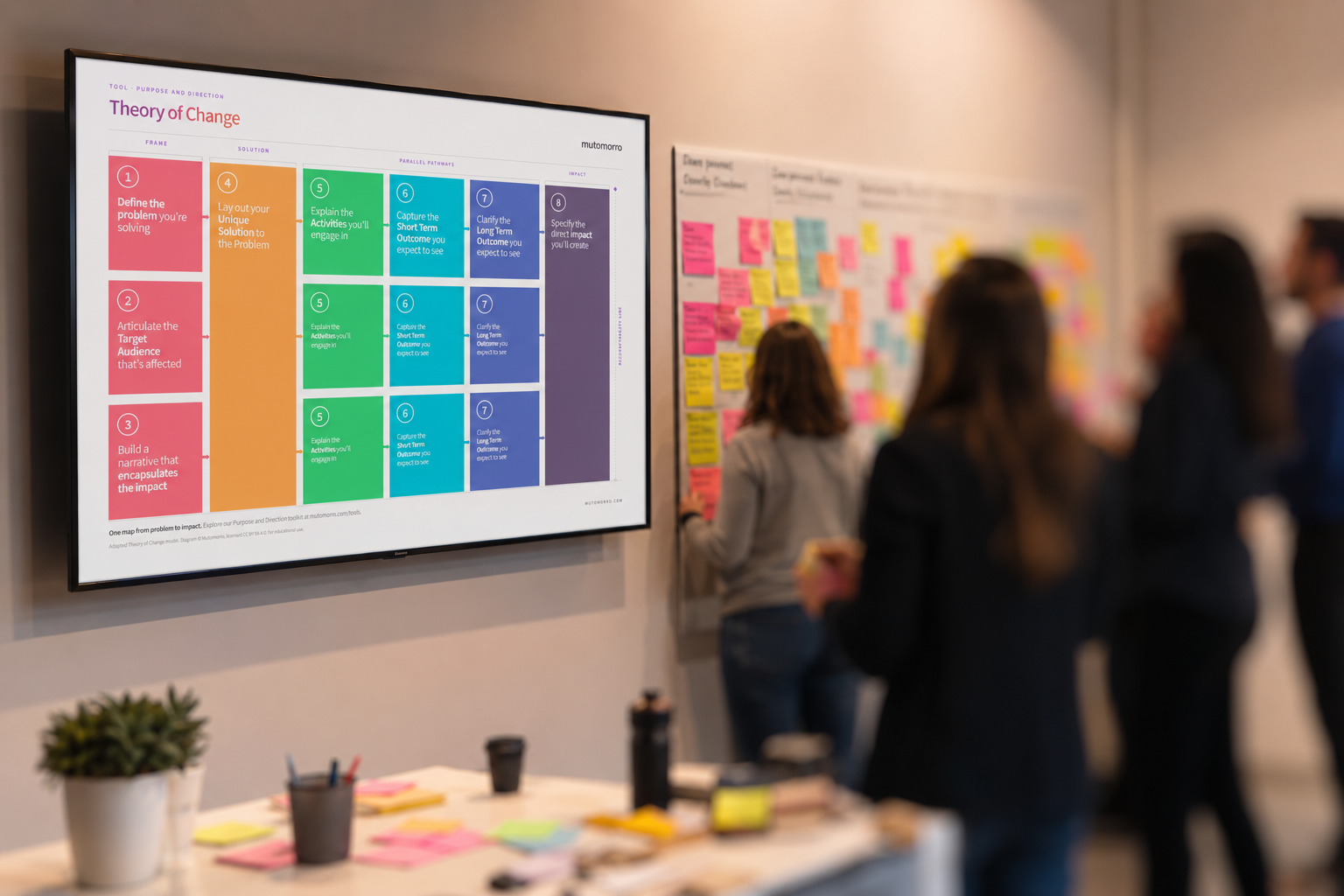
The eight elements at a glance
# | Element | The question it answers |
|---|---|---|
1 | Problem | What problem are you solving? |
2 | Target audience | Who is affected by it? |
3 | Impact on audience | How does the problem affect them? |
4 | Unique solution | What is your approach, and why this one? |
5 | Key activities | What will you actually do? |
6 | Short-term outcomes | What changes first, within months? |
7 | Long-term outcomes | What changes over years? |
8 | Direct impact | What lasting difference do you directly create? |
Elements 1 to 4 set up the why and the what. Elements 5 to 8 trace the how and the result - the causal pathway from activity to impact. The accountability line, covered further down, marks the point where your direct control ends and your influence takes over.
The eight elements of a Theory of Change
1. Define the problem you're solving
Everything else hangs off a clear problem. A strong problem statement names what is wrong, who it affects and why it matters, in language anyone could understand - without jumping ahead to your solution. The most common trap is describing the absence of your programme as the problem ("there is no after-school club") rather than the underlying issue ("children in the area have few safe places to learn after school"). Keep it specific and evidence-based, and resist the urge to solve it here. If you want to go deeper on this, the Problem Statement tool walks through it in detail.

The detail - what to include and what to avoid
Include:
- The nature of the problem - what is going wrong
- The scope - who is affected, and how widely
- The consequences of leaving it unaddressed
- Contextual factors that contribute to or worsen it
Avoid:
- Proposing solutions - those come later
- Jargon or overly technical language
- Unsupported claims or assumptions
- Being so broad it could mean almost anything
The aim is a statement specific enough to guide your work, but not so narrow it boxes you in.
2. Articulate the target audience
Next, be precise about who you're here for. Name the primary groups you aim to serve or influence, any secondary groups affected indirectly, and the characteristics that matter - who they are, where they are, and the specific needs or pressures they're living with. Vague audiences lead to vague programmes. "Young people" is a category; "16-to-18-year-olds leaving care in one city, setting up their first independent home" is an audience you can design for. An Empathy Map is a useful companion here, helping you build a richer picture of what your audience thinks, feels and needs.

The detail - what to include and what to avoid
Include:
- The primary groups you aim to serve or influence
- Any secondary groups affected indirectly by your work
- Characteristics that matter - age, location, circumstances, size of group
- The specific needs and pain points they experience
- How each group connects to the problem you've defined
Avoid:
- Audiences not directly tied to your mission
- Overly broad or vague descriptions
- Assumptions about people without supporting evidence
A note on terminology: service users, clients, beneficiaries, customers - sectors differ. Pick the term your audience already uses and stick with it.
3. Build a narrative that captures the impact
This element captures the impact of the problem on your audience - the human reality of it, brought into the Theory of Change. Having named the problem (element 1) and who it affects (element 2), here you show how that problem actually lands in people's lives: what they experience, and what it costs them. It matters for a structural reason as well as a human one. The harm you describe here is exactly what your direct impact at the end (element 8) is meant to answer - so capturing it well now creates a clear line between the problem and the difference you set out to make.

The detail - what to include and what to avoid
Include:
- The direct effects of the problem on your audience
- Any indirect or knock-on effects
- How it lands differently for different subgroups
- The scale and severity - with data where you have it
- A human example or two that bring it to life
Avoid:
- Effects not directly tied to the problem you named
- Speculative or unevidenced claims
- Technical language that hides the human story
Statistics earn attention; a well-told story earns memory. The strongest narratives use both.
4. Lay out your unique solution
Now your approach: what you'll do about the problem, and why this way rather than another. The clearest way to think about this element is as your value proposition - a plain statement of the value you offer, who you offer it to, and why your approach is worth choosing over the alternatives. Most problems could be tackled several ways; naming your unique solution forces the choice and pins down what you bring that others in the same space don't. Keep it to the approach and the value it carries - the specific activities come next.

The detail - what to include and what to avoid
Include:
- Your specific approach to addressing the problem
- The principles, evidence or theory it rests on
- How it differs from, or complements, what others do
- The "why us" - what you bring that's distinctive
Avoid:
- Jumping into a list of activities (that's the next element)
- Claiming distinctiveness you can't back up
- An approach that doesn't trace back to the problem
If your solution builds on what already works rather than fixing what's broken, the 5D's of Appreciative Inquiry offers a structured way to frame that asset-based approach.
5. Explain the key activities
These are the concrete things you'll do - the work itself. Run workshops, provide one-to-one support, distribute resources, train volunteers, campaign. Good activities are specific enough that someone could put them in a diary, and each one should trace back to the solution it serves. The common failure here is a wish-list of everything you could do; a Theory of Change asks you to name the activities that drive the outcomes you're after, and leave the rest out.

The detail - what to include and what to avoid
Include:
- The main programmes or services you'll provide
- Briefly, how each one will be delivered
- Who each activity is for, if they differ
- The expected output of each - people served, sessions run
Avoid:
- Activities that don't contribute to your solution or outcomes
- A wish-list beyond your real capacity
- Fine-grained operational detail (that belongs in other documents)
- Vague, poorly-defined activities
A few well-resourced activities usually achieve more than many thinly-spread ones. A simple format per activity keeps it clear - Activity / For whom / Method / Output.
6. Capture the short-term outcomes
Here the Theory of Change makes a distinction that trips up a great many of them: the difference between an output and an outcome. An output is what you produced - twelve workshops run, fifty people served. An outcome is what changed as a result - people more confident, a behaviour shifted, a skill gained. Counting outputs is easy and tempting; outcomes are harder to capture, and they're the truer measure of whether your work mattered. Short-term outcomes are the early changes you'd expect within months - new knowledge, first behaviours, initial take-up. Wherever you can, decide now how you'll measure each one. (The same output-versus-outcome discipline applies to the long-term outcomes that follow.)

The detail - what to include and what to avoid
Include:
- Clear, measurable statements of expected change
- The link between each outcome and its activity
- Realistic timeframes - weeks to months
- An indicator you'll use to measure each one
Avoid:
- Outcomes not directly tied to your activities
- Long-term changes dressed up as short-term
- Anything vague or unmeasurable
- Changes well outside your sphere of influence
Measuring it: set an indicator and a baseline before you start, use surveys, interviews, observation or simple tracking, set realistic targets, and review the data regularly. A small table - Activity / Outcome / Indicator / Timeframe - keeps it legible.
7. Clarify the long-term outcomes
Long-term outcomes are the deeper, more durable changes that build on the short-term ones over a longer horizon - often a year or more. They sit further from your direct control, because more of the wider world has a hand in them by this point. Each long-term outcome should connect logically to the short-term outcomes feeding it: this is the spine of the causal chain, where you show why the early changes should accumulate into something lasting.

The detail - what to include and what to avoid
Include:
- The lasting changes you expect, in measurable terms
- The logical progression from short-term to long-term
- Realistic timeframes - often years
- Any external assumptions that bear on them
Avoid:
- Outcomes not logically linked to your short-term ones
- Over-ambitious or unrealistic goals (and mission creep)
- Outcomes entirely dependent on factors you don't control
Measuring it: longer horizons call for longitudinal data and a mix of quantitative and qualitative methods. External evaluators or research partners help with rigour, and it's worth revisiting the measures as your understanding grows.
8. Specify the direct impact
Impact is the lasting difference your work creates - and the key word is direct. This is the change you can genuinely claim: the one that falls within your control and influence. The accountability line is what makes it precise - wider systemic change sits above the line, something you contribute to but don't command, while your direct impact sits at or below it. In complex settings it's tempting to reach for the grand, system-wide difference here; resist that. Keep this element to the impact you directly create. Indirect and systemic effects are worth exploring, but as a separate, wider piece of work - not lumped in here. Framing it this way keeps every element honest: if an activity or outcome doesn't trace up to your direct impact, it's worth asking why it's in the plan.

The detail - what to include and what to avoid
Include:
- The direct change you create and can genuinely claim
- A clear line from this impact back through your outcomes and activities
Avoid:
- Lofty, system-wide aspirations you can't connect to your work
- Claiming sole credit for change that depends on many hands
- Lumping wider, indirect impact in here - explore that separately
A useful test: would this impact still be felt if your organisation didn't exist? If the honest answer is no, you've found something you can genuinely claim.
What is the accountability line?
The accountability line is the point in your Theory of Change where your direct control ends and your influence begins. Your activities, outputs and the outcomes closest to them sit below the line - things you deliver and can be held to account for, including the direct impact you set out to create. Wider, system-level change sits above it: shaped by your work, but also by funders, partners, policy and circumstances you don't command. This is why element 8 is framed as direct impact - it keeps your Theory of Change to what's genuinely yours to claim, and leaves the broader systemic shifts as a separate, wider exploration.
Drawing the line matters for two reasons. It sets fair expectations: you can promise to deliver the activities and influence the outcomes, but you can't guarantee impact single-handedly. And it sharpens measurement - you measure what you control directly, and track (rather than claim sole credit for) what sits above the line. Being honest about where the line falls is one of the things that earns trust with funders.
Documenting your assumptions
Every Theory of Change rests on assumptions - the beliefs about how the world works that connect one element to the next. "If we train volunteers well, they'll stay and deliver consistently." "If young people gain this skill, employers will value it." These links feel obvious until they don't hold, and an untested assumption is where strategies quietly fail.
The remedy is simple: write them down. For each connection in your chain, note what has to be true for it to work, and how confident you are. Some assumptions will be safe; others are real risks worth monitoring. Surfacing them turns your Theory of Change from a tidy diagram into a working hypothesis you can test and refine. Looking at the deeper structures and mental models underneath your assumptions is exactly what the Iceberg Model is built for.
How to build a Theory of Change
You can fill in the eight-element template in a single focused session, but the thinking usually benefits from a few passes. A reliable sequence:
- Start at the end. Agree your direct impact first, then work backwards. It's easier to reason about what leads to a goal than to guess where a pile of activities might end up.
- Map the outcomes chain. Between your activities and your impact, lay out the short-term and long-term outcomes, and check each link: why would this lead to that?
- Add the activities. Only now bring in the work itself, attaching each activity to the outcome it serves. Drop anything that doesn't connect.
- Surface the assumptions. Walk the chain and name what has to be true at each step. Flag the risky ones.
- Pressure-test it. Read it as a sceptical funder would. Where's the weakest link? What evidence backs the boldest claim?
- Treat it as living. Revisit it as you learn. A Theory of Change is a hypothesis, not a monument - it should change as your evidence does.
A well-built Theory of Change is one of the clearest ways of embedding organisational purpose - it connects everyday work to the bigger picture of why you exist, which is also the heart of our Strategic Alignment work and the Embedded Strategy dimension of how organisations stay coherent as they grow.
Running a Theory of Change workshop
A Theory of Change is far stronger when it's built with the people who'll deliver it, rather than written alone and handed down. A half-day workshop is usually enough for a first draft. If you'd like a guided walk-through of facilitating one, our Building a Theory of Change workshop takes you through the whole process.
Before the day. Invite a mix - frontline staff, leadership, and if you can, someone who represents the people you serve. Send round the eight elements in advance so nobody arrives cold. Have plenty of wall space or a shared digital board: a Theory of Change wants to be seen whole.
Run it backwards. Open by agreeing the direct impact, then work back through long-term and short-term outcomes before touching activities. Doing it in reverse keeps the room focused on change rather than on defending existing programmes. Use sticky notes (physical or digital) so ideas can be moved, grouped and argued with.
Mind the gaps. As the chain takes shape, push on the joins: does each outcome really follow from the one before it? When the group hesitates, you've usually found an assumption - capture it rather than papering over it. A strengths-based opener like the 5D's of Appreciative Inquiry can help a group start from what's working before they problem-solve.
Close with ownership. End by agreeing who holds which part, what you'll measure, and when you'll revisit the whole thing. A Theory of Change that lives on a shared wall and gets updated beats a polished one filed away.
A worked example: a river restoration charity
Imagine a small charity working to bring a polluted local river back to life. Here's how the eight elements come together for them - a filled-in template you can use as a model for your own.
Element | The charity's Theory of Change |
|---|---|
1. Problem | A once-healthy river is degraded by agricultural run-off and storm sewage. Fish and insect life are declining, and the community has lost its connection to the water. |
2. Target audience | Residents and visitors who once used the river, anglers and wild swimmers, the farmers whose land borders it, the local authority, and the river ecosystem itself. |
3. Impact on audience | People can no longer swim or fish safely, children are kept away from the water, and the community has lost a place it valued. |
4. Unique solution | Combine volunteer citizen-science monitoring, practical advice for riverside farms, and community clean-up days - rather than relying on campaigning or engineering works alone. |
5. Key activities | Monthly water-quality testing by trained volunteers; advisory visits to riverside farms; quarterly clean-up events; a public dashboard of the results. |
6. Short-term outcomes | A reliable baseline of water-quality data; several farms adopting buffer strips; a growing, trained volunteer base; local press coverage. |
7. Long-term outcomes | A measurable fall in pollutant levels; the return of indicator species such as mayfly and trout; the local authority committing to tougher monitoring. |
8. Direct impact | Measurably cleaner water and a community that actively protects its river - the charity's direct contribution to a waterway that can become swimmable again. |
Read top to bottom, the logic holds: clean-up days and farm advice (activities) produce cleaner water and engaged volunteers (short-term outcomes), which over years allow wildlife to return and policy to tighten (long-term outcomes). The charity's direct impact is the cleaner water and the active, engaged community it creates; a fully restored, swimmable river is the wider change it contributes to - shared with farmers, the local authority and time. That split is exactly what the accountability line marks: the testing and clean-ups the charity can guarantee, set against the return of the trout it can influence but not promise.
When is a Theory of Change not the right tool?
A Theory of Change is powerful, but it has limits worth knowing.
- It can imply more certainty than exists. A neat chain of arrows can make complex, messy change look more predictable than it is. The assumptions layer is your guard against this - use it.
- It's a model, not reality. Real change rarely moves in a clean line; feedback loops, setbacks and surprises are normal. Hold the diagram lightly.
- It can become a one-off artefact. Built once for a funding bid and never revisited, it adds little. Its value comes from being used and updated.
- It isn't built for fast, uncertain problems. Where the path genuinely can't be mapped in advance, more adaptive approaches may suit better. For organisational change specifically, a model like Kotter's 8 Step Change Model addresses the how of leading change, which a Theory of Change deliberately leaves open.
Build your own Theory of Change
If you are ready to build your own, the free Theory of Change template puts the whole model on one printable page - the eight elements laid out left to right, the accountability line marking where your control ends, and a simplified second view for sharing the logic at a glance.
It pairs with the walkthrough above and the workshop format described earlier - work backwards from your direct impact, be strict about the difference between outputs and outcomes, and treat the finished sheet as a living hypothesis to test and update.
Download the Theory of Change template (PDF)
That template is the free starting point. When you need to run the whole process with a team, and would rather have the facilitation materials than build them yourself, the Theory of Change Toolkit is the paid, complete version - a rapid primer, assessment tools for gathering stakeholder input, a slide deck, worksheets and discussion guides, facilitator notes, and a Miro board blueprint. All editable, so you can fit them to your own branding and timings.
Getting started
The simplest way to begin is to write your direct impact at the top of a blank page and ask: what would have to be true, step by step, for that to happen? Work backwards through outcomes to activities, and don't worry about getting it perfect - a rough first draft you can argue with beats a blank page. Download the template below to map it out, gather a few colleagues, and give yourself an hour to sketch the chain. You can refine it from there.
Sources and further reading
- theoryofchange.org - the Center for Theory of Change, on the origins and core method
- UNDG Theory of Change companion piece - guidance from the development sector where the method took shape
We share thinking on organisational change and development on LinkedIn - practical ideas for people doing this work inside their own organisations.
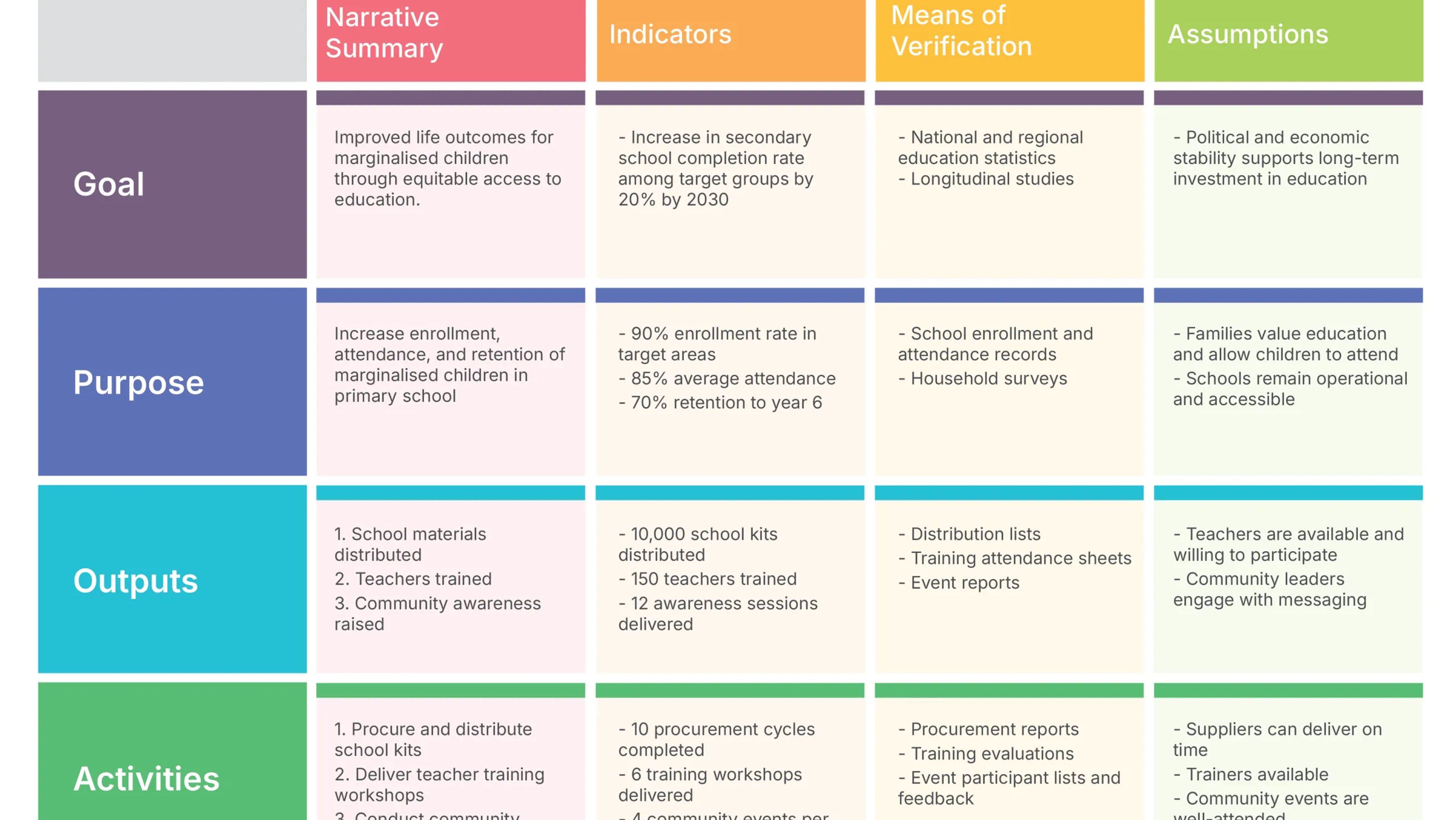
A LogFrame is a structured planning and evaluation tool that helps organisations set clear goals, define how they'll measure progress, and track what's actually being achieved. It's widely used in the nonprofit sector for programme management and impact reporting.
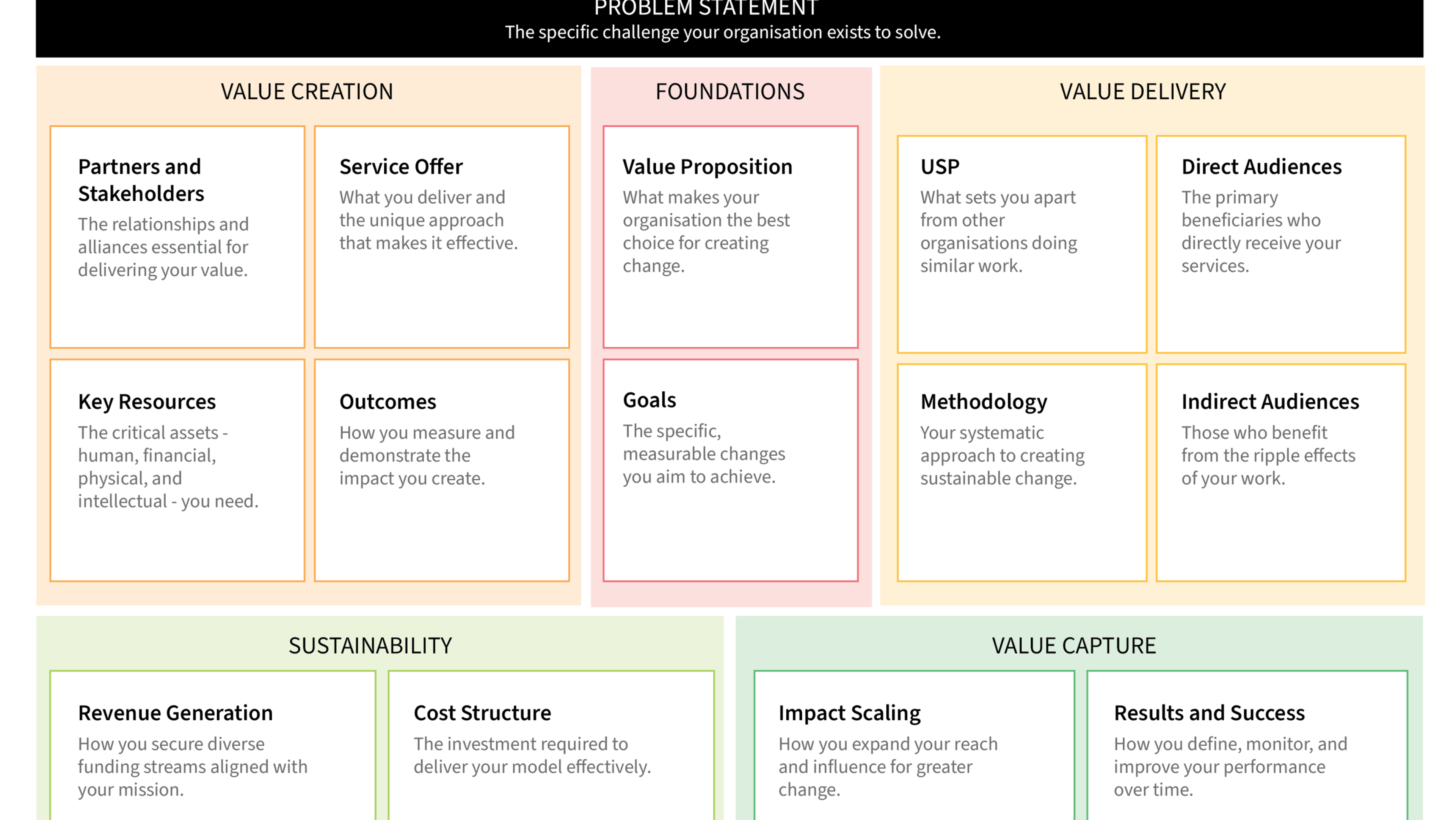
The Nonprofit Business Model Canvas is a visual planning tool that helps charities and social enterprises map out how they create, deliver, and sustain impact. It adapts the traditional business model canvas for organisations driven by mission rather than profit.
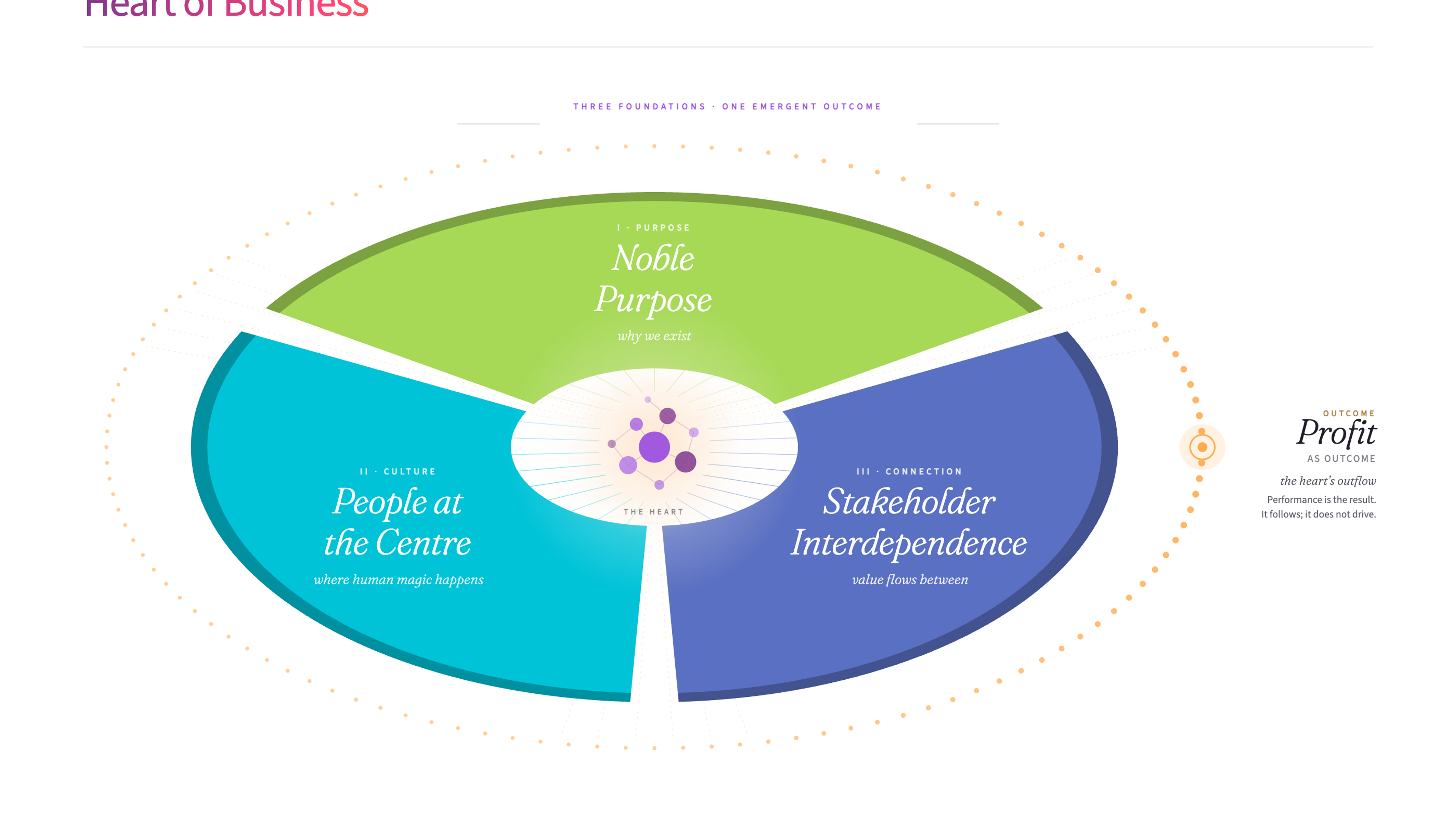
Hubert Joly's Heart of Business model identifies four pillars - noble purpose, people at the centre, stakeholder interdependence, and profit as outcome - that converge to create a purpose-driven organisation where financial performance follows from getting the foundations right.

Most organisations know they should measure their impact. Fewer know how to do it in a way that's genuinely useful rather than just generating reports. This article explores how to build an impact measurement framework that helps you understand what's working, learn from what isn't, and make better decisions.

Most organisations have a stated purpose. Far fewer have one that shapes how people actually work. This article explores why purpose gets stuck at leadership level and what it takes to embed it into daily decisions, team dynamics, and organisational culture.

The real business case for organisational purpose isn't about inspiration - it's about what happens when everyone in the organisation understands why the work matters and can use that understanding to make better decisions, every day.
When you need more than the template
The free template is a good start. If you want to take the next step and map a full Theory of Change with your team - the difference you're working towards and how your work gets you there - that is what we built the Theory of Change Toolkit for - a rapid primer, assessment tools for gathering stakeholder input, a slide deck, worksheets and discussion guides, facilitator notes, and a Miro board blueprint. Everything is editable, so you can fit it to your own branding and timings.
It's a paid toolkit, on our sister site toctoolkit.org. Reduced rates are available for small nonprofits, micro-organisations and students.
Theory of Change Workshop
A facilitated workshop that takes your team through building a Theory of Change, step by step, with us alongside.
James Freeman-Gray is the founder of Mutomorro. He's an organisational development practitioner who has spent over twenty years working with leaders across public, private and nonprofit sectors - helping organisations pull together around a common purpose, joined up in how they work. More about who we are and what it's like to work with us.
Theory of Change is probably the tool I've delivered the most workshops on. What I love about it is that it forces people to articulate their assumptions about how change actually happens - and those assumptions are almost always the thing nobody has made explicit. Building a Theory of Change as a team is one of the better alignment-building exercises I know.
Last reviewed: June 2026
Ready to use Theory of Change?
Download the free template - includes practical guidance for workshops and team sessions.
Get the free template
Want to put these ideas into practice?
Whether you're navigating a merger, rethinking how you're structured, or trying to shift a culture that isn't working - underneath, it's the same job: getting the whole organisation pulling in the same direction. Start with a conversation.