Nonprofit Business Model Canvas
The Nonprofit Business Model Canvas is a visual planning tool that helps charities and social enterprises map out how they create, deliver, and sustain impact. It adapts the traditional business model canvas for organisations driven by mission rather than profit.
Get the free template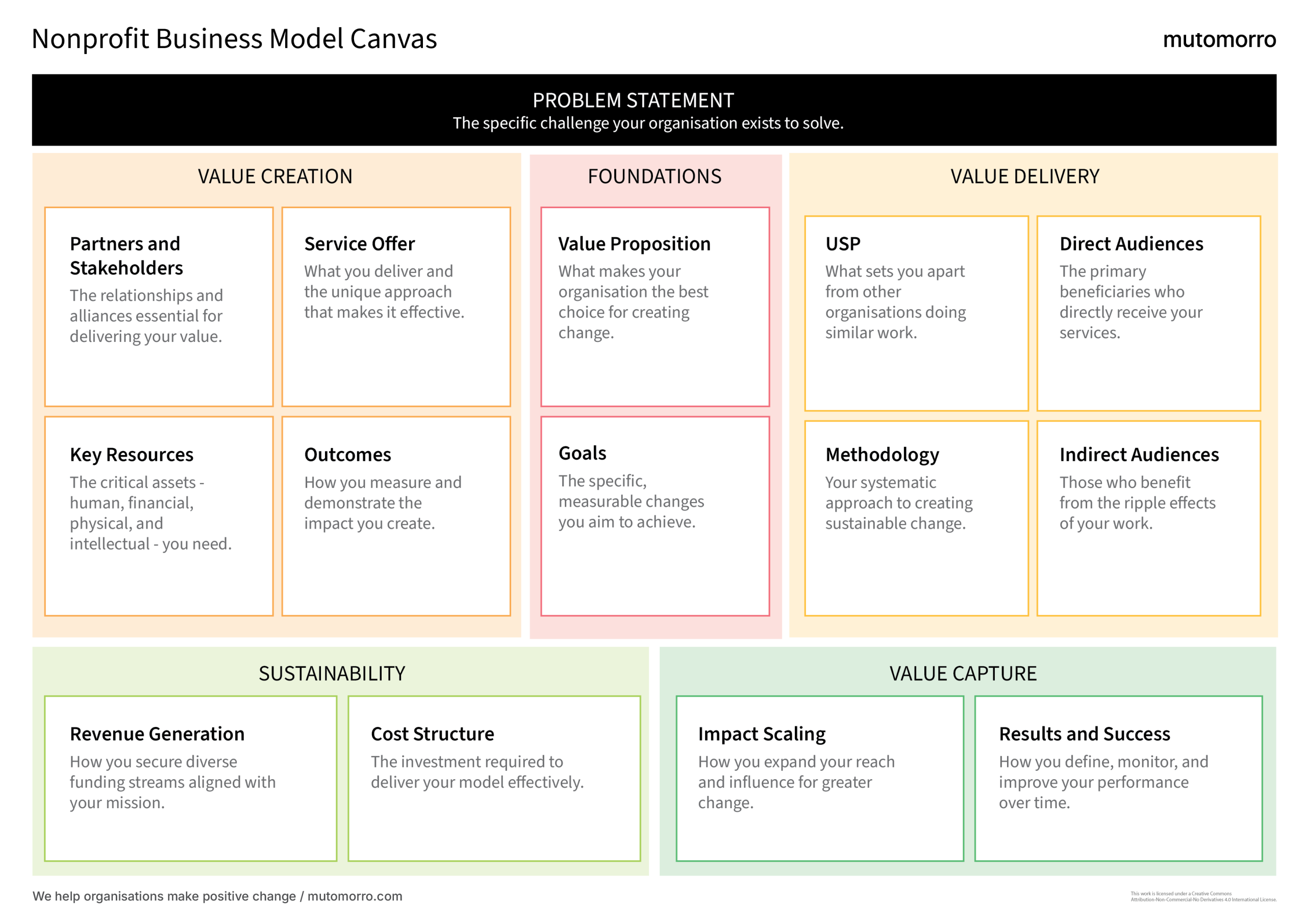
The nonprofit sector's scale and complexity is significant. With 1.8 million charities operating in the US alone and 10 million worldwide, organisations face intense competition for attention, resources, and impact. Despite the sector's impressive scale - with a global turnover exceeding $1 trillion by 1999, equivalent to the eighth largest economy - it remains poorly understood in mainstream business literature.
This creates a fundamental challenge: how can nonprofit organisations operate as effectively as possible when they lack clear frameworks for understanding their own business models? Without systematic approaches to thinking through value creation, delivery, and sustainability, even well-intentioned organisations risk inefficiency, mission drift, and ultimately, reduced impact on the communities they serve.
The business model canvas offers nonprofits a structured way to think strategically about their work, providing clarity on how they create value, for whom, and how they sustain that work over time.
If your organisation already uses the POLISM Canvas for operational modelling, the nonprofit business model canvas complements it by focusing specifically on the relationship between mission, value creation, and financial sustainability.
What is a business model canvas and why does it matter for nonprofits?
Originally developed by Alexander Osterwalder and Yves Pigneur, the business model canvas is a visual framework that allows organisations to describe, design, challenge, and pivot their business model in a single-page format. Think of it as a strategic blueprint that captures the essence of how your organisation creates, delivers, and captures value.
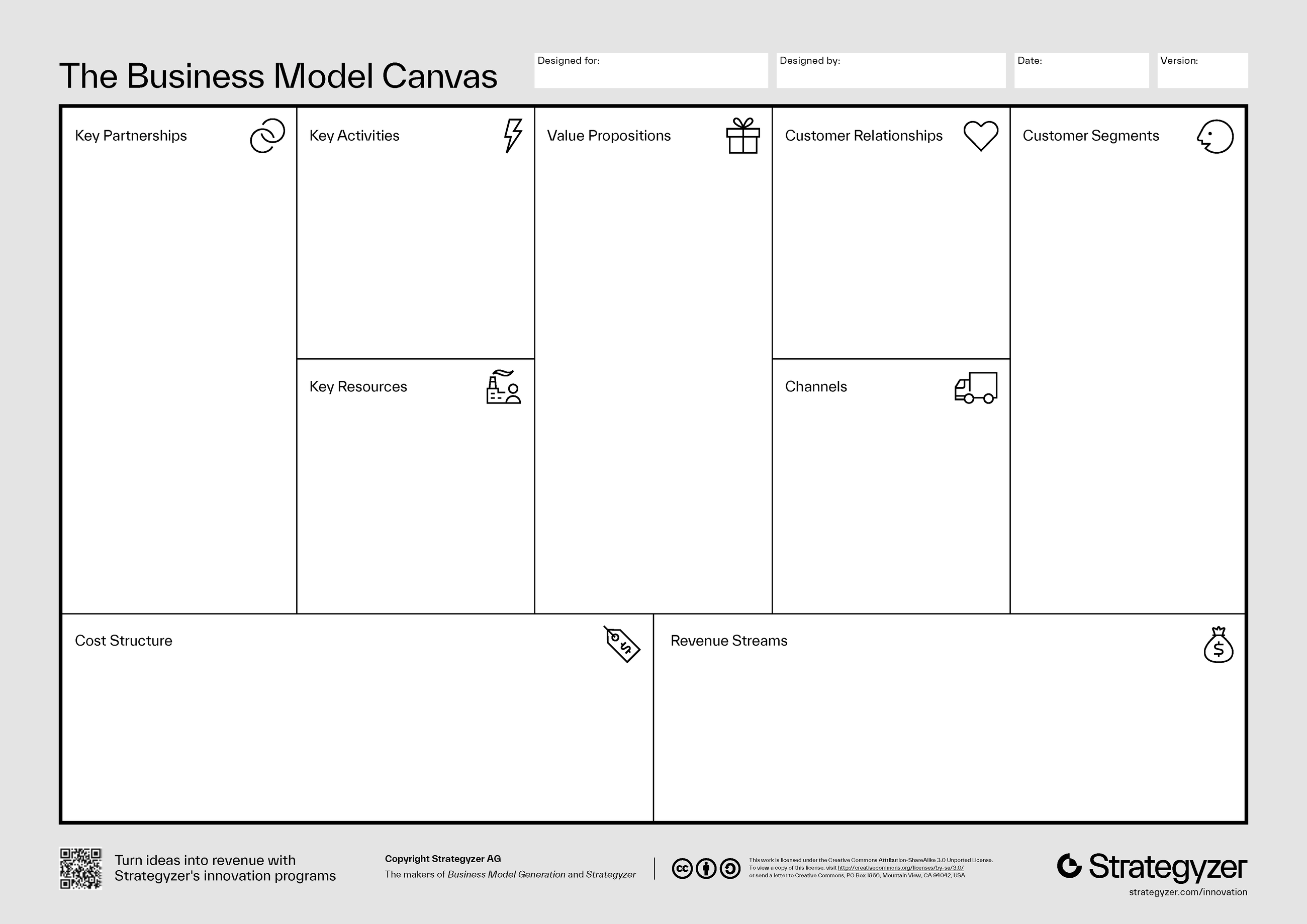
But here's where it gets interesting for nonprofits: traditional business model thinking doesn't quite fit the unique challenges of social impact organisations. As research from the Open University demonstrates, nonprofits operate in a distinctly different landscape where value creation serves beneficiaries whilst funding comes from entirely different stakeholders - donors, foundations, and governments.
Paula Gil Baizan's work on humanitarian innovation business models recognised this fundamental difference and began adapting the canvas for social sector realities. Building on this foundation, our enhanced model addresses six critical areas that nonprofit leaders must navigate to build sustainable, impactful organisations.
Why traditional business planning falls short for nonprofits
The conventional business plan - that hefty document gathering dust on countless office shelves - simply doesn't work for most nonprofits. Social Impact Architects found that organisations are moving away from traditional business plans due to cost, time investment, and the chicken-and-egg scenario nonprofits face: needing capital to develop plans that secure capital.
The canvas approach offers something different: a lightweight, visual tool that allows organisations to test new ideas early using criteria unique to the social sector, such as community need and sustainable revenue streams. More importantly, it forces nonprofit leaders to acknowledge the critical tension between impact and revenue - both must be viable for the organisation to succeed.
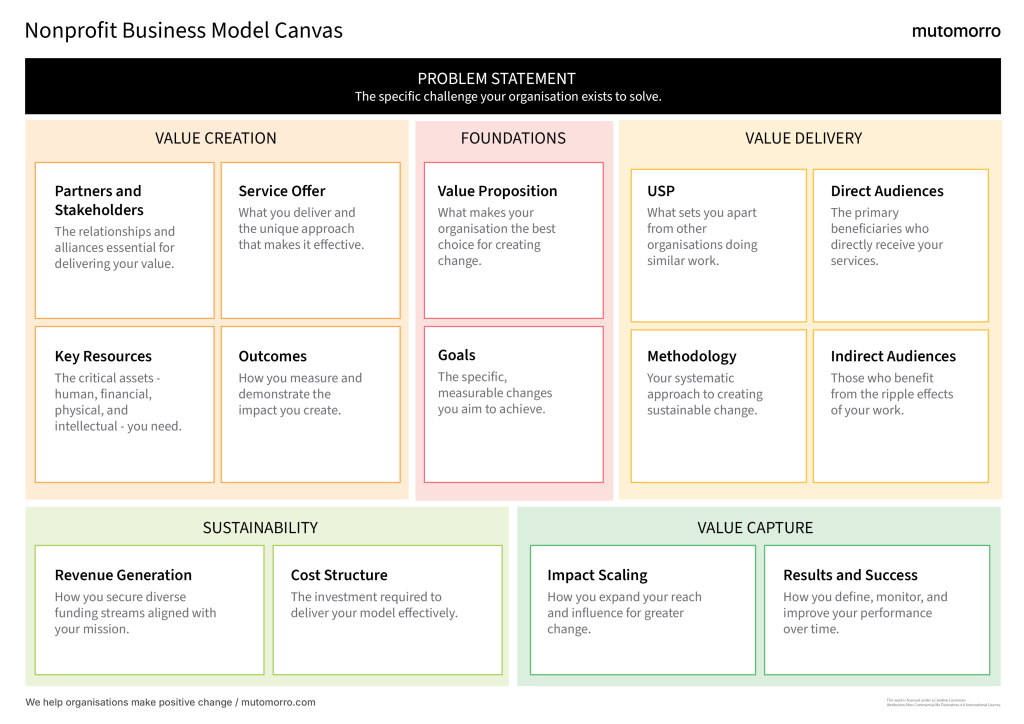
The six pillars of the nonprofit business model canvas
Our nonprofit business model canvas organises strategic thinking into six interconnected areas, each building upon the others to create a comprehensive view of your organisation's potential and sustainability.
1. Problem Statement: The specific challenge your organisation exists to solve.
2. Foundations: How you're uniquely positioned to address this problem.
A Theory of Change can strengthen your canvas by mapping the logic that connects your activities to the impact you're aiming to achieve.
The Heart of Business model explores the same territory from a different angle, focusing on how purpose sits at the centre of everything an organisation does.
3. Value Creation: How you create value in a unique and impactful way.
4. Value Delivery: How you deliver that value effectively to those who need it.
5. Sustainability: How you generate revenue and structure costs for long-term viability.
6. Value Capture: How you capture value and scale your impact for maximum benefit.
1. Problem statement: The foundation of purpose
Before diving into solutions, partnerships, or funding strategies, successful nonprofits start with a clear understanding of the problem they exist to solve. This isn't about what you think the problem is - it's about what research, community voices, and evidence tells you about the challenge at hand. The problem statement is the foundation of your nonprofit business model canvas.
Key questions to explore:
- What specific problem does your organisation exist to address?
- How do you know this problem exists and matters to the communities you serve?
- What evidence supports the urgency and scale of this challenge?
- How does this problem manifest differently across different populations or contexts?
Practical tip: Resist the urge to define problems in terms of what your organisation doesn't do for people ("lacks access to our services"). Instead, frame problems from the community's perspective. For example, rather than "youth lack access to mentoring programmes," consider "young people in our community struggle to envision pathways to economic mobility due to limited exposure to diverse career models and professional networks."
This foundational clarity becomes your north star, ensuring every other element of your canvas connects back to genuine community need rather than organisational assumptions.
A PESTLE Analysis can help map the external political, economic, social, and technological factors shaping the problem your organisation exists to address.
2. Foundations: Your unique role in the solution
Next up on the nonprofit business model canvas is purpose and goals. With your problem statement established, this section explores how your organisation is uniquely positioned to address the challenge. This is where many nonprofits either soar or stumble - the difference lies in honest self-assessment and strategic positioning.
Value proposition: What makes you different
Your value proposition answers a fundamental question every stakeholder asks: "Why should I support, partner with, or engage this organisation rather than others?" Research shows that effective nonprofit value propositions must appeal to funders and supporters, demonstrate clarity, show exclusivity, and establish credibility.
Crafting your value proposition:
Start with your ideal supporter's perspective. As fundraising experts note, defining your organisation's unique value proposition starts with understanding the "why" behind people's giving. What impact do they want to make? What characteristics do your most committed supporters share?
Consider Feeding America's clear value proposition: "Every dollar you give can provide at least 10 meals to families in need through the Feeding America network of food banks." This simple statement makes it easy for donors to understand exactly what their contribution accomplishes.
Organisational goals: what you aim to achieve
Your goals should flow naturally from your value proposition whilst being specific enough to measure progress. The most effective nonprofits focus on outcomes rather than outputs, shifting from "how many people we served" to "what measurable change occurred in people's lives."
Framework for goal setting:
- Short-term outcomes (6-18 months): What immediate changes will you create?
- Medium-term outcomes (1-3 years): What sustained changes will you achieve?
- Long-term impact (3+ years): What fundamental shifts will your work contribute to?
The power of Theory of Change:
Developing a robust Theory of Change can be invaluable in defining your outcomes and goals more fully. A Theory of Change maps out the logical connections between your activities and your intended long-term goals, helping you understand not just what you want to achieve, but how you believe change actually happens.
Your Theory of Change should articulate:
- Assumptions: What beliefs about change underpin your approach?
- Causal pathways: How do your activities lead to intermediate outcomes, and how do those lead to ultimate impact?
- External factors: What conditions must exist for your theory to work?
- Evidence base: What research or experience supports your theory of how change occurs?
This strategic thinking tool helps ensure your goals aren't just aspirational statements, but reflect a clear understanding of how transformation actually occurs in the communities you serve.
3. Value creation: Building the engine of change
This section of the nonprofit business model canvas focuses on how you'll actually create the value promised in your proposition. It's the operational heart of your model, encompassing partnerships, service design, resources, and measurement.
Partners and stakeholders: Your ecosystem of change
Successful nonprofits recognise they can't work in isolation. Academic research on NGO business models emphasises that key partnerships form a critical component of sustainable operations.
Mapping your partnership ecosystem:
Essential partners: Who must you work with to deliver your core services? Strategic allies: Which organisations share your goals and could amplify your impact? Resource providers: Beyond funders, who provides in-kind support, expertise, or platforms? Community connectors: Which trusted voices help you reach and serve your target populations?
Example in practice: A youth employment nonprofit might partner with local businesses (for job placements), community colleges (for skills training), social services agencies (for wraparound support), and resident councils (for community trust and recruitment).
Service offer: What you deliver and how
Your service offer goes beyond a simple programme description and is an important component in any nonprofit business model canvas. It encompasses your unique approach, methodology, and what makes your intervention special. The most effective nonprofits ground their service design in deep understanding of user needs rather than organisational assumptions about what people need.
Human-centred service design:
Effective services are built on design thinking principles that prioritise the experiences, needs, and constraints of the people you're trying to serve. This human-centred approach moves beyond asking "What services can we provide?" to exploring "What do people actually need, and how do they want to receive it?"
Design thinking for nonprofits involves:
- Empathy research: Spending meaningful time with your intended beneficiaries to understand their lived experiences, not just their apparent needs
- Journey mapping: Understanding the full experience someone has when trying to access and benefit from your services
- Co-design: Involving service users in designing solutions, recognising they're experts in their own experiences
- Rapid prototyping: Testing service concepts quickly and cheaply before full implementation
- Iterative improvement: Continuously refining services based on user feedback and outcomes data
Key elements to define:
- Core services: What do you directly provide to beneficiaries?
- User experience: How do people discover, access, and engage with your services?
- Unique methodology: What approach or framework guides your work?
- Quality differentiators: What makes your services more effective than alternatives?
- Accessibility features: How do you ensure your services reach intended populations?
- Feedback loops: How do you continuously learn from and adapt to user experiences?
Example in practice: Rather than assuming homeless individuals need only shelter, a human-centred approach might reveal they also need secure storage for belongings, access to mental health support, help navigating bureaucratic systems, and opportunities to maintain dignity and autonomy. Services designed with these insights are far more likely to achieve lasting impact.
An Empathy Map is a practical starting point for this kind of human-centred thinking - it helps teams build a shared picture of what your service users think, feel, and experience.
Key resources: The assets that make it possible
Understanding your key resources goes far beyond creating a budget or staffing plan. For nonprofits, resource mapping is a strategic exercise that reveals dependencies, vulnerabilities, and opportunities that can make or break your impact. Unlike for-profit organisations that can often acquire resources through market mechanisms, nonprofits must be more creative and intentional about how they secure, develop, and deploy the assets they need. Within a nonprofit business model canvas you're trying to establish the core components you'll need to deliver on your goals.
The challenge is that many nonprofits operate with resource scarcity as a given, leading to reactive rather than strategic thinking about what they truly need to succeed. By systematically examining your resource requirements, you can identify gaps that might limit your effectiveness, opportunities to leverage resources more efficiently, and partnerships that could strengthen your capacity.
Research identifies several critical resource categories that nonprofits require: human resources, financial resources, physical assets, and intellectual property.
Human resources: What skills, expertise, and capacity do you need? Consider both paid staff and volunteers, board expertise, and contracted specialists.
Financial resources: Beyond obvious funding needs, consider working capital requirements, reserve funds, and diverse revenue streams for sustainability.
Physical and technological assets: What infrastructure, technology platforms, or equipment enables your work?
Intellectual assets: What proprietary knowledge, methodologies, or community relationships give you a competitive advantage?
Outcomes: Measuring what matters
The conversation around nonprofit measurement has fundamentally shifted in recent years, and this nonprofit business model canvas takes that into account. Where organisations once focused primarily on counting activities - how many people attended workshops, how many meals were served, how many hours of service were provided - there's now recognition that these outputs tell us very little about whether lives are actually improving.
Impact measurement has become critical for nonprofits, with organisations that can demonstrate tangible results more likely to attract resources and talent. But the real power of outcomes measurement isn't just external - it's about learning. Organisations that measure to learn often find they're able to have more impact, adapt their programmes to changing circumstances faster, and make better resource allocation decisions.
Yet many nonprofits struggle with measurement, often collecting more data than they can use or focusing on indicators that don't actually tell them whether they're succeeding. Research shows that one out of four nonprofits don't have a system in place for measuring their programmes' impact, and of those that do collect "impact" data, only six percent feel they're using that information effectively to influence their greater strategy.
The key is developing measurement approaches that serve your organisation's learning needs whilst demonstrating accountability to stakeholders. This means being intentional about what you measure, why you're measuring it, and how you'll use the information to improve your work.
Designing your outcomes framework:
Logic model approach: Start with inputs → activities → outputs → outcomes → impact. This helps ensure your measurement strategy connects daily work to ultimate goals.
"Less is more" principle: Research consistently shows that organisations measuring fewer indicators often understand their impact better than those tracking everything possible.
Stakeholder involvement: What works well includes involving programme participants, community members, and other stakeholders in determining what outcomes matter most and how results should be used.
4. Value delivery: Reaching and serving your audience
Creating exceptional programmes is only half the battle. The most thoughtfully designed services in the world make no difference if they don't reach the people who need them most - or if those people can't access, engage with, or benefit from them effectively.
This is where many nonprofits face their greatest challenges. It's often easier to serve people who are already connected to systems, who have transportation, who speak the dominant language, or who are comfortable navigating institutional processes. But these may not be the people with the greatest need or who would benefit most from your intervention.
Value delivery requires nonprofits to think critically about accessibility, cultural competence, trust-building, and the many barriers that might prevent your intended beneficiaries from engaging with your work. It also demands honest reflection about whether your delivery methods match how different communities prefer to receive support.
This section focuses on how you'll effectively deliver that value to the people who need it most, ensuring your carefully designed services actually create change in the real world.
Unique selling proposition: Your competitive advantage
Defining a unique selling proposition in the nonprofit sector presents a particular challenge because the traditional business concept of "competition" doesn't quite fit. You're not trying to beat other organisations - ideally, you're all working toward similar social goals. Yet in practice, nonprofits do compete for limited funding, volunteer time, community attention, and the trust of the people they aim to serve.
This creates a complex dynamic where organisations must differentiate themselves whilst remaining collaborative, and where "winning" doesn't mean others lose, but rather that your unique contribution creates the most value for your community. The challenge is that many nonprofits struggle to articulate what makes them distinctive beyond general statements about caring deeply or working hard - qualities that virtually every organisation in the sector would claim.
Your USP for nonprofits operates differently than in commercial contexts. Rather than competing purely on features or price, nonprofit USPs often centre on trust, cultural competence, evidence base, or unique positioning within a community. These advantages can be much more sustainable than programme features, which can often be replicated, but they require deeper self-reflection to identify and articulate clearly.
Questions to explore:
- What can you deliver that others cannot or will not?
- What unique assets, relationships, or expertise do you bring?
- Why would someone choose to engage with you rather than other options?
- What story do your most successful outcomes tell about your distinctive approach?
Methodology: Your approach to change
Many nonprofits can articulate what they do - run workshops, provide counselling, distribute resources - but struggle to explain how they do it in ways that consistently produce results. The difference between organisations that create lasting change and those that simply deliver services often lies in having a clear, systematic methodology that guides their work.
Your methodology describes the systematic approach you take to creating change. This isn't just about what activities you do, but the underlying theory and framework that guides how you do them. It's what transforms a collection of well-intentioned activities into a coherent intervention designed to produce specific outcomes.
Having a clear methodology serves multiple purposes: it ensures consistency across different staff members and contexts, provides a foundation for training and quality assurance, enables you to articulate your approach to funders and partners, and creates a framework for continuous improvement. Perhaps most importantly, it makes your work replicable and scalable - others can understand and adapt your approach because you've clearly defined the principles and processes that drive your success.
Developing your methodology:
- Theory of change: What assumptions guide your approach to creating change?
- Evidence base: What research or proven practices inform your methods?
- Adaptation principles: How do you customise your approach for different populations or contexts?
- Quality standards: What non-negotiables ensure consistency and effectiveness?
Direct audiences: Your primary beneficiaries
Defining your direct audience might seem straightforward, but it's often more complex than nonprofits initially assume. The temptation is to cast a wide net - "we serve anyone who needs help" - but this approach typically leads to services that aren't particularly effective for anyone. Conversely, organisations sometimes define their audience so narrowly that they miss opportunities to serve people who could benefit significantly from their work.
Effective audience definition requires balancing specificity with inclusivity, understanding not just who you want to serve but who you can realistically reach and serve well with your current resources and approach. It also means grappling with difficult questions about prioritisation when need exceeds capacity.
Research emphasises the importance of clearly defining beneficiary segments for nonprofits. This includes demographic characteristics, geographic coverage, targeting criteria, and specific needs.
Segmentation considerations:
- Demographics: Age, income, location, family structure, etc.
- Psychographics: Values, motivations, barriers to engagement
- Situational factors: Crisis points, life transitions, or circumstances that create need
- Engagement preferences: How do different segments prefer to access services?
Indirect audiences: The ripple effect
One of the most undervalued aspects of nonprofit work is its ripple effect - the way that positive changes in one person's life often create benefits for their family, community, and broader social networks. Yet many organisations struggle to recognise, measure, or communicate these indirect impacts, missing opportunities to demonstrate the true scope of their influence.
This oversight can be costly. When nonprofits focus solely on direct service recipients, they often underestimate their actual impact and miss compelling stories that could strengthen funding proposals, volunteer recruitment, and community support. They may also fail to design programmes that intentionally maximise these ripple effects, leaving significant potential impact unrealised.
Understanding your indirect audiences requires thinking systemically about how change spreads through relationships, institutions, and communities. A job training programme doesn't just benefit the individual who gains employment - it affects their children's educational aspirations, their family's financial stability, their neighbourhood's economic vitality, and potentially the employer's diversity and community engagement efforts.
Nonprofit work often creates change beyond direct service recipients. Mapping these indirect beneficiaries helps you understand and communicate your broader impact whilst identifying opportunities to design programmes that intentionally amplify these positive ripples.
Examples of indirect impact:
- Family members of direct service recipients
- Community members who benefit from neighbourhood improvements
- Other organisations that learn from your model
- Policy makers influenced by your advocacy or evidence
5. Sustainability: Ensuring long-term viability
Perhaps no section of the canvas creates more anxiety for nonprofit leaders than sustainability. The very mention of "revenue diversification" or "financial planning" can trigger stress responses born from years of scrambling for grants, managing cash flow crises, and watching promising programmes end when funding disappears.
This anxiety is understandable. Unlike for-profit organisations that can adjust prices or seek investors when facing financial pressure, nonprofits operate within constraints that make financial sustainability genuinely challenging. They must balance mission fidelity with revenue generation, maintain public trust whilst operating efficiently, and often depend on external funders whose priorities and capacity can shift unexpectedly.
Yet approaching sustainability systematically can transform this challenge into strategic opportunity. Rather than reactively chasing whatever funding becomes available, organisations with clear sustainability strategies can make intentional choices about revenue sources that strengthen rather than compromise their mission. They can build financial resilience that enables long-term planning and innovation rather than constant crisis management.
The key is shifting from a scarcity mindset that views funding as something that happens to you, to a strategic mindset that sees financial sustainability as something you design and build deliberately.
Revenue generation: Diversifying your funding base
Revenue diversification sounds sensible in theory, but in practice it presents nonprofits with complex strategic decisions. Each revenue stream comes with its own requirements, reporting obligations, and potential constraints on how you operate. Foundation grants might require specific outcomes measurement, government contracts often involve lengthy procurement processes and compliance requirements, while individual donors may expect regular updates and recognition.
The challenge isn't just finding multiple funding sources - it's ensuring those sources work together coherently rather than pulling your organisation in different directions. A nonprofit that chases every available funding opportunity often ends up with a patchwork of programmes that don't reinforce each other, staff stretched across incompatible requirements, and a mission that becomes increasingly unclear.
Successful nonprofits develop multiple revenue streams to reduce dependency on any single source whilst aligning funding with organisational values and mission. This requires strategic thinking about which revenue streams genuinely strengthen your work versus those that might compromise your effectiveness or mission focus.
Revenue stream categories:
Charitable funding: Grants from foundations, government contracts, individual donations Earned revenue: Fee-for-service programmes, social enterprises, product sales Investment income: Endowment returns, planned giving, capital appreciation Partnership revenue: Corporate sponsorships, joint ventures, shared resources
Strategic considerations:
- Diversification balance: What mix reduces risk whilst maintaining mission focus?
- Capacity requirements: What infrastructure do different revenue streams require?
- Mission alignment: How well do potential revenue sources align with your values and goals?
Cost structure: Understanding your financial needs
Cost structure analysis is where many nonprofits stumble, often because they approach it as a necessary evil rather than a strategic tool. The sector's obsession with low overhead ratios has created a culture where organisations feel pressure to minimise costs that are actually essential for effectiveness - things like staff development, technology infrastructure, and quality measurement systems.
This creates a false economy where nonprofits under-invest in the very capabilities that would make them more impactful, then struggle to demonstrate results because they lack the systems and capacity to deliver and measure quality work. Meanwhile, the complexity of nonprofit operations - serving multiple stakeholder groups, managing restricted funding streams, and working toward outcomes that may take years to materialise - makes it genuinely difficult to understand the true cost of creating change.
Effective cost structure analysis goes beyond budgeting to understand the relationship between resources invested and impact created. This strategic approach helps organisations make informed decisions about where to invest limited resources for maximum effectiveness, rather than simply trying to minimise expenses.
Cost categories to examine:
- Programme delivery costs: Direct expenses for service provision
- Infrastructure costs: Technology, facilities, essential systems
- Human capital investment: Staff development, competitive compensation, benefits
- Growth and innovation costs: Pilot programmes, evaluation, strategic development
6. Value capture: Scaling and sustaining impact
Value capture represents the culmination of all your strategic thinking - it's where you determine how to maximise the return on all the effort, resources, and innovation you've invested in creating change. For nonprofits, this isn't about capturing financial value for shareholders, but about ensuring the social value you create reaches as many people as possible and generates lasting change.
This is often where the gap between good intentions and meaningful impact becomes most apparent. Many nonprofits excel at creating programmes that work well for the people they directly serve, but struggle to think systematically about how that success could benefit broader populations. Others become so focused on direct service delivery that they miss opportunities to influence systems, policy, or practice in ways that could multiply their impact.
The challenge is that nonprofit value capture requires different thinking than simply growing your organisation. Sometimes the most effective way to scale your impact is through partnerships, policy advocacy, or sharing knowledge rather than expanding your own operations. This requires strategic thinking about what aspects of your work are most scalable, what mechanisms could amplify your influence, and how to measure success beyond your direct service numbers.
The final section focuses on how you'll capture the value you create - both measuring and scaling your impact for maximum benefit.
Impact scaling: Growing your reach and effectiveness
The question of how to scale impact represents one of the most complex strategic decisions nonprofit leaders face. The instinctive response is often to think about organisational growth - hiring more staff, opening new locations, serving more people directly. But this approach can be resource-intensive, risky, and may actually dilute the very qualities that made your original work effective.
Many nonprofits have discovered that their most significant contributions to social change came not from directly serving more people, but from influencing how others work, changing systems and policies, or sharing innovations that other organisations could adapt. Sometimes a small organisation's greatest impact comes from demonstrating what's possible and inspiring others to adopt similar approaches, rather than trying to replicate their model everywhere themselves.
The challenge is that different scaling approaches require different capabilities, resources, and measures of success. Direct scaling demands operational excellence and significant funding. Policy scaling requires advocacy skills and political acumen. Knowledge scaling needs strong communication and relationship-building capabilities. Understanding which approach fits your organisation's strengths and context is crucial for making strategic decisions about growth.
Scaling impact doesn't always mean growing your organisation. Research on social impact scaling identifies several approaches:
Direct scaling: Expanding your own programmes to serve more people
Partnership scaling: Working with other organisations to replicate your model
Policy scaling: Influencing systems change that benefits broader populations
Knowledge scaling: Sharing learnings that improve practices across the sector
Questions for scaling strategy:
- What aspects of your work are most ready for scaling?
- What partnerships could accelerate your impact?
- How might policy or systems change multiply your effectiveness?
- What knowledge or tools could benefit others working on similar challenges?
Results and success: Defining and monitoring progress
Measuring results in the nonprofit sector involves a delicate balancing act. On one hand, you need robust evidence to demonstrate accountability to funders, boards, and the communities you serve. On the other, you need actionable information that helps you learn what's working, what isn't, and how to improve your approach. These two purposes - accountability and learning - don't always align neatly.
Many organisations get caught in the trap of measuring what's easy to count rather than what actually matters, or of collecting data to satisfy external requirements without considering how that information could improve their work. Others become so focused on proving their impact that they lose sight of the more nuanced insights that could make their programmes more effective.
The most effective measurement approaches serve both purposes by connecting directly to what the organisation is trying to achieve and how it believes change happens. This means your measurement strategy shouldn't be an afterthought added once programmes are designed - it should be integrated into your theory of change from the beginning.
Your approach to measuring results should connect directly to your theory of change whilst providing actionable information for continuous improvement. This integration ensures that what you measure actually tells you whether your approach to creating change is working, and gives you the insights needed to strengthen your impact over time.
Building your measurement system:
Define success clearly: What does success look like at individual, community, and systems levels? Choose appropriate indicators: What can you realistically measure that tells you whether you're succeeding? Plan for learning: How will you use data to improve programmes and strategy? Communicate impact: How will you share results to build support and accountability?
Putting it all together: From canvas to action
Creating your nonprofit business model canvas isn't a one-time exercise - it's a dynamic tool for strategic thinking and communication. Research shows that the canvas serves as a descriptive, communication, analytical, and visual tool that nonprofit leaders can use to navigate complexity and drive results.
Getting started: A practical approach
Gather diverse voices: Include programme staff, beneficiaries, board members, and community partners in your canvas development. Different perspectives often reveal important insights that leadership might miss.
Start with what you know: Don't wait for perfect information. Begin with current understanding and identify where you need additional research or input.
Test and iterate: Use the canvas to test assumptions about your model. What works? What needs adjustment? What new opportunities emerge?
Connect the dots: The real power of the canvas lies in understanding connections between different elements. How does your value proposition connect to your revenue strategy? How do your key partnerships enhance your service delivery?
Using your canvas strategically
Strategic planning: Use the completed canvas as foundation for strategic planning, ensuring all plans connect to your core model.
Communications: Adapt sections of your canvas for different audiences - funders, beneficiaries, partners, or community members.
Decision making: When facing strategic decisions, refer back to your canvas. Does this opportunity strengthen your model or distract from core strengths?
Performance monitoring: Regularly revisit your canvas to assess whether reality matches your model and where adjustments might be needed.
The nonprofit business model canvas offers a powerful lens for strategic thinking in our complex, resource-constrained environment. By systematically working through these six areas, organisations can build clarity about their purpose, sustainability, and path to impact.
Remember: the best business models aren't just strategic documents - they're living blueprints that guide daily decisions and long-term vision. Nonprofits that think strategically about their business models are better positioned to deliver the impact their communities need.
Ready to develop your nonprofit business model canvas? Start with the problem statement and work systematically through each area, engaging stakeholders throughout the process. The investment in strategic thinking will pay dividends in clarity, sustainability, and ultimately, impact.
For translating your business model into a structured implementation plan, the LogFrame helps connect activities to outcomes with clear indicators.
We share thinking on organisational change and development on LinkedIn - practical ideas for people doing this work inside their own organisations.
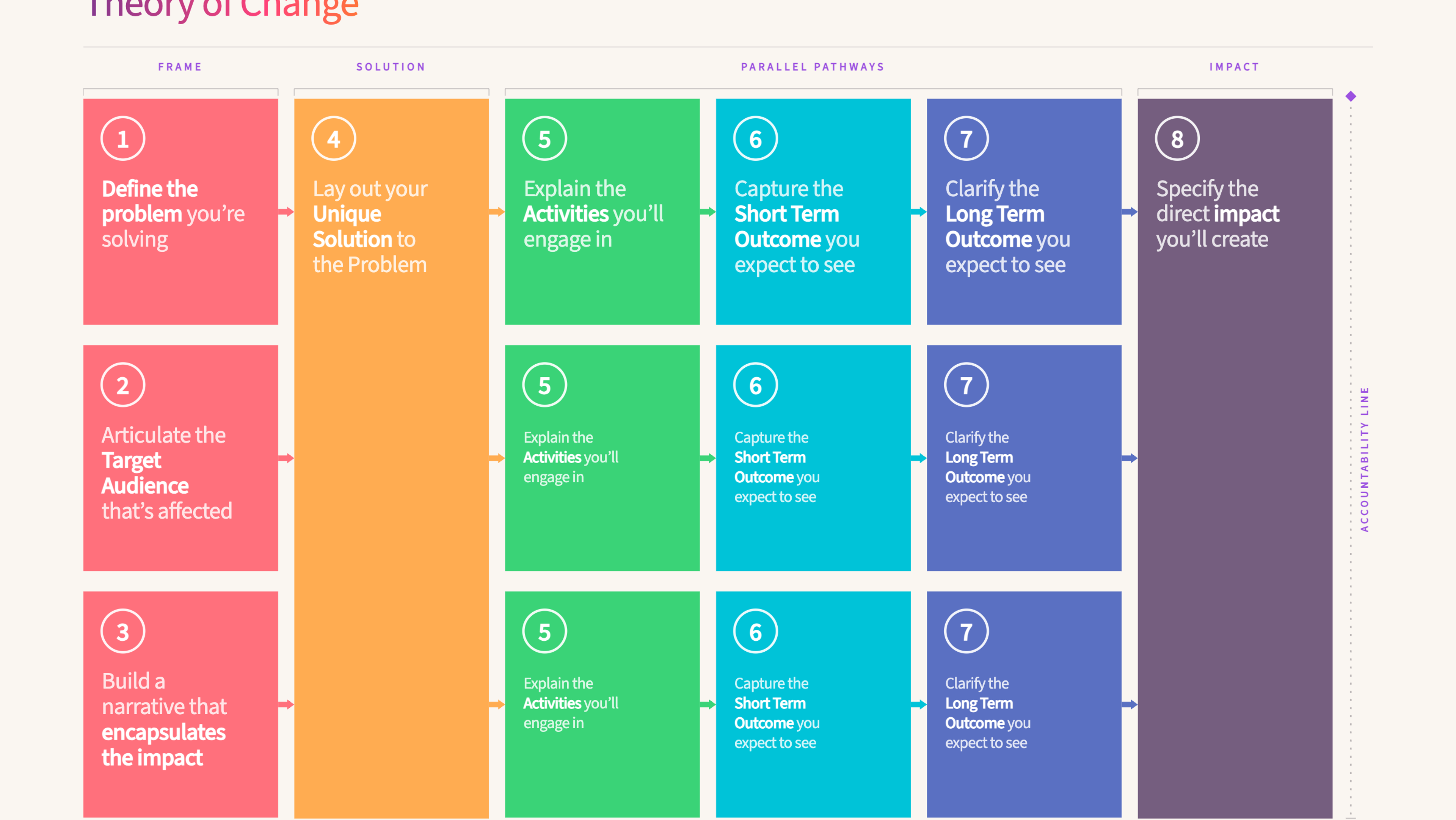
A Theory of Change is a strategic planning tool that maps out how and why you expect a desired change to happen. It connects your activities to your outcomes, showing the logical path from what you do to the impact you want to create.
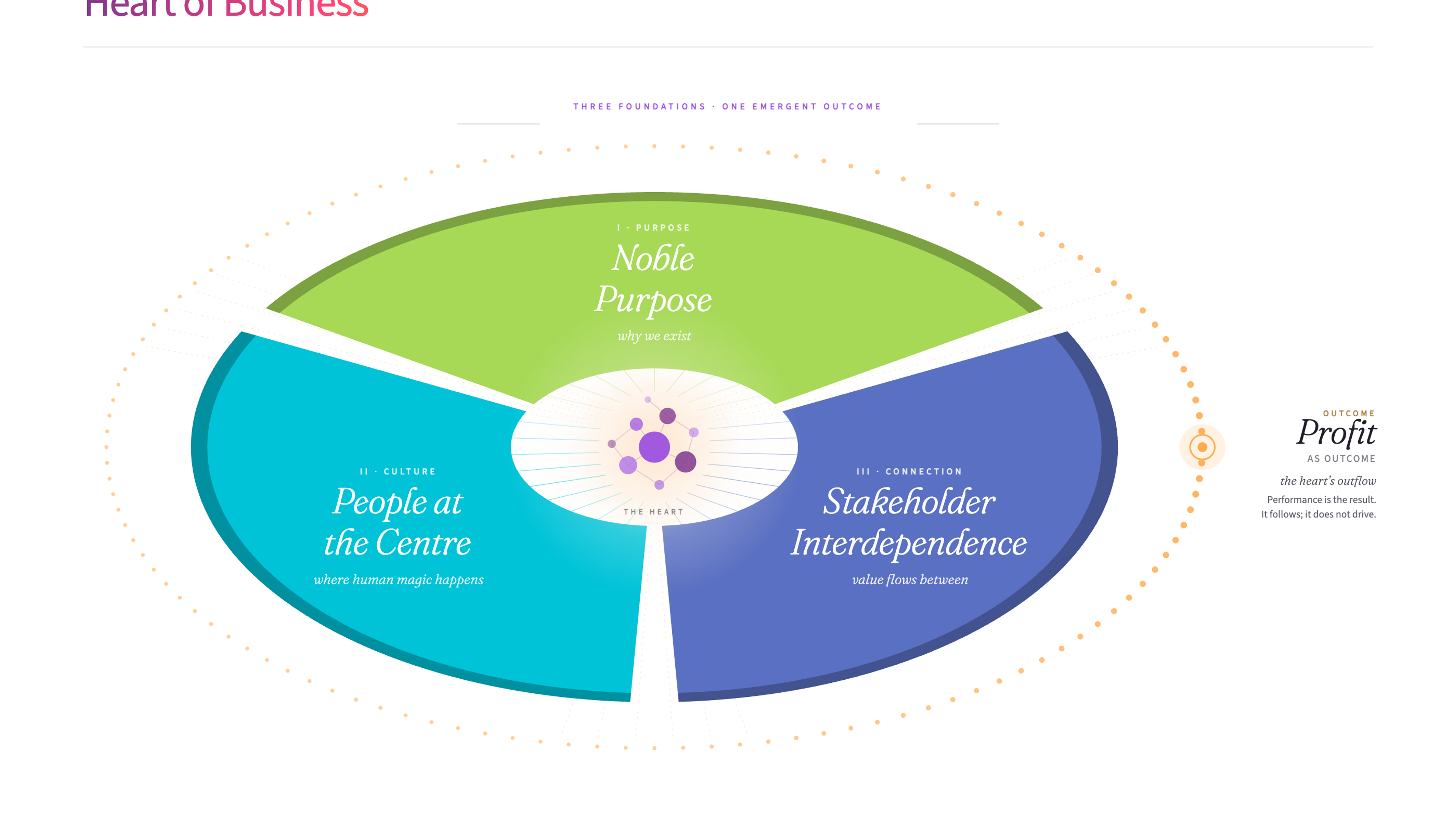
Hubert Joly's Heart of Business model identifies four pillars - noble purpose, people at the centre, stakeholder interdependence, and profit as outcome - that converge to create a purpose-driven organisation where financial performance follows from getting the foundations right.
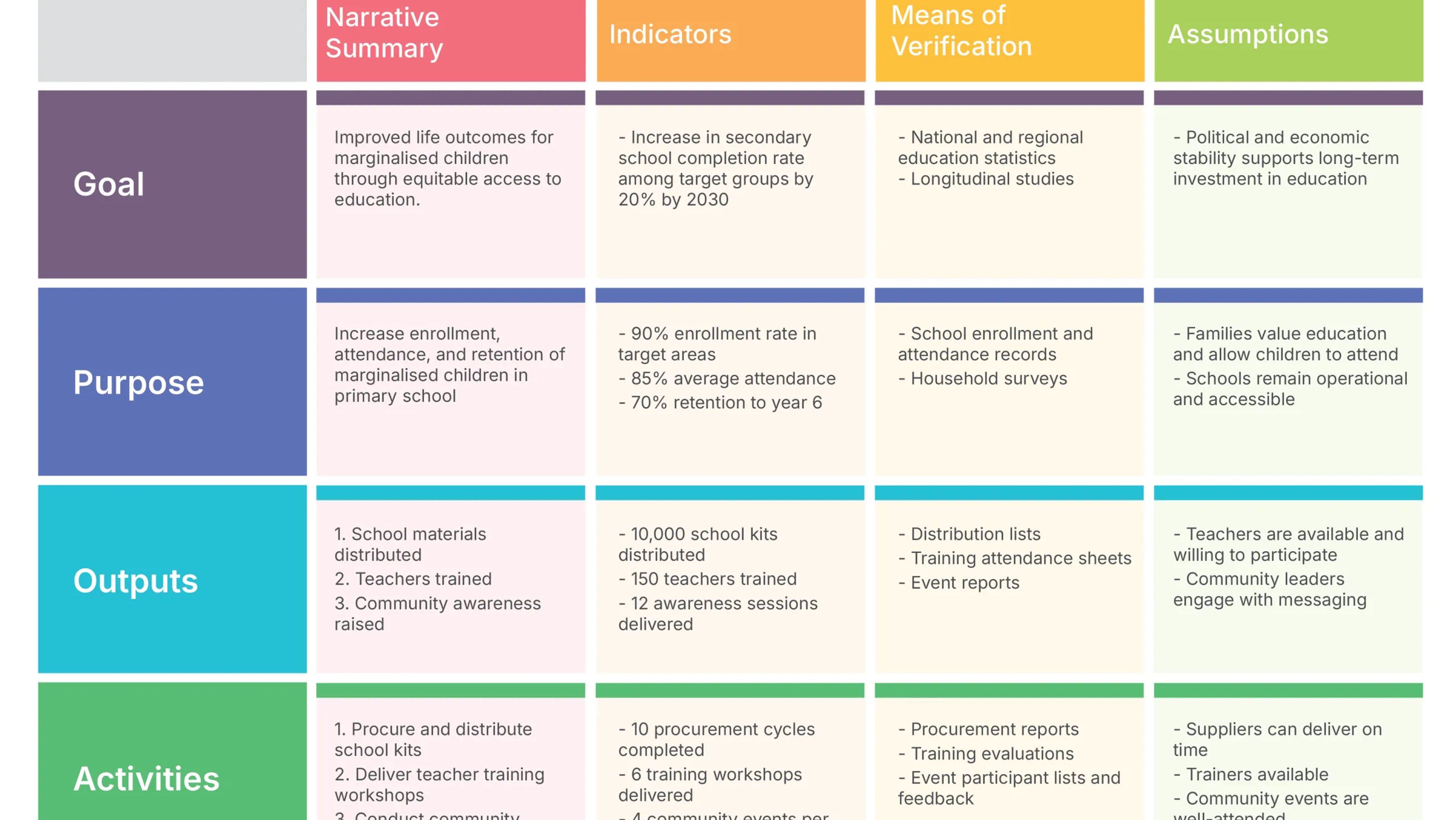
A LogFrame is a structured planning and evaluation tool that helps organisations set clear goals, define how they'll measure progress, and track what's actually being achieved. It's widely used in the nonprofit sector for programme management and impact reporting.

The real business case for organisational purpose isn't about inspiration - it's about what happens when everyone in the organisation understands why the work matters and can use that understanding to make better decisions, every day.

Most organisations know they should measure their impact. Fewer know how to do it in a way that's genuinely useful rather than just generating reports. This article explores how to build an impact measurement framework that helps you understand what's working, learn from what isn't, and make better decisions.
When you need more than the template
The free template is a good start. If you want to take the next step and map a full Theory of Change with your team - the difference you're working towards and how your work gets you there - that is what we built the Theory of Change Toolkit for - a rapid primer, assessment tools for gathering stakeholder input, a slide deck, worksheets and discussion guides, facilitator notes, and a Miro board blueprint. Everything is editable, so you can fit it to your own branding and timings.
It's a paid toolkit, on our sister site toctoolkit.org. Reduced rates are available for small nonprofits, micro-organisations and students.
James Freeman-Gray is the founder of Mutomorro. He's an organisational development practitioner who has spent over twenty years working with leaders across public, private and nonprofit sectors - helping organisations pull together around a common purpose, joined up in how they work. More about who we are and what it's like to work with us.
I've adapted the Business Model Canvas for purpose-led organisations many times. The nonprofit version explicitly addresses the dual nature of value creation - social impact alongside financial sustainability. It helps leadership teams see the whole picture on a single page rather than treating mission and money as separate conversations.
Last reviewed: May 2026
Ready to use Nonprofit Business Model Canvas?
Download the free template - includes practical guidance for workshops and team sessions.
Get the free template
Want to put these ideas into practice?
Whether you're navigating a merger, rethinking how you're structured, or trying to shift a culture that isn't working - underneath, it's the same job: getting the whole organisation pulling in the same direction. Start with a conversation.