Organisational Maturity Model
An Organisational Maturity Model maps how developed your organisation's processes and capabilities are across five stages - from ad-hoc and reactive through to optimising and continuously improving. It helps you see where you are and what the next step looks like.
Get the free template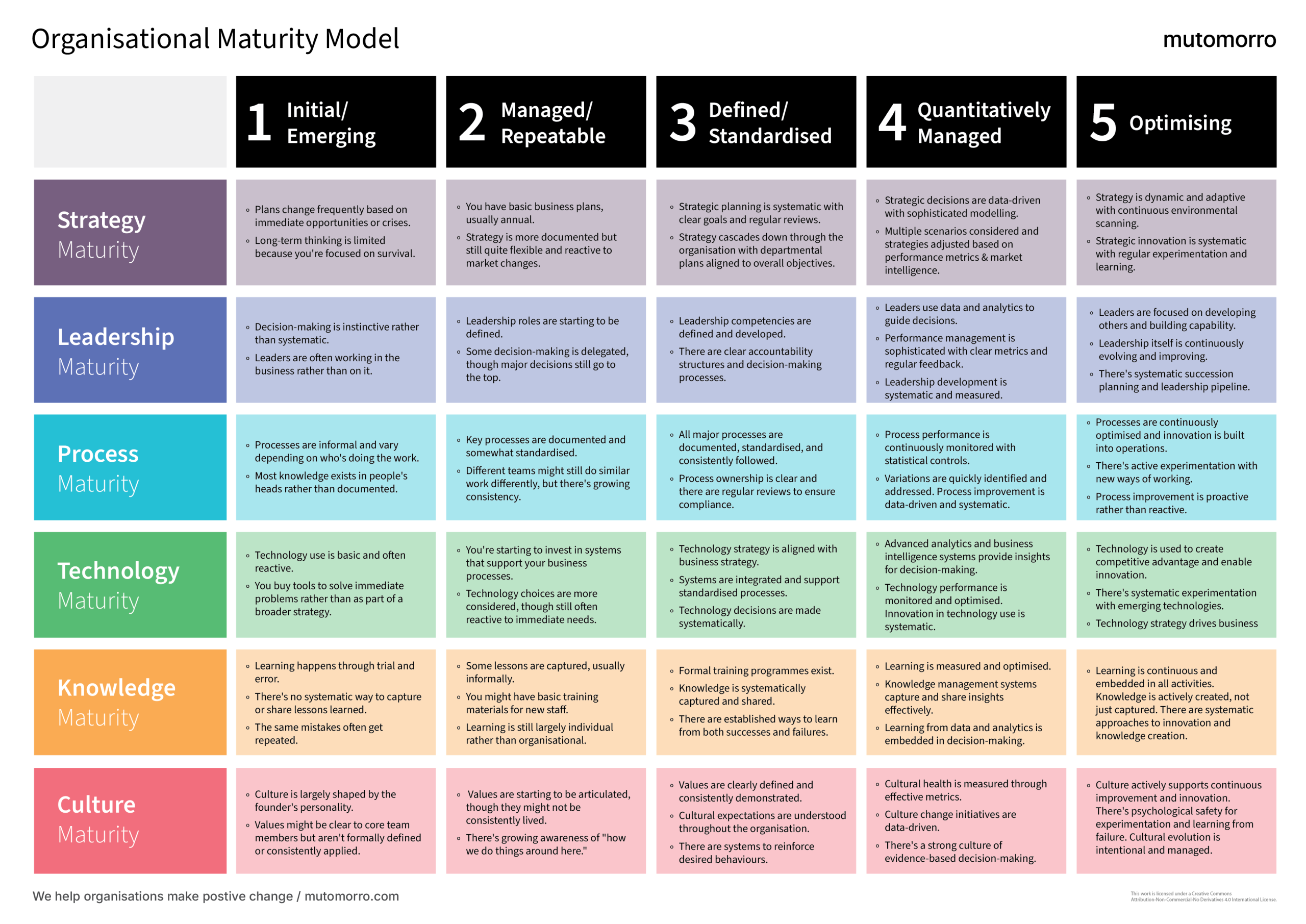
What is an Organisational Maturity Model?
An organisational maturity model refers to how well-developed and sophisticated your company's processes, systems, and capabilities are. Just like people develop from childhood through to adulthood, organisations evolve from operating in ad-hoc, reactive ways to becoming structured, strategic, and continuously improving enterprises.
Think of it as the difference between a startup that's figuring things out as they go, and an established company that has refined systems and can consistently deliver excellent results. A less mature organisation operates on instinct and individual heroics, while a mature one relies on proven processes and collective expertise.
When we talk about organisational maturity, we're looking at a few key areas:
- How you do things (Processes): Do you have clear ways of working that everyone follows, or does everyone just make it up as they go along?
- How you lead (Leadership): Are your leaders good at making decisions and helping the team grow, or are they just winging it?
- How you work together (Culture): Does everyone understand what the company stands for and pull in the same direction, or is it every person for themselves?
- How you learn (Learning & Knowledge): Do you capture lessons from successes and failures, share knowledge across teams, and continuously improve, or do you keep making the same mistakes?
- How you use technology: Do you use tech to make your work easier and better, or are you still doing everything the hard way?
- How you plan ahead (Strategy): Do you have clear plans for where you're going and how you'll get there, or are you just hoping for the best?
Why Organisational Maturity Matters
Developing organisational maturity isn't just about appearing more professional (though that's certainly a benefit). It has a direct impact on your company's performance and long-term success.
You achieve better results: When you have well-designed processes and everyone understands their role, you spend less time fixing mistakes and more time delivering quality work.
You adapt to change more effectively: This might seem counterintuitive, but companies with good structure actually find it easier to adapt when market conditions change. It's like having a strong foundation that allows you to build flexibly on top.
You identify problems early: Mature organisations are better at spotting issues before they become major problems, allowing for proactive rather than reactive management.
You scale sustainably: Instead of experiencing chaotic growth followed by operational breakdown, you can expand in a controlled way that maintains quality and efficiency.
Your team is more engaged: When people understand what's expected and how the organisation works, they feel more confident and satisfied in their roles.
You outperform competitors: Companies that master organisational maturity often outperform their less developed competitors across multiple metrics.
The Stages of Organisational Maturity
Most organisations go through five main stages as they mature. Let's look at each one in detail, with examples of what you might see and warning signs to watch out for.
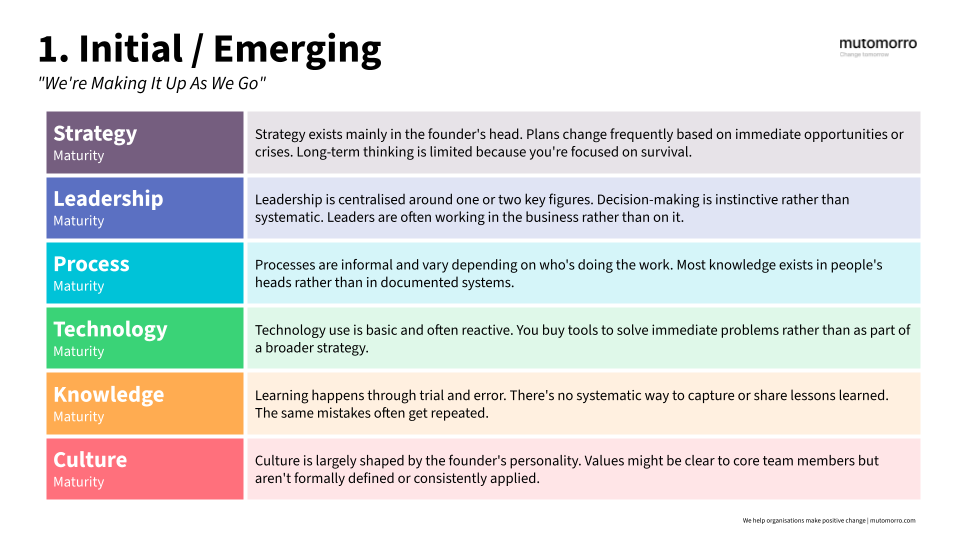
Stage 1: Initial/Chaotic - "We're Making It Up As We Go"
This is where most small companies and startups begin (or sometimes where organisations get stuck in a survival cycle). Everything depends on a few key people (often the founders) who make all the decisions and know how everything works.
What it looks like:
- The founder or CEO is involved in every decision, even small ones
- People often say "just ask Sarah, she knows how to do that"
- You don't have written procedures for most things
- Each project or programme feels like you're starting from scratch
- Meetings happen when problems arise, not on a regular schedule
- Your filing system is someone's desktop folder called "Important Stuff"
Maturity across key areas:
Strategy Maturity: Strategy exists mainly in the founder's head. Plans change frequently based on immediate opportunities or crises. Long-term thinking is limited because you're focused on survival.
Leadership Maturity: Leadership is centralised around one or two key figures. Decision-making is instinctive rather than systematic. Leaders are often working in the business rather than on it.
Process Maturity: Processes are informal and vary depending on who's doing the work. Most knowledge exists in people's heads rather than in documented systems.
Technology Maturity: Technology use is basic and often reactive. You buy tools to solve immediate problems rather than as part of a broader strategy.
Knowledge/Learning Maturity: Learning happens through trial and error. There's no systematic way to capture or share lessons learned. The same mistakes often get repeated.
Culture Maturity: Culture is largely shaped by the founder's personality. Values might be clear to core team members but aren't formally defined or consistently applied.
Edgar Schein's Culture Model is useful here - it helps surface the assumptions and values that shape how the organisation operates, even when they haven't been formally defined.
Examples you might recognise:
- A small marketing agency where the owner personally approves every piece of work before it goes to clients
- A tech startup where only the founder knows the server passwords
- A family business where "we've always done it this way" but no one can explain what "this way" actually is
Warning signs to watch for:
- Key people can't take holidays because everything will fall apart
- You keep making the same mistakes because no one remembers how you solved problems before
- New employees take months to figure out how things work
- You're constantly firefighting instead of preventing problems
- Growth feels impossible because you can't do more without working longer hours
The good news: At this stage, you can make decisions quickly and try new things easily. You're flexible and can adapt fast.
The challenge: You can't predict what will happen, and everything depends on having the right people available. If someone leaves, you might lose important knowledge forever.
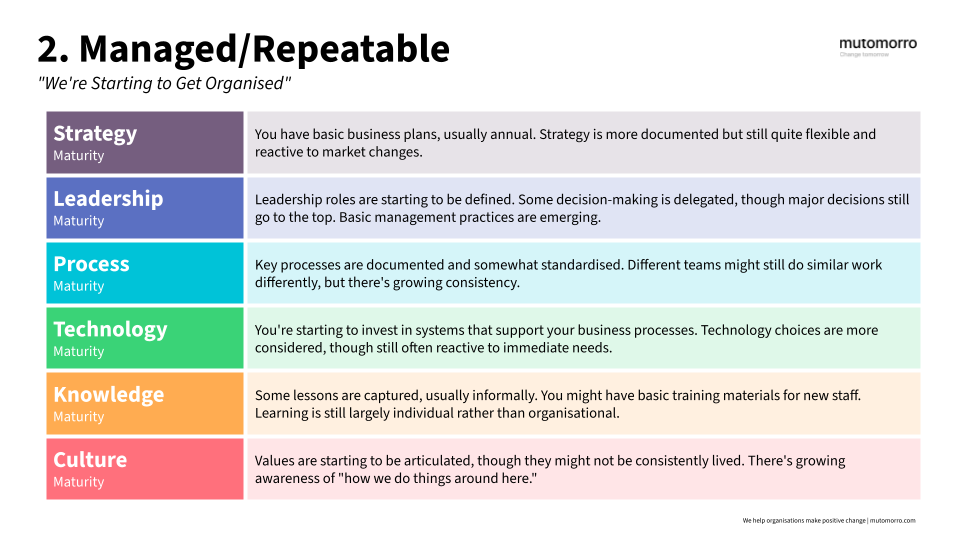
Stage 2: Managed/Repeatable - "We're Starting to Get Organised"
At this stage, you've realised that chaos isn't sustainable. You start putting basic systems in place and writing things down.
Process Mapping can help at this stage - giving teams a way to document how work flows before trying to standardise it.
What it looks like:
- You have some written procedures, even if they're basic
- You use simple project management tools like Trello or Asana
- You have regular team meetings, maybe weekly or monthly
- You've started keeping records of what you do and how well it works
- You have job descriptions, even if they're quite general
- You're starting to measure things like sales figures or customer satisfaction
Maturity across key areas:
Strategy Maturity: You have basic business plans, usually annual. Strategy is more documented but still quite flexible and reactive to market changes.
Leadership Maturity: Leadership roles are starting to be defined. Some decision-making is delegated, though major decisions still go to the top. Basic management practices are emerging.
Process Maturity: Key processes are documented and somewhat standardised. Different teams might still do similar work differently, but there's growing consistency.
Technology Maturity: You're starting to invest in systems that support your business processes. Technology choices are more considered, though still often reactive to immediate needs.
Knowledge/Learning Maturity: Some lessons are captured, usually informally. You might have basic training materials for new staff. Learning is still largely individual rather than organisational.
Culture Maturity: Values are starting to be articulated, though they might not be consistently lived. There's growing awareness of "how we do things around here."
Examples you might recognise:
- A growing consultancy that creates templates for common client deliverables
- A retail business that writes down the steps for opening and closing the shop
- A service company that starts tracking how long different types of jobs take
What to look out for:
- You might have processes in some areas but not others
- Different teams might do similar things in completely different ways
- Your procedures might be written down but not everyone follows them
- You're measuring some things but not sure what to do with the data
Warning signs:
- People still bypass the processes when they're busy
- New procedures get created but old ones don't get updated
- Only some people know about the new systems
- You have procedures but no one checks if they're being followed
The good news: You're starting to learn from experience and can repeat successful work. New people can start contributing more quickly.
The challenge: Your systems are still quite basic, and people might not stick to them when under pressure.
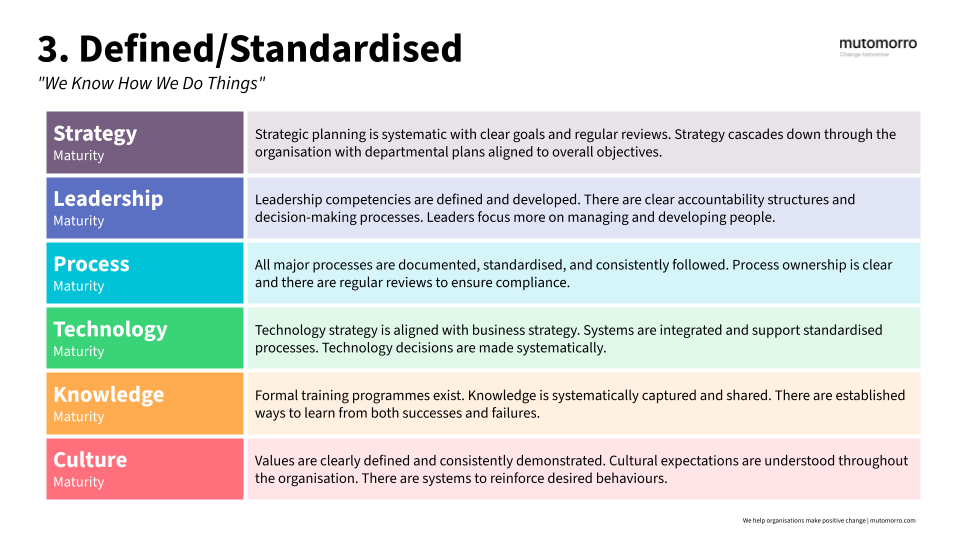
Stage 3: Defined/Standardised - "We Know How We Do Things"
This is where things start to feel more professional. You have clear, documented ways of working that everyone follows most of the time.
What it looks like:
- You have detailed procedures for all your main activities
- Everyone in similar roles does things the same way
- You have clear job descriptions and people know what's expected
- You measure quality and performance regularly
- You have proper training programmes for new starters
- Your management meetings follow a standard agenda
- You have clear rules about who can make what decisions
Maturity across key areas:
Strategy Maturity: Strategic planning is systematic with clear goals and regular reviews. Strategy cascades down through the organisation with departmental plans aligned to overall objectives.
Leadership Maturity: Leadership competencies are defined and developed. There are clear accountability structures and decision-making processes. Leaders focus more on managing and developing people.
Process Maturity: All major processes are documented, standardised, and consistently followed. Process ownership is clear and there are regular reviews to ensure compliance.
Technology Maturity: Technology strategy is aligned with business strategy. Systems are integrated and support standardised processes. Technology decisions are made systematically.
Knowledge/Learning Maturity: Formal training programmes exist. Knowledge is systematically captured and shared. There are established ways to learn from both successes and failures.
Culture Maturity: Values are clearly defined and consistently demonstrated. Cultural expectations are understood throughout the organisation. There are systems to reinforce desired behaviours.
Examples you might recognise:
- A manufacturing company where every product goes through the same quality checks
- A professional services firm where all client projects follow the same methodology
- A restaurant chain where every location follows the same recipes and service standards
What to look out for:
- Your procedures are comprehensive and usually up to date
- Most people follow the processes most of the time
- You can predict fairly well how long things will take and what they'll cost
- You rarely get surprised by problems you've seen before
- New employees can become productive relatively quickly
Warning signs to watch for:
- People might complain that processes are too rigid or bureaucratic
- You might be slow to adapt when circumstances change
- Innovation can feel difficult because "that's not how we do things"
- You might focus too much on following procedures rather than achieving good outcomes
The good news: You're reliable and predictable. Customers know what to expect, and you can plan ahead with confidence.
The challenge: You need to balance consistency with flexibility. Too much structure can stifle creativity and responsiveness.
Stage 4: Quantitatively Managed - "We Use Data to Make Decisions"
At this stage, you're not just following processes - you're constantly measuring and improving them based on data.
What it looks like:
- You collect data on almost everything important
- You use dashboards and reports to track performance
- Managers make decisions based on evidence, not just gut feeling
- You can predict future performance based on current trends
- You identify problems before they become serious
- You have regular reviews where you look at what the data is telling you
Maturity across key areas:
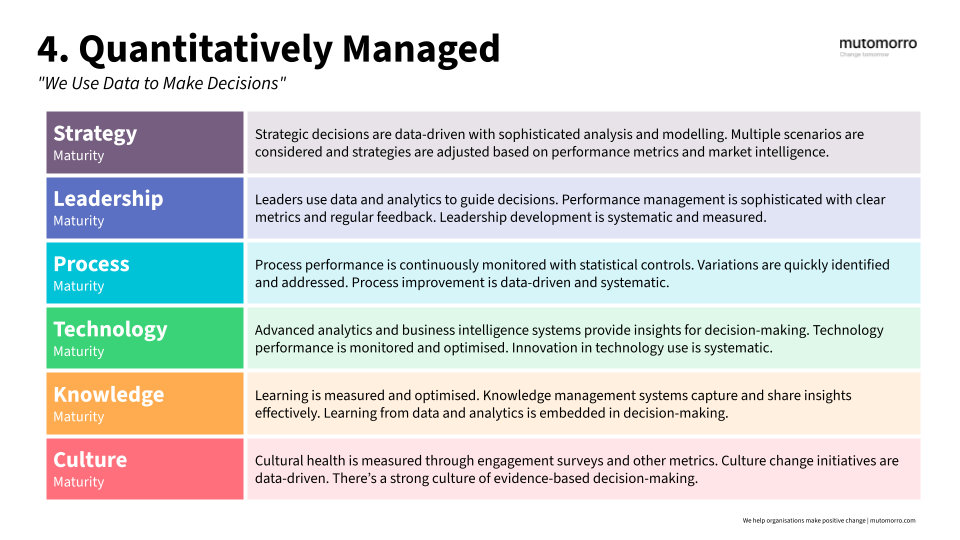
Strategy Maturity: Strategic decisions are data-driven with sophisticated analysis and modelling. Multiple scenarios are considered and strategies are adjusted based on performance metrics and market intelligence.
Leadership Maturity: Leaders use data and analytics to guide decisions. Performance management is sophisticated with clear metrics and regular feedback. Leadership development is systematic and measured.
Process Maturity: Process performance is continuously monitored with statistical controls. Variations are quickly identified and addressed. Process improvement is data-driven and systematic.
Technology Maturity: Advanced analytics and business intelligence systems provide insights for decision-making. Technology performance is monitored and optimised. Innovation in technology use is systematic.
Knowledge/Learning Maturity: Learning is measured and optimised. Knowledge management systems capture and share insights effectively. Learning from data and analytics is embedded in decision-making.
Culture Maturity: Cultural health is measured through engagement surveys and other metrics. Culture change initiatives are data-driven. There's a strong culture of evidence-based decision-making.
Examples you might recognise:
- An e-commerce company that tracks conversion rates for every page and makes changes based on the data
- A call centre that monitors call times, resolution rates, and customer satisfaction scores
- A software company that measures how many bugs are found at each stage of development
What to look out for:
- You have systems that automatically collect and analyse data
- Managers regularly review performance metrics with their teams
- You can spot trends and patterns in your business
- You make changes to improve performance based on what the data shows
- You rarely get caught off guard by problems
Warning signs to watch for:
- You might focus too much on metrics and forget about the bigger picture
- People might game the system to make their numbers look good
- You could become slow to respond to changes that don't show up in your data
- Analysis paralysis - spending too much time studying data instead of taking action
The good news: You make better decisions because they're based on facts. You can often prevent problems before they happen.
The challenge: You need to make sure you're measuring the right things and that data supports decision-making rather than replacing common sense.
Stage 5: Optimising - "We're Always Getting Better"
This is the highest level of maturity. You're not just measuring performance - you're constantly looking for ways to improve and innovate.
The PDCA Cycle provides a simple, repeatable structure for the kind of continuous improvement that defines this stage.
What it looks like:
- Everyone in the organisation thinks about how to improve their work
- You have formal programmes for capturing and sharing lessons learned
- You regularly try new approaches and learn from both successes and failures
- You anticipate changes in your market and adapt proactively
- Innovation is built into how you work, not just something that happens occasionally
- You share knowledge across the organisation so everyone can learn from each other
Maturity across key areas:
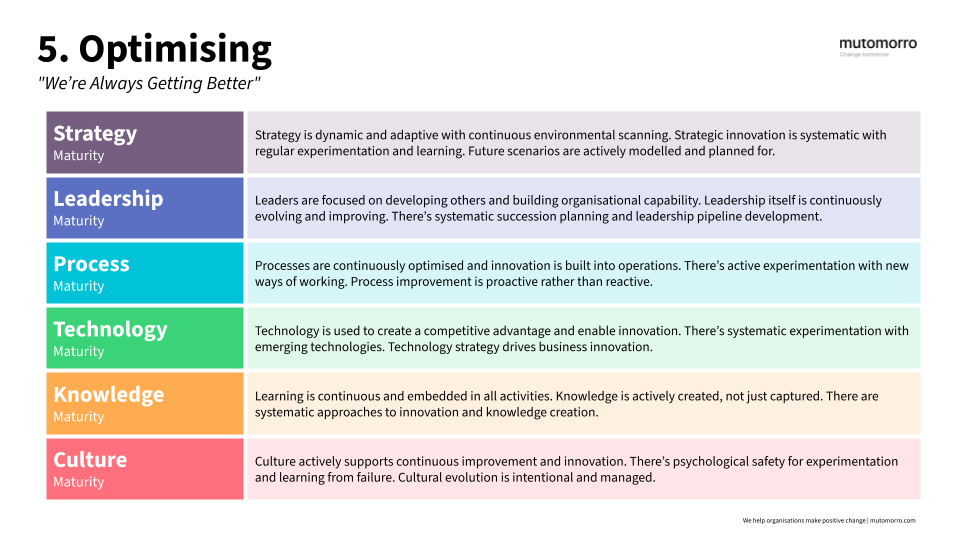
Strategy Maturity: Strategy is dynamic and adaptive with continuous environmental scanning. Strategic innovation is systematic with regular experimentation and learning. Future scenarios are actively modelled and planned for.
Leadership Maturity: Leaders are focused on developing others and building organisational capability. Leadership itself is continuously evolving and improving. There's systematic succession planning and leadership pipeline development.
Process Maturity: Processes are continuously optimised and innovation is built into operations. There's active experimentation with new ways of working. Process improvement is proactive rather than reactive.
Technology Maturity: Technology is used to create a competitive advantage and enable innovation. There's systematic experimentation with emerging technologies. Technology strategy drives business innovation.
Knowledge/Learning Maturity: Learning is continuous and embedded in all activities. Knowledge is actively created, not just captured. There are systematic approaches to innovation and knowledge creation.
Culture Maturity: Culture actively supports continuous improvement and innovation. There's psychological safety for experimentation and learning from failure. Cultural evolution is intentional and managed.
Examples you might recognise:
- A technology company that regularly experiments with new features and quickly scales successful ones
- A logistics company that continuously optimises routes and processes to reduce costs and improve service
- A professional services firm that captures insights from every client engagement and uses them to improve future work
What to look out for:
- You have systems for capturing ideas and improvements from everyone
- You regularly run experiments to try new ways of working
- You learn from other organisations and industries
- You're often ahead of market changes rather than reacting to them
- Your competitors often copy what you do
Warning signs to watch for:
- You might change things too often, confusing people or losing sight of what works
- You could become too focused on innovation and neglect day-to-day operations
- Different parts of the organisation might go in different directions
- You might pursue improvements that don't actually add value
The good news: You're constantly getting better and staying ahead of the competition. You can adapt quickly to changes while maintaining excellent performance.
The challenge: You need to balance innovation with stability and make sure all your improvements are moving you in the right direction.
Key Characteristics of Mature Organisations
Mature organisations share some common features that make them different from less developed companies:
They have a clear vision: Everyone understands where the company is going and why. It's not just written on a wall somewhere - people actually believe in it and use it to guide their decisions.
They make good decisions: They have clear processes for making decisions and the right people are involved. They don't spend forever debating everything, but they don't rush into things either.
They do things consistently: Their core work processes are well-designed and followed by everyone. This means customers get a consistent experience and quality doesn't vary depending on who's doing the work.
They use data wisely: They collect information about their performance and use it to make better decisions. They don't just collect data for the sake of it - they actually use it to improve.
They keep learning: They see mistakes as learning opportunities and have ways to share knowledge across the organisation. They're always looking for better ways to do things.
They handle change well: They can adapt to new situations without falling apart. They have the flexibility to change what they do while keeping the important things stable.
They think about everyone: They consider how their decisions affect employees, customers, suppliers, and the wider community. They don't just focus on short-term profits.
Benefits of Higher Organisational Maturity
When organisations become more mature, they typically see real improvements:
More predictable results: When you have good processes, you can better predict what will happen. This makes planning easier and helps you deliver on your promises.
Fewer nasty surprises: You're better at spotting problems early and dealing with them before they become disasters. This means fewer crises and less stress.
Better innovation: Mature organisations often innovate more effectively because they have the processes and resources to develop new ideas properly.
Greater resilience: When difficult times come, mature organisations cope better because they have strong foundations and good systems.
Better reputation: Customers, suppliers, and partners trust mature organisations more because they're reliable and professional.
Stronger financial performance: Studies show that mature organisations typically perform better financially - they're more profitable and grow more sustainably.
Common Maturity Models and Frameworks
While every organisation's journey is unique, several established frameworks can help you assess and develop your maturity. Here are some of the most widely used models:
Capability Maturity Model Integration (CMMI)
Originally developed for software development, CMMI has been adapted for various industries. It focuses on five maturity levels: Initial, Managed, Defined, Quantitatively Managed, and Optimising. This model is particularly strong on process improvement and quality management.
Best for: Technology companies, manufacturing, and any organisation focused on process excellence.
Key insight: CMMI emphasises that you can't skip levels - you need to build each foundation before moving to the next stage.
ISO 9001 Quality Management
While primarily a certification standard, ISO 9001 provides a framework for developing systematic approaches to quality management. It covers leadership, planning, support, operation, performance evaluation, and improvement.
Best for: Companies that want internationally recognised quality standards, especially those in regulated industries.
Key insight: ISO 9001 focuses on customer satisfaction and continuous improvement as core drivers of maturity.
Baldrige Excellence Framework
This comprehensive framework looks at leadership, strategy, customers, measurement and knowledge management, workforce, operations, and results. It's used by many organisations for self-assessment and improvement planning.
Best for: Large organisations seeking a broad approach to excellence across all areas of operation.
Key insight: Baldrige emphasises the interconnectedness of different organisational systems.
Agile Maturity Models
Various models exist for organisations adopting agile methodologies, focusing on team maturity, organisational agility, and continuous delivery capabilities.
Best for: Software development companies and organisations undergoing digital transformation.
Key insight: These models emphasise adaptability and rapid learning over rigid processes.
People Capability Maturity Model (P-CMM)
This framework focuses specifically on developing an organisation's workforce capabilities, covering areas like staffing, communication, work environment, performance management, and career development.
Best for: Service organisations and companies where human capital is the primary asset.
Key insight: P-CMM recognises that organisational maturity ultimately depends on people development.
Project Management Maturity Models
These frameworks (like OPM3 from PMI) focus on an organisation's project, programme, and portfolio management capabilities.
Best for: Project-based organisations and companies managing multiple complex initiatives.
Key insight: These models link project success to organisational maturity in planning and execution.
Choosing the Right Framework:
You don't need to pick just one model. Many successful organisations combine elements from different frameworks. The key is to choose approaches that match your industry, size, and specific challenges. Start with a simple assessment using one framework, then consider incorporating elements from others as you develop.
Common Challenges in Developing Maturity
The journey to maturity isn't always smooth. Here are some common obstacles:
- People resist change: Some people like the old ways of working and don't want more structure. This is especially true in companies that have been successful being informal and flexible.
- It costs money: Developing maturity requires investment in new systems, training, and sometimes more people. It can be hard to justify these costs when you're busy with day-to-day work.
- Culture clash: Some company cultures see more structure as bureaucracy that will kill creativity. Getting people to see the benefits takes time and careful communication.
- Leadership struggles: The skills needed to lead a mature organisation are different from those needed in earlier stages. Some leaders struggle to adapt.
- Complexity creep: As organisations become more mature, they can become more complex. Managing this complexity without creating bureaucracy is tricky.
- Finding the right balance: There's a risk of becoming too rigid and losing the flexibility that helped you succeed in the first place.
Strategies for Advancing Organisational Maturity
If you want to help your organisation become more mature, here are some proven approaches:
- Start with an honest assessment: Look at where you are now across different areas. Be honest about your strengths and weaknesses. This gives you a starting point and helps you focus on the most important areas.
- Make a plan: Don't try to do everything at once. Create a step-by-step plan that builds capabilities gradually. Think of it like learning to drive - you don't start on the motorway.
- Invest in your leaders: Make sure your leaders have the skills they need for a more mature organisation. This might mean training, coaching, or sometimes bringing in new people.
- Focus on your core processes: Start by improving the most important things you do. Document how they work, standardise them, and then look for ways to make them better.
- Get better at using data: Invest in systems and skills that help you collect and use information better. This includes both technology and training people to analyse and act on data.
- Create a learning culture: Set up ways for people to learn and share knowledge. This might include training programmes, regular reviews of what's working, and systems for capturing lessons learned.
- Manage the change carefully: Use proper change management to help people adapt. This means communicating clearly, providing training, and supporting people through the transition.
- Measure your progress: Set up ways to track how you're doing and regularly check your progress. Use this information to adjust your approach and keep momentum going.
Conclusion
Organisational maturity isn't about reaching a finish line - it's about continuously getting better at what you do. While the journey can be challenging, the benefits make it worthwhile.
The key is to be patient and systematic. Don't try to jump from chaos to optimisation overnight. Take it step by step, focus on the most important areas first, and make sure your people are on board with the changes.
Remember, the goal isn't to become mature for its own sake. It's to build an organisation that can deliver great results consistently, adapt to change, and create value for everyone involved. If you keep that in mind, you'll make the right choices along the way.
Every organisation can improve its maturity level with the right approach and commitment. The question isn't whether you can do it, but whether you're ready to start the journey.
We share thinking on organisational change and development on LinkedIn - practical ideas for people doing this work inside their own organisations.
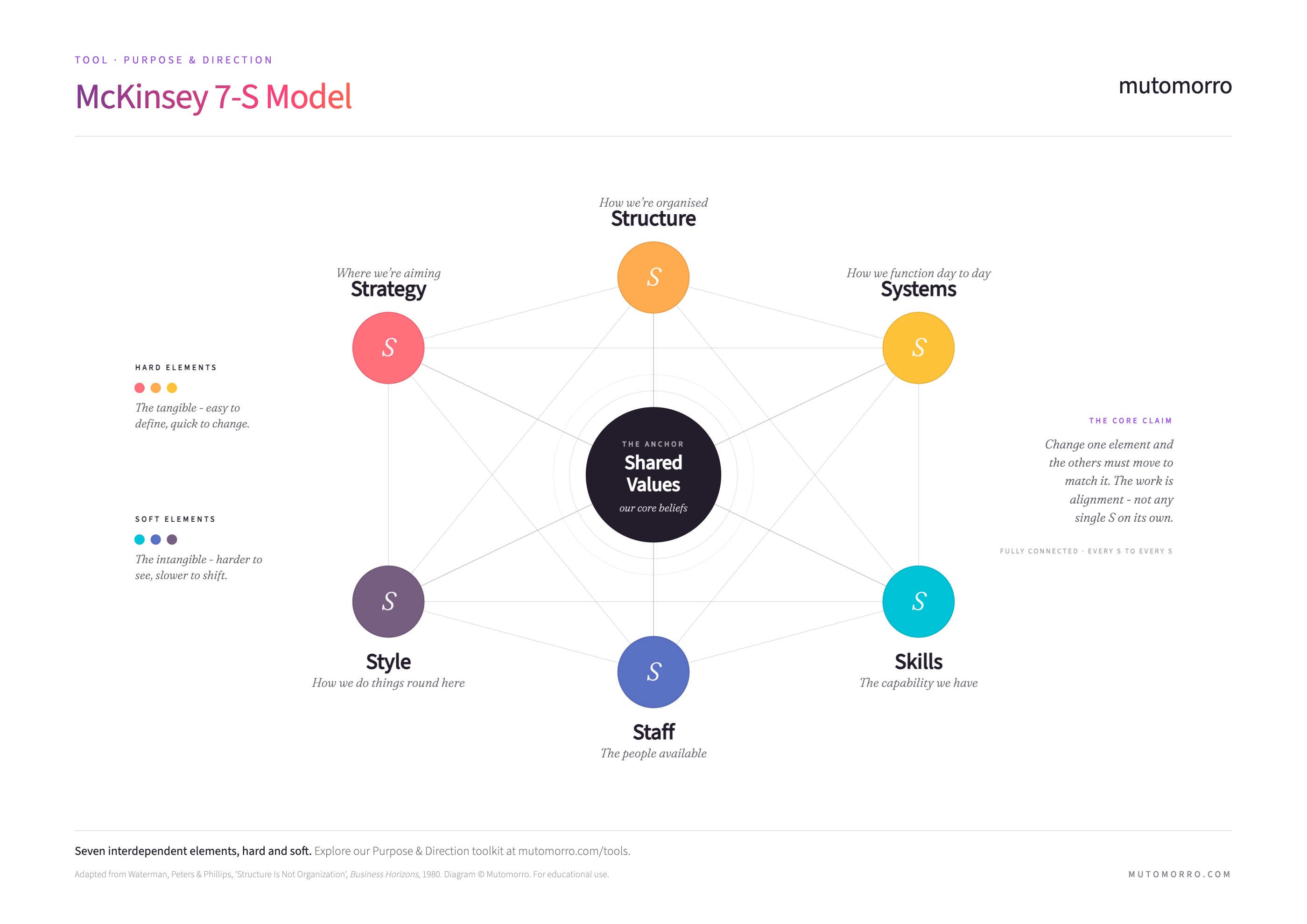
The McKinsey 7-S Model is a strategic framework that maps seven interconnected elements of an organisation - from strategy and structure to skills and shared values. It helps leaders understand how changing one part of the organisation affects everything else.
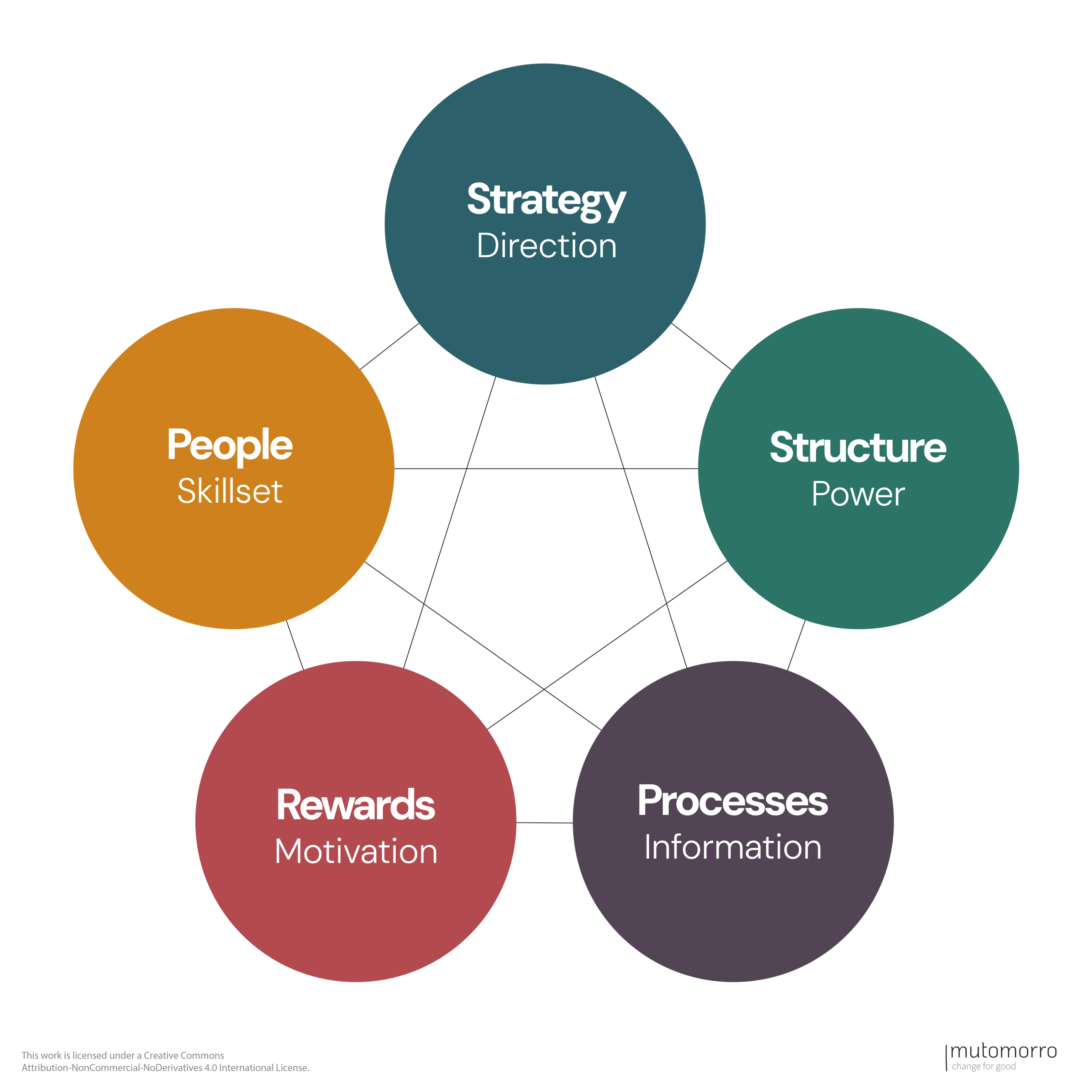
The Galbraith Star Model is an organisational design framework that maps five interconnected elements - strategy, structure, processes, rewards, and people. It helps leaders see how these elements need to align for the organisation to work well.
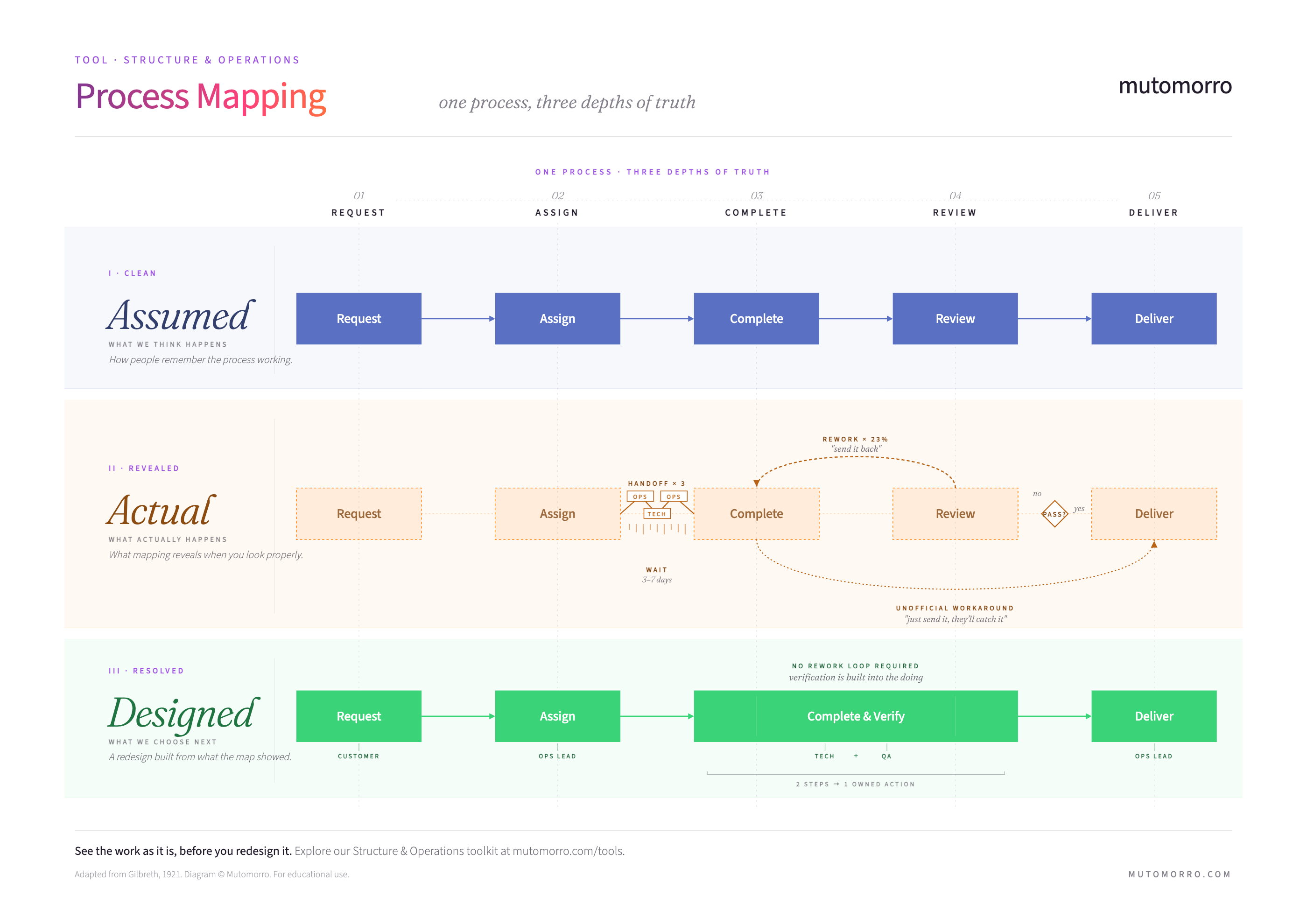
Process mapping is a visual method for documenting how a process works from start to finish. It helps teams see the full picture - every step, decision point, and handoff - so they can spot problems and design improvements.

Every growing organisation needs better processes, structures, and governance. But the operational foundations only work if the conditions underneath them - how decisions travel, how information flows, how culture holds together at scale - evolve at the same pace. Here's what's worth understanding before the scaling work begins.

Most organisations run on invisible infrastructure - the corridor conversation, the person who just knows, the relationships that bridge gaps between teams. Growth puts all of it under pressure. Scaling well means designing what replaces it.

Resilience isn't about bouncing back to where you were. It's about developing the capacity to adapt, learn, and come through difficulty stronger than before. This article explores what organisational resilience actually looks like and what leaders can do to build it.
Know where you stand first
A restructure readiness review gives you the honest baseline - what is working, what is strained and whether structural change is the right lever.
James Freeman-Gray is the founder of Mutomorro. He's an organisational development practitioner who has spent over twenty years working with leaders across public, private and nonprofit sectors - helping organisations pull together around a common purpose, joined up in how they work. More about who we are and what it's like to work with us.
Maturity models help organisations see where they are without judgment. I use this tool when leaders want to understand their organisation's current capability in a specific area and plan a realistic development path. The key is being honest about the current state rather than aspiring to level 5 overnight.
Last reviewed: May 2026
Ready to use Organisational Maturity Model?
Download the free template - includes practical guidance for workshops and team sessions.
Get the free template
Want to put these ideas into practice?
Whether you're navigating a merger, rethinking how you're structured, or trying to shift a culture that isn't working - underneath, it's the same job: getting the whole organisation pulling in the same direction. Start with a conversation.