McKinsey 7-S Model
The McKinsey 7-S Model is a strategic framework that maps seven interconnected elements of an organisation - from strategy and structure to skills and shared values. It helps leaders understand how changing one part of the organisation affects everything else.
Get the free template
You can redraw an org chart in an afternoon. Changing how the organisation actually works takes a great deal longer - and the McKinsey 7-S Model is a good way of seeing why. It treats an organisation not as a structure with people slotted into it, but as seven connected parts that only work when they move together. Three of them are easy to see and four are easy to feel, and the one idea behind the whole model is that you can't shift any of them on its own.
What is the McKinsey 7-S Model?
The McKinsey 7-S Model is a way of looking at an organisation as a whole, across seven elements that all begin with the letter S: strategy, structure, systems, shared values, skills, staff and style. It was developed at McKinsey in the late 1970s by the consultants Robert H. Waterman Jr., Tom Peters and Julien Phillips, who first set it out in a 1980 article called "Structure Is Not Organization". It reached a far wider audience two years later through Peters and Waterman's book In Search of Excellence.
The title of that first article is the whole point. Most attempts to improve an organisation start and end with structure - a reorganisation, a new reporting line, a fresh box on the chart. The 7-S Model argues that structure is only one of seven things that have to line up, and that the other six matter just as much. Get the structure right while the skills, the culture and the day-to-day systems pull in a different direction, and very little changes.
The seven elements split into two groups. The three "hard" elements - strategy, structure and systems - are tangible. You can write them down and point to them. The four "soft" elements - shared values, skills, staff and style - are harder to pin down, because they live in how people behave rather than in any document. The model's value is that it holds both kinds in the same frame, so neither gets ignored.
It works as a diagnostic. When something is off - a strategy that won't land, a change that keeps stalling, teams quietly working at cross purposes - the 7-S Model gives you a way to look across the whole organisation instead of fixing on the one part that happens to be most visible. If you've come across the Galbraith Star Model, 7-S is a close cousin: a similar whole-system view, with more weight on the soft, human side of how an organisation runs.
How the McKinsey 7-S Model works
The seven elements sit in a web, each connected to all the others and to a shared centre. That arrangement isn't decoration. It carries the model's core claim: change one element and the others have to move to match it, or the organisation falls out of alignment. A new strategy asks something of the structure. A new structure asks something of people's skills. New skills change how it feels to work there. Pull on any single thread and you feel it everywhere else.
This is why the model is more useful as a lens than as a checklist. The interesting questions are rarely about one element on its own. They're about the fit between them - whether the strategy and the structure agree with each other, whether the systems support the way people are actually expected to work, whether the stated values and the lived ones are the same thing.
Element | Hard / soft | In one line | The question it raises |
|---|---|---|---|
Shared values | Centre | The core beliefs the organisation runs on | Are the lived values the stated ones? |
Strategy | Hard | Where we're aiming | Does everything else line up behind it? |
Structure | Hard | How we're organised | Are we changing the shape, or moving the boxes? |
Systems | Hard | How we function day to day | Do the systems reward what the strategy asks? |
Skills | Soft | The capability we have | Do our skills match where we're heading? |
Staff | Soft | The people available | Right people in the right places, and looked after? |
Style | Soft | How we do things round here | Does the real culture match the one we claim? |
Shared values: the centre of the model

Shared values sit in the middle of the model, and that placement is deliberate. These are the core beliefs an organisation runs on - not the ones printed on the wall, but the ones that actually guide what people do when no one is watching. Waterman and his colleagues originally called this element "superordinate goals" to capture the sense of something higher that the other six serve.
When shared values are clear and genuinely held, they hold the other elements together and give them a common direction. When they're vague, or when the stated values and the real ones have drifted apart, the rest of the model struggles to align around anything. It's the hardest element to define and the one most worth getting right, which is why it earns the centre.
The hard elements
The three hard elements are the ones you can point to. They tend to be written down somewhere - in a strategy deck, an org chart, a set of processes - which makes them easier to define and quicker to change on paper. Whether they change in practice is a separate question, and usually a harder one.
Strategy

Where we're aiming. Strategy is the plan for where the organisation is heading and how it intends to get there - the choices about where to focus, what to prioritise and, just as importantly, what to say no to. The question 7-S asks of strategy isn't only "is it a good plan?" but "does everything else line up behind it?" A sound strategy that the structure, skills and culture don't support is a strategy in name only.
Structure

How we're organised. Structure is the shape of the organisation - reporting lines, teams, decision-making authority, who answers to whom. It's the element leaders reach for first, partly because it's the most visible and partly because redrawing it feels like decisive action. The trap is mistaking a new structure for change. Move the boxes around while the skills and the culture stay put, and you've often just rearranged the same problem.
Systems

How we function day to day. Systems are the procedures and routines that keep the organisation running - how decisions get made, how work flows, how information moves, how performance gets tracked. They're easy to overlook because they're mundane, but they shape behaviour more reliably than any strategy statement. People do what the systems make easy. If your systems reward one thing while your strategy asks for another, the systems usually win.
The soft elements
The four soft elements are harder to see and slower to shift. You won't find them in a document, because they live in how people behave and what they believe. They're also where most change efforts quietly run aground - a leadership team aligns the strategy, structure and systems, then can't understand why nothing moves, because the four elements they didn't address are pulling the other way.
Skills

The capability we have. Skills are what the organisation is genuinely good at - the abilities and know-how that let it deliver on its strategy. This is about more than the sum of individual job descriptions. It's the collective capability: the things this organisation can do well that others can't. When a strategy shifts, the skills needed often shift with it, and the gap between the two is one of the most common reasons change stalls.
Staff

The people available. Staff covers the people themselves - who's here, in what roles, and how they're developed, supported and brought through the organisation. Where skills are about capability, staff is about the human reality underneath it: whether the right people are in the right places, whether they're growing, and whether the organisation is looking after the people it depends on. No amount of clever strategy survives contact with a team that's stretched too thin or quietly heading for the door.
Style

How we do things round here. Style is the way leaders lead and the way the organisation behaves - its culture in action, as opposed to its culture on paper. It shows up in the small things: how meetings run, how decisions really get made, what gets rewarded and what gets quietly tolerated. There's often a gap between the style an organisation thinks it has and the one people experience day to day. Tools like the Cultural Web and the Competing Values Framework are useful for getting underneath that gap - and it's worth remembering that culture is something an organisation enacts through its choices, not something it can simply declare. (We explore that idea further under enacted culture.)
How to use the McKinsey 7-S Model
The model works best as a structured conversation with the people who lead a part of the organisation, not a solo desk exercise. Here's a way through it.
Start with the hard three. Look at strategy, structure and systems first, because they're the easiest to describe. Set out where you're aiming, how you're organised, and how work actually flows. Be honest about whether they already agree with each other.
Then read the soft four. Move to shared values, skills, staff and style. These take more care, because you can't simply look them up. You're inferring them from how people behave, from what gets said in the corridor rather than the boardroom. The Iceberg Model is a helpful companion here - it's built for surfacing the beliefs and assumptions that sit beneath what you can see.
Map the connections. This is where the real value is. Don't assess each element in isolation - look at how they pull on each other. Where is one element undermining another? A clear strategy that the structure makes impossible to act on. A set of stated values that the reward systems contradict. Asking 5 Whys about a mismatch is a quick way to get past the symptom to what's actually driving it.
Find the misalignments, not the perfect score. The point isn't to give each element a tick. It's to spot the places where two elements disagree - because that gap is almost always where the difficulty you're feeling is coming from.
Decide where to act, then keep checking. Use the picture to choose where to intervene first, bring people into the change rather than announcing it at them, and come back to the model as things move. It describes a living organisation, so the answers won't stay still.
The McKinsey 7-S Model in practice
Imagine a national charity that has set a bold new strategy. After years of running services in person, it wants to become digital-first and far more led by the people it serves - a genuine shift in what it does and how. A year in, the strategy hasn't landed, and the leadership team can't quite say why.
Run through the seven elements and a pattern appears. The strategy is clear and well argued. The structure has been redrawn to match it, with a new digital team and flatter decision-making. The systems, though, still run on the old in-person model, so the new structure is fighting the old plumbing every day. On the soft side, the skills for digital, user-led service design were never built - the charity restructured before it developed the capability the strategy assumed. Staff are stretched and unsettled, because the change has so far been something happening to them. The shared values still centre on a traditional idea of service, which quietly pulls against the new direction. And the style of decision-making is still cautious and top-down, despite the flatter chart.
Two elements moved. Five didn't. Seen through 7-S, the stall makes complete sense: the strategy and structure changed, but the systems, skills, staff, values and style stayed where they were, and a model that depends on alignment can't work with five of seven elements pointing the other way.
What the picture gives the leadership team is a better next move. Rather than treating this as a technology rollout that needs pushing harder, they can see it as a question of strategic alignment - the slower, more human work of building the capability, reshaping the systems and shifting the culture so that all seven elements are heading the same way. Less dramatic than another relaunch, and far more likely to work.
Limitations of the McKinsey 7-S Model
The model is genuinely useful, and like every tool it has edges worth knowing.
It tells you what to look at, not how to change it. 7-S is a diagnostic, not an implementation plan. It will show you where the misalignment is, but it won't walk you through fixing it. For the change itself, a dedicated change model such as Kotter's 8-Step Model is a useful partner.
It leaves out the world around you. The seven elements are all internal. Markets, regulation, funding and technology shape an organisation just as much, and 7-S keeps them off the page. The Burke-Litwin Change Model covers similar ground but adds the external environment as an explicit starting point.
The soft elements resist measurement. Skills, staff, style and shared values are real and they matter, but you can't put a clean number on them. You're working from judgement, conversation and observation, which takes more time and more honesty than reading off a dashboard.
"Alignment" can sound like a finished state. It isn't one. An organisation that's perfectly aligned today will drift as soon as anything changes around it. The model is most valuable when it's used to keep noticing misalignment over time, rather than to chase a tidy snapshot once.
Getting started
The simplest way in is to draw the seven elements on a whiteboard with your leadership team and write a single honest line under each: where we're aiming, how we're organised, how we function day to day, what we actually believe, what we're good at, who we have, how we do things round here. Keep it plain. The wording people reach for is itself revealing.
Then ask the question the model is built for: do any two of these disagree? The most useful conversations almost always start there - "we keep blaming the structure, but the real problem is that we never agreed what we're actually here to do." That's the model doing its job.
If this opens up bigger questions about designing an organisation that can hold together while it changes, our guide to adaptive organisational design is a good next read - and it's the kind of work we're always happy to think through alongside you.
Shared Values sits at the centre of the seven for a reason - it is the element the other six align around, and the one most organisations have never properly articulated. If the honest line under that heading is the thin one, a Mission, Vision and Values Workshop is a facilitated day to fill it in properly.
We share thinking on organisational change and development on LinkedIn - practical ideas for people doing this work inside their own organisations.
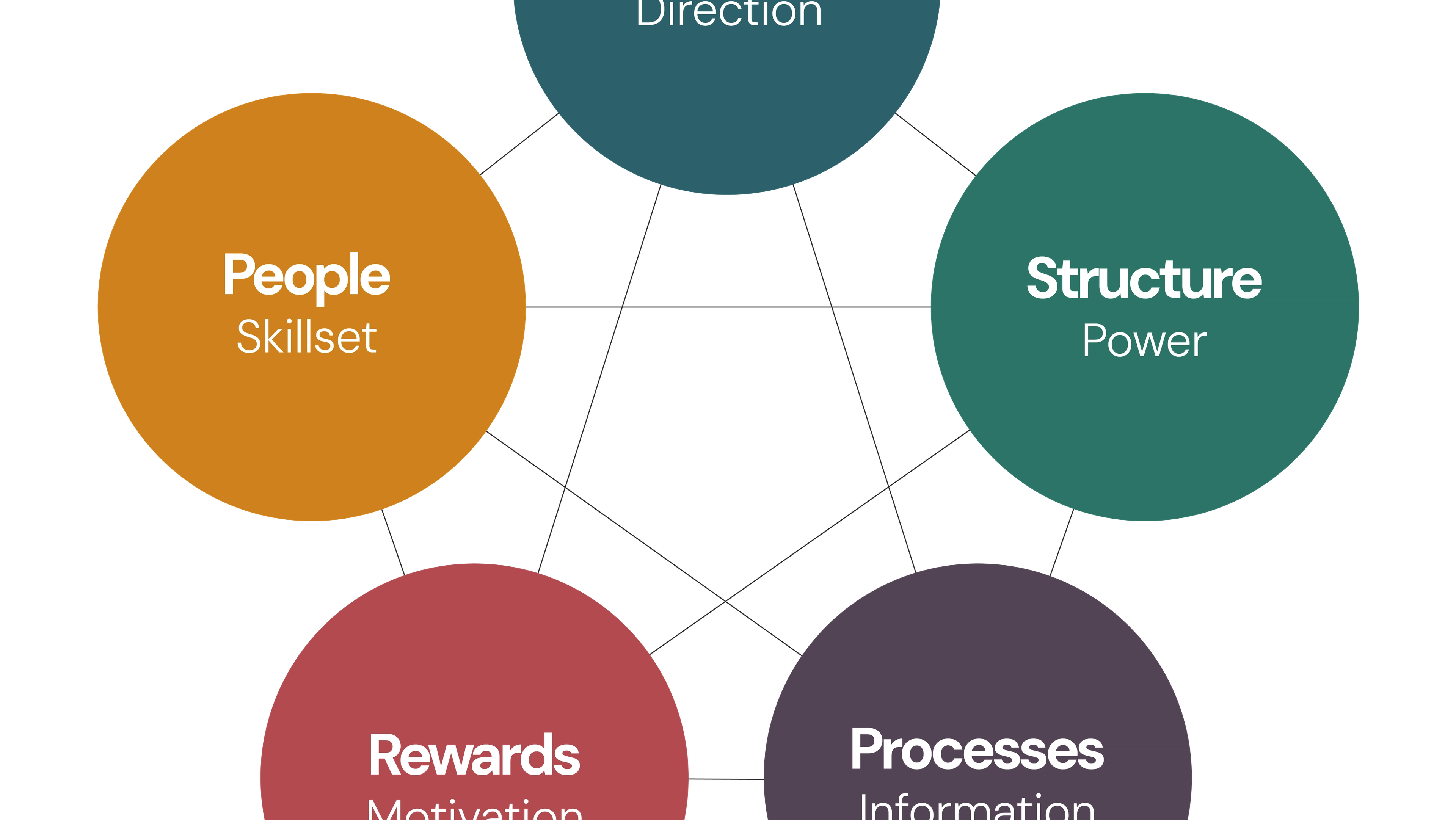
The Galbraith Star Model is an organisational design framework that maps five interconnected elements - strategy, structure, processes, rewards, and people. It helps leaders see how these elements need to align for the organisation to work well.
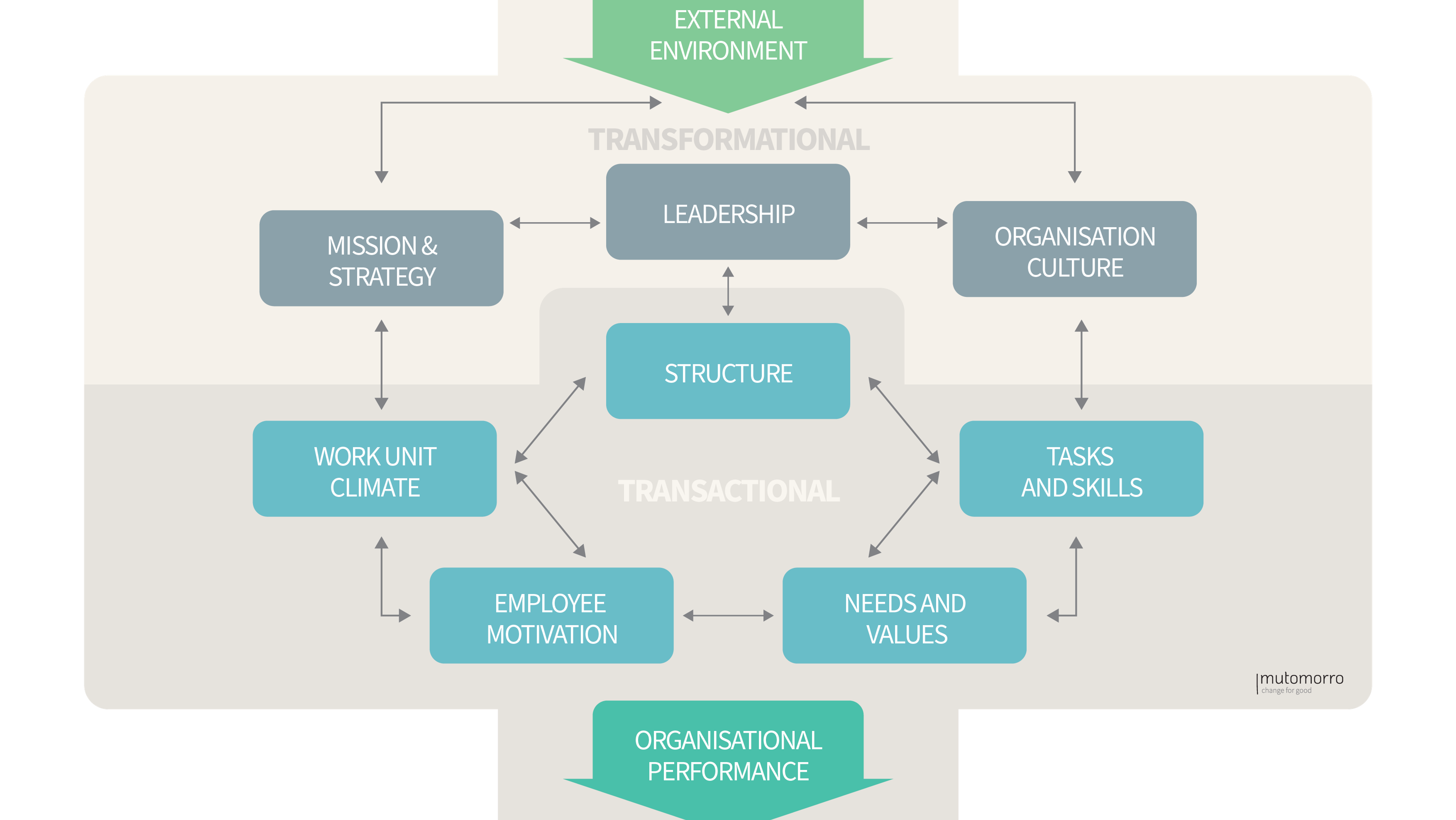
The Burke-Litwin Change Model maps how different parts of an organisation connect and influence each other during change. It helps leaders see which factors are driving performance and where to focus their effort for the biggest impact.
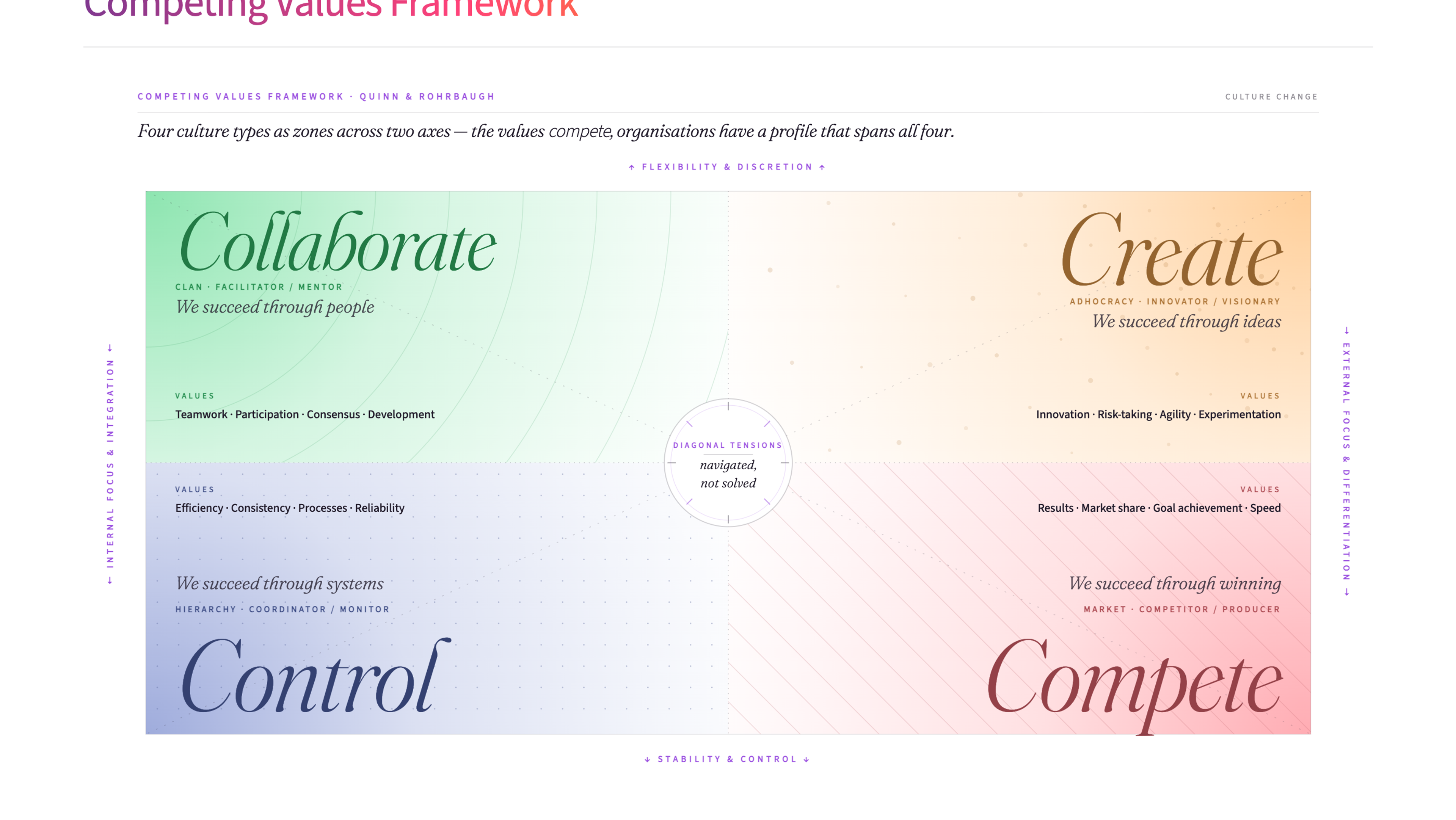
The Competing Values Framework is a model for understanding organisational culture by mapping it across two dimensions - flexibility versus stability, and internal versus external focus. It reveals which of four culture types your organisation leans towards.
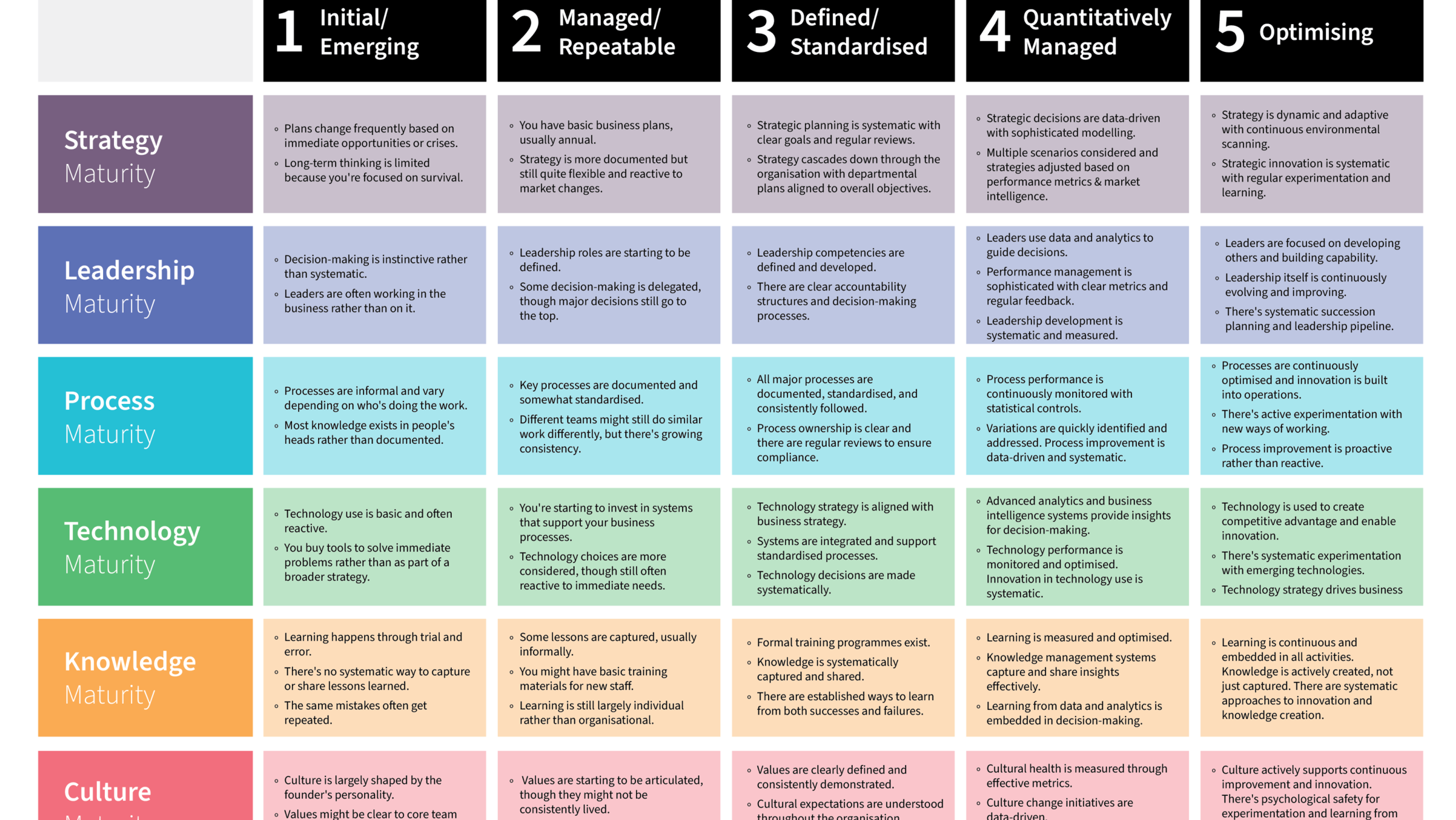
An Organisational Maturity Model maps how developed your organisation's processes and capabilities are across five stages - from ad-hoc and reactive through to optimising and continuously improving. It helps you see where you are and what the next step looks like.

Most organisational structures were designed for a different era - one where stability was the goal and change was the exception. This article explores what it means to design structures that can adapt when conditions change, and why getting this right matters more than getting the perfect org chart.
How to design governance that enables innovation rather than constraining it. This article explores the balance between oversight and freedom, and how the right governance structures can become a genuine advantage.
Are your seven S's aligned?
A restructure readiness review checks this alignment in practice - structure, decision rights and ways of working - and whether structural change is actually needed.
James Freeman-Gray is the founder of Mutomorro. He's an organisational development practitioner who has spent over twenty years working with leaders across public, private and nonprofit sectors - helping organisations pull together around a common purpose, joined up in how they work. More about who we are and what it's like to work with us.
The 7-S model is a comprehensive organisational diagnosis tool. It reveals how strategy, structure, systems, staff, skills, style, and shared values all need to align for an organisation to work well. I've found it particularly useful after mergers, where two organisations need to understand their differences before they can integrate.
Last reviewed: June 2026
Ready to use McKinsey 7-S Model?
Download the free template - includes practical guidance for workshops and team sessions.
Get the free template
Want to put these ideas into practice?
Whether you're navigating a merger, rethinking how you're structured, or trying to shift a culture that isn't working - underneath, it's the same job: getting the whole organisation pulling in the same direction. Start with a conversation.