2×2 Scenario Matrix
The 2x2 Scenario Matrix is a strategic planning tool that helps organisations explore different possible futures. By mapping two key uncertainties against each other, it creates four distinct scenarios you can plan and prepare for.
Get the free template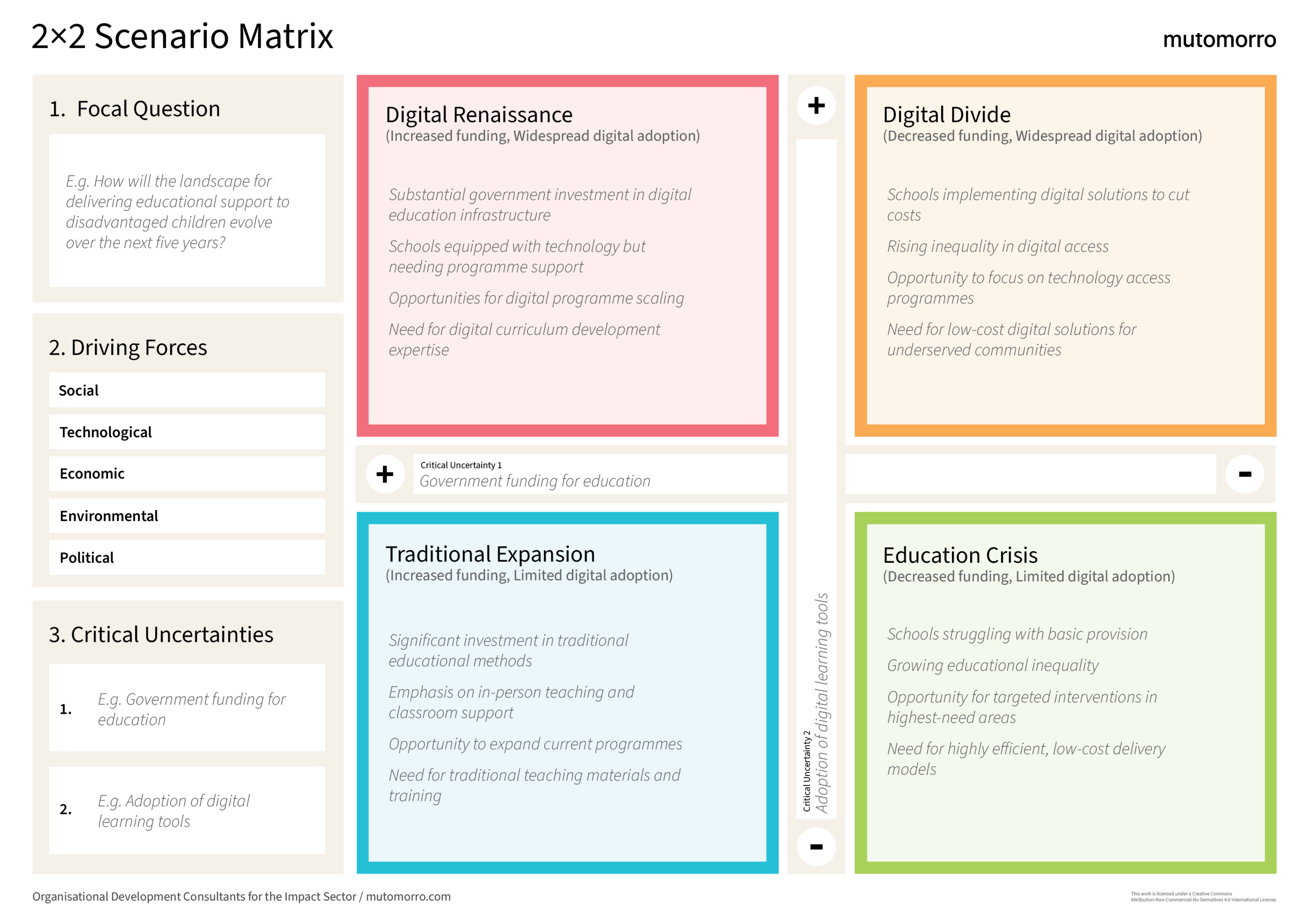
Using the 2×2 Scenario Matrix for Nonprofits and Charities
Nonprofit and charity leaders face unprecedented uncertainty in today's landscape, and with it comes increased risk and unpredictability. Whether it's shifts in funding patterns, changing beneficiary needs, technological disruption, or policy changes, organisations are being forced to prepare for multiple possible futures. The 2×2 Scenario Matrix is a strategic planning tool that helps nonprofit organisations systematically explore these potential futures and develop robust strategies for each scenario.
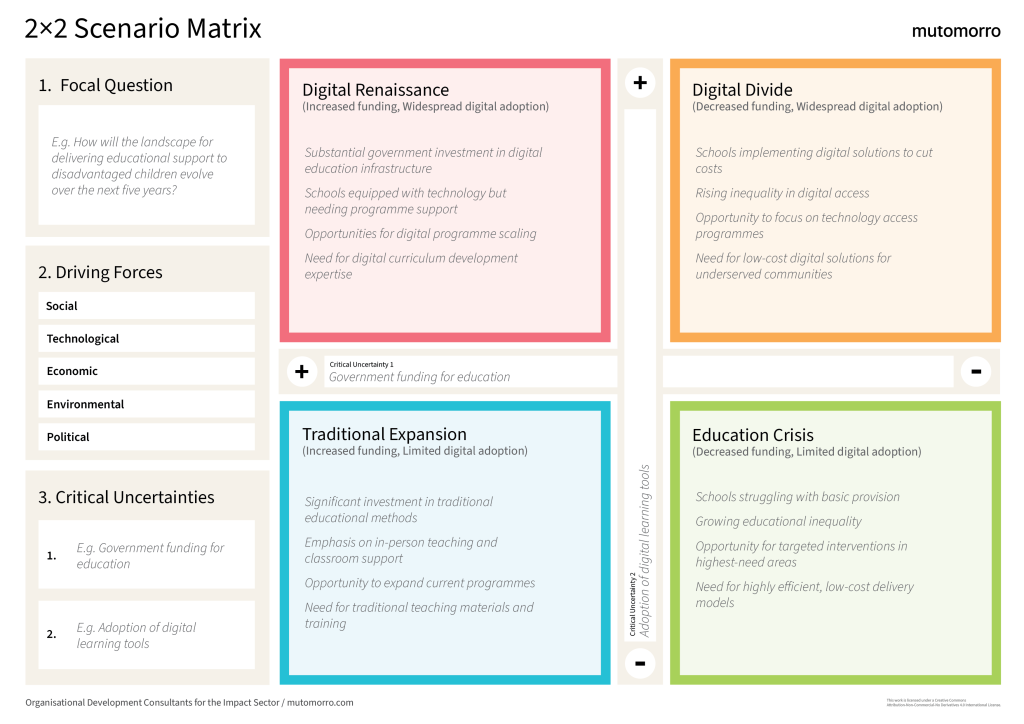
This guide gives an overview of effective scenario planning using the 2×2 Matrix approach, specifically tailored for nonprofits and charities. It's designed to help you move beyond reactive planning to proactive preparation for multiple scenarios, ensuring resilience and continued impact regardless of how the future unfolds.
Understanding the 2×2 Scenario Matrix
The 2×2 Scenario Matrix is a strategic planning method that helps nonprofit organisations prepare for an uncertain future by exploring multiple plausible scenarios. Unlike forecasting, which attempts to predict a single future, scenario planning acknowledges uncertainty by developing multiple coherent futures and preparing for each.
Core Concept
The approach centres on identifying two critical uncertainties - external factors that will significantly impact your organisation's future but whose outcomes are highly uncertain. These uncertainties become the axes of a matrix, creating four distinct quadrants that represent different potential futures or scenarios.
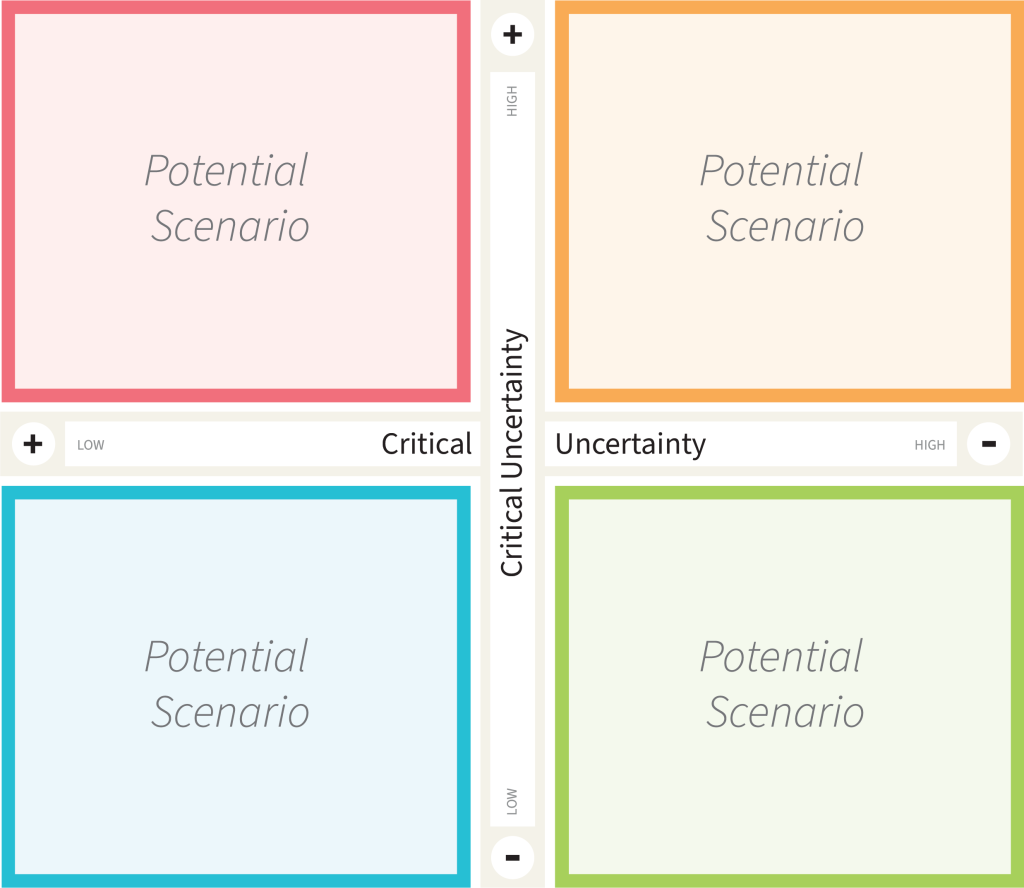
Each scenario tells a coherent story about how the future might unfold if certain conditions materialise. Using this 2x2 matrix, you can develop strategies that work across multiple scenarios, helping your organisation build greater resilience and agility, whatever the outcome.
Why It Works for Nonprofits
Nonprofits and charities operate in complex environments where funding, policy frameworks, social needs, and stakeholder expectations are constantly evolving. The 2×2 Matrix provides:
- Structured uncertainty exploration: Transforms overwhelming uncertainty into manageable scenarios
- Strategic agility: Helps anticipate and prepare for multiple potential futures
- Risk identification: Surfaces potential threats and opportunities that might otherwise be overlooked
- Stakeholder alignment: Creates a shared understanding of challenges among staff, board members, and partners
- Resource optimisation: Guides resource allocation decisions in uncertain environments
When to Use a 2x2 Scenario Matrix
The 2×2 Scenario Matrix is particularly valuable in the following situations:
The Cynefin Framework can help you assess the nature of the uncertainty you're facing before choosing your scenario axes.
- Strategic planning cycles: When developing or refreshing 3-5 year strategic plans
- Major funding transitions: When preparing for significant changes in funding patterns
- Policy evolution: When anticipating shifts in government policy or regulatory frameworks
- Beneficiary need changes: When demographics or needs of those you serve are evolving
- Technological disruption: When digital technology might transform your sector
- Organisational growth: When considering significant expansion or new programme areas
- Crisis preparation: When developing contingency plans for potential crises
How to use the 2x2 Scenario Matrix
A PESTLE Analysis is a useful starting point for identifying the external forces that should inform your scenario axes.
The 2×2 Scenario Matrix represents one of the most popular and widely used scenario planning templates available to nonprofit organisations today. It's a straightforward methodology that categorises complex uncertainties into four distinct possible futures that your organisation can prepare for.
The 2×2 Scenario Matrix pairs two drivers of the highest importance and greatest uncertainty as axes, creating a matrix with four quadrants. Each quadrant represents a different potential future scenario, allowing nonprofit leaders to explore how the world might change should certain trends emerge or particular events occur.
Step 1: Establish Your Focal Question
Define the specific strategic question you want to explore. This focal question should be:
- Directly relevant to your organisation's mission and strategy
- Forward-looking (typically 3-10 years in the future)
- Open-ended enough to allow for multiple outcomes
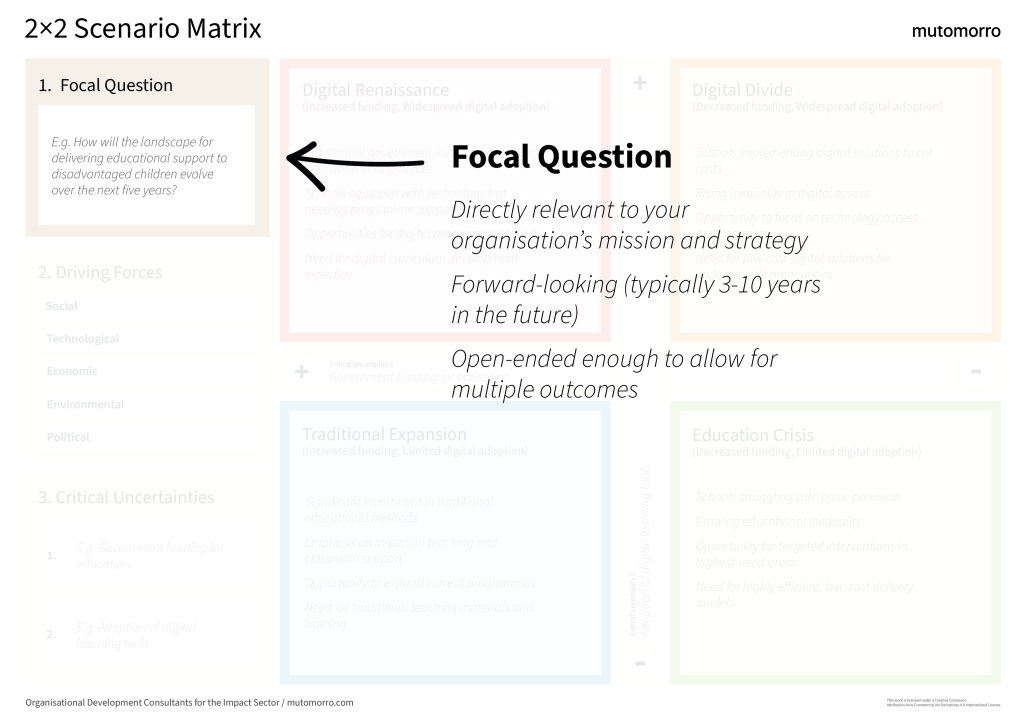
Example focal questions for nonprofits:
In an increasingly volatile environment, VUCA Prime offers a leadership lens for responding to the uncertainty your scenarios reveal.
- "How might our funding landscape change over the next five years?"
- "What will beneficiary needs look like in our sector by 2030?"
- "How might changes in government policy affect our ability to deliver services?"
Step 2: Identify Driving Forces
Conduct a structured analysis to identify forces that could shape your operating environment. You can use a variety of models to explore this. Generally we recommend using a PESTLE analysis or the STEEP framework to explore:
- Social: Demographic trends, attitudes, values, lifestyle changes
- Technological: Digital innovations, automation, data use
- Economic: Funding patterns, economic cycles, wealth distribution
- Environmental: Climate impacts, sustainability requirements
- Political: Policy changes, regulatory shifts, political climate
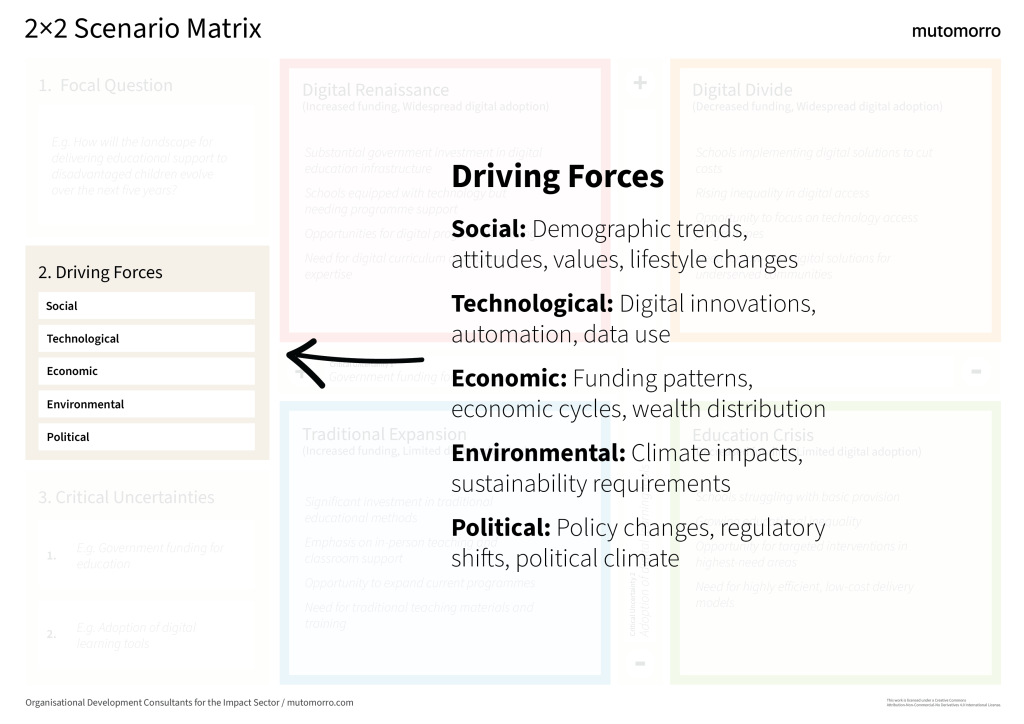
For each category, identify 3-5 key driving forces relevant to your organisation.
Workshop approach: Gather a diverse group of stakeholders (staff, board members, beneficiaries, partners) and use techniques like brainstorming, surveys, and expert interviews to identify these forces.
Step 3: Determine Critical Uncertainties
From your list of driving forces, identify the two most critical uncertainties. These should be:
- High impact: Forces that would significantly affect your organisation's operations or mission
- High uncertainty: Forces whose outcomes are genuinely uncertain
- Independent: Forces that aren't directly correlated with each other
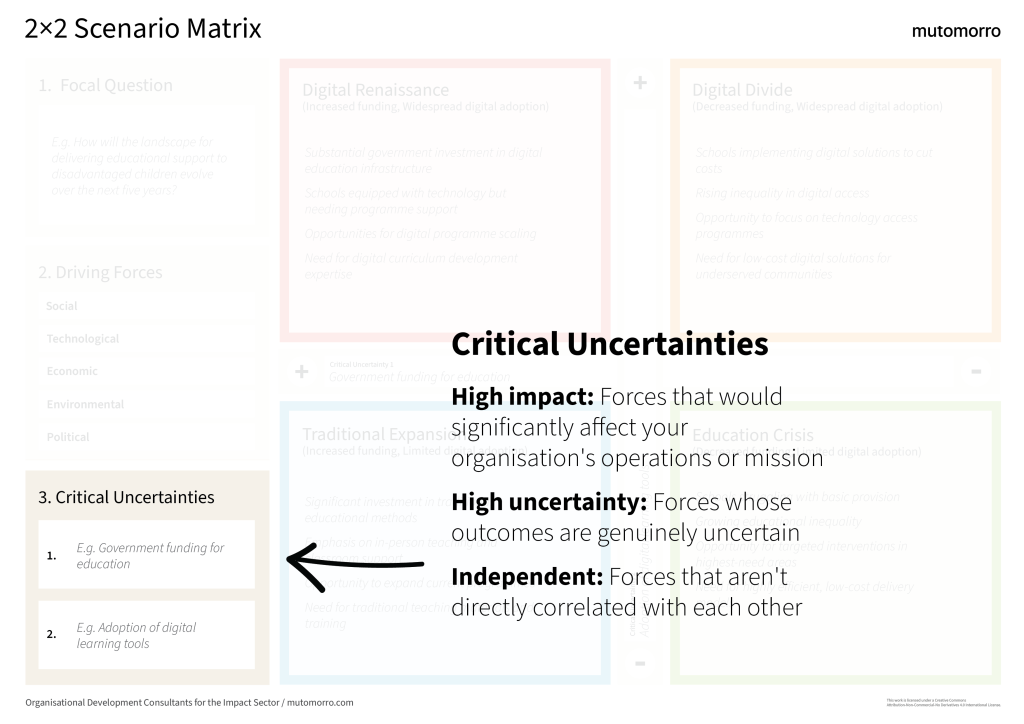
Prioritisation technique: Plot all driving forces on an impact/uncertainty matrix. Focus on those in the high-impact, high-uncertainty quadrant.
Step 4: Create Your 2×2 Scenario Matrix
To develop your 2×2 Scenario Matrix, draw a matrix with your two critical uncertainties as the axes. For each axis:
- Label one end with the positive or increased manifestation of the uncertainty
- Label the opposite end with the negative or decreased manifestation
This creates four quadrants, each representing a distinct scenario.
Example matrix for a homeless services charity:
- X-axis: Government funding for housing support (High ↔ Low)
- Y-axis: Public perception of homelessness as a social priority (High ↔ Low)
Step 5: Develop Detailed Scenarios
For each quadrant, develop a narrative that describes:
- How this future might unfold
- What the operating environment would look like
- Major challenges and opportunities
- Implications for your organisation's work
Give each scenario a memorable name that captures its essence.
Development techniques:
- Write newspaper headlines from the future
- Develop personas of beneficiaries or donors in each scenario
- Create day-in-the-life stories for your organisation in each future
Step 6: Identify Strategic Implications
For each scenario, explore:
- How your current strategy would perform
- Required adaptations to programmes or services
- Resources needed or constraints faced
- Potential partnerships or collaborations
- Fundraising and communication approaches
- Organisational capabilities needed
Step 7: Develop Robust Strategies
Identify strategies that would work well across multiple scenarios - these are your "robust strategies." Also identify scenario-specific strategies that would be implemented only if indicators suggest a particular scenario is emerging.
Strategic approaches:
- No-regret moves: Actions beneficial in all scenarios
- Hedging strategies: Actions that minimise negative impacts in challenging scenarios
- Option-creating strategies: Actions that create future flexibility
- Core-satellite approach: Core strategy with scenario-specific adaptations
Step 8: Identify Early Warning Indicators
Develop a monitoring system to track early signs indicating which scenario(s) might be emerging. For each critical uncertainty, identify 3-5 measurable indicators you can track regularly.
Example indicators:
- Funding trend metrics
- Policy consultation outcomes
- Public opinion surveys
- Media coverage analysis
- Beneficiary demographic shifts
Step 9: Integrate into Strategic Planning
Connect your scenario planning to your organisation's strategic planning process:
- Reference scenarios in strategic plans
- Align strategic goals with robust strategies
- Develop contingency plans for each scenario
- Create an adaptive planning approach
Step 10: Review and Refresh
Scenario planning is not a one-time exercise. Schedule regular reviews to:
- Update scenarios based on emerging trends
- Adjust strategies as needed
- Refine early warning indicators
- Maintain organisational awareness
Practical Examples for Nonprofits
Below are some real-life (anonymised) examples for charities and nonprofits we've helped develop recently. You may find them useful in developing your own 2×2 Scenario Matrix.
Example 1: Children's Educational Charity
Focal question: "How will the landscape for delivering educational support to disadvantaged children evolve over the next five years?"
Critical uncertainties:
- Government funding for education (Increased ↔ Decreased)
- Adoption of digital learning tools (Widespread ↔ Limited)
Resulting scenarios:
Scenario 1: Digital Renaissance (Increased funding, Widespread digital adoption)
- Substantial government investment in digital education infrastructure
- Schools equipped with technology but needing programme support
- Opportunities for digital programme scaling
- Need for digital curriculum development expertise
Scenario 2: Traditional Expansion (Increased funding, Limited digital adoption)
- Significant investment in traditional educational methods
- Emphasis on in-person teaching and classroom support
- Opportunity to expand current programmes
- Need for traditional teaching materials and training
Scenario 3: Digital Divide (Decreased funding, Widespread digital adoption)
- Schools implementing digital solutions to cut costs
- Rising inequality in digital access
- Opportunity to focus on technology access programmes
- Need for low-cost digital solutions for underserved communities
Scenario 4: Education Crisis (Decreased funding, Limited digital adoption)
- Schools struggling with basic provision
- Growing educational inequality
- Opportunity for targeted interventions in highest-need areas
- Need for highly efficient, low-cost delivery models
Strategic implications:
- Develop core educational content adaptable to both digital and traditional delivery
- Build partnerships with technology providers
- Develop funding streams independent of government sources
- Create a digital access programme that can scale if needed
Example 2: Homelessness Support Charity
Focal question: "How might the landscape for tackling homelessness change by 2028?"
Critical uncertainties:
- Government approach to homelessness (Proactive/Funded ↔ Minimal/Underfunded)
- Housing affordability crisis (Improving ↔ Worsening)
Resulting scenarios:
Scenario 1: Collaborative Solutions (Proactive government, Improving affordability)
- Significant government investment in prevention and housing
- Declining homelessness rates
- Opportunities for preventative work
- Need for evidence-based programme design
Scenario 2: Prevention Focus (Proactive government, Worsening affordability)
- Government emphasis on preventing new homelessness
- Continuing housing pressure
- Opportunity for early intervention programmes
- Need for service efficiency and preventative expertise
Scenario 3: Private Innovation (Minimal government, Improving affordability)
- Limited government support but improving housing access
- Philanthropy and social enterprise filling gaps
- Opportunity for innovative housing models
- Need for diverse funding streams and partnerships
Scenario 4: Crisis Response (Minimal government, Worsening affordability)
- Acute homelessness crisis with limited support
- Overwhelming demand for services
- Opportunity for emergency response specialisation
- Need for volunteer mobilisation and community resources
Strategic implications:
- Develop flexible service models that can scale up/down
- Build both prevention and emergency response capabilities
- Develop evidence base to influence government policy
- Create diverse funding streams beyond government contracts
Common Pitfalls and How to Avoid Them
Scenario planning is never easy, and always open to interpretation, biases and difficulty in effective future-casting. From our experience, here are some of the most common issues that nonprofits face when using the 2x2 Scenario Matrix.
Pitfall 1: Selecting Correlated Uncertainties
Problem: Choosing uncertainties that move together reduces the distinctiveness of your scenarios. Solution: Test independence by asking if one uncertainty could move without affecting the other.
Pitfall 2: Favouring a "Most Likely" Scenario
Problem: Treating one scenario as the "real" future undermines the purpose of scenario planning. Solution: Actively challenge the "official future" by exploring all scenarios equally.
Pitfall 3: Creating Unrealistic Extremes
Problem: Developing implausible scenarios reduces buy-in and strategic value. Solution: Ensure each scenario is challenging but plausible with internal coherence.
Pitfall 4: Failing to Connect to Decision-Making
Problem: Creating scenarios that don't inform concrete decisions. Solution: Always tie scenarios to specific strategic choices and resource allocations.
Pitfall 5: One-Time Exercise Syndrome
Problem: Treating scenario planning as a one-off exercise rather than an ongoing process. Solution: Establish regular review points and update scenarios as conditions change.
Pitfall 6: Stakeholder Exclusion
Problem: Developing scenarios without diverse input. Solution: Include staff, board members, beneficiaries, partners, and external experts in the process.
Pitfall 7: Missing Early Warning Signals
Problem: Failing to identify indicators that would signal a scenario emerging. Solution: Develop a monitoring system with specific metrics for each critical uncertainty.
Conclusion
Uncertainty remains an inevitable challenge for nonprofits, yet the 2×2 Scenario Matrix offers a way to transform unpredictability into strategic advantage. Throughout this guide, we've explored how this simple yet effective framework enables mission-driven organisations to visualise multiple futures and prepare accordingly. Therefore, rather than reacting to changes as they occur, your nonprofit can develop proactive strategies that ensure sustainability regardless of which scenario unfolds.
Scenario planning fundamentally shifts how nonprofits approach the future. Instead of assuming a single predictable outcome, this methodology acknowledges various possibilities and prepares your organisation for each one. So, when unexpected disruptions arise - whether funding fluctuations, policy changes, or global crises - you're ready with thoughtful, pre-considered responses.
The process we've outlined should provide a clear roadmap for implementing this approach at your organisation. Remember that effective scenario planning doesn't attempt to predict the future with perfect accuracy. Rather, it prepares your nonprofit to make informed decisions regardless of which future materialises. Above all, the 2×2 matrix creates a shared language and visual framework that board members, staff, and stakeholders can use to discuss complex possibilities in accessible terms.
The nonprofit sector faces growing uncertainty, yet organisations equipped with strategic foresight tools like the 2×2 Scenario Matrix gain a competitive advantage. Most importantly, this structured approach ensures your mission continues to make an impact even amid changing circumstances.
Our scenario planning for leaders course uses the 2x2 matrix as a core tool for building strategic foresight.
For more on building your organisation's capacity to think about the future, see our article on developing future literacy.
We share thinking on organisational change and development on LinkedIn - practical ideas for people doing this work inside their own organisations.
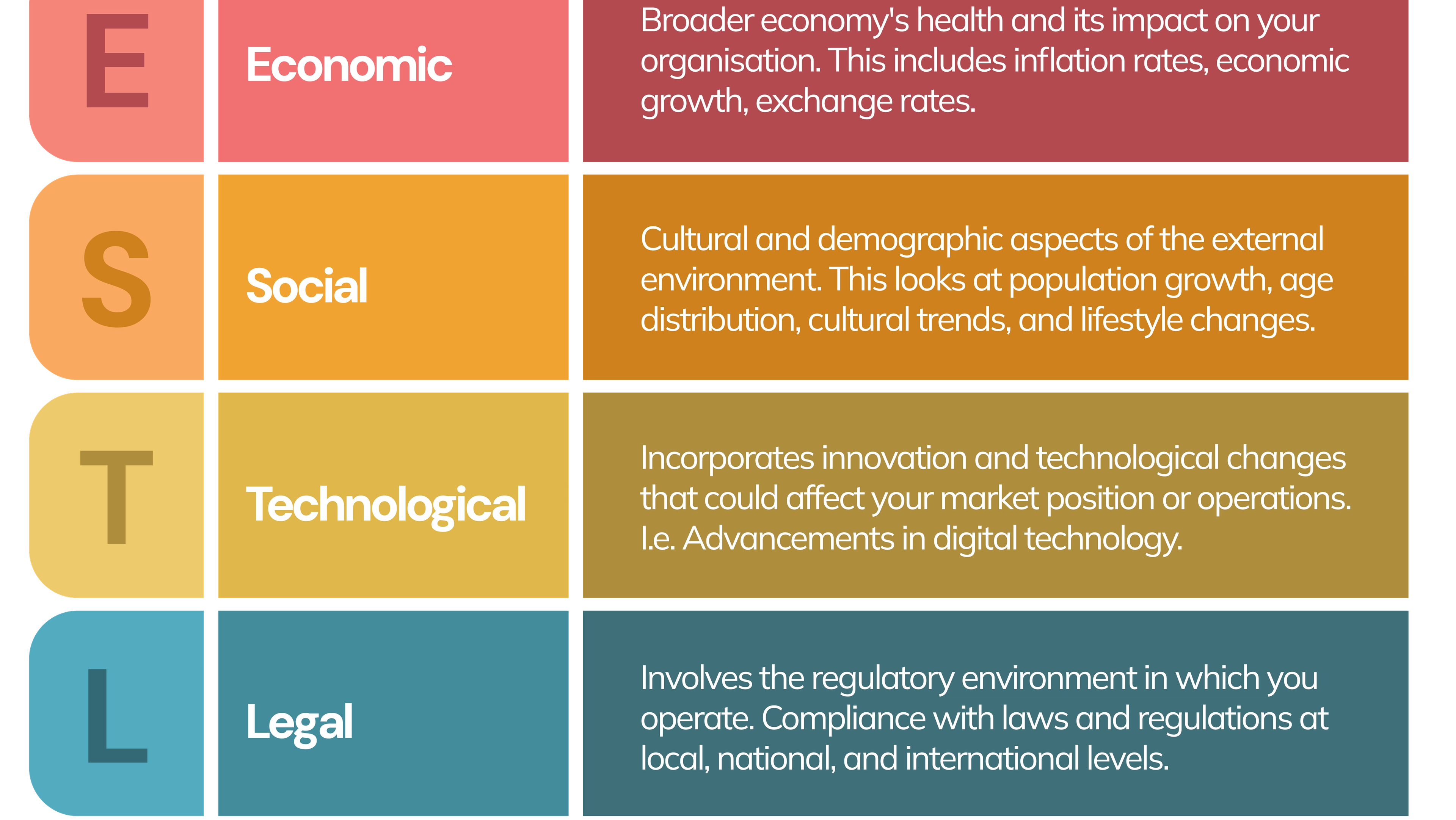
A PESTLE Analysis is a framework for scanning the external environment across six areas - Political, Economic, Social, Technological, Legal, and Environmental. It helps organisations understand the bigger forces that could affect their strategy and planning.
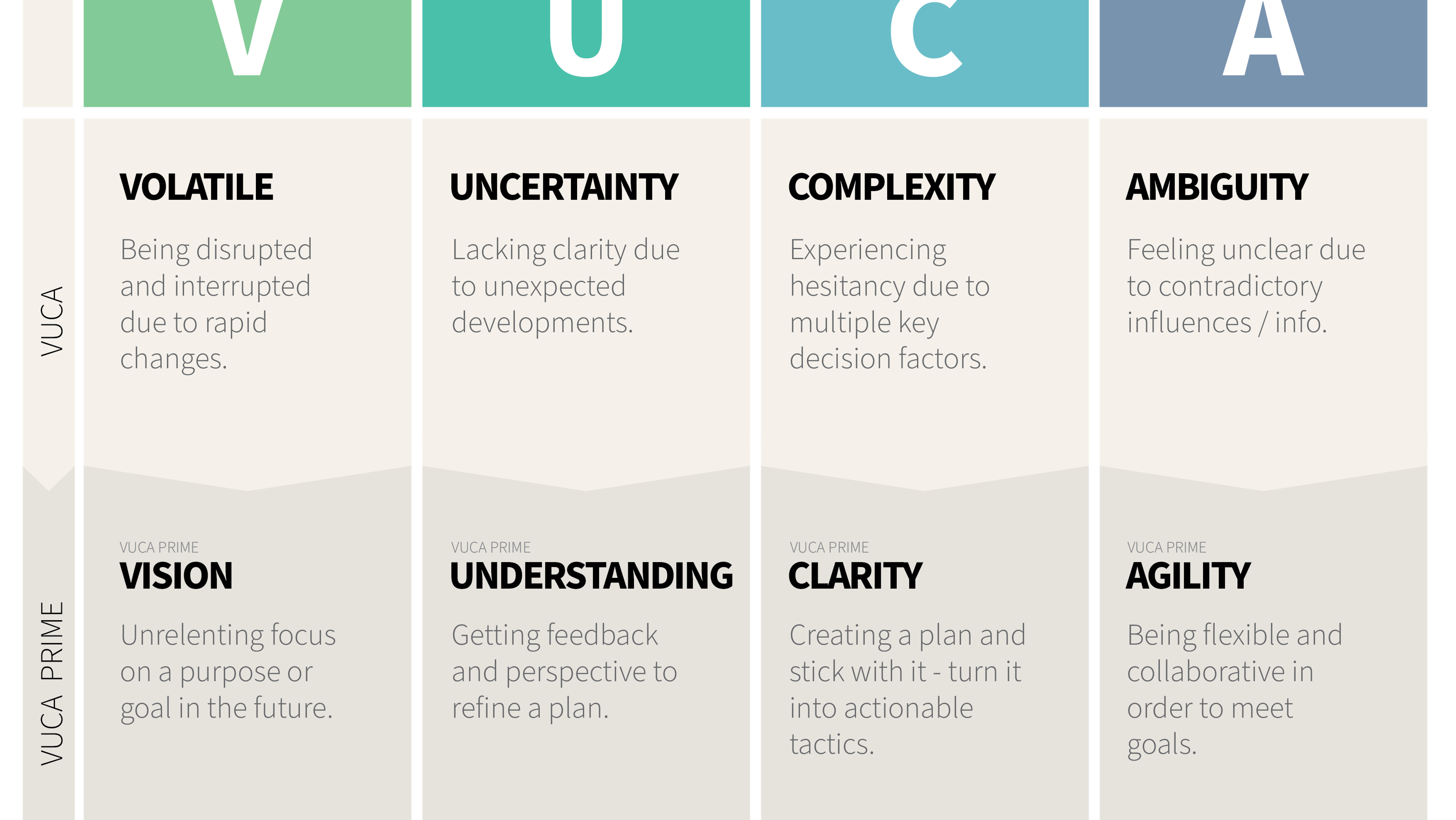
VUCA Prime is a leadership response framework for navigating Volatility, Uncertainty, Complexity, and Ambiguity. It pairs each challenge with a counter-strategy - Vision, Understanding, Clarity, and Agility - to help leaders act effectively in turbulent environments.
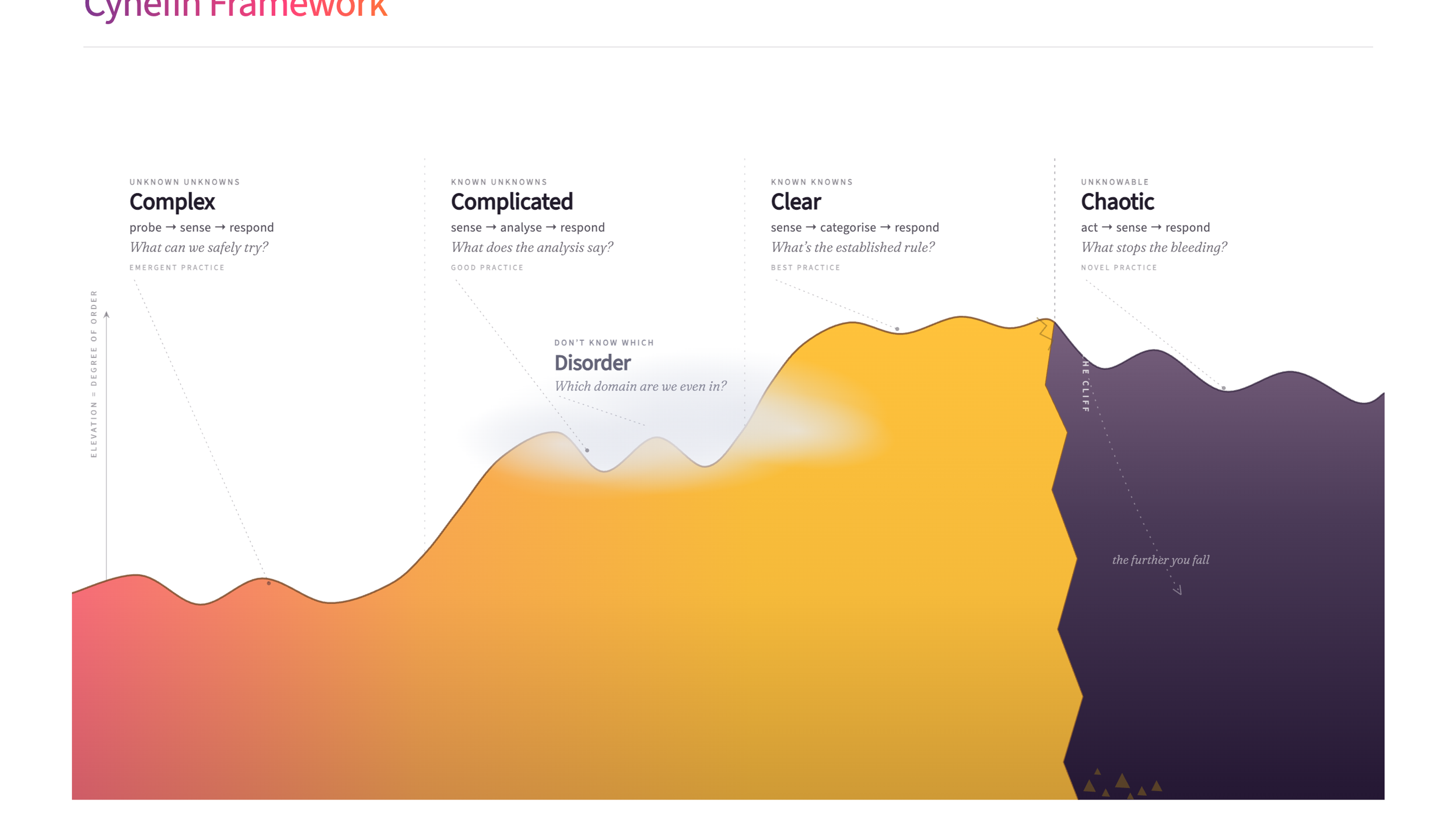
The Cynefin Framework is a decision-making model that helps leaders understand what kind of situation they're dealing with - clear, complicated, complex, chaotic, or confused. The right approach depends on the context, and this framework helps you match the two.
Why futures thinking needs to become an everyday organisational capability rather than an occasional planning exercise. This article explores how developing future literacy helps organisations navigate uncertainty with confidence.

Resilience isn't about bouncing back to where you were. It's about developing the capacity to adapt, learn, and come through difficulty stronger than before. This article explores what organisational resilience actually looks like and what leaders can do to build it.
Scenario Planning Workshop
The 2x2 matrix is the engine of a good scenario session; our Scenario Planning workshop is the day your team learns to build and use one.
James Freeman-Gray is the founder of Mutomorro. He's an organisational development practitioner who has spent over twenty years working with leaders across public, private and nonprofit sectors - helping organisations pull together around a common purpose, joined up in how they work. More about who we are and what it's like to work with us.
Scenario planning with a 2x2 matrix helps organisations prepare for uncertainty without pretending they can predict the future. I've used it with leadership teams to stress-test their strategy against multiple possible futures, which builds confidence and flexibility. The value isn't in getting the scenarios right - it's in having rehearsed your response.
Last reviewed: May 2026
Ready to use 2×2 Scenario Matrix?
Download the free template - includes practical guidance for workshops and team sessions.
Get the free template
Want to put these ideas into practice?
Whether you're navigating a merger, rethinking how you're structured, or trying to shift a culture that isn't working - underneath, it's the same job: getting the whole organisation pulling in the same direction. Start with a conversation.