PESTLE Analysis
A PESTLE Analysis is a framework for scanning the external environment across six areas - Political, Economic, Social, Technological, Legal, and Environmental. It helps organisations understand the bigger forces that could affect their strategy and planning.
Get the free template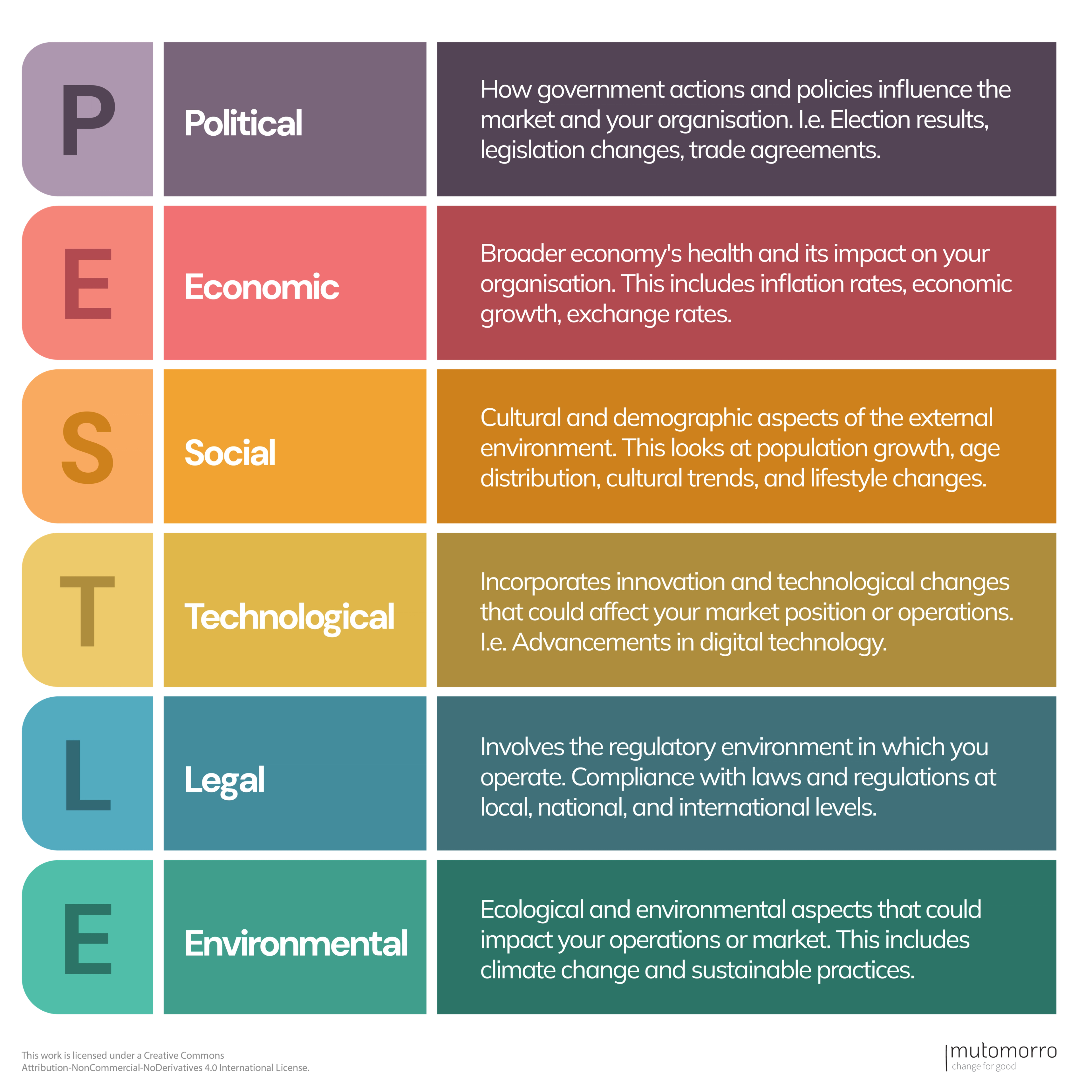
What is a PESTLE Analysis?
A PESTLE analysis is a framework for scanning the external environment across six areas - Political, Economic, Social, Technological, Legal and Environmental. You work through each area in turn, listing the outside forces that could affect your organisation, then judge which of them matter enough to act on. The output is a shared picture of the landscape you operate in - and an early warning of the parts of it that are moving.
This page gives you everything you need to run one: a free PESTLE analysis template, a plain-English walkthrough of all six areas, a full worked example for a UK housing association, and a comparison with PEST, STEEPLE and SWOT so you can check you're holding the right tool before you start.
Unlike most strategy models, PESTLE deliberately looks outward - it zooms past the organisation and asks what's happening in the wider system around it. That's why it turns up so often in charity risk management: it's a structured way to assess the external challenges that could destabilise the landscape an organisation works in, exactly the territory the Charity Commission's risk-management guidance (CC26) asks trustees to cover. The CIPD recommends it for much the same reason - it puts external evidence in front of managers making strategic decisions. The Iceberg Model pairs well here - where PESTLE scans the surface-level forces, the Iceberg helps you trace those forces down to the underlying patterns and structures that drive them.
Nonprofits and charities have particular reason to look outward. The funding landscape in some areas is changing quickly, and the volatility and uncertainty in our global systems mean that organisations watching only their own operations get caught out by forces they never saw coming.
Background to the PESTLE Analysis
PESTLE grew out of the earlier PEST analysis - a four-area version of the same idea that emerged from environmental-scanning work in the 1960s. As the world became more complex, the model grew with it. Legal was added as employment protections strengthened and organisations found themselves operating across more jurisdictions; Environmental was added as climate, supply chains and sustainability moved from the margins of strategy to the middle of it. The extra letters aren't decoration - they mark two categories of external force that now regularly decide whether strategies succeed or fail.
Uses for a PESTLE Analysis
A PESTLE analysis is versatile. Most organisations reach for it when they're planning - a new corporate strategy, a strategic shift, a new service, or entry into a new market or region. It's just as useful for risk management: working through the six areas is a disciplined way to surface external risks that never make it onto an internally focused risk register. And it earns its keep in compliance and horizon-scanning, where spotting a legal or regulatory change early is worth far more than reacting to it late.
It isn't only a threat detector. Working through the six areas often reveals gaps - needs that no other organisation is addressing, or areas where government support has fallen away. That makes it a genuinely useful tool if you're looking to pivot or to redefine your purpose and social impact. The social area, in particular, tends to surface cultural trends and workforce shifts that matter well beyond marketing.
Two things turn a scan into something you can act on. First, translate what you find into a clear problem statement - naming what specifically needs addressing is what moves you from scanning to action. Second, if you're a nonprofit or charity working overseas, use the analysis to test your assumptions about the contexts you deliver in. It works well as a light-touch cultural assessment, making sure local realities and sensitivities are taken into account before they become delivery problems.
6 Areas in the PESTLE Analysis
A PESTLE analysis breaks the external environment into six broad areas, each one a different lens on the world outside your organisation. Here's what each area covers, with a short set of examples and a note on how it tends to land for nonprofits and charities.
Political
Political factors are about how government actions and priorities shape the environment you operate in - everything from tax policy and trade agreements to which problems a government decides are worth funding. Political landscapes can change quickly, and a change of government usually means a change of priorities. Reading those shifts early is the difference between preparing and reacting - and sometimes between missing an opportunity and catching it.
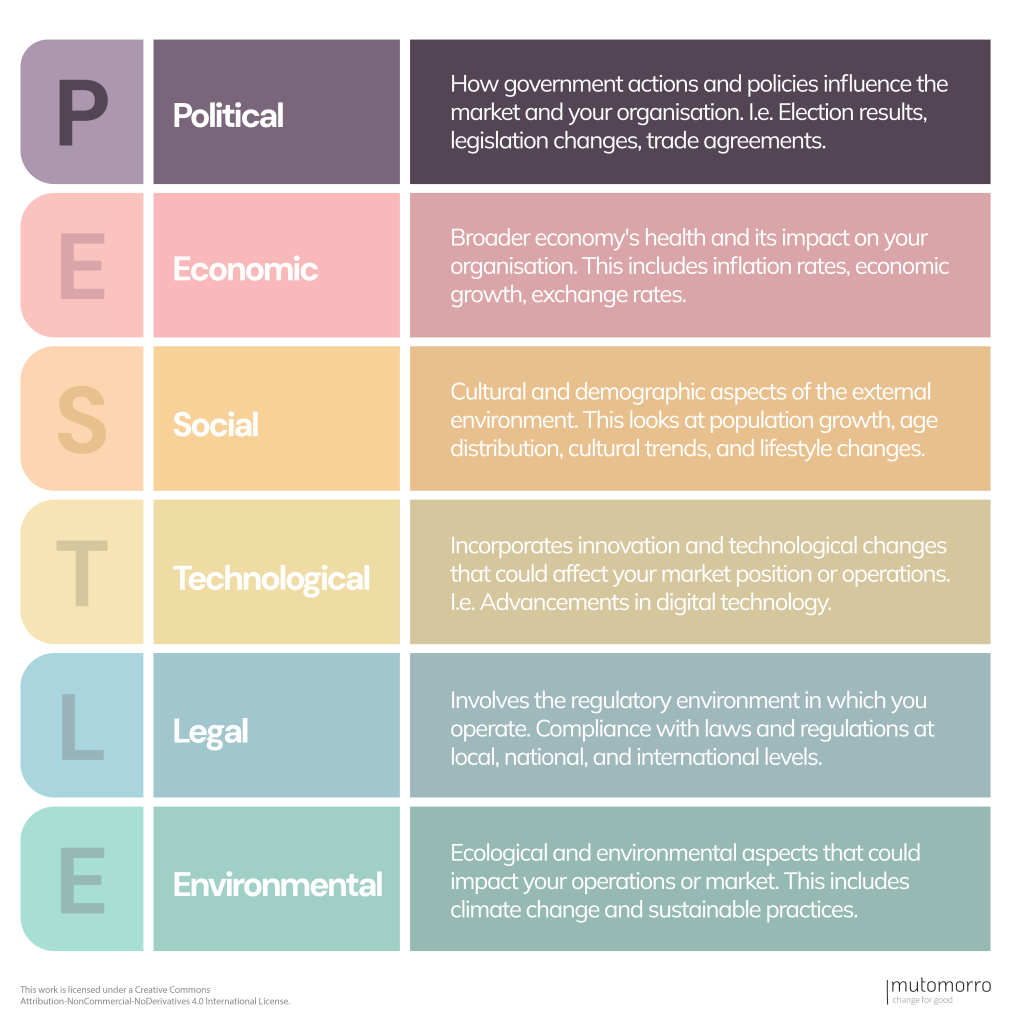
For example: election results, changes to legislation, trade agreements, or a sudden shift in government priorities.
For nonprofits and charities the political area often matters most, because so much of the sector's funding and legitimacy flows from political choices. Commissioning priorities move, regulation tightens or loosens, and a programme that fitted one government's agenda can sit awkwardly with the next one's. If your income or your beneficiaries depend on public policy, this is the lens to spend the most time behind.
Economic
Economic factors cover the health of the wider economy and what it does to your organisation - inflation, growth, interest rates, exchange rates, employment. At one level this is about spending power and behaviour. But downturns don't spread their pain evenly: they hit vulnerable groups hardest and drain funding from critical areas at exactly the moment demand rises. A decade and a half of austerity in the UK, for example, has had a considerable impact on essential services for the most vulnerable in society.
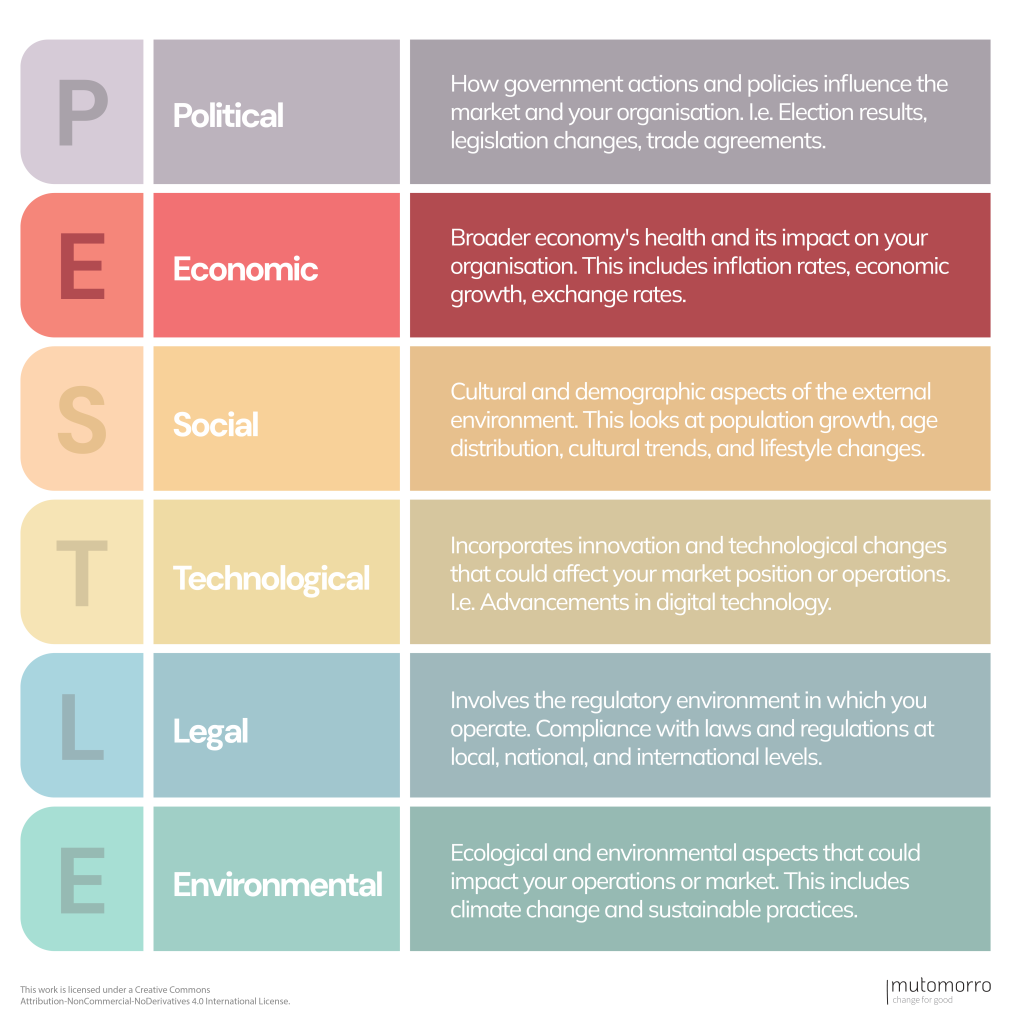
For example: inflation, interest rates, unemployment, and exchange-rate movements.
Charities feel economic shifts twice - once through income, as household donations and grant budgets tighten, and again through demand, as the same pressures push more people towards their services. Naming that double squeeze in an economic scan, rather than discovering it mid-year, is one of PESTLE's most practical payoffs for the sector.
Social
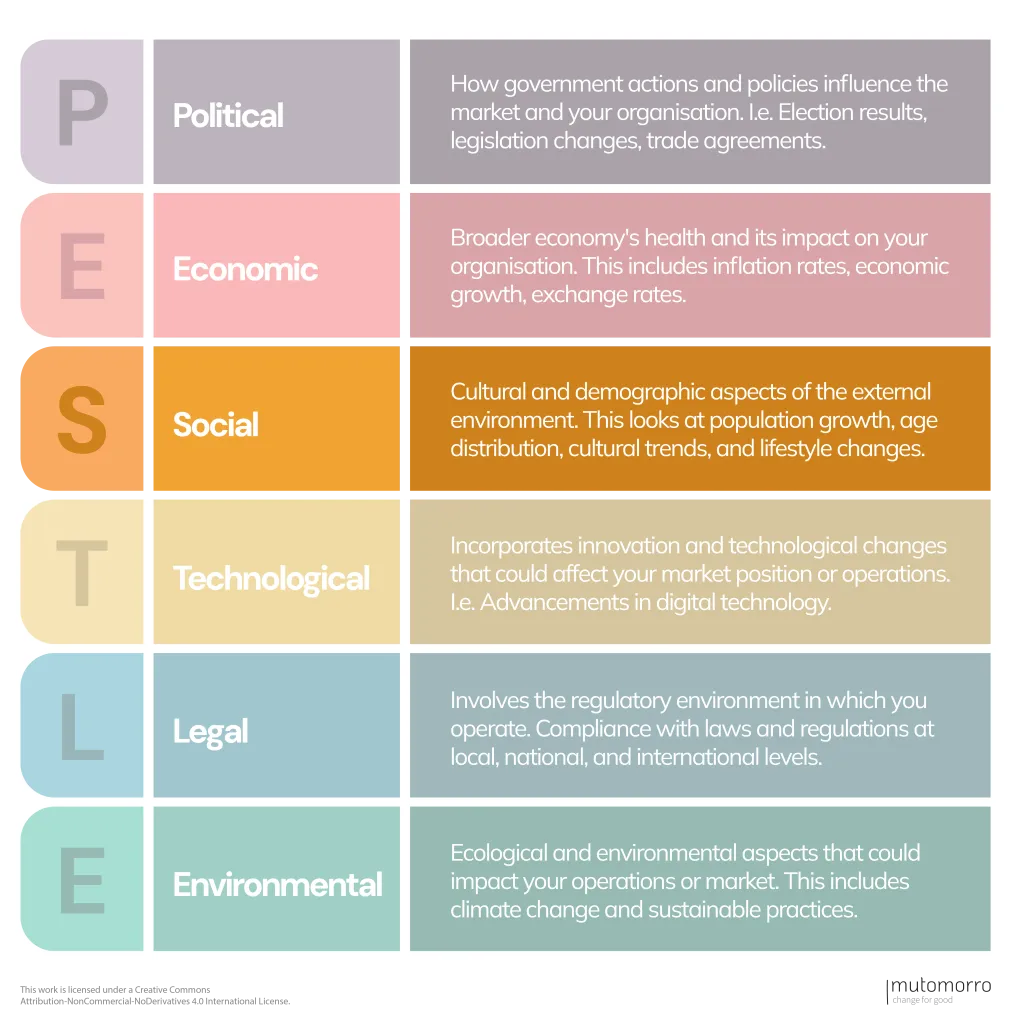
Social factors examine the cultural and demographic shape of the world around you - population growth, age distribution, lifestyle changes and shifting public attitudes. These forces can be slow-moving, which makes them easy to ignore, but they change markets and needs profoundly. Rising environmental awareness has put real pressure on organisations to work more sustainably; the shift to smaller households has quietly driven up demand for housing.
For example: changing family structures, shifting lifestyle trends, population demographics, and public attitudes.
For nonprofits, demographic change gradually rewrites who your beneficiaries are and what they need - and it reshapes your workforce and volunteer base at the same time. An empathy map can add depth to this part of the analysis - mapping what your audiences think, feel and experience takes you beyond demographic data to a richer understanding of social context.
Technological
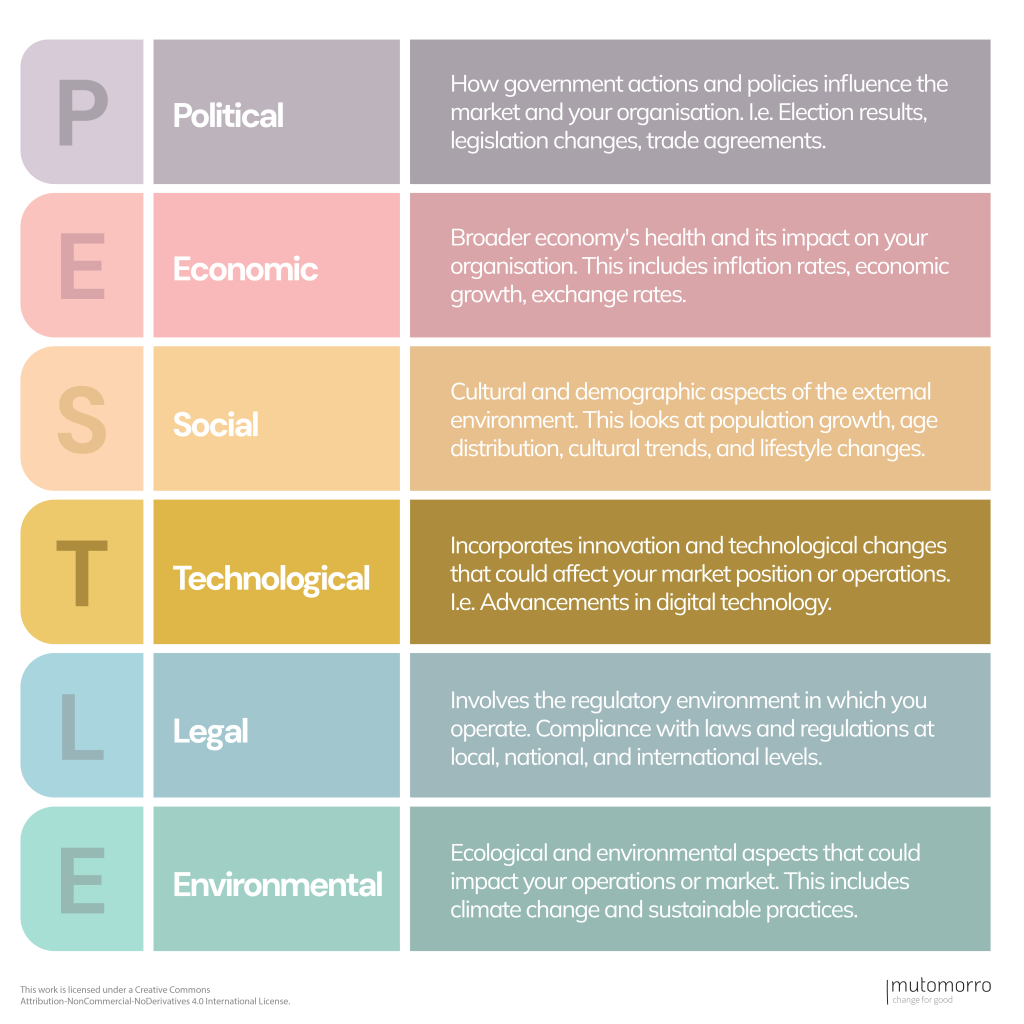
Technological factors are about innovation and the change it forces - or offers. This area keeps growing in scope and impact: technology now shapes how organisations deliver services, how they communicate, and how well they understand the people they serve. It's also worth turning the lens around. For organisations working internationally or with specific groups, understanding how your audience uses technology - and what they can actually access - matters as much as what you adopt yourself.
For example: advances in AI and automation, new communication channels, cyber-security threats, and changing patterns of access to technology.
For charities the technology question cuts both ways. Digital delivery can widen reach at low cost, but it can also quietly exclude the very people an organisation most needs to reach. And a sector that routinely holds sensitive data about vulnerable people carries security obligations it hasn't always resourced properly.
Legal
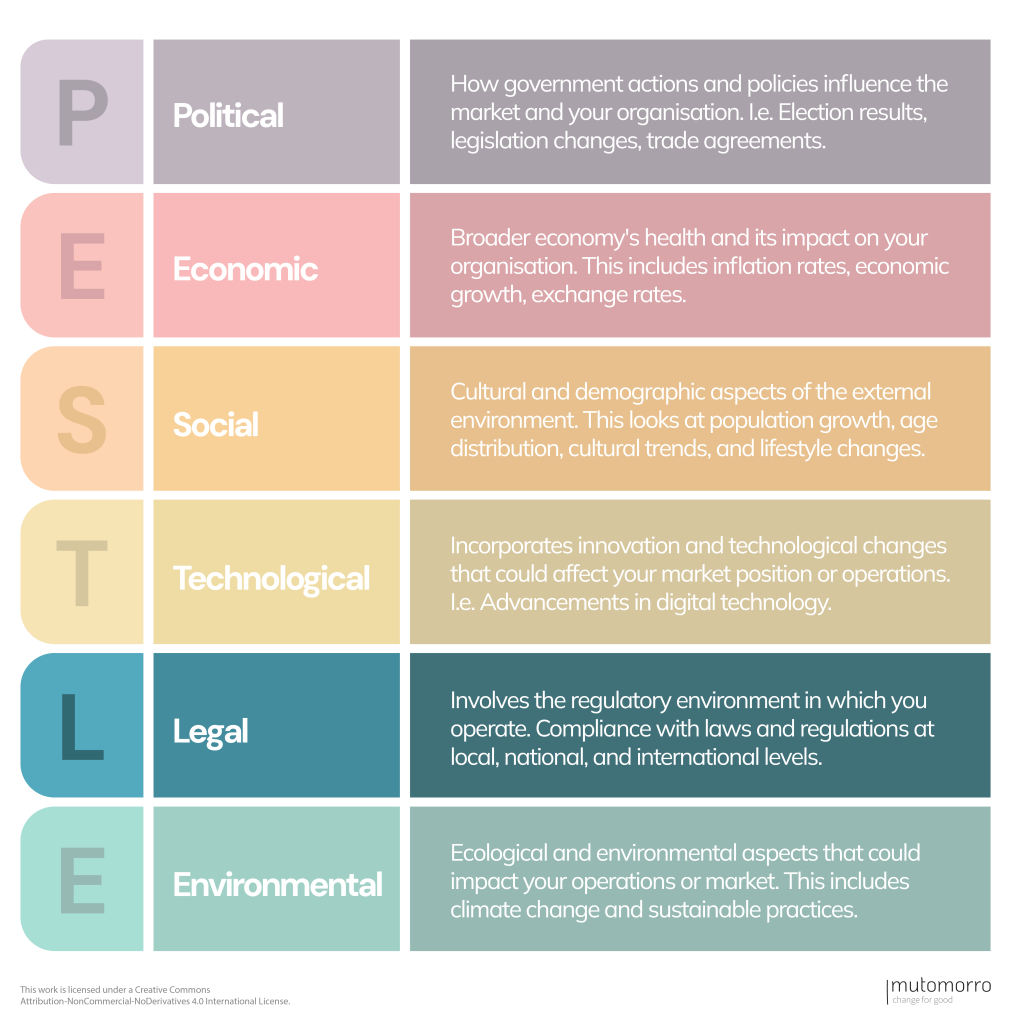
Legal factors cover the regulatory environment you operate in - compliance with laws and regulations at local, national and international level. This is the area most likely to carry hard deadlines: legislation lands whether you're ready or not, and the cost of adjusting policies, procedures and contracts is real.
For example: employment law, health and safety regulation, data protection, and consumer protection.
For charities the legal lens takes in a distinctive extra layer - charity law, safeguarding duties and fundraising standards - on top of everything that applies to any employer. Data protection deserves particular attention: nonprofits routinely hold sensitive information about the people they support, and the obligations that come with that are easy to underestimate.
Environmental
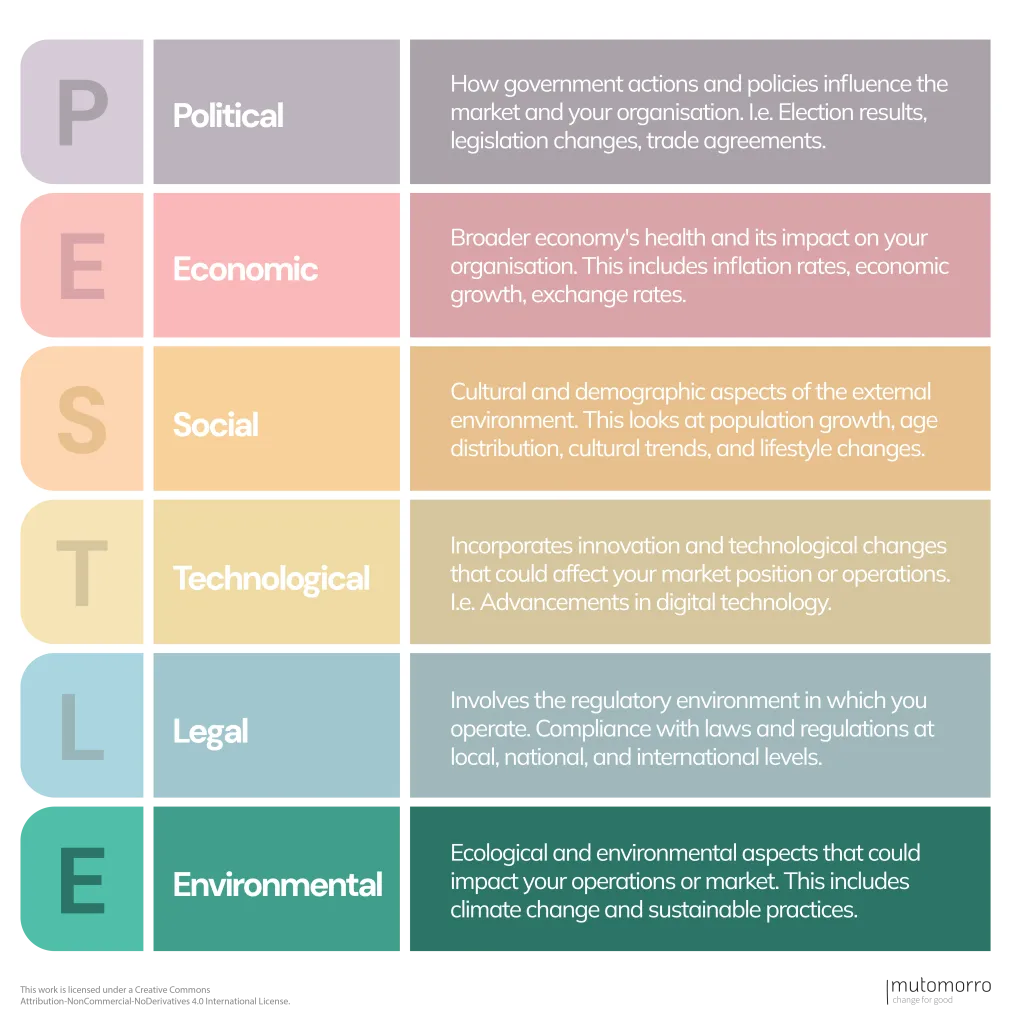
Environmental factors look at the ecological pressures on your operations and on the people you serve - climate change, energy, waste, and the growing expectation that organisations can show credible environmental commitments. What was once a corporate-responsibility footnote is now a driver of cost, regulation and reputation - and increasingly a driver of innovation.
For example: climate change impacts, energy costs, waste and emissions regulation, and extreme-weather risk.
Charities meet this area from both directions. Their premises, travel and supply chains carry environmental costs and rising energy bills, while the communities they serve are often the ones most exposed to climate impacts. Funders increasingly ask credible questions about both.
PESTLE vs PEST vs STEEPLE vs SWOT
PESTLE sits in a family of similar-sounding frameworks, and choosing between them is simpler than it looks.
Framework | What it covers | When to reach for it |
|---|---|---|
PESTLE | Six external areas: Political, Economic, Social, Technological, Legal, Environmental | The default for a full external scan - broad enough for most organisations without becoming unwieldy |
PEST | The original four areas: Political, Economic, Social, Technological | A quicker scan when legal and environmental forces genuinely aren't significant for you - which is rarer than it sounds |
STEEPLE | PESTLE plus an explicit Ethical area | When ethical questions - data use, funding sources, supply chains - are central enough to deserve their own lens rather than being spread across the other six |
SWOT | Strengths, Weaknesses, Opportunities, Threats - internal and external together | When you want a single picture of your overall position; PESTLE output feeds the Opportunities and Threats half |
They combine well. A common pattern is to run PESTLE first, then carry the strongest findings into the external half of a SWOT - so the SWOT is built on evidence rather than on whatever the room happened to remember.
PESTLE analysis example: a housing association planning its next corporate strategy
Here's how a PESTLE analysis plays out in practice. A mid-sized UK housing association is due to write its next corporate strategy, and wants to test its assumptions about the operating environment before committing to anything. The team runs a PESTLE workshop and works through the six areas.
Political. Housing policy emphasis keeps moving - between building new homes and investing in existing stock - and grant funding moves with it. Devolution is shifting decisions about housing and regeneration towards regional bodies the association hasn't historically worked with. Planning reform could change what gets built where, and how quickly.
Economic. The interest-rate environment sets the cost of the borrowing the development programme depends on. Construction cost inflation squeezes the same programme from the other side. And cost-of-living pressure on tenants feeds through to arrears and hardship demand - income and demand moving in opposite directions at once.
Social. The tenant population is ageing, which changes what adaptations, support and services will be needed over the strategy period. Household sizes and structures are shifting, changing demand across the stock. And expectations of tenant voice keep rising - residents increasingly expect to shape decisions, not hear about them afterwards.
Technological. Tenants increasingly expect the digital self-service they get everywhere else. Sensor and stock-condition data could transform how homes are maintained - damp, mould and heat loss spotted early rather than reported late. Both depend on data the organisation holds securely, so cyber resilience moves up the list.
Legal. Building-safety legislation continues to raise the bar - and the cost - of compliance across the stock. Consumer regulation of social housing is strengthening, with more attention on complaints, transparency and the condition of homes. And new duties around damp and mould hazards raise the standard for how quickly problems must be dealt with.
Environmental. The stock needs retrofit and decarbonisation investment over decades, and the strategy has to sequence that against everything else. Energy-efficiency standards keep tightening. And parts of the stock sit in places where flood and overheating risk is growing.
Pulled into one view:
Area | What the scan surfaced | What it means for the strategy |
|---|---|---|
Political | Shifting policy emphasis, devolution, planning reform | Build flexibility into the development programme; invest in new regional relationships |
Economic | Rates, construction inflation, tenant hardship | Stress-test the plan against borrowing costs; expect income and demand pressure together |
Social | Ageing tenants, changing households, tenant voice | Design services and involvement in from the start, not bolted on later |
Technological | Digital expectations, stock data, cyber resilience | Treat data and digital as core infrastructure, not add-ons |
Legal | Building safety, consumer regulation, hazard duties | Compliance is non-negotiable spend - plan it first |
Environmental | Retrofit, efficiency standards, climate risk | A decades-long investment programme the financial plan has to carry |
The value isn't the table - it's that the strategy conversation now starts from a shared, tested view of the landscape instead of six private ones. Two or three of these forces will end up shaping the whole strategy; the scan is how the team finds out which.
Limitations of the PESTLE Analysis
PESTLE is a powerful scanning tool, but it has clear limits, and it works best when you respect them.
It only looks outward. PESTLE deliberately ignores internal factors - capability, culture, finances - that can matter just as much as anything in the environment. Use it alongside an honest internal picture, so that external insight feeds real strategic alignment rather than sitting apart from it.
It dates quickly. The external environment doesn't hold still, so a PESTLE analysis is a snapshot with a shelf life. An analysis more than a year old is mostly a record of what the world used to look like - build in a refresh rhythm rather than treating it as a one-off exercise.
It's subjective. Different rooms produce different lists. Who you involve, what they read, and what they're worried about all shape the output. You can't remove that entirely, but a structured process with a genuinely mixed group narrows it a lot.
It can bury you in information. Six areas, honestly worked, produce long lists - and the discipline that matters is prioritisation, not collection. The Cynefin Framework can help you categorise what you've found - distinguishing the factors that are merely complicated from those that are genuinely complex.
It describes, but doesn't decide. A finished PESTLE is a picture, not a plan. The work that changes anything - choosing which forces to plan around, and what to do about them - starts when the scan ends.
Used with those limits in mind - refreshed regularly, prioritised ruthlessly, and connected to your internal picture - PESTLE remains one of the most accessible ways to build future literacy into how your organisation plans.
Run your own PESTLE analysis
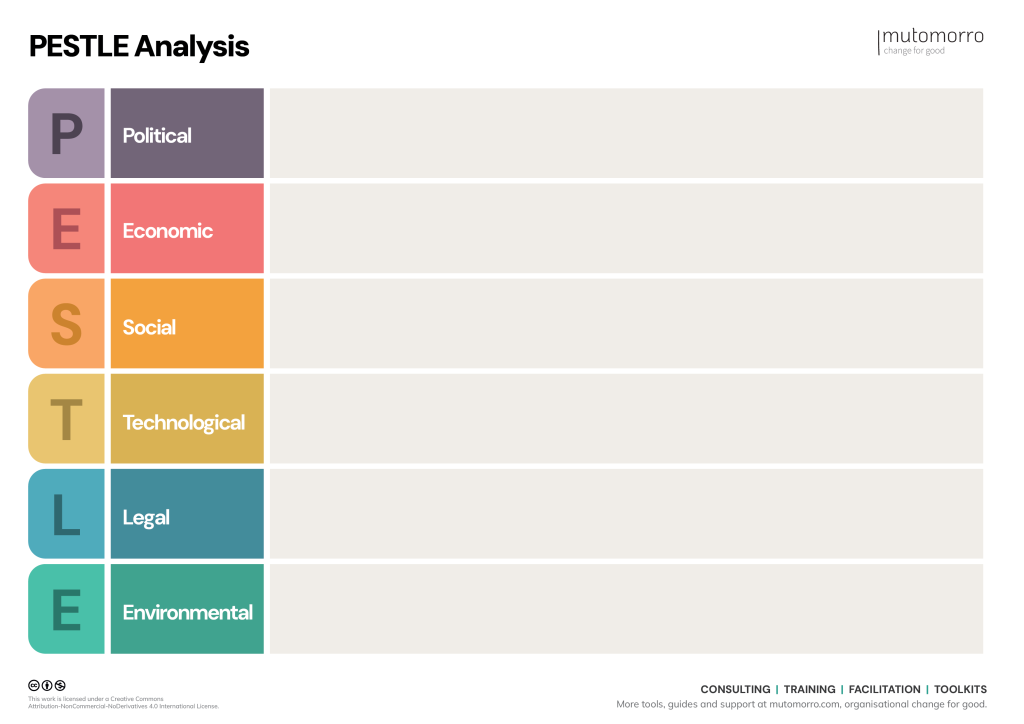
Our free PESTLE analysis template gives you all six areas laid out ready for a structured pass, with prompts in each section to help you identify the factors relevant to your context, judge their potential impact, and see how they might interact with each other. It's built to be used with a team - print it for a workshop wall, or work through it together on screen.
Download the free PESTLE analysis template - it's a PDF, and it's yours straight away.
For a practical guide to acting on what your analysis reveals, see our article on building organisational resilience.
PESTLE analysis FAQs
Is PESTLE analysis free to use?
Yes. PESTLE is a generic framework, not a proprietary product - there's no licence, no certification and nothing to buy. Our PESTLE analysis template is free to download too.
PESTLE or PEST - which should I use?
Use PESTLE unless you have a positive reason not to. PEST is quicker, but the two areas it drops - Legal and Environmental - are exactly the ones that have grown most in importance over the last two decades. If legal and environmental forces genuinely don't touch your work, PEST is fine; for most organisations, they do.
How often should we refresh a PESTLE analysis?
Treat it as a living document rather than an annual event. A sensible rhythm is a full refresh once a year - usually alongside business planning - with a lighter check whenever something significant shifts: a change of government, a major regulatory announcement, a budget. The analysis dates faster than most teams expect.
Who should be in the room?
More people than just the leadership team. The people closest to delivery see external forces first - frontline staff hear what's changing for the people you serve long before it shows up in a report. For charities, trustees bring a governance perspective and often a useful outside view. A mixed group takes longer, but it's the best defence against the subjectivity that's PESTLE's biggest weakness.
What comes after a PESTLE analysis?
Prioritise, then plan for uncertainty. Pick out the small number of forces with the highest potential impact and the highest uncertainty - those are the ones your strategy needs to be ready for. The 2x2 Scenario Matrix is the natural next step: it helps you take your PESTLE insights further, exploring how different forces might combine to create distinct future scenarios you can plan and prepare for.
Sources and further reading
We share thinking on organisational change and development on LinkedIn - practical ideas for people doing this work inside their own organisations.
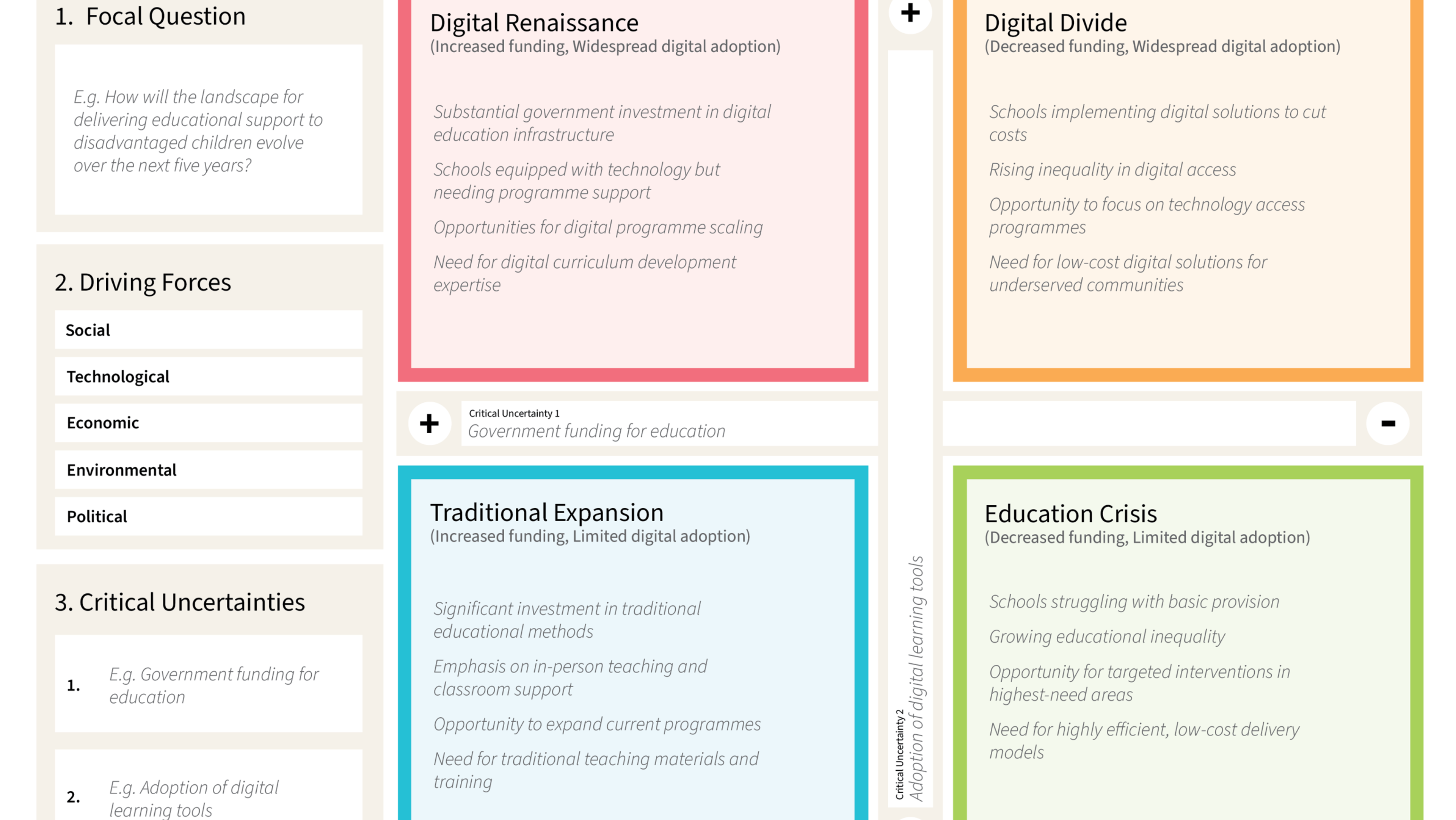
The 2x2 Scenario Matrix is a strategic planning tool that helps organisations explore different possible futures. By mapping two key uncertainties against each other, it creates four distinct scenarios you can plan and prepare for.
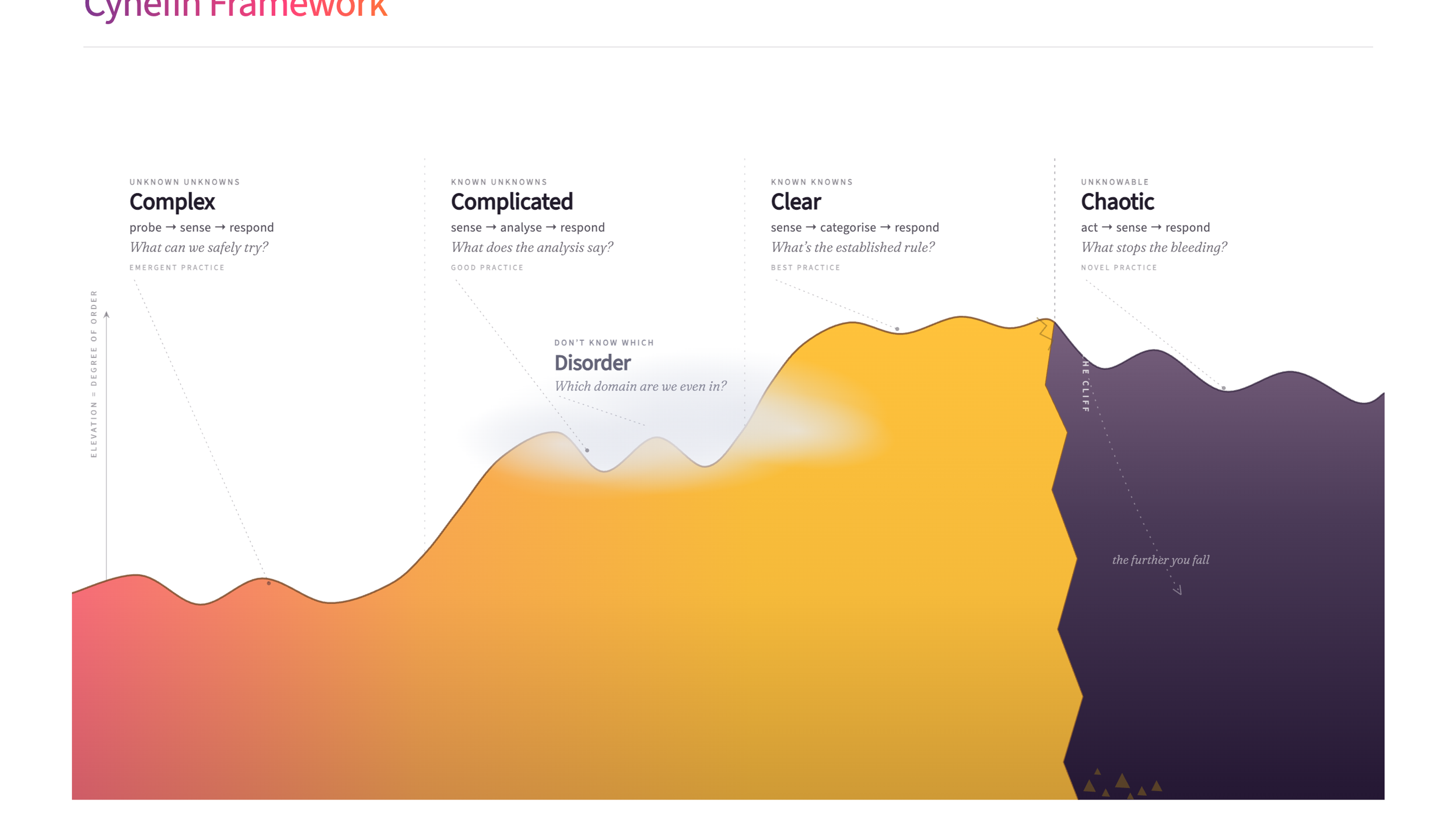
The Cynefin Framework is a decision-making model that helps leaders understand what kind of situation they're dealing with - clear, complicated, complex, chaotic, or confused. The right approach depends on the context, and this framework helps you match the two.
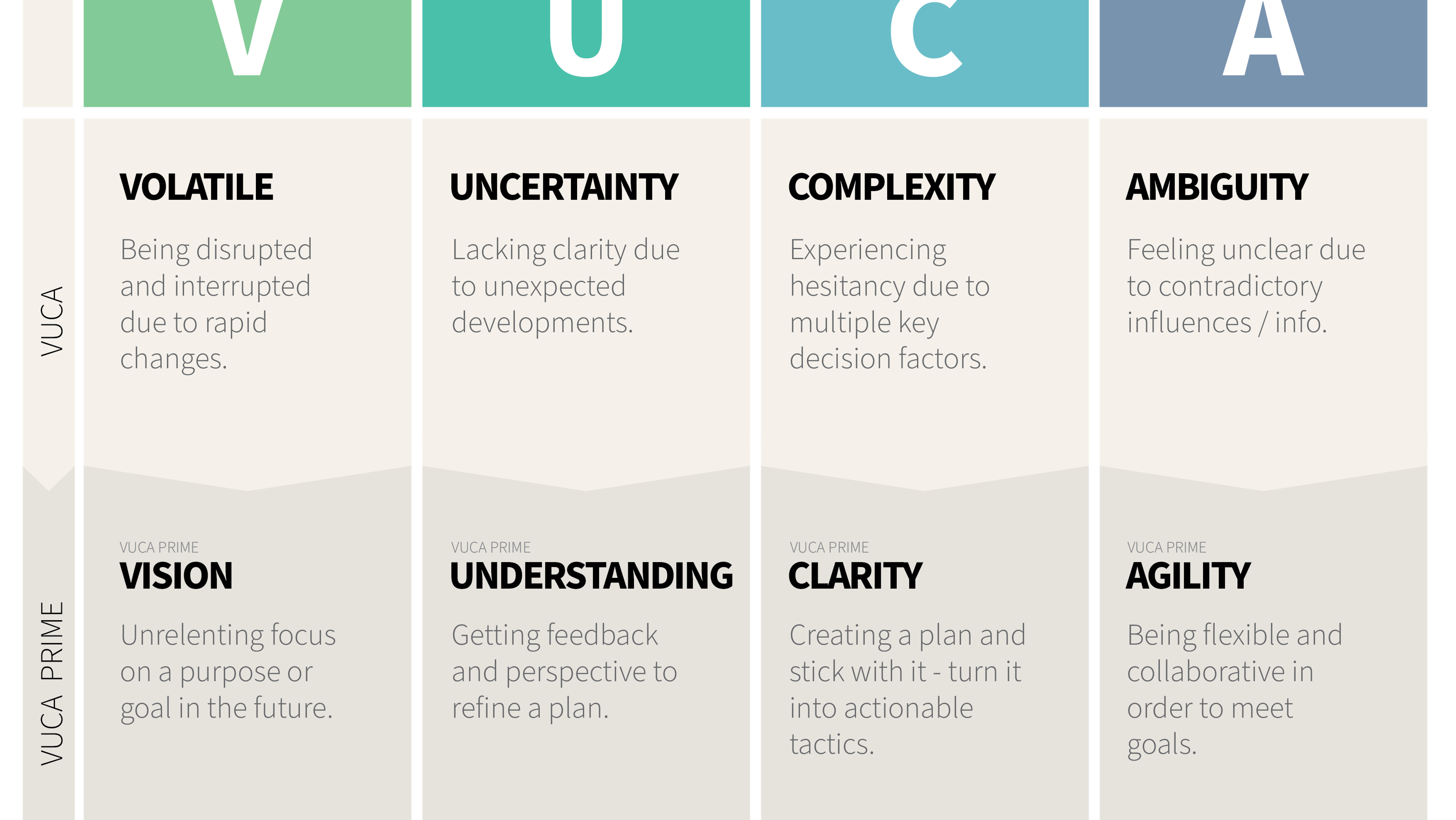
VUCA Prime is a leadership response framework for navigating Volatility, Uncertainty, Complexity, and Ambiguity. It pairs each challenge with a counter-strategy - Vision, Understanding, Clarity, and Agility - to help leaders act effectively in turbulent environments.
Why futures thinking needs to become an everyday organisational capability rather than an occasional planning exercise. This article explores how developing future literacy helps organisations navigate uncertainty with confidence.

Resilience isn't about bouncing back to where you were. It's about developing the capacity to adapt, learn, and come through difficulty stronger than before. This article explores what organisational resilience actually looks like and what leaders can do to build it.
Scenario Planning Workshop
PESTLE helps you scan what is changing around you, and it feeds directly into our Scenario Planning workshop, where your team learns to plan for it.
James Freeman-Gray is the founder of Mutomorro. He's an organisational development practitioner who has spent over twenty years working with leaders across public, private and nonprofit sectors - helping organisations pull together around a common purpose, joined up in how they work. More about who we are and what it's like to work with us.
PESTLE is the tool I use to help organisations look outward when they've become too inwardly focused. Working through the six lenses together - political, economic, social, technological, legal, and environmental - always surfaces factors that a leadership team has been ignoring or underestimating. It's a discipline for seeing the whole landscape.
Last reviewed: July 2026
Ready to use PESTLE Analysis?
Download the free template - includes practical guidance for workshops and team sessions.
Get the free template
Want to put these ideas into practice?
Whether you're navigating a merger, rethinking how you're structured, or trying to shift a culture that isn't working - underneath, it's the same job: getting the whole organisation pulling in the same direction. Start with a conversation.