Systems thinking training
This Introduction to Systems Thinking workshop is designed to give decision makers a solid foundation in the tools, approaches and practical applications to system thinking.
Every organisation is a system. Not a machine with separate parts - a living system where everything connects. How teams collaborate affects how services are delivered. How decisions flow affects how quickly things change. How knowledge moves affects how capable the organisation becomes.
Systems thinking is the skill of seeing these connections. Instead of looking at problems in isolation, you learn to see the patterns that connect them - the feedback loops, the unintended consequences, the leverage points where a small change can make a big difference.
The Cynefin Framework helps you categorise the complexity of different challenges, so you can choose the right approach for each one.
The Iceberg Model is one of the core tools you will use - helping you see how surface events are connected to deeper patterns, structures and mental models.
This course teaches your team to think in systems. It is a practical day where you will learn core systems thinking tools and apply them directly to real challenges in your organisation.
What you will work on
You will spend the day learning to see your organisation differently - not as a collection of departments and processes, but as an interconnected system. You will apply systems thinking tools to real challenges from your own work.
The day covers three areas:
Seeing the system - Most problems look simple until you see what is connected to them. You will learn to map the systems around a challenge - identifying feedback loops, delays, and connections that are not obvious from inside the problem. A team that is struggling with delivery might be dealing with a workload issue - or it might be a symptom of something structural three levels away. Systems thinking helps you tell the difference.
Understanding patterns - Organisations tend to fall into recognisable patterns. Growth that creates its own constraints. Quick fixes that make the underlying problem worse. Success in one area that quietly undermines another. You will learn to recognise these patterns using system archetypes - powerful diagnostic tools that help you see why the same problems keep recurring.
Finding leverage - In any system, there are points where intervention has a disproportionate effect. Systems thinking helps you find them. Instead of pushing harder on something that is not working, you learn to find the places where a different kind of intervention will shift the whole pattern. This is the difference between solving a problem and changing the system that produces it.
Who this is for
This course is for leaders, managers, and change practitioners who want to understand how their organisation really works - and use that understanding to make better decisions. It is particularly valuable for people who find themselves dealing with problems that keep coming back, initiatives that do not deliver what was expected, or improvements in one area that seem to create problems in another.
No prior knowledge of systems thinking is needed. The concepts are powerful but accessible - we teach them through practical application, not academic theory.
What you will take away
You will leave with a practical toolkit for systems thinking that you can apply immediately - causal loop diagrams, systems maps, and archetype recognition. You will also have a different way of seeing your organisation that makes complex problems feel more navigable. Most importantly, you will have applied these tools to a real challenge during the session, so you know they work in your context.
How the session works
The day alternates between short input on systems thinking concepts and hands-on exercises where you apply them to real organisational challenges. You will work in small groups, mapping systems, identifying patterns, and finding leverage points together. The facilitator draws on a wide range of systems thinking approaches, adapted to fit your context.
What makes this different
Systems thinking is a foundational skill for building organisational resilience - the ability to adapt and thrive when conditions change.
A lot of systems thinking training stays abstract - interesting ideas that are hard to apply. This course is relentlessly practical. Every concept is taught through application to real challenges. You will not just learn about feedback loops - you will map the ones operating in your organisation right now.
We also connect systems thinking to action. Seeing the system is not enough. You need to know what to do with what you see. We help you move from diagnosis to intervention - finding the leverage points where change will actually shift the pattern, not just treat the symptoms. That connection between seeing and acting is what makes systems thinking genuinely useful for organisational change.
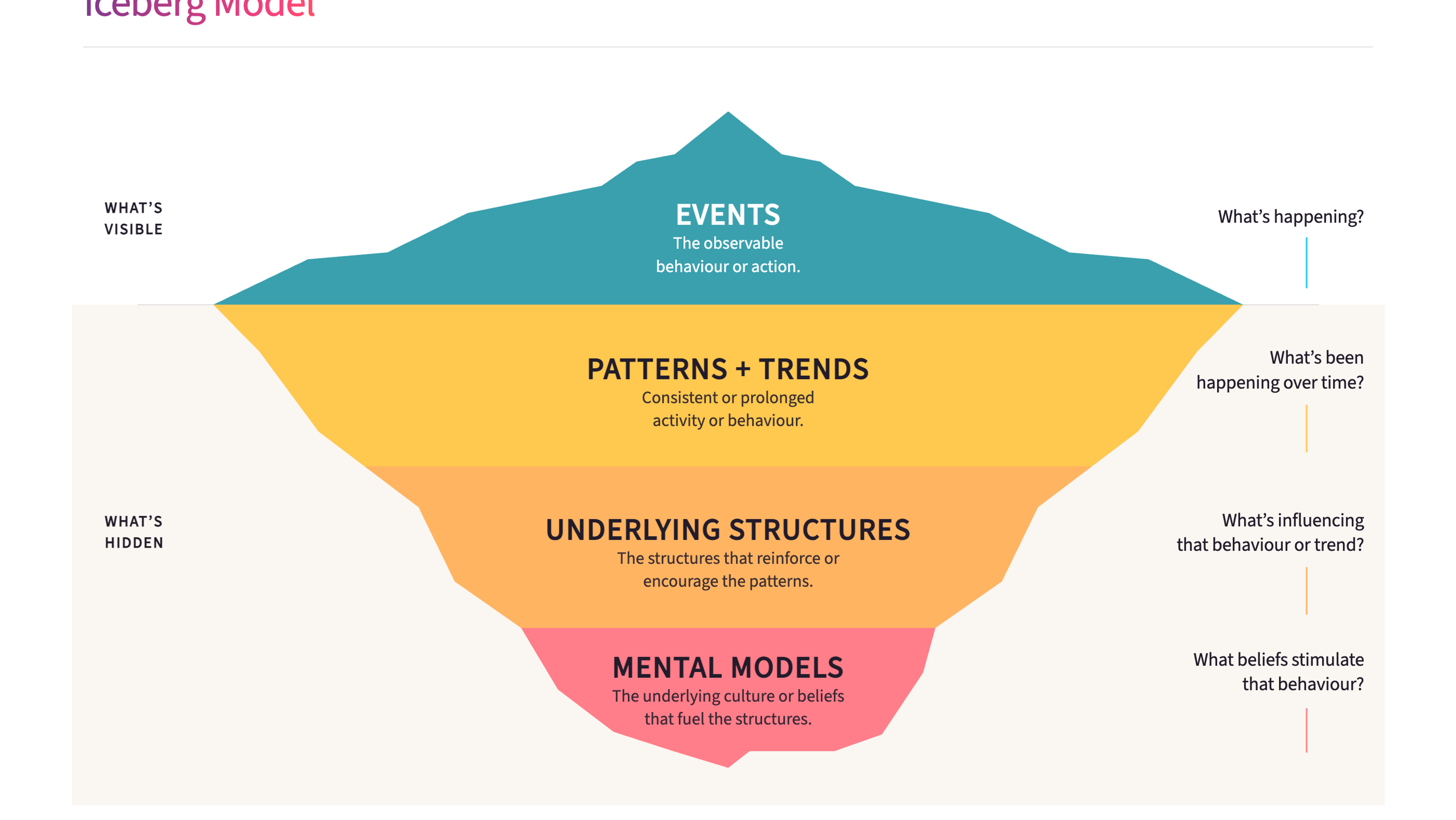
The Iceberg Model is a systems thinking tool that helps you look beneath surface-level events to find the patterns, structures, and mental models driving them. It's a way of seeing the deeper causes behind what's happening in your organisation.
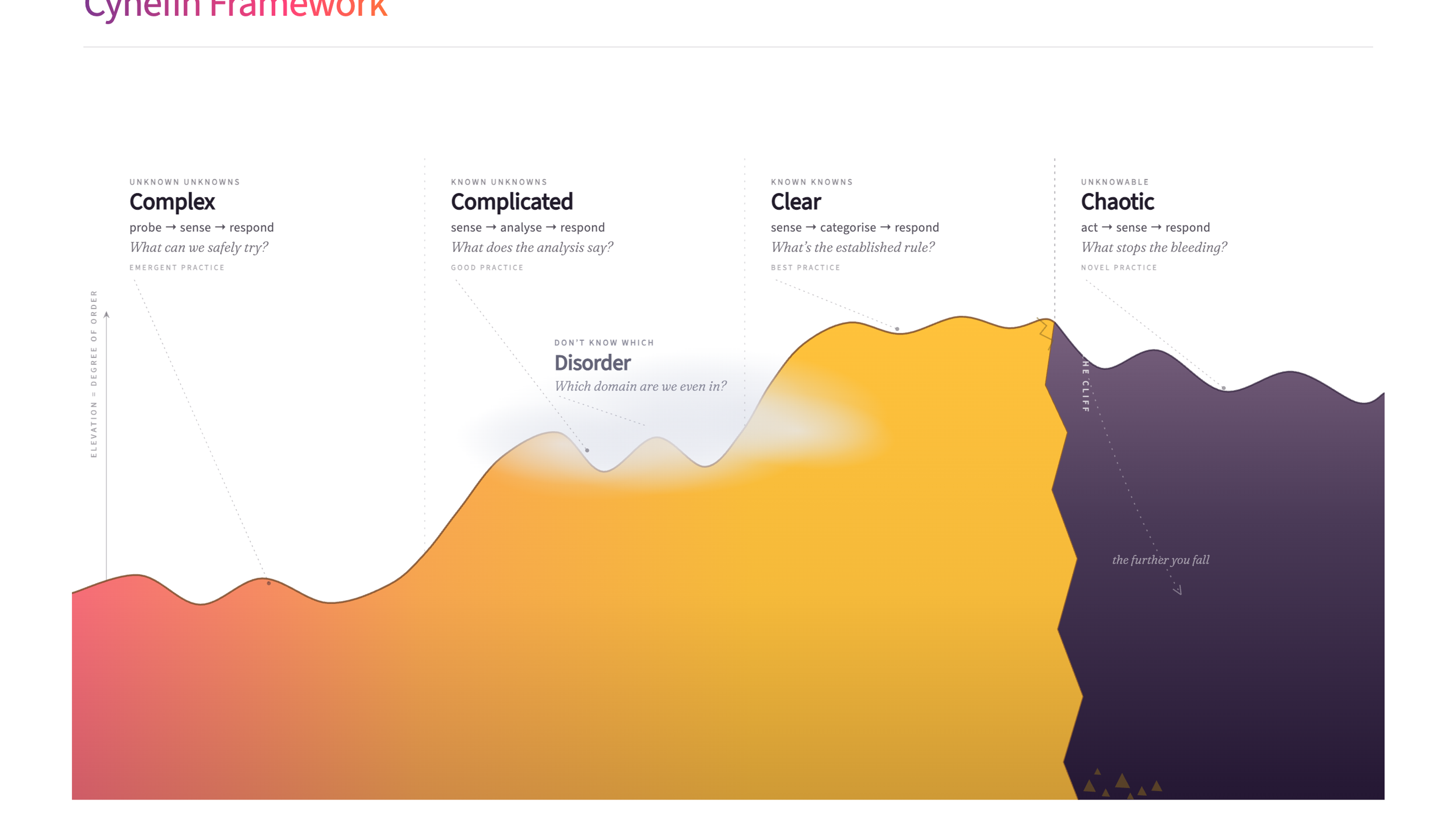
The Cynefin Framework is a decision-making model that helps leaders understand what kind of situation they're dealing with - clear, complicated, complex, chaotic, or confused. The right approach depends on the context, and this framework helps you match the two.

Get in touch to find out more or book a place
Whether you're navigating a merger, rethinking how you're structured, or trying to shift a culture that isn't working - start with a conversation.