Embedded Strategy
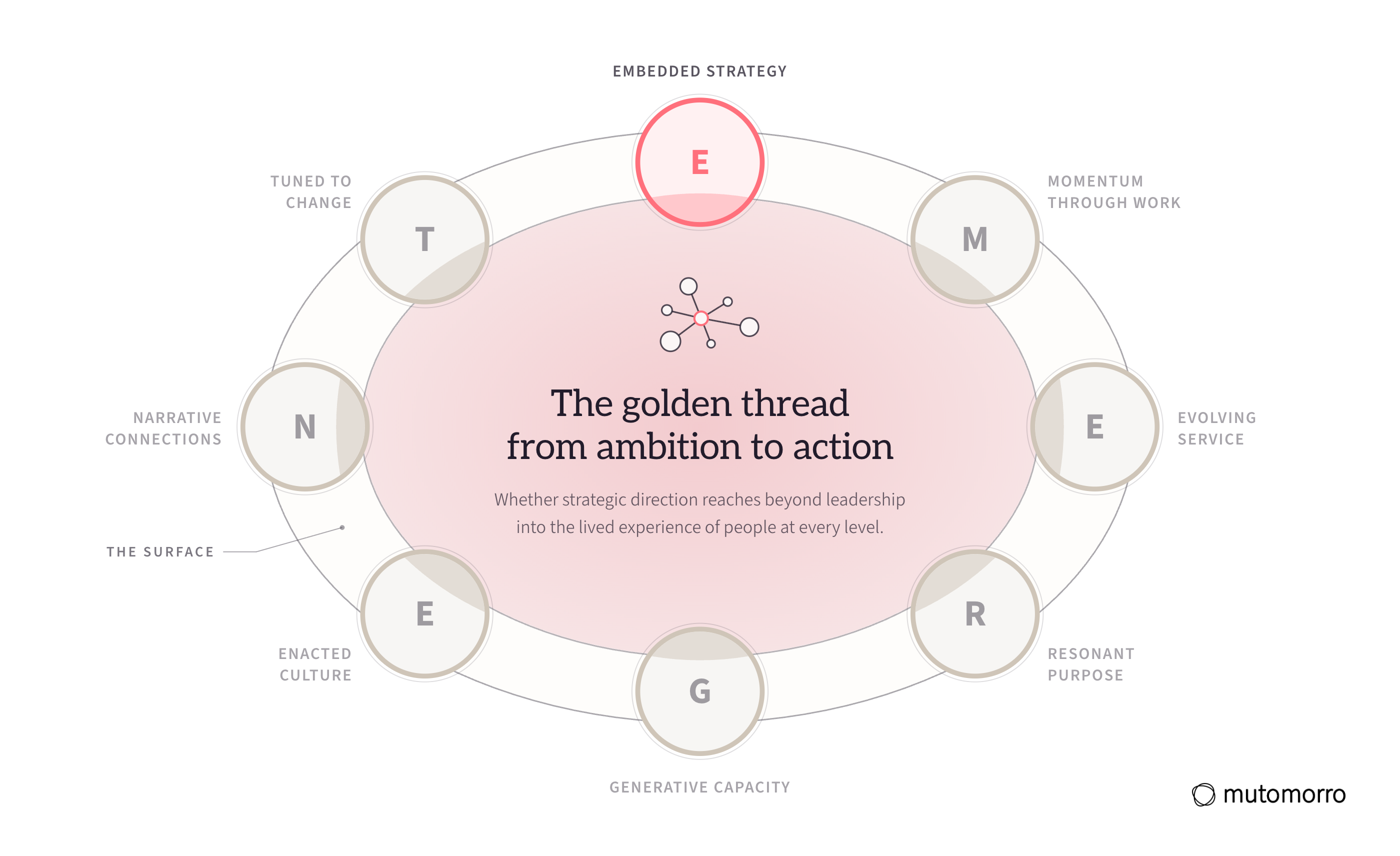
Whether strategic direction reaches beyond leadership into the lived experience of people at every level.
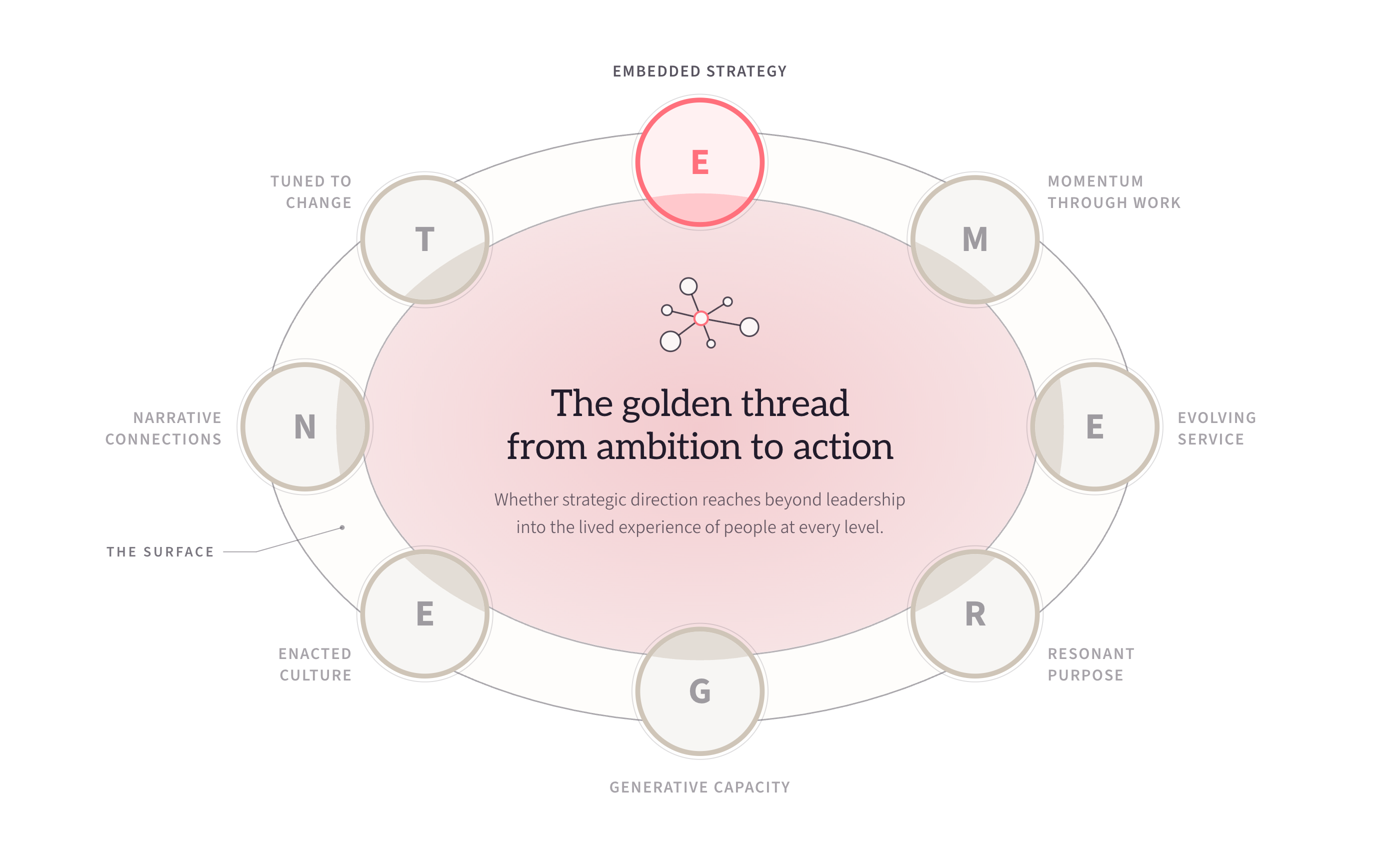
Pick something someone needed to work on this morning. Could you draw a line from it back to your strategic goals?
What it is
Watch what someone chooses to work on when two things compete for the same morning. In some organisations, that choice - made with no document open and no manager in the room - still pulls in the direction the strategy points. Multiply it across hundreds of people and thousands of small decisions, and you get an organisation whose ambition and daily work belong to the same plan. That's what this lens looks at. Not the quality of the strategy, but its reach: the distance between where strategy lives and where decisions happen. When that distance is small, the strategy isn't being followed. It's been absorbed - embedded in how people reason.
Why it matters
Most organisations have a strategy. Many have a good one. What shows up repeatedly isn't a failure of strategic thinking - it's the distance between the strategy and the daily work.
When that distance is small, decisions made independently by different teams still cohere, and people can absorb a shift in priorities without losing the thread. When it's large, the cost is real but hard to see.
It shows first in the people whose job is to carry strategy down the organisation. Asked to name any one of their company's top five priorities, only 55% of the middle managers in a survey of 7,600 managers could do it - given five chances, nearly half named none. Clarity thins with distance from the top, too: fewer than a third of senior executives' direct reports said they clearly understood how their organisation's priorities connect, and among frontline supervisors and team leaders that fell to 16%.
The UK picture is less direct, but points the same way. The ONS Management and Expectations Survey scored nearly 10,000 British firms on how structured their management practices are - how targets and performance measures get set and used, how underperformance is handled, how improvement actually happens. Moving from the bottom quarter of that score up to merely average was associated with 19% higher productivity. That is an association rather than a cause, and the score covers more than strategy. But it is measured here, on British firms, at scale.
The pattern is consistent. It's rarely the thinking that fails. It's the reach.
And reach is more than awareness. Plenty of organisations have communicated their strategy thoroughly - people in any team can describe it. The deeper test is what happens when no one's checking: whether the strategy shapes the choice someone makes between two competing priorities on an ordinary Tuesday. That's the difference between a strategy people know and a strategy that's become part of how they think - the way a fluent language stops requiring translation.
What it can tell you
Looked at through this lens, four things come into view.
Whether decisions cohere. Two teams making independent choices should arrive at answers that fit together - not identical answers, but answers that belong to the same plan. Where that coherence is missing, the organisation looks busy and purposeful inside each team, and contradictory from above.
Whether the thread survives a tug. Priorities shift and direction changes in every organisation. Where strategy is embedded, a shift produces adjustment; where it isn't, every shift feels like starting again from scratch. How your organisation absorbs its next change of priorities will tell you a great deal.
Whether the strategy is still alive. Most strategies launch well - the document is fresh, the priorities are current, everyone's talking about it. The revealing question comes three years in: is the strategy still part of working conversations, still shaping decisions - or is it quietly gathering dust while the organisation runs on something else? It's a pattern we see often. A strategy that's embedded stays in use for its whole life. One that isn't tends to fade long before anyone formally retires it.
Whether people have agency. There's a difference between following a strategy and thinking with it - between executing a plan that happens to have reached you and actively interpreting direction for your own context. The second is where strategy stops being leadership's possession and becomes the organisation's.
And running through all four: where the thread snaps. Trace the line from your biggest ambition, through strategic priorities, through team objectives, down to what someone chose to work on this morning. Where strategy is embedded, that thread holds - flexing at each level, never breaking. Where it isn't, it snaps somewhere. The point where it breaks tells you exactly where strategy stops reaching the work.
How to observe it
Strategy becomes visible in the moments where people have to choose what matters. These prompts help you see whether strategy is in the system - or just in the documents.
Listen for
- When someone explains what they're working on and why, does the reasoning connect to strategic priorities - or to who asked them to do it?
- When a new request lands that doesn't fit current priorities, can people say no confidently - or does everything feel equally urgent?
- Ask five people in different teams what the organisation's top three priorities are. How many different answers do you get?
- When the word "strategic" comes up in conversation, does it mean something precise - or is it just shorthand for "important"?
Watch for
- When two projects compete for the same resources, how does the decision get made? Against strategic criteria - or by who escalates fastest?
- Compare where the budget actually goes with what the strategy says matters. Do they tell the same story?
- When market conditions shift, does the strategy adapt visibly - or does the official strategy stay frozen while real priorities quietly change underneath?
- How many things currently in flight would survive if you tested them against the stated strategy? If everything survives, the strategy isn't filtering anything.
Measure
- What percentage of people can name the organisation's strategic priorities? At what level does that clarity drop off?
- How much alignment exists between what leadership says the priorities are and where people's time actually goes? Calendars don't lie.
- After a strategic shift, how long before frontline work visibly changes? Weeks, months - or never?
Notice
- Do teams set their own objectives in ways that naturally align with each other - or does alignment require top-down coordination every single time?
- Is strategic conversation a regular rhythm, or does it only happen during annual planning and crisis moments?
- Where does the golden thread snap? Trace the line from the board's ambition to a team's weekly work. The point where it breaks tells you exactly where strategy stops being embedded.
How to have meaningful conversations about it
- Can you trace a line from your biggest ambition to what someone worked on this morning?
- When two projects compete for the same resources, does the decision get made against strategic criteria - or by who escalates fastest?
- Ask five people in different teams what the top three priorities are. How many different answers do you get?
What you can do about it
You don't need a programme to start. Pick a recent strategic priority and ask three people in different parts of the organisation what it means for their work this week - then just listen. Don't explain, don't correct, don't fill silences. The pattern in their answers will show you where the thread is strong, where it frays, and where it disappears.
Or make it visible. At your next team session, ask everyone to draw the line from the organisation's biggest ambition to the work they did yesterday - literally draw it. Confident lines, hesitant lines, and gaps will show you exactly where strategy lives, and where it's lost in translation.