You've got a strategy and you want people to feel it everywhere. We help you create the conditions where the whole organisation moves with it.
You've invested heavily in getting the strategy right. The leadership team has thought deeply about direction, priorities, and what success looks like. That work matters. But there's a gap most organisations recognise: the strategy is clear, the leadership team is bought in, and yet what actually happens day to day doesn't quite match. The connection between strategic intent and organisational reality is weaker than anyone wants to admit.
That gap isn't usually a communication problem. You can cascade objectives perfectly through every level and still find that people understand the strategy but can't act on it - because how resources get allocated, how competing priorities are resolved, how the operating model connects to the strategic direction, and how decisions get made when things conflict all pull in a different direction. The organisation's conditions are quietly working against the strategy, even when everyone agrees with it.
Our strategic alignment consultancy starts there - at the connection point between strategy and organisation. We help you understand where those conditions support the strategy and where they pull against it, and make practical changes so that purpose, structure, operations, and culture all flow in the same direction.
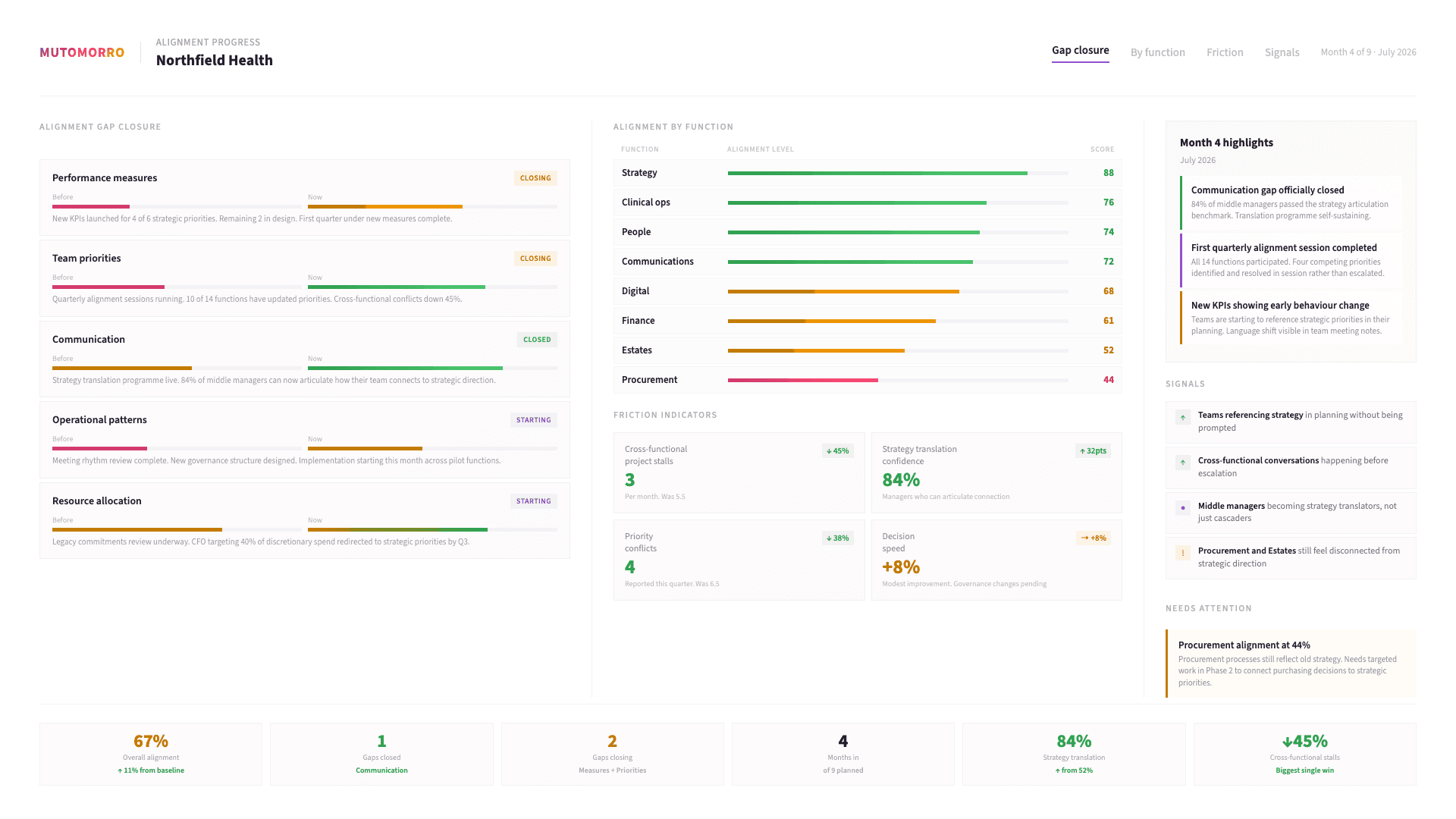
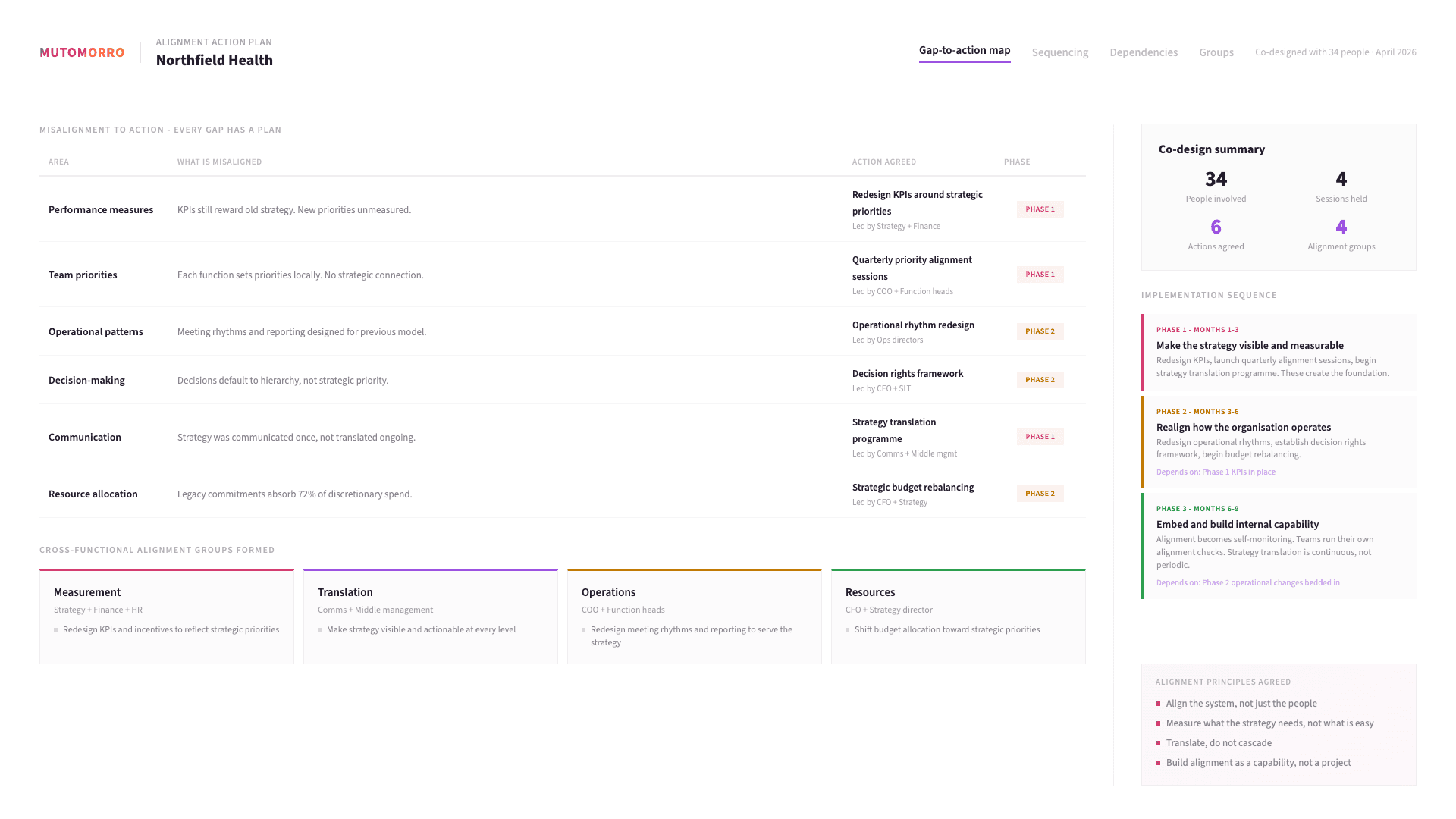




















The conditions inside the organisation determine whether strategy becomes reality. We help you shape them.
The gap between strategy and reality isn't about communication - it's about conditions
Every leader knows the feeling. The strategy is clear. The leadership team is aligned. People nod in the right meetings. And yet the organisation keeps producing the same outcomes it always has. Not because anyone disagrees with the direction - but because the conditions inside the organisation are quietly pulling against it.
How resources actually get allocated. How competing priorities between business-as-usual and strategic initiatives get resolved. Whether the operating model supports the new direction or was designed for a previous one. How decisions get made when the strategy says one thing and the pressure says another.
Think of it like a current. A strong strategy sets the direction, but the organisational conditions create the current that everything else moves in. When the current flows with the strategy, alignment feels natural - people's daily work connects to the bigger picture without constant reminding. When it doesn't, every step forward feels like swimming upstream. We start by working with you to understand the current - mapping the conditions that are shaping whether your strategy translates into reality or stays on paper.
Leaders come to us at moments like these
See how this works in real organisations
Every organisation's alignment challenge is different. Here are some recent examples of how we've helped leaders connect strategic intent to organisational reality.


What the evidence says about the gap between strategy and reality
67%
of well-crafted strategies fail due to poor execution
Harvard Business Review
95%
of employees do not understand their organisation's strategy
Kaplan & Norton
28%
of leaders believe their organisation executes strategy well
Bridges Business Consultancy
40%
of strategic value is lost to poor alignment
PMI
Want to explore how this could work for your organisation?
Every organisation is different, so we always start with a conversation. No pitch, no obligation — just an honest discussion about where you are and whether our approach feels right.
Explore strategic alignment
Articles
- Building an Impact Measurement Framework: A Practical Guide
Most organisations know they should measure their impact. Fewer know how to do it in a way that's genuinely useful rather than just generating reports. This article explores how to build an impact measurement framework that helps you understand what's working, learn from what isn't, and make better decisions.
Read article → - Why Some Organisations Get Stronger Under Stress
Why anti-fragility isn't a programme you build - it's what emerges when the right conditions exist inside an organisation. A living systems perspective on how some organisations get stronger under stress while others crack.
Read article → - Building Organisational Resilience: A Practical Guide
Resilience isn't about bouncing back to where you were. It's about developing the capacity to adapt, learn, and come through difficulty stronger than before. This article explores what organisational resilience actually looks like and what leaders can do to build it.
Read article → - Why Your Organisation Can't Think Ahead
Why futures thinking needs to become an everyday organisational capability rather than an occasional planning exercise. This article explores how developing future literacy helps organisations navigate uncertainty with confidence.
Read article →
Related tools
- 2×2 Scenario Matrix
The 2x2 Scenario Matrix is a strategic planning tool that helps organisations explore different possible futures. By mapping two key uncertainties against each other, it creates four distinct scenarios you can plan and prepare for.
Explore tool → - Cynefin Framework
The Cynefin Framework is a decision-making model that helps leaders understand what kind of situation they're dealing with - clear, complicated, complex, chaotic, or confused. The right approach depends on the context, and this framework helps you match the two.
Explore tool → - Heart of Business
The Heart of Business is a framework developed by Hubert Joly that helps organisations align their operations with a deeper sense of purpose. It moves beyond profit-driven goals to connect strategy, culture, and leadership around what the organisation is really for.
Explore tool → - LogFrame (Logical Framework)
A LogFrame is a structured planning and evaluation tool that helps organisations set clear goals, define how they'll measure progress, and track what's actually being achieved. It's widely used in the nonprofit sector for programme management and impact reporting.
Explore tool → - McKinsey 7-S Model
The McKinsey 7-S Model is a strategic framework that maps seven interconnected elements of an organisation - from strategy and structure to skills and shared values. It helps leaders understand how changing one part of the organisation affects everything else.
Explore tool → - Mendelow power-interest matrix
The Mendelow Power-Interest Matrix is a stakeholder mapping tool that helps you work out who matters most during a change or project. It plots stakeholders by their level of power and interest so you can plan how to engage each group.
Explore tool →
Part of a bigger picture
Our approach to strategic alignment grows from something broader: a conviction that organisations work more like living systems than machines. When you see it this way, alignment isn't a one-time exercise you complete and tick off. It's an ongoing quality of how the whole system stays connected - strategy, structure, operations, culture, and capability all influencing each other continuously.
We call this perspective Intentional Ecosystems. It shapes how we approach alignment, change, culture, and design. Our philosophy page is where the full picture comes together.
Common questions about strategic alignment
The commonly cited figure is that around 67% of well-crafted strategies fail to deliver their intended results. The reasons vary, but a pattern we see consistently is that organisations invest heavily in designing and communicating the strategy - and underinvest in shaping the conditions that determine whether people can actually act on it.
When the operating model was designed for a previous strategy, when resources keep flowing to legacy priorities, when competing demands make it impossible to focus on what the strategy needs - it's not surprising that the strategy stays on paper. The organisation's conditions are working against the direction, even when everyone agrees with it.
The organisations that achieve lasting alignment tend to be the ones that work on both: the strategy itself and the organisational conditions that shape whether it translates into reality.
Want to explore how this could work for your organisation?
Every organisation is different, so we always start with a conversation. No pitch, no obligation — just an honest discussion about where you are and whether our approach feels right.