Heart of Business
Hubert Joly's Heart of Business model identifies four pillars - noble purpose, people at the centre, stakeholder interdependence, and profit as outcome - that converge to create a purpose-driven organisation where financial performance follows from getting the foundations right.
Get the free template
Most organisations say purpose matters. Fewer can explain how it connects to the way they treat their people, relate to the communities around them, and sustain their performance over time. Hubert Joly's Heart of Business model offers a practical framework for making those connections visible - and for building an organisation that operates from its centre rather than its edges.
What is the Heart of Business?
The Heart of Business is a leadership model developed by Hubert Joly, drawing on his experience as CEO of Best Buy from 2012 to 2019. When Joly took over, the company was widely expected to fail - losing ground to Amazon, haemorrhaging talent, and facing calls to break up the business. Over the next seven years, he led a turnaround that rebuilt Best Buy into one of the most admired retailers in the United States, dramatically improving employee engagement, customer satisfaction, and financial performance at the same time.
Joly's argument is that these results weren't achieved despite putting people and purpose first - they were achieved because of it. He set out the model in his 2021 book, The Heart of Business: Leadership Principles for the Next Era of Capitalism, and has continued to develop the thinking through his teaching at Harvard Business School, where he remains a senior lecturer. He was included on the 2025 Thinkers50 list of the world's most influential management thinkers, received the 2026 Arthur W. Page Center Award for integrity in public communication, and joined the S&P Global board of directors in January 2026 - all of which reflects continuing interest in his approach to purpose-driven leadership.
The model identifies four pillars that, when they converge, create what Joly calls the "heart" of the organisation - the organising principle that connects why you exist, how you treat people, who you create value for, and what financial performance means in that context.
The four pillars
Pillar | What it means | The question to ask |
|---|---|---|
Noble Purpose | A specific, honest answer to what difference you're trying to make - one that shapes real decisions | Can you state your purpose in a sentence no rival could claim? |
People at the Centre | Treating people as the source of value, not a resource to manage - Joly's "human magic" | Do your people feel trusted, valued, and able to do their best work? |
Stakeholder Interdependence | Recognising that value flows between employees, customers, communities, suppliers and shareholders alike | Can you map the web of relationships your organisation depends on? |
Profit as Outcome | Financial performance as the result of getting the other three right, not the purpose | Does your financial model support or undermine the other three? |
Noble Purpose
Noble purpose is the starting point. Not a mission statement written for the annual report, but a genuine answer to the question: what difference are we trying to make?
Joly distinguishes noble purpose from corporate purpose statements that default to shareholder value or vague commitments to "excellence." A noble purpose is specific enough to guide decisions, ambitious enough to inspire people, and honest enough to hold up under scrutiny. At Best Buy, Joly reframed the company's purpose from selling electronics to "enriching lives through technology" - a shift that opened up entirely new possibilities for what the business could do and who it could serve.
For leaders working through this pillar, the question isn't "do we have a purpose statement?" Most organisations do. The question is whether that purpose is doing real work - shaping strategy, informing trade-offs, and helping people understand why their contribution matters. If your purpose statement could belong to any organisation in your sector, it probably isn't specific enough to function as a genuine organising principle.
This connects closely to how Narrative Strategy works - the story an organisation tells about itself needs to be rooted in a purpose that people can recognise as true.

People at the Centre
The second pillar is about creating the conditions where people can do their best work. Joly calls this "human magic" - what happens when people feel trusted, valued, and connected to something that matters.
This goes beyond engagement surveys and wellbeing programmes. Joly's argument is that organisations need to treat people as the source of value creation, not as a resource to be managed. That means understanding what drives each person - what they're good at, what they care about, what gives them energy - and creating an environment where those things can flourish.
In practice, this looks like: leaders who know their people as individuals, not just as role-holders. Development that builds on strengths rather than fixing weaknesses. Autonomy that trusts people to make good decisions rather than controlling every step. An honest recognition that people bring their whole selves to work, and the organisation is better when it makes room for that.
The research behind 6 Team Conditions and Project Aristotle reinforces this pillar - both show that the conditions surrounding people matter more than the talent of the individuals involved.

Stakeholder Interdependence
The third pillar recognises that organisations don't exist in isolation. Employees, customers, communities, suppliers, partners, and shareholders are all connected - and value flows between all of them, not just upward to investors.
This isn't a call to treat all groups equally or to try to make everyone happy. It's a recognition that these relationships are interdependent. Invest in your people and they create better experiences for customers. Serve your community well and you build trust that strengthens your brand. Treat suppliers as partners and they'll be more resilient when things get difficult. The system works when the relationships work.
Joly is direct about the implications: if your shareholder returns depend on suppressing wages, ignoring community impact, or squeezing suppliers to breaking point, that's not a sustainable model. It might produce short-term results, but it undermines the system that generates value in the first place.
For organisations exploring this pillar, the Empathy Map can be a useful starting point for understanding different groups' experiences. And the thinking connects naturally to organisational development work - understanding how an organisation relates to its wider ecosystem is central to how it evolves.

Profit as Outcome
The fourth pillar is the one that often meets the most resistance: profit is an outcome of getting the other three pillars right, not the purpose of the organisation.
This doesn't mean profit doesn't matter. Joly is explicit that financial performance is essential - no organisation survives without it. But his argument is that treating profit as the primary goal leads to decisions that undermine purpose, damage people, and strain the relationships that create long-term value. Profit-first thinking tends to optimise for the short term at the expense of everything else.
When noble purpose, people, and stakeholder value are working well, financial performance follows. Not automatically, and not without discipline - but as a natural consequence of an organisation that knows why it exists, invests in its people, and creates genuine value for the groups it serves. The Best Buy turnaround is Joly's primary evidence: a company that improved financial performance by prioritising purpose and people, not by cutting costs and chasing quarterly targets.
This is what makes the Heart of Business a convergence model rather than a list of four separate ideas. Profit doesn't sit alongside the other three as an equal pillar - it emerges from them. The diagram reflects this: three foundations creating the conditions for sustainable performance.

How to use the Heart of Business
The model works well as both an assessment tool and a conversation framework. Here's how to work through it with a leadership team.
Start with self-assessment. For each pillar, ask the team to rate - honestly - where the organisation stands. Not with a score, but with a description: what does this pillar look like for us right now? Where is it strong? Where are the gaps? The Competing Values Framework can help here if the team is struggling to articulate the current culture.
Map the connections. This is where the model's real value emerges. Look at how the pillars relate to each other. Does your stated purpose connect to how you treat people? Does your approach to employees translate into genuine value for customers and communities? Does your financial model support or undermine the other three pillars?
Find the tensions. Most organisations will discover misalignment. Perhaps the purpose is clear but the people experience doesn't match. Perhaps there's genuine care for employees but the shareholder model creates pressure that contradicts it. These tensions aren't failures - they're the diagnostic information you need to make progress.
Prioritise the convergence gap. You're looking for the place where strengthening one pillar would have the greatest positive effect on the others. That's your starting point. Not four simultaneous transformation programmes - one focused shift that creates momentum.
Check back regularly. This isn't a one-off assessment. The Heart of Business works well as a recurring conversation - perhaps quarterly or as part of an annual strategy review - to track whether the pillars are moving into stronger alignment or drifting apart.
Example
Imagine a professional services firm where the founders have always cared about doing meaningful work. Their stated purpose is about helping clients build stronger organisations. But as the firm has grown, the pressure to hit billing targets has gradually shifted the culture. Partners are rewarded for revenue generation, not client impact. Junior staff are stretched thin. The firm's community involvement has become a line in the annual report rather than something people experience.
Working through the Heart of Business, the leadership team discovers that Noble Purpose is clear on paper but disconnected from daily experience. People at the Centre has eroded - the firm says it values its people, but the incentive structure tells a different story. Stakeholder Interdependence is narrow - the firm thinks about clients and shareholders but has stopped paying attention to the wider community it operates in.
The convergence gap is between purpose and people. If the firm reconnects its stated purpose to how it develops, rewards, and supports its people, the other pillars start to shift too. Client work improves because people are engaged. Community involvement becomes natural because people have the energy and motivation for it. And financial performance becomes more sustainable because it's built on genuine value rather than overwork.
That's the Heart of Business in practice - not four separate improvement programmes, but one connected shift in how the organisation understands its own centre.
Limitations
The Heart of Business is a leadership philosophy first and a diagnostic tool second. It's powerful for helping leaders think differently about purpose, people, and performance - but it doesn't provide the operational detail you'll need for implementation.
The model assumes senior leadership has genuine agency to change how the organisation operates. In large, publicly traded companies with activist shareholders or short-term investor pressure, the "profit as outcome" pillar can be genuinely difficult to act on, regardless of leadership conviction.
Joly's primary evidence is the Best Buy turnaround - a remarkable story, but a single case study in a specific context (US retail, a company in crisis, a new CEO with a mandate for change). The principles are broadly applicable, but the degree of transformation possible will vary significantly depending on your starting point, sector, and governance structure.
The model doesn't address how to navigate the transition period. Moving from profit-first to purpose-led is a significant cultural and strategic shift, and the framework doesn't provide a roadmap for managing that change. Tools like Kotter's 8 Steps or the Change Curve may be useful companions for the implementation journey.
Getting started
Start by reading Joly's own description of the model - the book is worth the time, and his Harvard Business School case studies offer detailed worked examples.
Then gather your leadership team and ask one question for each pillar: can you articulate your noble purpose in a sentence? Do your people feel trusted and valued? Can you map the web of relationships your organisation depends on? And is your financial model supporting or undermining the other three?
You don't need to answer all four perfectly. You're looking for where the conversation gets uncomfortable - that's usually where the most useful work is waiting.
If you're exploring what organisational purpose means in practice - and how it connects to culture, people, and performance - that's the kind of work we do with leadership teams. Not delivering a purpose statement, but helping you find and operate from the heart of your organisation.
If putting your noble purpose into words is the work in front of you, a Mission, Vision and Values Workshop is a facilitated day that takes a leadership team through exactly that - finding the words for what your organisation stands for.
We share thinking on organisational change and development on LinkedIn - practical ideas for people doing this work inside their own organisations.
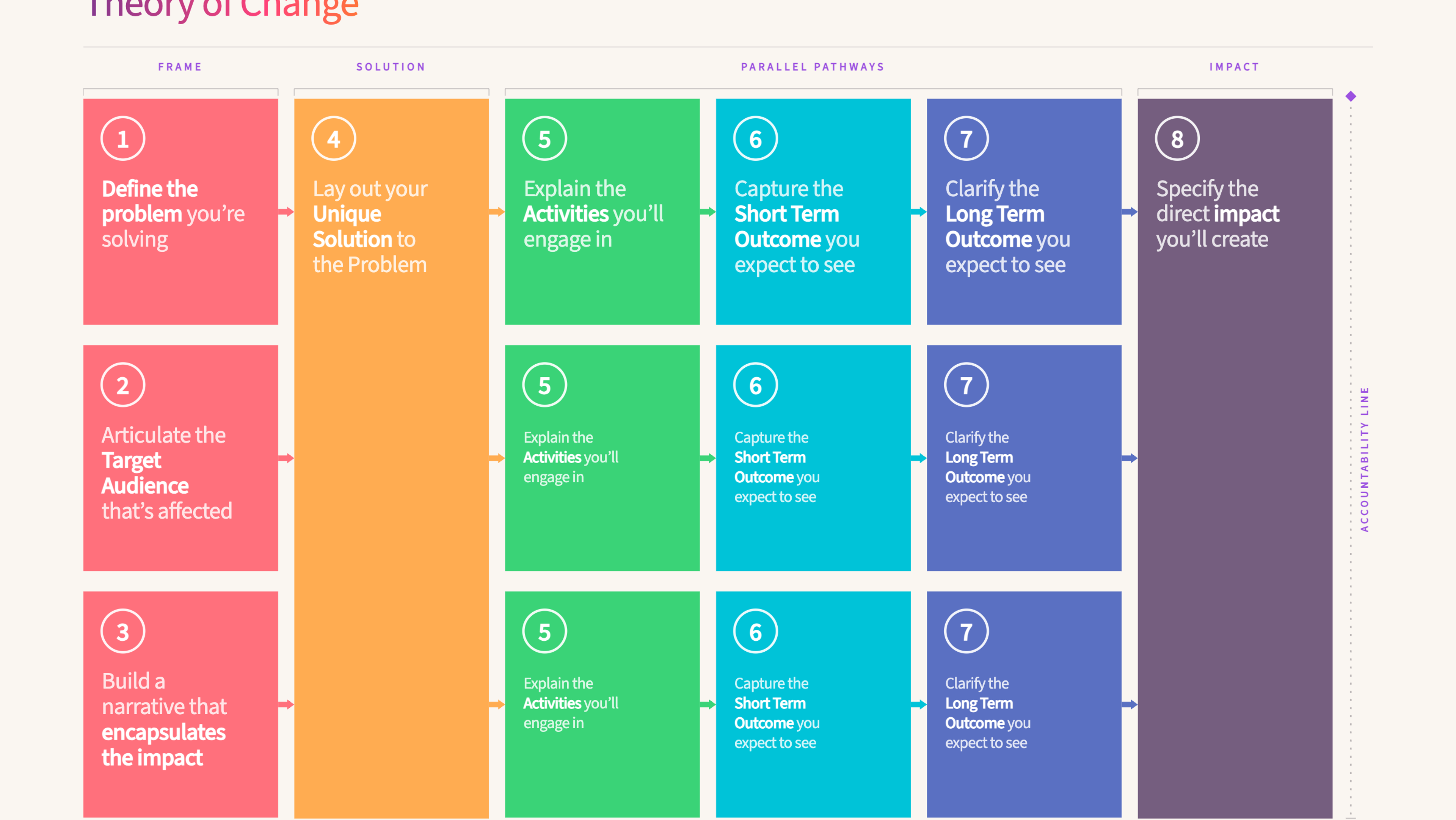
A Theory of Change is a strategic planning tool that maps out how and why you expect a desired change to happen. It connects your activities to your outcomes, showing the logical path from what you do to the impact you want to create.
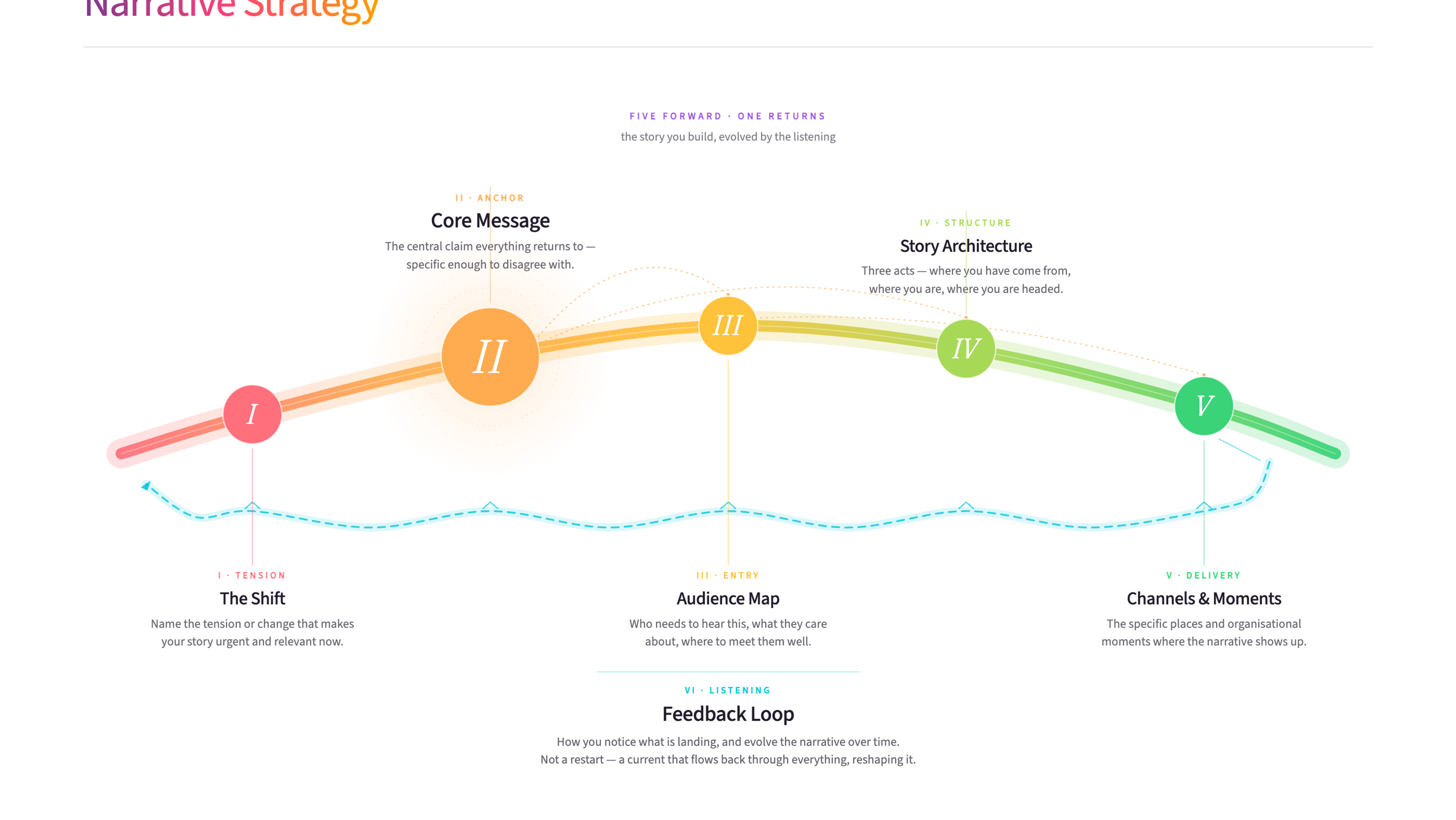
A Narrative Strategy is a plan for how your organisation tells its story in a way that connects with people and advances your goals. It goes beyond individual stories to create a consistent, compelling narrative that runs through everything you communicate.
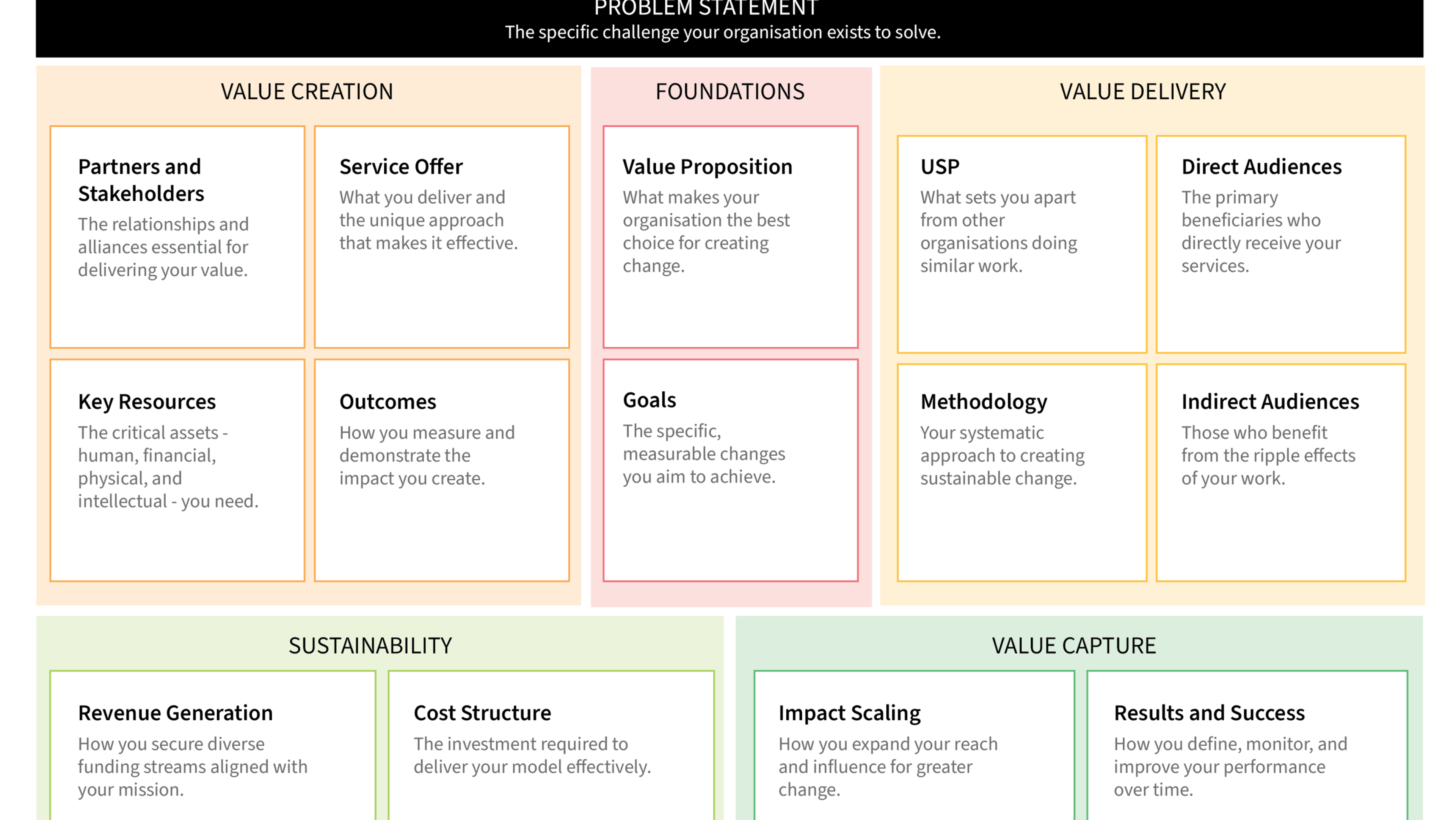
The Nonprofit Business Model Canvas is a visual planning tool that helps charities and social enterprises map out how they create, deliver, and sustain impact. It adapts the traditional business model canvas for organisations driven by mission rather than profit.

The real business case for organisational purpose isn't about inspiration - it's about what happens when everyone in the organisation understands why the work matters and can use that understanding to make better decisions, every day.

Most mission statements sound impressive but don't actually do anything. This guide helps you write one that works - a clear, honest statement that guides real decisions and connects your organisation's daily work to its deeper purpose.

Most organisations have a stated purpose. Far fewer have one that shapes how people actually work. This article explores why purpose gets stuck at leadership level and what it takes to embed it into daily decisions, team dynamics, and organisational culture.
When you need more than the template
The free template is a good start. If you want to take the next step and map a full Theory of Change with your team - the difference you're working towards and how your work gets you there - that is what we built the Theory of Change Toolkit for - a rapid primer, assessment tools for gathering stakeholder input, a slide deck, worksheets and discussion guides, facilitator notes, and a Miro board blueprint. Everything is editable, so you can fit it to your own branding and timings.
It's a paid toolkit, on our sister site toctoolkit.org. Reduced rates are available for small nonprofits, micro-organisations and students.
James Freeman-Gray is the founder of Mutomorro. He's an organisational development practitioner who has spent over twenty years working with leaders across public, private and nonprofit sectors - helping organisations pull together around a common purpose, joined up in how they work. More about who we are and what it's like to work with us.
The Heart of Business works well when leadership teams are ready to be honest about the gap between their stated purpose and their lived reality. The convergence conversation - where do the pillars reinforce each other, where do they pull apart - is usually where the most useful work happens.
Last reviewed: June 2026
Ready to use Heart of Business?
Download the free template - includes practical guidance for workshops and team sessions.
Get the free template
Want to put these ideas into practice?
Whether you're navigating a merger, rethinking how you're structured, or trying to shift a culture that isn't working - underneath, it's the same job: getting the whole organisation pulling in the same direction. Start with a conversation.