RASCI Framework
The RASCI Framework maps five roles in any project or decision - Responsible, Accountable, Supportive, Consulted, and Informed. It helps organisations clarify who does what, reducing confusion and speeding up delivery.
Get the free template
RASCI answers a question every project and every decision eventually runs into: who does what, exactly? It maps five roles - Responsible, Accountable, Supportive, Consulted and Informed - onto the tasks and decisions in front of a team, so everyone can see where they fit before the work starts, rather than working it out halfway through.
Used well, it does more than tidy up a single project. It builds a habit of role clarity into how an organisation runs - who owns which decisions, who has a say, and who simply needs to know.
What is the RASCI Framework?
RASCI is a way of assigning roles, sometimes called a responsibility assignment matrix. For each task or decision, it asks you to place five letters against the people involved:
- R - Responsible: the person or people who do the work.
- A - Accountable: the one person who owns the outcome and signs it off.
- S - Supportive: those who actively help the responsible people.
- C - Consulted: those whose input is sought before a decision or before the work proceeds.
- I - Informed: those who are kept updated once things happen.
It grew out of an older and more widely used model called RACI, adding the Supportive role to it. The difference sounds small, but it names something real - the colleagues who lend resources, expertise or hands to a piece of work without owning it. We will come back to how the two compare.
The problem RASCI solves is a familiar one. When several capable people share a piece of work, ownership can quietly blur - not through anyone's fault, but because no one named who holds it. Two people each assume the other has a task, so it slips. A decision stalls because it is not clear who gets to make the call. A colleague finds out about a change after it affects them and feels, fairly, left out. Across an organisation, that ambiguity is quietly expensive - it is the meeting that gets called to work out who decides, the duplicated effort, the decision that waits a fortnight for an approval no one realised they owned. RASCI gives a team a shared picture that heads all of it off, and because it is written down, it keeps doing so long after the conversation that created it. An hour with a grid is a small price for that.
The five RASCI roles
The clearest way to read RASCI is to notice that the five roles fall into two groups. Responsible, Accountable and Supportive are the people doing the work. Consulted and Informed are the people who need to know about it. The line between those two groups is where a lot of confusion lives - and seeing it drawn makes the rest of the model fall into place.
That line is an organisational-design idea as much as a project one. Most friction on a piece of work comes from someone being in the wrong group: a person who should simply be Informed is pulled into every decision and slows it down, or a person who needed to be Consulted finds out too late and has to unpick what has already been agreed. Drawing the boundary clearly - who is inside the work, who is around it - is half the value of the model before you have assigned a single specific role.
Role | In the work or around it | How many | The discipline |
|---|---|---|---|
Responsible | In the work | One or more | Keep it as short as the work needs |
Accountable | In the work | Exactly one | Never more than one - ownership can't be split |
Supportive | In the work | One or more | Name them so their time is planned for |
Consulted | Around it | Keep short | Two-way, before - set a deadline |
Informed | Around it | Any number | One-way, after - a notification, not a vote |
Responsible - does the work

The Responsible role belongs to whoever carries out the task. They are the doers: the analyst building the model, the team writing the policy, the engineer shipping the fix.
A task can have more than one Responsible person, and often does - three people might each own a section of the same report. That is fine. The discipline is to keep the list as short as the work honestly needs, and to give each person a real slice rather than a vague share. Pile on too many and you quietly recreate the very confusion RASCI exists to remove, because "everyone is doing it" slides back into "I thought you had it".
Accountable - owns it

The Accountable role is the single person who owns the outcome and has the authority to sign it off. They may not touch the work themselves, but the buck stops with them.
This is the one rule RASCI asks you not to bend: there should be exactly one Accountable person per task. The reason is in the nature of ownership. You can divide labour cleanly - this part is yours, that part is mine - but you cannot divide ownership without it disappearing. When two people both "own" an outcome, each assumes the other is watching it, and you get either stalemate or finger-pointing when something goes wrong. One name in the Accountable column means there is always one clear decision-maker and one place for issues to escalate to.
It is also the role people most often confuse with Responsible. A useful test: Responsible is the person doing the work; Accountable is the person answerable for whether it was done well. On a small task they might be the same person. On anything larger, separating them keeps both ownership and effort clear.
Supportive - helps deliver

The Supportive role covers the people who actively help those doing the work - lending expertise, resources or extra hands without being accountable for the result. A specialist who advises, a neighbouring team who provides data, an external partner brought in for a stretch.
This is the role RACI leaves out, and naming it has a quiet benefit: it makes visible the people whose time a piece of work genuinely depends on, so their involvement is planned for rather than assumed. Several people can hold the Supportive role, gathered around the work rather than sitting at its core.
Consulted - two-way, before

The Consulted role is for people whose input you seek before a decision is made or before work moves forward. It is a two-way exchange: you ask, they respond, and their view shapes what happens next. Subject-matter experts, the colleagues whose work connects to yours, the people who will have to live with the result.
The thing to watch here is length. Consultation is valuable, but a long Consulted list turns into design-by-committee, where reviews drag and decisions drift. Keep it to the people who materially improve the quality of the decision, set a clear deadline for their input, and move everyone else to Informed.
Informed - one-way, after

The Informed role is for people who need to be kept up to date but are not asked for input. It is one-way: you tell them what has happened or been decided, after the fact. They have a legitimate interest in the outcome, or will be affected by it, but they are not part of making it.
The difference between Consulted and Informed is the other pair people often muddle, and it matters. Consulted is a conversation before; Informed is a notification after. Getting it right keeps communication honest - people who are only Informed do not expect a vote, and people who are Consulted are genuinely heard rather than told after the fact.
How to build a RASCI matrix
A RASCI matrix is just a grid: the tasks or decisions run down one side, the people or roles run across the top, and each cell gets a letter. Building one takes about an hour for a focused piece of work.
- List the work down the left. Break the project or process into its real tasks and decisions - specific enough to assign, not so granular that the grid becomes unreadable.
- List the people across the top. Use roles rather than only names where you can, so the matrix survives someone changing jobs.
- Fill in each cell. Give every task its letters: R for who does it, A for who owns it, and S, C or I for the rest. Leave a cell blank if a person has no part in that task - not everyone needs a letter on every row.
- Check each row. Exactly one A. At least one R. A short C list. If a row has two A's, decide who really owns it. If it has none, you have found a gap worth closing now rather than later.
- Share it and agree it. Walk the matrix through with the people in it. The point is shared understanding, so gather their reactions and adjust - a matrix nobody agreed to will not hold.
- Keep it live. Roles shift as work moves on. Revisit the matrix at the points where things tend to change, rather than filing it away.
This is also where RASCI pairs naturally with process mapping: once you have mapped how work flows, a RASCI matrix clarifies who owns each step and who needs to be involved along the way.
Common mistakes to avoid
A handful of patterns trip teams up more than any others, and each is easy to head off once you know to look for it.
- More than one Accountable. The most common slip, and the reason the single-owner rule matters. If a task genuinely seems to sit across two people, the answer is not two A's - it is to raise accountability to the next manager they share, who can own it cleanly.
- Confusing Responsible and Accountable. When the two blur, the work still gets done, but nobody truly owns whether it was done well. A one-line ownership note for each Accountable - "owns the outcome and signs it off" - keeps the line sharp.
- An overcrowded Consulted column. Consultation is useful right up until it becomes a queue. Keep it to the people who genuinely improve the decision, and give them a deadline so their input does not turn into a bottleneck.
- No expectations set for Consulted and Informed. If no one agrees when input is due or how updates will arrive, Consulted people respond whenever they get to it and Informed people feel out of the loop. Something as simple as "input by Friday, updates every fortnight" is enough to fix it.
- Building it in isolation. A matrix written by one person and handed round rarely sticks. Most of the value is in the conversation that creates it, where the quiet disagreements about who owns what finally surface.
RASCI vs RACI vs DACI
RASCI is one of a small family of responsibility models, and it helps to know where it sits.
Model | Roles | Built for | Best when |
|---|---|---|---|
RASCI | Responsible, Accountable, Supportive, Consulted, Informed | Tasks, with support named | Complex work where support genuinely matters |
RACI | Responsible, Accountable, Consulted, Informed | Tasks - the leaner classic | Simpler work, or a team already using it |
DACI | Driver, Approver, Contributor, Informed | Decisions | Fast, decision-heavy work |
RACI is the same model without the Supportive role - Responsible, Accountable, Consulted, Informed. It is the more common version, and its simplicity suits smaller pieces of work or organisations with straightforward structures. The trade-off is that the people who support the work get folded into Responsible or Consulted, which can hide how much the work depends on them.
DACI takes a different angle, built for decisions rather than tasks: Driver, Approver, Contributor, Informed. The Driver moves the decision along, the Approver makes the final call, Contributors offer input and the Informed are told. It tends to suit fast-moving, decision-heavy work where decision speed matters as much as role clarity. If that is your situation, the DACI Framework is worth a look in its own right.
Choosing between them is less about which is "best" and more about how your organisation works. Complex work with real support dependencies leans towards RASCI. Simpler work, or a team that already uses RACI, may be better served by keeping things lean. Decision-led work points towards DACI. The model should fit the way the work runs, not the other way round.
If you're weighing the two head-to-head, our full RACI vs RASCI comparison maps one set of tasks both ways and gives a straight answer on when the Supportive role earns its place.
RASCI matrix example: supplier onboarding
Imagine your operations team is introducing a new supplier onboarding process. Without clear roles, it is the kind of project where finance assumes legal is checking the contracts, two people both think they are approving the final design, and the wider team hears about the change the week it lands.
A short RASCI matrix sorts it out. An operations analyst is Responsible for building the process. The head of operations is Accountable - one name, the person who signs it off and answers for it. Procurement and IT are Supportive, providing the supplier data and the system setup. Finance and legal are Consulted before sign-off, because their input shapes the design and they will have to work within it. The rest of the operations team is Informed once the process is ready, so they know what is changing and when.
Written out as a grid - one row per task, one letter per cell - the same project looks like this:
Task | Operations analyst | Head of operations | Procurement | IT | Finance | Legal | Operations team |
|---|---|---|---|---|---|---|---|
Map the current onboarding process | R | A | S | ||||
Design the new process | R | A | S | S | C | C | |
Set up the system and supplier records | R | A | S | ||||
Sign off the finished design | R | A | C | C | |||
Announce it to the operations team | R | A | I |
Now the "I thought you had it" risk is gone. Everyone can see, on one page, where they fit - and the single Accountable owner means that if a question comes up, there is one obvious person to bring it to.
Our free RASCI template (PDF) puts the five roles, the matrix how-to and the mistakes to watch for on a quick-reference card you can keep beside the work.
Limitations
RASCI is clarifying, but it is worth being honest about what it does and does not do.
- It clarifies who, not how well. A matrix says who owns and does each task. It says nothing about whether the work itself is any good - that still depends on the people and the plan.
- It goes stale if left alone. Roles change as work moves on. A matrix that is not revisited can end up describing a team that no longer exists.
- Too many R's or C's brings the confusion back. The model only helps if the lists stay disciplined. A crowded Responsible column or an over-long Consulted list quietly undoes the clarity it was meant to create.
- Imposed, it can become box-ticking. RASCI works when the people in it have agreed to it. Handed down without that conversation, it turns into a form to fill in rather than a shared understanding.
Getting started
The simplest way to try RASCI is to pick one decision or process that keeps stalling - the thing where ownership always seems fuzzy - and map a single row. List the task, name the one Accountable owner, the Responsible people, and who needs to be Consulted before and Informed after. Share it with the people in it and see whether it matches how they thought things worked. Often the disagreement that surfaces in that first five minutes is the very thing that was slowing the work down.
From there, RASCI sits comfortably inside the wider work of organisational design - making sure roles and accountabilities line up with how the organisation is structured and how work moves through it. For teams looking to build that role clarity into the way they run rather than treating it as a one-off, the Galbraith Star Model helps align roles with structure, strategy and process, and it connects to the work of keeping an organisation tuned to change as its needs shift.
We share thinking on organisational change and development on LinkedIn - practical ideas for people doing this work inside their own organisations.
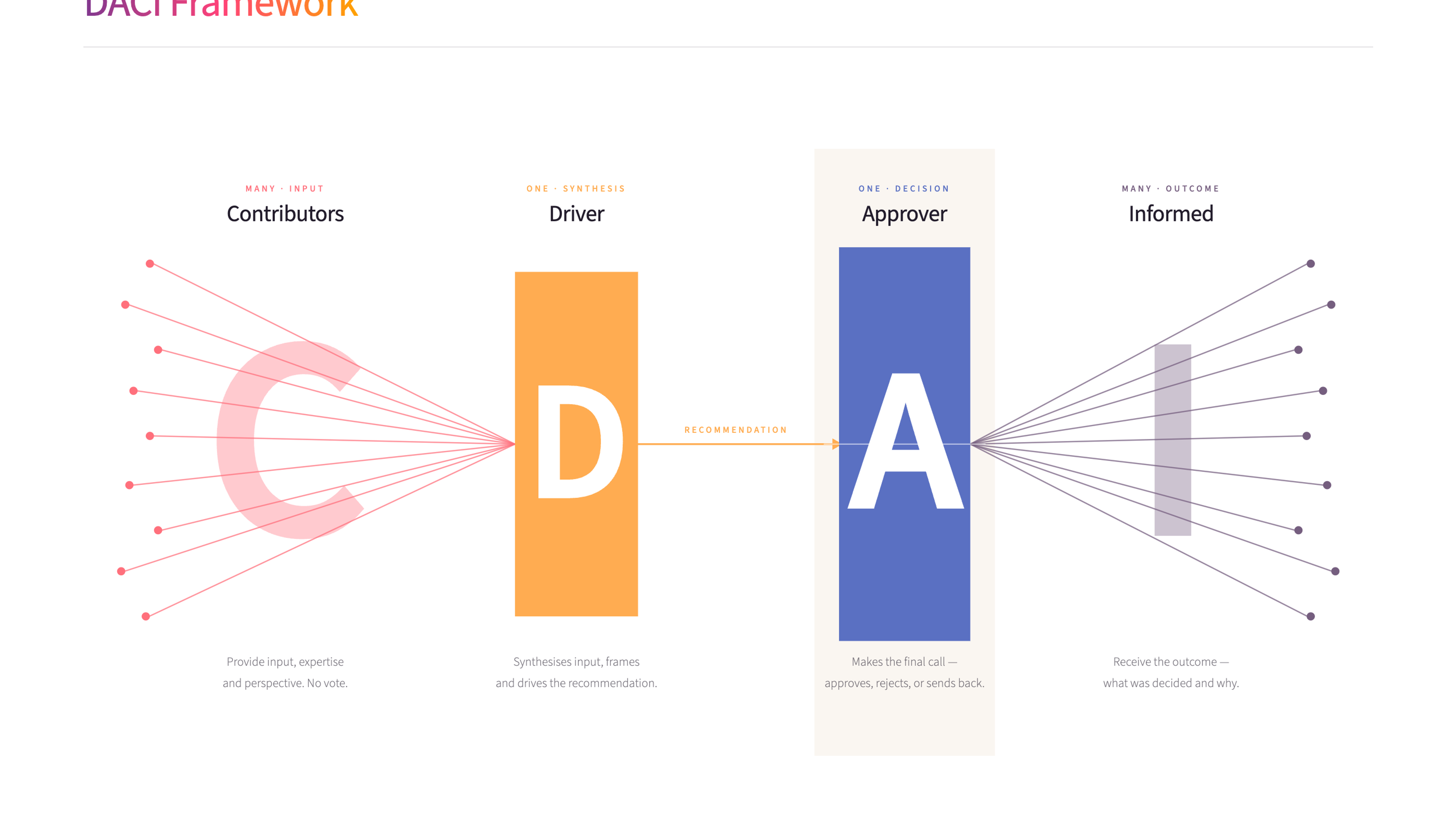
The DACI Framework is a decision-making tool that clarifies who plays what role in a decision - Driver, Approver, Contributors, and Informed. It cuts through ambiguity about who owns what, especially when decisions involve multiple people or teams.
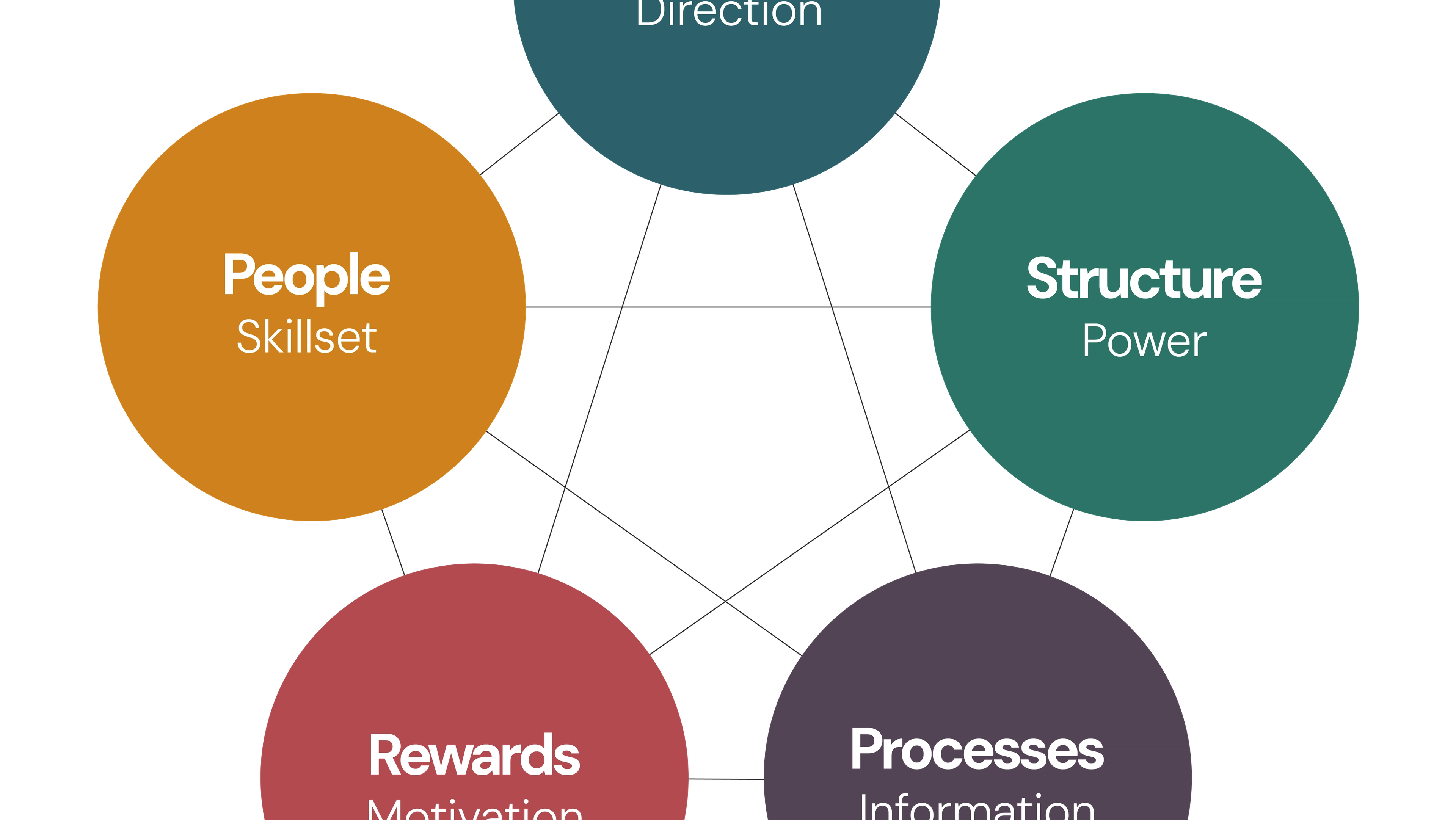
The Galbraith Star Model is an organisational design framework that maps five interconnected elements - strategy, structure, processes, rewards, and people. It helps leaders see how these elements need to align for the organisation to work well.
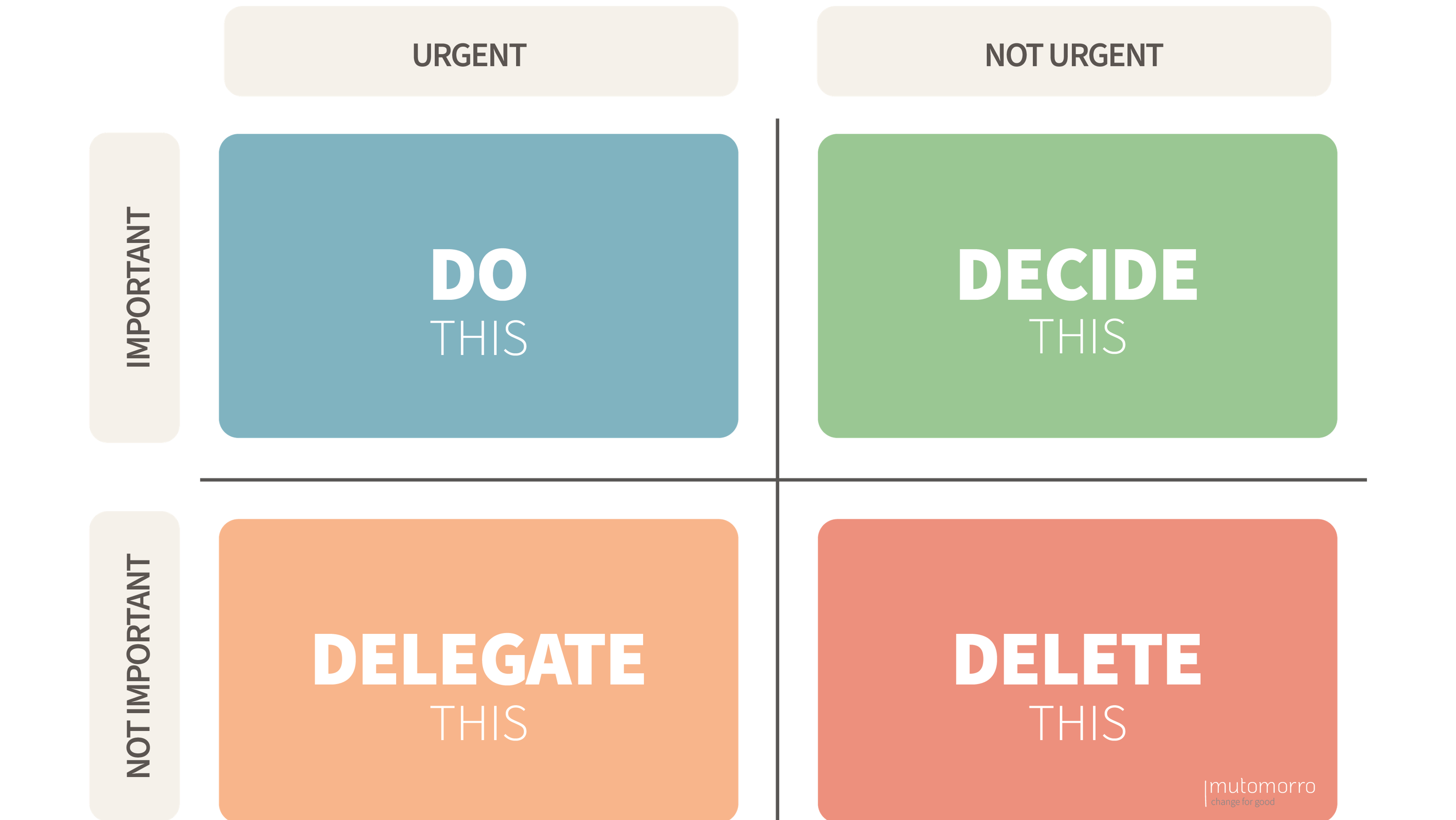
The Eisenhower Matrix is a time management and prioritisation tool that sorts tasks into four categories based on urgency and importance. It helps teams focus on what actually matters instead of just what feels most pressing.

Most organisational structures were designed for a different era - one where stability was the goal and change was the exception. This article explores what it means to design structures that can adapt when conditions change, and why getting this right matters more than getting the perfect org chart.

How to design governance that enables innovation rather than constraining it. This article explores the balance between oversight and freedom, and how the right governance structures can become a genuine advantage.

RACI and RASCI differ by one letter - the Supportive role. What the S actually adds, when it earns its place, and how to choose between RACI, RASCI and DACI, with the same tasks mapped both ways.
Team Effectiveness Training
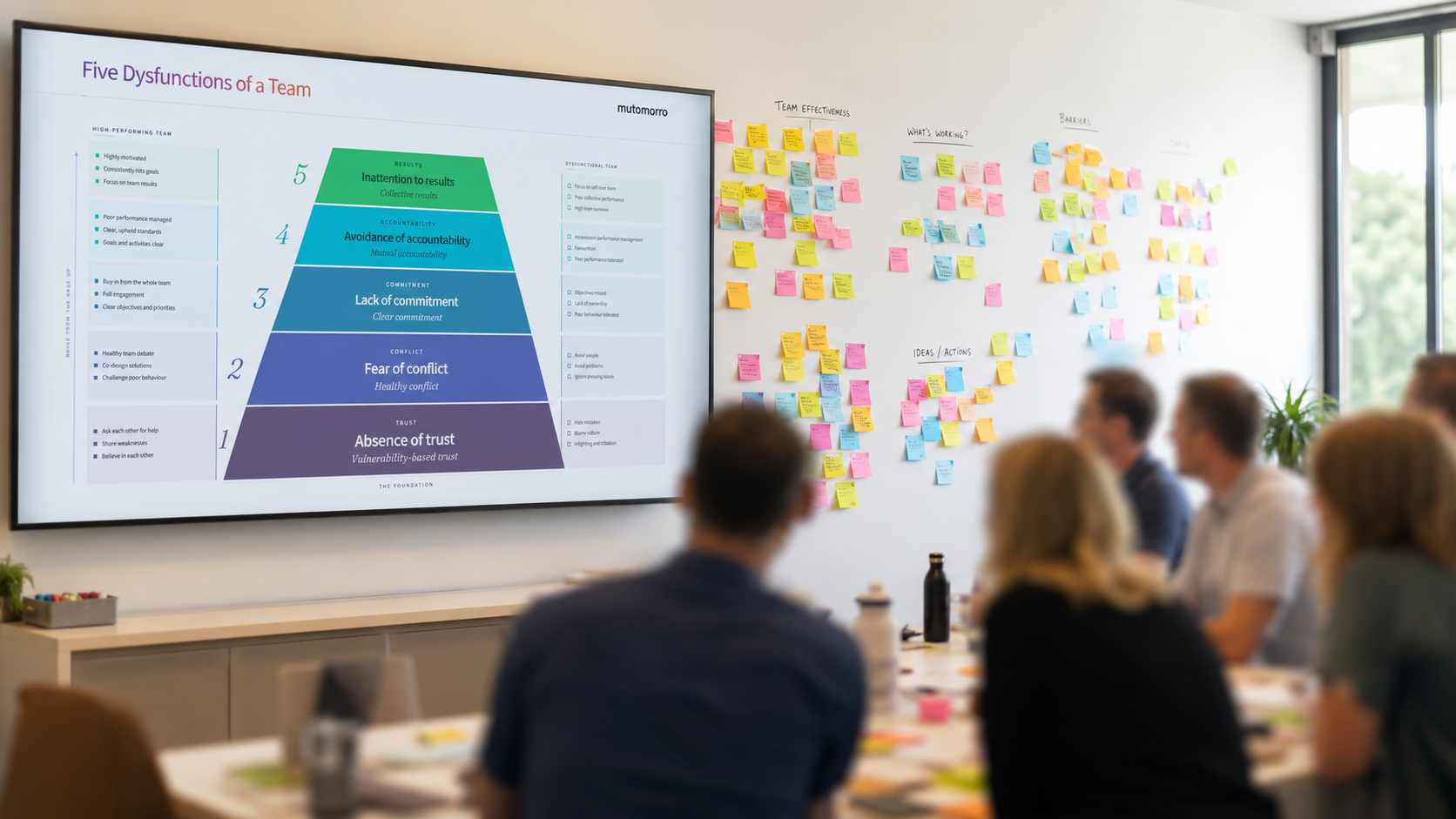
RASCI brings clarity to roles and responsibilities, and it is one of the tools we draw on in our Team Effectiveness training.
James Freeman-Gray is the founder of Mutomorro. He's an organisational development practitioner who has spent over twenty years working with leaders across public, private and nonprofit sectors - helping organisations pull together around a common purpose, joined up in how they work. More about who we are and what it's like to work with us.
RASCI is a step up from basic RACI - the added "Supportive" role addresses a gap I kept seeing in practice. I use it when projects or processes involve multiple teams and accountability keeps getting blurred. The conversation about who is Responsible versus who is Accountable is always more revealing than people expect.
Last reviewed: July 2026
Ready to use RASCI Framework?
Download the free template - includes practical guidance for workshops and team sessions.
Get the free template
Want to put these ideas into practice?
Whether you're navigating a merger, rethinking how you're structured, or trying to shift a culture that isn't working - underneath, it's the same job: getting the whole organisation pulling in the same direction. Start with a conversation.