BPM Lifecycle
The BPM Lifecycle is a five-stage cycle for designing, modelling, implementing, monitoring, and optimising how work flows through an organisation. Each pass through the cycle - design, model, implement, monitor, optimise - refines the process further.
Get the free template
Most organisations have processes that grew by accident. Someone found a way to get something done, other people copied it, and over time it became "how we do things." The BPM Lifecycle gives you a structured way to step back, look at how work actually flows, and improve it deliberately rather than leaving it to chance.
What is the BPM Lifecycle?
The BPM Lifecycle (Business Process Management Lifecycle) is a five-stage cycle for managing and improving business processes. It takes a process from its current state through design, modelling, implementation, monitoring, and optimisation - then loops back to the beginning, because processes are never truly finished.
The roots of BPM sit in the quality management traditions of the twentieth century - scientific management, Total Quality Management, and Lean manufacturing all contributed to the idea that how work gets done matters as much as what work gets done. The formal BPM discipline emerged in the 1990s as organisations started using technology to map, automate, and measure their processes more precisely. The lifecycle model draws on these traditions but frames them as a repeating cycle rather than a one-off improvement project.
What makes BPM different from a general "let's fix this process" conversation is the systematic nature of the approach. Each stage has a clear purpose, the stages build on each other, and the whole thing is designed to repeat. You're not aiming for a perfect process on the first pass - you're building a rhythm of continuous refinement. That momentum through how work flows is where the real value sits.
The BPM Lifecycle is most useful when processes cross team or departmental boundaries, when there's no single owner responsible for how the whole thing works end to end, or when a process has grown organically and nobody has examined it as a complete sequence for a while.
How the BPM Lifecycle works
The lifecycle moves through five stages in sequence, with the output of each stage feeding into the next. After the fifth stage, the cycle begins again - each pass building on what the previous one revealed.

Phase | Purpose | Output |
|---|---|---|
Design | Understand the current state, design a target state that closes the gaps | Clear objectives for the improved process |
Model | Test the design before committing - stress-test it | A design you're confident enough to build |
Implement | Take the redesigned process live | A working process, people briefed on the new way |
Monitor | Track performance against the design objectives | Data and patterns - what works, where it drifts |
Optimise | Turn monitoring into action; capture what works | Adjustments that feed back into the next Design |
1. Design
Design is where you define what the process should look like. This means understanding the current state - what actually happens today, step by step, including the workarounds and informal shortcuts that don't appear in any documentation - and then designing a target state that addresses the gaps.
Good design work involves the people who do the work, not just the people who manage it. A process designed in a meeting room without input from the team that runs it every day will miss things. Process mapping is a practical technique here - it gives you a shared picture of how work moves from start to finish and makes hidden handoffs and bottlenecks visible.
The design stage should produce clear objectives for the improved process: what does success look like, and how will you know you've achieved it?

2. Model
Modelling takes the design and tests it before you commit to changing anything. You create a representation of the new process - using flowcharts, BPMN notation, or process simulation software - and explore how it behaves under different conditions.
This is where you ask "what if" questions. What happens if volume doubles? What if a key team member is unavailable? What if two requests arrive at the same time? Modelling lets you stress-test the design in a way that's far cheaper than discovering problems after implementation.
Most teams go through several modelling iterations, adjusting variables and refining the design each time. The goal isn't a perfect model - it's building enough confidence that the design is sound before you invest in making it real.

3. Implement
Implementation is where the redesigned process goes live. This might mean changing workflows, updating technology, adjusting team responsibilities, or introducing new tools - often all of these at once.
The biggest risk in implementation isn't the process design itself; it's communication. Everyone involved needs to understand what's changing, why, and what their role looks like in the new way of working. A well-designed process will fail if the people running it don't know how it's supposed to work or why the change matters.
Implementation rarely goes perfectly the first time. Build in a transition period where the old and new approaches overlap, and make it easy for people to flag issues without feeling like they're criticising the change. The 8 Wastes of Lean framework can help you spot where the new process is introducing unnecessary friction during this transition.

4. Monitor
Once the process is running, you need to watch it. Monitoring means tracking performance against the objectives you set during the design stage - speed, quality, cost, error rates, or whatever measures matter for this specific process.
Good monitoring is active, not passive. You're not just collecting data and waiting for something to go wrong; you're looking for patterns, watching for drift, and catching small problems before they compound. A Gemba Walk - going to where the work happens and observing the process in action - is one of the simplest and most effective monitoring techniques.
The monitoring stage also reveals things that modelling couldn't predict. Real-world conditions, human behaviour, and edge cases all show up here. This is useful information, not a sign that the design failed.
Define your key performance indicators clearly and review them at a regular cadence. Weekly is often right for newly implemented processes; monthly or quarterly for established ones.

5. Optimise
Optimisation is where monitoring data turns into action. You evaluate how the process is performing, identify what's working well, and decide what to adjust.
This stage is about more than fixing problems. It's also about recognising what's working and understanding why. Sometimes a process performs better than expected because the team has found a better way to handle a step - capturing that improvement and making it part of the standard process is just as valuable as fixing a bottleneck.
The insights from optimisation feed directly back into the design stage. Maybe the process needs a minor adjustment. Maybe monitoring has revealed a bigger structural issue that requires a more significant redesign. Either way, the cycle continues - and each pass makes the process a little more effective than the last.
This rhythm of continuous refinement is what connects BPM to other improvement approaches like the PDCA Cycle and Kaizen. The common thread is that improvement isn't an event - it's a practice.
How to use the BPM Lifecycle
Choose a process that matters but isn't too complex to start with. Your first BPM cycle shouldn't be your most critical or most complicated process. Pick something that crosses a couple of teams, has visible pain points, and where improvement would be noticed. Onboarding a new client, handling a service request, or processing an internal approval are all good candidates.
Map the current state before designing the future state. It's tempting to jump straight to designing the improved process, but you need an honest picture of what happens today first. Walk through the process with the people who do it. You'll almost always discover steps, handoffs, and workarounds that aren't in any documentation.
Keep the design team close to the work. The people designing the process improvement should include people who run the process. Design decisions made without operational input tend to look elegant on paper and create problems in practice.
Set measurable objectives early. "Make the process better" isn't a useful goal. Decide what better means - faster turnaround, fewer errors, lower cost, better experience for the people involved - and agree on how you'll measure it before you start implementing.
Don't skip modelling. It's tempting to go straight from design to implementation, especially when the changes seem straightforward. But even simple process changes can have knock-on effects that aren't obvious until you think them through. A lightweight modelling step - even just walking through scenarios on a whiteboard - saves time in the long run.
Treat the first implementation as a learning exercise. The first pass around the cycle is about establishing the rhythm, not achieving perfection. What you learn from monitoring and optimising the first iteration will shape a much stronger second pass.
Example
A professional services firm handles client onboarding through a process that involves three teams: sales, operations, and the delivery team assigned to the account. Handoffs between these teams are inconsistent - sometimes information gets passed cleanly, sometimes it doesn't, and new clients occasionally experience a gap between signing a contract and the delivery team being fully briefed.
Design: The three teams map the current onboarding process together, identifying where information gets lost and where delays typically occur. They find that the handoff from sales to operations depends on an email chain that doesn't follow a consistent format, and that the delivery team often doesn't receive the client's priorities until the first meeting. They design a revised process with a structured handoff template and a brief kick-off call before the client meeting.
Model: They walk through the revised process using three recent client onboardings as test cases. This reveals that the kick-off call creates a scheduling bottleneck when multiple clients are onboarding simultaneously. They adjust the design to make the call optional for straightforward accounts, replacing it with a shared briefing document.
Implement: The revised process goes live, with all three teams briefed on the new handoff template and briefing document. A shared channel is created for flagging issues during the transition.
Monitor: Over eight weeks, they track time-to-first-meeting, the number of briefing gaps reported by delivery teams, and client satisfaction scores from the first interaction. The data shows a 40% reduction in briefing gaps and a modest improvement in time-to-first-meeting.
Optimise: The review reveals that the handoff template works well but is too detailed for smaller accounts. They create a lightweight version for accounts below a certain size. The shared briefing document has become the most valued part of the new process - delivery teams report feeling significantly better prepared. This feeds into the next cycle: refining the template variants and extending the approach to other internal handoffs.
Limitations
BPM works best for repeatable processes. If a process is different every time - genuinely creative work, one-off projects, emergent problem-solving - the lifecycle model has less to offer. It's designed for processes that happen regularly enough to observe, measure, and refine.
It requires organisational patience. The real value of BPM comes from multiple cycles, not from the first pass. Organisations looking for a quick fix may find the iterative approach frustrating, especially when the first implementation doesn't deliver dramatic results immediately.
Cross-functional processes need cross-functional buy-in. A process that spans several teams can only be improved if all those teams are willing to participate. If one team engages and another doesn't, the improvement stalls at the boundary between them.
The monitoring stage is where commitment often fades. Designing a new process is energising. Implementing it feels like progress. Monitoring it over weeks and months is less exciting but just as important. Without sustained attention to monitoring, the optimisation stage has nothing to work with.
Getting started
Pick one process that your team finds frustrating - something where the pain is real but the stakes aren't so high that experimentation feels risky. Spend an hour mapping how it works today, end to end, with the people who do it. That conversation alone will surface things worth changing.
From there, you're already in the design stage. The operational effectiveness work we do with teams often starts exactly this way - a single process, mapped honestly, with the people closest to the work.
The BPM Lifecycle was formalised as a discipline through the work of the Association of Business Process Management Professionals and academic contributions including Dumas et al.'s Fundamentals of Business Process Management (Springer, 2018).
We share thinking on organisational change and development on LinkedIn - practical ideas for people doing this work inside their own organisations.
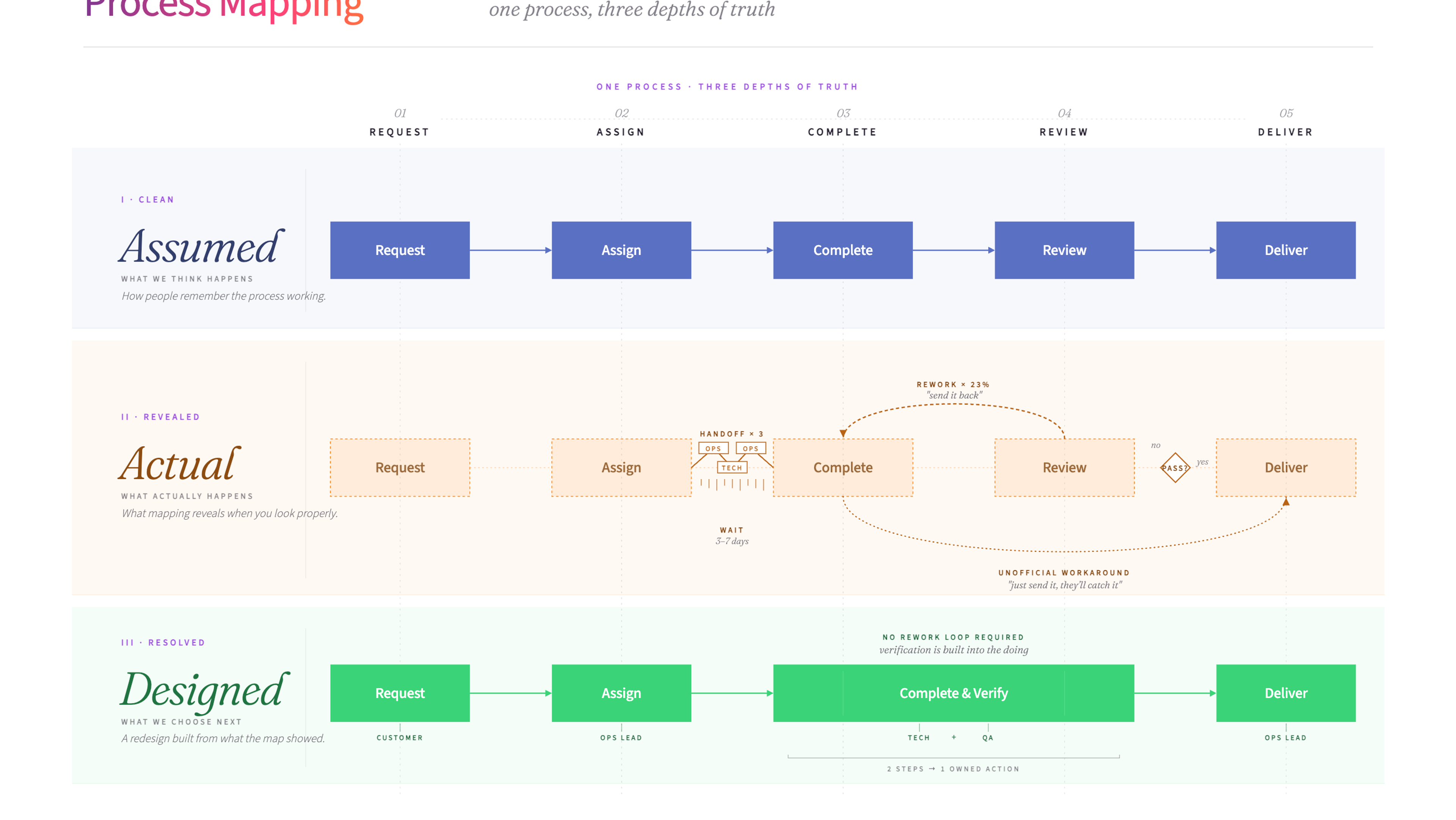
Process mapping is a visual method for documenting how a process works from start to finish. It helps teams see the full picture - every step, decision point, and handoff - so they can spot problems and design improvements.
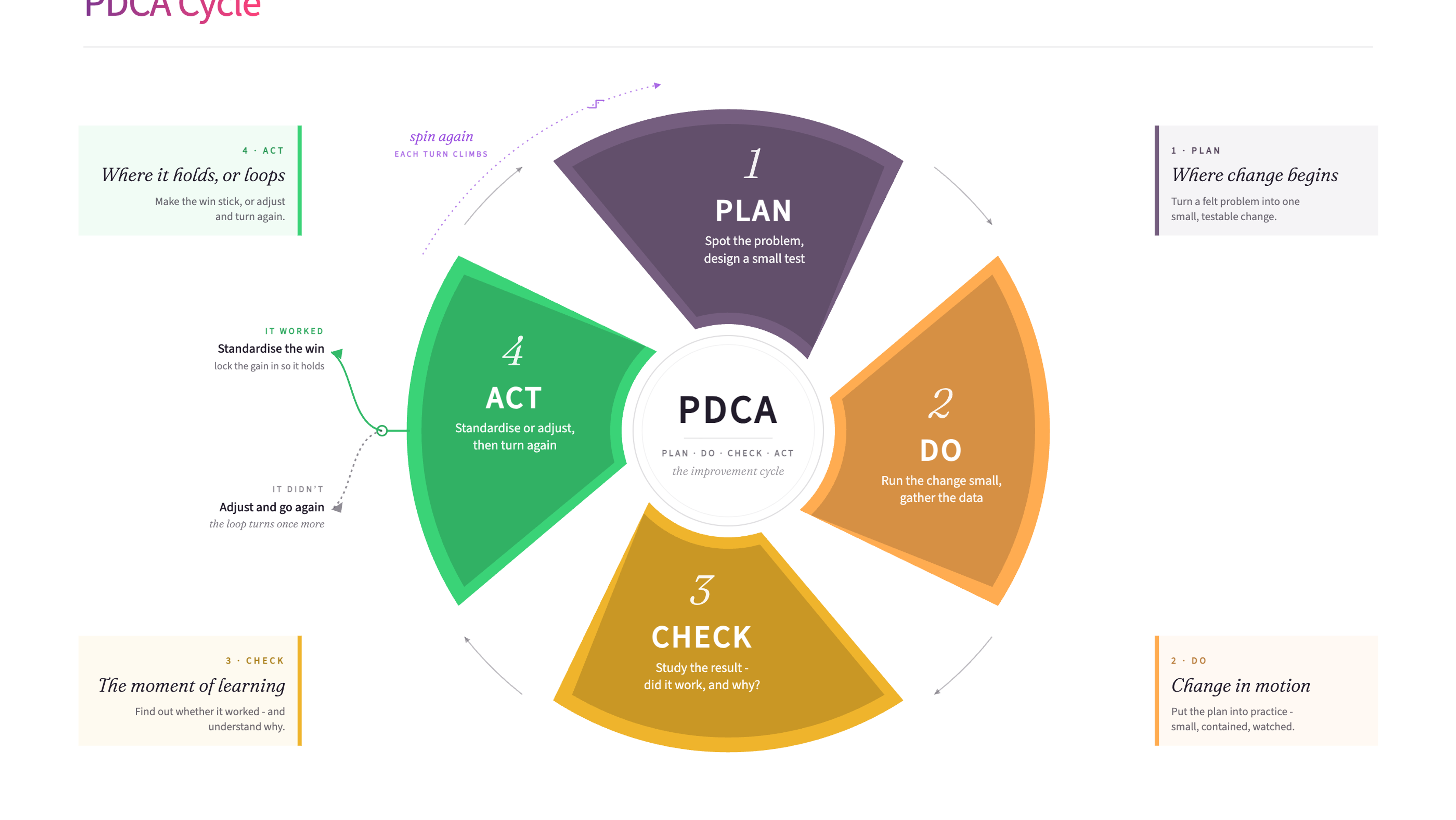
The PDCA Cycle (Plan, Do, Check, Act) is a continuous improvement framework for testing and refining processes. It creates a repeating loop of planning a change, trying it, checking whether it worked, and adjusting before the next round.
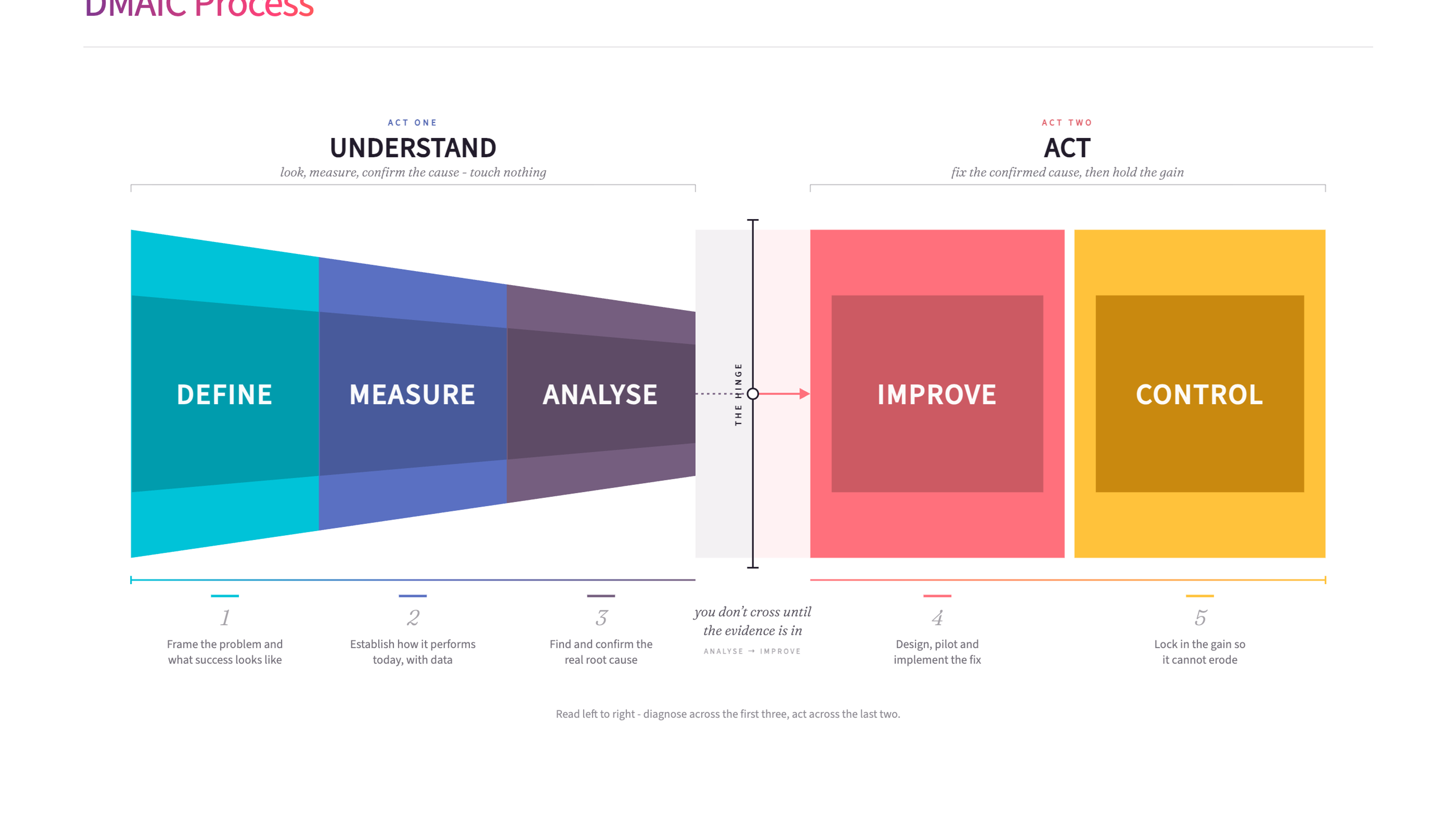
DMAIC (Define, Measure, Analyse, Improve, Control) is a structured problem-solving method from the Six Sigma toolkit. It gives teams a clear five-step process for improving existing processes using data and evidence.
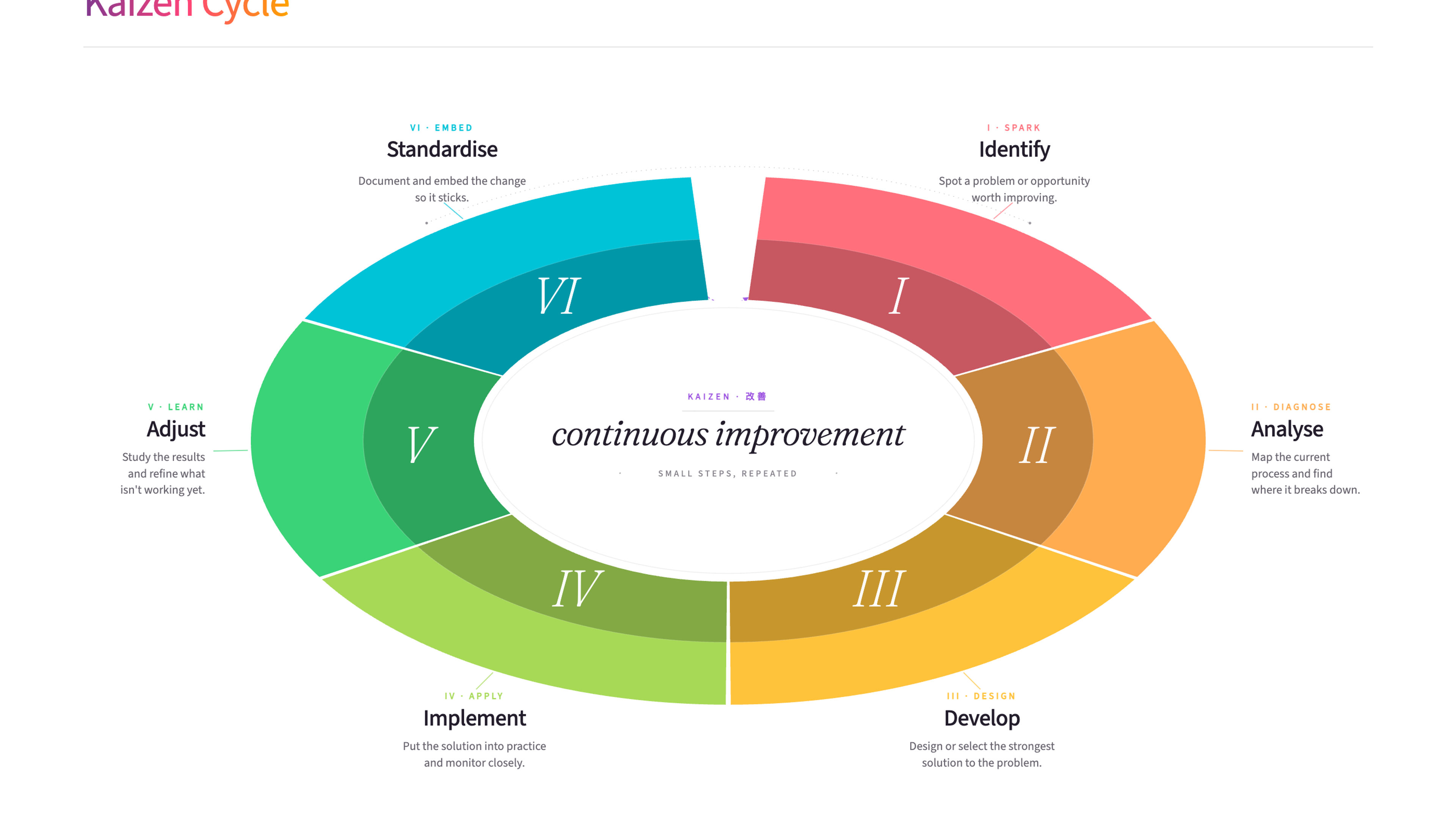
Kaizen is a Japanese continuous improvement philosophy built on the idea that small, ongoing changes add up to significant results over time. The Kaizen Cycle gives teams a structured way to identify improvements, test them, and build them into everyday work.
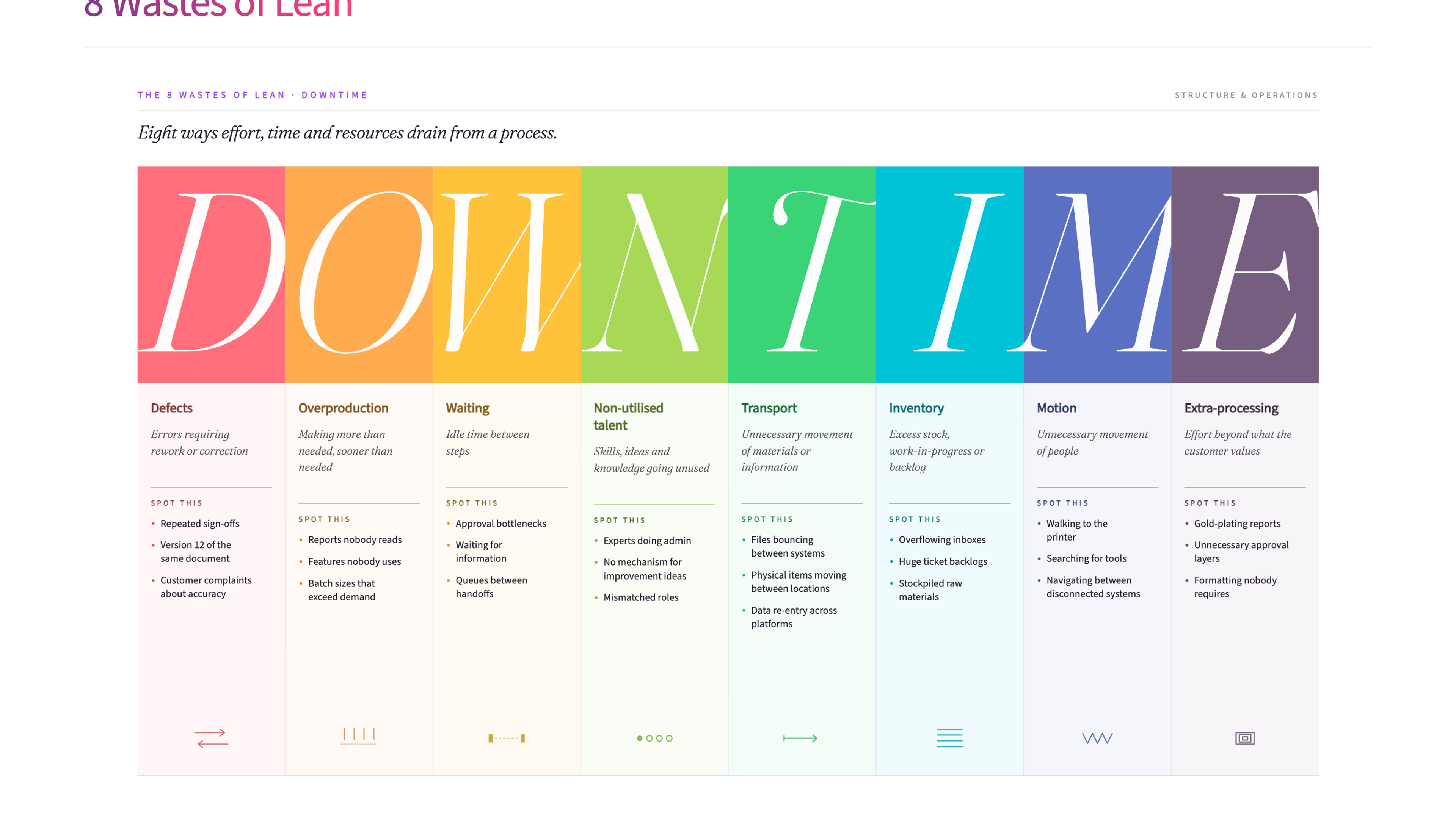
The 8 Wastes of Lean give you eight categories for finding where effort, time and resources leak from a process. Use the DOWNTIME acronym to work through each waste type systematically and build a clear picture of what to improve.

Every organisation has friction - the unnecessary effort, the needless complexity, the things that make simple work harder than it should be. This article explores how to find it, understand where it comes from, and reduce it without creating new problems in the process.
Most organisations run on invisible infrastructure - the corridor conversation, the person who just knows, the relationships that bridge gaps between teams. Growth puts all of it under pressure. Scaling well means designing what replaces it.
Process Mapping Workshop
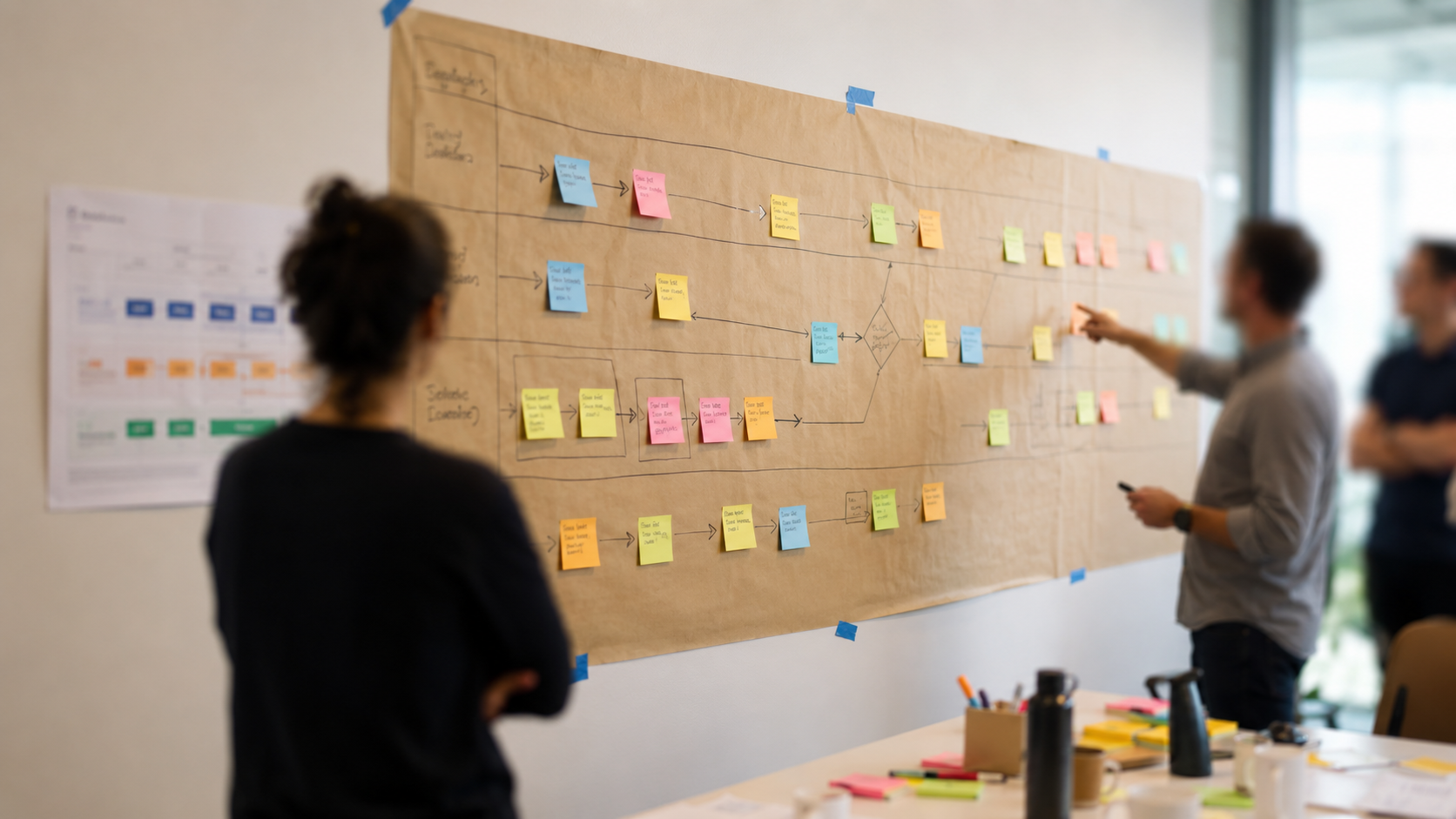
The BPM lifecycle sets the bigger picture; our Process Mapping workshop is where your team learns to do the mapping itself, hands-on.
James Freeman-Gray is the founder of Mutomorro. He's an organisational development practitioner who has spent over twenty years working with leaders across public, private and nonprofit sectors - helping organisations pull together around a common purpose, joined up in how they work. More about who we are and what it's like to work with us.
The Business Process Management lifecycle gives structure to what can otherwise feel like endless tinkering. I use it when organisations need to move from reactive process fixes to a more systematic approach to managing how work gets done. The key insight is that process management is ongoing, not a one-off project.
Last reviewed: June 2026
Ready to use BPM Lifecycle?
Download the free template - includes practical guidance for workshops and team sessions.
Get the free template
Want to put these ideas into practice?
Whether you're navigating a merger, rethinking how you're structured, or trying to shift a culture that isn't working - underneath, it's the same job: getting the whole organisation pulling in the same direction. Start with a conversation.