5 Whys
The 5 Whys is a simple root-cause analysis technique that drills into problems by asking "why?" repeatedly. It helps teams get past surface-level symptoms to find the real cause of an issue.
Get the free template
Some problems keep coming back. Not because the solutions were wrong, but because they were aimed at the wrong thing. A team misses a deadline, so you add a check-in meeting. A product launch stumbles, so you revise the sign-off process. The fix makes sense. It works - for a while. Then a different version of the same problem reappears, and you're solving it again.
The 5 Whys is one of the simplest tools for breaking this cycle. It asks a single question - "Why?" - repeatedly, following each answer to the next level of cause. Used well, it does more than identify a root cause. It opens a window into the conditions, assumptions, and patterns that made the problem possible in the first place.
What is the 5 Whys?

The 5 Whys is a questioning technique that moves you from observable symptoms to underlying causes. You start with a problem, ask why it happened, then ask why that answer is true - and keep going until you reach something fundamental enough to act on.
The approach was developed by Sakichi Toyoda, the founder of Toyota Industries, and became a central part of the Toyota Production System in the mid-20th century. Taiichi Ohno, the architect of that system, described it simply: "By repeating why five times, the nature of the problem as well as its solution becomes clear."
The name suggests exactly five questions, but that's a guideline rather than a rule. Some problems resolve in three. Others need seven or eight. The point isn't the number - it's the discipline of not stopping at the first plausible explanation. The American Society for Quality notes that the technique also has a companion method - the "Five Hows" - which works in the opposite direction, expanding a solution into actionable detail.
What makes the 5 Whys distinctive is what it asks of the people using it. Unlike data-heavy analytical methods, it relies on the knowledge, experience, and honesty of the people closest to the problem. That makes it fast and accessible. It also means the quality of the answers depends entirely on the quality of the conversation.
How the 5 Whys works
Most people encounter the 5 Whys as a linear drill-down: you start with a problem, ask why five times in sequence, and arrive at a root cause you can fix. That version is useful - particularly for contained, technical, or procedural problems where there's a clear causal chain.
But there's a second, more powerful mode. Instead of following a single chain to its end, you use the questioning to open up the problem - to surface the broader conditions, assumptions, and patterns that sit underneath the symptoms. In this mode, the value isn't just the root cause you land on. It's what the conversation reveals along the way.

The linear mode works like a drill. Each "why" narrows the focus, moving from symptom to cause to deeper cause. The chain is sequential, and the goal is to find the specific thing that broke so you can fix it.

The opening-up mode works more like a lens widening. As you ask why, the answers stop being about the specific incident and start being about how things work around here - the habits, structures, and beliefs that created the conditions for the problem. You're no longer looking for a broken step in a process. You're looking at the system the process sits inside.
The difference often shows up around the third or fourth "why." In the linear version, you're still tracing a procedural chain. In the broader version, someone says something like "because we've never had a clear way of deciding that" or "because nobody felt they could raise it" - and the conversation shifts from fixing a thing to understanding a pattern.
Both modes are legitimate. The skill is knowing which one the situation needs - and giving people enough scope to get there.
A useful rule of thumb: if the problem is contained, technical, and happened once, the linear mode will usually get you what you need. If the problem is recurring, involves multiple teams, or keeps showing up in slightly different forms, the opening-up mode is more likely to surface something worth acting on. The recurring part is the tell. Problems that keep coming back are rarely about a single broken thing - they're about the conditions that keep producing breakdowns.
Linear mode | Opening-up mode | |
|---|---|---|
How it works | A drill - each why narrows toward one root cause | A lens widening - each why surfaces broader conditions |
Best for | Contained, technical, one-off problems | Recurring problems that show up in different forms |
What it finds | A specific broken step to fix | The patterns, structures and beliefs underneath |
The tell | Stays on the procedural chain | Around the third or fourth why, shifts from "what happened" to "why things work this way" |
How to use the 5 Whys
Write a clear problem statement
Everything depends on where you start. A vague problem ("things aren't working well") produces vague answers. A good problem statement is specific, observable, and free from assumptions about cause.
"Our last three project deliveries were between two and four weeks late" is a good starting point. "We have a project management problem" is not - it already contains a conclusion.
Spend time on this. A well-written problem statement is often the difference between a productive session and one that goes in circles.
Get the right people in the room
The 5 Whys works best with people who are close to the problem - not just the people responsible for it. Include those who do the day-to-day work, those who see the consequences, and those who understand the wider context. A mixed group is more likely to follow the questioning into territory that a single perspective would miss.
If you're facilitating, you're not there to supply answers. You're there to keep asking "why" when the group wants to stop, and to notice when the answers are shifting from specific causes to broader conditions.
Follow the chain - but watch for branches
Real problems rarely have a single clean causal chain. When you ask "why did this happen?", you'll often get two or three plausible answers. That's not a problem - it's information.
You can follow each branch separately, which turns the exercise from a linear chain into a tree. Or you can ask the group which branch feels most significant and follow that one first, noting the others for later. Either way, resist the temptation to force a complex situation into a single storyline.
Notice when the conversation shifts
This is where facilitation matters most. At some point - usually around the third or fourth why - the answers start to change character. They stop being about what happened and start being about why things work the way they do.
"Because the brief wasn't clear enough" is a procedural cause. "Because nobody felt confident enough to push back on the brief" is a condition. Both are valid answers, but they lead to very different kinds of action.
If you're in linear mode, you'll follow the procedural path and find a process to improve. If you're in opening-up mode, you'll follow the condition and find something about the culture, the structure, or the assumptions that needs attention.
The facilitator's job is to notice this shift and make space for it - without forcing it. Sometimes the group needs the procedural answer. Sometimes they're ready for the deeper one.
Keep it about the work, not the people
The 5 Whys can get uncomfortable. As you dig deeper, the answers sometimes point toward decisions, behaviours, or gaps that feel personal. This is where the exercise either builds trust or breaks it.
The principle is simple: you're investigating the process, not the person. Frame questions around what happened and why, not who did what. If the conversation starts to feel like an interrogation, pause and reset. The goal is understanding, not accountability.
Know when to stop
You've gone deep enough when you reach a cause that is both believable and actionable - something the organisation can meaningfully change. If the answer is "because that's how things are" or "because the market changed," you've either gone too far or you've uncovered something that needs a different kind of response.
There's no fixed number. Five is a useful heuristic because most problems need at least that many layers to get past surface explanations. But stop when you've reached something real, not when you've hit an arbitrary count.
Keep it short and focused
A 5 Whys session shouldn't take more than 30 minutes for a single problem. If it's dragging, the problem statement probably isn't specific enough, or you're trying to tackle something that needs a broader analysis tool.
Write as you go - on a whiteboard, shared document, or even paper. Capturing each answer as it's given keeps the chain visible and helps the group see where they've been. It also makes it harder to skip levels or lose the thread. If the answers branch, sketch the tree so everyone can see the shape of what's emerging.
Example: two paths from the same problem
A technology team notices that their last three product releases have been delayed. The team lead brings this to a retrospective and uses the 5 Whys to understand what's happening.
The linear path
Problem: Our last three releases were delayed by two or more weeks.
Why? Because testing took longer than planned.
Why? Because testers received the build later than scheduled.
Why? Because development work wasn't completed on time.
Why? Because two developers were pulled onto urgent support work mid-sprint.
Why? Because there's no dedicated support rota, so the team absorbs support requests as they come in.
Root cause: No separation between planned development work and reactive support. The fix is structural - create a support rota or ring-fence development time.
This is a clean, useful analysis. It identifies a specific problem and points to a concrete solution. For many situations, this is exactly what you need.
The broader path

Same problem, but this time the facilitator gives the group more scope.
Problem: Our last three releases were delayed by two or more weeks.
Why? Because testing took longer than planned.
Why? Because the scope kept changing after development started.
Here the conversation branches. One branch follows the scope changes (who's requesting them, why so late). The other follows why testing absorbs the impact rather than pushing back.
Following the scope branch:
Why did scope keep changing? Because the people requesting changes didn't see the downstream impact on the timeline.
Why not? Because there's no shared visibility of how a change request affects delivery.
Why not? Because the team has never been given the space to set that up - they've always been in reactive mode.
Following the testing branch:
Why doesn't testing push back on late scope changes? Because the team culture treats testing as the phase that absorbs whatever time pressure exists.
Why? Because delivery dates are set before the team is consulted, so testing is always the buffer.
Now the picture is different. The root cause isn't just a missing support rota. It's a pattern where the team absorbs pressure rather than surfacing it - a combination of limited visibility, externally imposed timelines, and a culture that treats some functions as more compressible than others.
The second version doesn't replace the first. It builds on it. The support rota is still worth creating. But the broader inquiry reveals conditions that, if left unchanged, will produce new versions of the same problem even after the rota is in place.
This is what the 5 Whys can do when you give people the scope to think beyond the immediate chain. It moves from identifying waste in a process to understanding the system the process operates in - which is where the Iceberg Model picks up, looking at the structures, patterns, and mental models beneath the visible events.

Limitations and when to reach for something else
The 5 Whys is powerful in its simplicity, but that simplicity has edges.
It assumes a causal chain exists. The technique works well when there's a traceable sequence from symptom to cause. But some problems - particularly in complex, adaptive systems - don't have a single root cause. They emerge from the interaction of multiple factors, none of which is "the" cause on its own. For those situations, tools like the Cynefin Framework or systems mapping may be more appropriate.
It relies on what's in the room. The quality of the analysis depends on the knowledge, honesty, and psychological safety of the people involved. If key perspectives are missing, or if people don't feel safe naming uncomfortable truths, the chain will stop at a comfortable answer rather than the real one. A Gemba Walk - going to where the work happens and observing directly - can help ground the conversation in what's observable rather than what's assumed.
It can become blame-seeking if poorly facilitated. Each "why" peels back a layer, and at some point the layers involve human decisions. Without careful facilitation, the exercise can feel like working backwards to find someone at fault. This is the fastest way to shut down the honest answers the method depends on.
The linear version can oversimplify. Following a single chain to a single root cause creates a satisfying narrative - but reality is usually messier. If you find yourself forcing a complex situation into a tidy five-step sequence, it's worth stepping back and asking whether the tool is being asked to do more than it can.
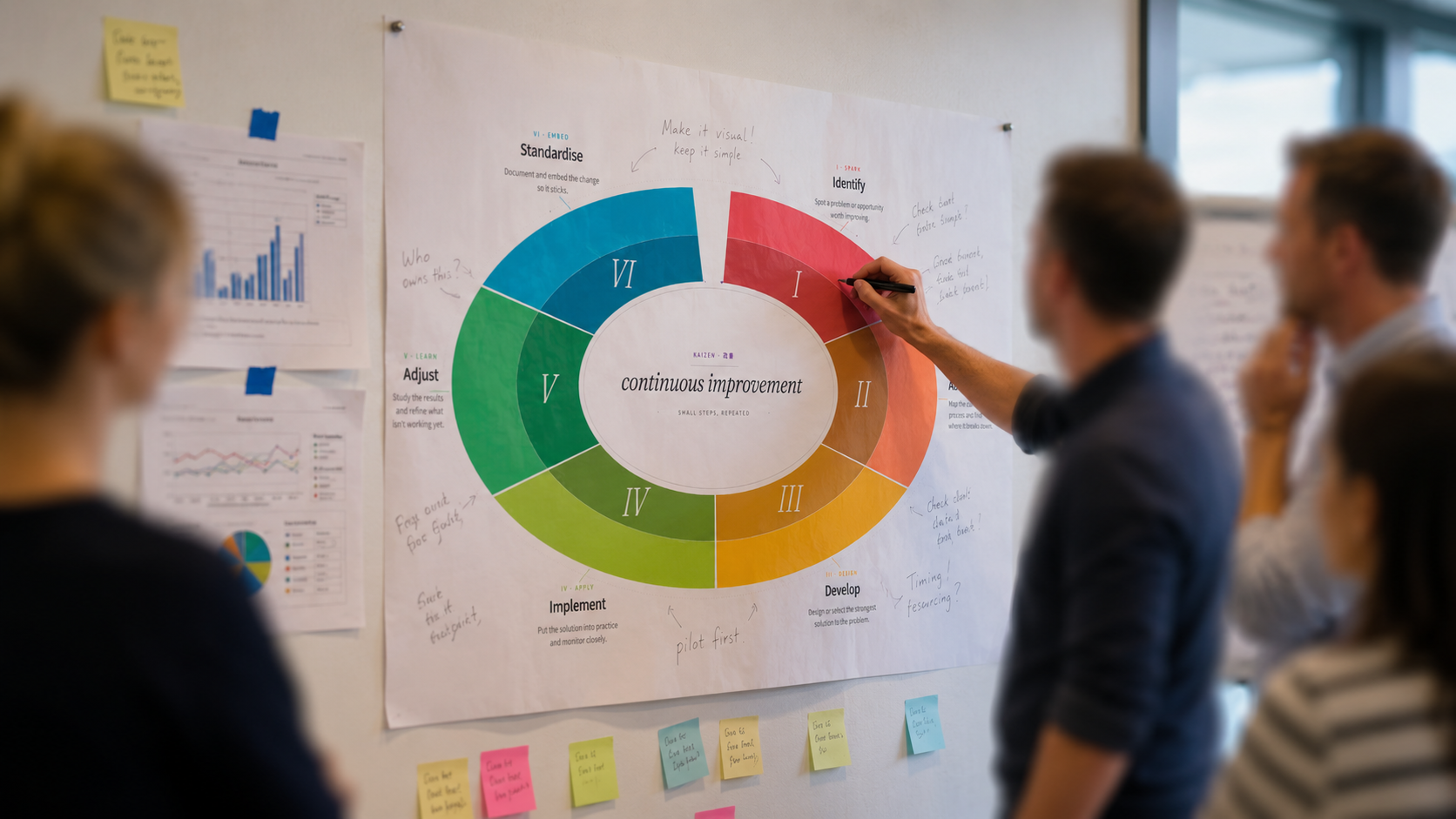
It's a starting point, not an endpoint. The 5 Whys reveals what needs attention. It doesn't design the solution. Once you've identified a root cause or a systemic condition, you'll likely need other tools to respond to it - process mapping to redesign a workflow, DMAIC for a structured improvement cycle, or the Kaizen Cycle for ongoing iterative change.
Getting started
The easiest way to try the 5 Whys is with a recent, specific problem your team has already experienced. Not the biggest problem - something contained enough that the people involved can trace the thread.
Write the problem down clearly. Gather the people who were closest to it. Start asking why - and pay attention to what happens around the third or fourth answer. That's usually where the conversation gets interesting: the shift from "what went wrong" to "why things work this way."
If the linear path gives you a clear fix, take it. If the broader path opens up something about how the team or organisation operates, that's worth noting too - even if you can't act on it immediately. Sometimes the most valuable output from a 5 Whys session isn't the root cause itself. It's the shared understanding of a pattern that nobody had named before.
For problems that are more diffuse or harder to pin down, start with a problem statement exercise first - it'll give you the sharp starting point that the 5 Whys needs to work well. And if the analysis keeps pointing toward deeper systemic conditions, the Iceberg Model offers a structured way to explore what's sitting beneath the surface.
Once you've used the tool a few times, it starts to shape how you think about problems more broadly - less rushing to fix, more willingness to ask one more question before reaching for a solution.
We share thinking on organisational change and development on LinkedIn - practical ideas for people doing this work inside their own organisations.
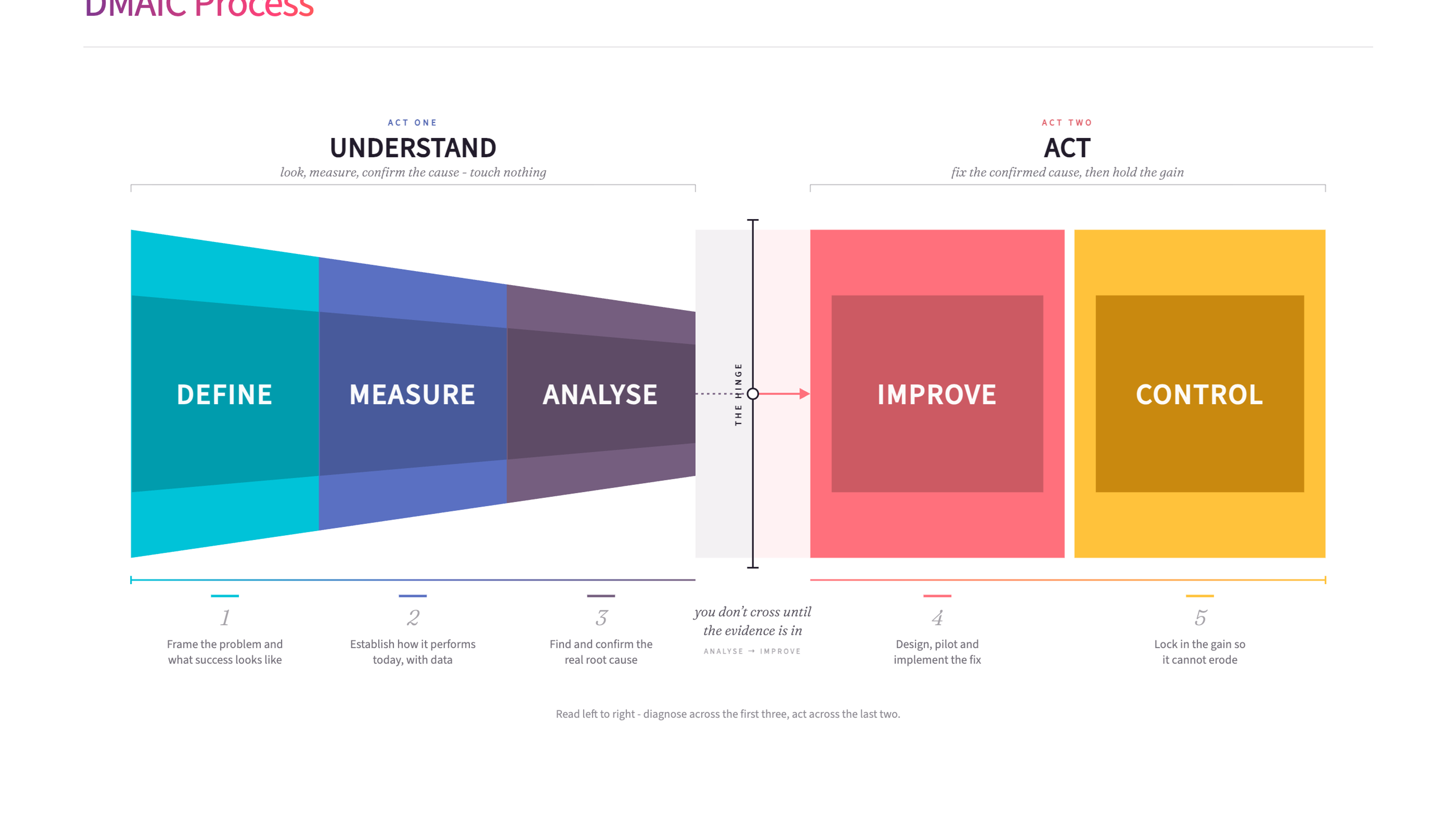
DMAIC (Define, Measure, Analyse, Improve, Control) is a structured problem-solving method from the Six Sigma toolkit. It gives teams a clear five-step process for improving existing processes using data and evidence.
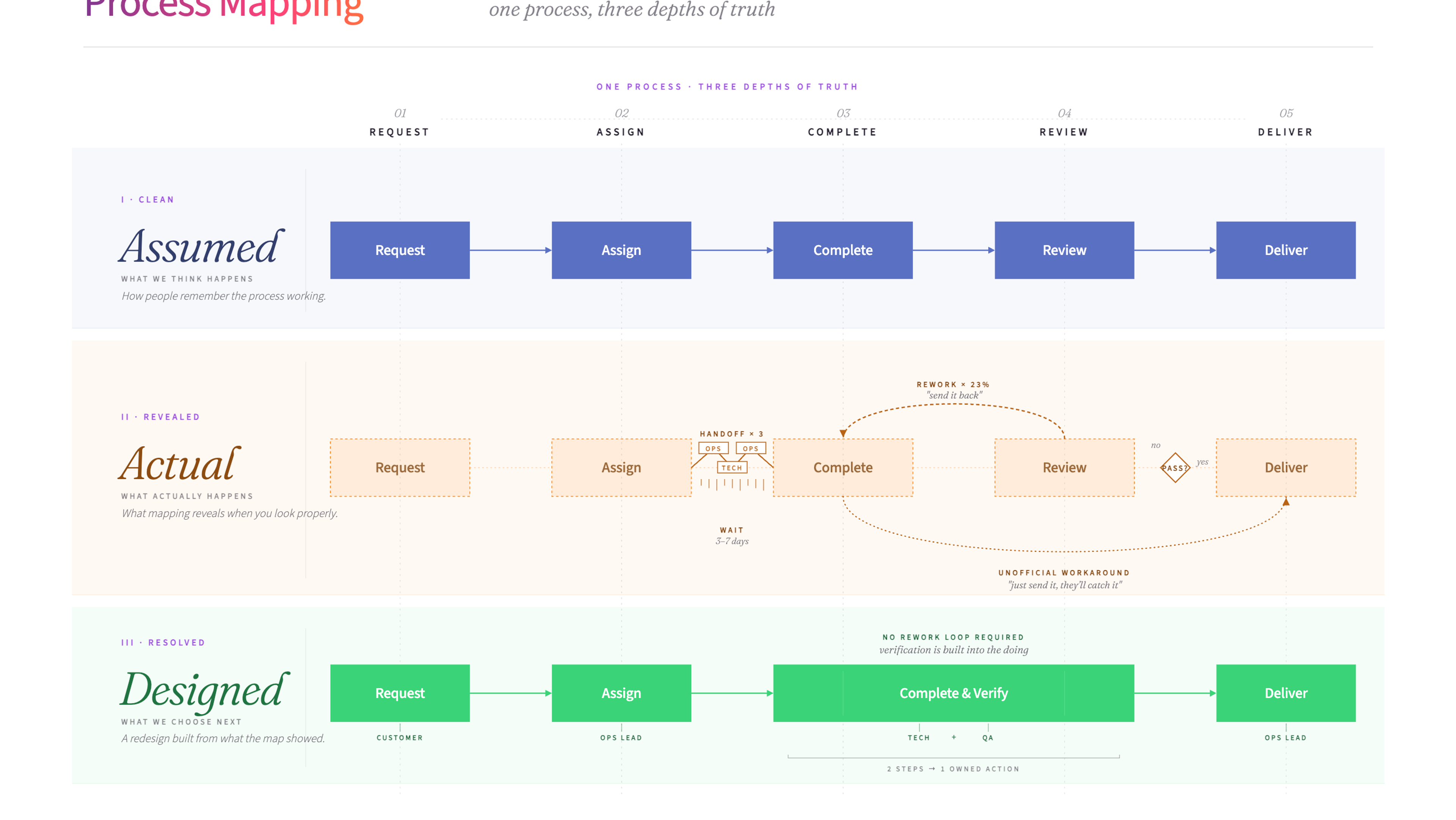
Process mapping is a visual method for documenting how a process works from start to finish. It helps teams see the full picture - every step, decision point, and handoff - so they can spot problems and design improvements.
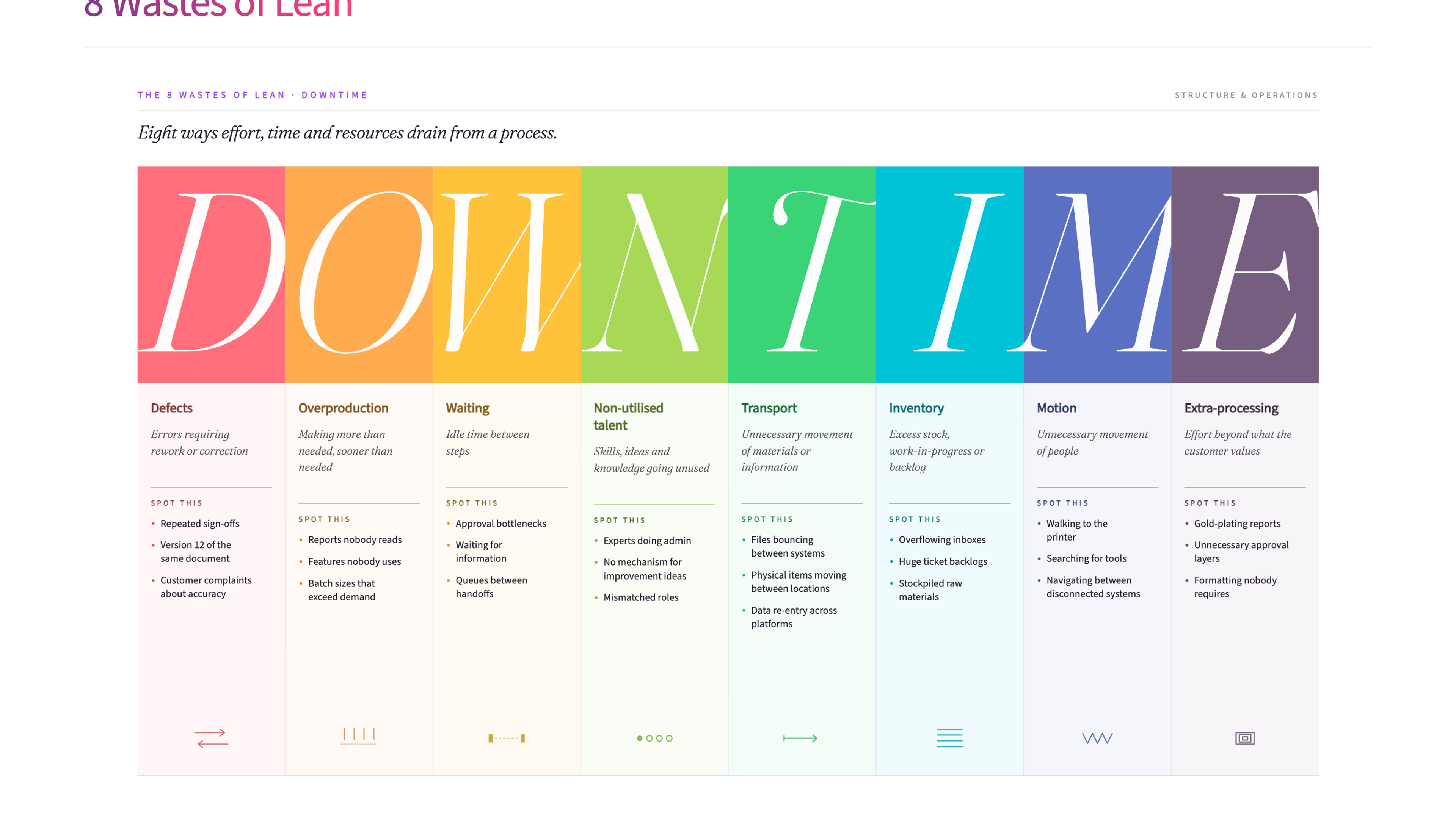
The 8 Wastes of Lean give you eight categories for finding where effort, time and resources leak from a process. Use the DOWNTIME acronym to work through each waste type systematically and build a clear picture of what to improve.
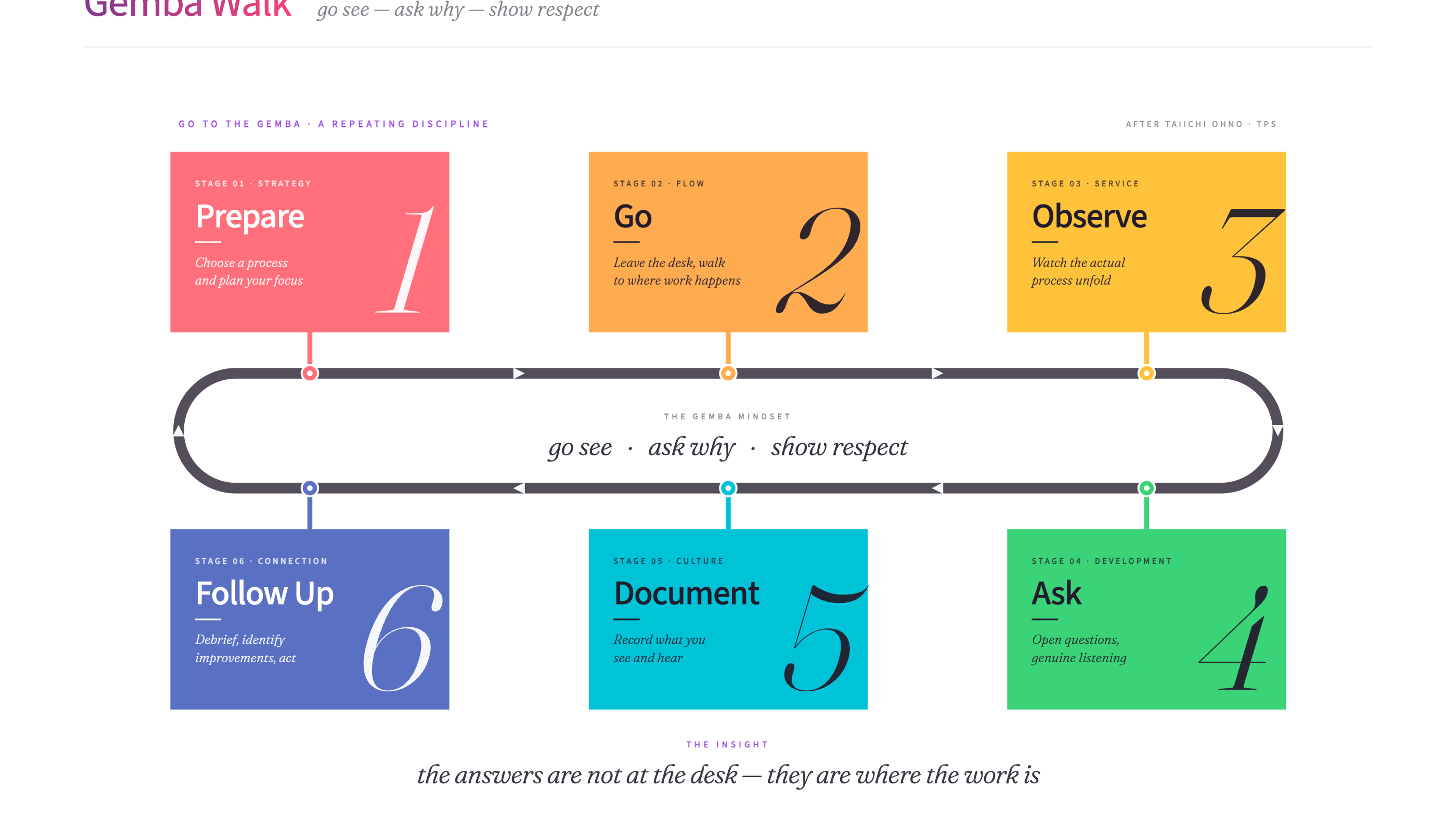
A Gemba Walk is a Lean practice where leaders go to the place where work actually happens to observe, listen, and understand. It bridges the gap between how leaders think work gets done and how it really gets done.
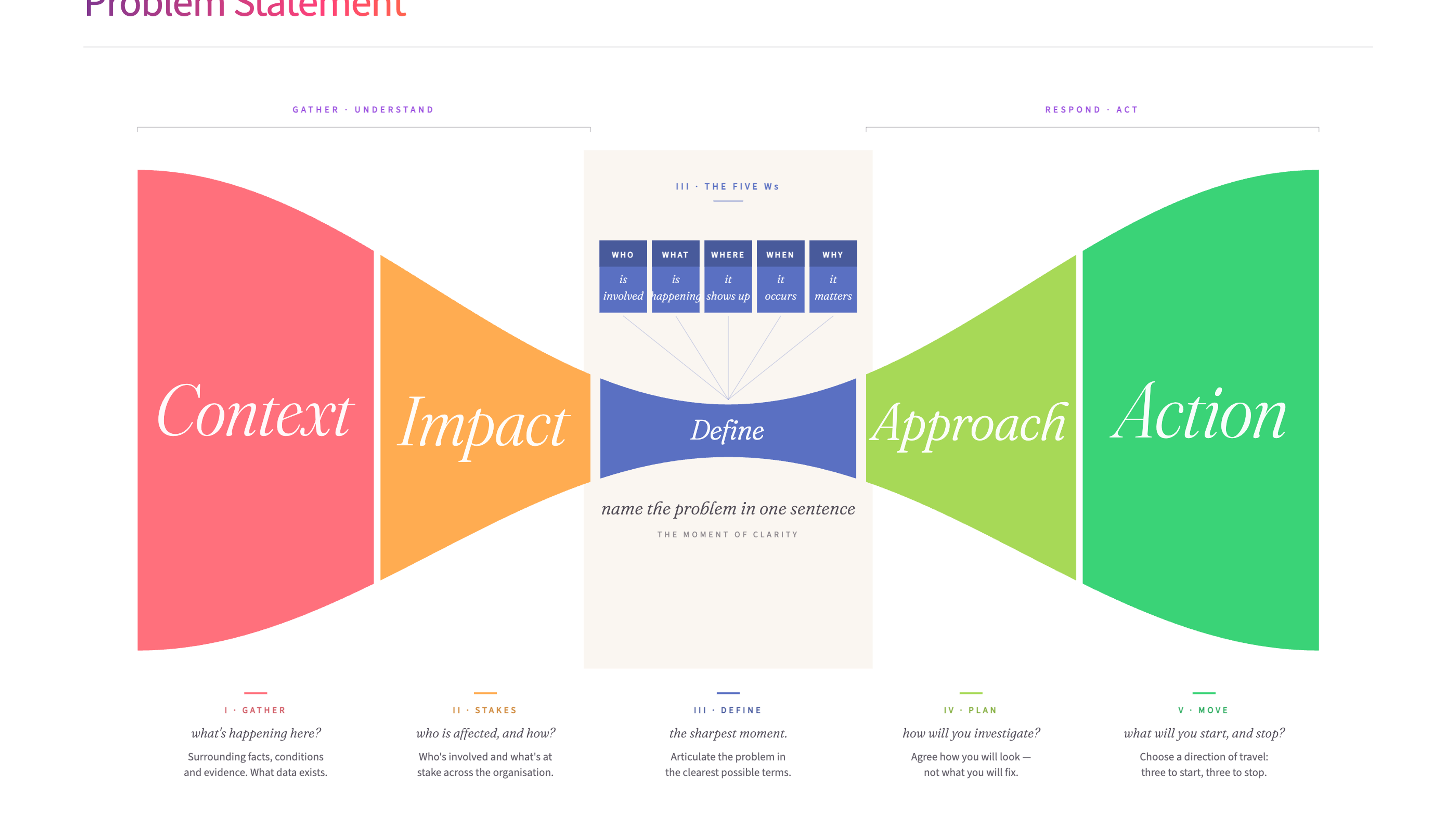
A problem statement is a clearly written summary of a problem you're facing, expressed in the simplest possible terms. It helps teams align around what they're actually trying to solve before jumping to solutions.
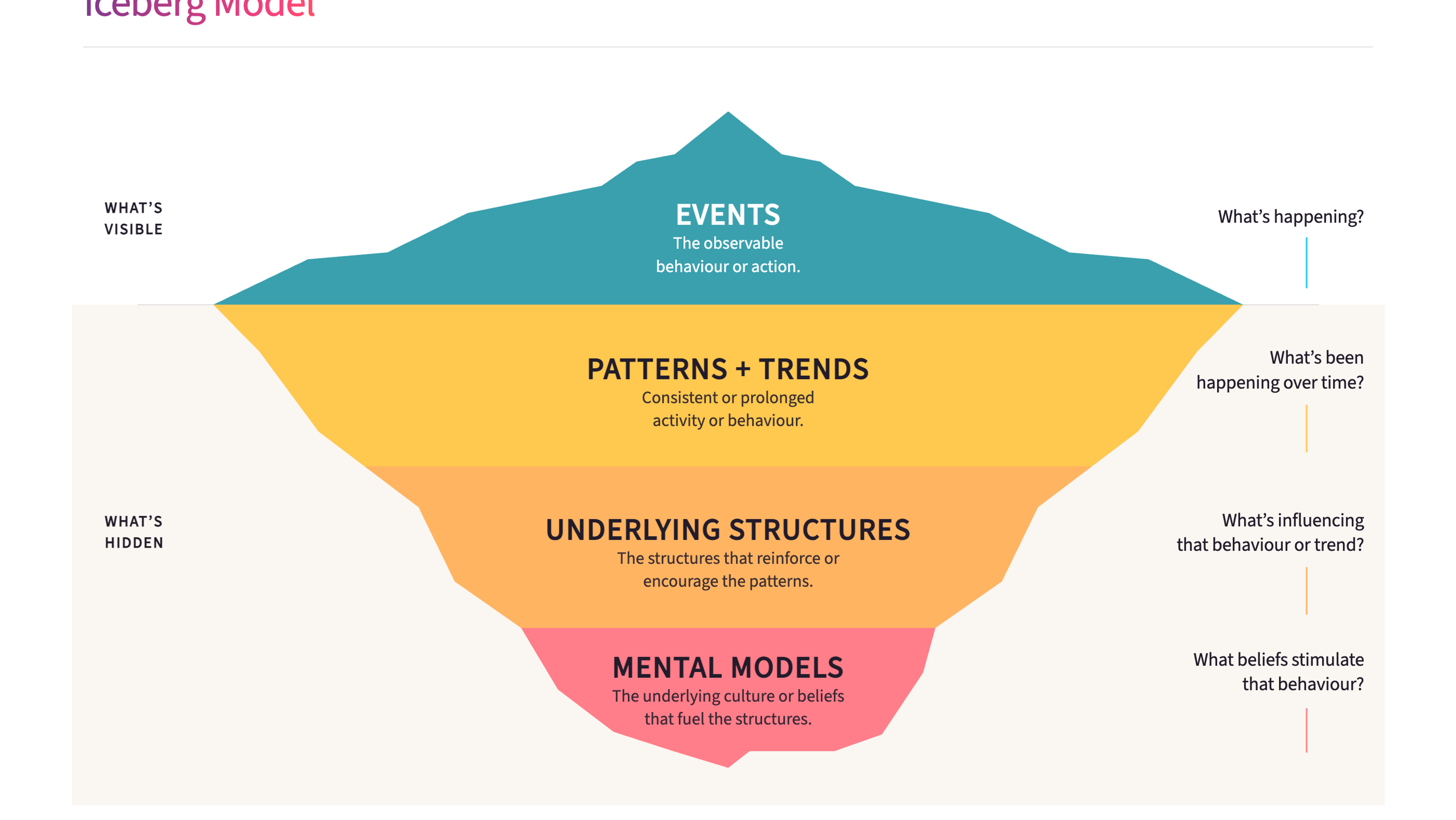
The Iceberg Model is a systems thinking tool that helps you look beneath surface-level events to find the patterns, structures, and mental models driving them. It's a way of seeing the deeper causes behind what's happening in your organisation.

Every organisation has friction - the unnecessary effort, the needless complexity, the things that make simple work harder than it should be. This article explores how to find it, understand where it comes from, and reduce it without creating new problems in the process.

Why the most reasonable solutions so often become next year's problem. Drawing on systems thinking, a 1930s sociologist, and MIT research on why the real cure gets abandoned just before it works - this piece traces the two ways a good fix turns on you, and the single habit that catches both.
Continuous Improvement Training
The Five Whys is a quick way to get past symptoms to causes - one of the tools we draw on in our Continuous Improvement training.
James Freeman-Gray is the founder of Mutomorro. He's an organisational development practitioner who has spent over twenty years working with leaders across public, private and nonprofit sectors - helping organisations pull together around a common purpose, joined up in how they work. More about who we are and what it's like to work with us.
The 5 Whys is beautifully simple. I use it when teams are stuck treating symptoms rather than causes. The discipline of asking "why" repeatedly - genuinely, not performatively - usually gets to something much more interesting by the third or fourth "why." It works best when people feel safe enough to give honest answers.
Last reviewed: June 2026
Ready to use 5 Whys?
Download the free template - includes practical guidance for workshops and team sessions.
Get the free template
Want to put these ideas into practice?
Whether you're navigating a merger, rethinking how you're structured, or trying to shift a culture that isn't working - underneath, it's the same job: getting the whole organisation pulling in the same direction. Start with a conversation.