The Hero's Journey
The Hero's Journey is a timeless narrative framework that helps organisations tell compelling stories about transformation, change, and growth by positioning their experiences as archetypal adventures with challenges, mentors, and ultimate triumph.
Get the free template
Every organisation going through change has a story. But finding the right way to tell it - so people feel it, not just hear it - is harder than it looks. You can announce a restructure, roll out a new strategy, and lay out the logic clearly. But logic alone rarely carries people through uncertainty. Narrative does. The Hero's Journey gives you a structure for the kind of story that helps people make sense of where they've been, what they're going through, and where they're heading.
What is the Hero's Journey?
The Hero's Journey is a narrative pattern that shows up in stories across every culture and era. The American mythologist Joseph Campbell identified it in his 1949 book The Hero with a Thousand Faces, after studying myths, legends, and folk tales from around the world. He found the same basic shape everywhere: a character leaves the familiar world, faces trials that change them, and returns with something new to offer.
Campbell called it the monomyth. The filmmaker George Lucas used it as the backbone for Star Wars. Christopher Vogler later distilled Campbell's original 17 stages into a more practical 12-stage structure that became standard in screenwriting and storytelling.
But the Hero's Journey isn't just for fiction. It's a pattern that maps how transformation works - in stories and in real life. And that's what makes it useful for organisations.
When a team, a department, or an entire organisation goes through significant change, the people inside it are living through a version of this arc. They start in a familiar world. Something disrupts it. They resist, then commit. They face setbacks, learn, and eventually arrive somewhere new. The Hero's Journey gives you a way to name those stages - and to help people see where they are in the story rather than feeling lost in the middle of it.
This isn't about manufacturing drama or spinning corporate comms. It's about recognising that change already has a narrative shape, and using that shape to help people stay oriented.
How the Hero's Journey works
Campbell's structure breaks into three acts: Departure, Initiation, and Return. Within those, Vogler's 12 stages trace the full arc. Here's how each one works - and what it looks like when you apply it to organisational life.
Act | Story stages | In organisational change |
|---|---|---|
Act 1: Departure | Ordinary World → Call to Adventure → Refusal → Meeting the Mentor → Crossing the Threshold | The familiar world is disrupted, people resist, then commit. Name current reality and the resistance honestly before crossing into change. |
Act 2: Initiation | Tests, Allies & Enemies → Approach to the Inmost Cave → The Ordeal → The Reward | The hardest stretch - early wins and setbacks, a build-up to crisis, the low point, then the first clear sign it's working. Don't skip the ordeal; it's what makes the story credible. |
Act 3: Return | The Road Back → Resurrection → Return with the Elixir | Making it stick. New ways of working embed, a final test proves the change is real, and the organisation returns transformed - with capability it didn't have before. |
Act 1: Departure

1. The Ordinary World - The starting point. Things as they are before the disruption. In an organisation, this is the culture, the operating model, the way things have always been done. Establishing this matters because people need to see their current reality acknowledged before they'll engage with a story about changing it.
2. The Call to Adventure - Something shifts. A market disruption, a new strategic direction, a crisis, a merger, a moment of recognition that the current approach isn't working. This is the event that makes staying still feel harder than moving.
3. Refusal of the Call - The resistance. In organisational terms, this is the period where people push back, hope it's temporary, or try to solve new problems with old methods. Including this stage honestly is what makes the difference between a credible story and a glossy one. People know change is messy. If your narrative pretends otherwise, they stop trusting it.
4. Meeting the Mentor - Someone or something provides the insight, tools, or confidence needed to move forward. This might be an external perspective, a piece of research, a team member who sees things differently, or a framework that reframes the problem. In change management, this is often the moment where a new way of thinking enters the room.
5. Crossing the Threshold - The point of commitment. A decision is made, resources are allocated, a public statement is given. The organisation steps out of the ordinary world and into unfamiliar territory. There's no going back to how things were.
Act 2: Initiation

6. Tests, Allies, and Enemies - The early phase of the new reality. Things go wrong. Some things go right. The organisation discovers who's on board, what the real obstacles are, and which assumptions were wrong. This is where team dynamics get tested and where trust is built or lost.
7. Approach to the Inmost Cave - The build-up to the hardest part. The organisation knows a critical moment is coming - a major launch, a difficult restructure, a point where the whole initiative will be judged. This is the stage of preparation, gathering nerve, and confronting deeper fears about whether the change will work.
8. The Ordeal - The crisis. The moment where failure feels not just possible but probable. Systems break, resistance peaks, confidence wavers. This is the dramatic low point - and it's the stage that most corporate narratives skip or sanitise. But it's also the stage that gives the story its credibility. If you're telling a transformation story and there's no moment where things nearly fell apart, people know you're leaving something out.
9. The Reward - The breakthrough. Not the end of the journey, but the first clear evidence that the change is working and the struggle was worth it. A milestone reached, a metric that shifts, a team that gels, a customer response that surprises everyone. This gives people something to hold onto.
Act 3: Return

10. The Road Back - Taking what's been learned and making it stick. This is the transition from "we survived the change" to "this is how we work now." It involves embedding new practices, scaling what worked, and letting go of whatever was only needed during the crisis.
11. Resurrection - A final test that proves the transformation is real, not just a temporary adaptation. In organisational terms, this might be how the team responds to a new challenge using their changed capabilities - not by reverting to old habits but by drawing on what they've become. It's the difference between surviving change and being changed.
12. Return with the Elixir - The transformed organisation, back in its world but fundamentally different. The "elixir" is the wisdom, capability, or sense of purpose that emerged from the journey - something that benefits not just the organisation but the people and communities it serves. This is where the story connects back to why the organisation exists and what it's now able to offer that it couldn't before.
How to use the Hero's Journey
The Hero's Journey works in several practical contexts. The common thread is that you're helping people make sense of a change by giving it narrative shape.
Framing a transformation story. If your organisation is going through - or has been through - a significant change, mapping the experience onto the 12 stages gives you a structure for telling that story. Not as spin, but as sense-making. Work through each stage and ask: what happened here? What did we learn? What was harder than we expected? The resulting narrative is useful for internal alignment, board reporting, case studies, and funding applications.
Helping people locate themselves. One of the most disorienting things about organisational change is not knowing where you are in the process. The Hero's Journey gives people a map. If your team is in the middle of a difficult transition and morale is dipping, being able to say "we're at Stage 8 - the ordeal - and this is a normal part of the arc" can be genuinely reassuring. It doesn't fix the problem, but it makes it navigable.
Building a narrative strategy. The Hero's Journey can serve as the backbone for how your organisation tells its story across different channels and audiences. The full 12-stage version might sit in an annual report or case study. A condensed version - ordinary world, call, ordeal, reward, return - might shape a leadership talk or a funding pitch. The structure stays consistent; the level of detail flexes.
Designing impact stories. If you need to show the difference your work makes - to funders, regulators, partners, or the public - the Hero's Journey provides a structure that's more compelling than a list of outputs. It lets you show the journey someone or something went through, not just the destination they arrived at. This connects to narrative connections - the idea that how you tell the story of your work shapes how people engage with it.
Coaching and leadership development. Leaders going through their own growth journeys can use the framework to reflect on where they are, what they're resisting, and what the "ordeal" they need to face might be. It works particularly well in leadership development programmes because it normalises the difficulty of growth rather than pretending leadership is a smooth upward line.
Example
A mid-sized health charity has just completed a two-year restructure, shifting from a regional delivery model to a thematic one. The CEO needs to present the story of this change to the board, to staff, and to partner organisations - three audiences with different needs.
She maps the journey onto the Hero's Journey structure:
- Ordinary World: The regional model that had served well for 15 years but was creating duplication and inconsistency
- Call to Adventure: An independent review that showed services were varying widely in quality depending on region
- Refusal: Six months of internal debate, with regional directors arguing the problems could be fixed without restructuring
- Mentor: A partnership with another charity that had made a similar transition and could share what they'd learned
- Threshold: The board vote to approve the new model
- Tests: Staff anxiety, two senior resignations, a pilot region that struggled with the transition
- Ordeal: The six-week period when both old and new systems were running simultaneously and nothing seemed to work
- Reward: The first quarterly data showing service consistency had improved by 40%
- Return: Embedding the new model, rewriting role descriptions, rebuilding team relationships
- Elixir: A more consistent, evidence-led service and an organisational confidence in its ability to change when it needs to
For the board, she tells the full arc with data at each stage. For staff, she focuses on the human story - the resistance, the difficulty, the breakthrough. For partners, she leads with the elixir and works backwards. Same story, different emphasis, consistent structure.
Limitations
Not every change is a hero's journey. Some changes are incremental, administrative, or routine. Trying to frame a software migration or a policy update as an epic quest will feel forced. The framework works best for changes that genuinely involved disruption, difficulty, and learning.
It can oversimplify. Real organisational change is rarely linear. Multiple things happen at once, timelines overlap, and there are usually several stories running in parallel. The Hero's Journey gives you one clean arc, which is useful for communication but doesn't capture the full complexity of what happened.
It centres a single hero. The framework naturally gravitates toward one protagonist - the organisation, the leader, the team. But most change involves many actors with different experiences of the same events. Be careful that the "hero" framing doesn't erase the contributions or perspectives of people whose journey looked different.
It can become performative. If the story is crafted to impress rather than to make sense of genuine experience, people will notice. The Hero's Journey works when it's grounded in what actually happened - including the parts that were difficult or unflattering. Strip out the honesty and you're left with corporate mythology.
Getting started
Pick a change your organisation has been through - ideally one that's complete enough to see the full arc. Sit down with two or three people who lived through it and map it onto the 12 stages. Don't force it. Some stages will be obvious; others might not apply. The conversation about what happened at each stage is where the value is.
Once you've mapped it, try telling the story out loud in under five minutes. If it holds together and feels true, you've got something you can use - in a presentation, a case study, a team reflection, or a leadership conversation about what you've learned and where you're heading next.
We share thinking on organisational change and development on LinkedIn - practical ideas for people doing this work inside their own organisations.
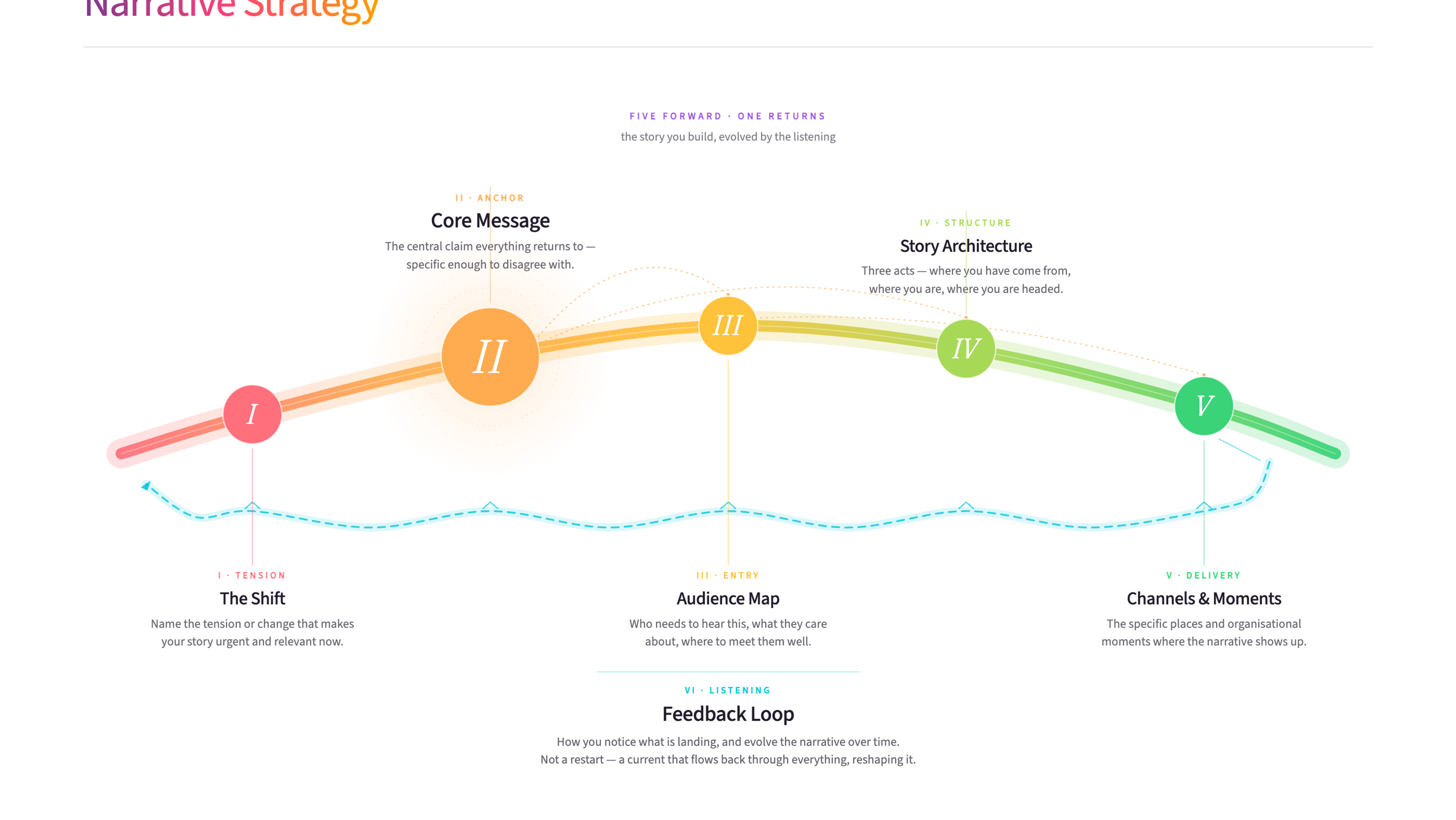

During change, the stories people tell each other matter more than the communications plan. How narrative shapes whether change lands or stalls.

In complex living systems, the leader who tries to have all the answers is working against the system. Why genuine not-knowing isn't a weakness - it's the condition that lets collective intelligence emerge.
James Freeman-Gray is the founder of Mutomorro. He's an organisational development practitioner who has spent over twenty years working with leaders across public, private and nonprofit sectors - helping organisations pull together around a common purpose, joined up in how they work. More about who we are and what it's like to work with us.
The Hero's Journey is a narrative structure I use when helping organisations communicate their transformation story. People intuitively understand this pattern - the call to adventure, the challenges faced, the transformation achieved. When an organisation's change story follows this structure, it gives people a role in the narrative rather than feeling like change is being done to them.
Last reviewed: June 2026
Ready to use The Hero's Journey?
Download the free template - includes practical guidance for workshops and team sessions.
Get the free template
Want to put these ideas into practice?
Whether you're navigating a merger, rethinking how you're structured, or trying to shift a culture that isn't working - underneath, it's the same job: getting the whole organisation pulling in the same direction. Start with a conversation.