Narrative Strategy
A Narrative Strategy is a plan for how your organisation tells its story in a way that connects with people and advances your goals. It goes beyond individual stories to create a consistent, compelling narrative that runs through everything you communicate.
Get the free template
Every organisation tells a story - through what it says, what it does, and where the two don't match. Narrative strategy is the practice of shaping that story deliberately, so people across the organisation and beyond it hear something coherent, feel something real, and know what they're part of.
What is narrative strategy?
A narrative strategy is a structured approach to defining and communicating the story your organisation tells about itself - where it has come from, what it stands for, and where it is heading.
It's different from marketing messaging or a communications plan. Those tend to focus on what to say and where to say it. A narrative strategy sits underneath them, providing the core story that everything else draws from. When a chief executive talks about the future in a town hall, when a team leader explains a restructure, when a job advert describes the culture - if there's a narrative strategy in place, all of those moments connect back to the same thread.
The idea has roots in political communication and social movements, where researchers like Marshall Ganz at Harvard demonstrated that structured storytelling - what he called "public narrative" - could mobilise collective action far more effectively than facts and arguments alone. In organisational life, the same principle applies: people don't rally around data. They rally around meaning.
A strong narrative strategy typically has three qualities. It is specific enough that someone could disagree with it - vague aspirations don't count. It connects the organisation's past, present, and future into a coherent arc. And it shapes not just what is communicated externally, but how people inside the organisation make sense of their work.
This is closely connected to what we call Narrative Connections - the idea that thriving organisations maintain living stories that connect people to purpose, rather than static messaging that sits in a brand guidelines document. And as research from Stanford has shown, stories are up to twenty-two times more memorable than facts alone - which is why getting the narrative right matters so much more than getting the data right.
How narrative strategy works
The approach moves through six components - five that build the narrative forward, and one that keeps it alive over time. Together they form a cycle: the story you build, evolved by the listening.
Component | What it does | The question it answers |
|---|---|---|
I. The Shift | Names the change or tension that makes the story urgent now | Why this story, and why now? |
II. Core Message | The central claim everything returns to - specific enough to disagree with | What are we really saying? |
III. Audience Map | Maps who needs to hear it, what they care about, and how the story flexes for each | Who is this for? |
IV. Story Architecture | Shapes the three-act arc: where you came from, are now, and are headed | What's the shape of the story? |
V. Channels and Moments | Where the narrative shows up - channels and the organisational moments that test it | Where does it come alive? |
VI. Feedback Loop | How you notice what's landing, what's misheard, and what needs to evolve | How do we keep it alive? |
I. The Shift

Every compelling narrative starts with tension. The Shift names the change, challenge, or moment that makes your story urgent and relevant now. Without this, a narrative strategy reads like a corporate brochure - pleasant but forgettable.
The shift might be external (a changing market, a societal trend, new regulation) or internal (a merger, a cultural challenge, a new direction). What matters is that it creates genuine stakes. People need to feel that the story is about something real that is happening, not a communication exercise.
II. Core Message

This is the anchor - the central claim everything returns to. A good core message is specific enough to disagree with, which is what gives it power. "We help people thrive" is too vague. "Every child deserves access to the outdoors, and we exist to make that normal" is a position.
The core message isn't a tagline or a strapline - it is the underlying argument your organisation is making about the world. Everything else in the narrative strategy should trace back to it.
III. Audience Map

Who needs to hear this story, what do they care about, and where is the best place to meet them? An audience personas exercise can help here, but the Audience Map goes further - it maps the relationship between different audiences and how the narrative needs to flex (without breaking) as it reaches each one.
A leadership team, a frontline team, a funder, and a service user will all need to hear the story differently. The core message stays the same, but the emphasis, language, and entry point shift. An empathy map can help you understand each audience's perspective before you decide how to reach them.
IV. Story Architecture

This is where the narrative takes shape as an actual story. The most useful structure is three acts - where you have come from (origin and context), where you are now (the tension and what you are doing about it), and where you are headed (the future you are building towards).
This three-act structure echoes what The Hero's Journey does at an individual level, but here it operates at the organisational scale. The organisation is not the hero - the people it serves, or the people within it, are. The organisation is the guide, the enabler, the vehicle for change.
The story architecture also makes clear what theory of change sits beneath the narrative. If your story says "we are building a more connected health system," the architecture should show the logic of how you get there - even if the public-facing narrative keeps it simple.
V. Channels and Moments

The fifth component maps where the narrative shows up - not just communication channels (intranet, social media, reports) but organisational moments. An all-hands meeting, an onboarding session, a strategy away day, a client pitch - these are all moments where the narrative either comes alive or falls flat.
The most common failure in narrative strategy is treating it as a communications project. The narrative should show up in how decisions are explained, how successes are celebrated, and how setbacks are framed. If it only lives in the marketing team's output, it is not a strategy - it is a campaign.
VI. Feedback Loop

The sixth component is what separates a living narrative from a fixed one. The Feedback Loop is how you notice what is landing, what is being misunderstood, and what needs to evolve.
This is not about restarting the narrative. It is a current that flows back through everything, reshaping it. The core message may stay the same for years, but the way it is told, the emphasis, the stories used to illustrate it - these should evolve as the organisation learns and changes.
Practically, this means building in regular listening points: pulse surveys, leadership reflections, narrative audits, and simply paying attention to the language people use when they talk about the organisation. When the words people use internally start to mirror the narrative, it is working. When they don't, the feedback loop tells you where to look.
How to use narrative strategy
Working through the six components doesn't need to be a linear process, but it helps to start with the Shift and the Core Message before moving to the others. Here is a practical approach:
Start by gathering a small group - typically senior leaders and people who communicate regularly on behalf of the organisation. Name the Shift together: what is happening in or around the organisation that makes this the moment to clarify the story? Be honest about what is driving the urgency.
Then draft the Core Message. Write multiple versions. Test them by asking: could someone disagree with this? If the answer is no, it is too safe. The core message should feel like a commitment, not a platitude.
Map your audiences and identify the two or three most important ones to get right first. You don't need to reach everyone simultaneously. For each audience, note what they care about and what their current understanding of the organisation's story is.
Build the Story Architecture using the three-act structure. This is often the most revealing step - many organisations find they can articulate where they want to go but struggle to connect it to where they have come from. The origin story matters because it provides authenticity and roots.
Identify the channels and moments where the narrative needs to show up. Prioritise the moments with the highest emotional stakes - a restructure announcement, a new partnership launch, an annual review - because these are where people pay closest attention.
Finally, decide how you will listen. Build in checkpoints - not just formal research, but informal observations. How are people retelling the story in their own words?
Example
Imagine a regional housing association that has grown significantly over fifteen years. It started as a community-led initiative, but years of growth have diluted the original sense of mission. Staff in newer teams don't know the founding story. External partners see the organisation as competent but generic.
The leadership team works through narrative strategy:
The Shift: The housing sector is facing unprecedented demand, and the communities the association was built to serve are being priced out of the areas they grew up in. The tension is real and urgent.
Core Message: "Good housing starts with knowing your neighbours - and we exist to build communities where that is still possible." This is specific enough to shape decisions - it suggests the organisation will prioritise community connection over portfolio growth.
Audience Map: Three primary audiences - tenants (who need to feel the organisation understands their lives), staff (who need to reconnect with the mission), and local authority partners (who need to see strategic value).
Story Architecture: Where we came from (community roots, tenant-led origins), where we are (a larger organisation navigating growth while holding onto what matters), where we are headed (a model for community-rooted housing in a market that has forgotten what that means).
Channels and Moments: The narrative shows up in tenant newsletters, staff onboarding, partnership proposals, and the annual report. But it also shows up in how maintenance visits are handled and how complaints are responded to - because those are the moments where the story is tested.
Feedback Loop: Quarterly listening sessions with tenants. A six-monthly narrative audit where the leadership team reviews whether external communications and internal behaviour are aligned.
Limitations
Narrative strategy is a powerful tool, but it has boundaries worth understanding.
It does not replace operational change. A compelling story about innovation means nothing if the organisation's processes prevent people from trying new things. The narrative and the reality need to move together - if they drift apart, people notice, and trust erodes. This is part of why the stories a change programme can't control matter just as much as the ones it plans.
It works best at organisational or programme level. It is less suited to small, tactical communications challenges where a simpler messaging framework would do.
It requires sustained attention. A narrative strategy that is launched with energy but never revisited becomes wallpaper. The Feedback Loop is not optional - it is what keeps the strategy honest.
And it can feel uncomfortable. A good core message is specific enough to exclude some things. Organisations that want their narrative to please everyone will end up with something that moves no one.
Getting started
Start with the Shift. Before doing anything else, get a small group together and answer one question honestly: what is the tension or change that makes this the right moment to get deliberate about the story we tell?
You don't need to work through all six components at once. The Shift and the Core Message are where the real work happens - everything else builds from there. Give yourselves permission to draft, test, and revise. A narrative strategy is not a document to be approved. It is a living story to be told.
If you want to explore how organisational purpose connects to narrative, or how narrative strategy supports culture change, those are natural places to go deeper. The story your organisation tells is inseparable from the culture it builds.
We share thinking on organisational change and development on LinkedIn - practical ideas for people doing this work inside their own organisations.
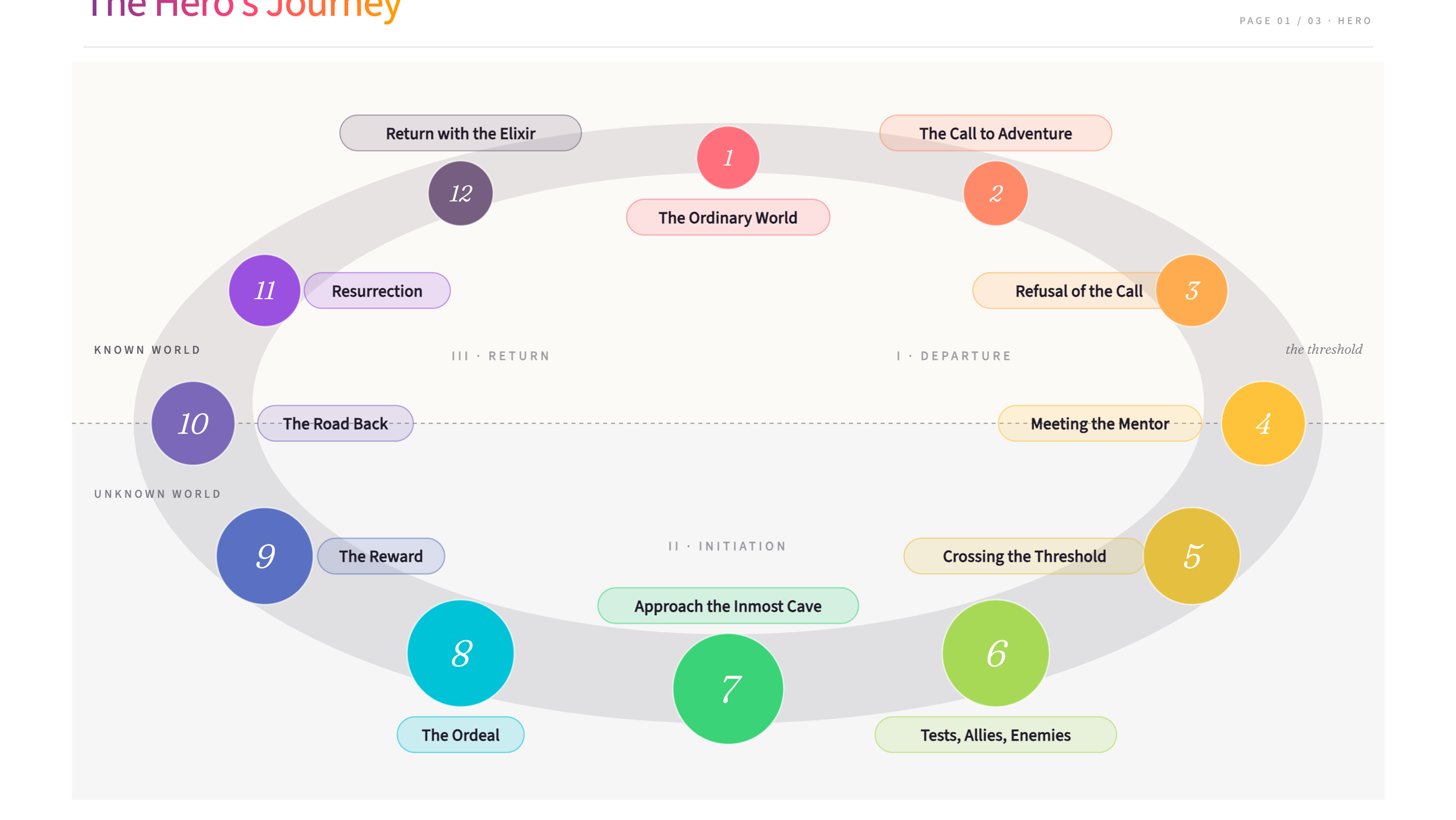
The Hero's Journey is a timeless narrative framework that helps organisations tell compelling stories about transformation, change, and growth by positioning their experiences as archetypal adventures with challenges, mentors, and ultimate triumph.
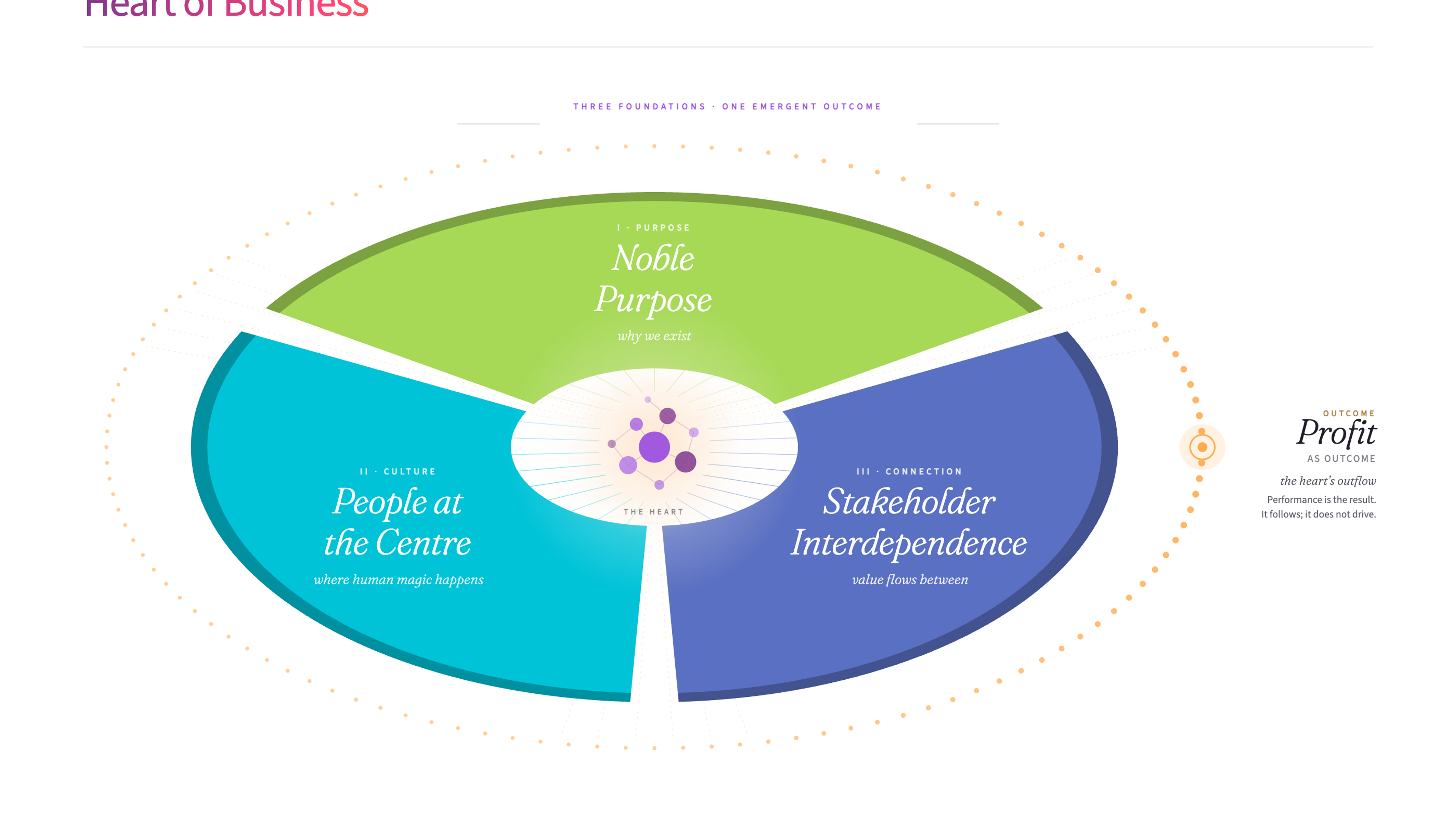
Hubert Joly's Heart of Business model identifies four pillars - noble purpose, people at the centre, stakeholder interdependence, and profit as outcome - that converge to create a purpose-driven organisation where financial performance follows from getting the foundations right.

During change, the stories people tell each other matter more than the communications plan. How narrative shapes whether change lands or stalls.

In complex living systems, the leader who tries to have all the answers is working against the system. Why genuine not-knowing isn't a weakness - it's the condition that lets collective intelligence emerge.

Most organisations have a stated purpose. Far fewer have one that shapes how people actually work. This article explores why purpose gets stuck at leadership level and what it takes to embed it into daily decisions, team dynamics, and organisational culture.
James Freeman-Gray is the founder of Mutomorro. He's an organisational development practitioner who has spent over twenty years working with leaders across public, private and nonprofit sectors - helping organisations pull together around a common purpose, joined up in how they work. More about who we are and what it's like to work with us.
I've seen well-crafted narratives transform how organisations communicate change. Narrative strategy is about more than telling a good story - it's about understanding which stories are already being told in your organisation and deliberately shaping the ones that will drive the change you need. The stories people tell each other are one of the powerful forces in organisational culture.
Last reviewed: June 2026
Ready to use Narrative Strategy?
Download the free template - includes practical guidance for workshops and team sessions.
Get the free template
Want to put these ideas into practice?
Whether you're navigating a merger, rethinking how you're structured, or trying to shift a culture that isn't working - underneath, it's the same job: getting the whole organisation pulling in the same direction. Start with a conversation.