Housing Association Service Improvement
Service improvement led by customers and teams, not handed down by consultants
A growing housing association where staff could recite the values but customers experienced something different - and previous improvement efforts kept addressing symptoms rather than causes. Getting every team working to one standard of service, rather than handing customers between them, was the real job.

A housing association where improvement needed to come from customers, not consultants
Paradigm Housing transformed how teams across the organisation worked with customers - not through new technology or top-down mandates, but through practical principles shaped by what customers actually said mattered. A housing association service improvement programme that started with listening and ended with every team owning their own way of getting better. This is what service improvement looks like when it's driven by customers rather than consultants.
Housing association service improvement: how Paradigm Housing built customer-led principles into everyday practice
Paradigm Housing is a housing association based in Buckinghamshire, providing homes and services across the south of England. Like many housing associations, Paradigm had organisational values that staff could recite - but a growing gap between those values and what customers actually experienced. Tenant satisfaction surveys and complaint data told a consistent story: the customer experience wasn't matching what the organisation aspired to.
Executive interviews revealed a consistent picture:
Customers often felt like an afterthought rather than the reason the organisation existed
- Teams operated in silos, creating handover gaps that left customers chasing for updates
- Bureaucracy and process absorbed energy that should have gone toward helping people
- Communication felt robotic rather than human - staff were nervous about saying sorry or flexing policy
Internal targets were financial rather than customer-focused, sending mixed messages about priorities
What made this striking was that customer feedback was saying exactly the same things. The leadership team and their customers had independently identified the same problems - the same frustrations with customer experience, the same concerns about tenant satisfaction. That alignment became the foundation for a different kind of housing association service improvement - one driven by the people it was designed to serve.
Housing association service improvement that changes how people work
The goal wasn't to create another customer charter that gathered dust on the intranet. Paradigm wanted housing association service improvement that changed how people actually worked - something practical enough for a repairs team, a rent recovery officer and a housing manager to each make their own.
This meant customer service standards that were simple enough to remember, interesting enough to become part of everyday conversations, and flexible enough that teams could interpret them for their own context without losing the intent. Service standards that would improve the customer experience not because staff were told to follow them, but because they believed in them.
Crucially, the organisation recognised that developing the service standards accounted for roughly ten percent of the work. The other ninety percent was about getting leadership and teams to tailor them, put them into practice and keep improving. Real service improvement happens in the doing, not the documenting.
Understanding what customers valued most
Understanding what customers actually valued
The work began by mapping what mattered most to customers alongside what the leadership team saw internally. Executive interviews across every directorate were cross-referenced with customer feedback, complaint themes and satisfaction data.
Six clear themes emerged - each one reflecting something customers and leaders were both saying. Rather than presenting these as problems to fix, they became the foundation for a set of customer commitments: be human and kind, make things effortless, take shared responsibility for a joined-up service, keep promises, and never forget why the organisation exists in the first place.
Principles, not rules
A deliberate choice shaped the entire housing association service improvement programme. When you're dealing with complicated things - machinery, accounting, compliance - rules work well. But when you're dealing with complex things - people, relationships, emotions - you need principles. Rules tell people what to do. Principles help people decide what to do when the rules don't fit.

This distinction mattered because most customer experience complaints weren't about what Paradigm did. They were about how it felt. A technically correct response delivered without warmth. An update that never came. A handover between teams where the customer fell through the gap. No rulebook could anticipate every situation - but a clear set of principles could guide every interaction and improve the customer experience across every service.
Translating principles into practical customer service standards
The commitments became a set of customer service standards across four areas. "No matter what" set the baseline for every interaction - five promises any customer could expect regardless of who they spoke to or what they needed. "Getting in touch" set clear expectations for response times across every channel. "Getting things done" distinguished between simple queries that should be sorted first time and complex issues needing clear ownership and a "what happens next" explanation. "Thinking ahead" challenged teams to keep customers informed before they needed to chase.
Each standard came with a corresponding question that could be asked of customers on an ongoing basis - building continuous measurement into the fabric of the service improvement, not bolted on afterwards. This created a direct line from tenant satisfaction feedback to practical action.
Embedding service improvement through every layer of the housing association
A six-month programme built the customer service standards into the organisation. Leadership sessions focused on role modelling - not just championing the standards but demonstrating them. Were leaders prioritising a customer interaction over an internal meeting? Walking past a ringing phone and picking it up? The language they used about customers mattered as much as the service standards themselves.

Three manager workshops, spaced over the programme, each built on the last. The first introduced the standards and asked teams to score themselves honestly against the five "no matter what" commitments. Self-assessment scores ranged from 3.3 to 4.2 out of 5 - honest enough to be useful, with "making you our number one priority" scoring lowest. The second workshop focused on practical service improvement - where had teams spotted small changes with big impact? The third brought managers together to share what was working and problem-solve what wasn't.
Between workshops, teams ran exercises designed to shift perspective: mapping end-to-end customer journeys across departmental boundaries, identifying information customers needed before they had to ask for it, and drafting "what happens next" explanations in language a customer would actually understand.
Supporting materials - conversation cards, customer walkthroughs, intranet guidance - drip-fed throughout, so the standards stayed in everyday conversation rather than arriving as a one-off event.

Teams owning their own improvement, not following a mandate
What emerged wasn't a housing association that had been told to be better at customer experience. It was one where teams were finding their own ways to improve - and talking to each other about it.
A rent recovery team redesigned their automated email responses to include signposting and support information, recognising that most people in rent arrears are anxious rather than negligent. A voids team started briefing contractors on customer service standards, understanding that a third-party supplier visiting someone's home represents the housing association whether they wear the badge or not. Support teams who never spoke to customers directly began treating internal colleagues as their customers, recognising that internal service quality directly shaped what residents experienced.
The "aggregation of marginal gains" framing resonated across the organisation. Teams weren't being asked for transformation. They were being asked: what small change could you make this week that would make things slightly better for a customer? One manager described the shift: previously, improvement felt like something that happened to teams. Now they were driving it themselves.
Cross-team relationships began to shift too. The end-to-end journey mapping made visible what everyone already knew - that customers don't care about departmental boundaries. Teams started having conversations about handover processes, shared ownership of complex queries, and how to stop customers falling through gaps between departments. This kind of service improvement across a housing association can't be mandated from the top. It grows from teams who can see the customer experience from the outside in.
Why housing association service improvement depends on culture, not compliance
For more on how removing friction improves both the customer experience and internal operations, see our guide to reducing organisational friction.
Housing associations face enormous pressure to improve tenant satisfaction. The regulatory environment demands it. The Tenant Satisfaction Measures framework now makes performance visible and comparable. The instinct is to respond with new systems, new processes, new compliance frameworks - to treat tenant satisfaction as a problem of measurement rather than a problem of culture.
But the Paradigm experience revealed something different about housing association service improvement. The biggest barriers weren't operational - they were cultural. Staff who were nervous about apologising. Teams that blamed other departments rather than solving problems together. A sense that customers got in the way of the day job rather than being the day job.
No amount of process redesign addresses those barriers. What works instead is giving people a clear, simple set of customer service standards they can believe in - then trusting them to work out what those principles mean for their team, their service, their daily interactions. The shift from rules to principles is the shift from compliance to ownership. And ownership is what makes service improvement last.
This project helped shape an understanding that sits at the heart of the Mutomorro approach to operational effectiveness: lasting improvement doesn't come from telling people what to do differently. It comes from helping them see their work through their customers' eyes - then giving them the principles, the permission and the practical support to act on what they see. That's how a housing association moves from chasing tenant satisfaction scores to genuinely improving the customer experience.
Process Mapping can help teams see the full workflow from a customer's perspective - making the friction points visible so they can be addressed.
The question for any housing association facing similar challenges isn't "what service standards should we set?" It's "are we willing to let our customers set them for us - and trust our teams to make them real?"
See more of our work across social housing, including customer experience at Paragon.
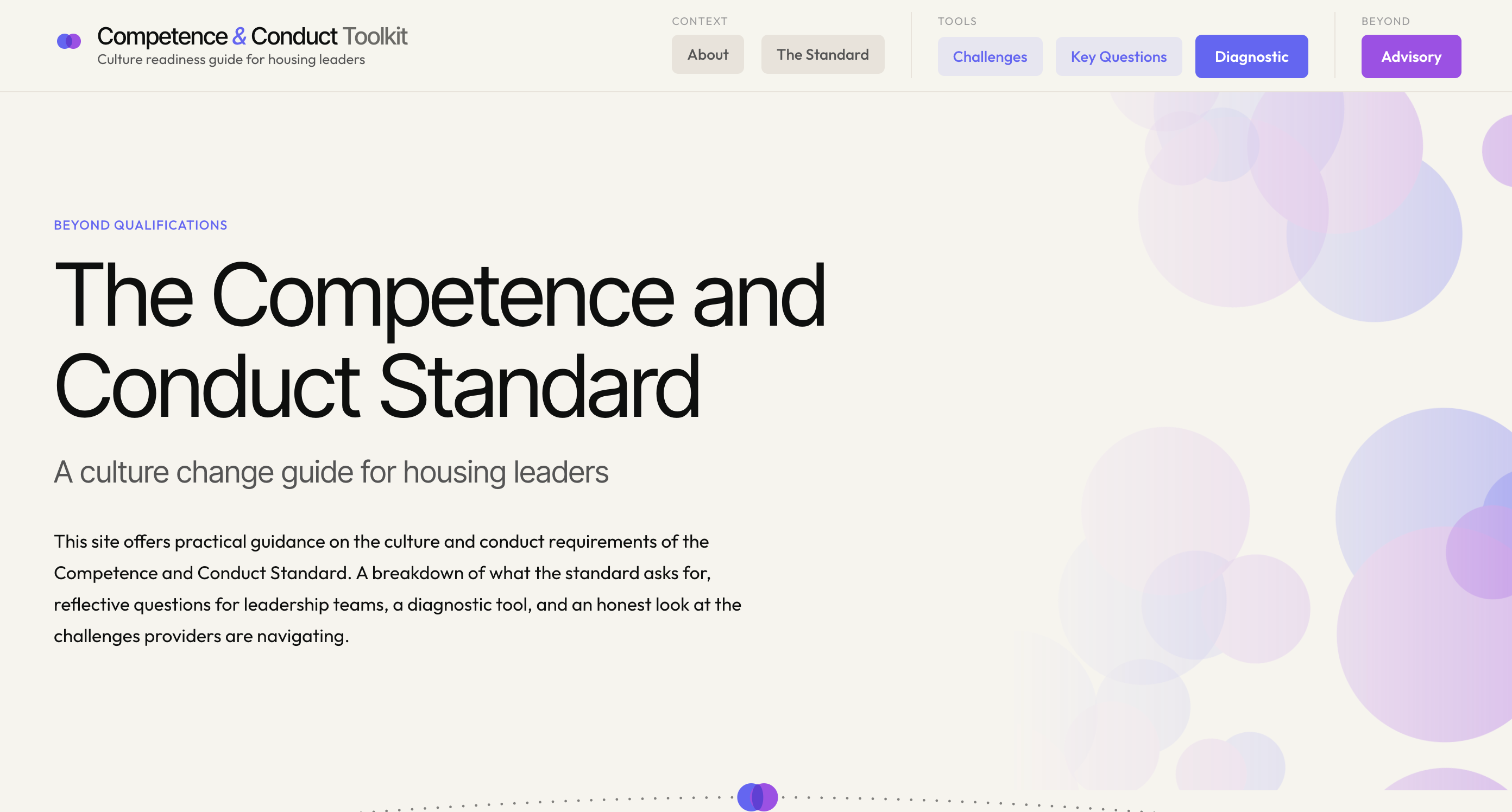
Competence and Conduct Standard - free culture readiness toolkit
The Competence and Conduct Standard applies from October 2026. The qualification requirements are well documented elsewhere. The culture and behaviour side - how your organisation evidences conduct, gives residents real influence, and shows that training leads to better outcomes - is the harder leadership work.
We built a free toolkit for housing leadership teams preparing for this side of the standard. It includes a breakdown of the culture requirements, six practical challenges providers are working through, reflective questions for leadership teams, and a diagnostic you can complete in five minutes.
Facing something similar in housing?
From culture under the consumer standards to merger integration and service improvement, the hardest part is usually the organisational side - connecting strategy to how the work actually gets done. If that's where you are, we'd like to hear about it.

Let's talk about what you're working on
Whether you're navigating a merger, rethinking how you're structured, or trying to shift a culture that isn't working - underneath, it's the same job: getting the whole organisation pulling in the same direction. Start with a conversation.