Contextual inquiry
Contextual inquiry is a user research method where you observe and interview people in their actual work environment while they perform real tasks. It uncovers insights about real behaviour and needs that surveys and interviews in meeting rooms simply can't reach.
Get the free template
Surveys tell you what people think they do. Interviews reveal what they remember doing. Contextual inquiry shows you what actually happens - by putting you in the room while the work is being done. If you are designing or improving a service, there is no substitute for watching real people navigate real situations.
What is contextual inquiry?
Contextual inquiry is a qualitative research method that combines observation with real-time interviewing. Rather than bringing people into a meeting room and asking them to recall their experience, you go to where the work happens - an office, a ward, a call centre, a kitchen - and watch them do it, asking questions along the way.
The method was developed by Hugh Beyer and Karen Holtzblatt in the late 1980s as part of their Contextual Design methodology. It has since become a cornerstone of service design and customer experience research.
The core idea is a shift in who holds the expertise. In a traditional interview, the researcher leads and the participant responds. In contextual inquiry, the participant is the expert - the person who knows their work intimately - and the researcher is the apprentice, there to learn. This dynamic is not just a nice framing. It changes what you hear. People share differently when they are teaching you something than when they feel they are being studied.
What makes contextual inquiry distinctive is that it captures the gap between reported behaviour and actual behaviour. People develop workarounds, shortcuts and habits they no longer notice. They adapt to frustrations until those frustrations become invisible. Watching the work unfold in real time reveals things that no amount of asking would surface - and those hidden patterns are often where the most important design decisions live.
It shares a philosophy with the Gemba Walk - the principle that understanding comes from going to where the work happens, not from reading about it in a report.
The four principles of contextual inquiry
Contextual inquiry is built on four principles. These are not steps to follow in order - they are qualities that run through every session.
Principle | What it means |
|---|---|
Context | Observe in the person's real environment, not a meeting room. The space, tools, and interruptions are part of how the work works. |
Partnership | Researcher and participant learn together - the participant is the expert, the researcher the apprentice. Trust surfaces the shortcuts and frustrations. |
Interpretation | Share your hypotheses in the moment and let the participant correct them - so you don't leave with a neat but wrong story. |
Focus | Go in with a clear research question to steer the session - focused enough to be useful, open enough to be surprised. |
Context

Observation happens in the participant's real environment, not in a lab or meeting room. This matters because the physical and social setting shapes behaviour in ways people cannot easily describe. The interruptions a nurse deals with, the tools a project manager has pinned to their second monitor, the Post-it notes on a receptionist's desk - these are part of how work works. Remove the environment and you remove the information.
Context means paying attention to everything: the space, the tools, the interruptions, the pace, the informal communication happening around the edges. What people have adapted their environment to do is often more revealing than what they say about their process.
Partnership

The researcher and participant work together to understand what is happening. The interview alternates between watching the participant work and talking about what they just did and why.
In fast-paced settings, this might mean observing silently during busy periods and saving questions for natural pauses. In quieter work, the conversation can be more continuous. The balance depends on the situation, but the principle stays the same: you are learning together, not studying from a distance.
Partnership builds trust. When someone feels like a collaborator rather than a subject, they share more freely - including the shortcuts, frustrations and informal practices that are often the richest source of insight.
Interpretation

As you observe, you form hypotheses about what you are seeing. The interpretation principle says: share those hypotheses with the participant in the moment, and let them correct or build on your understanding.
This is where contextual inquiry gets its depth. You might watch someone switch between three different systems and assume they find the workflow confusing. But when you say that out loud, they explain that each system is better for a different task and the switching is deliberate. Your assumption was wrong - and the correction tells you something far more useful than the assumption would have.
Real-time interpretation prevents you from walking away with a neat but inaccurate story. It keeps the participant's reality in charge.
The observations from a contextual inquiry feed naturally into an Empathy Map, helping you synthesise what you have seen and heard into a structured picture of the experience.
Focus

Without direction, a contextual inquiry session can drift into general observation. The focus principle means going in with a clear research question - what you are trying to understand and why - and steering the session towards it.
Focus does not mean rigidity. Some of the best insights come from unexpected moments. But having a clear frame - "we are trying to understand how prescription errors happen during shift handovers" - helps you recognise which observations matter and which are noise.
The balance is important: focused enough to produce something useful, open enough to be surprised.
How to use contextual inquiry
Prepare your research question
Start by defining what you need to understand. Not "how do people use the system" (too broad) but "how do front-line staff handle service requests that do not fit the standard process" (specific enough to guide observation). Your question shapes who you recruit, where you observe, and what you pay attention to.
Recruit the right participants
You need people who represent the experience you are studying, in settings where you can observe real work. Be clear about what participation involves - typically two to four hours of being observed and questioned while they work. Contextual inquiry is a significant commitment, so explain what they will get from it (usually: someone genuinely interested in understanding their experience) and respect their time.
Run the session
Open with a brief conversation to build rapport and explain the apprentice-expert dynamic. Then let the participant begin working. Observe, ask questions at natural moments, share your interpretations, and let them correct you. Take notes continuously - or better, work with a note-taker so you can stay focused on the conversation.
Watch for workarounds, hesitations, environmental adaptations, and moments where the participant does something without thinking about it. These automatic behaviours are often invisible to the person doing them but highly visible to a fresh pair of eyes.
Synthesise what you found
After each session, capture your observations while they are fresh. What patterns did you see? What surprised you? Where did your assumptions get corrected?
When you have completed several sessions, bring your team together to review the observations collectively. Look for recurring patterns across participants - these are your strongest findings. One-off observations might be interesting but patterns are what you can design from. The insights from contextual inquiry often become the foundation for service blueprints - mapping the full picture of how a service works from both the user's and the organisation's perspective.
Contextual inquiry typically works with small samples - six to twelve participants for a focused study. The depth of each session compensates for the smaller numbers, but consider pairing your findings with broader quantitative data when making decisions that affect many people.
Example
A local council wants to improve how residents report and track housing repairs. The current system gets low satisfaction scores, but surveys just say "too slow" and "hard to contact" without explaining why.
A two-person research team spends three days running contextual inquiry sessions. They observe four residents making repair requests from home and two housing officers processing requests at their desks.
Watching residents, they discover that most people call the repairs line while doing something else - making breakfast, supervising children, on a work break. The process demands their full attention (account number, postcode, detailed description of the fault) at moments when they cannot give it. Two residents abandon the call and try again later. One gives an incomplete description because she is rushing, which leads to the wrong contractor being sent.
Watching housing officers, they find that officers spend roughly a third of their time on callbacks - chasing residents for missing information that could have been captured differently at the first point of contact. The officers have developed their own informal checklist on a sticky note because the system prompts do not match the information contractors need.
Neither of these patterns appeared in the satisfaction survey. The survey measured speed. The real problem was timing and information design. The council used these findings to redesign the intake process - allowing residents to report via a short online form at their own pace, with prompts matched to what contractors need. Callback time dropped by half within two months.
Limitations
Contextual inquiry is resource-intensive. Each session takes two to four hours, plus travel and synthesis time. A study of eight participants can take two to three weeks. For teams under time pressure, this is a genuine constraint - not every research question warrants this level of investment.
It works best for understanding existing practices, not for exploring reactions to things that do not exist yet. If you want to test a new concept or prototype, you need a different method. Contextual inquiry tells you about the current world, not the future one.
The researcher's presence changes behaviour, even with the best rapport. People may work more carefully or tidily when someone is watching. This effect diminishes over time, which is one reason longer sessions tend to yield better data than short ones.
Small sample sizes mean your findings are deep but not necessarily representative. What you observe with eight participants might not hold true across eight hundred. Combining contextual inquiry with audience personas built from broader data helps you check whether your observations fit the wider picture.
Finally, the quality of the insights depends heavily on the researcher's skill. Knowing when to ask, when to watch, and when to share an interpretation without leading the participant takes practice. It is a method that improves significantly with experience.
Getting started
Pick a service or process your team is working on improving. Identify one person who does the work every day and ask if you can spend two hours watching them and asking questions. Explain that you are there to learn, not to evaluate - you want to understand how the work really happens.
Go in with one clear question: "What is hard about this process that does not show up in our data?" Watch, ask, and take notes. Pay particular attention to the moments where the person does something your systems or processes did not anticipate - a workaround, a shortcut, a phone call to a colleague. Those gaps between what was designed and what actually happens are where your best improvement opportunities live.
Our service design and customer experience work regularly uses contextual inquiry alongside other research methods to understand how people experience services in practice - the starting point for making those services work better.
We share thinking on organisational change and development on LinkedIn - practical ideas for people doing this work inside their own organisations.
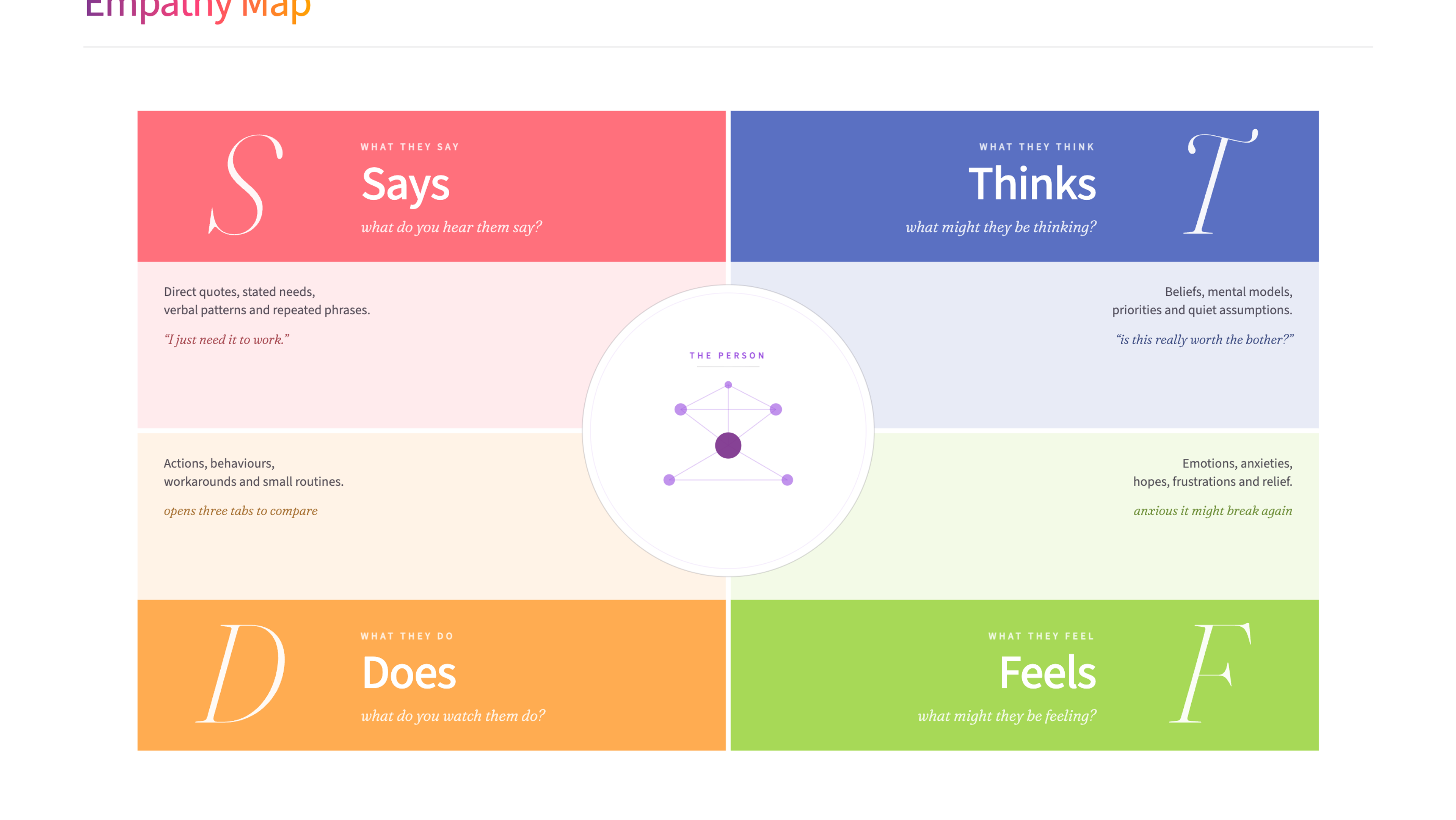
An empathy map is a collaborative visualisation tool that captures what we know about a user's behaviours, thoughts, feelings, and motivations, helping teams develop deeper understanding and more human-centred solutions.
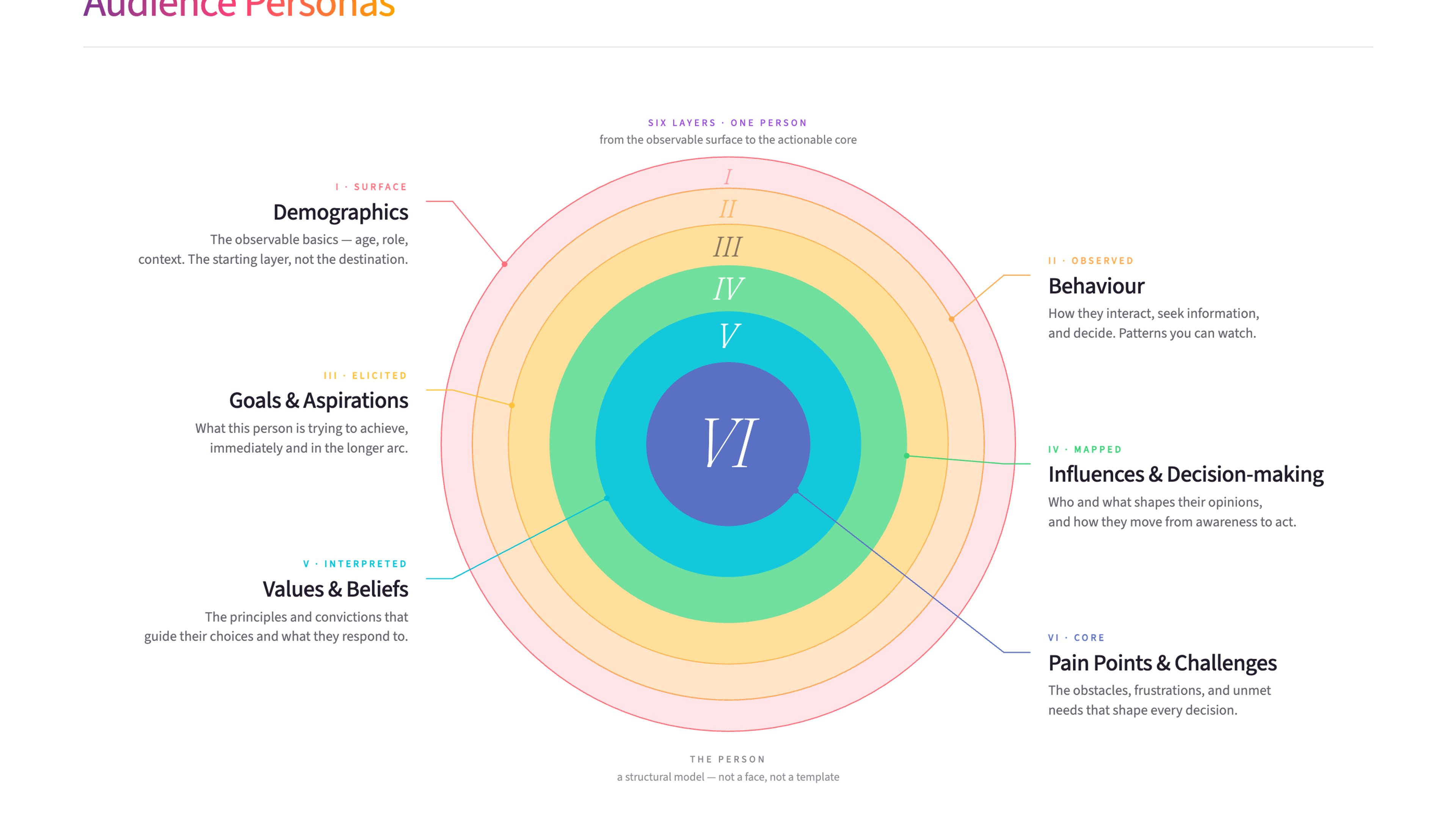
Audience personas are detailed profiles of the people you're trying to reach, built from real research into their needs, behaviours, and motivations. They help organisations design services and communications that actually resonate with the people who matter most.
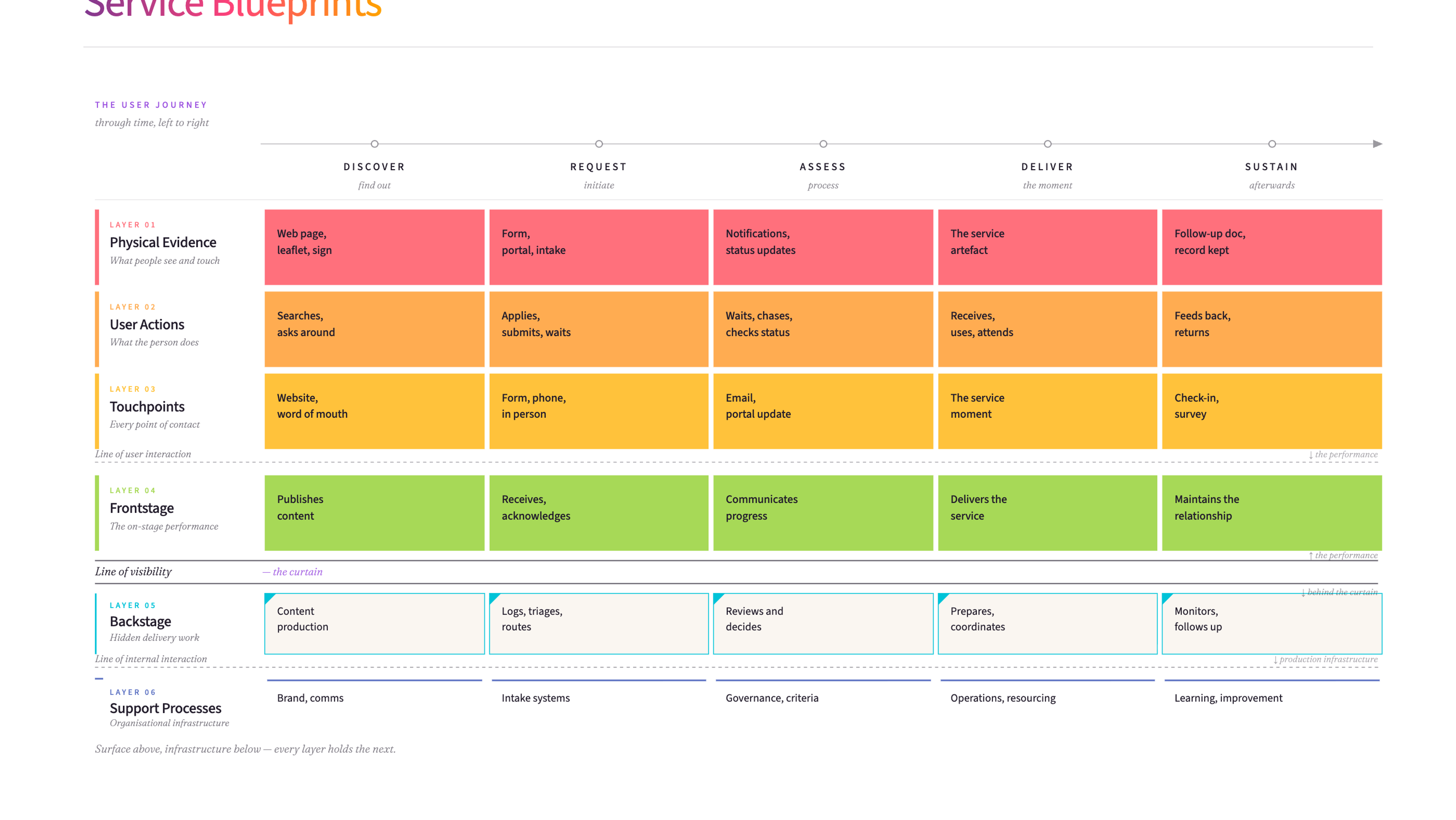
A service blueprint is a detailed map of how a service actually works - what the user sees and experiences on the front end, and everything happening behind the scenes to make it possible. It helps organisations redesign services by showing the full picture.

Customer Experience Training
Watching people in their own context tells you what surveys miss - one of the approaches we use in our Customer Experience training.
James Freeman-Gray is the founder of Mutomorro. He's an organisational development practitioner who has spent over twenty years working with leaders across public, private and nonprofit sectors - helping organisations pull together around a common purpose, joined up in how they work. More about who we are and what it's like to work with us.
Contextual inquiry - observing and talking to people in their real environment - is one of the more underused research methods I know. I've seen it transform how organisations understand their customers' experience. There's no substitute for seeing someone actually use your service in the context of their real life.
Last reviewed: June 2026
Ready to use Contextual inquiry?
Download the free template - includes practical guidance for workshops and team sessions.
Get the free template
Want to put these ideas into practice?
Whether you're navigating a merger, rethinking how you're structured, or trying to shift a culture that isn't working - underneath, it's the same job: getting the whole organisation pulling in the same direction. Start with a conversation.