Audience Personas
Audience personas are detailed profiles of the people you're trying to reach, built from real research into their needs, behaviours, and motivations. They help organisations design services and communications that actually resonate with the people who matter most.
Get the free template
Every organisation makes decisions about the people it serves - how to communicate with them, what services to offer, how to design experiences that work. Audience personas take those decisions from gut feeling to grounded understanding. They're detailed, research-based profiles that represent the key groups of people your organisation needs to reach, and they change how teams think about who they're designing for.
What are audience personas?
An audience persona is a fictional but research-grounded profile that represents a meaningful segment of your audience. It captures who someone is, what they're trying to achieve, what gets in their way, and how they make decisions - built from real data, not guesswork.
The concept has roots in user-centred design. Alan Cooper introduced personas in the late 1990s as a way to keep software design focused on real human needs rather than abstract feature lists. The idea was simple: if you can describe the person who will use what you're building, you'll make better choices about what to build. That principle has since expanded well beyond software into service design, communications, policy, and organisational strategy.
Personas are different from market segments. A segment tells you that 35% of your audience is aged 30-45 and lives in urban areas. A persona tells you that Priya is a mid-career professional juggling competing priorities, sceptical of jargon, and looking for practical tools she can use immediately. The segment gives you a number. The persona gives you someone to design for.
Good personas share a few characteristics. They're grounded in evidence - interviews, observation, behavioural data - rather than assembled from assumptions. They go beyond demographics to capture motivations, frustrations, and decision-making patterns. And they're used actively, not filed away. A persona that sits in a strategy document nobody opens is just an expensive creative writing exercise.
How audience personas work
A useful persona is built in layers. The surface details are the easiest to capture, but the deeper layers are where the real value sits. Each layer adds a dimension of understanding that shapes different kinds of decisions.
Component | What it captures |
|---|---|
Demographics and context | Age, role, location, professional context, life stage. The basic frame - necessary, but not enough on its own. |
Goals and aspirations | What the person is trying to achieve, in work or life - so you frame what you offer in their terms, not yours. |
Pain points and challenges | Where their experience falls short - the friction and frustration. One of the most direct inputs into service improvement. |
Behaviour | How they actually act - how they seek information, decide, and navigate services. Often different from what they say or you assume. |
Values and beliefs | The principles that guide their choices. Harder to uncover than demographics, which is exactly why they matter more. |
Influences and decision-making | Who and what shapes their opinions, and how they move from awareness to action - quickly, or after consulting widely. |
Demographics and context

This is the starting layer: age, role, location, professional context, life stage. It provides the basic frame for who this person is and where they sit. Demographics are necessary but not sufficient - a persona that stops here is just a profile, not a tool for decision-making.
Goals and aspirations

What is this person trying to achieve? Not just in their interaction with your organisation, but in the broader context of their work or life. Understanding goals helps you frame what you offer in terms of what matters to them, rather than what matters to you.
A senior leader navigating a restructure isn't looking for "organisational development consultancy." They're looking for confidence that the change will land and that their people will come through it well.
Pain points and challenges

Where does this person's experience fall short? What frustrates them, slows them down, or creates unnecessary friction? Pain points reveal gaps between what people need and what they currently get - and they're one of the most direct inputs into service improvement.
The value here is specificity. "Finds the process confusing" is less useful than "has to explain their situation to three different people before reaching someone who can help."
Behaviour

How does this person interact with your organisation and the wider world? How do they seek information, make decisions, and navigate services? Behavioural patterns reveal what people actually do, which often differs from what they say they do or what you assume they do.
Behaviour includes things like preferred communication channels, how much research someone does before making a decision, whether they engage digitally or face-to-face, and how they respond to different types of messaging.
Values and beliefs

The principles that guide this person's choices. Values shape what resonates with people and what falls flat. An organisation whose communications emphasise efficiency will connect with people who value getting things done - but may alienate people who prioritise thoroughness and quality.
Values are harder to uncover than demographics, which is precisely why they're more valuable. They explain the "why" behind choices that demographic data can only describe.
Influences and decision-making

Who and what shapes this person's opinions? How do they move from awareness to action? Understanding the influence landscape - trusted sources, peer networks, professional communities, past experiences - helps you design communications and services that meet people where they already are.
This layer also captures how decisions are made. Some audiences decide quickly on their own. Others consult widely. Some need evidence and data. Others respond to stories and peer recommendations. Designing your approach without understanding this is guessing.
How to use audience personas
Building a persona is one thing. Making it useful is another. Here's how to turn research into something that changes how your team works.
Ground every persona in real evidence
Start with real people, not imagined ones. The minimum viable research for a useful persona is five to seven interviews with people from the segment you're trying to understand. Supplement with behavioural data - website analytics, service usage patterns, support queries - to validate what you're hearing.
If you can, use contextual inquiry alongside your persona research. Going to where people live and work reveals things that interviews alone miss - the workarounds people have developed, the frustrations they've normalised, the parts of their experience they don't think to mention because they've accepted them as "just how it is."
Build a small set, not a single profile
Three to five personas is the sweet spot for most organisations. Fewer than three and you're probably oversimplifying your audience. More than seven and the set becomes too complex to hold in working memory - which means people stop using it.
Each persona should be genuinely distinct. If two personas share the same goals, pain points, and behaviours, they're probably the same persona in different demographic clothing.
Make personas present in everyday decisions
The real test of a good persona set is whether people refer to it. Print the key details on a poster for the project room. Name the personas and use those names in meetings: "Would this work for Priya?" or "We're designing this for David, not for us."
Personas should appear in briefs, in design reviews, in service planning sessions, and in communications planning. If they only appear in the strategy deck, they're not working.
Add emotional depth with complementary tools
A persona captures who someone is and what they need. An empathy map adds what they think, feel, say, and do in a specific context. Combining the two gives you a richer, more emotionally grounded picture that's harder to ignore in decision-making.
You can also connect personas to service blueprints to design end-to-end experiences that work for specific audience groups. The persona tells you who you're designing for; the blueprint tells you how the experience should work for them.
Keep them alive
Personas aren't a one-off exercise. People's circumstances, needs, and behaviours change - sometimes gradually, sometimes dramatically. Build in a regular review cycle (every six to twelve months) where you check your personas against fresh evidence and update them where they've drifted.
A persona that was accurate two years ago might be actively misleading today. Treat them as working hypotheses, not permanent truth.
Example
A housing association wants to improve how tenants experience repairs. They've had complaints about communication, but the feedback is contradictory - some tenants want more updates, others say they're getting too many. The repairs team is frustrated because they feel they're doing the right things but nothing seems to land.
The team builds three personas from tenant interviews and service data:
Busy professional (Marcus): Works full-time, rarely available during standard hours. Wants to book repairs online, get a confirmed time slot, and receive text updates. His main pain point is having to phone during work hours. Values efficiency and reliability. Makes decisions quickly based on convenience.
Older tenant living alone (Dorothy): Prefers phone communication. Wants to speak to the same person each time. Her main pain point is feeling like she's "just a number." Values personal connection and being listened to. Makes decisions slowly and wants reassurance that things are being handled.
Young family (Aisha and Karim): Flexible on communication channel but overwhelmed by life with young children. Main pain point is unpredictable appointment windows that clash with school runs. Values clarity and advance notice. Decisions are made jointly and need to work around a packed schedule.
The same information - "we're sending an engineer between 8am and 1pm" - lands completely differently for each persona. Marcus wants a specific slot he can plan around. Dorothy wants someone to explain what will happen and check she's comfortable. Aisha and Karim want enough notice to arrange childcare or adjust their day.
With these three personas visible in the team, the repairs service can design three communication approaches instead of one, without adding significant complexity. The information is the same; the delivery is tailored to how each group needs to receive it.
Limitations
Personas are a simplification by design, and that creates genuine trade-offs worth being honest about.
They flatten diversity within segments. A persona represents a group, not an individual. The risk is that teams start treating the persona as a complete picture rather than a useful approximation. Real people within any segment will vary significantly from the persona that represents them.
They can reinforce existing assumptions. If the research behind a persona is thin - or if the team interprets research through the lens of what they already believe - personas become a sophisticated way of confirming bias rather than challenging it. The quality of the persona is only as good as the quality of the research underneath it.
They struggle with people who don't fit neatly into segments. Some audience members sit across multiple personas or shift between them depending on context. Personas work best when the segments are relatively stable and distinct; they work less well for highly fluid or situational audiences.
They can become stale without maintenance. A persona set that was built three years ago and never revisited may be doing more harm than good - giving teams false confidence that they understand an audience that has since changed.
Getting started
Pick one specific decision your organisation is currently making about the people it serves - a service redesign, a communications review, a new programme. Don't try to build a complete persona set for your entire audience. Start with the group that's most relevant to that decision.
Talk to five people from that group. Ask what they're trying to achieve, what gets in the way, and how they currently navigate the experience you're designing. Write up what you hear as a single persona - name, context, goals, pain points, behaviours - and put it somewhere visible.
Then use it. Bring it into the next planning meeting. Ask "does this work for [persona name]?" when reviewing a decision. That's the test. If the persona changes how the conversation goes, you've got something worth building on.
Mutomorro's service design work includes persona development as part of understanding the people an organisation serves - grounding strategy in evidence rather than assumption.
We share thinking on organisational change and development on LinkedIn - practical ideas for people doing this work inside their own organisations.
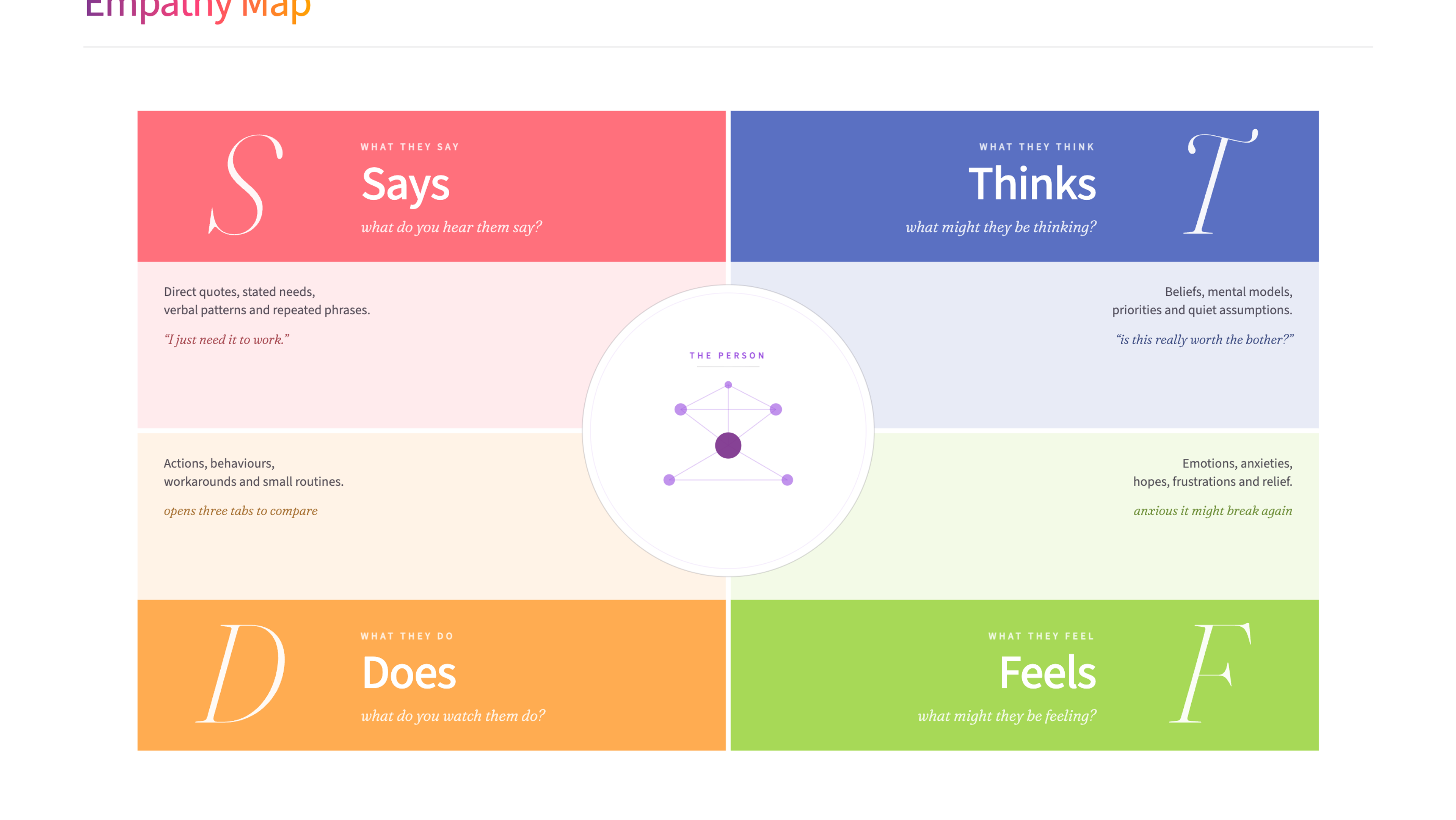
An empathy map is a collaborative visualisation tool that captures what we know about a user's behaviours, thoughts, feelings, and motivations, helping teams develop deeper understanding and more human-centred solutions.
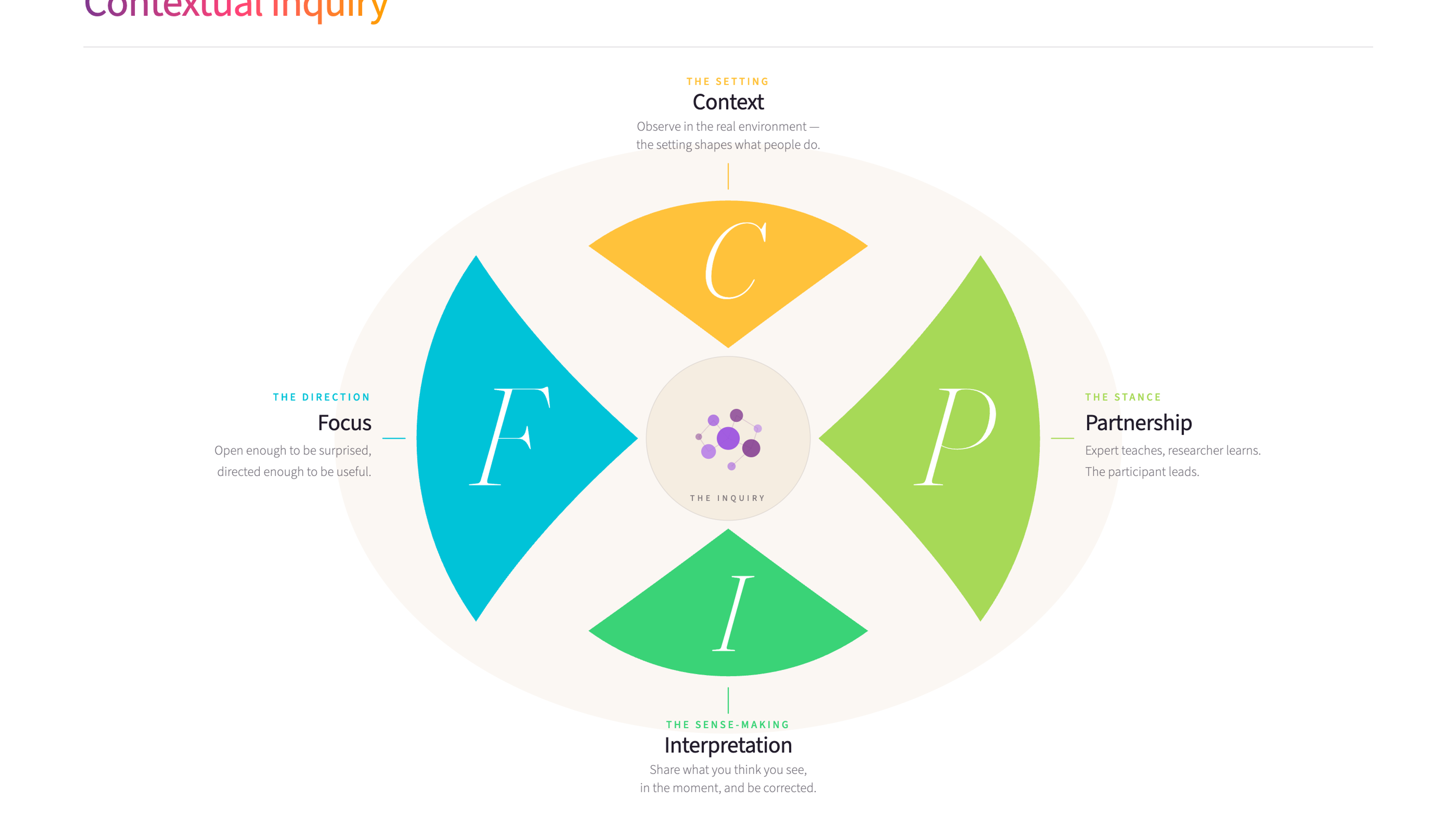
Contextual inquiry is a user research method where you observe and interview people in their actual work environment while they perform real tasks. It uncovers insights about real behaviour and needs that surveys and interviews in meeting rooms simply can't reach.
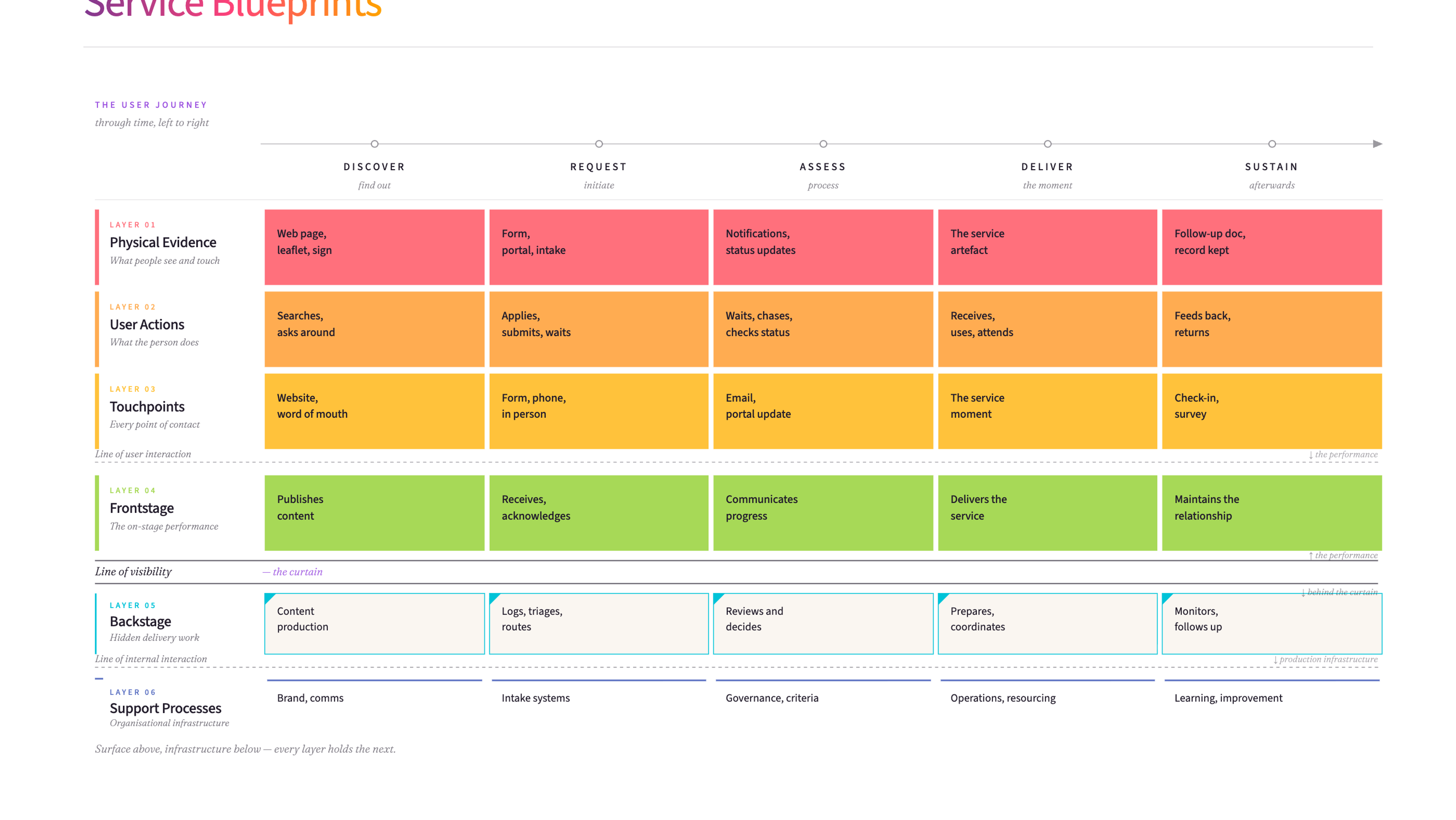
A service blueprint is a detailed map of how a service actually works - what the user sees and experiences on the front end, and everything happening behind the scenes to make it possible. It helps organisations redesign services by showing the full picture.

Customer Experience Training
Personas keep real people in view as you design, and they are one of several tools we work with in our Customer Experience training.
James Freeman-Gray is the founder of Mutomorro. He's an organisational development practitioner who has spent over twenty years working with leaders across public, private and nonprofit sectors - helping organisations pull together around a common purpose, joined up in how they work. More about who we are and what it's like to work with us.
Good personas are living documents, not filing cabinet exercises. I use them to help organisations stay connected to the real people they serve, rather than talking in abstract segments. The best personas I've helped create were built from actual conversations with real people, not assumptions in a workshop.
Last reviewed: June 2026
Ready to use Audience Personas?
Download the free template - includes practical guidance for workshops and team sessions.
Get the free template
Want to put these ideas into practice?
Whether you're navigating a merger, rethinking how you're structured, or trying to shift a culture that isn't working - underneath, it's the same job: getting the whole organisation pulling in the same direction. Start with a conversation.