Change Curve
The Change Curve maps the emotional stages people move through during organisational change, from shock and denial through to acceptance and commitment. It helps leaders understand where people are in the process and what support they need.
Get the free template
What is the change curve?
The change curve is a model of the emotional journey people go through during organisational change. It maps the dip - in mood, morale and performance - between first hearing about a change and genuinely committing to it, and the recognisable emotional states along the way: shock, denial, frustration, depression, experimentation, decision, integration. It's descended from the five stages of grief described by the psychiatrist Elisabeth Kübler-Ross in 1969, adapted by the change profession for the workplace. It isn't a change process and it won't tell you how to deliver anything; what it does is help leaders supporting people through change anticipate how people are likely to feel, spot where individuals and teams actually are, and choose the right support at each point.
This page works through the curve in four stages - Status Quo, Disruption, Exploration and Rebuild - with the same two-line device at every stage: the reaction (what people feel) and the approach (what leaders do). You'll find a free change curve template (PDF) with all four stages mapped, a walkthrough of each stage, a worked example following one team through the whole curve, and a comparison with Bridges, ADKAR and Satir so you can check you're holding the right model before you start.
From five stages of grief to four stages of change
The curve's lineage is worth telling straight - partly because most pages fudge it, and partly because the honest version makes the model more useful, not less.
Elisabeth Kübler-Ross was a Swiss-American psychiatrist. In On Death and Dying (1969) she described the five stages of grief - denial, anger, bargaining, depression and acceptance - drawn from her clinical work with terminally ill patients. She wasn't writing about organisations. The change profession later borrowed the shape, on a fair insight: significant organisational change involves real loss - of routine, of competence, of status, of colleagues - so something like the grief arc shows up at work too. The result is the organisational change curve, which now circulates in five-, six- and seven-stage versions, none of them canonical. Kübler-Ross never drew one.
She was also careful about her stages in a way the workplace versions often aren't. She wrote repeatedly that they were observations rather than a fixed sequence - people skip stages, revisit them and feel several at once - and in her later work with David Kessler she cautioned directly against treating them as a neat linear package. That caution applies double at work, and our version is built to respect it.
The four-stage reading this page uses - Status Quo, Disruption, Exploration and Rebuild - isn't a rival model; it's just a helpful way of thinking about the stages. Leaders can't act on seven overlapping emotions, but they can act on four situations: the emotions stay on the curve, and the stages group them into the four moments where a leader's job changes. Every stage then carries the same device, which is really this page's whole method: the reaction - what people are likely to feel - and the approach - what leaders should do about it. You can't manage feelings into existence, but you can build the conditions that let people move. The device keeps attention where a leader's leverage actually is.
How to use the change curve
The change curve is a map you hold, not a process you run. It won't tell you how to deliver a change - hold it alongside your delivery framework (Kotter's 8 Step Change Model is a common one) and use it to plot the emotional journey that delivery will create.
In practice it earns its keep in three ways. Before a change, it's a planning tool: anticipate the reactions each stage will bring and prepare the communication, forums and support to match, rather than improvising them mid-dip. During a change, it's a diagnostic: the behaviours you can observe - silence, hyper-vigilance to errors, quiet experiments - suggest where people actually are, which is rarely where the project plan assumes they are. And one-to-one, it's a way of making sense of a difficult transition with someone; people are often relieved to discover that what they're feeling has a name and a place on a map.
Two cautions, both inherited from the model's own history. Don't use the curve to push people through the stages - it isn't a tick-box progression, and people move at different speeds, skip stages and revisit them. Use it to spot where people are, then create the right environment, support and activities for that. And watch the cumulative load: organisations that go through repeated change without adequate support find each new curve harder to climb than the last.
The four stages of the change curve: a walkthrough
The curve below is the version we use: seven emotional waypoints, from shock through to integration, grouped into four working stages, each with its reaction and approach. The dashed arrow matters as much as the curve itself - people fall back from experimentation into frustration when something goes wrong, and the model treats that as part of the journey, not a failure of it.

No two people (or organisations) move through change identically. Some are naturally open to it; some are so invested in the status quo that they struggle to move at all; most take different paths and timeframes through the same four stages, and some pass over parts entirely. Treat what follows as guidelines rather than a hard process: explore with your team where they think they are, watch for the behaviours that suggest where they actually are, and meet them there.
Stage 1: Status Quo
The first stage covers the ground between the status quo and the change actually happening - the announcement, and the unsettled period that follows it. Lewin's Change Model calls this moment "unfreezing": the point where the current state begins to give way, whether people are ready or not. What defines this stage emotionally is that the change is being imposed - uncontrolled, from the individual's seat - and people react to uncontrolled change accordingly.

The reaction: shock and denial. The early response is shock or disbelief - withdrawal, or a group version where teams hunker down and engage less with everyone else. Denial usually follows: a refusal to engage with the change or acknowledge what it might mean. Both are self-protection mechanisms - subconscious attempts to prevent the change or shield the person from it - and neither is a discipline problem.
The approach: communicate and contextualise 5x more than you think you should. The job at this stage is to create the perception of individual control - think of it as shining a torch into the darkness, giving people an idea of where you're heading and why. Explain and contextualise far more than feels necessary: time runs differently when people are anxious or waiting on news, and a day can feel like a lifetime. A good rule of thumb: if you're not being told you're communicating too much, you're not communicating enough. Answer the questions people have before they ask them, and explain the journey in emotional as well as practical terms - you're helping people visualise the unknown.
Stage 2: Disruption
The second stage arrives with the early implementation of the change - and it's the low point of the curve, where the disruption is at its most real and the mood at its most raw.

The reaction: frustration and depression. Once the denial subsides, frustration and anger surface: "why are we doing this?", "it's not going to work". Expect people to be hyper-vigilant to errors and issues at this point - they're looking for external justification for their emotional state, and every glitch is evidence. Teams experience this stage very differently depending on how affected they are, their general resistance to change, and the leadership style they're used to; adaptive teams, and teams used to a coaching style of leadership, tend to weather it more comfortably.
The approach: give people a voice and a say. Tempting as it is, meeting these emotions with facts tends to be counterproductive - you can't rebut a feeling. Focus instead on listening, documenting, engaging and iterating: show people that what they're raising is being acknowledged and, where it should be, acted on. This is the stage for open forums - places to ask questions, voice concerns and workshop ideas - and for visibly changing something in response to what you hear. Nothing says "you have a voice" like the plan changing because of it.
Stage 3: Exploration
In the third stage, teams are working to integrate and understand the change - a period of experimentation and iteration while the new way of working beds in. Expect regression: teams can slip from here back into frustration when an approach fails or something breaks - the curve draws that path deliberately, and it's worth naming in advance as an expected part of the journey.

The reaction: acceptance by experimentation. Acceptance rarely announces itself; it shows up as small experiments - someone trying the new process unprompted, a team testing a variation on it. The critical thing is that people can experiment without judgement: if teams are worried they'll be reprimanded for trying things that don't quite work, the change stalls right here. This is also the point where autonomy and control start returning to teams - the Satir Change Model describes the same turning point, where a transforming idea lifts people out of chaos and into integration.
The approach: empower through discovery. Give teams the control and authority to start discovering for themselves. That can feel unnerving for the change team, and the answer is collaboration and joint working rather than handing over and hoping: keep change champions alongside teams while ownership transfers. Individuals vary here too; some will still be struggling with their emotional state while everyone around them accelerates, and support or coaching for those people is time well spent.
Stage 4: Rebuild
The final stage is integration: the point where people make the decision to accept the change and build on it rather than resist it. One caution before celebrating - this stage is about emotional state, not your change project plan. The plan's integration phase and people's actual readiness often run on different calendars, and it's worth checking honestly which one you're reading before you push forward.

The reaction: decision and acceptance. When people accept a change they begin to adapt, folding the new normal into their working lives - and the emotional weather changes with it, becoming more positive and forward-looking. This is the moment to build on: work with teams to keep integrating the change while the energy is with you.
The approach: reinforce the reason to change. Focus on the successes and the changes already made. Use social capital: highlight the good being done across the organisation and what it means for teams and customers. And include the struggles - the challenges teams have faced and how they got through them. A balanced narrative does two jobs at once: it keeps the story credible, and it tells the people still finding it hard that they're not alone.
Change curve example: a restructure, stage by stage
Here's how the four stages play out on a real-scale change. This is an illustrative example - the organisation is fictional, invented for the purpose - but the reactions, and the leadership calls that meet them, are the ones this kind of change reliably produces.
A mid-sized organisation merges its two customer service teams - one handling phones, one handling email and webchat - into a single multi-skilled team. Around forty people are affected. Nobody's job is at risk, but specialisms people have built their working identity around are going, rotas are changing, and two well-liked team leaders will become one.
Status Quo. The announcement lands to near silence in the all-hands - and disbelief in smaller rooms afterwards. The phone team quietly concludes it won't really happen ("they tried this in 2019"), and both teams hunker down. Leaders respond by communicating far past the point that feels natural: a weekly open session even when there's nothing new to say (no news, said out loud, still beats silence), the reasons restated in practical and emotional terms, and the change curve itself shared with the teams - this is the journey, dip included.
Disruption. The new rota goes live and the mood drops. "Why are we fixing something that wasn't broken?" Every glitch in the new call-routing is screenshotted and circulated within minutes - hyper-vigilance doing its usual work of gathering evidence for how everyone already feels. Leaders resist the urge to answer feelings with dashboards. Instead: listening forums in every team, concerns logged where everyone can see them, and two genuine changes made to the rota design in response - announced as exactly that. "You said, we changed."
Exploration. Energy returns unevenly. A phone specialist tries the webchat queue on a quiet afternoon; a small group starts swapping shortcuts. Then a bruising service outage knocks the whole team back into frustration for a fortnight - the regression the curve promised. Leaders protect the experiments from judgement (nobody gets pulled up for a clumsy first week on an unfamiliar channel), name the setback as a normal part of the journey rather than a verdict on the change, and keep change champions working alongside the teams as control is handed back.
Rebuild. The tell is small: someone from the old phone team corrects a new starter with "that's not how we do it here" - about the new way of working. Acceptance has become ownership. Leaders reinforce the reason to change: the first quarter's service improvements are shared alongside the honest account of the outage fortnight, and the people who found the change hardest - and got there anyway - are the ones asked to tell the story.
Pulled into one view:
Stage | What people showed | What leaders did |
|---|---|---|
Status Quo | Silence, disbelief, "it won't really happen", teams hunkering down | Communicated past the point of comfort; shared the curve itself, dip included |
Disruption | Frustration; every glitch screenshotted and circulated | Listened, logged concerns visibly, changed the rota in response - "you said, we changed" |
Exploration | Quiet experiments; a fortnight's regression after an outage | Protected experimentation from judgement; named the setback as part of the journey |
Rebuild | Acceptance becoming ownership of the new way | Reinforced the reason to change - successes and struggles told together |
Notice what the model contributed: not a prediction, but preparation. Leaders knew the dip was coming, so when it came they didn't panic, take it personally or try to argue people out of their feelings - they matched the approach to the stage and let the curve do what it's for.
Change Curve vs Bridges vs ADKAR vs Satir
The change curve is one of several models of how people experience change, and they're less interchangeable than they look - each one holds a different seat. The curve's seat is emotional: it maps what people are likely to feel, over time, so leaders can support rather than fight it. The Bridges Transition Model maps the psychological process underneath - endings, the neutral zone, new beginnings - and gives you something closer to a method, starting with honouring what's being lost. The Satir Change Model is the curve's closest relative: it also plots performance through a dip, but adds two sharp ideas of its own - the foreign element that tips people out of the old status quo, and the transforming idea that lifts them out of chaos. And the ADKAR model leaves the emotional seat entirely: five sequential elements you can assess person by person to find exactly where a change is stuck.
Model | What it maps | When to reach for it |
|---|---|---|
Change Curve | The emotional journey - four stages from Status Quo to Rebuild, with the reaction and approach for each | Anticipating how people will feel and choosing the right support at each stage |
Bridges Transition | The psychological transition - endings, the neutral zone, new beginnings | When loss and identity are the hard part and you need a process for the human side |
Satir Change Model | Performance through change - status quo, foreign element, chaos, transforming idea, integration | When a team is deep in the dip and you're looking for the idea that moves them forward |
ADKAR | Individual readiness - Awareness, Desire, Knowledge, Ability, Reinforcement | Diagnosing where a change is stuck, person by person or group by group |
They combine well. A common pattern is to run the delivery with a campaign model, check readiness with ADKAR, and hold the curve alongside as the weather map - it tells you what season the people in the change are in, whatever the plan says the date is. One note from our own training rooms: when the focus is a team's dynamics rather than individual journeys, we tend to reach for Satir over the curve - the foreign element and the transforming idea give a team more to work on together.
Change Curve Template
Our free change curve template puts the whole model on one page: the four-stage curve with the emotional characteristics of each stage mapped out, guidance for recognising where people actually are, and practical approaches for supporting them at each point - from communication and context-setting in the early stages to empowerment and discovery as people begin to explore. It's built to be used with a team - in a workshop, a leadership session or a one-to-one - not just read.
Download the free change curve template (PDF) - fill in your details and it's yours straight away.
Change curve FAQs
Is the change curve the same as the five stages of grief?
No, though they're directly related. The five stages of grief - denial, anger, bargaining, depression, acceptance - are Elisabeth Kübler-Ross's description of how people respond to terminal illness and profound loss, published in On Death and Dying in 1969. The change curve is the change profession's later adaptation of that shape to organisational life, and the two have grown apart: bargaining rarely features in workplace versions, which instead add stages Kübler-Ross never described - experimentation, decision, integration - because a change at work, unlike a bereavement, ends with something to build. Kübler-Ross never drew an organisational change curve herself; her foundation continues her work, and the Kübler-Ross Change Curve is its registered trademark.
How many stages does the change curve have?
There's no official number, because there's no official curve. Five-stage versions map the grief stages across directly; six- and seven-stage versions add endpoints like integration or problem-solving; this page works with four. The emotional waypoints are all still there - our diagram plots seven, from shock to integration - but we group them into four working stages (Status Quo, Disruption, Exploration, Rebuild) because that's the level a leader can act at. Emotions arrive several at once and in any order; situations are stable enough to plan for. Each of our stages is a situation with a job attached: communicate, listen, empower, reinforce.
What are the criticisms of the change curve?
Three land hardest, and they're worth taking seriously. First, the evidence base: Kübler-Ross's stages were clinical observations, not the product of controlled research, and later grief research hasn't supported a fixed stage sequence - a weakness the workplace version inherits. Second, it isn't linear, and was never claimed to be: Kübler-Ross herself, and later her co-author David Kessler, cautioned against reading the stages as a schedule - yet the workplace curve is routinely drawn, and managed, as if people move through it in order and on time. Third, it isn't universal: plenty of people meet a change with relief or indifference, and a model that expects everyone to grieve can lead leaders to patronise people who are simply fine.
The way through all three is the same: hold the curve as a map of emotional range, not a schedule. It doesn't predict what everyone will feel - it names what people may feel, makes the dip normal when it comes, and points at what helps. That stops leaders panicking at resistance, taking it personally, or trying to fix people who mostly need time and support.
How do you use the change curve with a team during a change?
Share the curve itself, early - ideally before the hardest part of the change lands. Showing a team the whole journey, dip included, is one of the most quietly powerful things the model does: it makes the difficult middle normal and expected rather than a sign the change is failing. From there, use it to locate rather than push: watch for the behaviours each stage predicts - silence and disbelief early, hyper-vigilance to errors in the dip, quiet experiments as energy returns - and match your support to the stage rather than the timetable. It works one-to-one as well as with a whole team. Our free template gives you the four stages mapped for exactly this, and if you want to build the skill properly, our change management training works through the human side of change with your teams.
Change curve or Bridges - which should I use?
They're the two best-known people-side models, and they do different jobs. The change curve is a map of feelings: it helps you anticipate and recognise the emotional journey, and choose support to match. The Bridges Transition Model is closer to a process: it says every transition starts with an ending, passes through a neutral zone, and only then reaches a new beginning - and it gives you work to do at each phase, starting with honouring what's being lost. If you want to understand and support how people are feeling, start with the curve. If loss and identity are clearly the heart of your change - a merger, the end of a much-loved service, a retiring founder - Bridges gives you more to work with. They stack comfortably: hold the curve as the weather map and run the transition with Bridges.
Sources and further reading
- Elisabeth Kübler-Ross, On Death and Dying (1969; Routledge edition) - the book the five stages of grief, and everything descended from them, came from
- Elisabeth Kübler-Ross Foundation - The Kübler-Ross Change Curve - the lineage and the non-linearity caution, from the model's own home
We share thinking on organisational change and development on LinkedIn - practical ideas for people doing this work inside their own organisations.
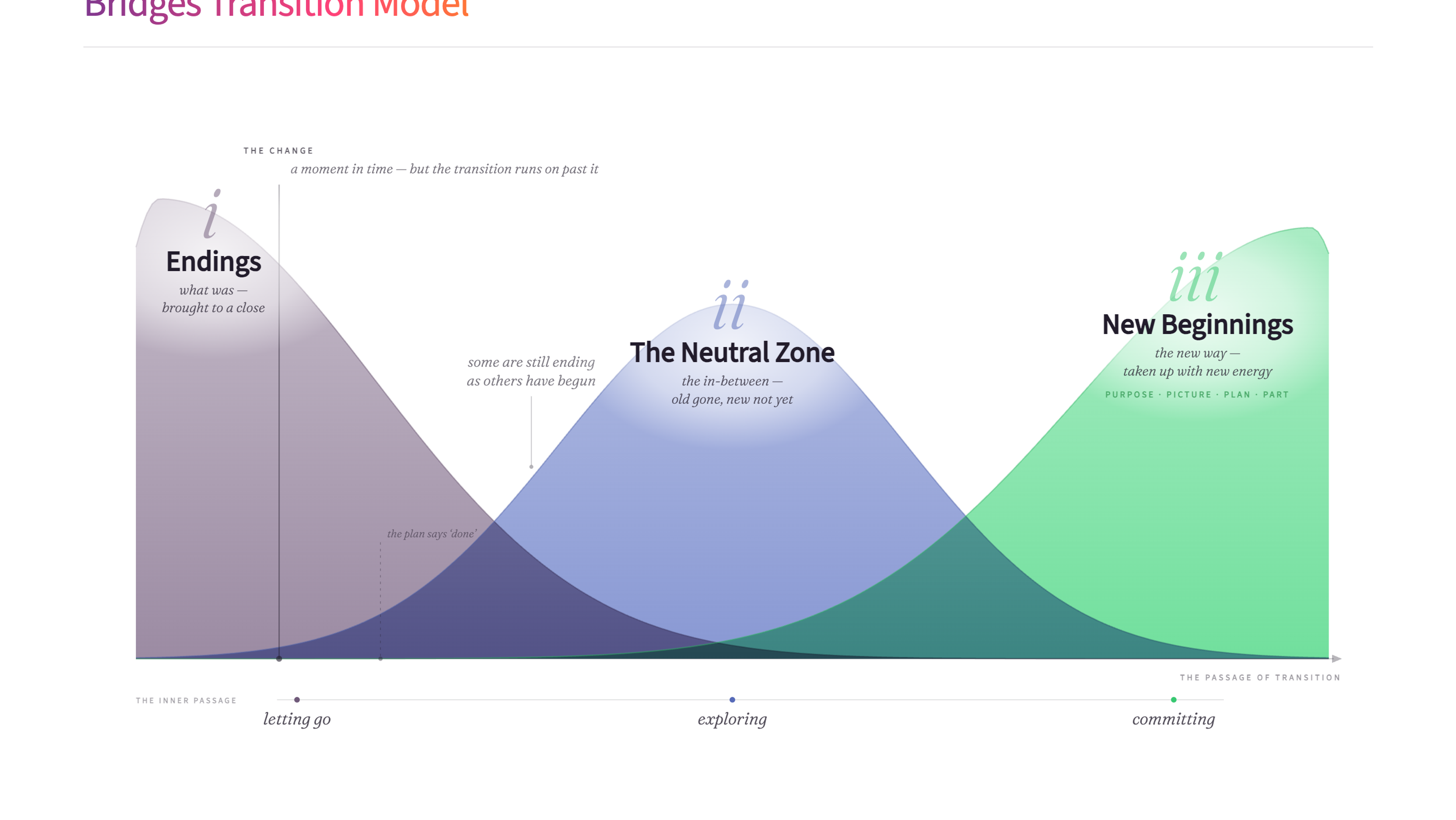
The Bridges Transition Model focuses on the human side of change - the psychological transition people go through rather than the external change itself. It maps three phases: Endings, the Neutral Zone, and New Beginnings.
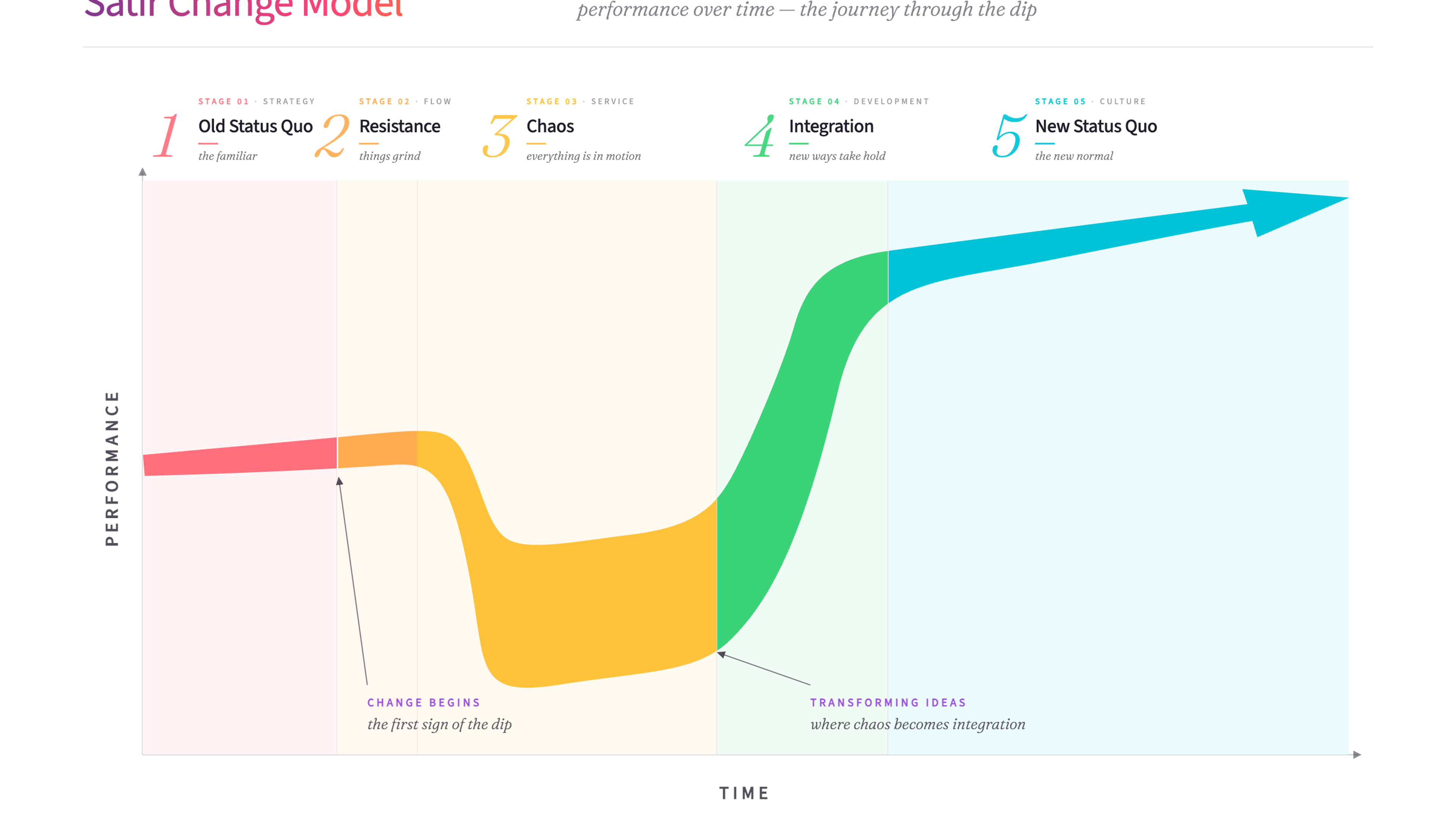
The Satir Change Model maps the emotional journey teams move through during change - from familiar stability through resistance and chaos to integration and a new way of working.
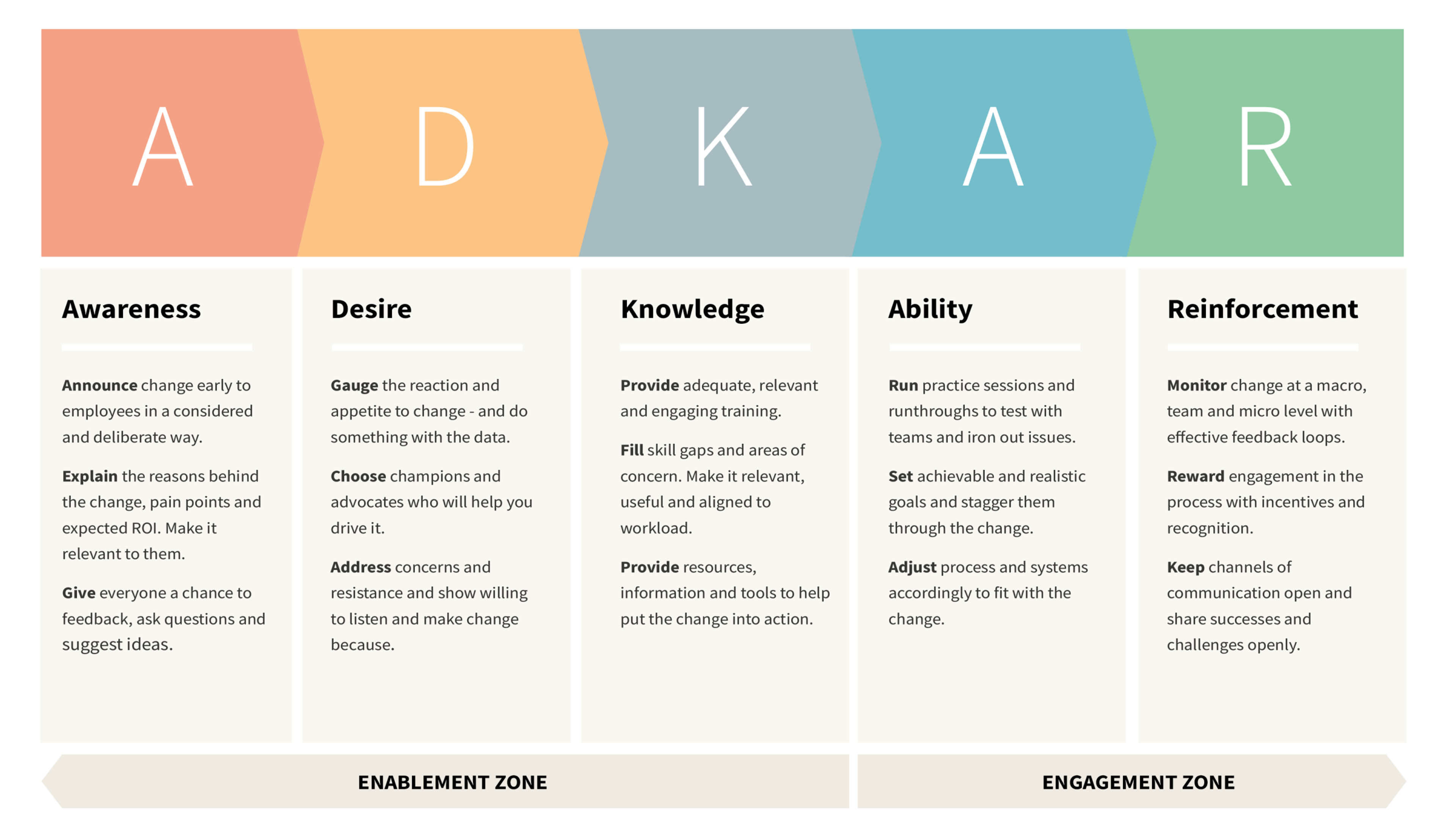
The ADKAR model is a five-stage framework for managing change at an individual level - Awareness, Desire, Knowledge, Ability, and Reinforcement. It helps organisations understand what people need at each point in a change process and where things are getting stuck.

Change doesn't just affect what people do - it affects who they feel they are. Understanding the human experience of change helps leaders create conditions where people can adapt.
Change fatigue in the workplace is growing fast. This article explores what's really driving it - not just the volume of change, but how organisations approach it - and what leaders can do to rebuild capacity without slowing down.
How to assess whether your organisation is genuinely ready for change - looking at the whole system, not just the surface. Covers what to examine, how to gather honest insight, and how to use what you find to build a change plan that works with your organisation rather than against it.
Change Management Training
Understanding how people move through change sits at the heart of our Change Management training, where teams learn to lead it rather than just chart it.
James Freeman-Gray is the founder of Mutomorro. He's an organisational development practitioner who has spent over twenty years working with leaders across public, private and nonprofit sectors - helping organisations pull together around a common purpose, joined up in how they work. More about who we are and what it's like to work with us.
The Change Curve is one of the best-known change models, which makes it a useful entry point for conversations about how people experience change. It's not a prediction tool - it's a compassion tool. When leaders can see that resistance and dips in performance are a normal part of the process, they stop trying to fix people and start trying to support them.
Last reviewed: August 2026
Ready to use Change Curve?
Download the free template - includes practical guidance for workshops and team sessions.
Get the free template
Want to put these ideas into practice?
Whether you're navigating a merger, rethinking how you're structured, or trying to shift a culture that isn't working - underneath, it's the same job: getting the whole organisation pulling in the same direction. Start with a conversation.