Bridges Transition Model
The Bridges Transition Model focuses on the human side of change - the psychological transition people go through rather than the external change itself. It maps three phases: Endings, the Neutral Zone, and New Beginnings.
Get the free template
A change can be finished on paper and still feel unfinished in the room. The new structure is announced, the system goes live, the plan says "done" - and weeks later things still feel unsettled. The Bridges Transition Model explains that gap. It separates the change itself, which can happen almost overnight, from the transition people go through to catch up with it, which runs on a much slower clock.
What is the Bridges Transition Model?
The Bridges Transition Model is a way of understanding the human side of change - not the event itself, but the internal process people go through as they come to terms with it. It was developed by William Bridges, an American consultant who first set out the idea in his 1980 book Transitions and applied it to organisations in Managing Transitions (1991), later developed with Susan Bridges over several decades.
Its central move is a distinction that sounds small and turns out to matter a great deal: the difference between change and transition.
Change is the external event - the restructure, the new system, the merger, the leadership handover. It happens at a fixed point in time, and it can happen fast. Transition is the internal, psychological process of letting go of how things were, finding your feet in the in-between, and gradually committing to how things will be. Change is something that happens to people. Transition is what happens inside them.
The reason this distinction earns its place is that organisations tend to plan the change in great detail and assume the transition will look after itself. The launch date goes in the calendar. The training gets booked. The comms go out. And then, when people are slower to settle than the plan expected, that lag gets read as resistance or underperformance rather than as the ordinary work of transition still going on. The model gives leaders a language for that lag, and a reason to plan for it rather than be surprised by it.
How the Bridges Transition Model works
The model describes three phases of transition: Endings, the Neutral Zone, and New Beginnings. It is tempting to read those as three tidy steps in a row, but that is the one thing they are not. The phases overlap. At any moment in a real organisation, some people are still grieving what has ended while others are already finding their feet in the new way of working - and most people are holding pieces of more than one phase at once. The shape of the model is less a line and more a set of overlapping waves, with the centre of gravity shifting over time.
Holding that in mind changes how you use it. You are not waiting for everyone to clear one stage before the next begins. You are noticing where the weight is sitting, for whom, and what each phase asks of you.
Phase | What's happening | What people experience | The leader's task |
|---|---|---|---|
Endings | Letting go of the old way | Loss - even when the change is welcome | Name what's ending; don't rush past it |
The Neutral Zone | Old way gone, new way not yet settled | Uncertainty; productivity often dips | Make the uncertainty survivable; shield people from output pressure |
New Beginnings | Taking up the new way as their own | Renewed energy and direction | Offer the four Ps - purpose, picture, plan, part |
Endings

Every transition starts, paradoxically, with an ending. Before people can take up something new, they have to let go of something old - a familiar way of working, a team they liked, a sense of being good at their job, sometimes just the comfort of knowing what each day would hold.
This phase is marked by loss, and loss shows up even when the change is welcome. Someone can be genuinely glad about a promotion and still quietly mourn the colleagues and routines they are leaving. The work of this phase is to name what is ending honestly, to give people room to acknowledge it, and to resist the urge to rush past it. The Change Curve maps the emotions of this stage in more detail - the shock, denial and frustration that often come before acceptance.
What does not help is pretending nothing is being lost. When leaders skip the ending and talk only about the exciting future, people hear that their experience is being dismissed, and the loss goes underground rather than away.
The Neutral Zone

The Neutral Zone is the in-between. The old way has gone, the new way has not yet settled, and people are working in a space that feels uncertain and often unproductive. Bridges saw this as the hardest phase to sit with and the most important not to skip.
It is uncomfortable for a reason: old habits no longer fit and new ones have not formed, so everything takes more effort. Productivity often dips. People feel at sea. The instinct - for leaders especially - is to compress this phase as quickly as possible. But the Neutral Zone is also where the real reorientation happens. It is the space in which people let go of old assumptions and start to imagine new possibilities. Virginia Satir described a similar stage in her Satir Change Model, which she called chaos, and saw as the point where genuine transformation becomes possible rather than a problem to be eliminated.
The task here is to make the uncertainty survivable: to keep communicating even when there is little new to say, to protect people from being judged on output while the ground is still moving, and to treat the discomfort as a sign the transition is working rather than failing.
New Beginnings

A beginning is not the same as a start. A start is a date - the day the new structure goes live. A beginning is the moment people genuinely take up the new way as their own, with fresh energy and a sense of who they are becoming. Starts can be scheduled. Beginnings cannot be forced; they emerge when people are ready.
Bridges offered a practical guide for helping beginnings take hold, often called the four Ps:
- Purpose - why the change matters, explained clearly enough that people can see the point of it
- Picture - what the new situation will look and feel like, made concrete rather than abstract
- Plan - the path for getting there, including how people will be supported along the way
- Part - a genuine role for each person to play, so they are participants in the new way rather than passengers
When all four are present, people have something to move towards rather than simply something they are being moved into. The energy of a new beginning - the renewed sense of direction and identity - is what the whole transition has been working towards.
Because the phases overlap, all of this is happening at different rates across a group at the same time. A model like Bridges sits well alongside the more structured change frameworks: Kotter's 8 Step Change Model maps the leadership actions that make change stick, Lewin's Change Model frames the wider arc of unfreezing and refreezing, and the ADKAR Model sets out what each individual needs to adopt the change. Bridges adds the dimension those frameworks tend to leave out: what people are feeling and working through underneath the plan.
How to use the Bridges Transition Model
The model becomes useful the moment you stop treating change and transition as the same thing. A few practical moves:
Separate the change from the transition. Write down the change - the concrete thing that is happening. Then, separately, write down the transition it sets off: what people will have to let go of, what the in-between will feel like, and what the new way will ask of them. Planning the first without the second is where most change efforts quietly come unstuck.
Map who is losing what. Different groups lose different things in the same change. A team lead might lose status; a long-serving member might lose mastery; a whole department might lose a shared identity. Naming these specifically - rather than talking in general terms - lets you support the transition where it is really being felt.
Hold the Neutral Zone instead of rushing it. Give people permission to find this phase hard. Keep talking even when the message is "we don't know yet." Protect the space rather than papering over it with forced optimism, and treat the dip in productivity as expected rather than as a failure to be fixed.
Use the four Ps to open the new beginning. When you are ready to help people commit to the new way, check you have given them a purpose, a picture, a plan, and a part. If commitment is not coming, one of the four is usually missing.
Expect people to move at different speeds. Some will reach a new beginning while others are still in the middle of an ending. This is not a sign that anything has gone wrong. Avoid splitting people into those who are "on board" and those who are "lagging" - it adds pressure exactly where patience is needed, and it can deepen the resistance you are trying to ease.
Example
Imagine two teams that have always worked separately being brought together into one, under a new manager, after a restructure. The change is clean and fast: the new reporting lines are announced on a Monday, and on paper the merged team exists from that day.
The transition is slower and messier. In the weeks that follow, people are firmly in the Endings phase - one team has lost a manager they trusted, the other has lost the sense of being a tight, self-contained group, and both have lost the small routines that told them how their day would go. If the new manager opens with an upbeat vision of the combined team's potential, it lands badly, because nobody has had room to acknowledge what they are leaving behind.
A few months on, the team is deep in the Neutral Zone. Two ways of doing the same job sit side by side, nobody is quite sure which counts, and meetings take longer than they used to. Output dips. Read through the model, this is not the merger failing - it is the merger working its way through the in-between. The manager's job here is to keep communicating, to make the uncertainty bearable, and to resist the temptation to declare everything settled before it is.
The new beginning comes later, and unevenly. A couple of people find the combined way of working genuinely better and become quiet advocates; others take longer. When the manager gives the team a clear purpose, a concrete picture of how the merged group will work, a plan with support built in, and a real part for each person to play, the centre of gravity finally shifts. The team is not "done" - some are still letting go - but it has begun.
Limitations
The Bridges Transition Model is a lens, not a complete method, and it helps to be clear about what it does not do.
It describes the experience of transition without explaining why a particular change provokes the reaction it does. To understand that, you have to look at what people are really losing - their identity, status, relationships, sense of competence - and at the conditions around them. The model tells you people are in transition; it does not diagnose the deeper causes.
It is not an implementation plan. It will not sequence the work, set milestones, or tell you what to do first. That is why it pairs naturally with structured approaches like Kotter, Lewin or ADKAR, which handle the operational arc the Bridges model deliberately leaves alone.
And its three labels invite a tidy, linear reading that the reality rarely matches. Treated as three boxes in a row, the model can mislead as much as it helps. Its value depends on holding the overlap in mind: phases running at once, people moving at different speeds, the whole thing less orderly than the diagram suggests.
There is one more boundary worth naming. The model centres the individual, and says little about the wider system a transition sits inside. In practice, one person's transition is bound up with everyone else's - roles shift, relationships re-form, and the meaning of the change ripples through the whole network rather than landing on people one at a time. Seen that way, the Neutral Zone is not only an individual discomfort to be managed but a shared, generative space the whole organisation passes through together. This systemic view of how organisations move is what we explore through the Tuned to Change dimension of our work, and it is often where repeated change efforts run into trouble - the territory of change fatigue, where the system, not the individual, is worn down.
Getting started
The simplest way to begin is to put the change and the transition on a single page, side by side. At the top, write the change - the concrete event that is happening and when. Underneath, in your own words, write what people are being asked to let go of, what the in-between will feel like, and what a real new beginning would look like.
That one page will tell you more than most launch plans. It will show you where the losses sit, which groups have the furthest to travel, and where you have been planning the change while assuming the transition would take care of itself. From there, the next move is usually a conversation - with the people closest to the change - about what they are leaving behind, before any talk of where you are all heading.
If you are carrying a significant transition and want a thinking partner for the human side of it, our work in change management is built around exactly this: helping leadership teams understand the transition their people are going through, and building that understanding into how change is planned, communicated and supported.
We share thinking on organisational change and development on LinkedIn - practical ideas for people doing this work inside their own organisations.
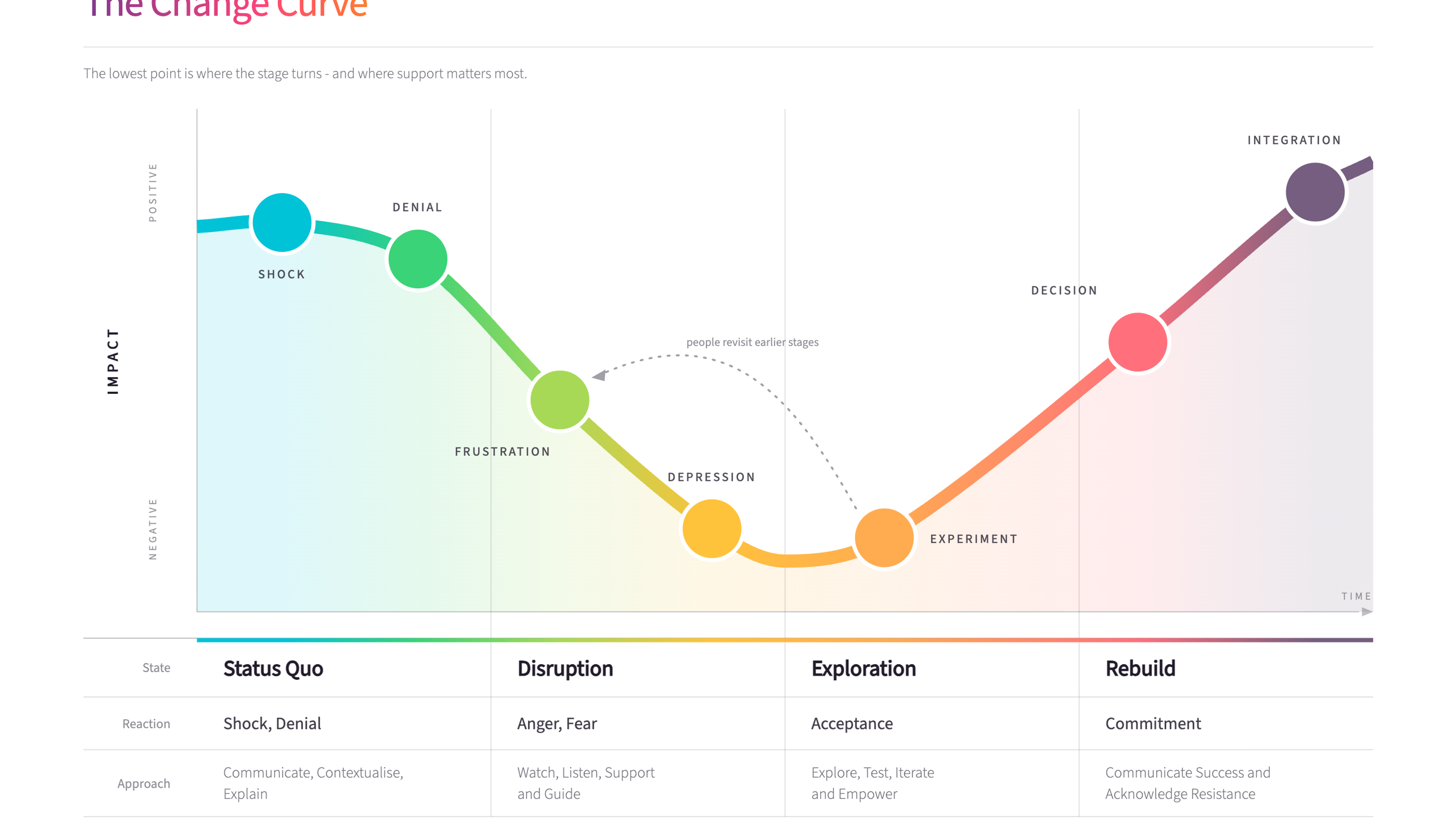
The Change Curve maps the emotional stages people move through during organisational change, from shock and denial through to acceptance and commitment. It helps leaders understand where people are in the process and what support they need.
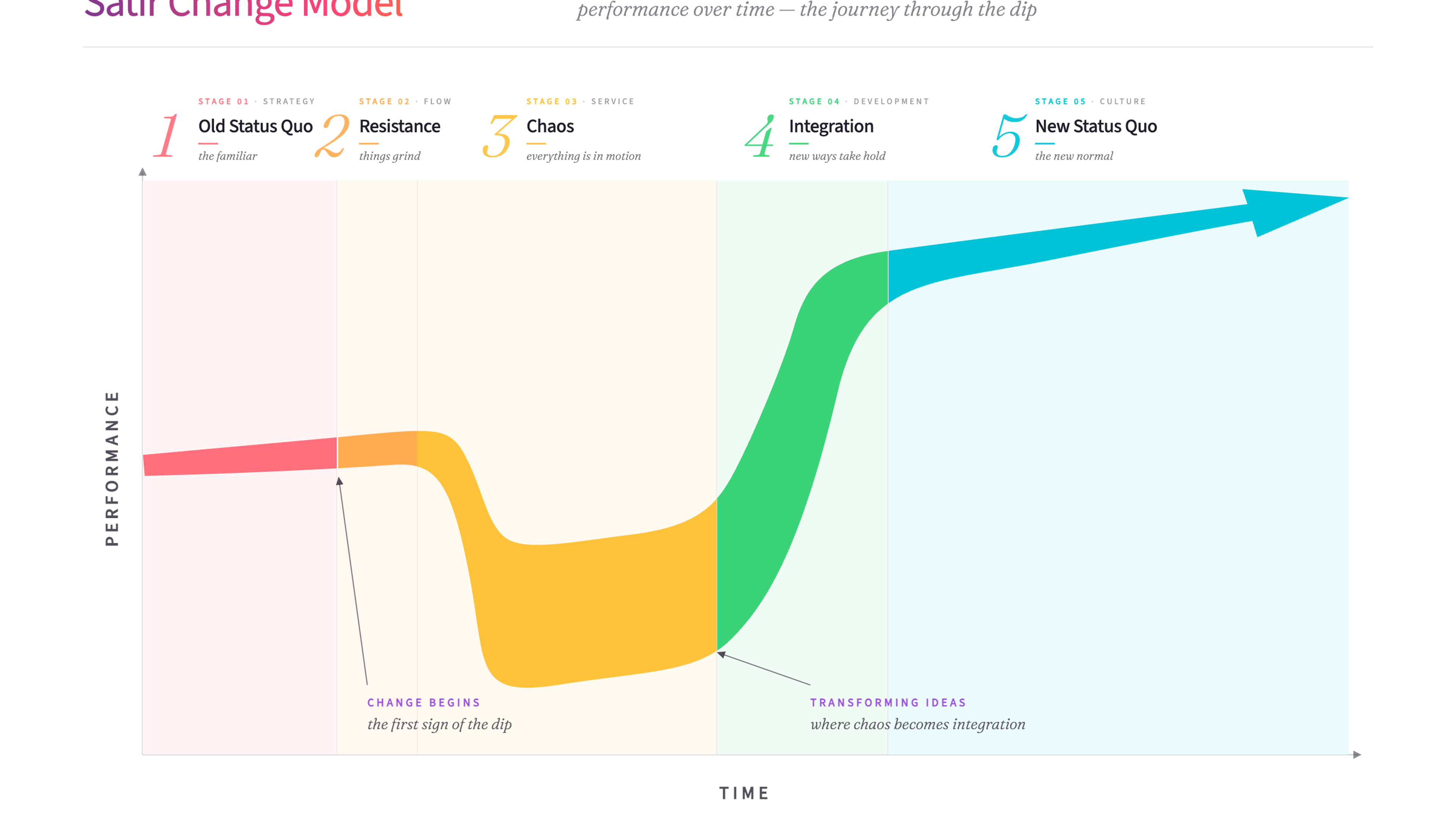
The Satir Change Model maps the emotional journey teams move through during change - from familiar stability through resistance and chaos to integration and a new way of working.
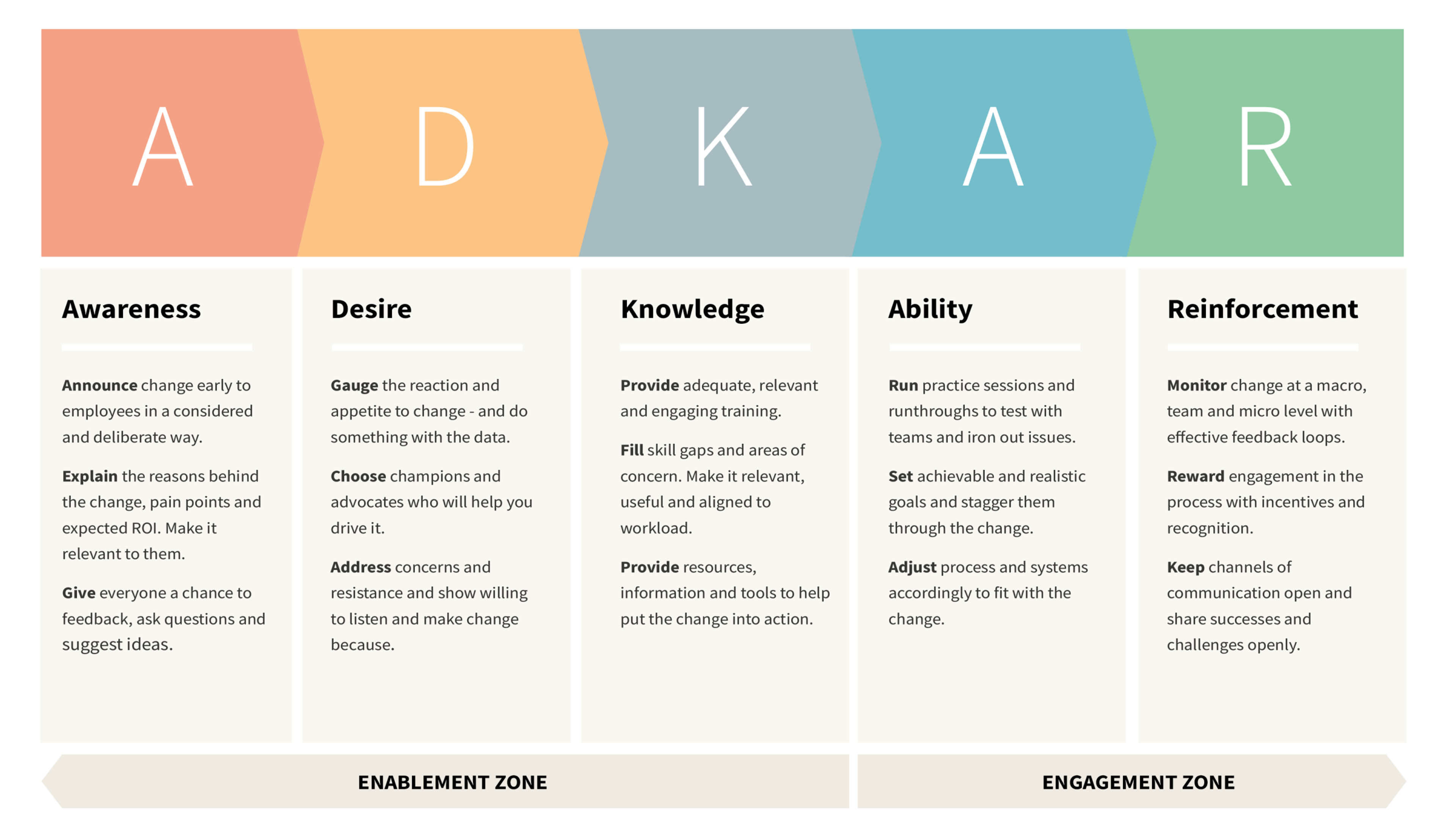
The ADKAR model is a five-stage framework for managing change at an individual level - Awareness, Desire, Knowledge, Ability, and Reinforcement. It helps organisations understand what people need at each point in a change process and where things are getting stuck.

Change doesn't just affect what people do - it affects who they feel they are. Understanding the human experience of change helps leaders create conditions where people can adapt.
Change fatigue in the workplace is growing fast. This article explores what's really driving it - not just the volume of change, but how organisations approach it - and what leaders can do to rebuild capacity without slowing down.
How to assess whether your organisation is genuinely ready for change - looking at the whole system, not just the surface. Covers what to examine, how to gather honest insight, and how to use what you find to build a change plan that works with your organisation rather than against it.
Change Management Training
Bridges' work on transitions is one of the models we use in our Change Management training, helping teams support people through the human side of change.
James Freeman-Gray is the founder of Mutomorro. He's an organisational development practitioner who has spent over twenty years working with leaders across public, private and nonprofit sectors - helping organisations pull together around a common purpose, joined up in how they work. More about who we are and what it's like to work with us.
Bridges' distinction between change and transition has been a really useful idea I bring into client work. Change is the external event - the restructure, the new system, the merger. Transition is the internal process people go through. Organisations often plan for the change but forget about the transition entirely.
Last reviewed: June 2026
Ready to use Bridges Transition Model?
Download the free template - includes practical guidance for workshops and team sessions.
Get the free template
Want to put these ideas into practice?
Whether you're navigating a merger, rethinking how you're structured, or trying to shift a culture that isn't working - underneath, it's the same job: getting the whole organisation pulling in the same direction. Start with a conversation.