ADKAR Model
The ADKAR model is a five-stage framework for managing change at an individual level - Awareness, Desire, Knowledge, Ability, and Reinforcement. It helps organisations understand what people need at each point in a change process and where things are getting stuck.
Get this template
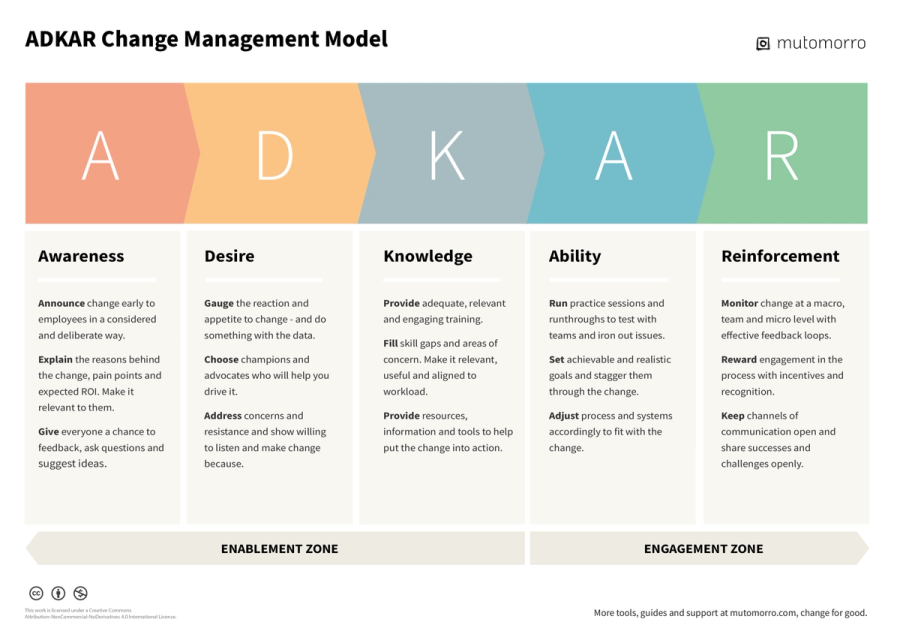
The ADKAR model
The ADKAR model is a well-known approach to managing organisational change. It breaks down the change process into five distinct stages, exploring key considerations for each and how best to implement them. The model takes a slightly different approach to change, as it considers it from the individual's perspective rather than the organisation's.
What is the ADKAR model?
The ADKAR model was developed by Jeff Hiatt in the late 1990s after studying change processes across nearly 1,000 organisations. What he discovered was refreshingly straightforward - successful change follows a predictable pattern at the individual level.
The acronym breaks down into five sequential building blocks:
- Awareness of the need for change
- Desire to participate and support the change
- Knowledge of how to change
- Ability to implement required skills and behaviours
- Reinforcement to sustain the change
Think of these elements as stepping stones across a river. Miss one, and you're likely to find yourself in rather cold water. Recent research from Prosci confirms that organisations using structured change management approaches like ADKAR are up to seven times more likely to achieve their objectives.
Why does ADKAR work differently?
Most change models focus on what the organisation needs to do. ADKAR flips this perspective entirely - it asks what each individual needs to experience for change to stick.
Most change models - like Kotter's 8 Step Change Model - focus on what the organisation needs to do. ADKAR flips this perspective entirely.
Consider how traditional change announcements typically unfold: "We're implementing a new system to improve efficiency." The emphasis sits squarely on the organisational benefit. ADKAR would reframe this as: "Here's what this change means for your daily work, and here's how we'll support you through it."
Microsoft's implementation of ADKAR resulted in a 450% increase in adoption rates, with 80% of customers reporting improved adoption and half reducing their deployment times. The difference? They focused relentlessly on the individual experience of change.
The five stages of ADKAR: a detailed walkthrough
The ADKAR model is broken down into 5 sequential steps - each one necessary to build individual understanding, awareness and engagement with change.

Understanding the zones: enablement and engagement
Before diving into the individual stages, it's useful to understand how ADKAR organises itself into two distinct operational zones. These "zones" help change practitioners understand where to focus their energy and resources at different phases of the change journey.
The enablement zone: building the foundation
The first three stages - Awareness, Desire, and Knowledge - comprise what's known as the enablement zone (development phase). This zone focuses on preparing people for change by building understanding, motivation, and capability.
Think of the enablement zone as laying the groundwork. It's where you're essentially asking people to get ready for change rather than actually implementing it. The activities here are largely preparatory:
- Communication and engagement to build awareness
- Influence and motivation strategies to create desire
- Training and skill development to provide knowledge
The enablement zone represents the classic "hearts and minds" approach to change management. You're working to ensure people understand why change is necessary, want to be part of it, and know how to contribute effectively.
The engagement zone: turning preparation into action
The final two stages - Ability and Reinforcement - form the engagement zone (implementation and monitoring phase). This is where theoretical preparation meets practical reality.
The engagement zone is fundamentally different from enablement. Here, people are actually demonstrating new behaviours, using new systems, and working in new ways. The focus shifts from preparation to performance:
- Hands-on application and skill demonstration
- Performance monitoring and support
- Continuous improvement and habit formation
Why the zones matter in practice
Understanding these zones can help change practitioners make more strategic decisions about resource allocation and timing. Research from organisations implementing ADKAR shows that different zones require different approaches:
Resource intensity varies: The enablement zone typically requires more communication and training resources, whilst the engagement zone demands more coaching and support infrastructure.
Timeline considerations: Many organisations underestimate the time needed for the enablement zone, rushing into implementation before people are truly ready. Moving from the "enablement" zone (planning & research) to the "engagement" zone (go do it) brings critical transition challenges.
Measurement approaches differ: In the enablement zone, you're measuring readiness indicators like comprehension and enthusiasm. In the engagement zone, you're tracking performance and adoption metrics.
Stakeholder roles shift: Senior leaders are most critical during the enablement zone for communication and sponsorship. Middle managers become crucial during the engagement zone for coaching and day-to-day support.
One technology company discovered this distinction the hard way. They invested heavily in the engagement zone - providing excellent systems and support - but hadn't adequately addressed the enablement zone. Despite having all the tools they needed, staff lacked the foundational awareness and desire to use them effectively. The result? A technically successful implementation that failed to achieve its intended outcomes.
Now let's take a look at each of the 5 stages in more detail...
Stage 1: Awareness - lighting the way forward
Awareness isn't simply about announcing change - it's about creating genuine understanding of why change matters. People need to grasp not just what's changing, but why the status quo is no longer sustainable.

The challenge: Research indicates that 74% of leaders believe they've involved employees in change initiatives, yet only 42% of employees report feeling included. This disconnect often starts with inadequate awareness-building. Here, you're painting a picture of the need for change.
What effective awareness looks like:
- Context setting: Explain the business drivers, market pressures, or opportunities that necessitate change
- Impact clarity: Help people understand how the change affects their specific role and department
- Two-way dialogue: Create channels for questions, concerns, and feedback rather than one-way communication
Practical approaches:
- Host department-specific sessions rather than generic all-hands meetings
- Use data and examples that resonate with different audiences
- Address the "what happens if we don't change?" question directly
- Share competitor examples or market trends that illustrate the need
Remember, awareness isn't a tick-box exercise. Studies show that clear communication can improve change success rates by up to 3.5 times, but only when it addresses individual concerns and provides relevant context.
Stage 2: Desire - igniting the motivation to change
Creating desire goes beyond rational arguments - it taps into both practical and emotional motivations. People need to want the change, not simply understand it.

The psychology factor: Recent research reveals that 57% of organisations identify employee resistance as the biggest barrier to successful change initiatives. This resistance often stems from inadequate desire cultivation.
Understanding the emotional journey of change can help leaders anticipate and work with this resistance rather than against it.
Building genuine desire:
- Personal relevance: Connect change benefits to individual career development and daily frustrations
- WIIFM clarity: Answer the "What's In It For Me?" question honestly and specifically
- Risk mitigation: Address fears about job security, skill obsolescence, or increased workload
- Champion engagement: Identify and support influential advocates across different levels and departments
Practical strategies:
- Share success stories from pilot groups or similar organisations
- Provide skills development opportunities tied to the change
- Create incentive structures that reward engagement with the change process
- Acknowledge legitimate concerns rather than dismissing them
One healthcare organisation we studied found that desire increased significantly when they framed their digital transformation as "giving clinicians more time with patients" rather than "improving operational efficiency." Same change, different desire outcome.
Stage 3: Knowledge - building the foundation for success
Knowledge encompasses both the technical know-how and the broader understanding of how work will be different. It's where the rubber meets the road in terms of practical preparation.

The training trap: Many organisations assume that comprehensive training equals effective knowledge transfer. However, research shows that 60% of change failures are attributed to people-related issues, often because training doesn't translate into confident application.
Effective knowledge building includes:
- Contextual learning: Training that reflects real work scenarios and challenges
- Multiple modalities: Combining formal training, peer learning, documentation, and hands-on practice
- Just-in-time support: Resources available when people need them, not just when it's convenient to deliver them
- Role-specific content: Tailored information that addresses different responsibilities and skill levels
Implementation approaches:
- Create "learning journeys" rather than one-off training events
- Develop job aids and quick reference guides for complex processes
- Establish peer mentoring systems
- Provide sandbox environments for safe experimentation
The key insight? Knowledge isn't just about knowing what to do - it's about understanding how the change fits into the bigger picture of daily work.
Stage 4: Ability - transforming knowledge into action
Ability bridges the gap between knowing what to do and actually doing it confidently. This stage often reveals the practical barriers that weren't apparent during planning.

The performance paradox: Studies indicate that organisations with excellent change management practices are six times more likely to meet performance expectations. Yet many struggle at this crucial ability stage.
Supporting ability development:
- Gradual implementation: Phase rollouts that allow skill building without overwhelming existing workloads
- Performance support: On-demand help, coaching, and troubleshooting resources
- Psychological safety: Environments where people can make mistakes and learn without fear
- System and process alignment: Ensuring that organisational structures support new ways of working
Practical considerations:
- Identify and address systemic barriers that prevent new behaviours
- Provide coaching support during the early implementation period
- Create feedback loops that help people improve their performance
- Adjust workload expectations during the transition period
One technology company discovered that their ability stage stalled because their performance management system still rewarded old behaviours. Alignment across all organisational systems proved crucial.
Stage 5: Reinforcement - making change stick
Reinforcement prevents the natural tendency to revert to familiar ways of working. It's where temporary changes become permanent habits.

The sustainability challenge: Research shows that 74% of employees feel overwhelmed when multiple changes are introduced quickly, making reinforcement even more critical for long-term success.
Effective reinforcement strategies:
- Measurement and feedback: Regular check-ins on both adoption and results
- Recognition systems: Celebrating progress and acknowledging effort, not just perfect execution
- Continuous improvement: Using feedback to refine and improve the change
- Integration: Embedding new behaviours into standard operating procedures and systems
Sustaining momentum:
- Build change adoption into performance reviews and goal setting
- Share success stories and lessons learned across the organisation
- Address backsliding quickly and supportively
- Continuously communicate progress and wins
The reinforcement stage often determines whether your change initiative becomes a lasting transformation or another "flavour of the month" that people wait out.
When ADKAR works best (and when it doesn't)
ADKAR excels in situations involving:
- Process improvements and system implementations
- Skill development and capability building
- Cultural shifts that require individual behaviour change
- Mergers and acquisitions involving role changes
For transitions involving identity and role changes, the Bridges Transition Model complements ADKAR's individual focus.
However, it may be less suitable for:
- Crisis management requiring immediate action
- Highly technical changes with minimal human impact
- Strategic pivots that require rapid organisational restructuring
Recent research from 2024 demonstrates ADKAR's continued effectiveness across diverse sectors, from education to technology, particularly when organisations adapt the model to their specific context rather than applying it rigidly.
Measuring ADKAR effectiveness
Success metrics should align with each stage:
Awareness metrics:
- Comprehension surveys and feedback sessions
- Quality and quantity of questions being asked
- Consistent messaging across different levels
Desire metrics:
- Participation rates in voluntary change activities
- Feedback sentiment analysis
- Champion engagement levels
Knowledge metrics:
- Training completion and assessment scores
- Confidence levels in applying new skills
- Quality of questions progressing from "what" to "how"
Ability metrics:
- Performance indicators during early implementation
- Error rates and help desk tickets
- Time to competency measures
Reinforcement metrics:
- Sustained behaviour change over time
- Employee satisfaction with the change
- Business results achievement
Prosci research indicates that organisations measuring compliance and performance are significantly more likely to meet their objectives - 76% versus only 24% for those who don't measure.
Real-world applications: lessons from the field
Case study: Financial services transformation
A major international bank with 80,000+ employees needed to transform their risk management processes following regulatory changes. Using ADKAR:
- Awareness: They conducted role-specific sessions explaining regulatory requirements and personal accountability
- Desire: Career development paths were linked to new competencies, with clear progression opportunities
- Knowledge: Learning was delivered through realistic scenario-based training modules
- Ability: Coaching support was provided during the first six months of implementation
- Reinforcement: New behaviours were integrated into performance management and recognition systems
The result? 95% adoption within 18 months and sustained compliance that exceeded regulatory requirements.
Case study: Healthcare digital transformation
A regional healthcare system needed to transition from paper to electronic health records. Their ADKAR approach:
- Awareness: Focused on patient safety improvements and clinical efficiency gains
- Desire: Highlighted reduced administrative burden and improved patient care capabilities
- Knowledge: Provided hands-on training in realistic clinical scenarios
- Ability: Embedded super-users in each department for ongoing support
- Reinforcement: Tracked and celebrated improvements in patient care metrics
The outcome included faster implementation than projected and higher user satisfaction scores compared to similar healthcare transformations.
Getting started with ADKAR
Before you begin:
- Assess readiness: Evaluate your organisation's change capacity and current initiatives
- Define success: Establish clear, measurable outcomes for your change
- Map stakeholders: Identify who needs to change and how the change affects them
- Resource planning: Ensure adequate time, budget, and support for proper implementation
Implementation steps:
- Baseline assessment: Measure current ADKAR levels across your target audience
- Gap analysis: Identify where additional support is needed
- Action planning: Develop specific strategies for each ADKAR stage
- Pilot testing: Try your approach with a small group before full rollout
- Monitor and adjust: Use feedback to refine your approach continuously
The future of change management
As organisations face increasing demands for rapid transformation, with digital transformation, sustainability initiatives, and evolving workforce expectations, ADKAR's focus on individual change becomes even more relevant.
Recent data shows that 67% of organisations using ADKAR report successful outcomes with their project objectives. As change velocity increases, having a structured approach to supporting individuals through transition becomes not just beneficial, but essential.
The most successful organisations are those that recognise change as fundamentally human. They understand that behind every transformation initiative are individuals who need to wake up tomorrow and do their jobs differently. ADKAR provides the roadmap for supporting them on that journey.
Key takeaways
- Change is personal: Organisational transformation succeeds only when individuals successfully navigate their own change journey
- Structure matters: Following the sequential ADKAR stages significantly improves the likelihood of success
- Measurement is crucial: Tracking progress at each stage allows for timely adjustments and course corrections
- Context is king: Adapt ADKAR principles to your specific organisational culture and change requirements
- Support is ongoing: Successful change requires sustained effort beyond the initial implementation
Remember, ADKAR isn't a magic formula that guarantees success - it's a framework that significantly improves your odds by focusing on what research consistently shows matters most: supporting people through change.
The question isn't whether your organisation will face change - it's whether you'll be ready to guide your people through it successfully. ADKAR gives you the tools to do exactly that.
If you're looking for practical training on applying these principles, our change management training brings ADKAR to life with your team.
Ready to implement ADKAR in your organisation? Start by assessing where your people currently stand on each of the five elements. Understanding your baseline is the first step toward building a successful change strategy.
We regularly share thinking on organisational change and development on LinkedIn - ideas, practical approaches, and useful tools for people working on making their organisations better.

Kotter's 8 Step Change Model is a structured framework for leading organisational change, from building urgency through to embedding new ways of working. It gives leaders a clear sequence to follow when the change is big and the stakes are high.

The Bridges Transition Model focuses on the human side of change - the psychological transition people go through rather than the external change itself. It maps three phases: Endings, the Neutral Zone, and New Beginnings.

The Change Curve maps the emotional stages people move through during organisational change, from shock and denial through to acceptance and commitment. It helps leaders understand where people are in the process and what support they need.

How to assess whether your organisation is genuinely ready for change - looking at the whole system, not just the surface. Covers what to examine, how to gather honest insight, and how to use what you find to build a change plan that works with your organisation rather than against it.

The traditional approach to building a case for change relies on urgency and burning platforms. But urgency wears off, and fear creates resistance. This article explores a different approach - building a case for change that's rooted in honesty, shared understanding, and a genuine picture of what's possible.
Change management and change leadership are often used interchangeably, but they're fundamentally different. This article explains what each involves, why the distinction matters, and how to develop both capabilities in your organisation.
James Freeman-Grayis the founder of Mutomorro. He's an organisational development practitioner who has spent over a decade working with leaders across public, private, and nonprofit sectors - helping organisations navigate change, strengthen culture, and design better ways of working.
ADKAR is a really practical change tool I use with clients, because it shifts the conversation from "what are we changing" to "what do people need at each stage." I've found it particularly useful for diagnosing where a change programme has stalled - nine times out of ten, the blockage is at Desire or Ability, not Awareness.
Last reviewed: April 2026
Get this template
Fill in your details and the PDF will appear right here - no email, no waiting.
Want to put these ideas into practice?
Whether you're navigating a merger, rethinking how you're structured, or trying to shift a culture that isn't working - start with a conversation.