Storytelling and organisational change
The Stories Your Change Programme Can't Control
During change, the stories people tell each other matter more than the communications plan. How narrative shapes whether change lands or stalls.
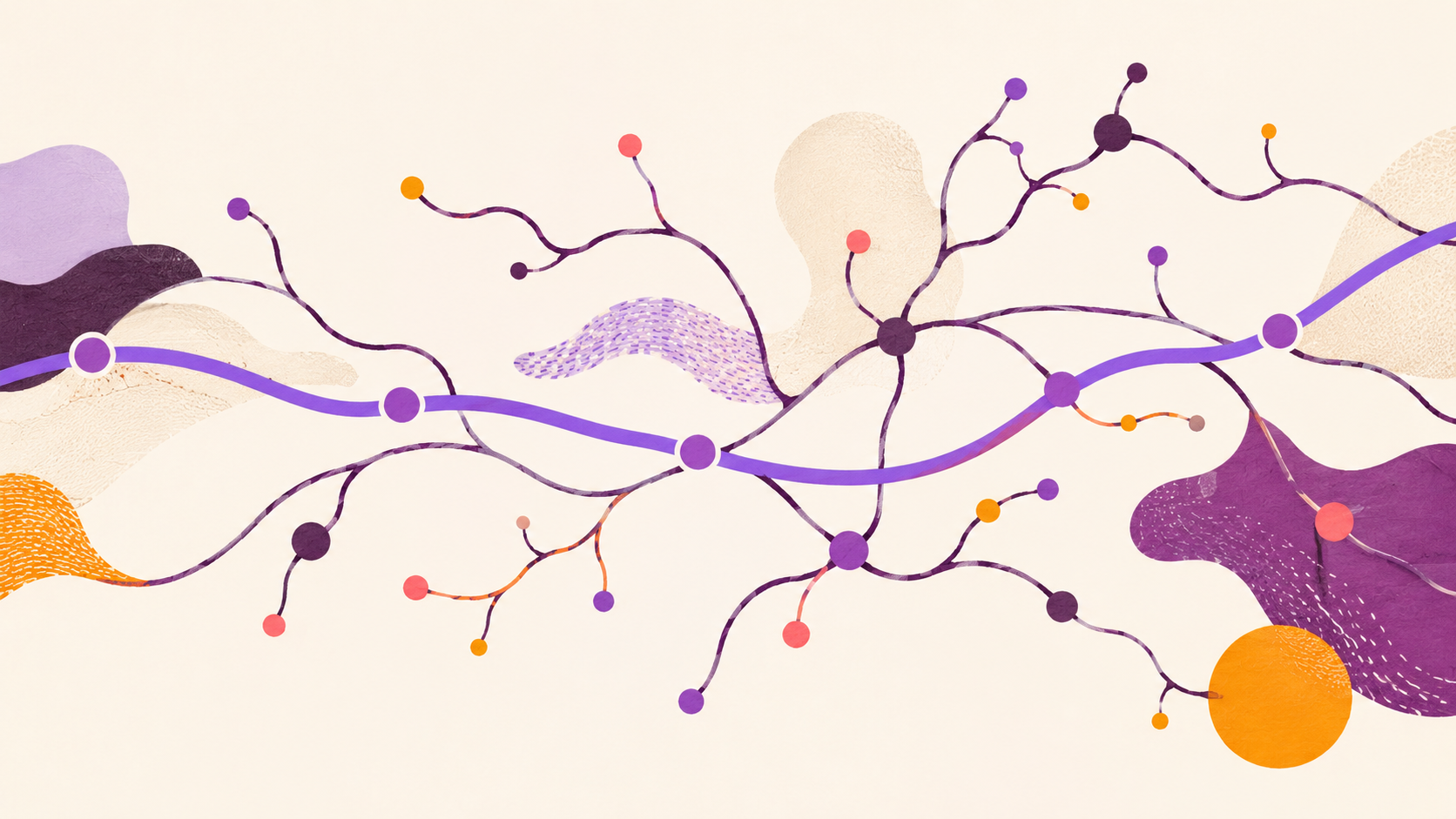
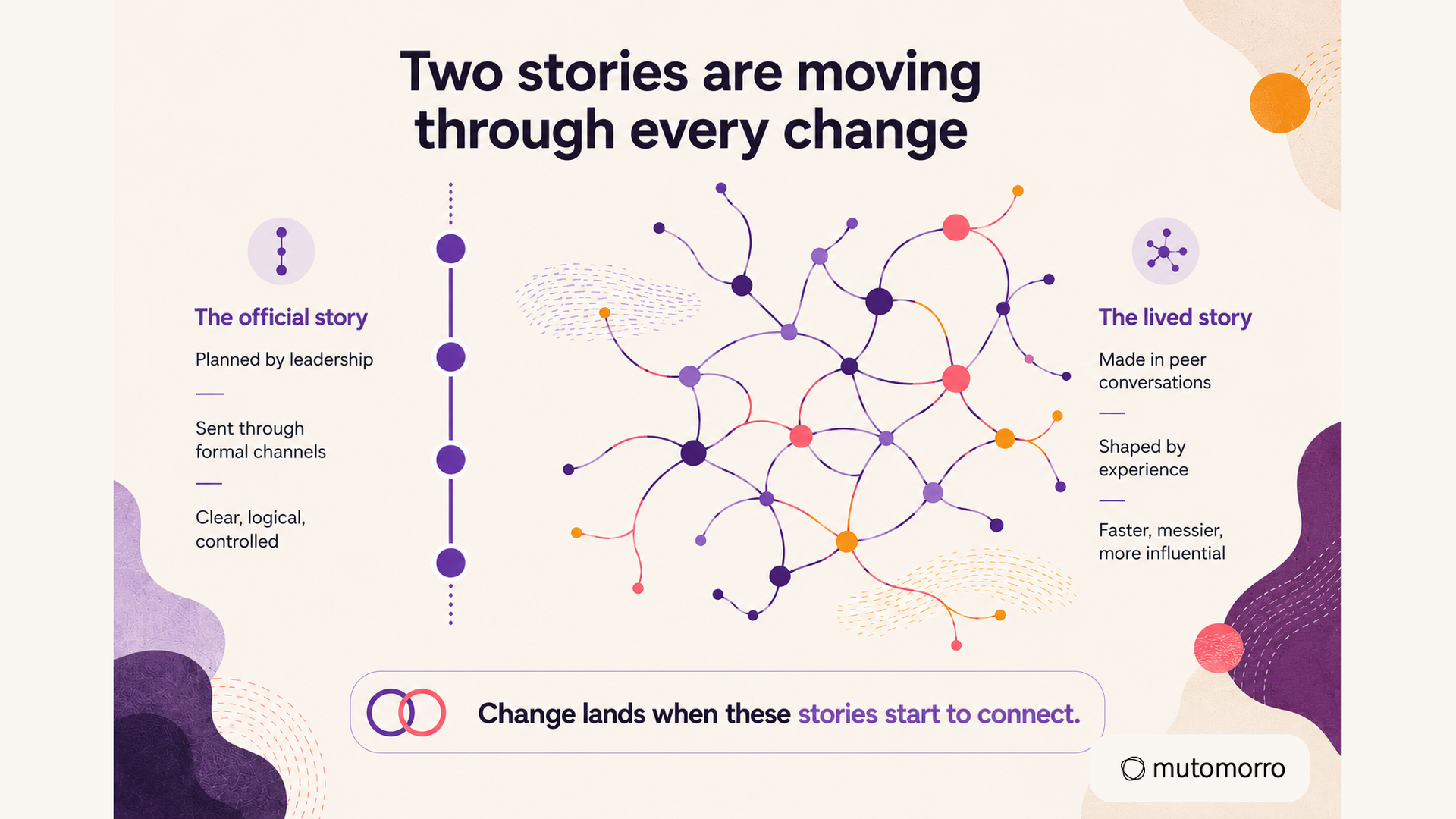
Every change programme has two narratives running at once.
There's the one leadership wrote. The strategy deck. The town hall script. The carefully sequenced emails explaining what's happening and why. This narrative is polished, logical, and usually quite compelling. It's the story the organisation is telling about itself.
Then there's the other one. The version forming in kitchens and corridors and quiet conversations after meetings. The version that starts with "Have you heard..." and "What do you think this actually means?" and "I spoke to someone in the other team and apparently..." This narrative is messier, faster-moving, and almost always more influential than the one it's running alongside.
Most change management thinking focuses entirely on the first narrative. Better communications plans. Clearer messaging. More frequent updates. More channels. And these things aren't unimportant. But they miss something fundamental about how people actually make sense of change - and why the gap between the official story and the lived story is often where change programmes quietly stall.
What's really happening when people "aren't getting the message"
There's a familiar frustration in change work. Leaders have communicated the change clearly - multiple times, through multiple channels. And yet people across the organisation seem confused, sceptical, or disconnected from the direction. The instinct is to communicate more. Send another update. Run another Q&A session. Create an FAQ.
But the issue usually isn't a lack of information. It's a lack of meaning.
Information is what gets broadcast. Meaning is what gets made. And meaning doesn't get made in town halls or intranet posts. It gets made in the informal conversations where people try to work out what a change actually means for them - for their team, their role, their daily work, their future.
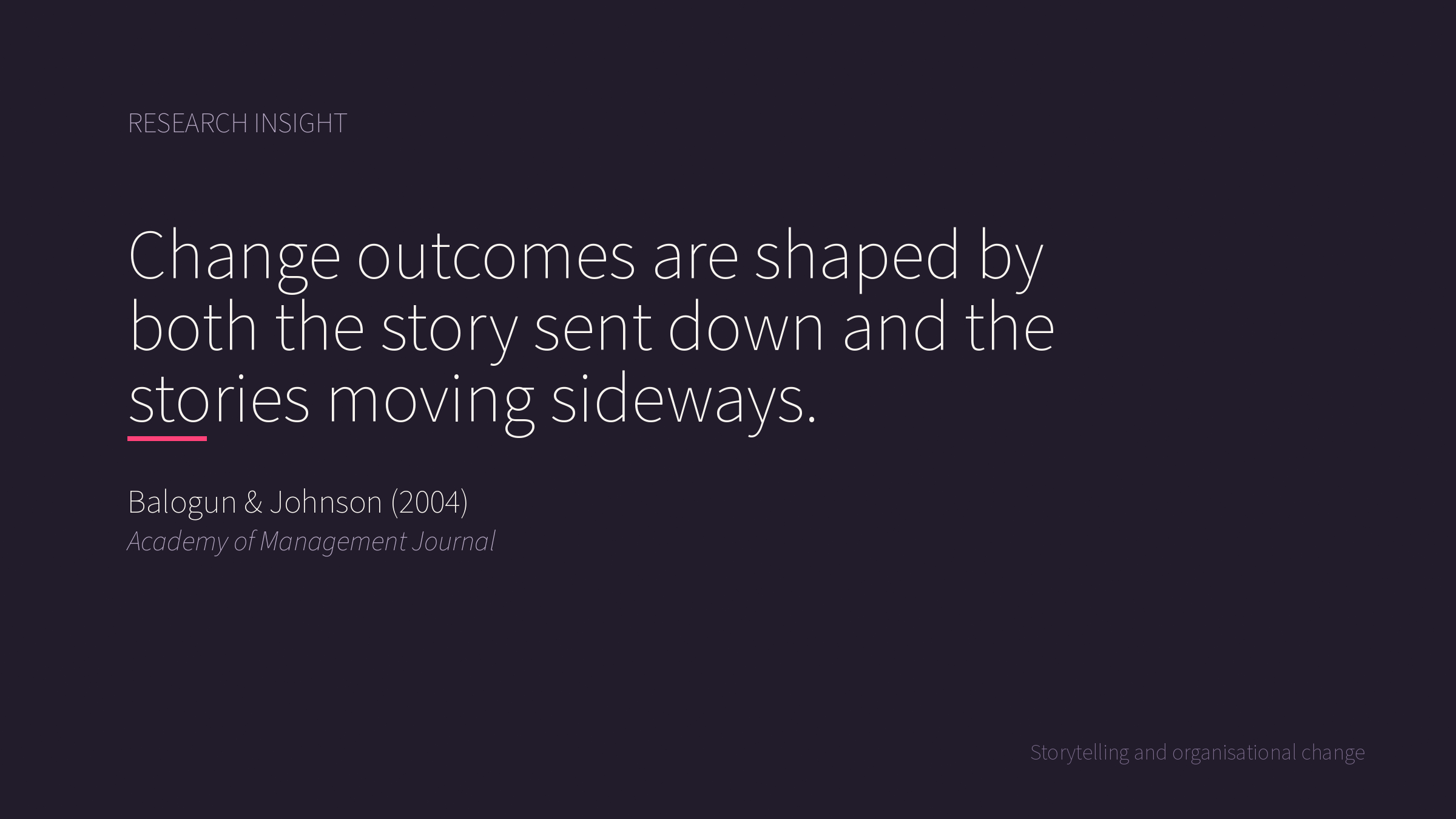
Julia Balogun and Gerry Johnson's research at the Academy of Management tracked this process in detail during organisational restructuring. They found that middle managers' informal, lateral conversations with each other shaped change outcomes just as much as the formal, top-down communication from senior leaders. The resulting change, they concluded, was always a mix of intended outcomes from vertical interactions and emergent outcomes from lateral ones. In other words: the stories travelling sideways through your organisation are as powerful as the ones travelling downward.
This isn't a failure of communication. It's a feature of how human beings process change. People don't absorb a new direction by receiving information - they absorb it by constructing a story that connects what they knew before to what they're hearing now. When the official narrative doesn't give them enough material to build that story, they build it anyway - from fragments, rumours, and the behaviour they observe in the leaders around them.
The gap between the written story and the lived one
Here's where things get interesting. The stories circulating through an organisation during change aren't random noise. They're signal. They reveal, with remarkable honesty, what the environment actually feels like from the inside.
When the official story says "this merger is about creating something stronger together" but people's experience is redundancy consultations and territory disputes, the lived story reflects the experience, not the intention. When the narrative says "we're investing in our people" but the training budget was the first thing cut, people notice. They don't need to articulate the contradiction formally - it shows up in the stories they tell.
The gap between the official narrative and the lived narrative is one of the most useful pieces of information available to leaders during change. It tells you where trust is under pressure, where the logic of the change hasn't connected to people's reality, and where something in the conditions of the organisation is creating a different experience from the one you intended.
A housing association going through a merger might communicate a story of "bringing two organisations together to strengthen services for residents." But if the lived experience on the ground is duplicated roles, confusion about reporting lines, and two teams doing the same work with different processes, the story that travels is about uncertainty and competition - not about strengthened services. The official narrative isn't wrong, exactly. But it describes an aspiration while people are living through a messy transition. That distance between aspiration and experience is where cynicism takes root.
And yet this gap is almost never treated as data. It's treated as a communications problem to solve - a sign that the message needs refining, or that resistant individuals need bringing on board. Rarely is it understood as feedback about the environment the change is entering.
This is a missed opportunity. The stories circulating through an organisation during change are a form of distributed intelligence. They aggregate thousands of individual observations about what's working and what isn't. They carry emotional data that no engagement survey can capture. And they move at the speed of conversation, not the speed of the quarterly update cycle.
Why "better comms" doesn't fix a narrative problem
There's a meaningful difference between communication and narrative, and the distinction matters for anyone leading a change initiative.
Communication is about information transfer. Did the message reach the right people? Was it clear? Was it timely? These are channel questions - they concern the plumbing. And the plumbing matters. But narrative is about shared meaning. Can people across the organisation tell a coherent story about where things are heading and why? Do those stories connect to each other? When someone in one team explains the change to a new joiner, does it sound recognisably similar to what someone in another team would say?
When these stories don't connect - when each part of the organisation is working from a different version of what's happening - that fragmentation shows up in everything. Priorities conflict. Teams duplicate effort or work at cross-purposes. People protect their corner because they're not confident that the bigger picture holds together.
Research by Young Kim and Nur Uysal, published in 2025, found that transparent communication doesn't just transfer information - it cultivates a sense of community. It's the sense of community, not the information itself, that mediates positive employee outcomes like voice, loyalty, and engagement. In other words, what makes communication work during change isn't its clarity but its capacity to help people feel like they belong to the same story.
This shifts the question from "how do we communicate the change more effectively?" to something deeper: "what conditions would allow a shared narrative to form?"
What healthy narrative looks like during change
Organisations where change lands well tend to share certain characteristics in how stories move. None of these are about having a better comms team. They're about the environment - the conditions that either support shared meaning or fragment it.
People understand reasoning, not just decisions. When a decision is communicated as a conclusion - "we're restructuring into three divisions" - people receive the outcome but not the thinking that led to it. Without the reasoning, they can't construct a story that makes sense to them. They can only accept or resist a decision they don't fully understand.
In organisations where narrative flows well, people can explain why something is happening, not just what. The reasoning is available. This doesn't mean endless consultation - it means trusting people with the logic behind the direction, even when that logic involves trade-offs and uncertainty.
There's coherence across different parts of the organisation. If you ask three people in different teams what the change is about and get three substantially different answers, the narrative has fragmented. This isn't a comms failure - it's a sign that the conditions for collective sensemaking aren't in place. Perhaps teams are too siloed. Perhaps middle managers were given the conclusion but not the context they need to translate it for their teams. Perhaps the change affects different parts of the organisation so differently that a single narrative can't hold it all.
The work here isn't about scripting a consistent message. It's about ensuring the conditions exist for coherent meaning to form - which usually means making the reasoning available, creating spaces where people across boundaries can compare their understanding, and accepting that coherence doesn't mean uniformity. People in different roles will emphasise different aspects of the same change. That's healthy. What matters is whether those different emphases still add up to a recognisable whole.
People can raise what they're seeing and be heard. Narrative isn't one-directional. In healthy organisations, stories don't just flow from leadership outward - they also flow from the edges inward. People who work closest to services, customers, and operations often see the effects of change first. When their observations can travel back up, the organisation's understanding of its own change deepens. When those observations hit a wall - when people learn that raising concerns leads nowhere, or worse, leads to being labelled as resistant - the official narrative and the lived experience continue to diverge. And the stories people tell each other about that experience become part of the narrative too.
What the organisation says about itself matches what it's like to work there. This is the authenticity test. Every organisation has a version of its own story - its values, its purpose, its culture. During change, this story gets pressure-tested. If the change is consistent with the story, it strengthens. If it contradicts the story, people notice - and the narrative that circulates will be about the contradiction, not the change.
The stories are already there
If you're leading an organisational change and wondering how the narrative is landing, the simplest thing you can do is listen. Not through a survey. Not through a formal feedback mechanism. Just listen to the stories people are actually telling.
What version of the change do people describe to each other? What aspects of the change are absent from their telling? What emotions sit beneath the surface of how they talk about what's happening? Is the tone curious, resigned, cynical, hopeful, confused?
These stories are a living map of how the change is being experienced. They don't replace the formal tools of change management - the readiness assessments, the stakeholder analysis, the case for change. But they add a dimension that those tools often miss: the felt experience of being inside a change you didn't design.
Storytelling in the context of organisational change isn't a leadership technique to master. It's not about crafting a more compelling narrative or using storytelling frameworks to package the message more persuasively. It's about recognising that stories are already flowing through your organisation all the time - and during change, they carry the meaning that determines whether the change lands.
The organisations that handle change well aren't the ones with the best communications plans. They're the ones where the conditions allow meaning to form - where reasoning is shared, where stories connect across boundaries, where people can speak honestly about what they're seeing, and where the gap between what's said and what's experienced is treated as information rather than inconvenience.
The most important story in your organisation during change is the one you didn't write. Learning to listen to it is one of the most useful capabilities a leader can develop.
Let's talk about what you're working on
Whether you're navigating a merger, rethinking how you're structured, or trying to shift a culture that isn't working - start with a conversation.