Narrative Connections
How information, knowledge, and stories flow through the organisation.
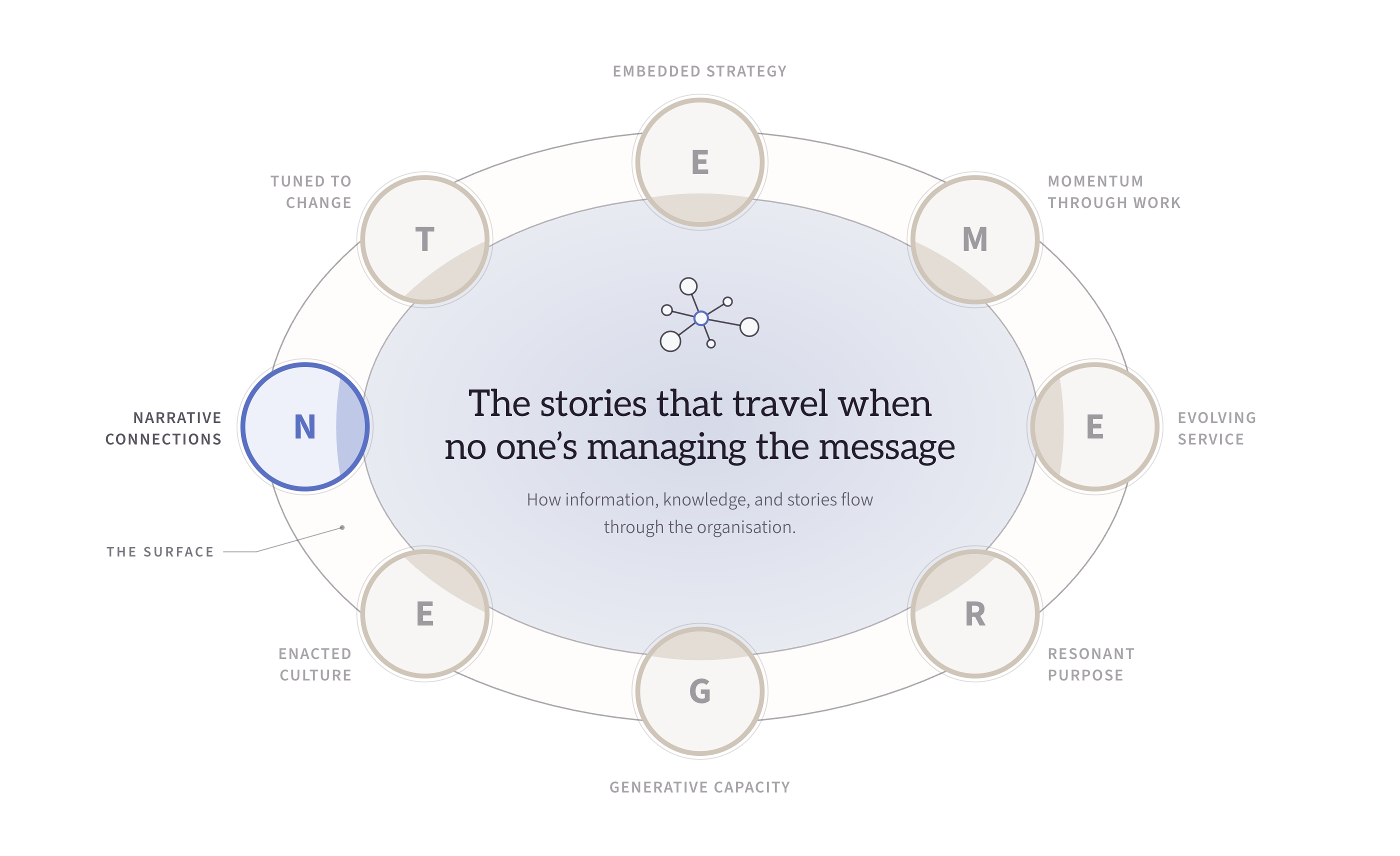
Listen in on the stories your organisation tells itself - in meetings, in corridors, over coffee. What is it thinking about?
What it is
If you wanted to understand how someone thinks, you'd listen to what they talk about. Organisations are the same. Every day, thousands of stories move through yours - in meetings, on calls, in the corridor: what happened to the last project, why that person left, what the leadership team is really like, what that decision actually meant. Those stories aren't chatter around the real work. They're the organisation thinking - making sense of events, deciding what matters, working out what's true. And they form a web: who tells stories to whom, and what those stories carry. That web is what this lens looks at. It's one of the most powerful things an organisation has, and one of the least visible: it holds people together in shared understanding, carries meaning faster than any official channel, and shapes how every message that follows will be read.
Why it matters
Organisations run on shared understanding, and the evidence on whether it actually arrives is not encouraging. Consider the shortest journey that understanding has to make: from a manager to the person sitting in front of them. In the CIPD's Good Work Index 2025, a survey of just over 5,000 UK employees weighted to be representative of the national workforce, 49% said their manager was good at keeping them informed of management discussions or decisions. Asked about the other direction - whether their manager was good at seeking the views of employees - 51% said yes. Those are people rating a single relationship, at the closest range an organisation has, and about half of them say it works. That first figure had risen from 45% in 2023 - this is the better picture, not the worse one.
Everything this lens looks at is a longer journey than that: sideways between teams, out to the edges and back, through people who appear on no distribution list. That web is rarely measured, because nothing routinely records it. When Microsoft moved its whole US workforce to remote working in 2020, researchers tracking 61,182 employees reported in Nature Human Behaviour that the collaboration network had become more siloed, with fewer ties bridging separate parts of the company, and the share of time people spent with the contacts who bridge those parts fell by the equivalent of 41% of its pre-shift level. That was one American technology firm, and the change was to how people worked rather than to who reported to whom; it counted contact, not what the contact carried. What it shows is an informal network thinning within months, as a by-product of a decision about something else.
Shared stories do more than keep people informed. The web of narratives they form is part of what holds an organisation together - a common sense of who we are and what we're doing that no structure alone can supply. When it's strong, people in different teams read events the same way, trust travels ahead of the message, and the organisation makes sense of things collectively rather than in fragments. It's also the fastest, most honest sensing channel an organisation has: the reality on the ground - what's actually happening with customers, with workloads, with morale - moves through stories long before it appears in any report. An organisation whose narrative connections are healthy hears its own truth quickly.
And here's what makes this dimension easy to underestimate: the web is invisible. It doesn't appear on the org chart, so nothing accounts for it when the org chart changes. A restructure redraws the reporting lines and quietly severs the storylines - the relationships through which people made sense of things together. Teams are moved, trusted narrators scattered, and months later the organisation wonders why understanding stopped travelling and rumour started filling the gaps. Nobody demolished the web on purpose. Nobody realised it was there.
What it can tell you
Looked at through this lens, four things come into view.
Whether meaning arrives - not just messages. Most organisations communicate constantly: newsletters, updates, dashboards, town halls. The revealing gap is between what leadership believes has been communicated and what people report having understood. An organisation can be drowning in information and starving for meaning - more channels carrying less shared understanding of what any of it means.
Where the web has dead zones. Stories don't travel evenly. They stop at boundaries - between levels, between departments, between the centre and the edges - and those dead zones map exactly where connection is weakest. Notice too who the informal narrative bridges are: the people who carry context between parts of the organisation that wouldn't otherwise connect. They're load-bearing, and mostly invisible - until a restructure moves them and understanding stops flowing somewhere, without anyone able to say why.
Which story people act on. When the official message and the corridor conversation tell different stories, one of them wins. If the informal story consistently wins, that's not cynicism - it's a signal that the informal channels carry more credibility, and that's worth understanding rather than fighting.
What the stories are carrying. When something goes wrong, does the account travel accurately - or distort as it moves, becoming rumour, blame or mythology? When successes are shared, do the stories carry an understanding of why something worked, or just that it worked? The web can carry ground truth faster than any report - or carry noise. What it's carrying now tells you what it will carry in a crisis.
How to observe it
Narrative connections are visible in how understanding moves - or fails to move - across the organisation. These prompts help you see where meaning flows, where it pools, and where it gets lost entirely.
Listen for
- When a significant decision is made, do people across the organisation understand the reasoning - or just the outcome? "We're restructuring" without the why creates anxiety. The why creates understanding.
- When something goes wrong, does the story travel accurately - or does it distort as it moves through the system, becoming rumour, blame, or mythology?
- Do people reference what's happening beyond their immediate team with understanding - or with indifference?
- When successes are shared, do the stories carry an understanding of why something worked - or just that it worked?
Watch for
- When one team makes a decision that affects another, was the affected team already aware of the context - or blindsided?
- Do lessons from one team's experience reach others who could benefit - or does each part of the organisation learn the same things independently, again and again?
- Are there people who act as informal narrative bridges - carrying context between parts of the organisation that wouldn't otherwise connect? What happens when those people move or leave?
- When the official message and the corridor conversation tell different stories, which one do people act on?
Measure
- What's the gap between what leadership believes has been communicated and what people report having understood? That gap is a direct measure of narrative connection.
- How many layers does information pass through before reaching the people who need it - and what's lost at each layer?
- Do people regularly discover information they should have had earlier? That's the system telling you the connections aren't there.
Notice
- Where are the narrative dead zones - the places where stories stop travelling? Between levels? Between departments? Between the centre and the edges? Those boundaries tell you where connection is weakest.
- Does the organisation have a healthy relationship with its own history - learning from it without being trapped by it? Or is the past either forgotten or weaponised?
- Is the organisation drowning in information but starving for meaning? More newsletters, more updates, more dashboards - but less shared understanding of what any of it means?
How to have meaningful conversations about it
- When something significant happens, how does your organisation make sense of it?
- When a significant decision is made, do people across the organisation understand the reasoning - or just the outcome?
- When something goes wrong, does the story travel accurately - or does it distort into rumour and blame?
What you can do about it
You don't need a programme to start. Ask four or five people from different parts of the organisation the same question: what's the story of this organisation right now - what chapter are we in? Don't guide them; let them choose their own framing. You're not looking for accuracy. You're listening for coherence - whether people are in the same story or completely different ones.
Or replace one update with a story. At your next team gathering, ask everyone to share one moment from the past month where they saw what this organisation is for - in action, not in words. No slides, no preparation. You'll hear things no report would capture. And the act of sharing them does something in itself - it connects individual experience to a collective narrative, and the work feels less isolated for it.