Tuned to Change
Whether change feels natural and supported, or disruptive and imposed.
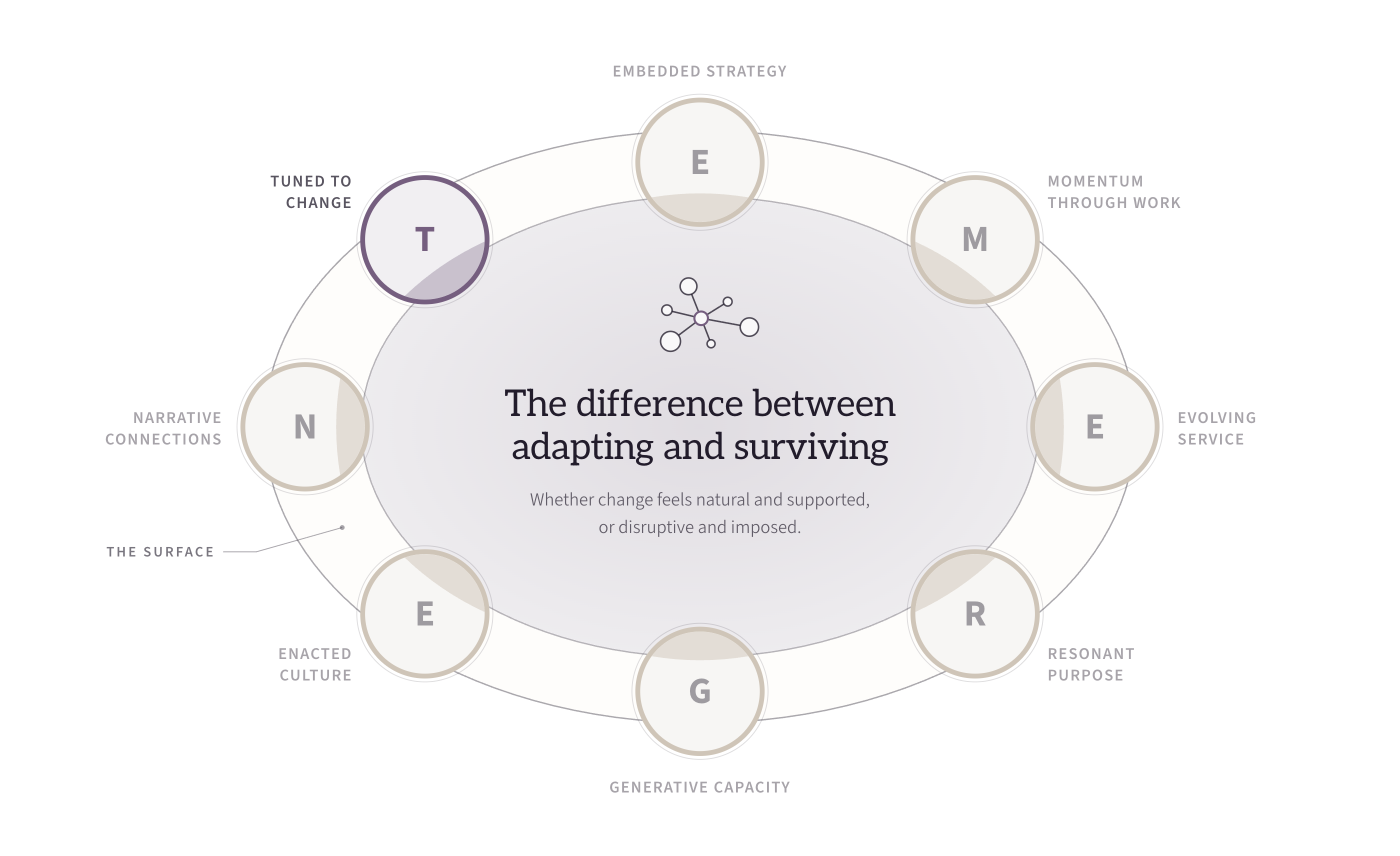
When change arrives, does it feel like a natural part of the daily rhythm - or a shock to the system?
What it is
There's a pattern in organisations that handle change well, and it isn't only better change management. It's that change doesn't register as a special category of activity - it's just how things work. Conditions shift, the organisation notices early, and adjustment happens as a natural - sometimes even welcome - part of the daily rhythm: small corrections, made close to where the change was sensed, before anything needs a name. In other organisations, every shift has to become a programme before anything can move - a plan, a steering group, a launch - and by the time the response is organised, the conditions have often shifted again. This lens looks at which of those describes yours: whether the organisation is tuned to the change around it, moving with shifting conditions - or fighting them each time they arrive.
Why it matters
Change is the medium every organisation now moves through - markets shift, technology moves, needs evolve. What we notice in the ones that move well is that adaptability sits inside how they already operate: change gets absorbed as part of the work, rather than handled as an exception to be managed.
That last distinction matters more than any framework. Most organisations don't lack change effort - if anything, they carry a great deal of it, often several initiatives at once. What varies is the relationship with change itself. In some organisations, change arrives as adjustment: sensed early, absorbed steadily, handled close to the ground. In others it arrives as event: announced, programmed, pushed through - and each one lands on people still absorbing the last.
Two of the largest workforces in the country publish how that feels from the inside. In the 2025 Civil Service People Survey, answered by 343,961 staff across 102 government organisations, 30.7% agreed that change is managed well where they work. Of every statement the survey asks people to agree or disagree with, none scored lower. The next lowest was 36.2%.
The 2025 NHS Staff Survey asks something narrower: not whether change is handled well, but whether people are involved in deciding on the changes that affect their own work area, team or department. It drew 751,088 responses from staff at NHS trusts. 48.63% agreed that they were - down for a second consecutive year, and below half for the first time in four years. Neither survey tells you whether the changes themselves worked, and neither is a picture of UK organisations generally: one is central government, the other the NHS in England. What both measure is the experience of being changed.
And there's a cost neither survey captures, one that compounds quietly. Every change an organisation goes through shapes its posture towards the next one. A change that was necessary and right, but handled in a way that left people feeling worse about change in general, doesn't just cost that moment - it erodes the system's future ability to adapt. Change capacity is real, it's finite, and it's spent or built with every change that passes through.
What it can tell you
Looked at through this lens, four things come into view.
The organisation's change posture. When a new initiative is announced, do people lean forward or lean back? Ask people what it feels like to go through change here - not what they think of the changes, but the experience of them - and listen for the emotional texture: energised, exhausted, resigned, confident. That posture has been shaped by every change that came before, and it will shape every change that comes next.
Whether change flows or lurches. Some organisations adjust organically as conditions shift; in others, nothing can move until there's a formal programme. An organisation that changes in sudden bursts is reacting; one that evolves steadily is tuned. Look at what triggered your last five significant changes - sensing and responding, or crisis - and notice whether outdated decisions get revisited when their context shifts, or persist because nobody has the appetite to reopen them.
How much change is already in the system. Change capacity is finite. Count the initiatives currently running and ask honestly whether that number is sustainable given what people are already absorbing. Completion rates tell the same story from the other end: how many changes land fully, how many partially, and how many quietly fade without anyone formally ending them.
Whether the ability itself is growing. Over the last two or three years, has the organisation's capacity to handle change grown, held steady, or quietly diminished? Is it learning how to adapt - or just surviving each wave? And notice the parts of the organisation that adapt naturally while others struggle: the conditions in those adaptive pockets are telling you what the whole system needs.
How to observe it
Being tuned to change shows up in how the organisation responds when the ground shifts. These prompts help you see whether the system adapts naturally or seizes up every time something moves.
Listen for
- When people talk about change, is the language one of possibility or one of exhaustion? And if it's exhaustion - is it from the change itself or from how change gets handled?
- When someone spots an emerging shift - in the market, in the community, in internal dynamics - do they have a way to surface it? Or does the observation die with them because there's no channel for it?
- Do people distinguish between changes that are necessary and changes that feel arbitrary? Is the organisation honest about that distinction?
- Is there confidence that leadership will be straight about what's changing and why - or do people brace for spin?
Watch for
- When circumstances change, does the organisation adjust organically - or does every shift require a formal change programme before anything can move?
- When a change doesn't land as intended, is the response to learn and adjust - or to push harder on the original plan?
- Are outdated decisions revisited when the context that produced them shifts - or do they persist because no one has the authority or appetite to reopen them?
- Is there space for experimentation - trying something small, learning, iterating? Or does every change require a full business case before anything can be tested?
Measure
- How many change initiatives are running simultaneously right now? Is that number sustainable given the organisation's actual capacity to absorb change?
- What's the completion rate of change programmes? How many land fully, how many land partially, and how many quietly fade away without anyone formally ending them?
- Is change proactive or reactive? Look at what triggered the last five significant changes. Were they driven by sensing and responding - or by crisis?
Notice
- Does change happen in traumatic lurches or in a continuous flow? An organisation that changes in sudden bursts is reacting. One that evolves steadily is tuned.
- Are there parts of the organisation that adapt naturally while others resist? What's different about the conditions in each? The adaptive pockets are telling you what the whole system needs.
- Over the last two to three years, has the organisation's ability to handle change grown, stayed the same, or quietly diminished? Is it learning how to adapt - or just surviving each wave?
How to have meaningful conversations about it
- The last time something unexpected happened, did the organisation adapt - or did it wait for someone to write a plan?
- When people talk about change, is the language one of possibility or one of exhaustion?
- Is there confidence that leadership will be straight about what’s changing and why - or do people brace for spin?
What you can do about it
You don't need a programme to start. Ask five people across different levels what it feels like to go through change here - not their view of the changes themselves, but the experience of them. The pattern in their answers will tell you more about whether the next change will succeed than any readiness assessment.
Or, before your next change - even a small one - ask the team how much change is already in the system. What's already shifting? What are people already absorbing? Is there genuine capacity for more? If the honest answer is no, the discipline to wait or sequence differently will do more for the organisation's adaptability than any framework. Building the habit of asking is the point.