Lewin's Change Model
Lewin's Change Model breaks organisational change into three stages - Unfreeze, Change, and Refreeze. Before anything can shift, the conditions holding the current state in place need to soften. Then the change happens. And then the new patterns need to solidify, or the organisation drifts back.
Get the free template
Every change initiative faces the same quiet problem: people understand why things need to be different, but the old way still has gravity. Habits, routines, assumptions, relationships - they hold the current state in place. Lewin's Change Model is one of the earliest and most enduring frameworks for thinking about how that grip loosens, how a team or organisation moves through the messy middle, and how the new way becomes the way things are done around here.
What is Lewin's Change Model?
Lewin's Change Model breaks organisational change into three stages: Unfreeze, Change, and Refreeze. The idea is straightforward. Before anything can shift, the conditions holding the current state in place need to soften. Then the change happens - new behaviours, new structures, new ways of working. And then those new patterns need to solidify into the new normal, or the organisation drifts back to where it started.
The model is named after Kurt Lewin, a social psychologist working in the 1940s whose research on group dynamics, leadership styles, and social change laid the groundwork for what we now call organisational development. Lewin is also the mind behind force field analysis - the idea that any situation is held in balance by forces pushing for change and forces resisting it. That same thinking runs through this model. Unfreezing is what happens when the driving forces start to outweigh the restraining ones.
It's worth knowing that Lewin himself didn't draw three boxes on a whiteboard. The three-stage formulation was distilled from his broader body of work after his death in 1947, largely through the writing of Edgar Schein and others who built on Lewin's field theory. What Lewin did articulate clearly was that lasting change requires disrupting the existing equilibrium, moving to a new state, and then stabilising that new state. The three-stage model is a faithful distillation of that thinking, even if the neat packaging came later.
The model's lasting value is its simplicity. It gives teams a shared language for the shape of change - where they are, what's needed next, and why the middle feels uncomfortable. In a landscape crowded with more elaborate change frameworks (Kotter's 8 steps, ADKAR, Burke-Litwin), Lewin's three stages remain the foundation that most of them build on.
How Lewin's Change Model works
The model describes three distinct phases that any successful change moves through. They're sequential - you can't skip ahead - and each one serves a different purpose.
Stage | What happens | What to do |
|---|---|---|
Unfreeze | The grip of habits and assumptions loosens; people see the current state won't hold | Make the case concrete, acknowledge what worked, build safety and alignment |
Change | Old patterns break down before new ones form; confidence often dips | Communicate consistently, support new behaviours, tolerate imperfection, stay visible |
Refreeze | New behaviours and structures settle into the new normal | Update systems, recognise progress, build habits, watch for drift |
Unfreeze

Before a team can change, they need to recognise that the current state isn't working - or won't work for much longer. Unfreezing is the process of loosening the assumptions, habits, and structures that hold things in place.
This isn't about creating panic. It's about making the case clearly enough that people understand why standing still is no longer a safe option. The most effective unfreezing happens when people can see the gap between where things are and where they need to be - and feel confident that closing that gap is possible.
In practice, unfreezing involves:
- Surfacing the case for change. What's happening in the market, the team, or the organisation that makes the current approach unsustainable? Make this concrete, not abstract.
- Acknowledging what works. People are more willing to let go of the old way when they feel it's being respected, not dismissed. Name what's been valuable before explaining why it needs to evolve.
- Creating psychological safety. Change feels risky. If people think they'll be punished for getting it wrong during the transition, they'll cling to the familiar. Make it safe to experiment.
- Building alignment. Not everyone needs to be enthusiastic, but the people who matter need to understand the direction and be willing to move.
The Bridges Transition Model is a useful companion here. Bridges focuses on what unfreezing feels like from the inside - the experience of letting go, which is often the hardest part.
Change

The middle stage is where the work happens - and where things feel most uncertain. Old patterns are breaking down, new ones haven't fully formed yet, and teams often experience a dip in confidence, clarity, or productivity before things start to improve.
This is normal. The Satir Change Model describes this same territory as "chaos" - a necessary stage where old patterns dissolve before new ones can take hold. The Change Curve maps the emotional experience people move through during this phase. Both models confirm what Lewin's implies: the middle is supposed to be uncomfortable.
During this stage, the work is about:
- Communicating consistently. Not a single announcement, but an ongoing conversation. People need to hear the direction repeatedly, in different ways, and have space to ask questions.
- Supporting new behaviours. Training, coaching, adjusted processes, updated tools - whatever people need to do the new thing competently, not just willingly.
- Tolerating imperfection. The first version of the new way won't be as smooth as the old way. That's not evidence the change was wrong. Give people room to get better at it.
- Staying visible. Leaders who announce a change and then disappear send a signal that the change isn't a priority. Presence matters.
This is the stage where most change efforts stall. Not because the destination was wrong, but because the support during the transition wasn't sustained. Teams need to know that the discomfort is temporary and that leadership is still committed.
Refreeze

Once the new behaviours, structures, and ways of working are in place, the final stage is about making them stick. Refreezing is the process of embedding change into the organisation's routines, culture, and systems so it becomes the new default rather than a temporary experiment.
Without this stage, changes drift. The old way has years of muscle memory behind it. Unless the new way gets built into how things work - policies, processes, recognition, rituals - people gradually revert.
Refreezing involves:
- Updating systems and processes. If the change requires people to work differently but the performance management system still rewards the old behaviour, the system wins every time.
- Recognising progress. Not a one-off celebration, but ongoing acknowledgement that the new way is working and valued.
- Building the new habits. Repetition, reinforcement, and removing the scaffolding gradually as the new patterns become natural.
- Monitoring for drift. Check in after three months, six months, a year. Are people still doing the new thing, or quietly sliding back? Early correction is easier than a full restart.
The metaphor behind the name is worth taking seriously. Refreezing doesn't mean rigidity - it means stability. The new shape holds, but the organisation hasn't lost the ability to unfreeze again when the next change comes. Healthy organisations treat refreezing as "solid enough to build on" rather than "permanent."
How to use Lewin's Change Model
Lewin's works best as a diagnostic lens rather than a project plan. At any point in a change management initiative, ask: which stage are we in, and are we doing what that stage requires?
Map before you move. Before launching into action, assess where the organisation is. If people don't understand why the change is needed (still frozen), jumping to implementation won't work. If the new way is in place but not yet embedded (change done, refreezing not started), the risk is regression.
Match your effort to the stage. Unfreezing needs communication and alignment work. The change stage needs capability building and support. Refreezing needs system updates and reinforcement. Teams often over-invest in the change stage and under-invest in unfreezing and refreezing - the bookends that determine whether the middle work lasts.
Use it alongside more detailed frameworks. Lewin's tells you the shape of the journey. Kotter's 8 steps fills in the detail of what to do at each point. ADKAR focuses on the individual experience of change. These aren't competing models - they nest inside each other. Lewin's is the map, the others are the route guides.
Watch for false stability. Sometimes a team appears to have refrozen, but the new behaviours are being held in place by sheer effort rather than genuine adoption. If removing the supporting structures (the extra meetings, the visible leadership attention) causes an immediate slide, the refreezing hasn't taken hold yet.
Name the stage out loud. One of the most useful things about Lewin's model is that it gives teams a shared vocabulary. "We're still unfreezing" is a more useful statement than "people are resisting change." It locates the problem in the process, not in the people.
Example
A technology team is moving from waterfall project management to agile ways of working. The leadership team has decided this is the direction, but the first few sprints are chaotic - deadlines slip, people feel uncertain about their roles, and there's a growing undercurrent of "this doesn't work."
Using Lewin's model, the team lead recognises they jumped straight to the Change stage without properly unfreezing. People understood that agile was happening, but they hadn't been given time to understand why the old approach was no longer working, what the new way would look like in practice, or how their roles would evolve. The resistance isn't about agile - it's about moving before the ground was ready.
The team lead steps back: runs a session on what's driving the shift, acknowledges what worked well under waterfall, and pairs experienced agile practitioners with team members who are struggling. The transition still isn't smooth - Lewin's model doesn't promise smooth - but the team now has a shared understanding of where they are in the process and what needs to happen next.
Limitations
It's deliberately simple. Three stages can't capture the full complexity of organisational change. For large-scale or multi-year transformations, you'll need more granular frameworks to plan the work. Lewin's is the orientation compass, not the detailed map.
Change is rarely this linear. Real organisations unfreeze and refreeze multiple things at different speeds. A team might be refreezing one process while still unfreezing attitudes. The three-stage sequence is a useful simplification, not a literal description of how change unfolds.
The "refreeze" metaphor has attracted criticism. Some argue that in fast-moving environments, organisations should stay permanently fluid rather than refreezing. This misreads the metaphor. Refreezing doesn't mean becoming rigid - it means making the new way sustainable enough to build on. Even organisations that value agility need stable foundations.
It focuses on the organisation, not the individual. Lewin's model describes what's happening at a system level. For the individual experience of change - the emotional journey each person goes through - the Change Curve or Bridges Transition Model are more useful.
Getting started
Start with the question that unlocks everything: where are we right now? Pick one change your team is navigating - it doesn't have to be a major transformation - and place it in the model. Are you still unfreezing (people aren't yet aligned on why this needs to happen)? In the messy middle (the new way is being tried but hasn't landed yet)? Or trying to make something stick (the change has happened but keeps slipping)?
Once you've located where you are, check whether your effort matches the stage. Most teams find they're doing change-stage work (training, new processes, new tools) when they haven't finished the unfreezing work (building understanding and alignment). That single diagnosis often explains why things feel harder than they should.
Organisations that understand their own readiness for change - and build that understanding into how they work - tend to navigate transitions with less disruption and more lasting results. The Tuned to Change dimension of the EMERGENT framework explores what this looks like as a sustained organisational capability.
We share thinking on organisational change and development on LinkedIn - practical ideas for people doing this work inside their own organisations.
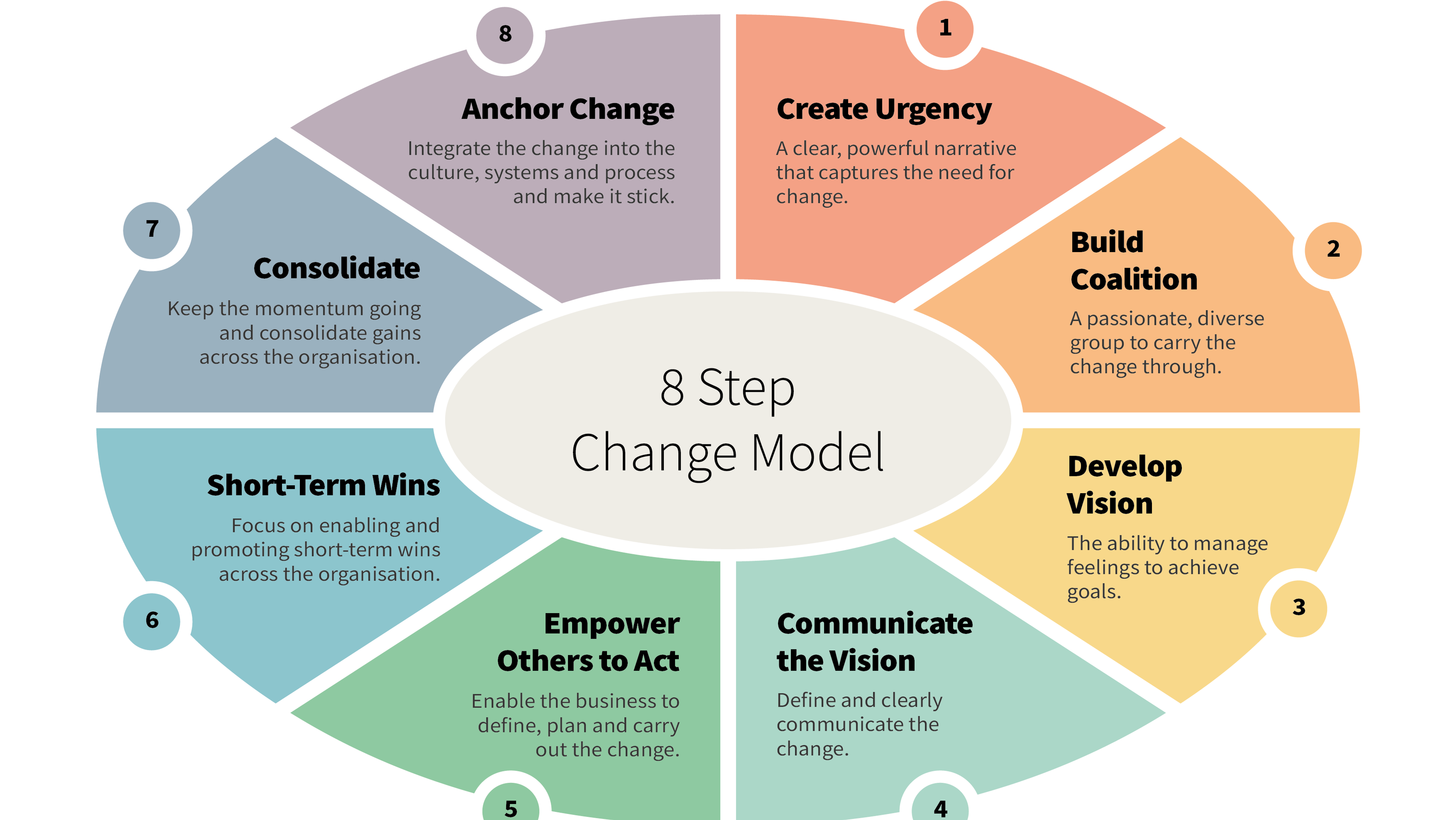
Kotter's 8 Step Change Model is a structured framework for leading organisational change, from building urgency through to embedding new ways of working. It gives leaders a clear sequence to follow when the change is big and the stakes are high.
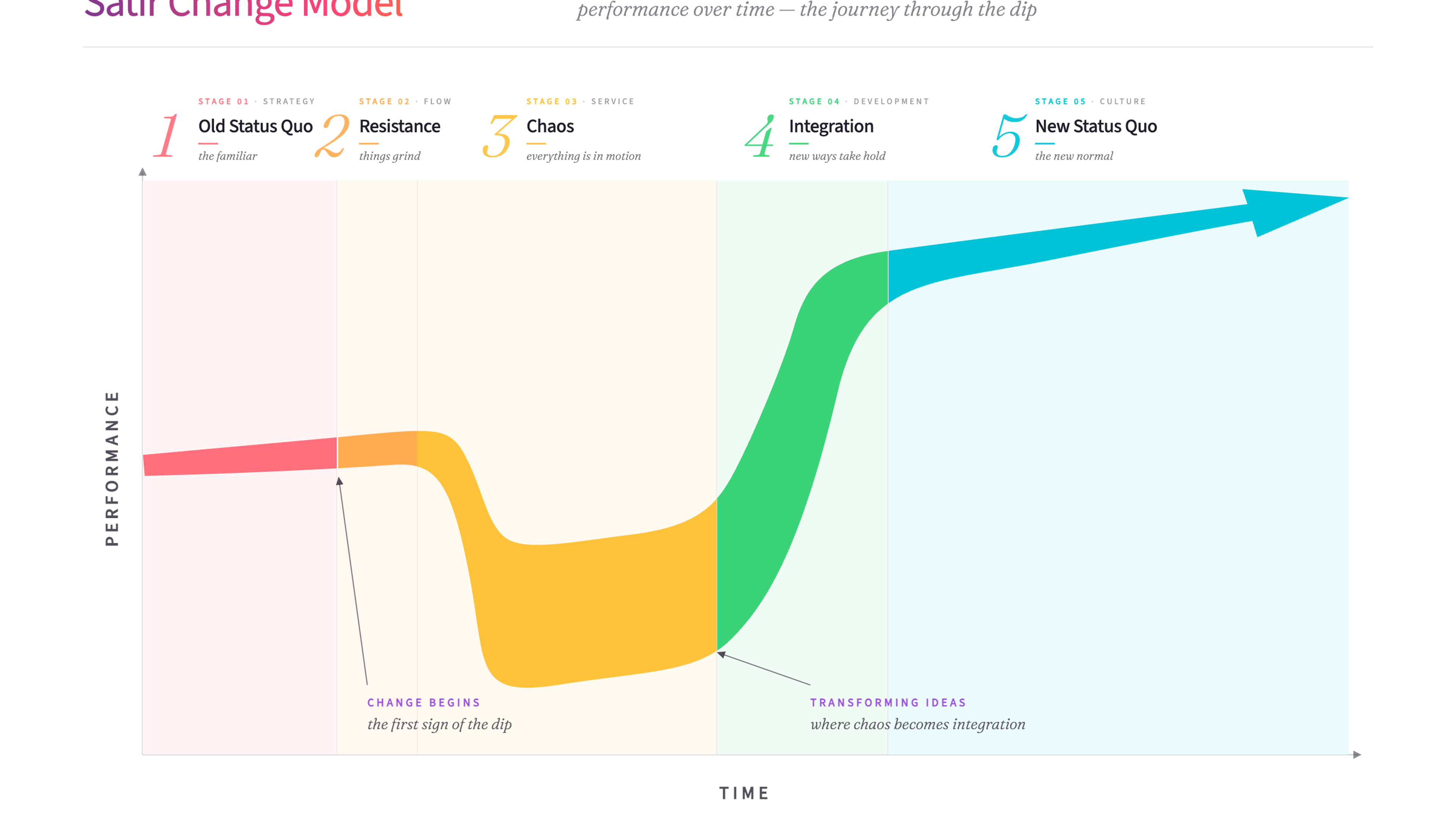
The Satir Change Model maps the emotional journey teams move through during change - from familiar stability through resistance and chaos to integration and a new way of working.
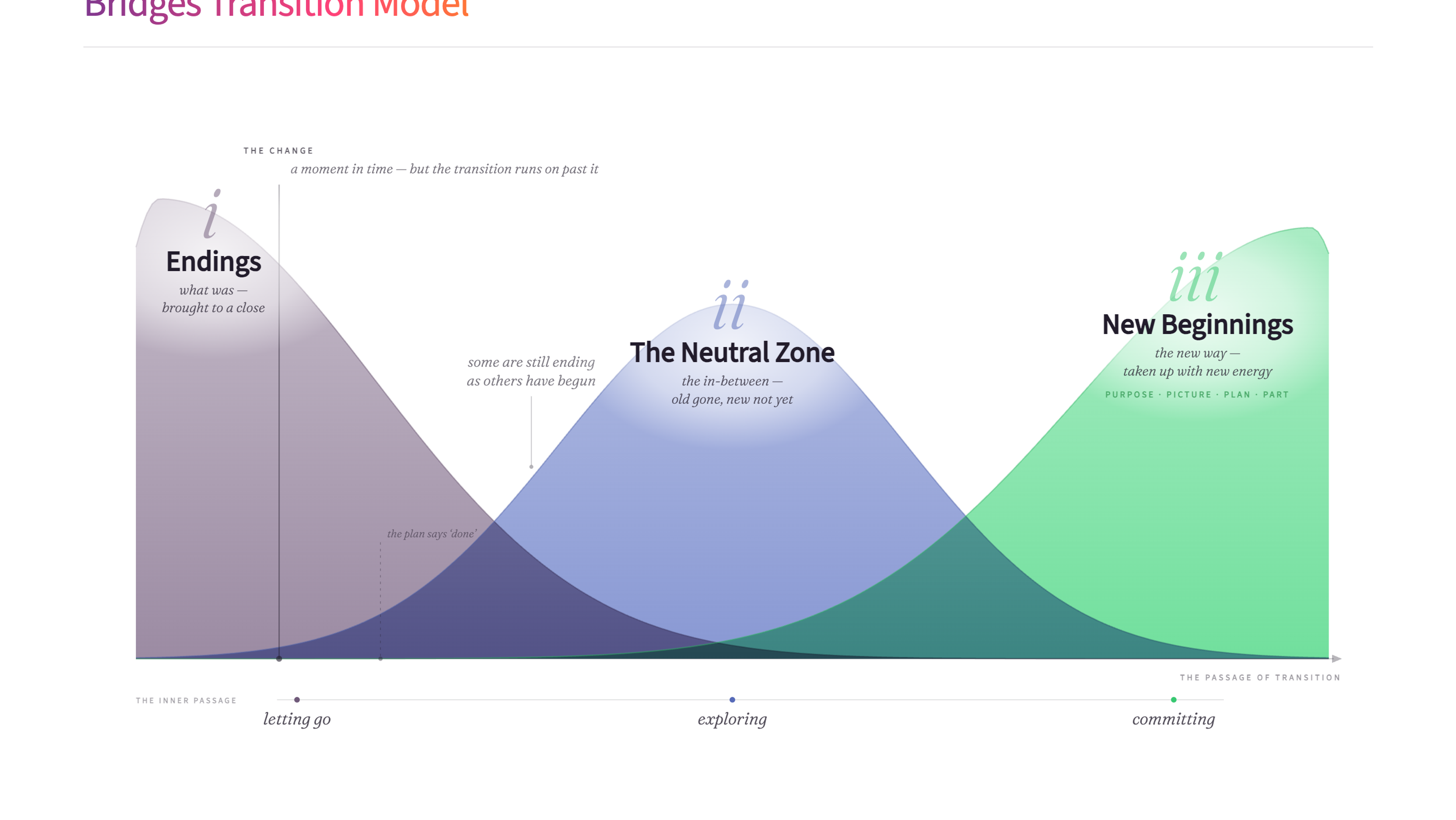
The Bridges Transition Model focuses on the human side of change - the psychological transition people go through rather than the external change itself. It maps three phases: Endings, the Neutral Zone, and New Beginnings.
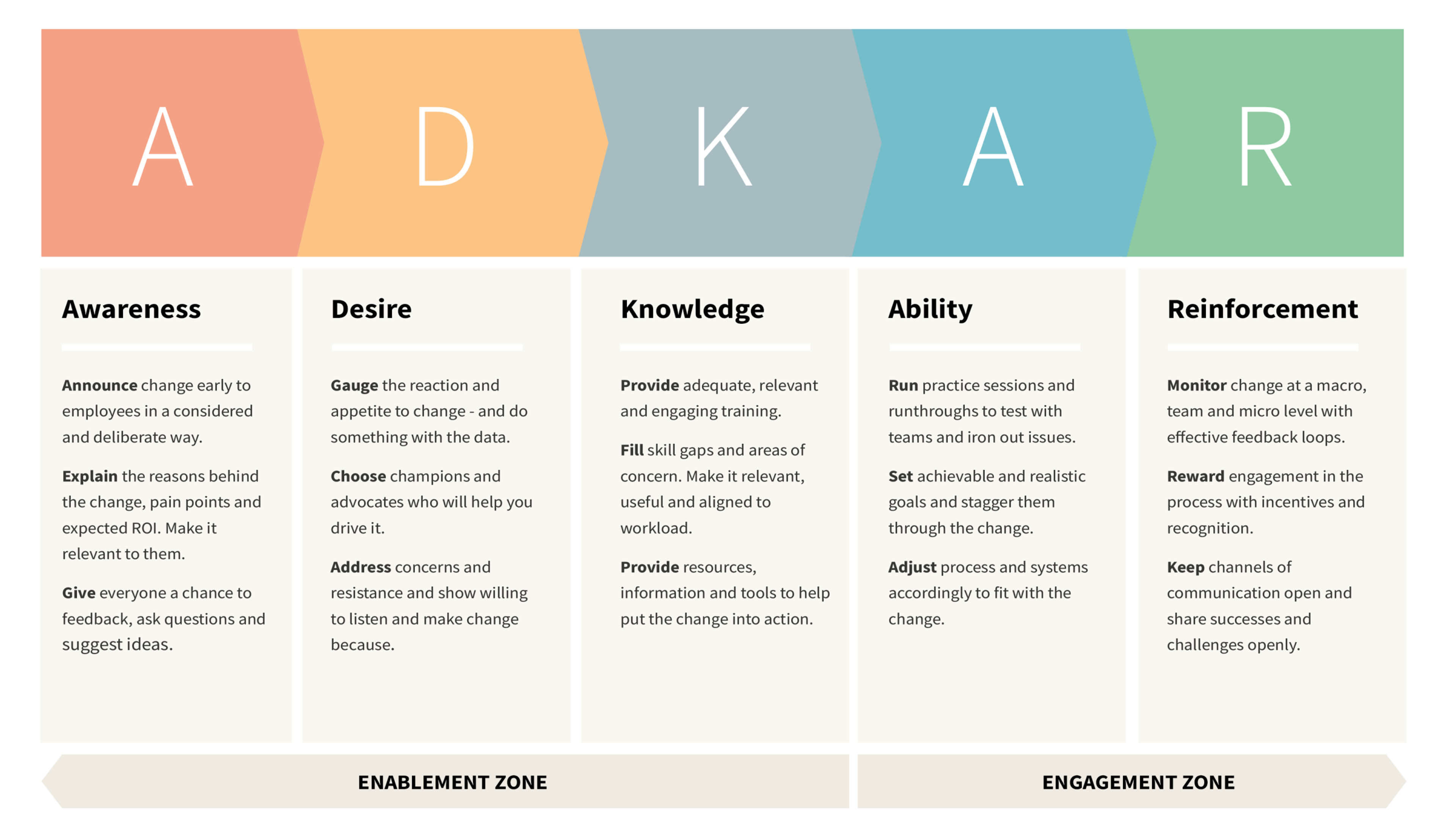
The ADKAR model is a five-stage framework for managing change at an individual level - Awareness, Desire, Knowledge, Ability, and Reinforcement. It helps organisations understand what people need at each point in a change process and where things are getting stuck.
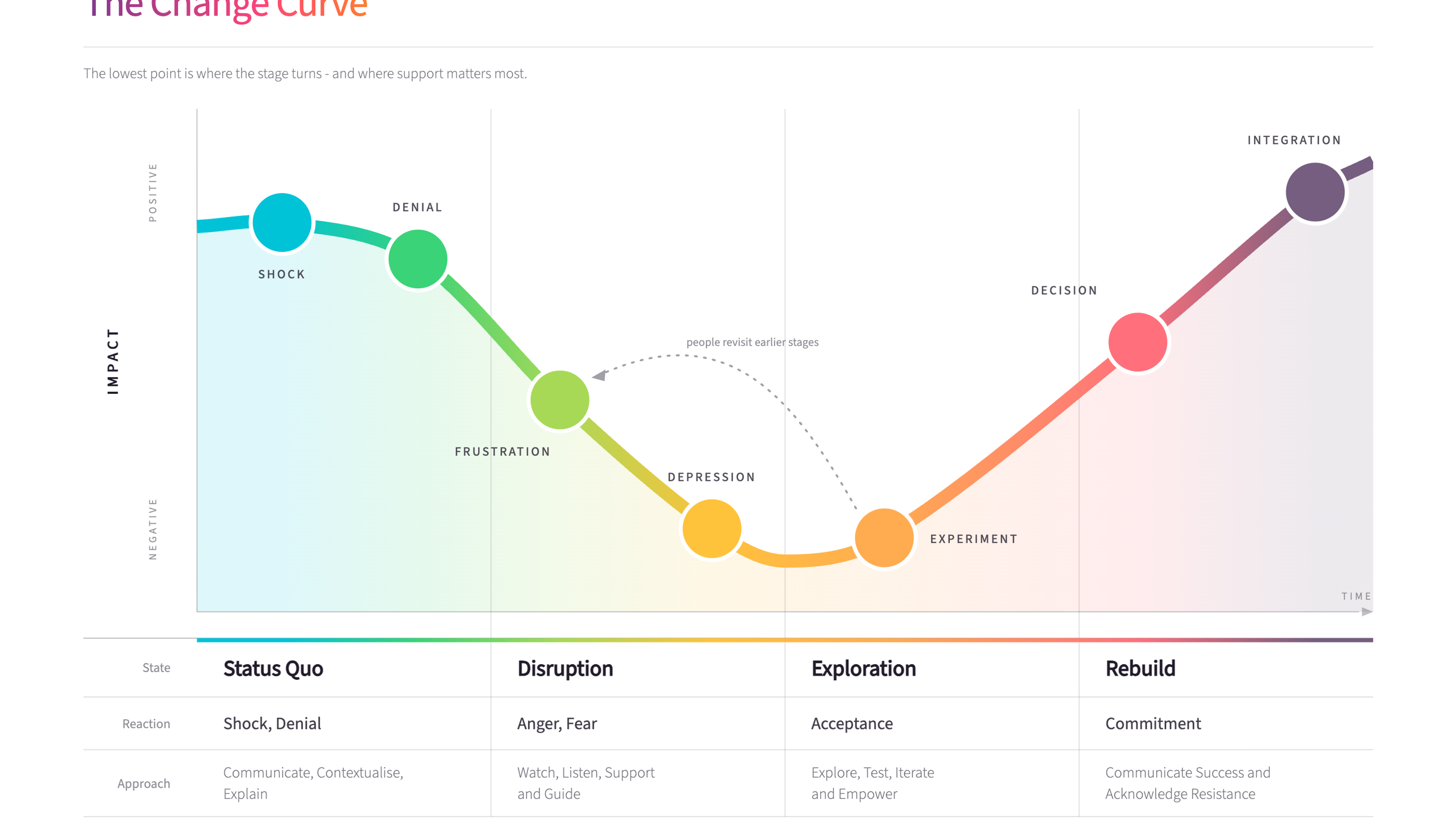
The Change Curve maps the emotional stages people move through during organisational change, from shock and denial through to acceptance and commitment. It helps leaders understand where people are in the process and what support they need.
Change management and change leadership are often used interchangeably, but they're fundamentally different. This article explains what each involves, why the distinction matters, and how to develop both capabilities in your organisation.
Change fatigue in the workplace is growing fast. This article explores what's really driving it - not just the volume of change, but how organisations approach it - and what leaders can do to rebuild capacity without slowing down.
Change Management Training
Lewin's model is a good starting point, and one of several we draw on in our Change Management training - put to work on real change.
James Freeman-Gray is the founder of Mutomorro. He's an organisational development practitioner who has spent over twenty years working with leaders across public, private and nonprofit sectors - helping organisations pull together around a common purpose, joined up in how they work. More about who we are and what it's like to work with us.
Lewin's model is deceptively simple, but I keep coming back to it because the "unfreeze" stage is where organisations often rush. They announce the change and expect people to move. The real work is helping people let go of how things are now before they can genuinely engage with how things could be.
Last reviewed: June 2026
Ready to use Lewin's Change Model?
Download the free template - includes practical guidance for workshops and team sessions.
Get the free template
Want to put these ideas into practice?
Whether you're navigating a merger, rethinking how you're structured, or trying to shift a culture that isn't working - underneath, it's the same job: getting the whole organisation pulling in the same direction. Start with a conversation.