Satir Change Model
The Satir Change Model maps the emotional journey teams move through during change - from familiar stability through resistance and chaos to integration and a new way of working.
Get the free template
When a team hits a significant change - a restructure, a new system, a shift in leadership - performance often dips before it rises. Sometimes the dip is visible: things slow down, mistakes increase, confidence drops. Sometimes it's hidden: the team maintains output but at a cost - longer hours, higher stress, unsustainable effort. Either way, the disruption is real. The Satir Change Model explains why. Developed by family therapist Virginia Satir, it maps the predictable emotional and behavioural journey that groups of people move through during change, and it makes a case that most leaders find both uncomfortable and relieving: the disruption is part of the process, not a sign that something has gone wrong.
What is the Satir Change Model?
Virginia Satir spent decades working with families in crisis. What she observed was a consistent pattern: when a system of people is disrupted by something new - a "foreign element" in her language - the group doesn't smoothly transition from one state to another. Instead, it passes through a predictable sequence of stages, including a period of genuine chaos where performance, confidence and clarity all drop.
Satir's model identifies five stages: Old Status Quo, Resistance, Chaos, Integration, and New Status Quo. Plotted on a graph of performance over time, they trace a distinctive curve - stable, then dipping sharply, then recovering to a higher level than before.
What makes this model distinctive is its honesty. Most change management frameworks focus on what leaders should do. Satir focuses on what people actually experience. It doesn't promise a smooth transition. It says: things will get messy, and the mess is where the learning happens.
The model has been widely adopted beyond its therapeutic roots. In organisational settings, it's particularly useful for team leaders - people close enough to the day-to-day experience of their teams to recognise the emotional texture of each stage. Where programme-level frameworks like Kotter's 8 Steps help leaders plan the change, Satir helps them read the room while it's happening.
How the Satir Change Model works
The five stages describe what happens to a group's performance, confidence and behaviour as change moves through a system. Each stage has its own character, and each calls for a different kind of leadership response.
Stage | What happens | How it feels | What to do |
|---|---|---|---|
Old Status Quo | Settled routines; performance stable and predictable | Familiar, comfortable | Notice the equilibrium is actively maintained, not static |
Resistance | A "foreign element" disrupts the equilibrium | Questioning, pushback | Acknowledge what's being lost, not just what's being gained |
Chaos | Old patterns stop working; new ones haven't formed | Uncertain, frustrated | Hold steady - stay present rather than fixing or rushing |
Integration | A "transforming idea" clicks; new routines build | Growing confidence | Reinforce what's emerging without over-managing it |
New Status Quo | A new equilibrium settles, often higher than before | Settled, capable | Pause and reflect; treat it as the start of the next cycle |
1. Old Status Quo

This is the world before change arrives. The team has settled patterns - routines, habits, relationships, unspoken agreements about how things work. Performance is stable, even if it isn't where it needs to be. People know what to expect.
The important thing about the Old Status Quo isn't whether it's good or bad. It's that it's familiar. The team has organised itself around the current conditions, and that familiarity creates a kind of equilibrium - comfortable, predictable, and resistant to disruption.
In a team setting, this often sounds like: "We've always done it this way" or "It's not perfect but we know how it works." The status quo isn't static - it's actively maintained.
2. Resistance

Change arrives - what Satir called the "foreign element." This might be a new system, a restructure, a change of leadership, or a strategic shift. Whatever form it takes, it disrupts the equilibrium the team has built.
The natural response is resistance. Not because people are being difficult, but because the foreign element threatens something the team has invested in. The Assume Positive Intent principle matters here: resistance is usually a sign that people care about their work and are worried about losing something that matters to them.
In teams, resistance shows up as questions that feel like pushback ("Why are we doing this?"), selective hearing ("I'm sure this won't affect our team"), or a sudden attachment to processes that nobody previously liked much. Performance may wobble, but the real shift is emotional - people are processing the possibility that the familiar is about to change.
Leaders who try to push through resistance quickly often make it worse. The more useful response is to acknowledge what's being lost, not just promote what's being gained.
3. Chaos

This is the stage most leaders dread - and the one the Satir model treats as essential. Once the foreign element has genuinely landed (not just been announced, but felt), the team enters a period where old patterns no longer work and new ones haven't formed yet.
Performance often drops. Confidence drops. People feel uncertain, frustrated, sometimes overwhelmed. The team may experience conflict, confusion about roles, or a sense that nobody quite knows what they're doing any more. This is the bottom of the curve.
Sometimes, though, performance stays steady on paper - but only because the team is absorbing the disruption through extra effort, longer hours, or sheer determination. The dip in the curve might be in energy and wellbeing rather than output. Leaders who only watch the metrics can miss this version of chaos entirely, which makes it harder to support the team through it.
The Change Curve maps similar emotional territory - both models recognise that people move through predictable phases when confronting change. Bridges' Transition Model calls this the "neutral zone" - the disorienting gap between endings and new beginnings.
Satir's distinctive contribution is the insistence that chaos is not a failure of the change process. It's the change process working. The old patterns are breaking down, and that breakdown is what creates space for new patterns to emerge. Teams that skip chaos - or pretend it isn't happening - tend to snap back to the Old Status Quo rather than moving through to something better.
For leaders, the chaos stage requires holding steady. Not fixing, not rushing, not pretending things are fine - but staying present and honest while the team finds its footing. In organisations managing multiple changes at once, this stage is also where change fatigue sets in - something Satir helps leaders spot by watching for teams that stay in chaos longer than expected.
4. Integration

Integration begins with what Satir called the "transforming idea" - the moment something clicks. It might be a new way of working that suddenly makes sense, a relationship that shifts, or a collective insight that the team couldn't have reached without going through the chaos.
This isn't a single lightbulb moment. It's more like a series of small breakthroughs that build on each other. The team starts to develop new routines, new habits, new agreements. Performance begins to climb, and there's a growing sense of competence and confidence.
In teams, integration often sounds like: "Oh, I see why we're doing it this way" or "This is starting to work." People stop comparing everything to the old way and start building on the new one.
The leadership challenge here is subtler than in chaos. It's about reinforcing what's emerging without over-managing it. The new patterns are still fragile, and too much structure too soon can prevent the team from developing genuine ownership of the change.
5. New Status Quo

The final stage is a new equilibrium - and if the change has been genuinely integrated, performance settles at a higher level than where it started. The team has new patterns, new capabilities, and new ways of relating to each other. What was once foreign is now familiar.
The New Status Quo isn't the end of the story. It's the start of the next cycle. Every new equilibrium eventually becomes an old one, and the next foreign element will start the process again. Teams that have been through the cycle consciously tend to navigate it faster the next time - not because it gets easier, but because they recognise the stages and trust the process.
This is also the stage to pause and reflect. What did the team learn? What worked? What would they do differently? The insight from Satir's model is that the team that emerges from integration is not the same team that entered resistance. It has developed new capability through the experience itself.
How to use the Satir Change Model
The most practical use of this model is as a reading tool. Rather than trying to apply it as a step-by-step process, use it to make sense of what you're already seeing in your team.
Map where your team is. The five stages give you a shared language for what's happening. "I think we're in chaos right now" is a more useful conversation than "everything feels broken." It normalises the experience and makes it navigable.
Adjust your leadership to the stage. Each stage calls for something different. In resistance, listen more than you explain. In chaos, hold steady rather than fix. In integration, reinforce rather than restructure. The model helps you resist the instinct to apply the same leadership approach to every phase.
Watch for false stability. Sometimes a team appears to have moved to a New Status Quo, but has actually retreated to the old one. And sometimes a team appears to be sailing through chaos without a dip - but is maintaining performance through unsustainable effort. Both are forms of false stability. The test is whether the team's patterns have genuinely changed, and whether the level of effort it takes to perform is sustainable.
Use it alongside programme-level frameworks. Satir doesn't replace Kotter or ADKAR - it complements them. Those frameworks help you plan the change. Satir helps you understand how people are experiencing it. The two perspectives together give a much richer picture than either one alone.
Example
A technology team is migrating from a legacy system they've used for years to a new platform. The team leader notices familiar patterns:
In the Old Status Quo, the team is productive with the legacy system. They know its quirks, have built workarounds, and can solve most problems without thinking too hard.
When the migration is announced (Resistance), several team members raise concerns - the new system doesn't support their current workflow, the timeline is too tight, training is insufficient. The leader recognises this as resistance rather than obstruction and creates space for the concerns to be heard.
During the first weeks on the new system (Chaos), productivity drops noticeably. People are slower, making errors they wouldn't have made before, and frustration is high. The leader names what's happening: "We're in the chaos stage. This is expected. It doesn't mean the migration was wrong."
Gradually, team members start finding their own shortcuts and approaches on the new platform (Integration). One person discovers a feature that solves a problem the legacy system never could. Small wins accumulate.
After a few months, the team is working more effectively than before (New Status Quo). The legacy system feels like a distant memory. The leader facilitates a retrospective: what did we learn about how we handle change?
Limitations
The Satir Change Model is descriptive, not prescriptive. It tells you what's likely to happen, but not specifically what to do about it. Leaders still need to make judgement calls about timing, support, and intervention.
The five stages suggest a linear progression, but reality is rarely that tidy. Teams can loop between stages, experience multiple changes simultaneously, or have different members at different stages at the same time. The model is a map, not a timetable.
The model emerged from family therapy, where the "system" is small and the relationships are deep. In larger organisations, change affects different teams differently, and the collective curve may be an average of many individual ones. It works best at team level rather than organisation-wide.
Finally, the model normalises chaos - which is its great strength but also its risk. "We're in chaos" shouldn't become a reason to avoid addressing real problems. The distinction between productive chaos (old patterns breaking down to make room for new ones) and dysfunction (something genuinely going wrong) still requires judgement.
Getting started
Next time your team faces a change, sketch the Satir curve on a whiteboard and ask the team where they think they are. Not as a diagnostic exercise - just as a conversation starter. You'll likely find that naming the stage changes how people relate to the experience. Chaos feels less threatening when you can see integration on the other side of it.
We share thinking on organisational change and development on LinkedIn - practical ideas for people doing this work inside their own organisations.
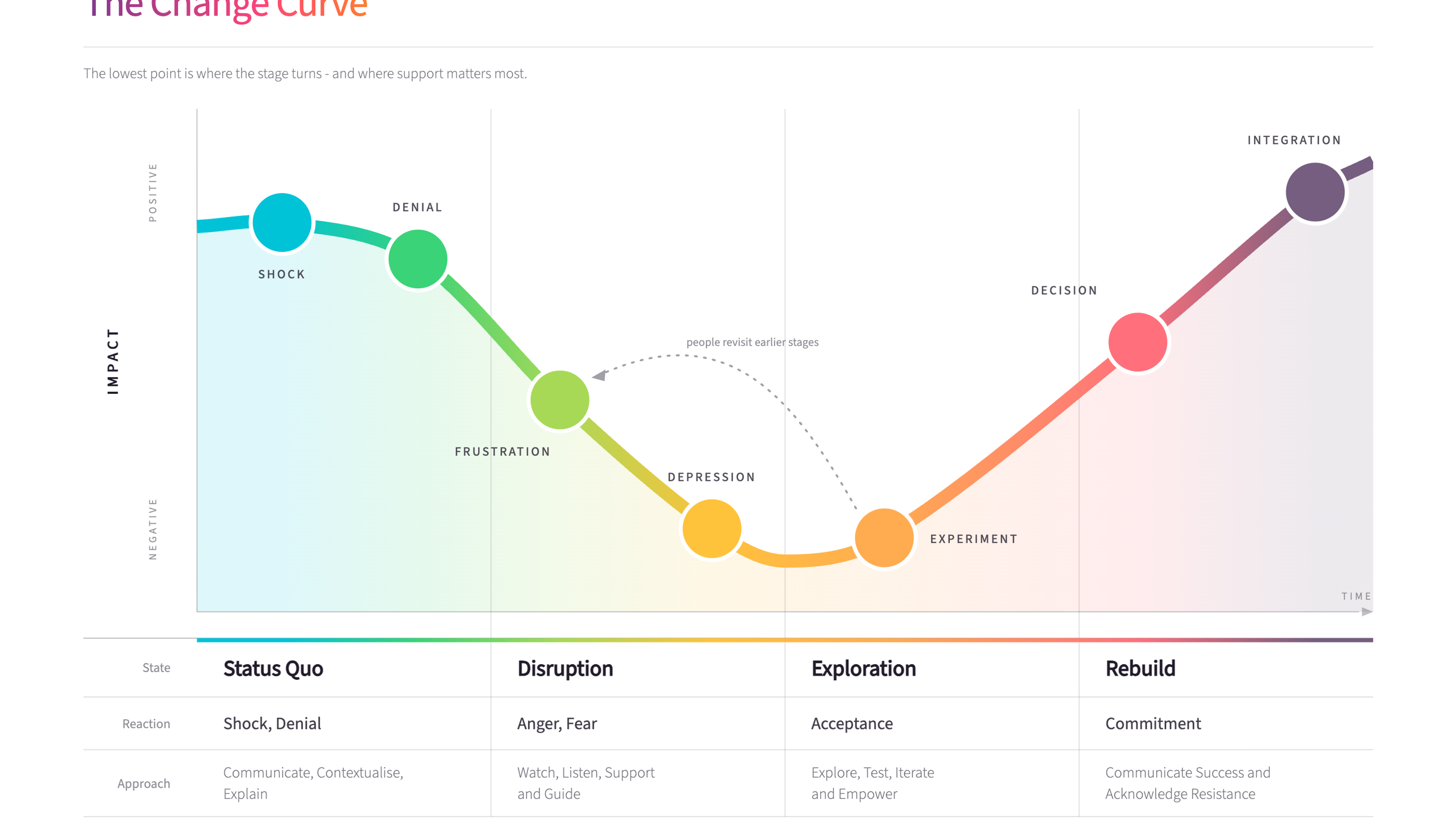
The Change Curve maps the emotional stages people move through during organisational change, from shock and denial through to acceptance and commitment. It helps leaders understand where people are in the process and what support they need.
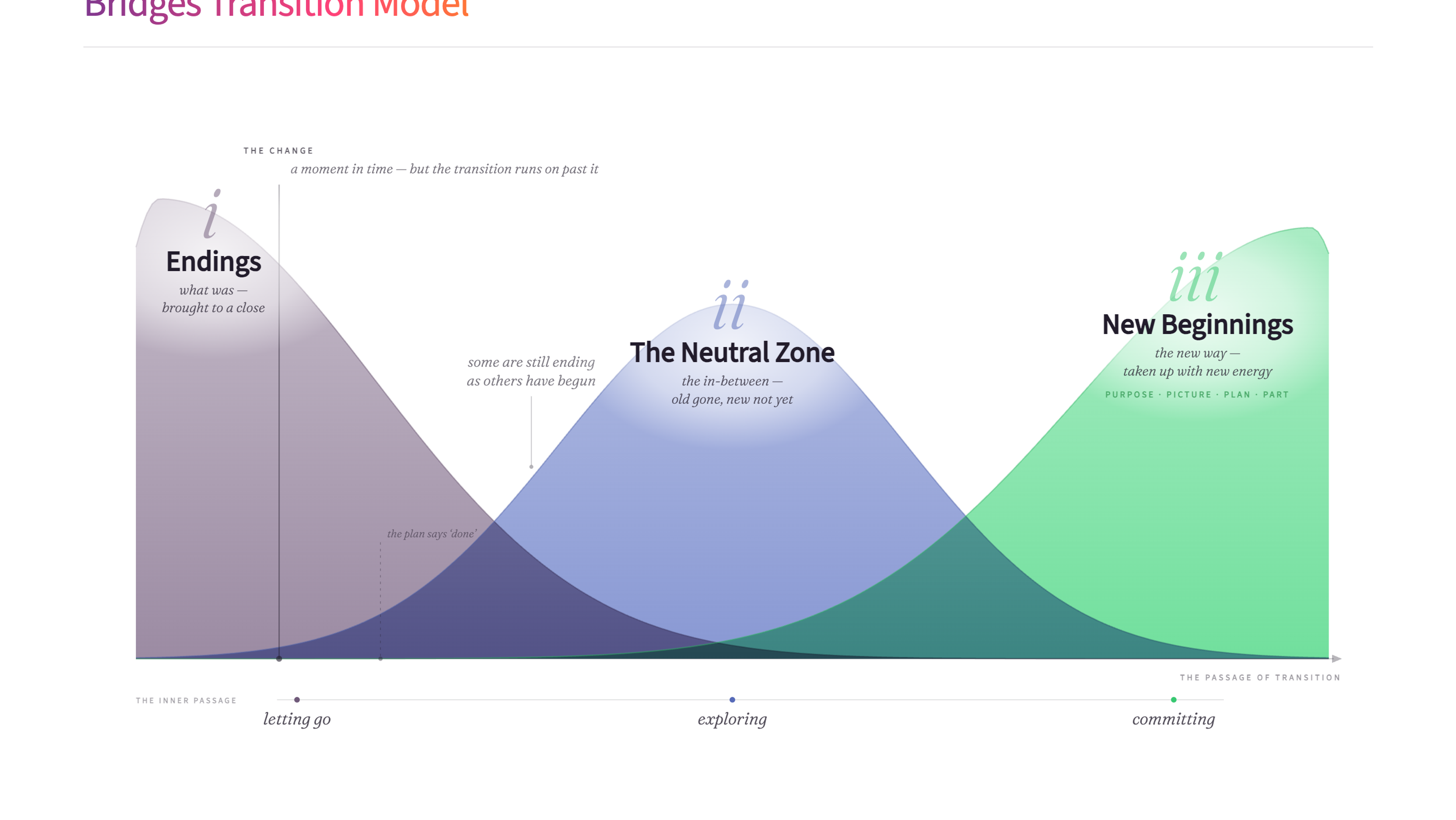
The Bridges Transition Model focuses on the human side of change - the psychological transition people go through rather than the external change itself. It maps three phases: Endings, the Neutral Zone, and New Beginnings.
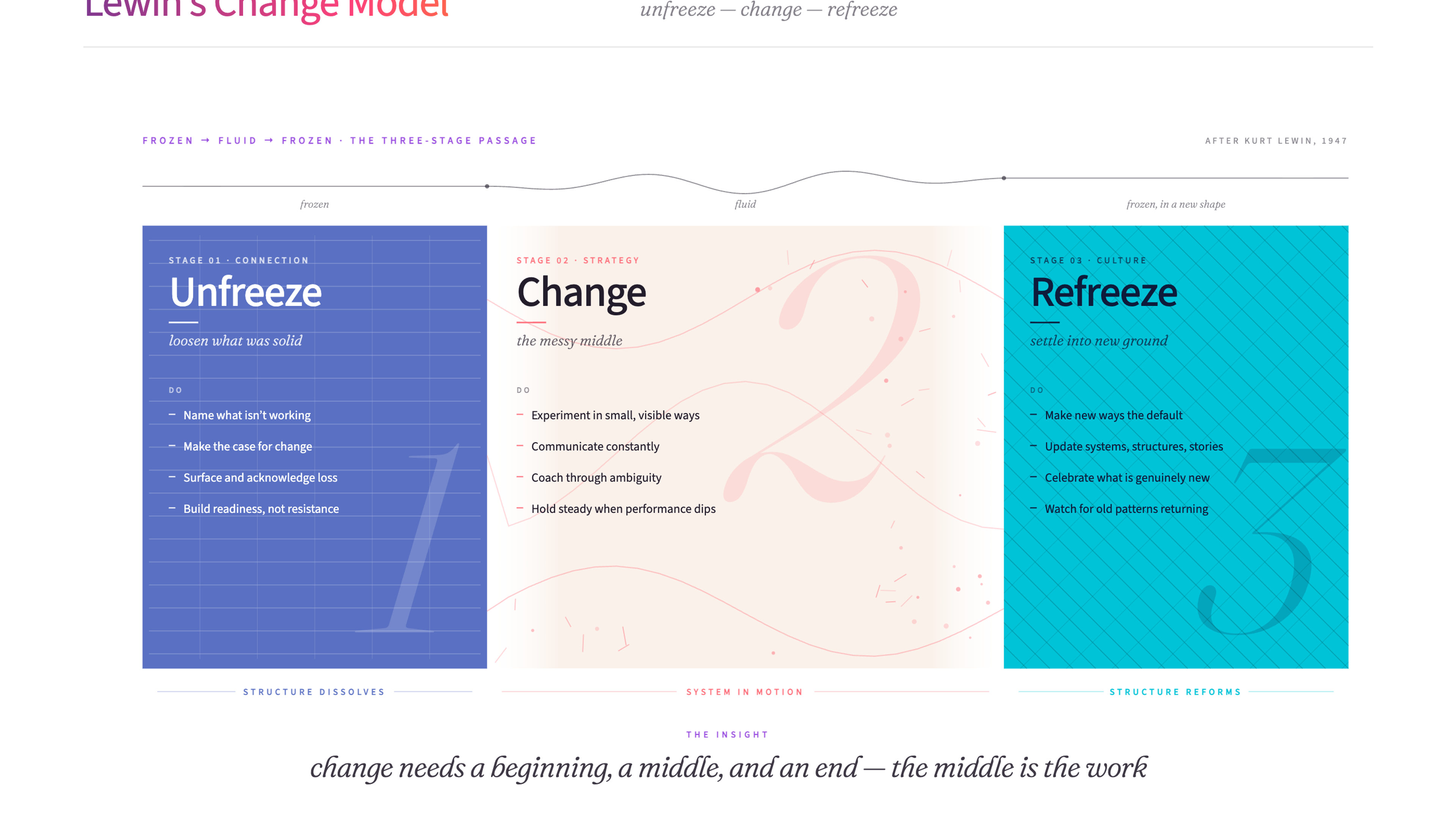
Lewin's Change Model breaks organisational change into three stages - Unfreeze, Change, and Refreeze. Before anything can shift, the conditions holding the current state in place need to soften. Then the change happens. And then the new patterns need to solidify, or the organisation drifts back.

Change doesn't just affect what people do - it affects who they feel they are. Understanding the human experience of change helps leaders create conditions where people can adapt.
Change fatigue in the workplace is growing fast. This article explores what's really driving it - not just the volume of change, but how organisations approach it - and what leaders can do to rebuild capacity without slowing down.
Psychological safety is one of the strongest predictors of team performance - but it's often misunderstood. This article explores what it actually looks like in practice, why it matters beyond the research headlines, and what leaders can do to build the conditions where honesty, learning, and real collaboration become possible.
Change Management Training
The Satir model is one of several lenses on change we explore in our Change Management training, applied to the situations your teams are facing.
James Freeman-Gray is the founder of Mutomorro. He's an organisational development practitioner who has spent over twenty years working with leaders across public, private and nonprofit sectors - helping organisations pull together around a common purpose, joined up in how they work. More about who we are and what it's like to work with us.
I use the Satir model when working with leaders who are worried about a performance dip during change. It's the only model I know that honestly acknowledges things will get worse before they get better - and that the chaos stage is where the real learning happens. It's also useful for understanding team dynamics through change, which often gets missed when the focus is purely on programme delivery.
Last reviewed: June 2026
Ready to use Satir Change Model?
Download the free template - includes practical guidance for workshops and team sessions.
Get the free template
Want to put these ideas into practice?
Whether you're navigating a merger, rethinking how you're structured, or trying to shift a culture that isn't working - underneath, it's the same job: getting the whole organisation pulling in the same direction. Start with a conversation.