Hofstede's Cultural Dimensions - Free Template
A visual guide to Hofstede's six cultural dimensions. Includes an overview diagram showing all six spectra, individual dimension breakdowns with pole descriptions, and a practical walkthrough for using the framework in cross-cultural and organisational contexts.
Based on our full guide to Hofstede's Cultural Dimensions.
Get this PDF template
Fill in your details and download the PDF straight away.
What's in this Hofstede's Cultural Dimensions template
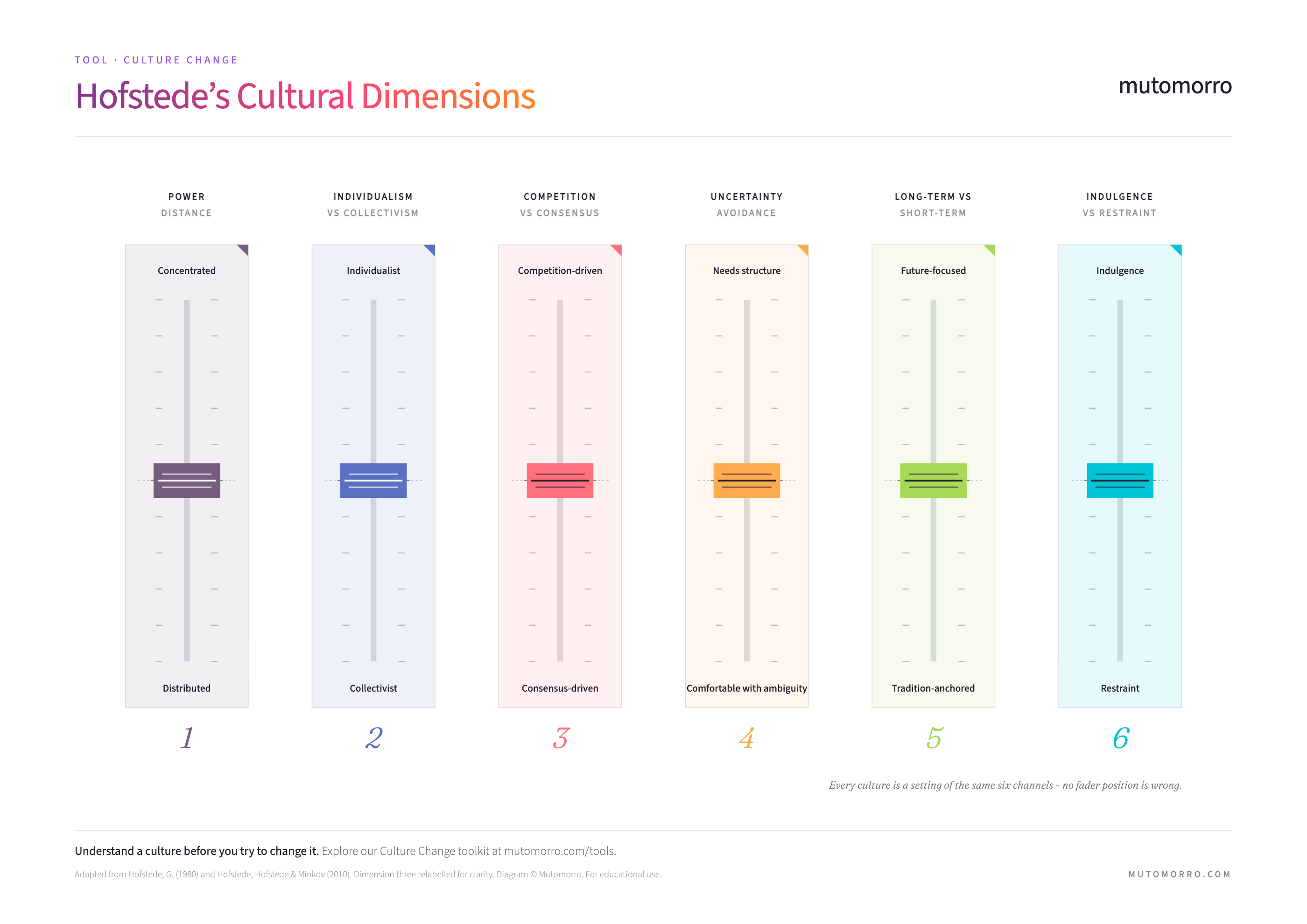
Overview diagram showing all six cultural dimensions as spectra - power distance, individualism vs collectivism, competition-driven vs consensus-driven, uncertainty avoidance, long-term vs short-term orientation, and indulgence vs restraint.
Dimension-by-dimension breakdowns with clear descriptions of what each pole means in practice - from how hierarchy is experienced to how ambiguity is tolerated.
Practical application guide covering how to identify the most relevant dimensions for your situation, how to compare cultural positions without scoring them, and how to use what you find to adjust your approach.
Diagnostic prompts for each dimension - questions you can use with a team to surface where cultural assumptions might be creating friction or missed opportunities.
Tips for using it
Start with context, not categories. Pick the situation where cultural differences are showing up - a merger, a cross-border team, a programme that's landing differently in different places - and work from there.
Focus on two or three dimensions. All six won't be equally relevant every time. Power distance and uncertainty avoidance tend to dominate in change contexts. Individualism vs collectivism matters most for team design.
Compare, don't score. The value is in seeing where two cultures diverge and what that means for how they work together. There is no right end of any spectrum.
Use it as a conversation starter. Present dimension positions to a team and ask: does this feel accurate? Where do we see this playing out? The framework works when it opens dialogue.
Culture Change
When cultural differences are creating friction in your organisation - whether across borders, after a merger, or between teams with different ways of working - it helps to have someone who can surface the patterns and design a response that fits.
Charity Culture Change
A community trust born from decades of activism, with brand values that felt bold on paper but hadn't yet changed how services were delivered or how teams worked day to day. Sports, housing and arts ran as different organisations to the person walking through the door.
Read the case study →