5D’s of Appreciative Inquiry - Free Template
A three-page PDF covering the 5D Appreciative Inquiry cycle. Includes a hero diagram of the full framework, a quick-reference summary card with practical guidance for each stage, and a connection to Mutomorro's Change and Development services.
Based on our full guide to 5D’s of Appreciative Inquiry.
Get this PDF template
Fill in your details and download the PDF straight away.
What's in this 5D’s of Appreciative Inquiry template
The toolkit gives you everything you need to run a strengths-based change process with your team.
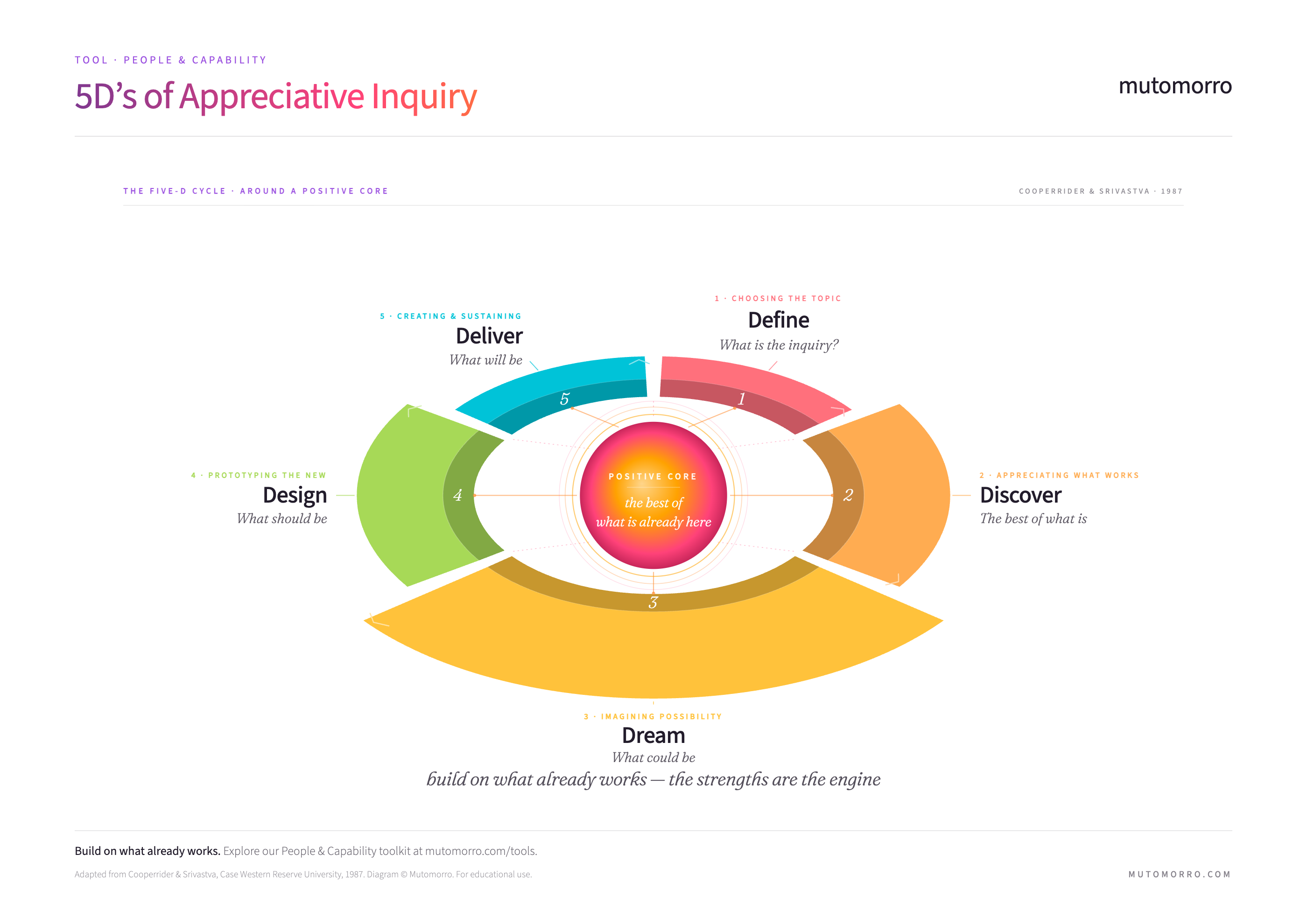
Page one is the full 5D cycle diagram - the five stages (Define, Discover, Dream, Design, Deliver) arranged around the Positive Core. Use it as a reference point during sessions or as a visual anchor when introducing the approach.
Page two is a summary card covering what each stage involves, practical tips for facilitation, and common pitfalls to watch for. It's designed to be printed and kept to hand during an Appreciative Inquiry process.
Page three connects the 5D framework to Mutomorro's broader approach to change and development, including how strengths-based inquiry fits within change management and organisational development work.
Tips for using it
- Frame the topic affirmatively. The quality of the entire process depends on how you frame the opening question. "What helps our team thrive?" opens a different conversation to "Why is morale low?" Spend real time on this.
- Give Discover at least half the total time. Teams want to rush to solutions. The richness of the Dream and Design stages depends entirely on what surfaces during Discover. If people haven't shared their best stories, the rest builds on thin ground.
- Use paired interviews. Having people interview each other in pairs surfaces personal stories that group discussions miss. It also gives quieter voices space to contribute without competing for airtime.
- Print the summary card. Having the framework visible during sessions keeps the group oriented. It's a reference, not a script - adapt as the conversation needs.
Change Management
Appreciative Inquiry works well as a standalone exercise, but it's most powerful as part of a broader approach to change. We work with leadership teams to design and facilitate strengths-based change processes - from initial inquiry through to sustained implementation.
Change Management Training
A housing association in the middle of a significant transformation, with more change on the horizon than its managers had the tools or training to lead.
Read the case study →