Hofstede's Cultural Dimensions
A six-dimension framework for understanding how national and organisational culture shapes values, behaviour, and expectations. Each dimension is a spectrum - use it to surface invisible differences before they become friction.
Get the free template
Every organisation has a culture. But when that organisation spans borders - or when teams from different cultural backgrounds work together - the assumptions people carry about hierarchy, independence, ambiguity, and fairness can quietly derail even the best-designed plans. Hofstede's Cultural Dimensions gives you a structured way to surface those invisible differences before they become friction.

What are Hofstede's Cultural Dimensions?
Hofstede's Cultural Dimensions is a framework developed by Dutch social psychologist Geert Hofstede to understand how national culture shapes values, behaviour, and expectations in organisations. It grew out of a large-scale study of IBM employees, using survey data collected between 1967 and 1973 - first analysed across 40 countries and later extended to more than 70. The original model identified four dimensions. Two more were added through later research, bringing the total to six.
The framework treats each dimension as a spectrum. There is no right end - only different positions that reflect different cultural priorities. A culture that scores high on one dimension is not better or worse than one that scores low. It is simply different, and those differences have real consequences for how people communicate, make decisions, manage conflict, and respond to change.
This matters for organisational development because culture is not just something that sits in the background. It actively shapes how people interpret what is happening around them and what they expect from the organisation. If you are designing a culture change programme, restructuring teams, or merging two organisations, Hofstede's dimensions help you see where the invisible fault lines are likely to run.
The model is one of the most widely referenced in cross-cultural psychology, and its practical application extends well beyond international business. Any situation where different cultural assumptions meet - whether across countries, sectors, or professional backgrounds - is a situation where these dimensions are in play.
How Hofstede's Cultural Dimensions work
The model maps culture across six dimensions. Each one describes a spectrum between two poles. Where a culture sits on that spectrum affects everything from meeting dynamics to decision-making speed to how people respond to uncertainty.
Dimension | One end | Other end | What it shapes |
|---|---|---|---|
Power Distance | Low - power distributed, hierarchy openly questioned | High - hierarchy expected, authority rarely challenged | How decisions flow; whether junior staff speak up |
Individualism vs Collectivism | Individualist - personal initiative and self-reliance | Collectivist - group harmony and shared responsibility | How feedback, decisions and conflict are handled |
Competition-driven vs Consensus-driven | Competition - achievement, material success, clear winners | Consensus - relationships, quality of life, negotiated outcomes | Performance management and reward systems |
Uncertainty Avoidance | Low - comfortable with ambiguity and improvisation | High - prefers clear rules and predictability | How people cope with ambiguity during change |
Long-Term vs Short-Term Orientation | Long-term - perseverance, thrift, pragmatic adaptation | Short-term - stability, tradition, quicker returns | Planning horizons and tolerance for delayed results |
Indulgence vs Restraint | Indulgence - leisure, expression, personal happiness | Restraint - duty and social regulation | Response to wellbeing initiatives and social norms |
1. Power Distance

Power distance describes how much inequality is accepted as normal within a society or organisation. In cultures with high power distance, hierarchy is expected and rarely questioned. Decisions flow from the top, and people at lower levels are comfortable deferring to authority. In cultures with low power distance, power is more distributed. People expect to be consulted, challenge decisions openly, and treat hierarchy as functional rather than fixed.
This dimension shapes everything from how meetings are run to whether junior staff feel able to raise concerns. If you are introducing a flatter operating model into a high power distance culture, expect resistance - not because people disagree with the idea, but because it contradicts deep assumptions about how authority works. Understanding power distance is a practical companion to models like the Iceberg Model, which reveals how invisible assumptions drive visible behaviour.
2. Individualism vs Collectivism

This dimension measures the degree to which people define themselves through individual achievement or through membership of a group. Individualist cultures reward personal initiative, expect people to speak for themselves, and treat career progression as a personal project. Collectivist cultures prioritise group harmony, shared responsibility, and loyalty to the team or organisation.
In practice, this shows up in how feedback is given (directly or through intermediaries), how decisions are made (individually or by consensus), and how conflict is handled (confronted or absorbed). It also affects how people relate to their work. In a collectivist culture, leaving a team can feel like a betrayal. In an individualist culture, it is simply the next step.
3. Competition-driven vs Consensus-driven

This dimension captures the balance between competitive, assertive values and cooperative, caring ones. Competition-driven cultures value achievement, material success, and clear winners. Consensus-driven cultures value relationships, quality of life, and negotiated outcomes.
Hofstede originally labelled this dimension "Masculinity vs Femininity" - terms drawn from the sociological patterns he observed in the data. The labels reflected tendencies he found correlated with gender socialisation across cultures. The underlying research remains sound, but the language has dated. What the dimension measures is the cultural emphasis on competition and assertiveness versus consensus and care - and that is how we refer to it here.
This dimension is particularly visible in how organisations handle performance management. Competition-driven cultures tend toward individual rankings, visible targets, and public recognition. Consensus-driven cultures lean toward developmental conversations, team-based outcomes, and quiet competence. Neither approach is inherently better, but importing one into a culture that expects the other creates confusion.
4. Uncertainty Avoidance

Uncertainty avoidance describes a culture's tolerance for ambiguity and the unknown. Cultures with high uncertainty avoidance prefer clear rules, established procedures, and predictable environments. Cultures with low uncertainty avoidance are more comfortable with improvisation, informal arrangements, and open-ended situations.
This is not the same as risk avoidance. A culture can take enormous risks within a tightly structured framework (think of highly regulated financial trading). What uncertainty avoidance measures is the emotional discomfort people feel when situations are unstructured or unpredictable.
For change practitioners, this dimension matters because it directly affects how people respond to ambiguity during transitions. If you are working with a team that scores high on uncertainty avoidance, detailed planning, clear timelines, and explicit communication will matter more than in a team that is comfortable with emergence. Tools like the Competing Values Framework can help you see where a culture's tolerance for ambiguity sits alongside its other priorities.
5. Long-Term vs Short-Term Orientation

This dimension describes whether a culture is anchored in tradition and established norms or oriented toward the future and pragmatic adaptation. Long-term oriented cultures value perseverance, thrift, and adapting traditions to fit modern conditions. Short-term oriented cultures value stability, social obligations, and respect for established ways of doing things.
In organisational life, this shows up in planning horizons, investment decisions, and how much weight is given to precedent versus experimentation. A culture with strong short-term orientation may resist a strategy that requires years of investment before results appear - not because the strategy is wrong, but because the cultural instinct is to seek more immediate returns.
6. Indulgence vs Restraint

The sixth dimension, added by Hofstede and Michael Minkov in 2010, captures the degree to which a culture permits free gratification of basic human desires related to enjoying life. Indulgent cultures place value on leisure, freedom of expression, and personal happiness. Restrained cultures emphasise duty, social regulation, and the suppression of gratification.
This dimension is often overlooked in organisational contexts, but it matters. It influences how people respond to wellbeing initiatives, how much social activity is expected alongside work, and how openly people express satisfaction or dissatisfaction. An employee engagement programme designed in an indulgent culture may feel intrusive or frivolous in a restrained one.
How to use Hofstede's Cultural Dimensions
The framework works best as a diagnostic lens rather than a classification system. The goal is not to label a culture but to surface the differences that are most likely to create friction - or opportunity - in a specific situation.
Start with the context. Identify the situation where cultural differences are relevant. This might be a cross-border merger, a new team with mixed cultural backgrounds, an international programme rollout, or a culture change initiative that needs to work across different parts of the organisation.
Map the dimensions that matter most. Not all six dimensions will be equally relevant in every situation. Power distance and uncertainty avoidance tend to dominate in change management contexts. Individualism vs collectivism is central to team design. Competition-driven vs consensus-driven matters in performance and reward systems. Focus on the two or three dimensions most likely to shape outcomes.
Compare positions, don't score them. The dimensions are spectra, not scales. A team that sits high on uncertainty avoidance is not worse than one that sits low - it simply needs different conditions to do its best work. The value is in the comparison: where do two cultures diverge, and what does that divergence mean for how they will work together?
Use it alongside other tools. Hofstede's dimensions describe the cultural water people swim in - the values and assumptions that sit beneath conscious behaviour. Pairing them with Edgar Schein's Culture Model (which works from artefacts inward to underlying assumptions) or the Cultural Web (which maps six interconnected cultural elements) gives you a richer picture. The McKinsey 7-S Model adds the organisational alignment layer.
Talk about what you find. The most valuable use of Hofstede's dimensions is as a conversation starter. Present the dimension positions to a team and ask: does this feel accurate? Where do we see these differences playing out? What would we do differently if we took them seriously? The framework works when it opens dialogue, not when it closes it with a classification.
Example
A UK-based professional services firm acquires a German subsidiary and a Brazilian office in the same year. The leadership team notices that integration is progressing at very different speeds. The German office resists changes to established processes and wants detailed documentation for every new procedure. The Brazilian office adapts quickly but makes decisions through informal networks that bypass the official governance structure.
Using Hofstede's dimensions, the integration team maps the relevant differences. Germany scores high on uncertainty avoidance - the resistance to process change is not stubbornness but a cultural need for clarity and structure. Brazil scores lower on uncertainty avoidance but higher on power distance - decisions flow through personal relationships with authority figures rather than through formal channels.
The team adjusts its approach. For the German office, they invest in detailed transition guides and longer timelines. For the Brazilian office, they work through the informal authority network rather than against it, briefing key relationship holders first and letting the formal governance catch up. Both offices integrate successfully, but through different routes - shaped by where they sit on the dimensions that matter most.
Limitations
National averages, not individual truths. The dimensions describe tendencies across large populations. They do not predict how any individual will behave. Using them to make assumptions about a specific person because of their nationality is stereotyping, not diagnosis.
The data has a corporate origin. The original research was conducted within IBM - a single multinational corporation. While the findings have been validated through subsequent studies across 93 countries, the sample carries an inherent bias toward large, structured, Western-headquartered organisations.
Cultures are not static. Hofstede's scores represent a snapshot. Cultures evolve - sometimes rapidly. Urbanisation, migration, generational shifts, and digital connectivity all reshape cultural values in ways that fixed scores cannot capture. The dimensions are a starting point, not a permanent map.
Six dimensions cannot capture everything. Culture is vast. Other researchers - Trompenaars, Inglehart, Schwartz, the GLOBE study - have proposed alternative or complementary frameworks. Hofstede's model is widely used because it is accessible and well-researched, but it is not the only lens available.
Getting started
Pick one situation where cultural differences are creating friction or confusion. It does not need to be international - it could be a merger between two organisations with very different ways of working, or a team that includes people from different professional cultures.
Map the two or three dimensions most relevant to that situation. Use The Culture Factor Group's comparison tool to see published scores for national cultures as a starting point, and then adjust based on what you observe in your own context. Present what you find to the people involved and see what resonates. The dimensions are most useful when they give a team permission to name differences that everyone can feel but nobody has had the language to describe.
If you are working on enacted culture - the gap between what an organisation says it values and what it rewards in practice - Hofstede's dimensions can help explain why that gap exists. The values people bring from their wider cultural context do not stop at the office door.
We share thinking on organisational change and development on LinkedIn - practical ideas for people doing this work inside their own organisations.
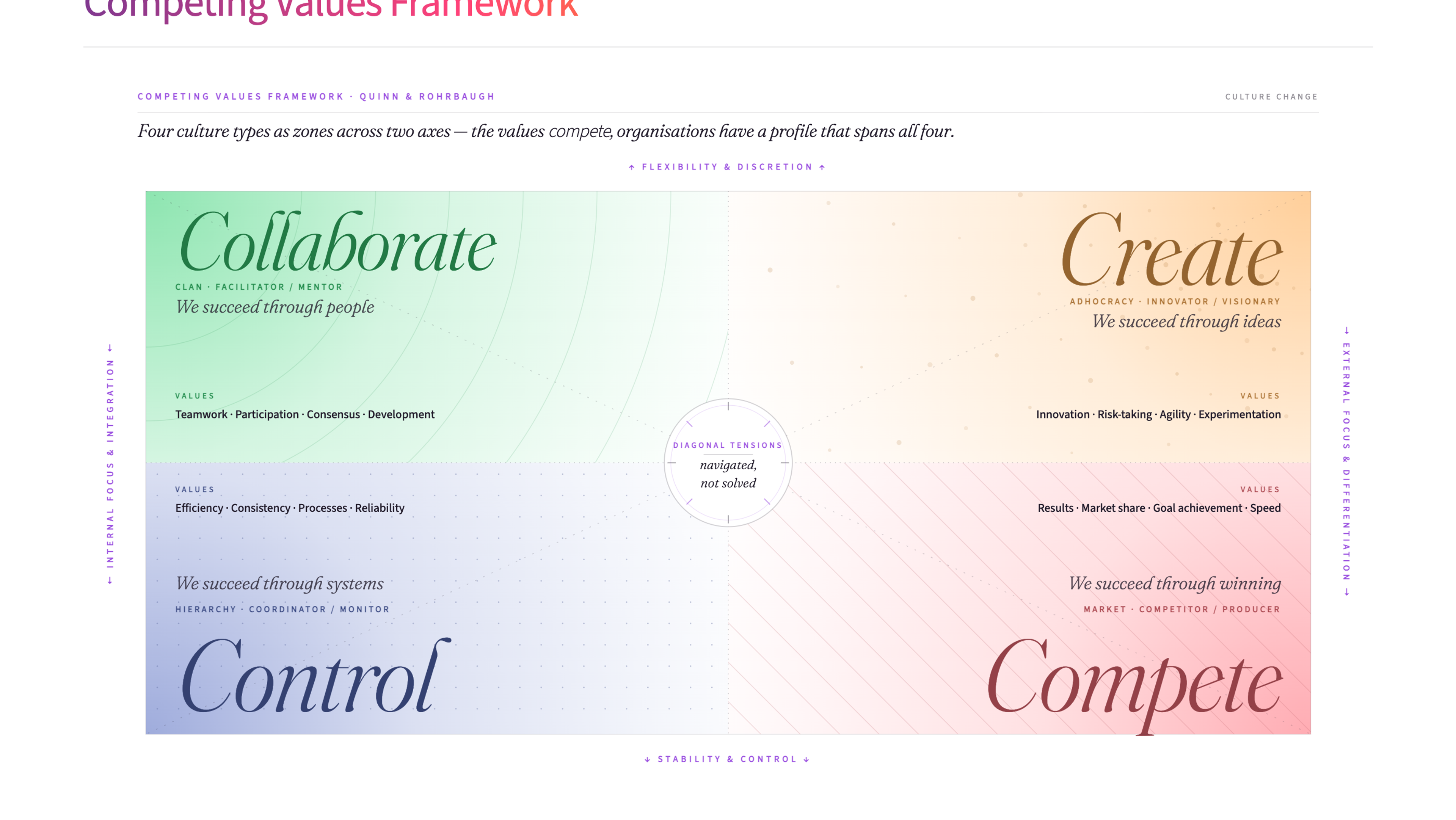
The Competing Values Framework is a model for understanding organisational culture by mapping it across two dimensions - flexibility versus stability, and internal versus external focus. It reveals which of four culture types your organisation leans towards.
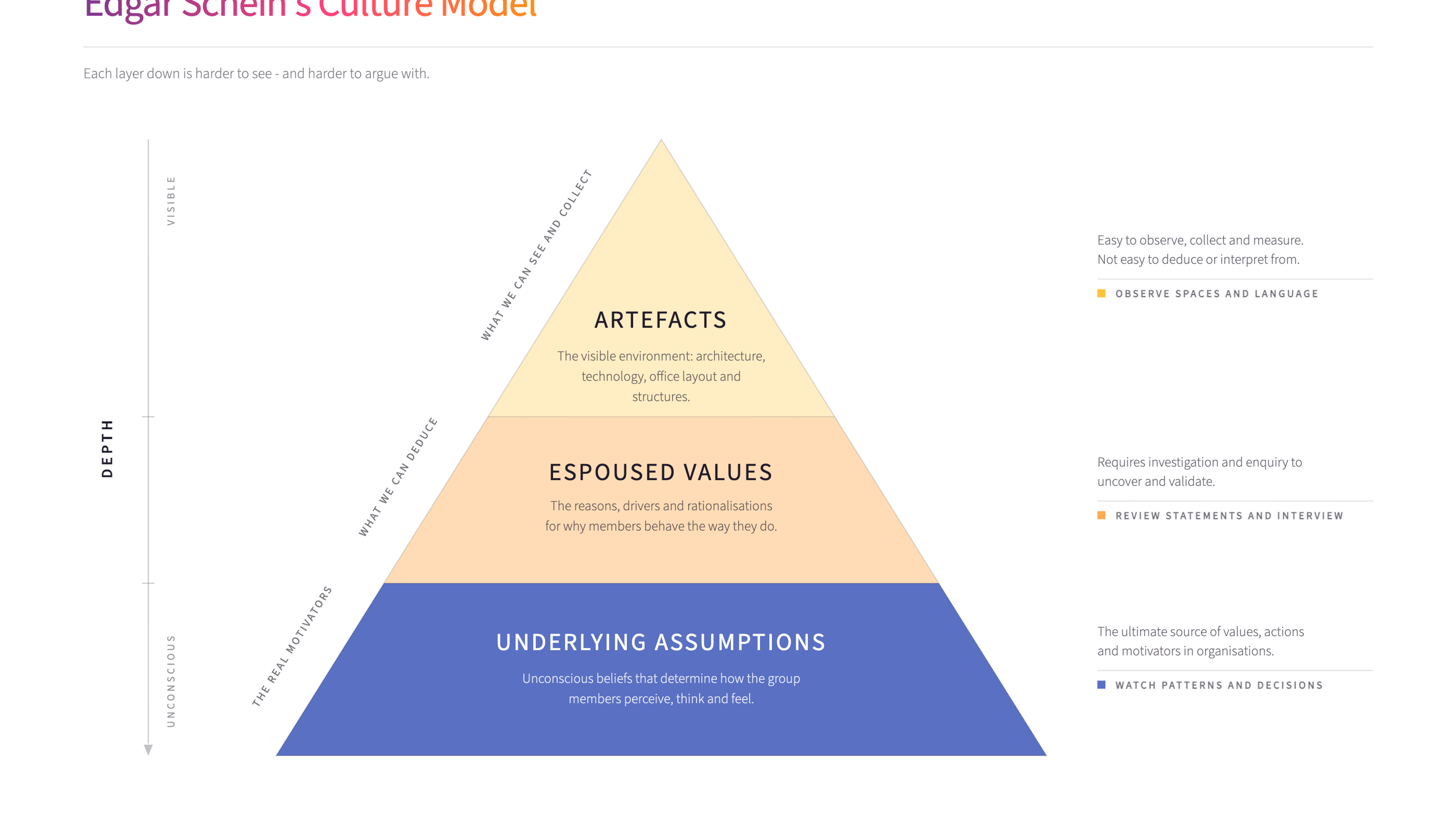
Edgar Schein's Culture Model explores organisational culture at three levels - visible artefacts, stated values, and the deeper underlying assumptions that really drive behaviour. It helps organisations get beneath the surface of what their culture actually is.
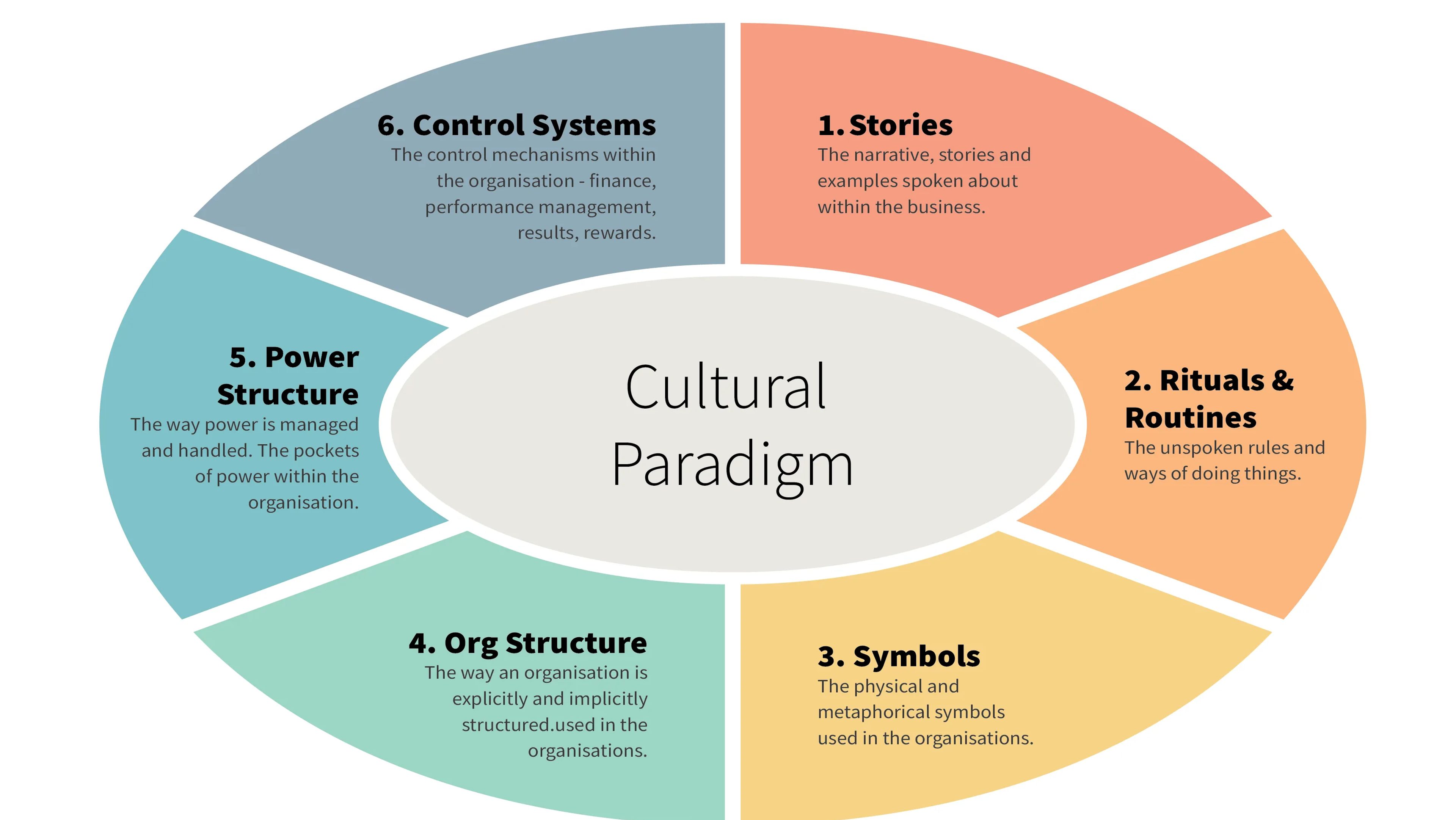
The Cultural Web is a model for understanding and mapping organisational culture across six interconnected elements. It helps you see how stories, rituals, symbols, power structures, controls, and organisational structures shape the way things are done.
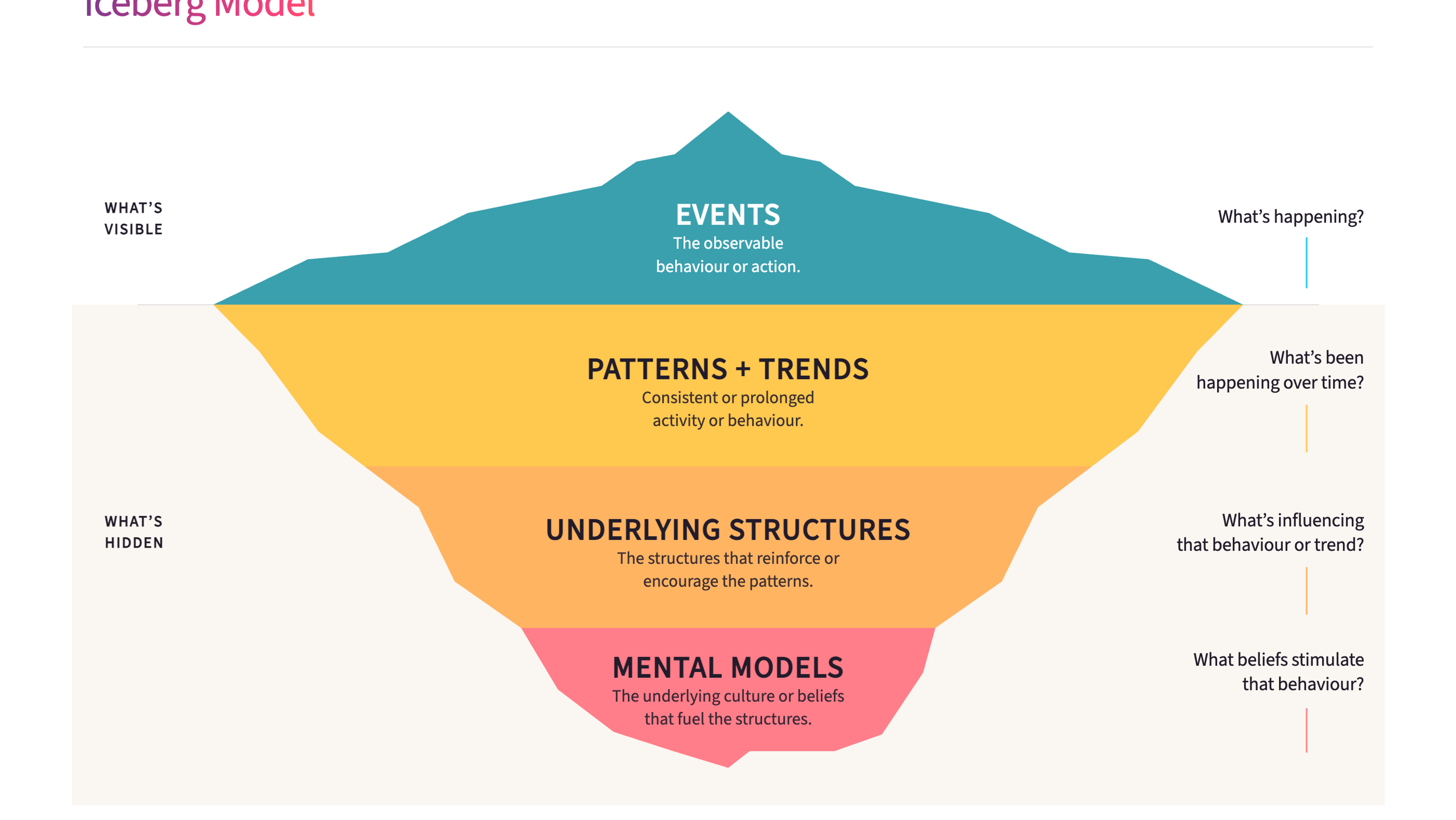
The Iceberg Model is a systems thinking tool that helps you look beneath surface-level events to find the patterns, structures, and mental models driving them. It's a way of seeing the deeper causes behind what's happening in your organisation.
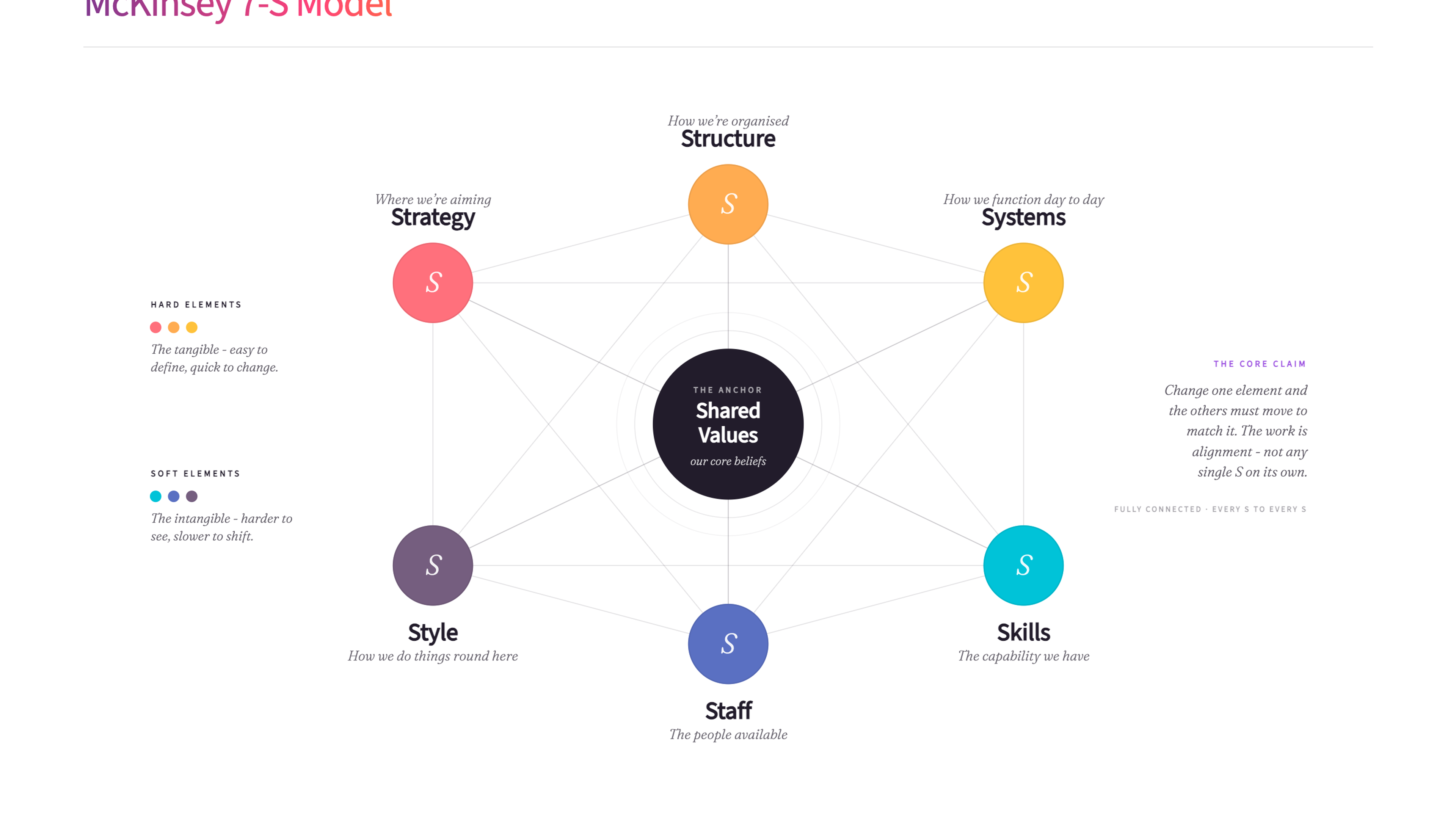
The McKinsey 7-S Model is a strategic framework that maps seven interconnected elements of an organisation - from strategy and structure to skills and shared values. It helps leaders understand how changing one part of the organisation affects everything else.
Merging two cultures?
An integration readiness assessment shows where cultural differences will bite before they do - and what to plan for.
Ready to use Hofstede's Cultural Dimensions?
Download the free template - includes practical guidance for workshops and team sessions.
Get the free template
Want to put these ideas into practice?
Whether you're navigating a merger, rethinking how you're structured, or trying to shift a culture that isn't working - underneath, it's the same job: getting the whole organisation pulling in the same direction. Start with a conversation.