Change management plan
A change management plan built around the people making the move - thorough enough to rely on, with room to adapt as you learn.

A change management plan sets out how a change will land for the people making it - who's affected and how, what each group will need, when things happen, and how you'll know it's working. We build it with you, working out what would help each group see why the change is worth it, feel their voice counts, learn the new way and take it on at a pace they can manage. Shaping it with the people who'll use it means the plan is thorough enough to rely on, and fits how things really happen - with room to adapt as you learn.
Planning first gives everyone a shared view of the change before it starts. You can see which teams will feel it most, give managers time to get ready before their teams ask questions, and fit the change around everything else people are carrying. It also makes adapting easier: when something shifts along the way, you can see what to adjust, because you know what the plan was built around. For a small change, diving straight in can be fine. The bigger the change, and the more people it touches, the more a plan helps.
When a change management plan might help
A change management plan can be useful at lots of different moments. Here are a few we often come across.
The situation | How it might help |
|---|---|
A big change is coming | Gives you one clear plan for the people side, so you know who's affected, what they'll need and when. |
A new system, process or structure is on the way | Plans how people will move to the new way of working, alongside the people building the technical side. |
You've had a readiness assessment | Turns what it found into a plan, building on the readiness that's already there. |
Past changes lost energy after the launch | Builds in what keeps a change moving after go-live, not just up to it. |
Several changes are landing at once | Fits this change around what else is moving, so teams aren't asked for too much at once. |
Managers will be carrying the change | Gives them time and support to get ready first, so they can help their teams. |
You want a plan your teams will actually use | Builds it with the people who'll run it, so it lands as theirs. |
You have a plan, but the people side is thin | Adds the parts that help people make the move, around the plan you already have. |
What a change management plan might cover
A good change management plan has a few parts that need to work together. Most of them will be familiar if you've seen change plans before. What we add is a simple test for each one: for every group affected, what would help them see why the change is worth it, feel their voice counts, know how to do it, do it day to day, shape their part of it, and have a say in the pace? Those are the sentences at the heart of our change management model, and they give the plan its shape.
We'd choose and size each part with you. A small change might only need a few of them, kept light.

Shaping and sizing the change
This is the overall shape of the change: how big it is, how much it disrupts the day job, and the order things happen in. It's often called the change approach.
Sizing the change first means the rest of the plan fits it. A change that touches one team needs a lighter plan than one that reshapes how the whole organisation works. It's also where we'd look at timing - what else is landing on the same teams, and when - so people get a real say in the pace and nobody is asked to carry too much at once.
Leaders and managers going first
This part sets out who leads the change, and how they'll stay involved from start to finish. In many plans it's called the sponsor and leadership plan.
Leaders who stay visible after the launch help people believe the change matters. Managers matter just as much, because they're who their teams turn to first. So we'd plan for managers to make sense of the change before everyone else - time to ask their own questions, and support to answer their teams' - built into the routines they already have.
Understanding who's affected, and how
Here we map who the change affects and how much, group by group - what will be different for each, and who people look to for a lead. This is often called a stakeholder and impact map.
It's one of the most useful parts of any change management plan, because it shows where to focus. A small change for one group might be a big one for another. Tools like the Mendelow power-interest matrix can help, but we'd go further than influence. For each group, we'd ask which of the sentences will need the most support - so the plan works hardest where the change asks the most.
Telling the story, and listening
This part covers how people hear about the change, and how they can respond. It's usually called the engagement and communication plan.
It starts with a clear, honest story of why the change is worth it, told in plain words, so leaders and managers can share it in their own way. Then we'd plan how people can ask questions, raise doubts and shape what happens - and how their input will visibly count. Conversation tends to work better than announcement, so we'd plan for both: the messages people need, and the chances to talk them through.
Helping people learn the new way
This part sets out the training, coaching and hands-on support people will need. It's often called the capability and training plan.
We'd compare what the change will ask of each group with the skills and support they have today, and plan for the gap. Timing matters as much as content - learning lands best just before people need it. And we'd plan room to practise in real work, with time to be slow at first and someone close by to help, because confidence tends to grow with each go.
Helping people through the harder parts
Every change asks people to let go of something familiar, so it's natural for some to push back. Many plans call this a resistance management plan.
We'd plan to listen first: where people might find the change hardest, what's behind it, and what would help. Pushback often comes from people feeling left out, so giving each team a say in how the change works in their own area helps a lot - including protecting what already works well. We'd also involve the people others listen to, who aren't always the most senior, and who can help a new way of working feel possible.
Seeing how it's landing
This part sets out how you'll know the change is working, and how the plan will adjust as you go. It's often called governance and adoption measures.
We'd agree a few simple signs early on - things you'd hope to see and hear in everyday work once people have made the move. Then a light rhythm for checking them, so you can spot where the change is landing well and where a group needs a little more. When something shifts, the plan shifts too.
A change management plan might use all of these parts or just a few, depending on the change.
Where these parts come from
These are the parts most change management plans include, drawn from long-standing approaches to change such as the ADKAR model, Kotter's 8 Step Change Model and the Bridges Transition Model. We use them to make sure the plan is complete, rather than as a template.
What makes the plan ours is the test we apply to each part. For every group, we ask what would help people say the sentences in our change management model - including two of our own: shaping your part of it, and having a say in the pace.
How we'd build your change management plan with you
We'd agree the approach with you, based on the size of the change and how much you already know. Whatever the mix, two things stay the same: the people who'll use the plan help shape it, and ideas get tested before anything is settled.
Starting from what you already know
Most organisations have made changes well before, and the people who were part of them know what helped. We'd start there - and with a change readiness assessment if you've had one, or a round of conversations if not. Building on what's worked before gives the plan a head start, and gives people confidence that this change can go well too.
Picturing the new normal
It helps to be clear about where the change is heading. What will people be doing differently once it's settled in? What will a team meeting, or an ordinary Tuesday, look like? A shared picture gives every part of the plan something to aim at, and gives you the signs to look for later.
Planning with the people affected
The people doing the work know where a change will be easy and where it might be hard, in ways no plan on paper shows. So we'd plan with them - in workshops with people from different teams and levels, and in conversations with the groups the change affects most. Our part is to bring structure, good questions and experience from elsewhere, so the plan draws on both what's known inside and what tends to work outside.
Testing the plan before you start
Before anything is settled, it helps to walk through the plan with a few of the groups it affects. One useful way is a pre-mortem: imagine it's a few months in and the change has stalled, then ask what might have caused it. People often find it easier to name a worry this way, and it surfaces risks early, while they're still easy to plan for.
Bringing it together
The plan comes together in one place, written simply, so leaders, managers and project teams can all use it. We'd go through it together in a working session - why it's shaped the way it is, where it stays flexible, and what the first steps are.
A lighter change management plan might be a few working sessions and a short written plan. A deeper one might add wider conversations, more detailed impact mapping and more than one round of testing.
The thinking behind it
People tend to follow a plan they helped write. They know why it's shaped the way it is, and they trust that it fits how the work really goes. A plan written only from the inside can miss what an outside eye would spot, and one written only from the outside can miss how things really work. Building it together, with sound frameworks alongside, gives you a plan that's both thorough and used.
Testing it before you start keeps it honest. It's much easier to adjust a plan on paper than to change course once a change is under way.
What you come away with
A change management plan your people helped write, ready to put into practice. It usually includes:
- The shape and size of the change - how big it is, the order things happen in, and how it fits around everything else.
- Who's affected, and how - group by group, with what each will need most.
- How leaders and managers will go first - and the support they'll have to help their teams.
- The story of the change, and ways to respond - what people will hear, and how they can shape what happens.
- Learning and support - what each group will need, and when.
- Simple signs to look for - and a light rhythm for checking how the change is landing.
- The first steps - so you know exactly where to begin.

Because your people helped write it, the plan already makes sense to them. That makes it easier to hand to the managers and teams who'll carry it, and easier to adjust when things change.
From there, it's your call. Many organisations take the plan forward themselves. Others like to have us alongside - supporting people through the change, or helping the new way hold. And if it turns out you need something lighter than you expected, we'll say so.
Common questions
Do we really need a change management plan, or can we just get on with it?
For a small change, getting on with it can be fine. For a bigger one, a plan helps you see who's affected, give managers time to get ready and fit the change around everything else - so there are fewer surprises, and it's easier to adjust when things shift. It doesn't need to be heavy. We'd size the plan to the change.
What's usually in a change management plan?
Most include the overall approach, a picture of who's affected and how, plans for leaders and managers, communication and engagement, training and support, how to help people through the harder parts, and how you'll know it's working. We'd shape each part around what would help every group make the change their own.
Is a change management plan the same as a change management strategy?
They're close. A change management strategy sets the overall direction - how you'll approach the change, and why. A change management plan sets out the detail - what happens, when, and who's involved. We'd usually shape both together, with the strategy as the first part of the plan.
Do we need a change readiness assessment first?
No. If you already have a good sense of how ready people are, you can start here. If you'd like a clearer picture first, a change readiness assessment can help, and the two fit well together.
Does this cover the system, process or structure behind the change?
We plan the people side - how people move to the new way of working. Where the change rests on a new system, process or structure, we'd plan alongside the people building it, so the two sides fit together.
Can you work with our existing project plan or template?
Yes. If you already plan projects in a particular way, we can shape the change management plan to fit alongside it, so it's easy for everyone to use.
Who would be involved?
Usually leaders, managers and a mix of people from the groups the change affects most. How many depends on the size of the change.
Will the plan change as we go?
It should. We'd build in simple ways to check how the change is landing, and points where the plan can be adjusted.
How long does it take?
It depends on the size of the change. A lighter plan might take a few weeks, and a deeper one a little longer. We'd agree a timeline together at the start.
How much does it cost?
There's no standard price, because each plan is shaped around your change. We'll talk through what would be most useful and give you a clear figure before you commit.
Got a change coming up? Talk to us about a change management plan
We've helped plan change in housing associations, charities, public bodies and businesses - new systems, new structures and new ways of working. Every change is different, so every change management plan is shaped around yours. What stays the same is a plan people helped write, and know how to use.

Training managers called a game changer - it helped them lead change, not just survive it
A housing association in the middle of a significant transformation, with more change on the horizon than its managers had the tools or training to lead.
Read case study →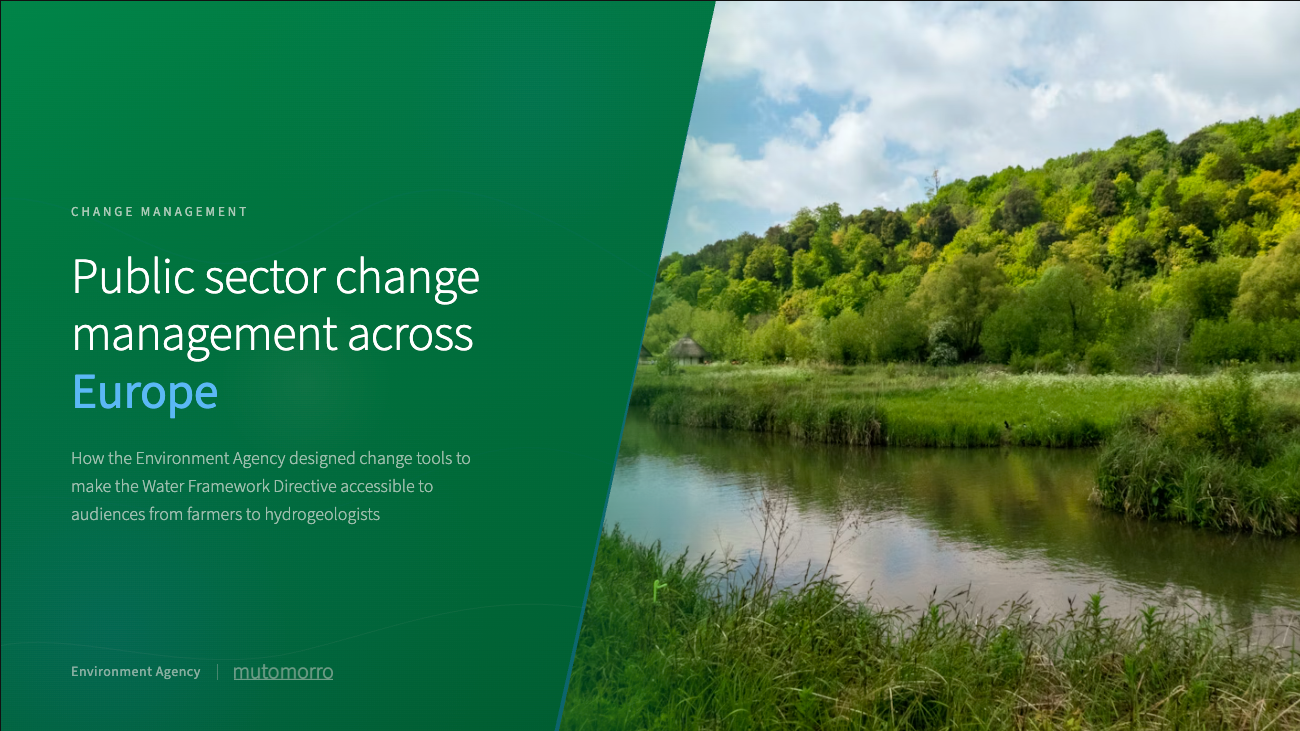
Making complex policy understandable for the people it affects most
The EU's most complex piece of environmental legislation needed to reach audiences who had almost nothing in common - from farmers managing land near rivers to specialist hydrogeologists monitoring groundwater.
Read case study →Change goes well when each person can make the move in their own way, at a pace they can manage, until the new way becomes everyone's normal. We work with leaders and managers on the people side of change - helping each person get to where they can honestly say the new way works for them.
See how ready your organisation is for the change you're planning, from the side of the people making the move.
The Change Delivery Programme runs your change plan across the organisation: the communications, the sponsorship, the learning and the go-live, delivered as workstreams tied to the project milestones, with intensive support through go-live so the new ways of working are in use and holding.
Making Change Stick keeps a delivered change in use and improving as conditions change, and builds your own people's ability to reinforce and run it. The core is the capability your team carries, with optional light support from us for as long as it helps.
Kotter's 8 Step Change Model is a structured framework for leading organisational change, from building urgency through to embedding new ways of working. It gives leaders a clear sequence to follow when the change is big and the stakes are high.
The ADKAR model is a five-stage framework for managing change at an individual level - Awareness, Desire, Knowledge, Ability, and Reinforcement. It helps organisations understand what people need at each point in a change process and where things are getting stuck.
Lewin's Change Model breaks organisational change into three stages - Unfreeze, Change, and Refreeze. Before anything can shift, the conditions holding the current state in place need to soften. Then the change happens. And then the new patterns need to solidify, or the organisation drifts back.
The Mendelow Power-Interest Matrix is a stakeholder mapping tool that helps you work out who matters most during a change or project. It plots stakeholders by their level of power and interest so you can plan how to engage each group.
The Bridges Transition Model focuses on the human side of change - the psychological transition people go through rather than the external change itself. It maps three phases: Endings, the Neutral Zone, and New Beginnings.
A strengths-based approach to organisational change. The 5D cycle - Define, Discover, Dream, Design, Deliver - helps teams build on what's already working rather than fixating on what's broken.
The traditional approach to building a case for change relies on urgency and burning platforms. But urgency wears off, and fear creates resistance. This article explores a different approach - building a case for change that's rooted in honesty, shared understanding, and a genuine picture of what's possible.
Change management and change leadership are often used interchangeably, but they're fundamentally different. This article explains what each involves, why the distinction matters, and how to develop both capabilities in your organisation.
Your change initiative was well-planned, well-managed, and well-communicated. And it still didn't land. Here's what most change programmes overlook.
During change, the stories people tell each other matter more than the communications plan. How narrative shapes whether change lands or stalls.
A change management plan is one of several ways into our change management work. To see how it fits with the others, and the thinking behind them all, visit our main Change Management page.