You've got ambitious plans and a team that wants to deliver on them. We help you build the collective capability to make that happen - and keep it growing.
Every organisation invests in developing its people. Training programmes, leadership development, coaching, mentoring. That work matters - and it produces real results at the individual level.
But something keeps happening. People develop new skills and return to systems that don't support them. Knowledge sits with a few experienced individuals instead of flowing through the organisation. Teams that were developed together perform well, but the capability doesn't spread. New starters take months to become effective because institutional knowledge lives in people's heads rather than in how things work.
The gap isn't a lack of investment in development. It's the difference between developing individuals and developing the organisation's collective capability to do what it needs to do - reliably, adaptably, and at the scale your ambitions require.
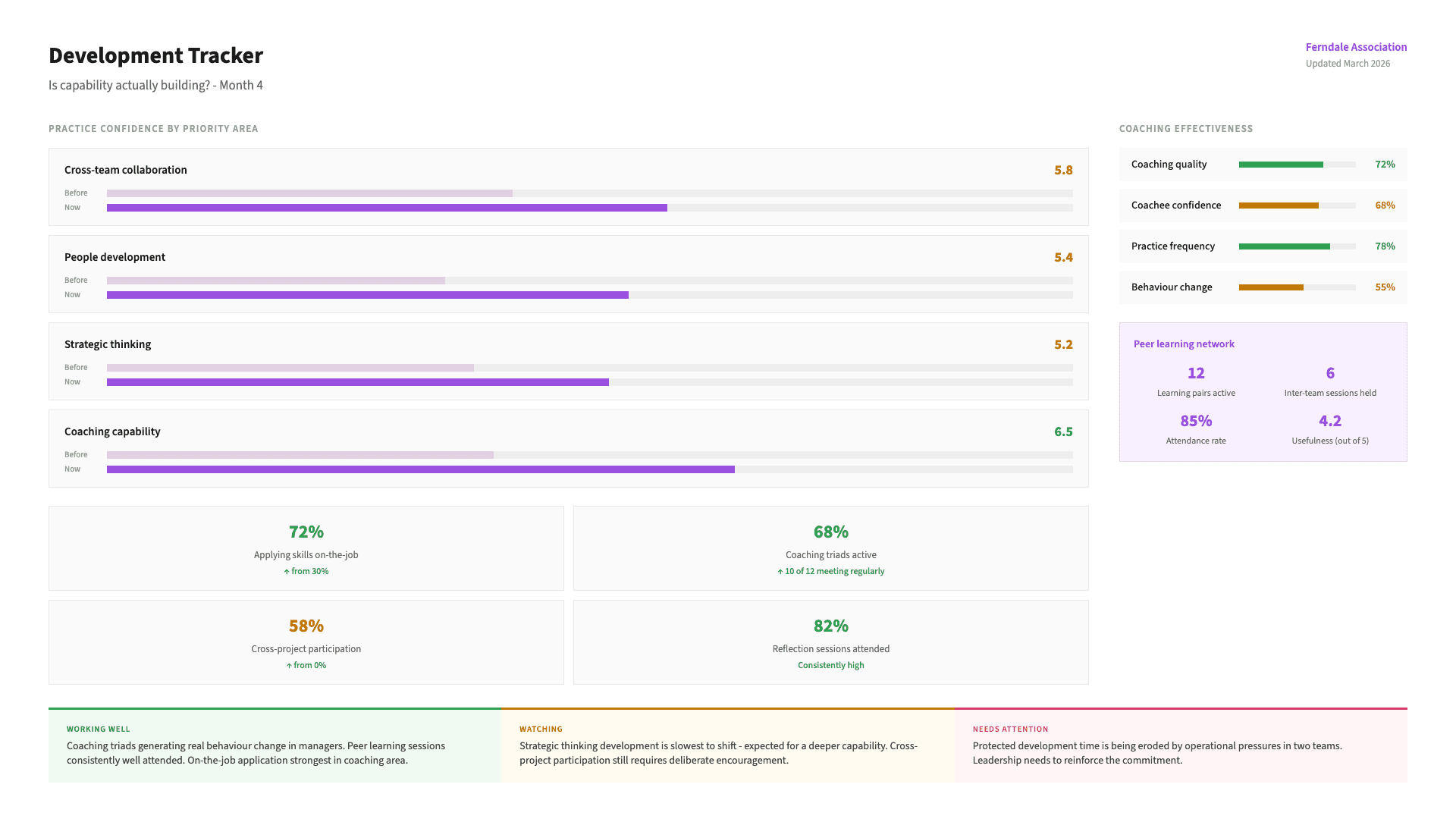
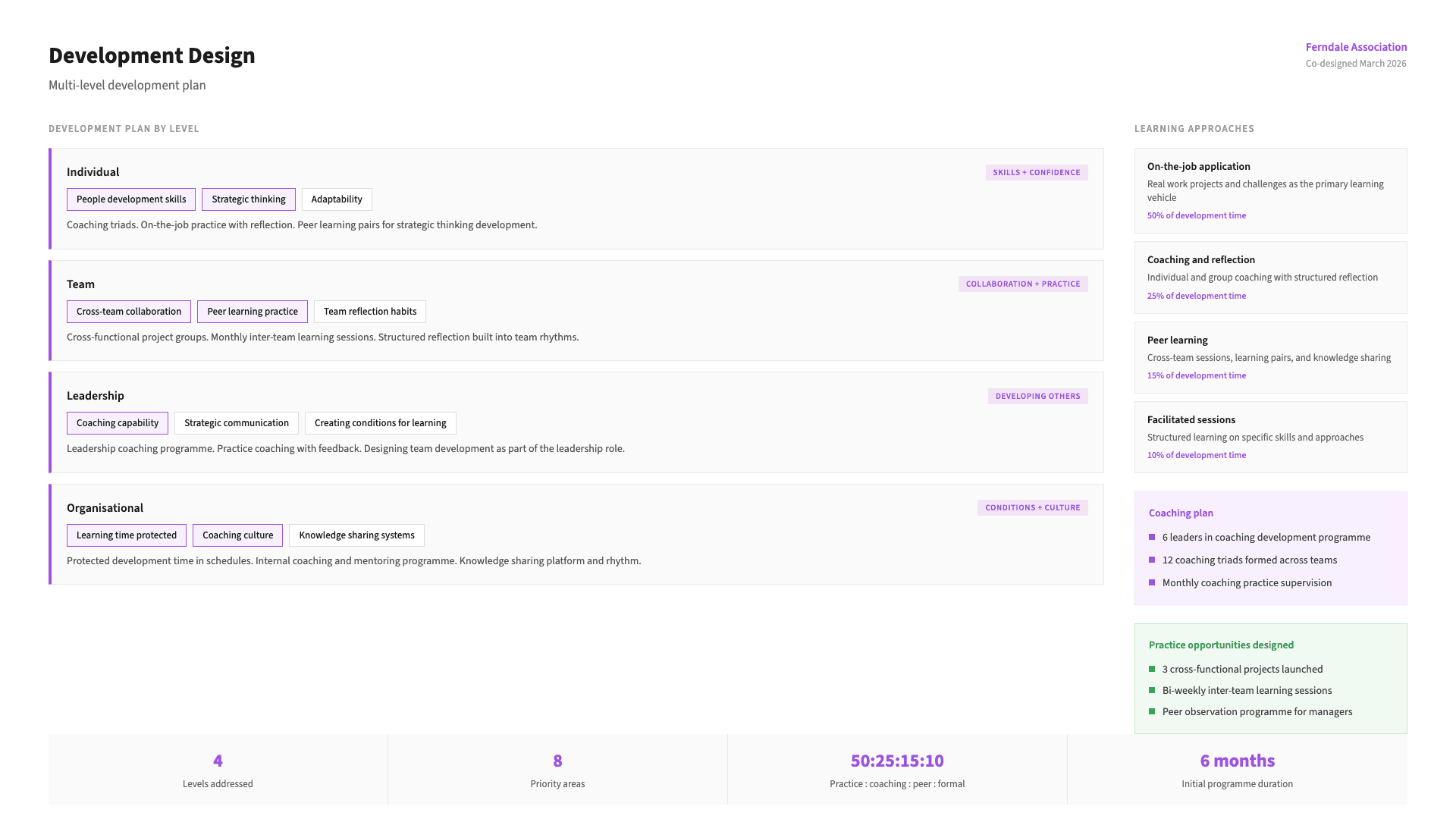
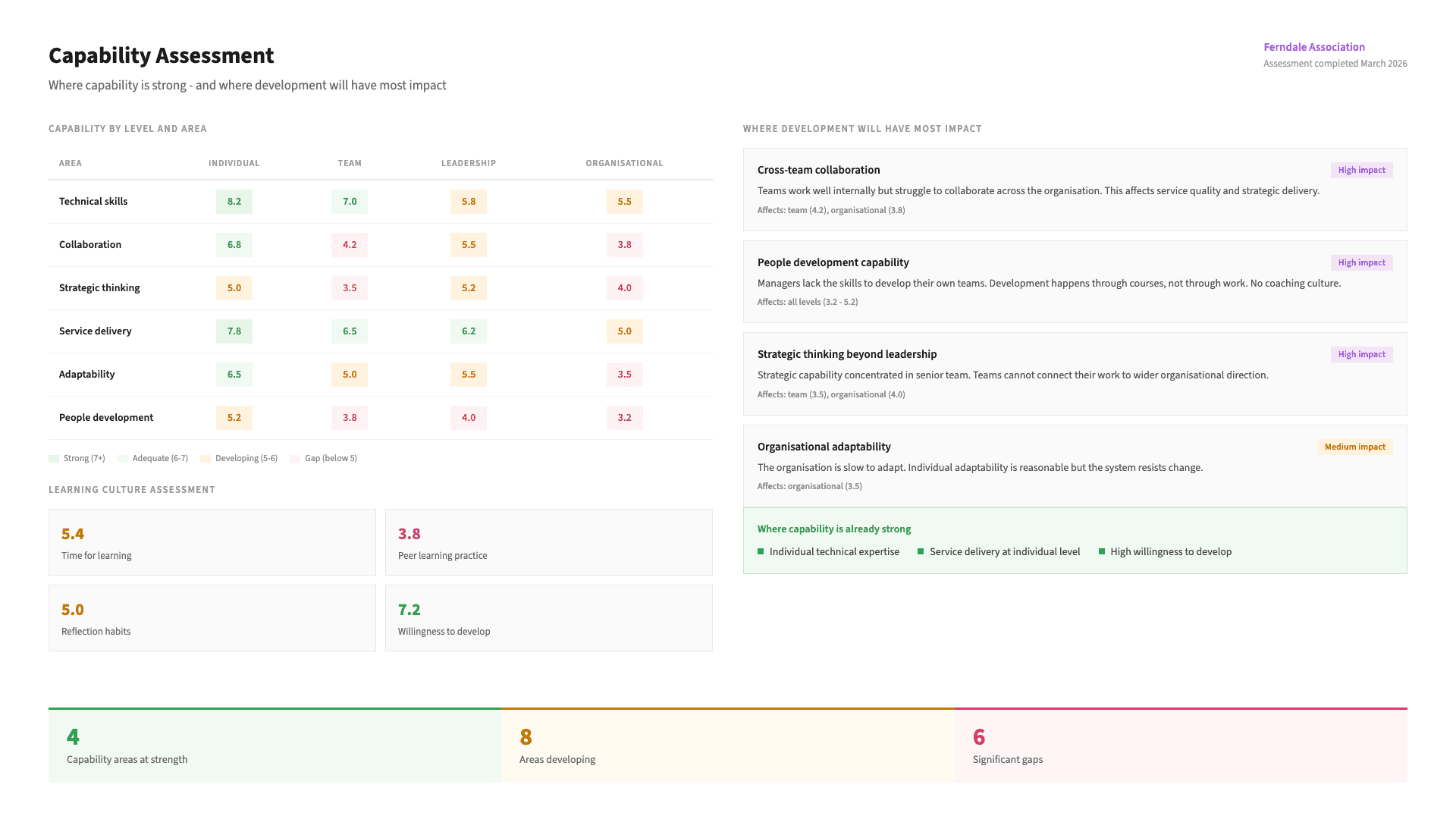






















Capability that compounds, because the conditions support it
The conditions determine whether capability grows or fades
An organisation can invest heavily in development and still find that capability doesn't stick. New skills go unused because the systems don't support them. Knowledge concentrates in a few people instead of spreading. Learning happens in training rooms but not in the work itself. When this pattern keeps repeating, the issue isn't the quality of the development - it's the conditions it returns to.
How learning flows between experienced and newer people. How much autonomy teams have to apply what they've learned. Whether the organisation creates space for practice, reflection, and growth - or whether the pressure of delivery crowds everything else out.
Leaders come to us at moments like these
See how this works in real organisations
75%
of organisations struggle to build high-performance cultures
McKinsey State of Orgs 2026
90%
of leaders say capability building is something their organisation needs to act on now
McKinsey
70-90%
of training content is forgotten within a month if not immediately applied
Learning retention research
25%
workforce involvement is the tipping point where adoption accelerates and impact multiplies
McKinsey
Want to explore how this could work for your organisation?
Every organisation is different, so we always start with a conversation. No pitch, no obligation — just an honest discussion about where you are and whether our approach feels right.
Explore capacity building
Articles
- Emotional Intelligence for Leaders: What It Actually Looks Like
Emotional intelligence in leadership isn't about being nice or reading a room. It's about the quality of attention you bring to how people are experiencing your leadership - and the willingness to adjust what you do based on what you notice.
Read article → - The Power of Not Having All the Answers
In complex living systems, the leader who tries to have all the answers is working against the system. Why genuine not-knowing isn't a weakness - it's the condition that lets collective intelligence emerge.
Read article → - Psychological Safety in Organisations: What It Takes
Psychological safety is one of the strongest predictors of team performance - but it's often misunderstood. This article explores what it actually looks like in practice, why it matters beyond the research headlines, and what leaders can do to build the conditions where honesty, learning, and real collaboration become possible.
Read article →
Related tools
- 4 Stages of Psychological Safety
The 4 Stages of Psychological Safety is a framework that maps how safe people feel to be themselves, learn, contribute, and challenge the status quo. It helps leaders understand what conditions people need before they'll speak up and take risks.
Explore tool → - Belbin's Team Roles
Belbin's Team Roles identify nine distinct roles that people naturally take on in a team. Understanding these roles helps you build more balanced teams and get the best from each person's strengths.
Explore tool → - CEDAR™ Feedback Model
The CEDAR Feedback Model is a structured framework for leading feedback conversations that feel collaborative rather than top-down. It walks through Context, Examples, Diagnosis, Action, and Review to turn feedback into genuine development.
Explore tool → - DiSC Styles
The DiSC model is a behavioural profiling tool that maps four personality styles - Dominance, Influence, Steadiness, and Conscientiousness. It helps teams understand how different people communicate, make decisions, and approach work.
Explore tool → - Five Dysfunctions of a Team
The Five Dysfunctions of a Team is Patrick Lencioni's framework for understanding why teams struggle. It maps five connected problems - from absence of trust to inattention to results - that build on each other when left unaddressed.
Explore tool → - LogFrame (Logical Framework)
A LogFrame is a structured planning and evaluation tool that helps organisations set clear goals, define how they'll measure progress, and track what's actually being achieved. It's widely used in the nonprofit sector for programme management and impact reporting.
Explore tool →
Part of a bigger picture
Capability building is one dimension of a healthy organisational ecosystem. It connects to everything - how culture enables or constrains development, how strategy creates direction for growth, how design distributes the conditions for learning across the organisation. When we help organisations build regenerative capability, we're working with the same principles that shape all of our work: creating conditions, working with how things connect, and building something that sustains.
If you're noticing that capability challenges are tangled up with broader questions about how your organisation develops and adapts, our organisational development work takes a wider view of organisational health.
Common questions about capacity building
Training develops individuals. Capability building develops the organisation's collective ability to do what it needs to do - and keep getting better at it. Training is one ingredient, but without the right conditions - management support, opportunities to practice, knowledge-sharing structures, autonomy to apply learning - even excellent training doesn't translate into organisational capability. We work at the system level: developing people AND creating the conditions for that development to compound.
Want to explore how this could work for your organisation?
Every organisation is different, so we always start with a conversation. No pitch, no obligation — just an honest discussion about where you are and whether our approach feels right.