Belbin's Team Roles
Belbin's Team Roles identify nine distinct roles that people naturally take on in a team. Understanding these roles helps you build more balanced teams and get the best from each person's strengths.
Get the free template
Belbin's Team Roles describe nine clusters of behaviour that people tend to bring to a team - nine ways of contributing, each with strengths worth using and weaknesses worth accepting as the price of them. Developed by Dr Meredith Belbin from research at Henley Management College, the model helps a team see its own composition: what it has plenty of, what it is light on, and why certain frictions keep recurring.
What are Belbin's Team Roles?
Belbin's Team Roles come from research Dr Meredith Belbin carried out through the 1970s at Henley Management College. Belbin and his colleagues watched teams compete in business simulation exercises and tried to predict which would win. What they found was that the strongest teams were not the ones with the cleverest individuals - they were the ones with the widest spread of behaviours.
From that work Belbin identified eight roles, published in Management Teams: Why They Succeed or Fail in 1981. A ninth, the Specialist, arrived later. Belbin's own account is that the simulation used in the original research needed no prior expertise, so the Specialist had nowhere to show up; the role only became visible once the theory was being used in industry.
One distinction matters more than any other here, and it is the one most often missed. Belbin measures behaviour, not personality. Belbin Associates are explicit that the Self-Perception Inventory is not a psychometric instrument and that team roles are not personality types. Personality stays relatively stable; behaviour shifts with the job, the colleagues, and the situation. The same person can be the Shaper in one team and the Teamworker in another, and both readings can be accurate.
Most people recognise two or three roles they lean towards naturally, a few they can manage when needed, and a couple they would rather leave to someone else.
Role | Category | Contribution | Allowable weakness |
|---|---|---|---|
Resource Investigator | People oriented | Explores opportunities, develops contacts, brings the outside in | Over-optimistic; loses interest once the initial enthusiasm passes |
Teamworker | People oriented | Co-operative and perceptive; listens well and heads off friction | Indecisive when it comes to the crunch; avoids confrontation |
Co-ordinator | People oriented | Clarifies goals, sees what people bring, delegates well | Can be seen as manipulative; may offload their own share of work |
Shaper | Action oriented | Drive and courage to push past obstacles; thrives under pressure | Prone to provocation; can bruise feelings in the rush |
Implementer | Action oriented | Practical and reliable; turns agreements into arrangements | Somewhat inflexible; slow to respond to new possibilities |
Completer Finisher | Action oriented | Conscientious; finds the errors, polishes, finishes properly | Inclined to worry unduly; reluctant to hand work over |
Plant | Cerebral | Creative and free-thinking; solves the problems others get stuck on | Might ignore practicalities; too preoccupied to communicate well |
Monitor Evaluator | Cerebral | Sober and discerning; weighs the options and judges accurately | Lacks drive to inspire others; can read as overly critical |
Specialist | Cerebral | Single-minded and dedicated; holds the deep expert knowledge | Contributes on a narrow front; can dwell on technicalities |
How can Belbin's Team Roles be helpful for teams?
The most useful thing Belbin does is give a team language for something it can already feel but cannot name.
Teams often arrive at a point where the effort going in does not match what comes out. Projects start with real energy and then stall. Decisions get revisited. The same two people keep rubbing against each other, and everyone privately files it under personality. Belbin reframes all of that as a question about composition rather than character - which is both more accurate and considerably easier to talk about.
Three things tend to follow.
It makes gaps visible. A team can be strong across the board on one kind of contribution and hold none of another, without anyone having chosen that. Hiring solves for the work in front of you, so composition accumulates rather than gets designed.
It depersonalises friction. A Shaper and a Monitor Evaluator will see the same decision differently - one wants momentum, the other wants to be sure. Neither is being difficult. Naming it as a role difference lets a team discuss it without anyone having to be in the wrong, which is the kind of condition that makes psychological safety hold up under pressure.
It changes how work gets allocated. Different stages of a piece of work want different behaviours. Knowing who brings what lets you match people to the moment rather than to the job title.
What Belbin does not do is tell you a team is badly built. It tells you what a team is made of. What you do about that is a separate and more interesting conversation.
The three category types in Belbin's Team Roles
The nine roles group into three categories of contribution: people oriented, action oriented, and cerebral. Each contains three roles.
The grouping is worth understanding as a diagnostic short cut. Before you look at nine roles, look at three: is the team spread across all three categories, or clustered in one or two? A team heavy on action and light on cerebral will move fast and occasionally in the wrong direction. A team heavy on cerebral and light on action will think beautifully and ship late.
A note on names, because you will see variations. The people oriented, action oriented and cerebral labels are the ones in widest circulation, including in the University of Cambridge Institute for Manufacturing's summary of the model. Belbin Associates now use social, action or task, and thinking. The groupings are identical; only the wording moves.
People oriented roles
These three shape how the team holds together, and how it connects to everything outside itself.
Resource Investigator

Resource Investigators are the team's outward-facing antenna. They are enthusiastic, curious and well connected, and they bring back ideas, contacts and opportunities from beyond the team's own walls. They are the person who knows someone who has already solved this, and who will happily make the introduction. Give them the early, exploratory stretch of a piece of work and they thrive.
The allowable weakness is follow-through. Enthusiasm is the engine, and when the novelty fades so does the interest. Resource Investigators do their best work when someone else picks up what they have opened.
Teamworker

Teamworkers hold the social fabric together. They are co-operative, diplomatic and unusually good at reading a room - they notice the person who has gone quiet, and they smooth an edge before it becomes an argument. Their contribution is often invisible until they are absent, at which point it becomes very visible indeed.
The allowable weakness is a reluctance to force the issue. When a team needs a hard conversation, a Teamworker will tend to soften it, and can hold back their own view rather than break the peace.
Co-ordinator

Co-ordinators are natural chairs. They see what different people bring, clarify what the team is actually trying to do, and direct work towards whoever is best placed to take it. They tend to be calm under pressure and comfortable with authority without needing to assert it.
The allowable weakness is that delegation can shade into offloading. Co-ordinators are so effective at routing work that their own share of it can quietly go missing, and at the extreme the skill can read as manipulation.
Action oriented roles
These three turn intent into movement, and movement into something finished.
Shaper

Shapers supply drive. They challenge complacency, set demanding goals, and find a way through obstacles that would stop a more measured team. Pressure sharpens them rather than rattling them. Without a Shaper, teams have a habit of drifting pleasantly nowhere.
The allowable weakness is friction. Shapers push, and pushing leaves marks - they can provoke, and can trample feelings while focused on the result. A team that understands this reads it as urgency rather than aggression, which is a meaningful difference.
Implementer

Implementers turn what the team has agreed into something that can be done. They are practical, systematic and reliable, and they take an abstract intention and give it a sequence, an owner and a date. They are the reason things exist rather than remaining ideas.
The allowable weakness is a certain inflexibility. Once a plan is set, an Implementer is invested in it, and can be slow to reopen it when circumstances have moved on.
Completer Finisher

Completer Finishers are where quality lives. They notice the inconsistency in the figures, the step missing from the process, the thing everyone else has stopped seeing. They finish work properly, which is rarer than it sounds.
The allowable weakness is worry. The same attention that catches errors also generates anxiety about errors, and Completer Finishers can find it hard to hand work over - partly because handing over means trusting someone else's standard.
Cerebral roles
These three sharpen the team's thinking, and improve the quality of what it decides.
Plant

Plants are the source of original thought. They generate ideas, approach a problem from an angle nobody else has tried, and are frequently the reason a stuck team becomes unstuck. Their best work tends to happen slightly apart from the group rather than in the middle of it.
The allowable weakness is practicality, and communication. A Plant's idea may not survive contact with the operational detail, and Plants can be too absorbed in the thinking to explain it well - which means good ideas sometimes lose out to well-explained mediocre ones.
Monitor Evaluator

Monitor Evaluators bring judgement. They are sober, strategic and genuinely dispassionate - they can hold an option they dislike and assess it fairly, which is harder than it looks. When a team is about to commit, they are the person who tests whether the reasoning holds.
The allowable weakness is that they can read as cold or unenthusiastic, and their care takes time. A team in a hurry experiences a Monitor Evaluator as a brake. Usually the brake is the point.
Specialist

Specialists hold depth. They know one area properly and are the person you go to when the question needs real expertise rather than a general view. Their commitment to the subject is often what keeps standards high in that domain.
The allowable weakness is narrowness. A Specialist contributes on a front rather than across the whole, and can disappear into technicalities that matter enormously to them and less to the decision in hand.
How to use Belbin's Team Roles
Map the team. Have each person identify the two or three roles that feel most like them. The formal route is Belbin's own Self-Perception Inventory, which pairs a self-assessment with observer feedback from colleagues. The informal route is to share the nine descriptions and let people place themselves. The formal route gives you better data; the informal one still gives you the conversation, which is where most of the value is.
Look at three before you look at nine. Are all three categories represented? Where are the clusters? A gap in a category tells you more, faster, than a gap in a single role.
Name gaps as gaps. This is the point where a session either works or quietly goes wrong. A missing Completer Finisher is a property of the team, not a criticism of anyone in it. Keep the language structural and people stay in the room.
Allocate against the stage. Early work wants Plants and Resource Investigators. The middle wants Implementers and Co-ordinators. The end wants Completer Finishers and Monitor Evaluators. Most teams apply the same people to every stage and then wonder why one stage always goes badly.
Agree cover, and revisit it. Where a role is missing, decide who will hold it, in what circumstances, and for how long. Someone covering a role they do not naturally hold is doing real work, and it is worth saying so. Then put a date on reviewing it, because behaviour moves.
If you want a sharper read on who owns what once the roles conversation is done, the RASCI Framework handles decision rights directly, and the T7 Model for Teams widens the lens to the conditions around the team rather than its composition.
Example
A six-person delivery team has a recurring shape to its failures. Projects open with genuine energy and good thinking. Then they stall somewhere in the middle, and finish late with rough edges that get picked up after release rather than before.
Mapping the roles gives an explanation the team had not considered. They have two Plants, two Resource Investigators, a Shaper and a Co-ordinator. Ideas and connections in abundance, plenty of drive. No Implementer, no Completer Finisher, no Monitor Evaluator.
Read that back against the pattern and it stops being a mystery. The team is built to start things. Nothing in its composition is built to structure the middle, test the reasoning, or finish properly. Nobody has been failing - the team has been asked to do work it has no natural capacity for, and has been compensating with effort.
They cannot recruit, so they adjust. The Co-ordinator takes explicit ownership of implementation oversight. One of the Plants takes quality checking as a defined responsibility rather than an assumption. For the two or three genuinely consequential decisions in each project, they borrow a Monitor Evaluator from a neighbouring team.
The next project starts with the same creative energy and holds its shape through the middle. What changed was not the people. It was the team's understanding of what it was short of, and its willingness to arrange around that rather than push harder.
Limitations of Belbin's Team Roles
The measurement has been contested for decades, and it is worth knowing why. In 1993 Furnham, Steele and Pendleton published a psychometric assessment of the Self-Perception Inventory in the Journal of Occupational and Organizational Psychology, questioning its internal consistency. Belbin replied in the same volume, arguing that a team role was never conceived as a single trait to be correlated item by item, and that judging it by instruments built for personality measurement misses what it is doing. The exchange has continued in the literature since. The practical upshot: treat Belbin as a structured conversation that reliably produces insight, not as a measurement that produces a number you can lean on.
It describes composition, not everything. Team performance also rests on trust, clarity of purpose, and the conditions the organisation sets around the team. Google's Project Aristotle research pointed at how a team works together rather than who is in it, and the 6 Team Conditions model looks at the enabling structures. Belbin answers a real question, but it answers one question.
Self-report on its own drifts. People describe themselves as they hope to be, or as the last team needed them to be. Observer assessment exists precisely because of this, and a mapping without it should be held more loosely.
The neat nine assumes a bounded team. In matrix structures, or where people sit across four project groups at once, the unit Belbin describes is harder to locate. You may find yourself thinking about role balance at a portfolio level, which the model was not built for.
The full assessment is a paid product. Belbin Associates hold copyright on the inventory and license it commercially. The role descriptions are freely discussable, and much of the value is accessible without the instrument - but the validated data is not.
Getting started
Share the nine descriptions with your team and ask everyone to pick the two or three that feel most like them. Do it live rather than by email, because the conversation is the deliverable, not the map.
Then look at the profile together and ask one question: what is this team well set up to do, and what does it have to work harder at? You are not trying to fix the composition. You are trying to see it clearly enough to arrange around it deliberately rather than by accident.
Belbin sits comfortably alongside other lenses. DiSC Styles looks at how people prefer to communicate rather than how they contribute, and the two together often explain more than either alone. If you are interested in how a team's capacity to adapt gets built over time, that sits within generative capacity in our EMERGENT framework.
We use Belbin in our team effectiveness sessions and as part of longer capacity building work, usually where a team knows something is not clicking and wants to understand the shape of it before deciding what to change.
Belbin's Team Roles FAQs
Is there a free Belbin test?
Not a legitimate one. Belbin Associates hold copyright on the Self-Perception Inventory and license it commercially, and they have acted against reproductions of it. What you will find free online are look-alike questionnaires of unknown provenance. You can run a useful role-mapping session using the published nine descriptions - which is free, and which is what most teams need - but that is a discussion exercise, not the assessment.
Is Belbin a personality test?
No, and Belbin Associates are firm about the distinction. The model measures behaviour in a team context, not personality, and the inventory is not a psychometric instrument. The practical consequence is that your roles can change - a new job, a different set of colleagues, or a shift in what the work demands will move them. Personality tests aim for the opposite.
Can you have more than one Belbin team role?
Yes, and nearly everyone does. Most people have two or three roles they occupy naturally, several they can manage when the team needs it, and one or two they find genuinely uncomfortable. A profile is a shape, not a label.
How many people do you need for a balanced team?
Fewer than nine. The common misreading of Belbin is that you need one of each, which would make every team at least nine strong. Because people hold several roles, a team of four or five can cover the ground perfectly well. Belbin himself argued for small teams. Balance is about coverage across the three categories, not a full set of nine.
What is the difference between Belbin and Myers-Briggs?
They are answering different questions. Myers-Briggs describes psychological preference and treats it as relatively fixed. Belbin describes how someone behaves in a team and expects that to move with context. For a team trying to understand its own composition, Belbin is the closer fit; for individual self-understanding, the preference-based tools have more to say.
Sources and further reading
- Belbin, R. M. (1981). Management Teams: Why They Succeed or Fail. Heinemann - the original account of the Henley research.
- Belbin Team Roles, Belbin Associates - the model as its owners describe it, including the behaviour-not-personality distinction.
- Belbin frequently asked questions, Belbin Associates - on the origin of the Specialist role and the current category names.
- Furnham, A., Steele, H. and Pendleton, D. (1993). A psychometric assessment of the Belbin Team-Role Self-Perception Inventory. Journal of Occupational and Organizational Psychology, 66, 245-257.
- Belbin, R. M. (1993). A reply to the Belbin Team-Role Self-Perception Inventory by Furnham, Steele and Pendleton. Journal of Occupational and Organizational Psychology, 66, 259-260.
- Belbin's team roles, University of Cambridge Institute for Manufacturing.
We share thinking on organisational change and development on LinkedIn - practical ideas for people doing this work inside their own organisations.
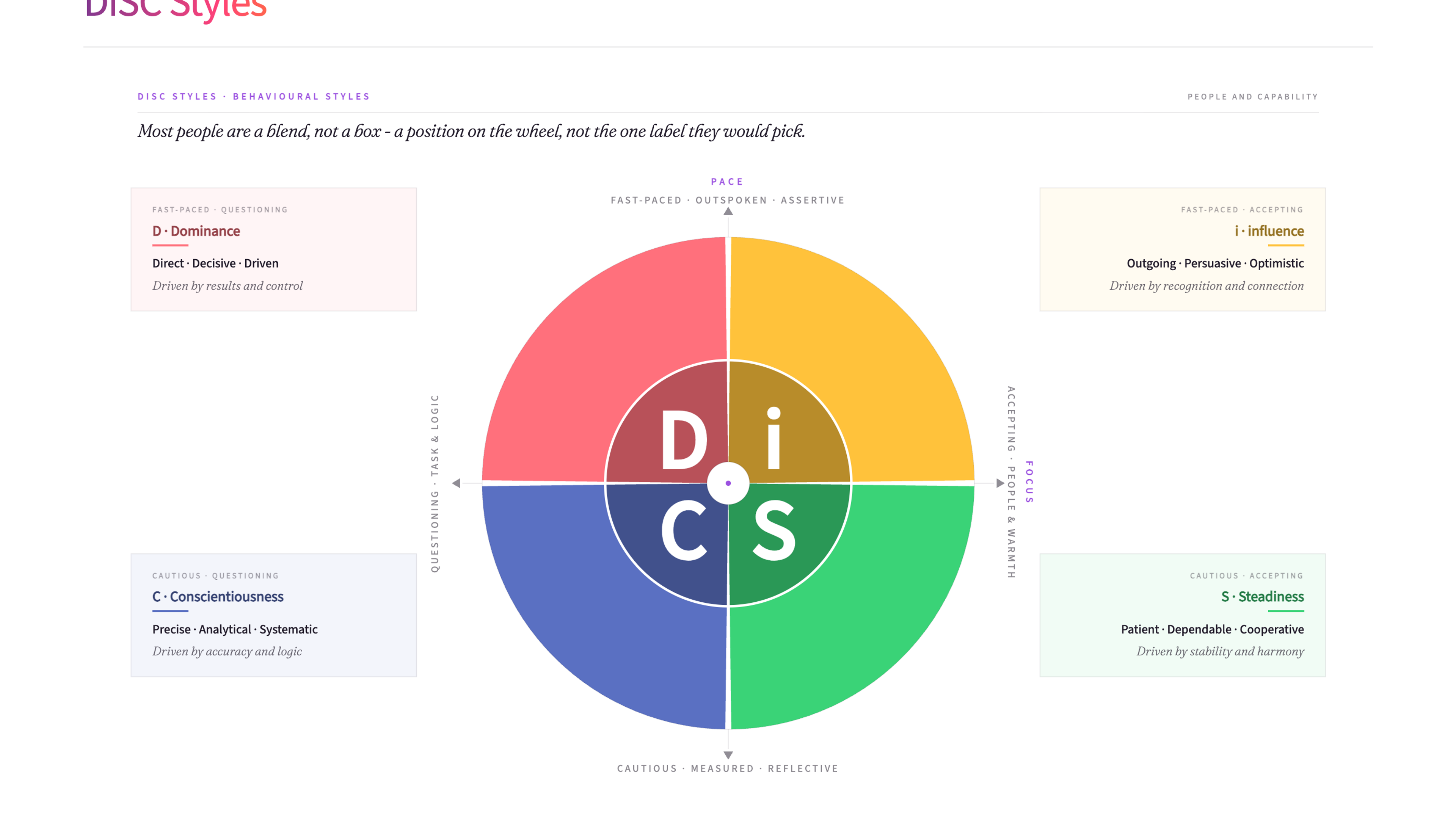
The DiSC model is a behavioural profiling tool that maps four personality styles - Dominance, Influence, Steadiness, and Conscientiousness. It helps teams understand how different people communicate, make decisions, and approach work.
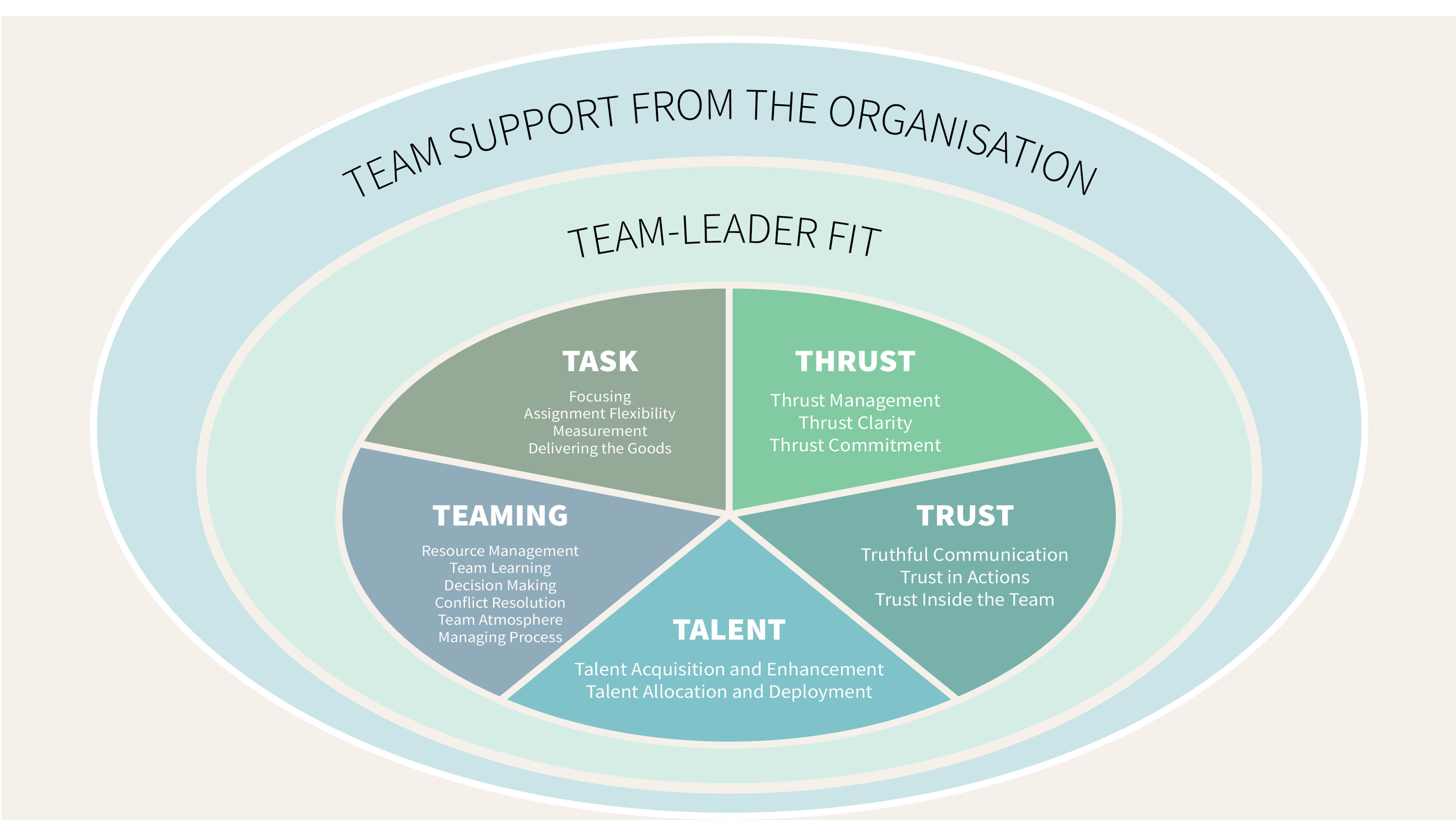
The T7 Model is a framework that identifies seven factors driving team effectiveness - five internal (like trust and talent) and two external (like team-leader fit and organisational support). It helps you diagnose where a team is strong and where it needs work.
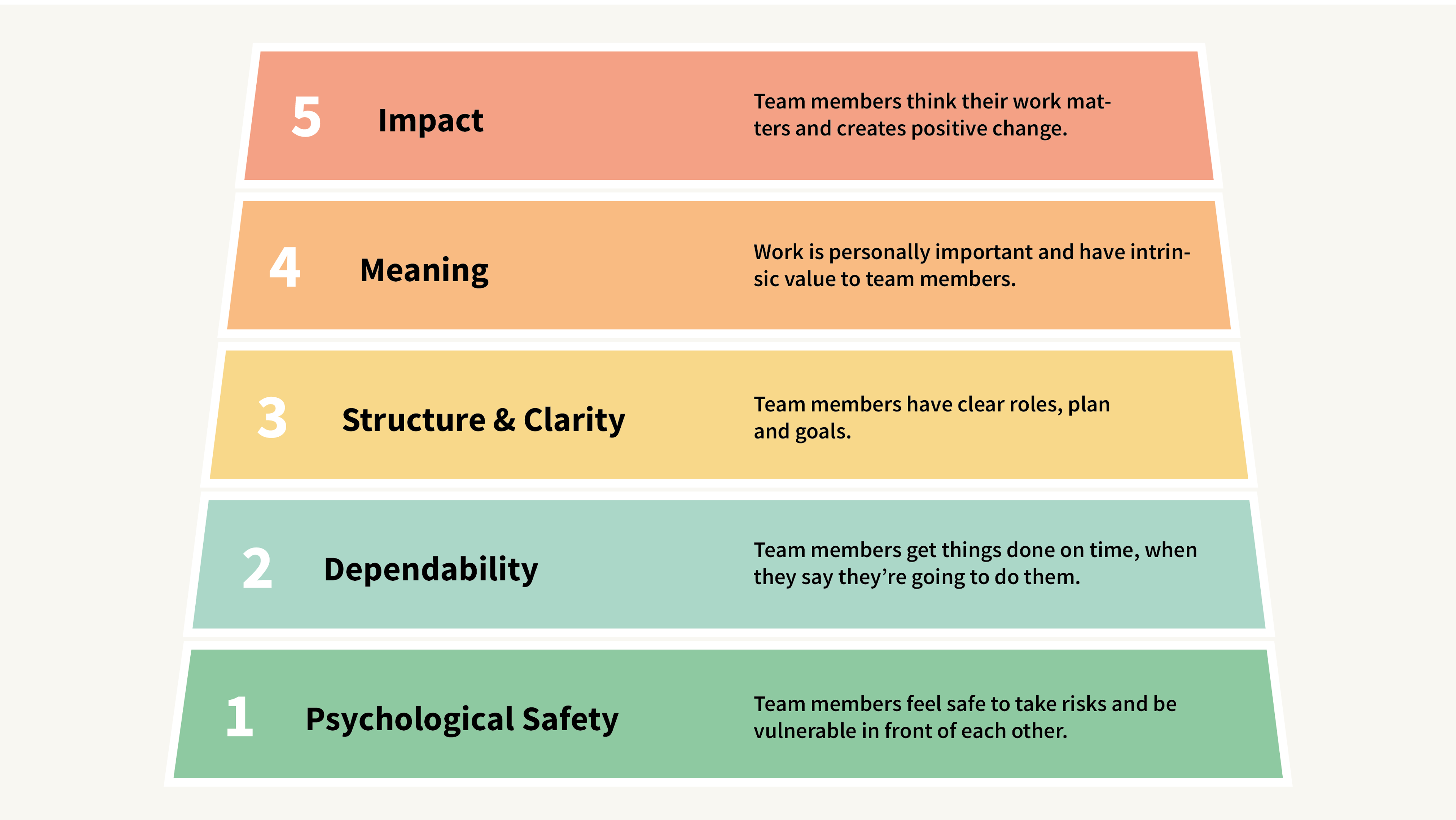
Project Aristotle is Google's research into what makes teams effective. It found that psychological safety - feeling safe to take risks and be vulnerable - matters more than who is on the team.
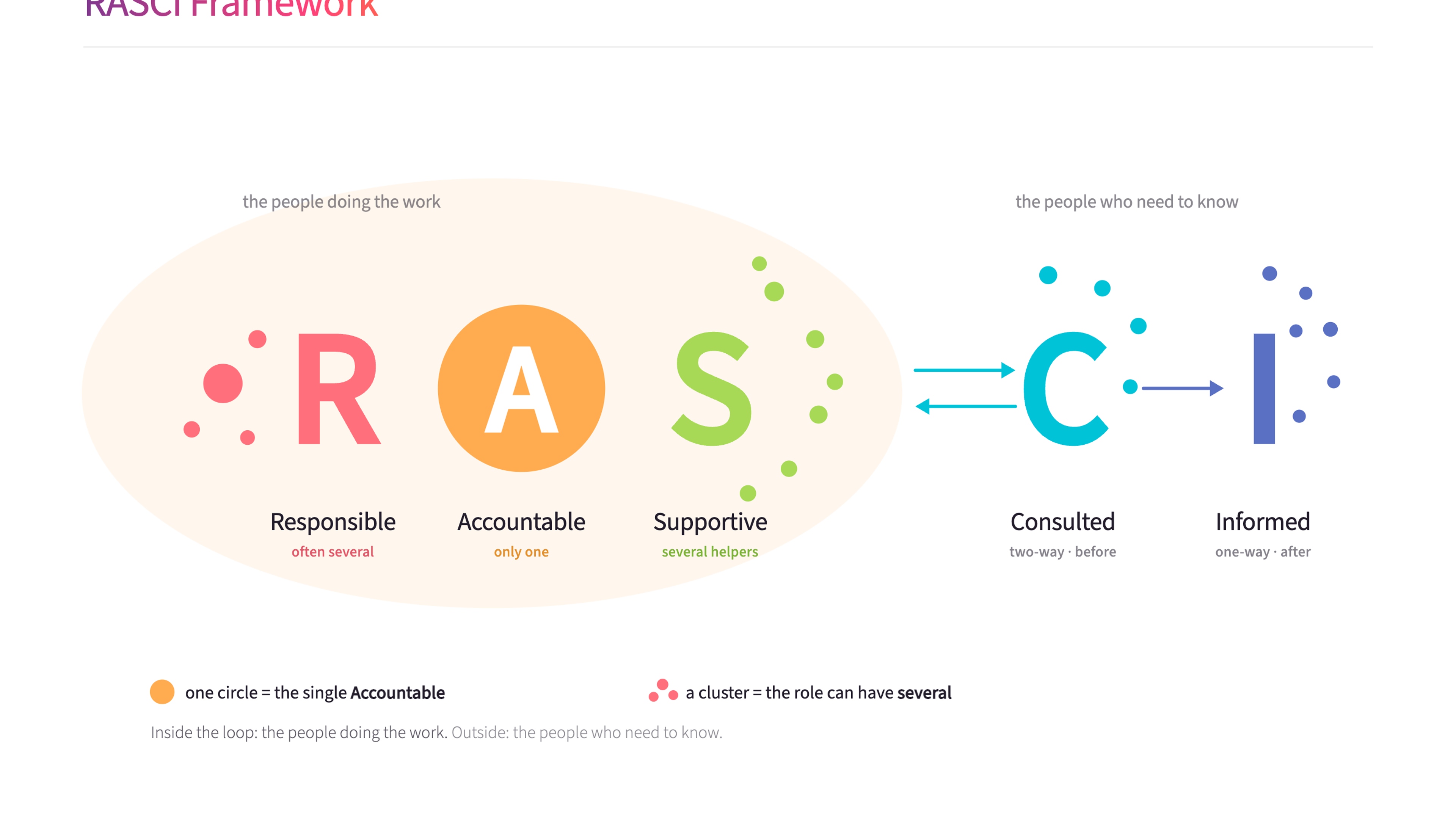
The RASCI Framework maps five roles in any project or decision - Responsible, Accountable, Supportive, Consulted, and Informed. It helps organisations clarify who does what, reducing confusion and speeding up delivery.
Psychological safety is one of the strongest predictors of team performance - but it's often misunderstood. This article explores what it actually looks like in practice, why it matters beyond the research headlines, and what leaders can do to build the conditions where honesty, learning, and real collaboration become possible.

Emotional intelligence in leadership isn't about being nice or reading a room. It's about the quality of attention you bring to how people are experiencing your leadership - and the willingness to adjust what you do based on what you notice.
Team Effectiveness Training
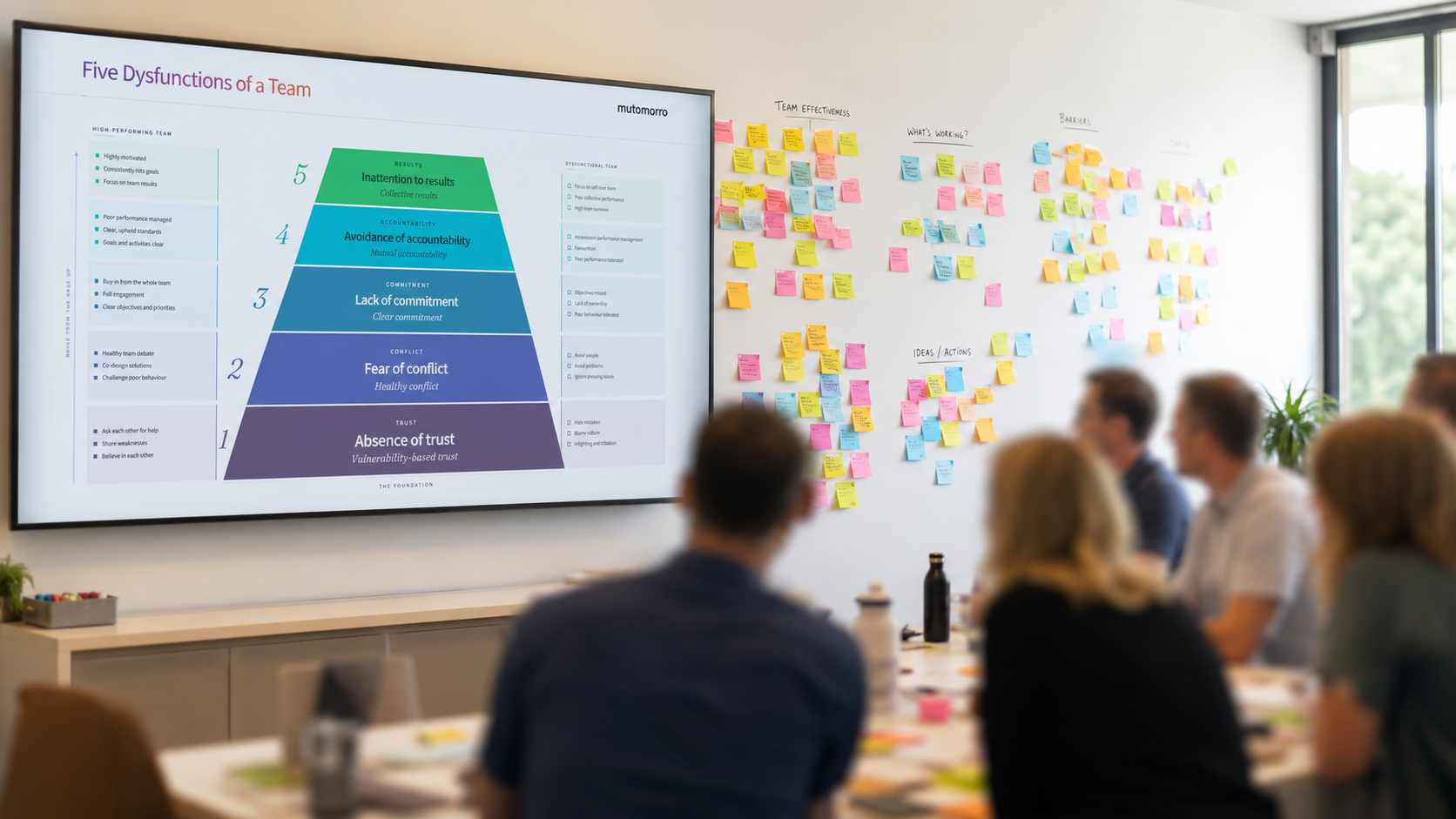
Belbin's roles are one of several lenses we use in our Team Effectiveness training, where teams learn to understand how they work together.
James Freeman-Gray is the founder of Mutomorro. He's an organisational development practitioner who has spent over twenty years working with leaders across public, private and nonprofit sectors - helping organisations pull together around a common purpose, joined up in how they work. More about who we are and what it's like to work with us.
I use Belbin when teams are struggling with collaboration but can't quite put their finger on why. It often reveals that a team is overloaded with one or two role types and missing others entirely. The conversation shifts from "why can't we work together" to "what perspectives are we missing."
Last reviewed: August 2026
Ready to use Belbin's Team Roles?
Download the free template - includes practical guidance for workshops and team sessions.
Get the free template
Want to put these ideas into practice?
Whether you're navigating a merger, rethinking how you're structured, or trying to shift a culture that isn't working - underneath, it's the same job: getting the whole organisation pulling in the same direction. Start with a conversation.