4 Stages of Psychological Safety
The 4 Stages of Psychological Safety is a framework that maps how safe people feel to be themselves, learn, contribute, and challenge the status quo. It helps leaders understand what conditions people need before they'll speak up and take risks.
Get the free template
The 4 Stages of Psychological Safety is a model, developed by Timothy R. Clark, that describes how safe people feel in a team across four ascending stages: feeling included, feeling safe to learn, feeling safe to contribute, and feeling safe to challenge the status quo. It maps the conditions a team needs before people will speak up, take risks and do their best thinking together. The further a team travels through the stages, the more openly its people can question, contribute and improve.
What are the 4 Stages of Psychological Safety?
Psychological safety is the shared sense that a group is a safe place to take interpersonal risks - to ask a question, admit a mistake, offer a half-formed idea or disagree - without fear of being embarrassed or shut down. The term comes from Harvard researcher Amy Edmondson, whose 1999 study of work teams introduced it as a shared team belief rather than an individual trait.
Timothy R. Clark built on that foundation with the 4 Stages model, set out in his 2020 book. His insight was that safety isn't a single switch - it grows in a sequence, each stage asking a little more of the team than the last. He describes the underlying exchange as rewarded vulnerability: someone takes a small risk, the group responds well, and a little more safety is earned. Repeat that often enough and a team can travel a long way.
The four stages, in order:
Stage | What it means | What people feel safe to do |
|---|---|---|
1. Inclusion safety | Belonging and acceptance | Be themselves and be part of the group |
2. Learner safety | Room to learn and grow | Ask questions, try things, make mistakes |
3. Contributor safety | A real voice in the work | Share ideas and make a difference |
4. Challenger safety | Freedom to question | Challenge the status quo and those in charge |
Before the first stage sits exclusion - the absence of safety, where people feel neither accepted nor free to take part. It isn't one of the four; it's the starting point the stages move away from.
How the 4 Stages of Psychological Safety work
The model plots safety on two axes. Respect runs up the side: how much a team values each person, their judgement and their point of view. Permission runs across the bottom: how free people are to get involved, to speak and to act. The four stages climb the diagonal between them, because safety only grows when respect and permission rise together.
That diagonal is the heart of the model. Lift one without the other and a team slips into one of two failure modes that sit in the corners:
- Paternalism - high respect, low permission. People are valued but not trusted to act for themselves. It tends to show up as well-meaning micromanagement: the team's job is to follow, not to initiate.
- Exploitation - high permission, low respect. People are handed freedom and demands but aren't valued for who they are. The team is asked to give without being given much back.
Both are uncomfortable places to work, and both stall the climb. The four stages describe what it looks like when respect and permission move up together instead.
1. Inclusion safety

Inclusion safety is the sense of belonging - that you're accepted as a member of the group for who you are, before you've proved anything. It's the foundation everything else rests on, because no one takes a risk in a room they don't feel part of.
Where it's present, people are comfortable being themselves, and differences are treated as something the team is glad to have rather than something to smooth over. Where it's thin, people stay on the edges - quiet, careful, holding back - and the team loses the perspectives it most needs.
A useful question for a team: does everyone here feel they belong, or are some people still waiting to be let in?
2. Learner safety

Learner safety is room to grow - to ask questions, try new approaches and get things wrong without it being held against you. Because learning and mistakes are inseparable, this stage lives or dies on how the team treats failure.
Teams with learner safety treat not-knowing as normal: people ask for help, admit gaps and experiment, and the group gets steadily better at what it does. Where it's absent, people hide what they don't know and avoid anything risky, and development quietly stalls.
A useful question: is it safe here to say "I don't know" or "that didn't work"?
3. Contributor safety

Contributor safety is having a real voice in the work - knowing your ideas are wanted and that they'll get a fair hearing. It turns on the equality of voices: who gets listened to, and whether quieter people get the same airtime as the most confident. Understanding how different people contribute - which Belbin's Team Roles maps in detail - helps a team make space for every voice, not just the loudest.
Where contributor safety is thin, conversations turn into people defending positions rather than exploring a problem together, and the most vocal tend to set the direction. Where it's strong, people offer ideas freely - including ones that might not land - because contributing feels welcome rather than risky.
A useful question: do people here put ideas forward, or wait to be asked?
4. Challenger safety

Challenger safety is the freedom to question the way things are done - including decisions made by people more senior - and to suggest something better. It's the most demanding stage because it asks the group to welcome being challenged, not merely tolerate it.
This is not the same as confrontation. Challenger safety is as much about how a challenge is offered and received as the challenge itself. Open questions like "why do we do it this way?" or "could we try something different?" are normal and encouraged. People pushing personal agendas or grievances in unconstructive ways are doing something else - that sits closer to the exploitation corner than to genuine challenge.
A useful question: when did someone here last question a decision from the top, and how did it go?
How are the 4 Stages of Psychological Safety used?
Most teams use the model as a shared lens rather than a score. The point isn't to land on a number, it's to have an honest conversation about where the team is and what's getting in the way. A few principles help:
- Start at the bottom. Inclusion comes before challenge - a team that doesn't feel it belongs together won't question each other safely. Work through the stages in order rather than jumping to the one that sounds most impressive.
- Read the team as it is today. Talk through where people honestly think they sit, stage by stage, before trying to move anywhere.
- Use the axes, not just the stages. The real diagnostic value is in respect and permission. High respect with low permission (paternalism) is a different problem from low respect with high permission (exploitation), and they call for different responses.
- Make it a conversation, not a verdict. The model works best when a team talks through where they think they are together, rather than a leader rating them from the outside.
Psychological safety is widely recognised as a foundation for how well teams work. Google's Project Aristotle research into team effectiveness found it to be the single biggest factor in what made their teams succeed. The 6 Team Conditions framework describes the structural conditions - a real team, a compelling direction, the right people - that make that kind of effectiveness possible in the first place. And the Five Dysfunctions of a Team model makes a related point from the other direction, placing the absence of trust at the base of everything that goes wrong.
An example
Imagine a team that has grown quickly and works well on the surface, but where ideas always seem to come from the same two or three people. Run through the stages together and the picture often sharpens. Inclusion safety is fine - everyone gets on. Learner safety is reasonable - people ask questions. But contributor safety is thin: newer members assume their ideas aren't wanted yet, so they hold back, and challenger safety barely registers because no one wants to be the first to question how things are done.
Seen through the axes, the team has plenty of respect but not much permission - a mild case of paternalism. The useful next move isn't a values exercise; it's the leaders actively inviting and acting on contributions from the quieter half of the team, so that permission catches up with the respect that's already there.
Limitations
The model is a helpful map, not a measurement. A few things are worth holding in mind:
- Real teams don't climb it cleanly. It describes a sequence, but safety can be strong in one relationship and absent in another, and a team can slip back down under pressure.
- Safety is necessary but not sufficient. A psychologically safe team still needs clear direction, the right mix of people and good ways of working to perform. Safety makes those things work; it doesn't replace them.
- Comfort is easy to mistake for safety. Quiet agreement and politeness can look like a healthy team while hiding the doubts you most need to hear. Real safety often sounds like more disagreement, not less.
- It isn't about lowering the bar. The aim isn't to make work feel nice - it's to make it safe enough to surface hard truths, which raises standards rather than softening them.
Getting started
The simplest place to start is a conversation. Share the four stages with your team and ask people, honestly, where they think the team sits and why - you'll learn as much from the disagreement as the agreement.
From there, focus on the stage just above where the team is now rather than the one at the top: if inclusion is shaky, challenger safety can wait. And model it yourself - ask for help, admit when you're not sure, and respond well when someone takes a risk in front of you. Each time vulnerability is rewarded rather than punished, a little more safety is earned. This is the kind of foundation our organisational development work tends to start from, because the way a team is able to talk to each other shapes almost everything else it does - the culture it enacts day to day as much as the results it gets.
We share thinking on organisational change and development on LinkedIn - practical ideas for people doing this work inside their own organisations.
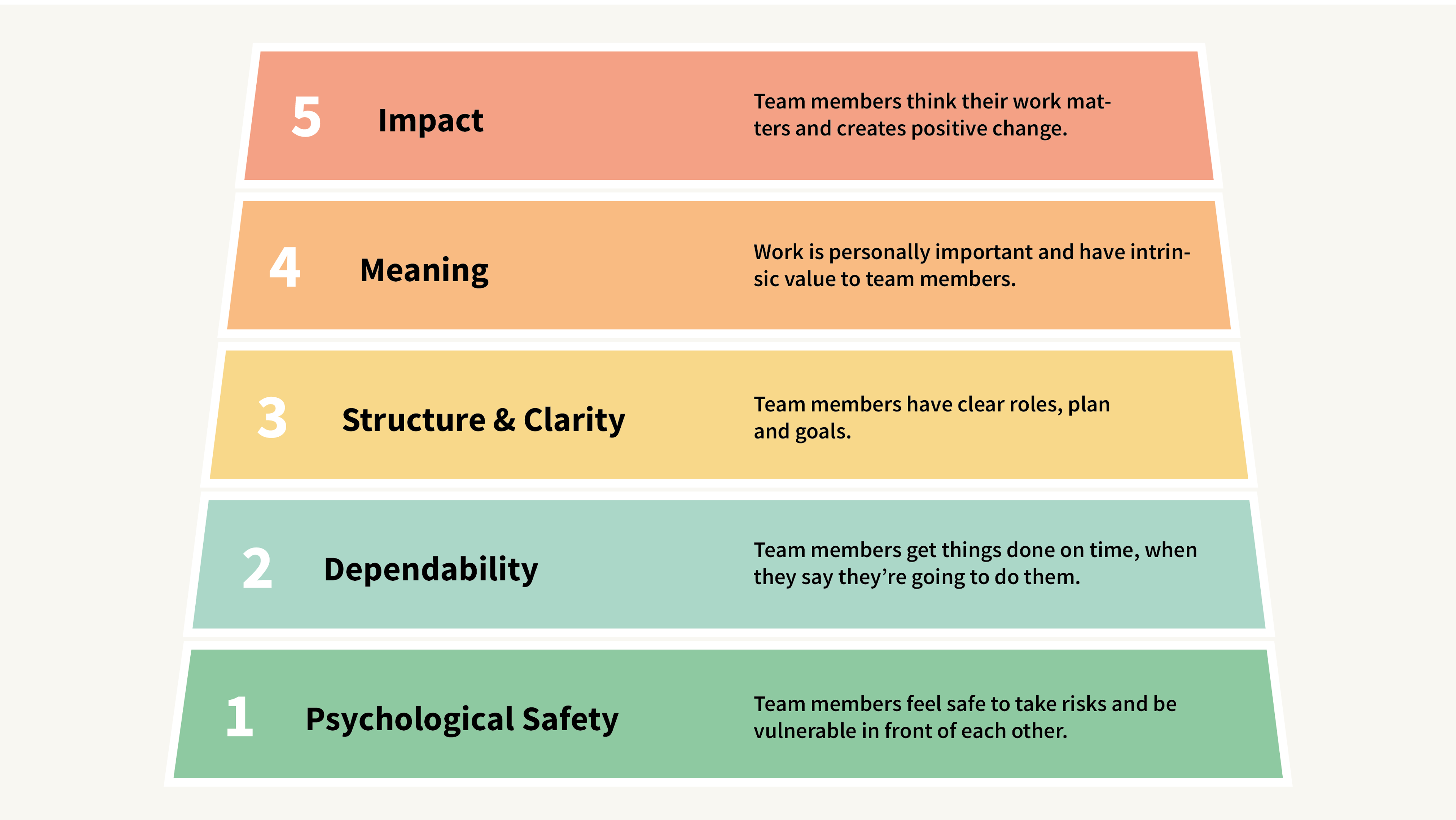
Project Aristotle is Google's research into what makes teams effective. It found that psychological safety - feeling safe to take risks and be vulnerable - matters more than who is on the team.
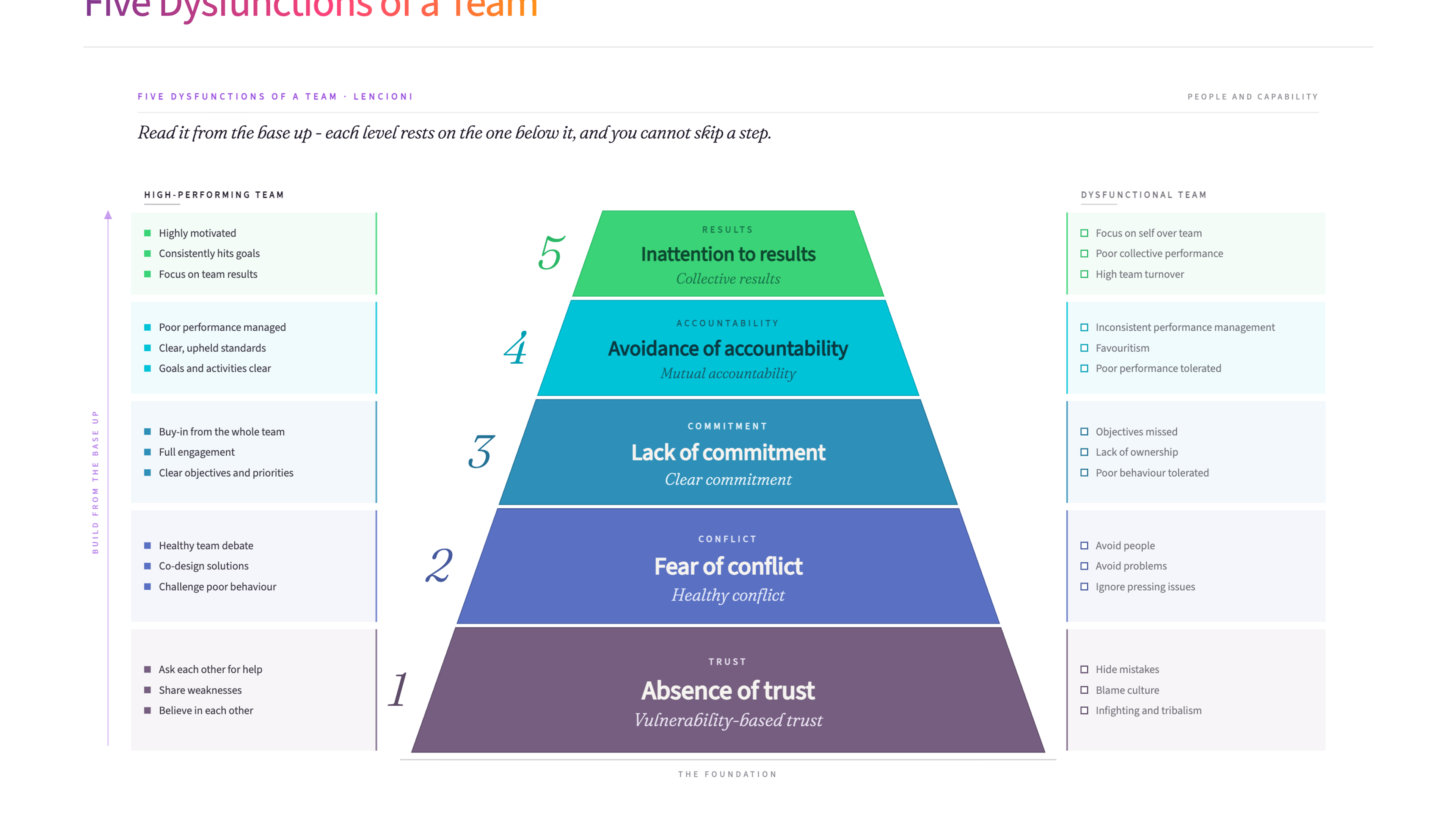
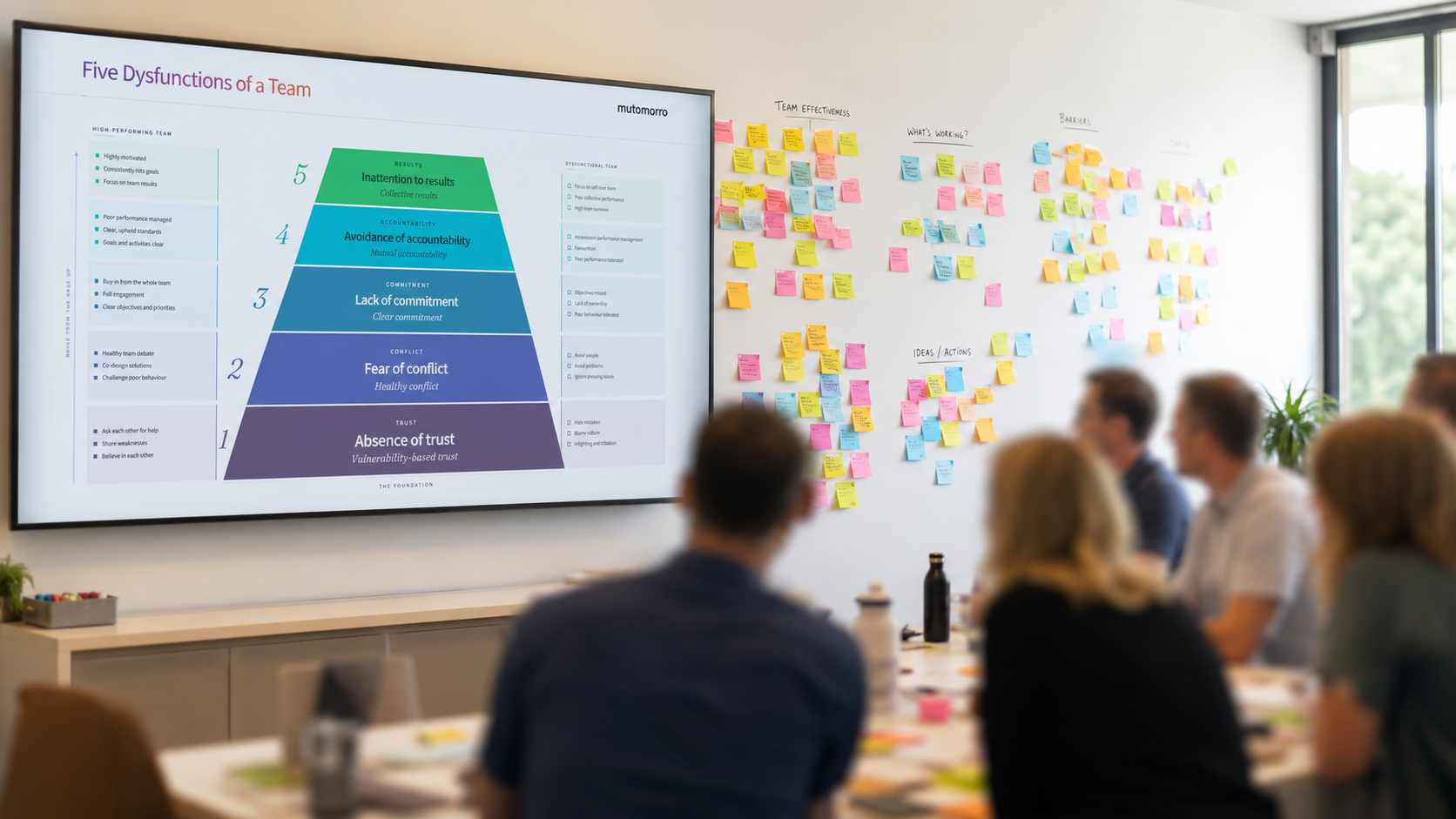
The Five Dysfunctions of a Team is Patrick Lencioni's framework for understanding why teams struggle. It maps five connected problems - from absence of trust to inattention to results - that build on each other when left unaddressed.
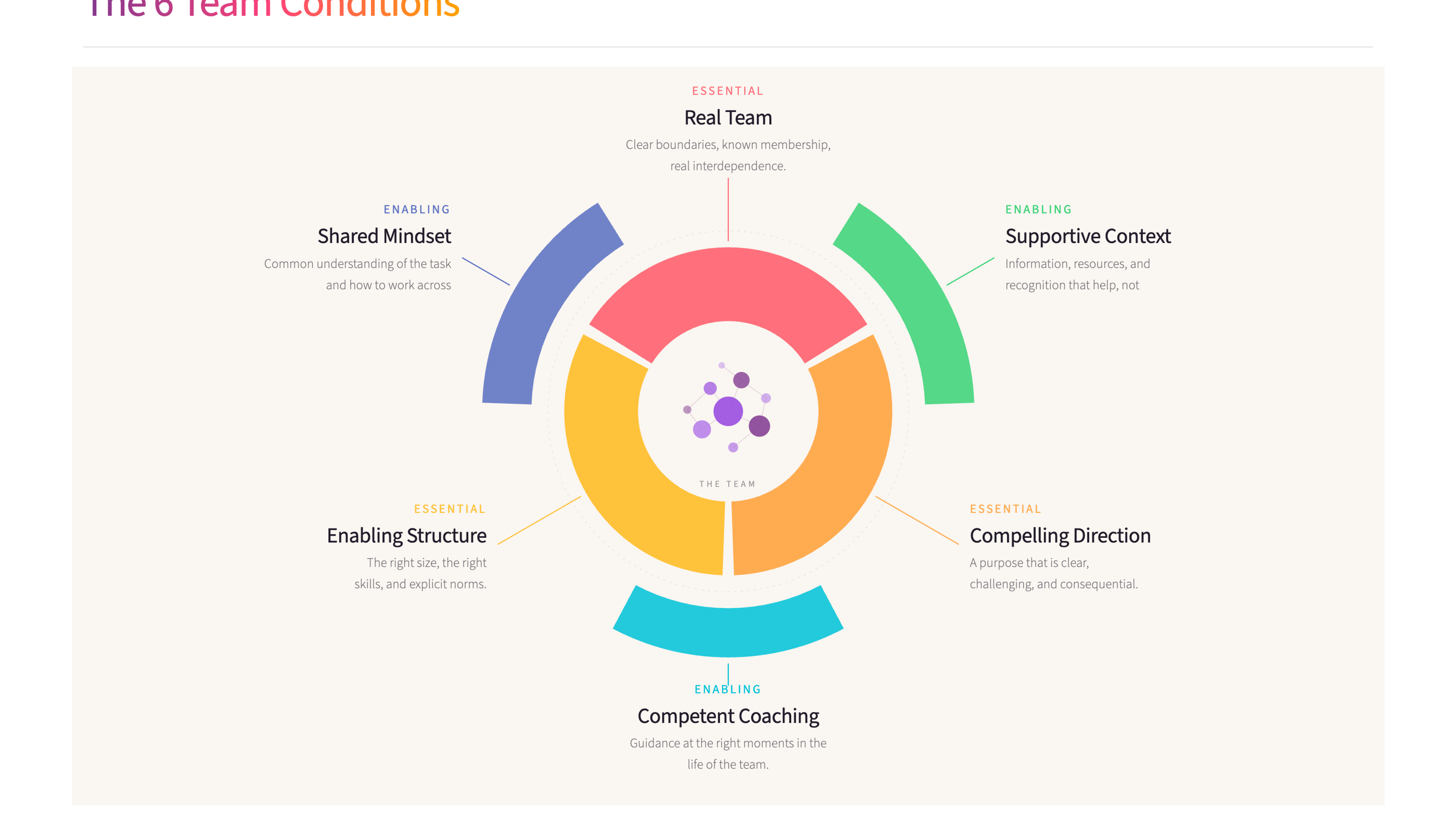
The 6 Team Conditions for Team Effectiveness is a research-based framework that identifies what high-performing teams actually need to thrive. It covers everything from having a clear direction to getting the right coaching and support.
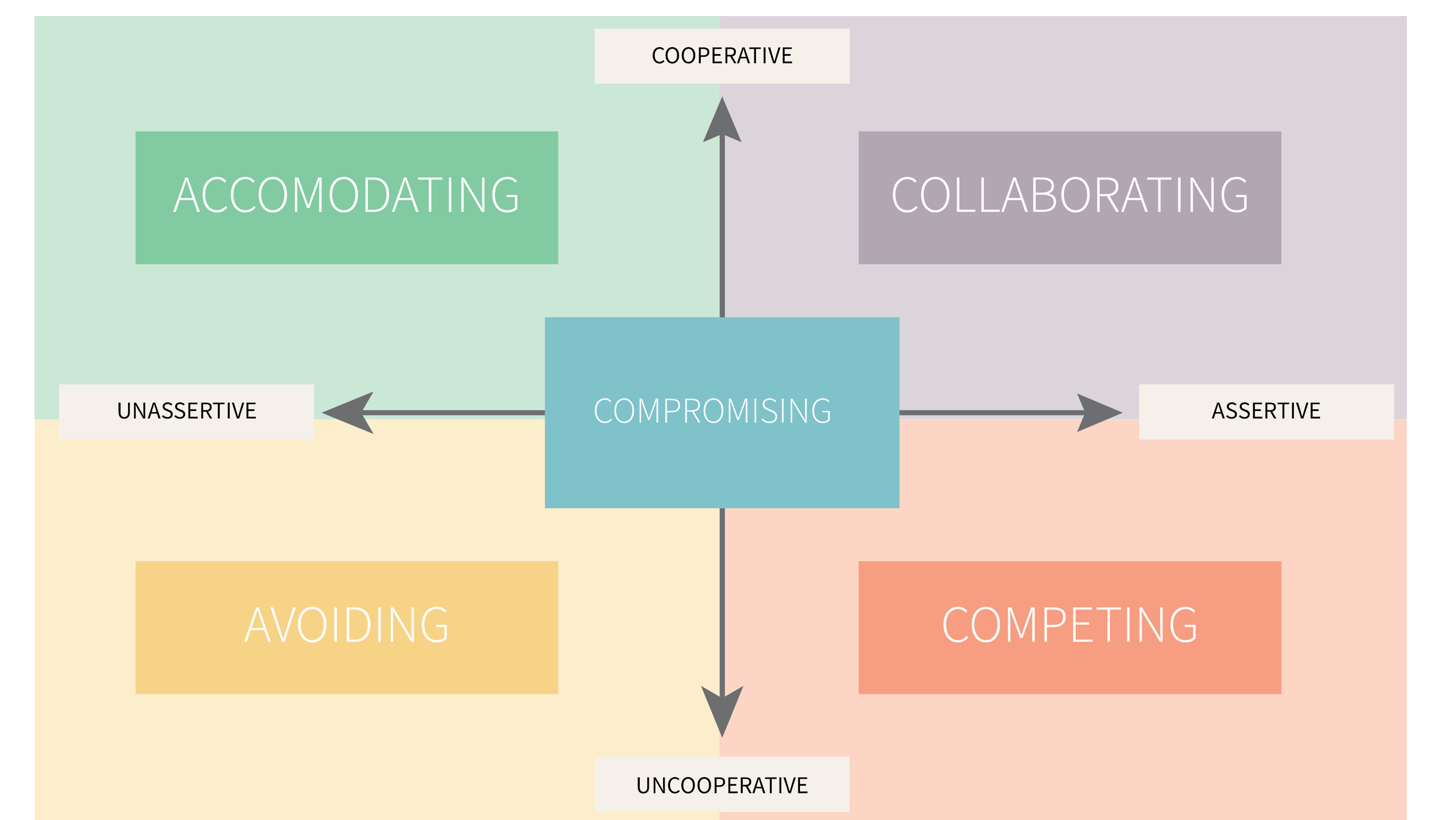
The 5 Conflict Styles model (Thomas-Kilmann) maps five different ways people approach conflict - from avoiding it to collaborating through it. It helps teams understand their default patterns and choose more effective approaches.
Psychological safety is one of the strongest predictors of team performance - but it's often misunderstood. This article explores what it actually looks like in practice, why it matters beyond the research headlines, and what leaders can do to build the conditions where honesty, learning, and real collaboration become possible.

Emotional intelligence in leadership isn't about being nice or reading a room. It's about the quality of attention you bring to how people are experiencing your leadership - and the willingness to adjust what you do based on what you notice.
A practical guide to developing organisational culture. Cuts through the theory to explain what culture actually is, why most culture change programmes fail, and how to develop culture in a way that lasts - by working with your organisation as a living system, not a machine.
Team Effectiveness Training
Psychological safety is foundational to how teams work, and it runs through our Team Effectiveness training as one of several lenses we use.
James Freeman-Gray is the founder of Mutomorro. He's an organisational development practitioner who has spent over twenty years working with leaders across public, private and nonprofit sectors - helping organisations pull together around a common purpose, joined up in how they work. More about who we are and what it's like to work with us.
Timothy Clark's four stages framework gives leaders a practical way to build safety in their teams incrementally. I've found it especially useful because it sequences the work - you can't expect people to challenge the status quo (stage 4) if they don't first feel safe to contribute ideas (stage 3). Starting at the right stage matters.
Last reviewed: June 2026
Ready to use 4 Stages of Psychological Safety?
Download the free template - includes practical guidance for workshops and team sessions.
Get the free template
Want to put these ideas into practice?
Whether you're navigating a merger, rethinking how you're structured, or trying to shift a culture that isn't working - underneath, it's the same job: getting the whole organisation pulling in the same direction. Start with a conversation.