Gemba Walk
A Gemba Walk is a Lean practice where leaders go to the place where work actually happens to observe, listen, and understand. It bridges the gap between how leaders think work gets done and how it really gets done.
Get the free template
A Gemba Walk is a structured observation practice where leaders leave their desks, go to where work actually happens, and watch the real process unfold. The idea is simple but the shift is significant: instead of relying on reports, dashboards, or second-hand accounts, you go and see for yourself.
What is a Gemba Walk?
The word "gemba" comes from Japanese and means "the real place" - the place where value is created. In a hospital, that might be a ward. In a software company, it might be a sprint planning session. In a warehouse, it's the floor where orders are picked and packed.
A Gemba Walk is the practice of going to that place, observing how work flows, listening to the people doing it, and using what you learn to make things better. It originated in the Toyota Production System, where Taiichi Ohno insisted that managers could not understand a process without physically seeing it. The principle has since spread well beyond manufacturing into healthcare, technology, professional services, and the public sector.
The core insight is straightforward: there is almost always a gap between how leaders think work gets done and how it actually gets done. Reports and metrics tell you what happened. A Gemba Walk shows you why.
Three principles sit at the heart of the practice:
- Go see - be physically present where the work happens, not relying on summaries
- Ask why - seek to understand the process, not to judge or fix
- Show respect - the people closest to the work understand it best
A Gemba Walk is not an audit, not an inspection, and not a surprise visit. It's a discipline of curiosity. Done well, it builds trust between leaders and teams while surfacing improvements that no dashboard would reveal.
How a Gemba Walk works
A Gemba Walk follows six stages, forming a loop that you repeat regularly. It's a discipline, not a one-off exercise - the value builds with each cycle as your understanding of the work deepens.
Step | Focus |
|---|---|
Prepare | Choose one process, decide who walks, brief the team in advance |
Go | Leave the desk and be present where the work happens |
Observe | Watch the flow without intervening - where it moves, where it stalls |
Ask | Open questions; listen rather than lead or fix |
Document | Capture what you saw and heard while it's fresh |
Follow up | Debrief, decide on a few changes, close the loop with the team |
1. Prepare

Before walking anywhere, get clear on what you're looking at and why. Choose a specific process to observe - not the whole operation, just one flow of work from beginning to end. This might be how a customer complaint gets resolved, how a new starter gets onboarded, or how a product moves from assembly to dispatch.
Decide who will walk. A small group works best - two to four people - and ideally includes someone who doesn't work in that area day to day. Fresh eyes notice things that familiarity hides.
Brief the team doing the work ahead of time. A Gemba Walk works on openness, not surprise. People need to know you're coming, why you're coming, and that you're there to understand the process - not to evaluate them.
2. Go

This is the step that sounds obvious but changes everything. Leave the office, the meeting room, the dashboard. Physically go to where the work happens.
The transition matters more than it seems. Reports compress reality into numbers. Conversations filter it through interpretation. Being present lets you see the hesitations, workarounds, physical distances, interruptions, and waiting that no summary captures.
If you're working with distributed or remote teams, a Gemba Walk can still happen - through screen-sharing a real workflow, joining a live process session, or walking through the tools someone uses in real time. The principle is the same: observe the actual work, not a presentation about the work.
3. Observe

Watch the process unfold without intervening. This is harder than it sounds - most leaders are wired to solve problems the moment they spot one. On a Gemba Walk, the job is to see, not fix.
Pay attention to the flow of work: where does it move smoothly? Where does it stall? Where do people have to work around the system rather than with it? Look for the gaps between the intended process and what actually happens.
The 8 Wastes of Lean give you a useful lens here - categories like waiting, unnecessary motion, and overprocessing help you name what you're seeing. But don't walk in with a checklist that narrows your vision. Observe first, categorise later.
Notice the physical environment too. Is information visible where people need it? Are tools and materials within reach? Does the layout support the flow of work or work against it?
4. Ask

Once you've observed, engage with the people doing the work. Ask open questions that invite them to explain the process in their own words:
- "Can you walk me through what happens next?"
- "What makes this step straightforward on a good day?"
- "Where do you find yourself waiting or working around something?"
- "If you could change one thing about this process, what would it be?"
The key discipline is listening, not leading. Resist the urge to suggest solutions, share your theories, or explain why things are the way they are. You're there to understand their experience of the work, not to test your assumptions about it.
Ask follow-up questions. "Tell me more about that" and "what happens when that goes wrong?" are some of the most useful things you can say.
5. Document

Record what you observed and heard while it's fresh. This doesn't need to be elaborate - a few clear notes capturing what you saw, what surprised you, what questions remain, and any patterns that stood out.
Process Mapping can help here. If you sketch the flow of work as you observed it - not as the procedure manual says it should go - you create a powerful visual record of reality versus intention.
Some teams use a simple three-column format: what we saw, what we heard, what we want to explore further. The format matters less than the habit of capturing it consistently, because a single walk gives you a snapshot. A series of documented walks gives you a pattern.
6. Follow up

This is where Gemba Walks succeed or fail. If observations lead to nothing, people will quickly see the walk as a management exercise with no real purpose - and they'll stop being open with you.
Debrief with the walking team first. Compare observations, identify the two or three most significant findings, and decide what to do about them. Not everything needs a major project - some improvements are small, practical changes that can happen quickly.
Then close the loop with the team you observed. Share what you noticed, what you're planning to do about it, and what you'd like to explore next time. This builds the trust that makes future walks more productive.
Gemba Walk observations feed naturally into Kaizen improvement cycles - turning what you see into small, practical changes that compound over time. The walk surfaces the reality; the improvement cycle acts on it.
How to use a Gemba Walk
A Gemba Walk works best as a regular rhythm, not a special event. Weekly or fortnightly walks keep leaders connected to operational reality and create a steady stream of small improvements.
Start with one process. Don't try to observe everything at once. Pick a single flow of work - ideally one where you suspect the gap between how you think it works and how it actually works might be significant.
Keep it short. A focused walk of 30 to 45 minutes is more useful than a two-hour marathon that loses energy. You're building a discipline, not conducting a comprehensive review.
Rotate where you walk. Over time, cover different processes, different teams, and different times of day. A process that runs smoothly at 10am might look very different at 4pm or during a busy period.
Separate observation from action. The walk is for seeing and understanding. Decisions about changes happen afterwards, with proper thought and the right people involved. This separation protects both the quality of your observation and the trust of the people you're observing.
Make the follow-up visible. When a Gemba Walk leads to a change - even a small one - make sure the team knows the connection. "We noticed this during the walk, so we've adjusted that" is the single most powerful thing you can do to make the next walk more valuable.
Your operational effectiveness improves most when leaders maintain a genuine, ongoing connection to how work actually flows - not just how it's designed to flow.
Example
A regional manager in a housing association decides to Gemba Walk the repairs scheduling process. She knows the team handles roughly 200 repair requests per week, and tenant satisfaction scores for repairs have been declining.
She tells the scheduling team she'll be spending a morning with them, observing how requests come in and get allocated. No agenda beyond understanding the process.
What she sees surprises her. The scheduling system works well for routine jobs, but urgent requests create a cascade of manual rescheduling. Each urgent job displaces two or three routine ones, and the schedulers spend significant time phoning tenants to rearrange. The system doesn't flag the knock-on effect - it just shows the next available slot.
She asks the team what they'd change. Their answer is immediate: a simple priority buffer - two unallocated slots per day reserved for urgent work - would eliminate most of the rescheduling. They've suggested it before, but it got lost in a larger system review that never completed.
The buffer is implemented the following week. Rescheduling calls drop by 60% within a month. The improvement came not from a new system or a consultancy engagement, but from a leader who went to where the work happened and listened.
Limitations
A Gemba Walk is a powerful observation tool, but it has boundaries worth understanding.
It captures a snapshot, not the full picture. What you see on one walk reflects that day, that team, that time. Patterns only emerge over multiple walks - drawing conclusions from a single observation is risky.
Observer effect is real. People behave differently when they know they're being watched. Some will perform more carefully than usual; others will highlight problems they want management to see. Neither is the unfiltered reality. Regular walks reduce this effect over time as the practice becomes normal.
It's not a substitute for data. A Gemba Walk shows you why things happen, but it doesn't tell you how often or at what scale. Pair observations with operational data to understand both the story and the numbers.
It requires genuine follow-through. A Gemba Walk without action is worse than no walk at all. It signals that leadership is interested in observing but not in changing - and it erodes the trust you need for honest conversations.
It works at process level, not system level. A Gemba Walk is excellent for understanding how a specific process operates. For understanding how multiple processes interact, or how organisational design shapes operational outcomes, you'll need complementary approaches.
Getting started
Pick one process that matters to your team's performance and that you haven't personally watched end-to-end in the last six months. Tell the team you'd like to spend 30 minutes observing how it works - not evaluating, just understanding. Bring a notebook, leave your laptop, and focus entirely on what you see and hear. Afterwards, write down three things that surprised you. That's your first Gemba Walk - and the beginning of a practice that gets more valuable every time you do it.
We share thinking on organisational change and development on LinkedIn - practical ideas for people doing this work inside their own organisations.
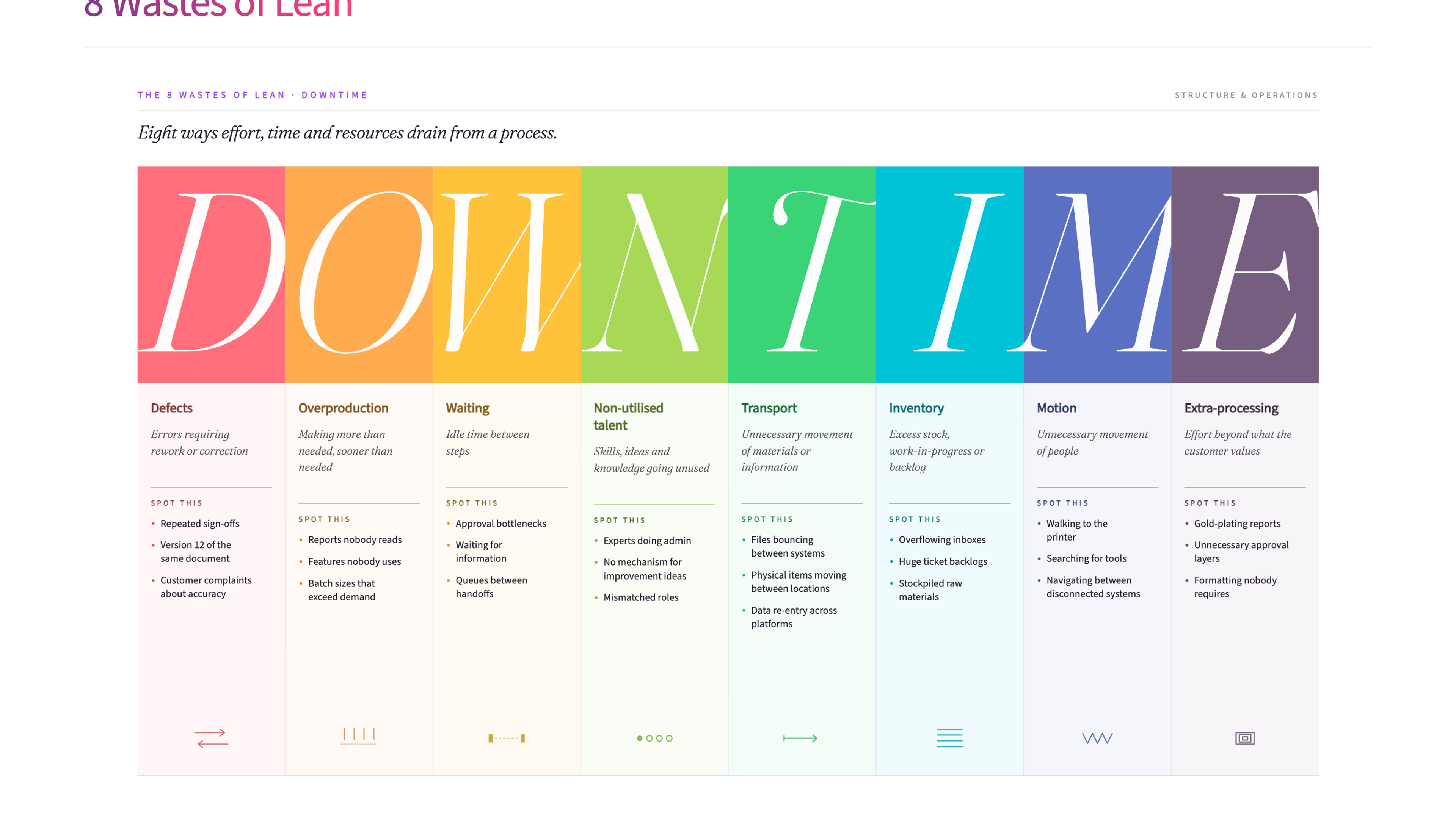
The 8 Wastes of Lean give you eight categories for finding where effort, time and resources leak from a process. Use the DOWNTIME acronym to work through each waste type systematically and build a clear picture of what to improve.
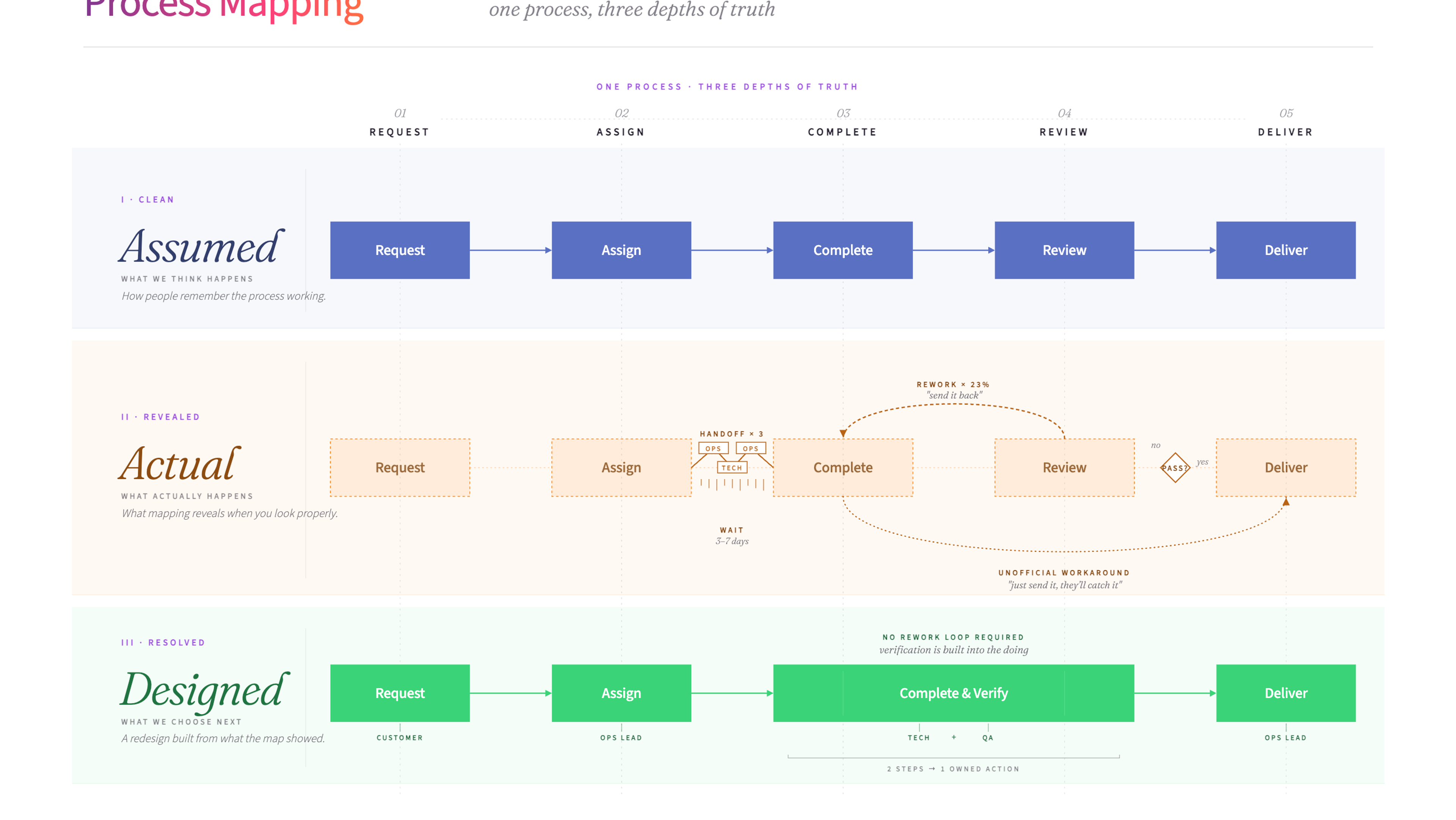
Process mapping is a visual method for documenting how a process works from start to finish. It helps teams see the full picture - every step, decision point, and handoff - so they can spot problems and design improvements.
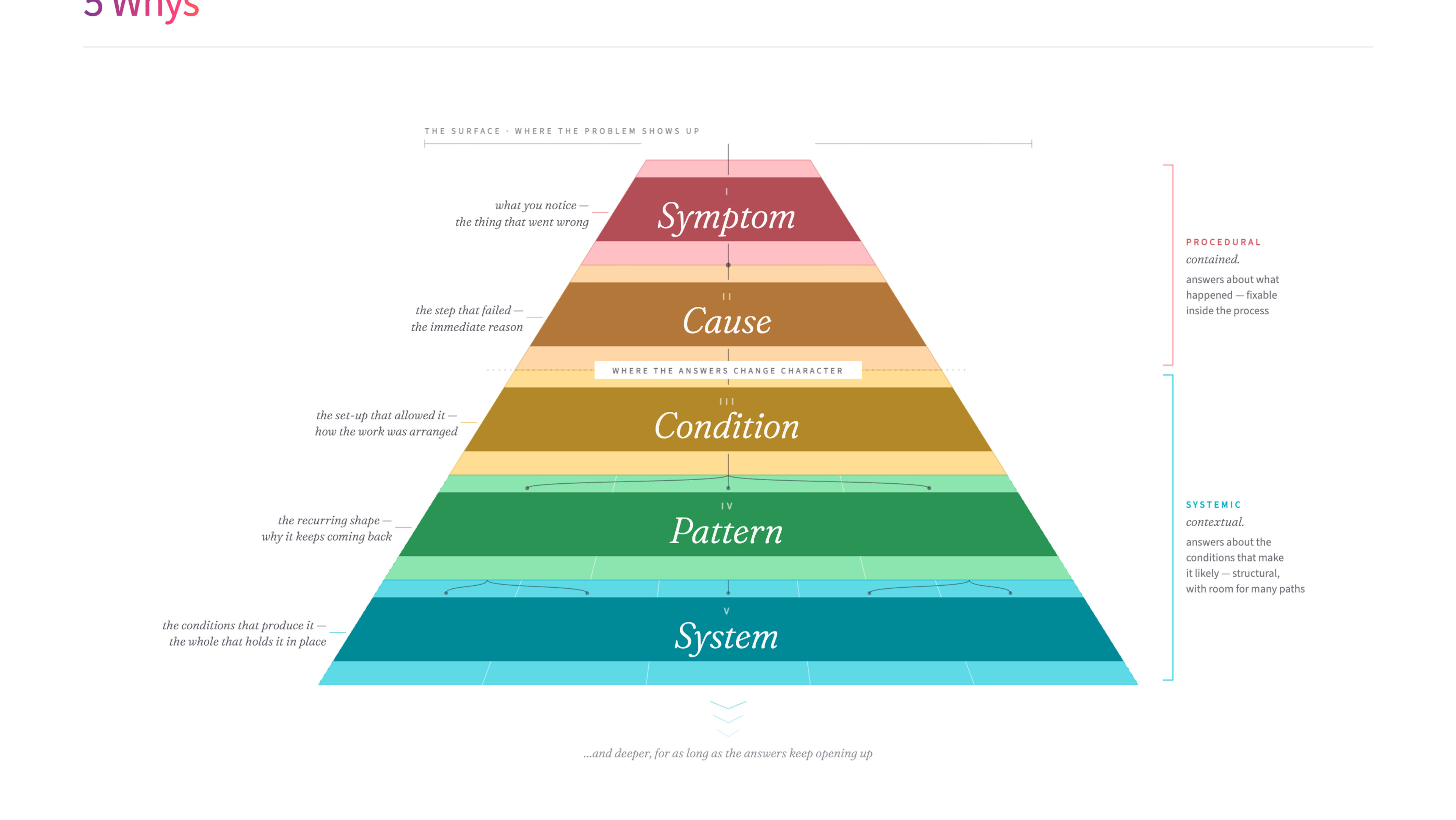
The 5 Whys is a simple root-cause analysis technique that drills into problems by asking "why?" repeatedly. It helps teams get past surface-level symptoms to find the real cause of an issue.
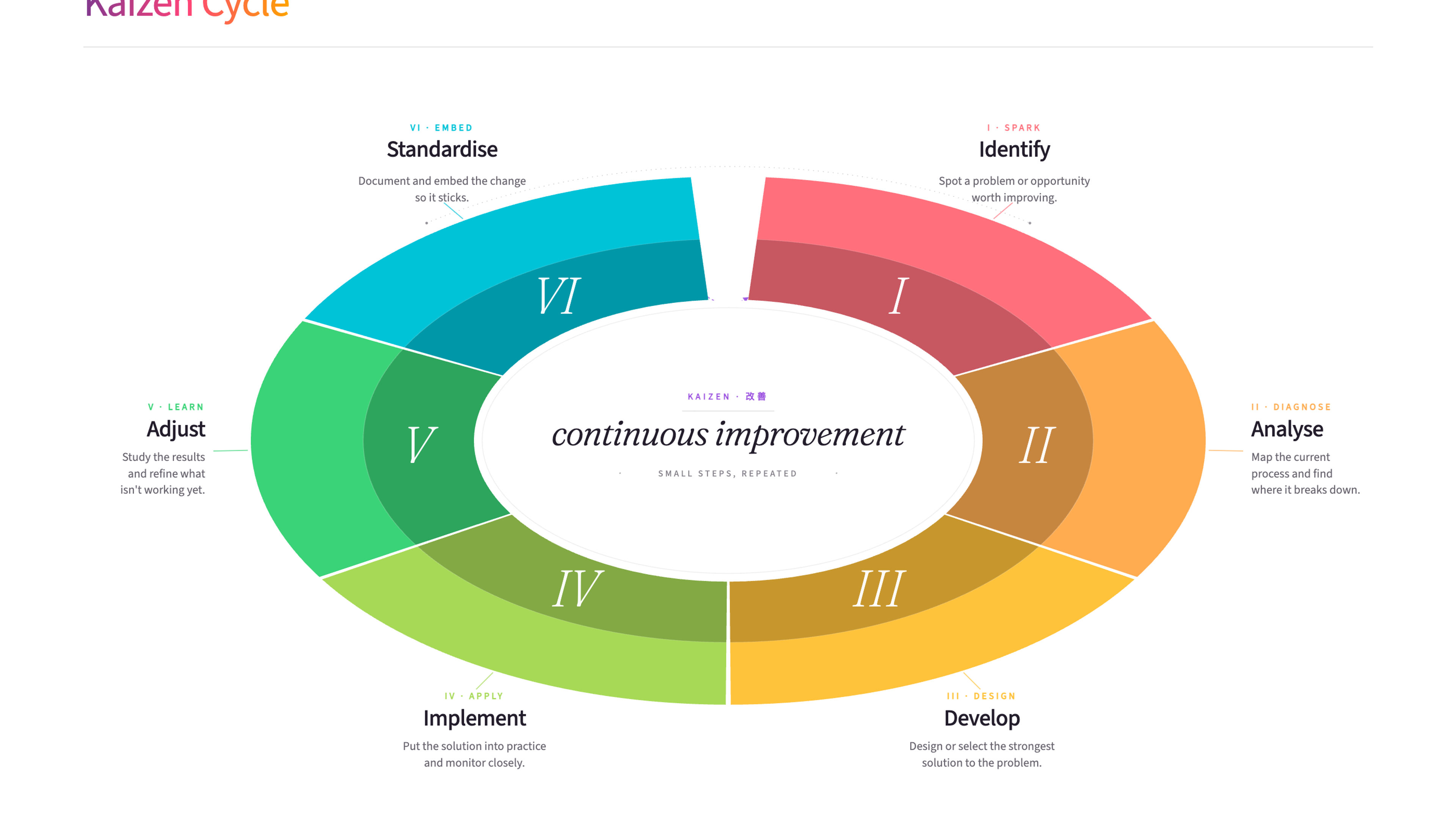
Kaizen is a Japanese continuous improvement philosophy built on the idea that small, ongoing changes add up to significant results over time. The Kaizen Cycle gives teams a structured way to identify improvements, test them, and build them into everyday work.
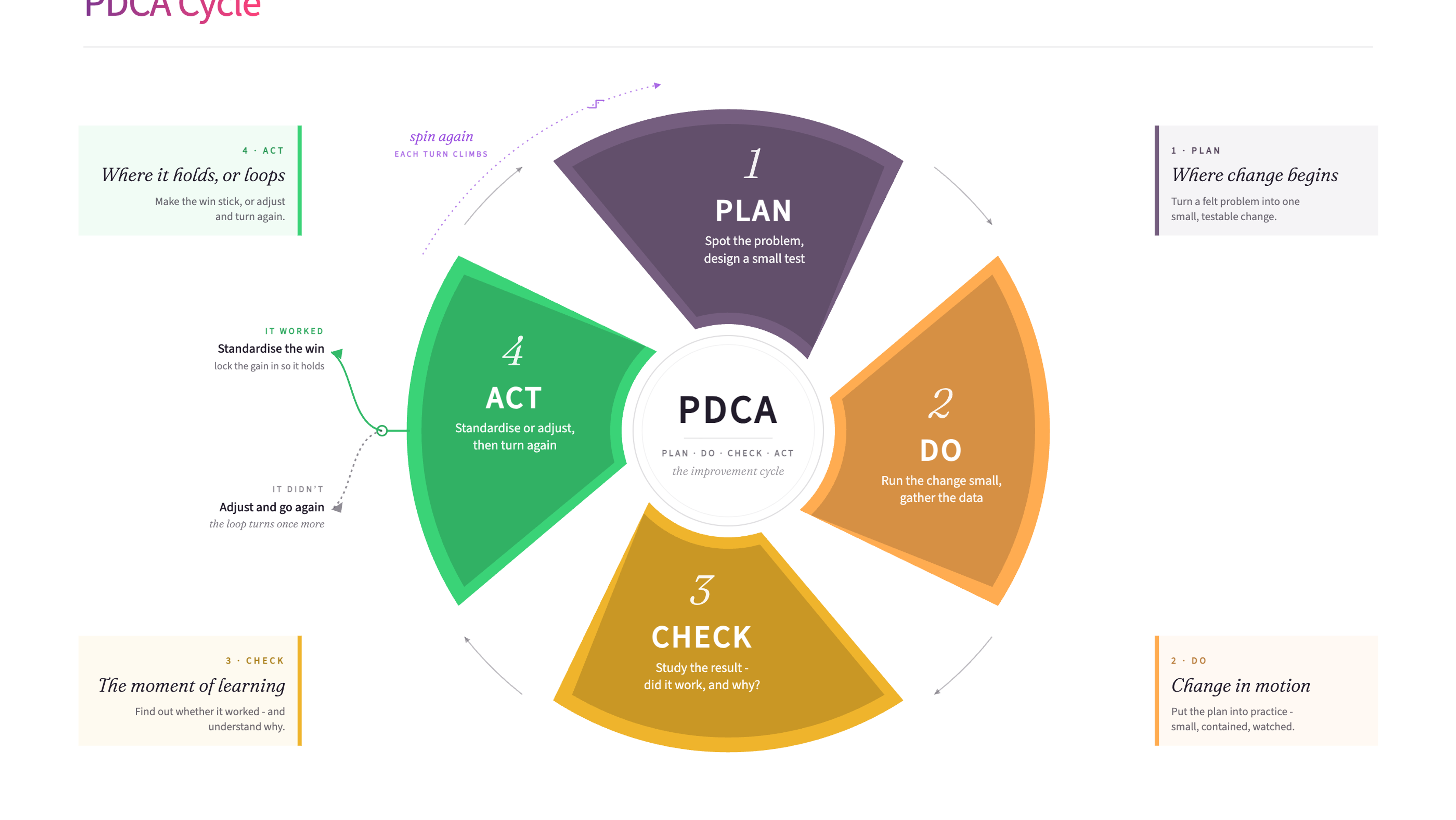
The PDCA Cycle (Plan, Do, Check, Act) is a continuous improvement framework for testing and refining processes. It creates a repeating loop of planning a change, trying it, checking whether it worked, and adjusting before the next round.

Every organisation has friction - the unnecessary effort, the needless complexity, the things that make simple work harder than it should be. This article explores how to find it, understand where it comes from, and reduce it without creating new problems in the process.
Most organisations run on invisible infrastructure - the corridor conversation, the person who just knows, the relationships that bridge gaps between teams. Growth puts all of it under pressure. Scaling well means designing what replaces it.
Continuous Improvement Training
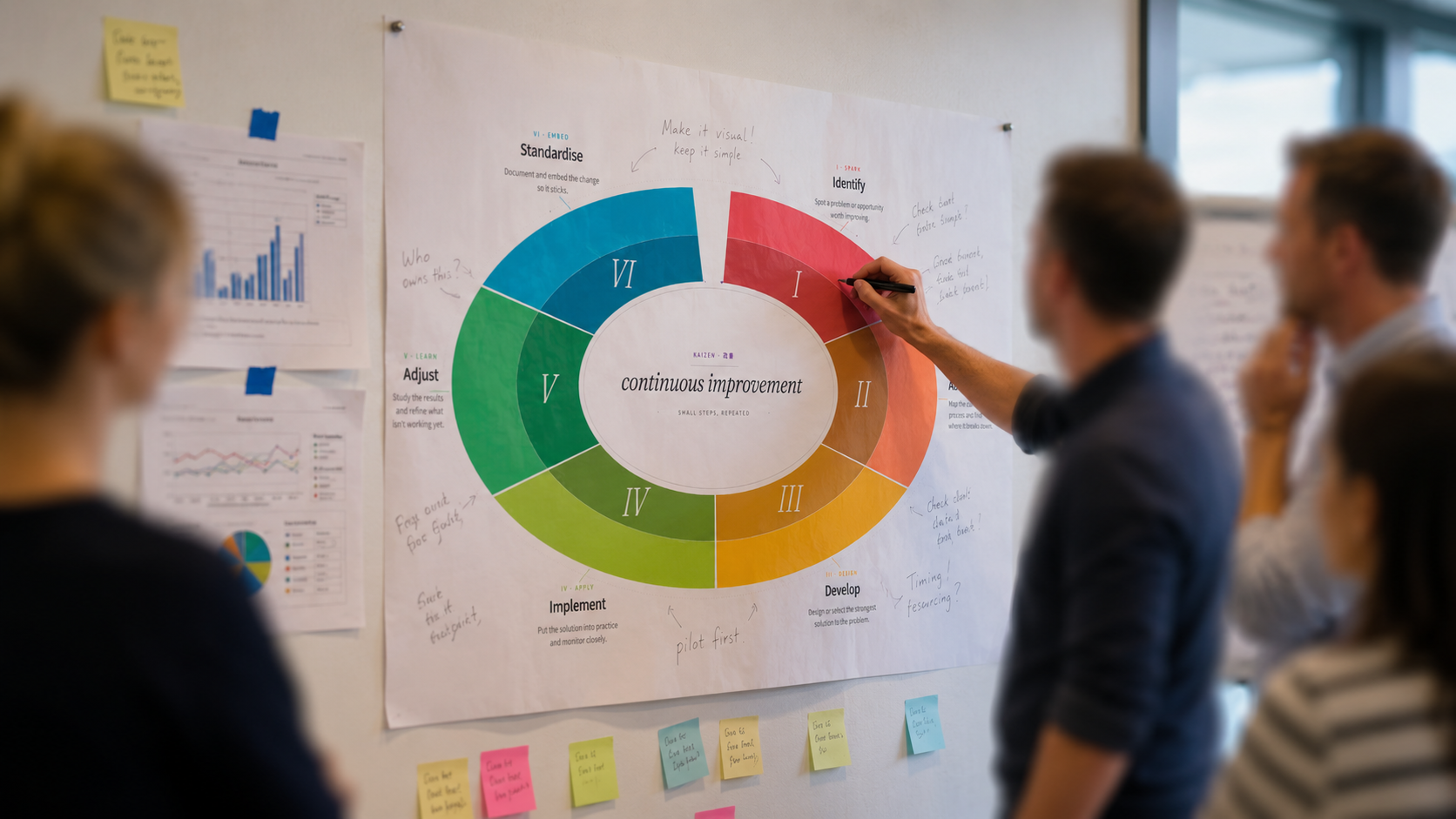
Going to see the work for yourself is at the heart of the Gemba walk, one of several practices we use in our Continuous Improvement training.
James Freeman-Gray is the founder of Mutomorro. He's an organisational development practitioner who has spent over twenty years working with leaders across public, private and nonprofit sectors - helping organisations pull together around a common purpose, joined up in how they work. More about who we are and what it's like to work with us.
The Gemba Walk is a powerful tool I recommend to leaders who feel disconnected from how work happens. Going to where the work is done and observing - without an agenda, without judgment - reveals things that no report or dashboard ever will. I've seen it fundamentally shift how leaders understand their organisations.
Last reviewed: June 2026
Ready to use Gemba Walk?
Download the free template - includes practical guidance for workshops and team sessions.
Get the free template
Want to put these ideas into practice?
Whether you're navigating a merger, rethinking how you're structured, or trying to shift a culture that isn't working - underneath, it's the same job: getting the whole organisation pulling in the same direction. Start with a conversation.