Scenario Planning Workshop
A day spent learning to plan for an uncertain future - by planning for yours. Your leadership team leaves with a set of scenarios built around your organisation, a strategy tested against them, and the skill to run the process again.

Half-day, one day or multi-day · in person or online · for your leadership team
Why plan for more than one future
The world your organisation works in keeps changing. Some of those changes you can see coming. Others will catch you out. The useful question isn’t whether things will change - it’s whether your strategy is ready for more than one version of what comes next.
Most strategy quietly bets on a single forecast: the future we expect, planned for as if it’s the future we’ll get. Scenario planning does something steadier. Instead of one bet, you build several plausible futures and look for the strategic choices that hold up across all of them.
This workshop is a structured day for doing that thinking properly - together, as a leadership team, on your actual strategy. If what you’re after is the method itself - what scenario planning is and how the core tools work - our free 2×2 Scenario Matrix and PESTLE Analysis cover that ground. This page is about putting them to work on your organisation.
What you’ll build in the workshop
Two things leave the room with you.
The first is a set of scenarios built around your organisation - not generic futures pulled from a trend report, but specific, plausible stories about how your operating environment could change, and what each would mean for you. Alongside them, a stress-tested view of your current strategy: where it holds up across the scenarios, where it breaks, and which assumptions it quietly rests on.
The second is the method. Because your team builds the scenarios rather than watching someone else build them, you learn the process from the inside - how to scan for the forces that matter, how to turn uncertainty into useful scenarios, and how to test a strategy against them. Strategic foresight becomes something you can return to, not a one-off day. When the ground shifts again, you’ll be able to run the process yourselves.
Scenario planning workshop formats and pricing
Three ways to run it, depending on what you’re working through.
Half-day | One day | Multi-day | |
|---|---|---|---|
Best for | A single strategic question, or a first set of scenarios | A strategy that needs properly stress-testing across several futures | Organisation-level foresight, or several strategic questions and business units |
You leave with | A first set of scenarios and a clear note of what to test | A complete set of scenarios and a stress-tested strategy | Connected scenarios and strategic implications across the organisation |
Group | Up to ~8 | Up to ~12 | Shaped to you |
Price | Starting at £2,400 + VAT | Starting at £4,390 + VAT | Scoped together |
Every format runs in person at your place or online. Registered charities and social enterprises get a nonprofit discount - just mention it when you get in touch.
How the workshop works
Scanning the horizon
Before you can build a scenario, you need a clear view of what’s actually moving around you. You’ll use structured techniques to pick out the trends, uncertainties and possible disruptions that matter most to your organisation - sorting the external forces (political, economic, social, technological, legal, environmental) into something you can work with. This isn’t about reading more trend reports. It’s about building the habit of looking outward and thinking critically about what you see.
Building scenarios
With the forces that matter identified, you’ll build a set of plausible futures - usually three or four, different enough from each other to stretch your thinking. The 2×2 approach gives you the structure: take two of your biggest uncertainties, cross them, and four distinct futures fall out. The skill is making each one vivid and specific enough to be useful without tipping into prediction. Good scenarios aren’t forecasts. They’re stories that help you think.
Stress-testing your strategy
This is where the value lands. You’ll take your current strategy and run it against each scenario in turn. Where does it hold? Where does it break? What is it quietly assuming, and how safe are those assumptions? You’ll come out with the strategic choices that work across several futures, and a clear view of the vulnerabilities worth addressing now - a more resilient basis for the decisions you have to make.
The arc compressed: scanning and a first set of scenarios, with a light pass at stress-testing. You leave with scenarios to work from and a clear note of what to test next.
The full arc, with proper time on building the scenarios and stress-testing the strategy against them. The work leaves the room tested, not just sketched.
The arc run across several strategic questions or business units, plus the connective layer - how the futures and their implications add up across the organisation.
Who the workshop is for
Leadership teams and senior people responsible for setting direction - in businesses, public sector bodies, charities, and any organisation whose plans depend on an environment it doesn’t fully control.
It tends to land at three moments: a strategy being set or refreshed, a big decision that hinges on how the future plays out, or a stretch of real uncertainty - a changing market, a shifting policy landscape, a sector in transition - where the usual planning assumptions feel shakier than they used to. And it works best when the people who make the strategic calls are in the room together, because the scenarios you build and the conversations they spark are most useful when everyone owns them.
Start with the free tools
The best warm-up for the workshop is free. Our 2×2 Scenario Matrix walks through the core structure you’ll use on the day, and the PESTLE Analysis helps you get a first read on the forces shaping your environment. Plenty of teams arrive having roughed something out with these - which makes the day quicker, because you come with questions rather than a blank page.
Or we can run it for you
This workshop teaches your team to run scenario planning - that’s the point of it. But sometimes the method isn’t what you need; what you need is the thinking done well, with your leadership team in the room and someone else holding the pen and the process. That’s facilitation rather than training, and we do that too - working alongside you on the strategy itself. Same care, different kind of day.
What makes this workshop different
Scenario planning earns its keep when it’s tied to a real decision. A lot of foresight work stops at the interesting-but-abstract stage - a set of futures that never quite touch the strategy. We build the day the other way round: around the choices you’re actually facing, so what you leave with is something to act on rather than a document that gathers dust.
We also take a systems view of strategy. Your organisation doesn’t sit on its own - it works inside a wider web of stakeholders, competitors, regulators and communities, all moving at once. The scenarios you build here account for those connections, which makes them a more honest picture of how the future might unfold for your organisation - and more useful when it does.
Scenario planning workshop FAQs
Do we need anything prepared?
No - the day starts from wherever you are. It helps if the people in the room know the organisation and its strategy well, and some teams like to rough out a first pass with the free tools beforehand, but neither is required. For one-day and multi-day formats we can run a short pre-workshop scan with your team first, so the day opens with a shared picture of the forces already on your radar.
Can one workshop cover several strategic questions?
Yes - that’s what the multi-day format is for. You can run scenarios for different parts of the organisation or different big questions, then draw out where the strategic implications overlap.
How many scenarios will we build?
Usually three or four. That’s enough to challenge a strategy from genuinely different angles without becoming impossible to hold in your head. They’re built by crossing two of your biggest uncertainties, so each one is distinct and grounded in the things you’re least sure about.
Isn’t this just trying to predict the future?
No - and that’s the point. Scenario planning doesn’t forecast a single future and plan for it; it builds several plausible ones and looks for the choices that work across all of them. The aim isn’t to be right about what happens. It’s to be ready whichever way it goes.
How does online delivery work?
The same workshop, run live over video with a shared digital whiteboard - same stages, same outputs. Multi-day formats can be spread across a few weeks online, which some teams find easier to fit around diaries.
How does the nonprofit rate work?
Registered charities and social enterprises get a nonprofit discount on the half-day and one-day formats - just mention it when you get in touch.
What if we want help with the whole strategy, not just the scenarios?
Then you probably want us facilitating rather than training - working on the strategy with your leadership team. The fork is simple: learn the method here, or have us run the process with you there.
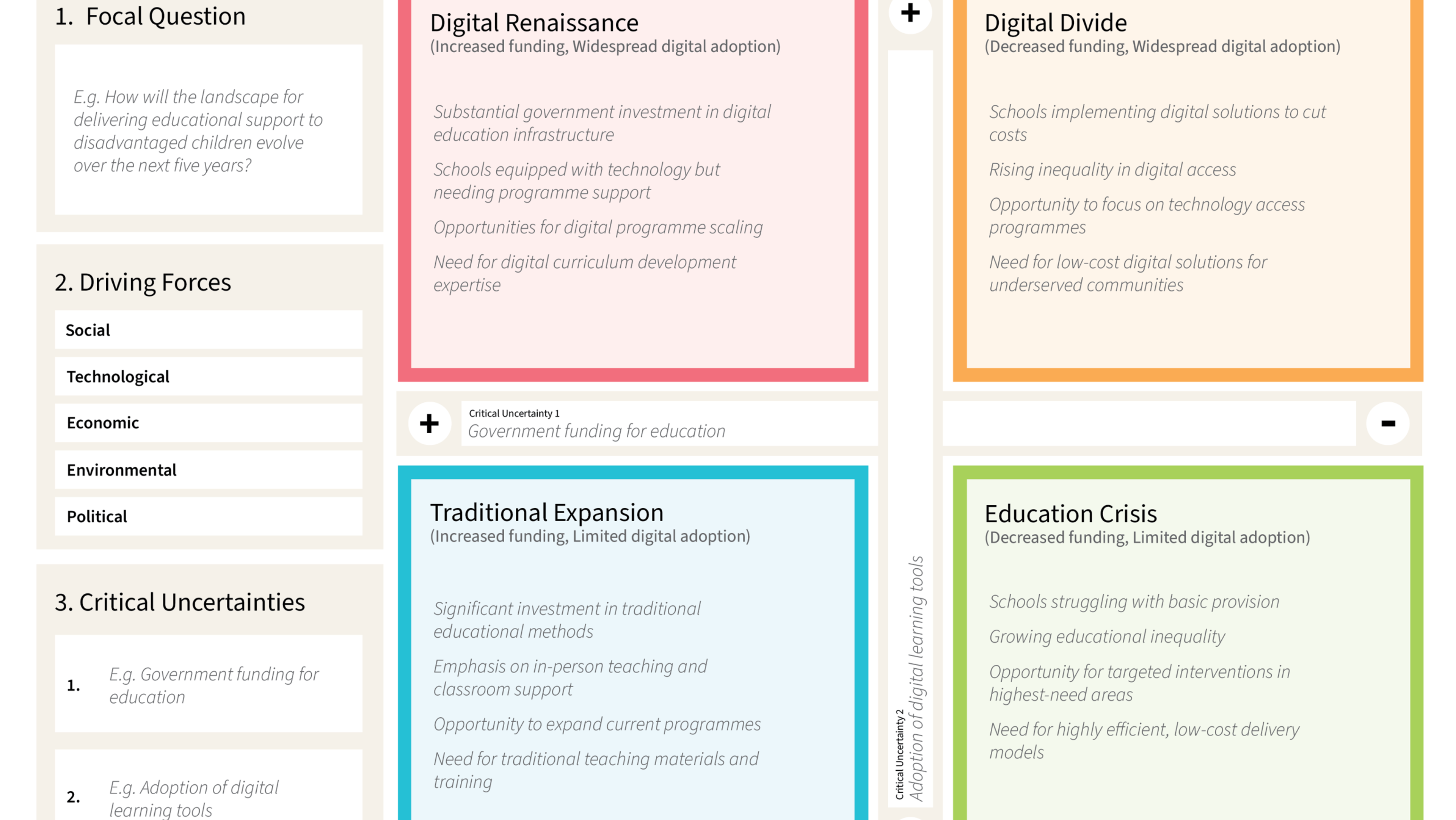
The 2x2 Scenario Matrix is a strategic planning tool that helps organisations explore different possible futures. By mapping two key uncertainties against each other, it creates four distinct scenarios you can plan and prepare for.
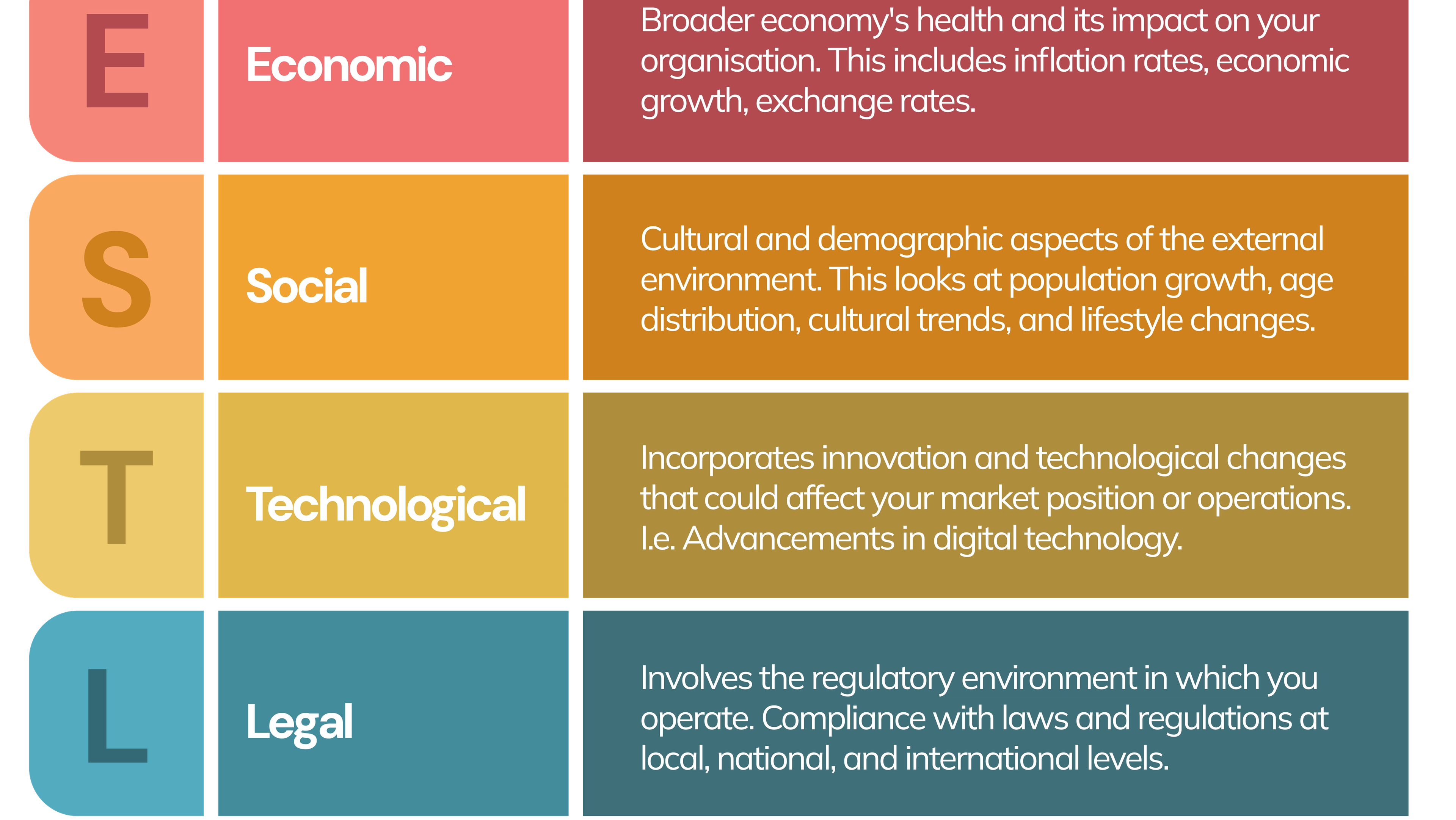
A PESTLE Analysis is a framework for scanning the external environment across six areas - Political, Economic, Social, Technological, Legal, and Environmental. It helps organisations understand the bigger forces that could affect their strategy and planning.
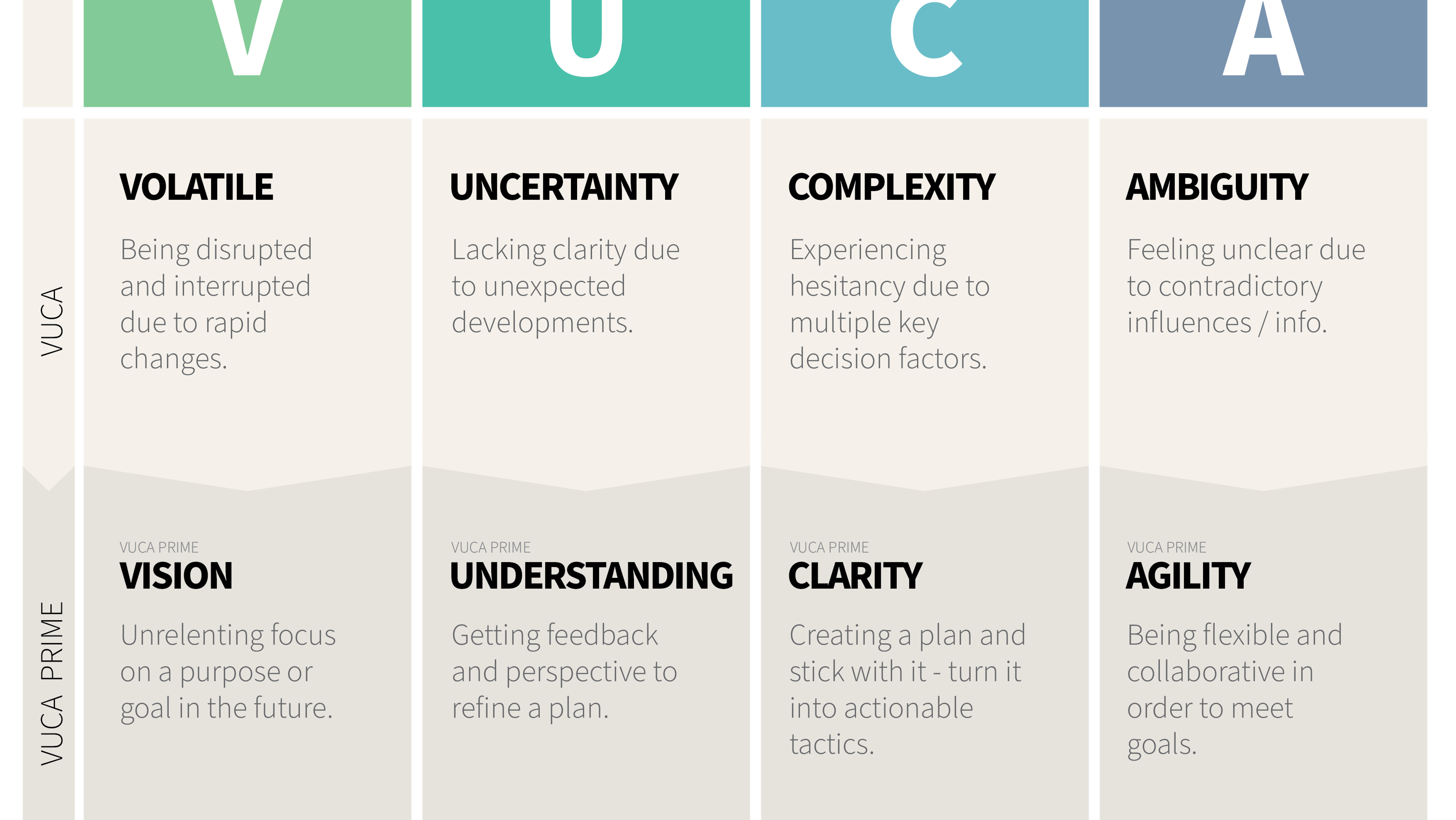
VUCA Prime is a leadership response framework for navigating Volatility, Uncertainty, Complexity, and Ambiguity. It pairs each challenge with a counter-strategy - Vision, Understanding, Clarity, and Agility - to help leaders act effectively in turbulent environments.
Why futures thinking needs to become an everyday organisational capability rather than an occasional planning exercise. This article explores how developing future literacy helps organisations navigate uncertainty with confidence.

Resilience isn't about bouncing back to where you were. It's about developing the capacity to adapt, learn, and come through difficulty stronger than before. This article explores what organisational resilience actually looks like and what leaders can do to build it.