Theory of Change Workshop
A day spent learning to build a Theory of Change - by building yours. Your team leaves with a working model for your programme, and the skill to run the process again.

Half-day, one day or multi-day · in person or online · for your team
Why build a Theory of Change together
You know what your programme is trying to achieve. You have objectives, activities, a team and a budget. But can you show, step by step, how the work you do every day connects to the change you’re working towards?
Sometimes the prompt to answer that question comes from outside - a funder has asked for a Theory of Change, or a bid needs one. Sometimes it comes from inside - you can feel the gap between the day-to-day work and the difference it’s meant to make. Both are good reasons to be here. A funder asking for a Theory of Change is really asking to see your thinking - and thinking that holds together on paper tends to hold together in practice.
This workshop is a structured day for doing that thinking properly - together, as a team, on your actual programme. If what you’re after is the model itself - what a Theory of Change is and how one is put together - our free Theory of Change tool covers that ground. This page is about building one.
What you’ll build in the workshop
Two things leave the room with you.
The first is a working Theory of Change for your programme. The problem you exist to address. Who the work is for. What you actually do. The outcomes that build along the way, the impact they add up to - and the assumptions connecting each step, made visible so they can be tested rather than quietly relied on.
The second is the method. Because your team builds the model rather than watching one being built, you learn the process from the inside - the questions to ask, the order to ask them in, where it usually gets sticky and how to get unstuck. When the next programme needs a Theory of Change, you’ll be able to run the process yourselves.
Theory of Change workshop formats and pricing
Three ways to run it, depending on what you’re mapping.
Half-day | One day | Multi-day | |
|---|---|---|---|
Best for | A single programme with clear aims | A programme that needs its assumptions properly tested | Organisation-level or multi-programme models |
You leave with | A first working draft | A complete, tested Theory of Change | A connected model across programmes |
Group | Up to ~8 | Up to ~12 | Shaped to you |
Price | Starting at £2,400 + VAT. £1,200 + VAT nonprofit rate | Starting at £4,390 + VAT. £2,195 + VAT nonprofit rate | Scoped together |
Every format runs in person at your place or online. Registered charities and social enterprises pay the nonprofit rate - same workshop, priced for the sector.
How the workshop works
Framing the problem
Most planning starts with activities and works forwards. A Theory of Change starts at the other end: the change you want to see, described concretely enough that you’d know it if you saw it. You’ll pin down the problem your programme exists to address, who it affects, and what different actually looks like - not a vague aspiration, but something specific enough to build towards.
Mapping the chain
Between what you do and the impact you’re aiming for sit the intermediate outcomes - the changes that have to happen along the way. You’ll map them step by step, building the chain of logic from activity to impact. This is usually where teams discover gaps in their thinking: activities that don’t clearly lead anywhere, outcomes nothing is feeding. Both are useful finds - better made in the room than in delivery.
Testing assumptions
Every link in the chain rests on an assumption - something you believe to be true about how one change leads to the next. You’ll make those assumptions explicit, work out which carry the most risk, and decide how to test the ones that matter. This is the stage that turns a tidy diagram into a model you can trust.
The narrative
A Theory of Change earns its keep when you can tell it as a story - to a funder, a board, a new team member. You’ll close the day by turning the map into that story: what you do, why it works, what you’re watching for. The diagram is the artefact; the explanation is the asset.
The arc compressed: framing, mapping, and a first pass at the assumptions. You leave with a working draft and a clear note of what to test next.
The full arc, with proper time on assumptions and the narrative. The model leaves the room tested, not just drawn.
The arc run across several programmes, plus the connective layer - how the individual models add up to one organisational story.
Who the workshop is for
Programme and project teams - in charities, social enterprises, public sector teams, and any organisation that needs to show how its work creates change. Funders commission it for grantees too, sometimes as a cohort.
It tends to land at three moments: a funding application that asks for a Theory of Change, an evaluation of an existing programme, or the design of a new one. And it works best when the team attends together - the model you build collaboratively is the one everyone owns afterwards.
Start with the free Theory of Change tool
The best warm-up for the workshop is free. Our Theory of Change tool and template gives you the background and a structure to take a first pass with - plenty of teams arrive having roughed something out, which makes the day quicker because you bring questions rather than a blank page. There’s also our paid Theory of Change Toolkit - the full method, with facilitator notes and worksheets - if you want to go deeper before we meet.
Or we can run it for you
This workshop teaches your team to run the process - that’s the point of it. But sometimes the method isn’t what’s needed; what’s needed is the Theory of Change done well, with your leaders in the room and someone else holding the pen. That’s facilitation rather than training, and we do that too - working alongside you on the strategy itself. Different kind of day, same care.
What makes this workshop different
The most useful Theories of Change are the ones teams keep using. And what keeps a model in use, in our experience, is the connective thinking: assumptions made explicit rather than implied, the space between activities and outcomes treated as the interesting part rather than the awkward gap. That’s where we spend the day’s energy.
We also help you place the model in its wider context - what’s around your programme that could help or hinder the pathway. A Theory of Change that knows its surroundings is more realistic on day one, and more resilient when things change around it.
One device we use throughout the day is the ceiling of accountability - the line between the change your work directly creates and the wider change you contribute to but can’t control. Every claim that ends up below the line is one you could defend to a funder; everything above it stays honest about being a contribution. Drawing that line tends to be the conversation teams remember.
Theory of Change workshop FAQs
Do we need anything prepared?
No - the day is designed to start from wherever you are. It helps if the people in the room know the programme well, and some teams like to rough out a first pass with the free template beforehand, but neither is required. For one-day and multi-day formats we can also run a short pre-workshop assessment with your team, so the day opens with an honest picture of where your current thinking stands.
Can one workshop cover several programmes?
Yes - that’s what the multi-day format is for. You map each programme properly, then build the connective layer that shows how they add up to one organisational story.
What about LogFrames?
They’re close cousins, and funders often ask for both. A Theory of Change shows the logic of your programme; a LogFrame organises it for monitoring and reporting. Build the first and the second gets considerably easier.
How does online delivery work?
The same workshop, run live over video with a shared digital whiteboard - same stages, same outputs. Multi-day formats can be spaced across weeks online, which some teams find easier to schedule.
How does the nonprofit rate work?
Registered charities and social enterprises pay the nonprofit rate - half the standard price for the half-day and one-day formats. Just mention it when you get in touch.
What if we want help with the whole strategy, not just the map?
Then you probably want us facilitating rather than training - working on the strategy with your leadership team. The fork is simple: learn the method here, or have us run the process with you there.
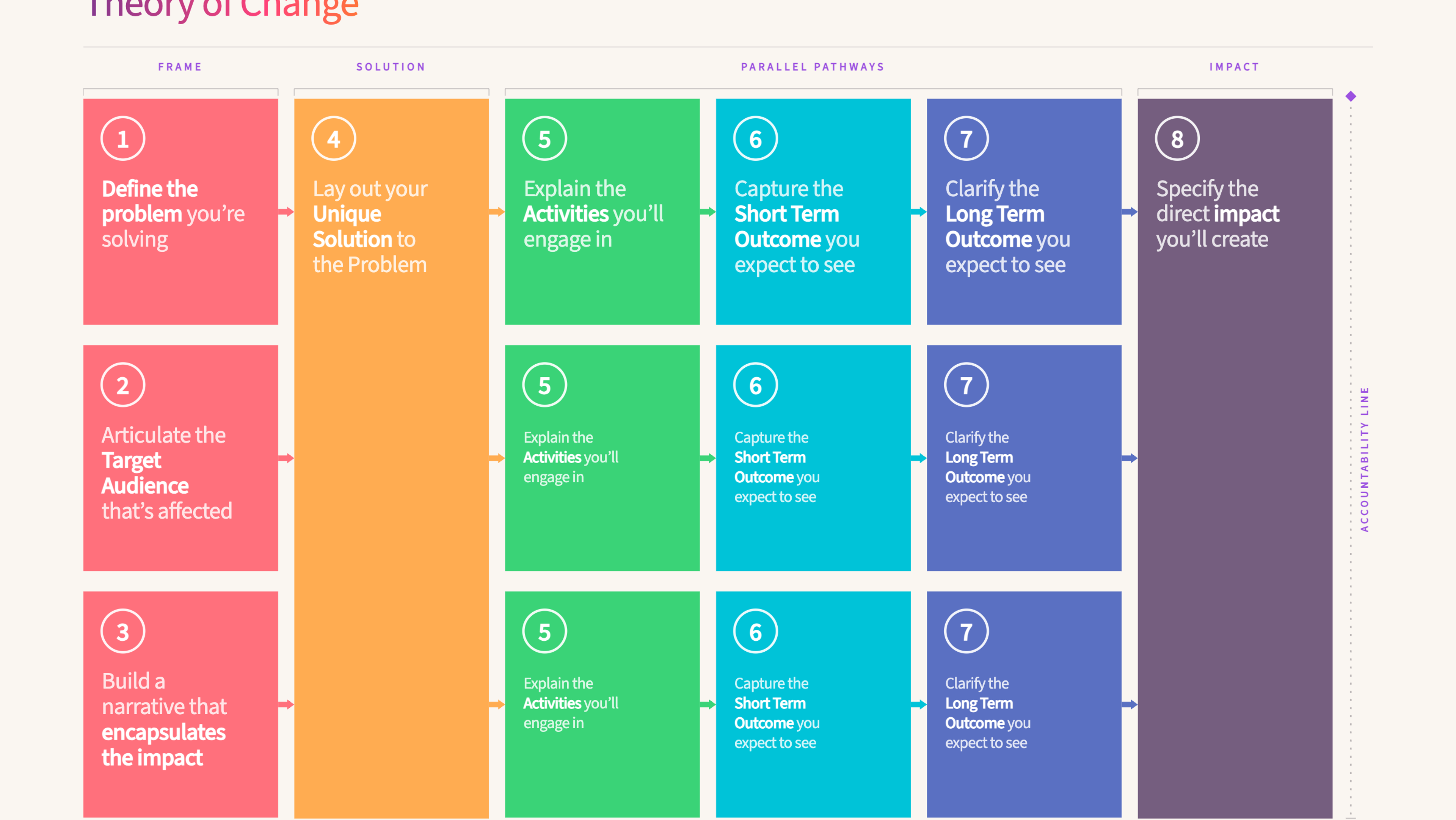
A Theory of Change is a strategic planning tool that maps out how and why you expect a desired change to happen. It connects your activities to your outcomes, showing the logical path from what you do to the impact you want to create.
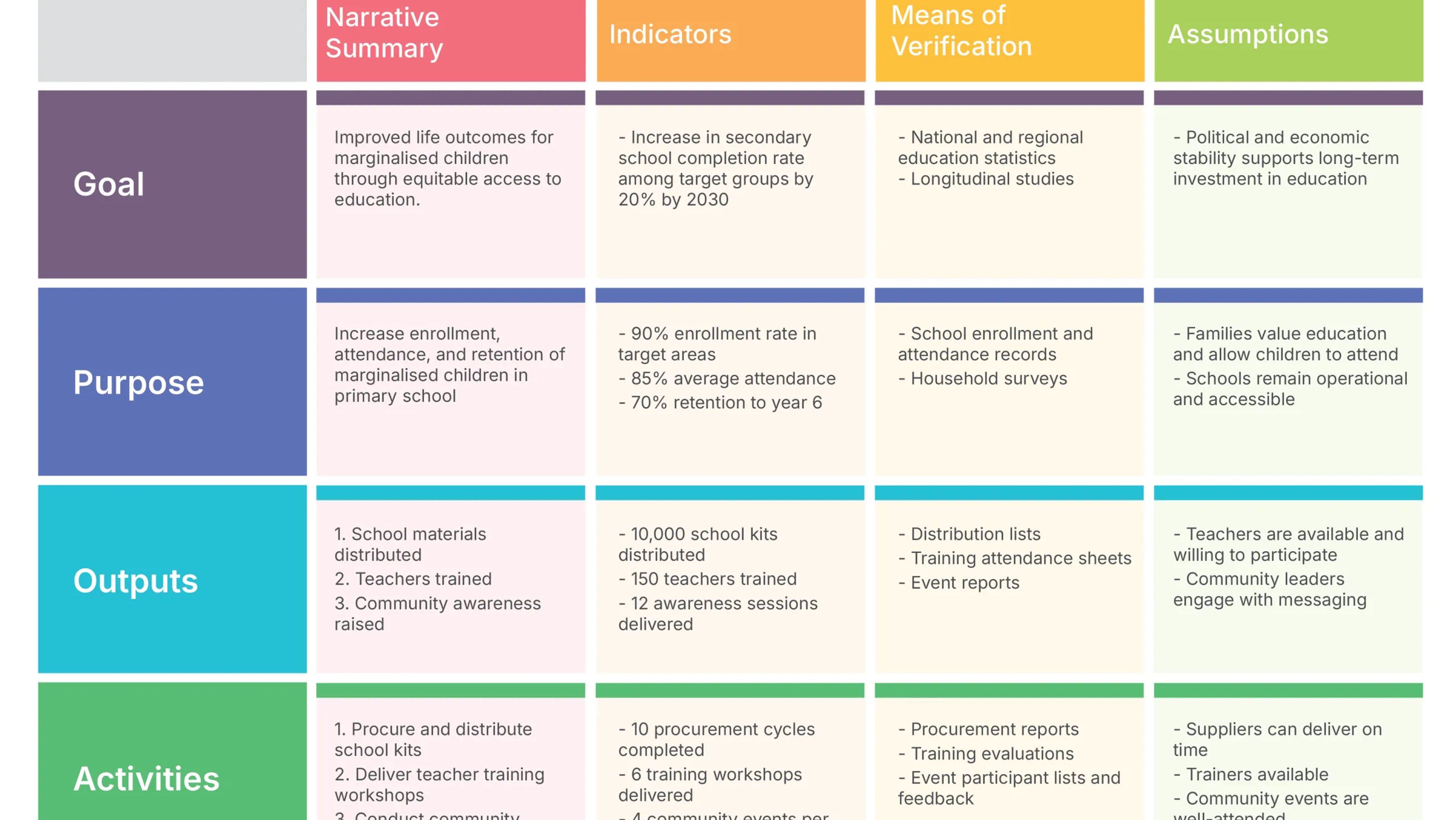
A LogFrame is a structured planning and evaluation tool that helps organisations set clear goals, define how they'll measure progress, and track what's actually being achieved. It's widely used in the nonprofit sector for programme management and impact reporting.
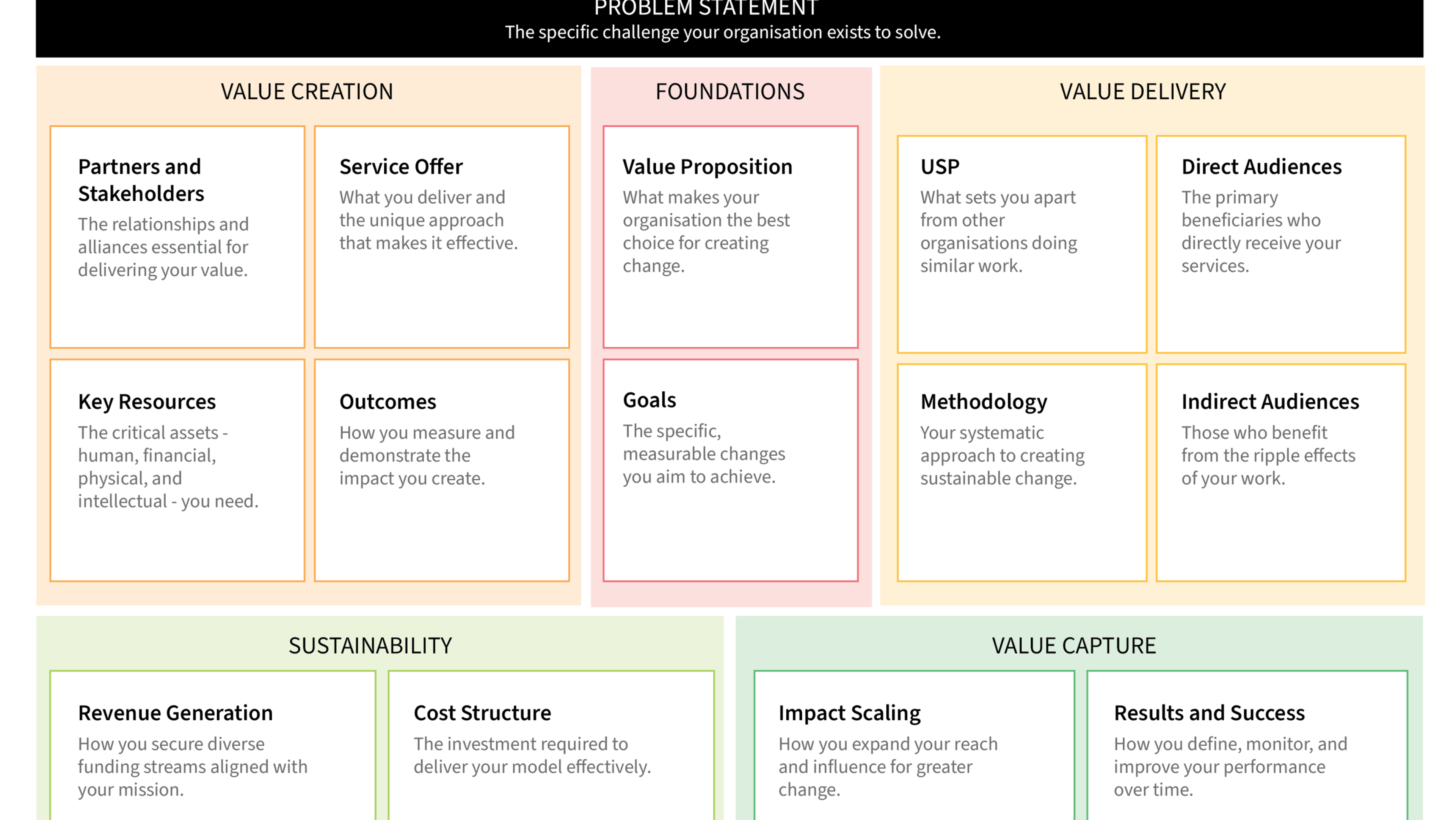
The Nonprofit Business Model Canvas is a visual planning tool that helps charities and social enterprises map out how they create, deliver, and sustain impact. It adapts the traditional business model canvas for organisations driven by mission rather than profit.
Most organisations know they should measure their impact. Fewer know how to do it in a way that's genuinely useful rather than just generating reports. This article explores how to build an impact measurement framework that helps you understand what's working, learn from what isn't, and make better decisions.
The real business case for organisational purpose isn't about inspiration - it's about what happens when everyone in the organisation understands why the work matters and can use that understanding to make better decisions, every day.
When you need more than the template
The free template is a good start. If you want to take the next step and map a full Theory of Change with your team - the difference you're working towards and how your work gets you there - that is what we built the Theory of Change Toolkit for - a rapid primer, assessment tools for gathering stakeholder input, a slide deck, worksheets and discussion guides, facilitator notes, and a Miro board blueprint. Everything is editable, so you can fit it to your own branding and timings.
It's a paid toolkit, on our sister site toctoolkit.org. Reduced rates are available for small nonprofits, micro-organisations and students.