Process Mapping Workshop
A hands-on day spent mapping a real process from your own organisation - and learning to run the sessions yourselves. Your team leaves with a clear picture of how the work actually flows, where it breaks down, and a redesigned version that removes the friction.

Half-day, one day or multi-day · in person or online · for your team
Why map a process together
You know something isn’t working. Tasks take longer than they should, work gets stuck between teams, and people have built workarounds nobody questions any more. But when you try to explain the problem, it’s hard to pin down - because no one person can see the whole picture.
That’s what mapping a process together does: it puts the whole flow on the wall, end to end, so the people who actually do the work can see where it gets stuck and design something better. This workshop is a structured day for doing that properly - on a real process from your organisation, with the people who know it best. If what you want first is the method itself - what process mapping is and how it’s done - our free Process Mapping tool covers that ground. This page is about putting it to work on yours.
What you’ll build in the workshop
Two things leave the room with you.
The first is a clear picture of your process - a current-state map showing how the work really flows today (every step, every handoff, every decision point), a future-state design showing how it could work better, and a practical improvement plan with specific actions.
The second is the skill. Because your team maps the process rather than watching it being mapped, you learn the method from the inside - how to put a flow on the wall, where to look for the friction, how to redesign without just moving the problem somewhere else. When the next process needs untangling, you’ll be able to run the session yourselves.
Process mapping workshop formats and pricing
Half-day | One day | Multi-day | |
|---|---|---|---|
Best for | A single, contained process | A core process that needs a proper redesign | Several connected processes, or a whole value stream |
You leave with | A current-state map, the friction marked, and a first cut at the redesign | A current-state map, a future-state design and an improvement plan | A connected set of maps, a shared improvement roadmap, and a clear view of how the pieces fit together |
Price | From £2,400 + VAT | From £4,390 + VAT | Scoped together |
Nonprofits and social enterprises pay a reduced rate. Groups are kept small so everyone gets to work through their own process - we’ll confirm numbers when we scope the day.
How the workshop works
The day moves through four stages, whatever the format - the format just changes how far you get and how much you take on.
Mapping the current state
You put the whole flow on the wall, end to end: every step, every handoff, every decision point. Simple visual techniques anyone can follow - sticky notes, markers and wall space, or a shared digital whiteboard if you’re online. No special software, no notation to learn first.
Finding the friction
Once the whole flow is visible, the problems surface: steps that add nothing, handoffs where information gets lost, loops where work goes back and forth. You learn to spot the patterns and, just as importantly, understand why they’re there - because fixing a symptom without the cause just moves the problem somewhere else.
Designing the future state
Mapping isn’t the goal; improvement is. You redesign the process to strip out the waste, simplify the handoffs, and create a flow that works for the people who actually use it - ending with a future-state map you’ve built yourselves.
Planning the change
A future-state map only matters if it happens. You turn the redesign into a practical plan with specific actions, and think through what it’ll take to make the change stick. The BPM Lifecycle frames where mapping sits in the wider cycle - from design through to ongoing improvement.
One contained process, mapped, with the friction marked and a first redesign sketched.
The full arc on a core process: mapped, redesigned, and a plan to act on.
Several connected processes, or a whole value stream, plus the connective layer: how they hand off to each other and where the shared friction sits.
Who the workshop is for
Teams responsible for how work gets done - operations managers, team leaders, project managers, improvement leads, and anyone who regularly thinks ‘there must be a better way to do this.’
It works best when a whole team attends together, because the mapping works best when the people who actually do the work are in the room. They know where the real problems are - and they’re the ones who’ll own the improvements.
Three moments when it tends to land:
A process that’s visibly creaking - delays, rework, complaints, or a workaround that’s quietly become the way things are done.
A change that’s scrambled the flow - a merger, a restructure or a new system, where how the work moves needs re-drawing.
A continuous-improvement push - when you want a shared method your teams can keep using, not a one-off fix.
Start with the free Process Mapping tool
The best warm-up for the workshop is free. Our Process Mapping tool and template gives you the background and a structure to take a first pass with - plenty of teams arrive having roughed out a map already, which makes the day faster, because you come with questions rather than a blank wall.
It’s also a fair test of where you are. If the free tool gets you what you need, brilliant - use it. If it shows you how much there is to untangle, that’s exactly what the workshop is for.
Or we can run it for you
This workshop teaches your team to run process mapping themselves - that’s the point of it. But sometimes what’s needed isn’t the skill; it’s the map done, with an independent facilitator holding the pen while your team focuses on the thinking. That’s facilitation rather than training, and we do that too - we can map and redesign the process with you. Different kind of day, same care. If you’re not sure which you need, the workshop is usually the better place to start - the skill stays with you afterwards.
What makes this workshop different
The most useful process maps are the ones that lead to change that sticks. What makes change stick, in our experience, is understanding why the process works the way it does in the first place - the team dynamics, the historical decisions, the quiet workarounds that shaped the current flow. A map that only captures the steps misses that; a map that captures the reasons can be redesigned with confidence.
So we treat the mapping as a way to see a system, not just draw a diagram. A process never exists in isolation - how it connects to other processes, other teams and other priorities matters as much as the steps within it, and we keep that wider view in sight as you redesign. The biggest gains usually sit at the handoffs, because a process only really flows when the teams either side of it are pulling the same way.
Process mapping workshop FAQs
Do we need to prepare anything?
No - we start from wherever you are. It helps to have the people who actually do the work in the room, and to come with a process in mind. Some teams rough out a first map with the free tool beforehand, which gives the day a head start, but it isn’t required.
Can one workshop cover more than one process?
Yes - that’s the multi-day format. We map each process, then add the connective layer: how they hand off to each other and where the shared friction sits. For a single contained process, a half-day or one day is usually right.
In person or online?
Both. In person we use wall space, sticky notes and markers; online we run the same stages on a shared digital whiteboard. The outputs are the same either way - a current-state map, a redesign and a plan.
Do we need special software?
No. The workshop uses simple visual tools anyone can follow - no flowcharting software and no formal notation to learn first. If your team already works in a particular tool, we’re happy to map straight into it.
How does the nonprofit rate work?
Nonprofits and social enterprises pay a reduced rate on all our workshops. Tell us a little about your organisation when you get in touch and we’ll confirm the rate.
What if we want the process mapped for us, rather than learning to do it?
Then what you want is facilitation, not training - we run the session and hold the pen for you while your team focuses on the thinking. The workshop is the better choice if you want the skill to stay in-house afterwards.
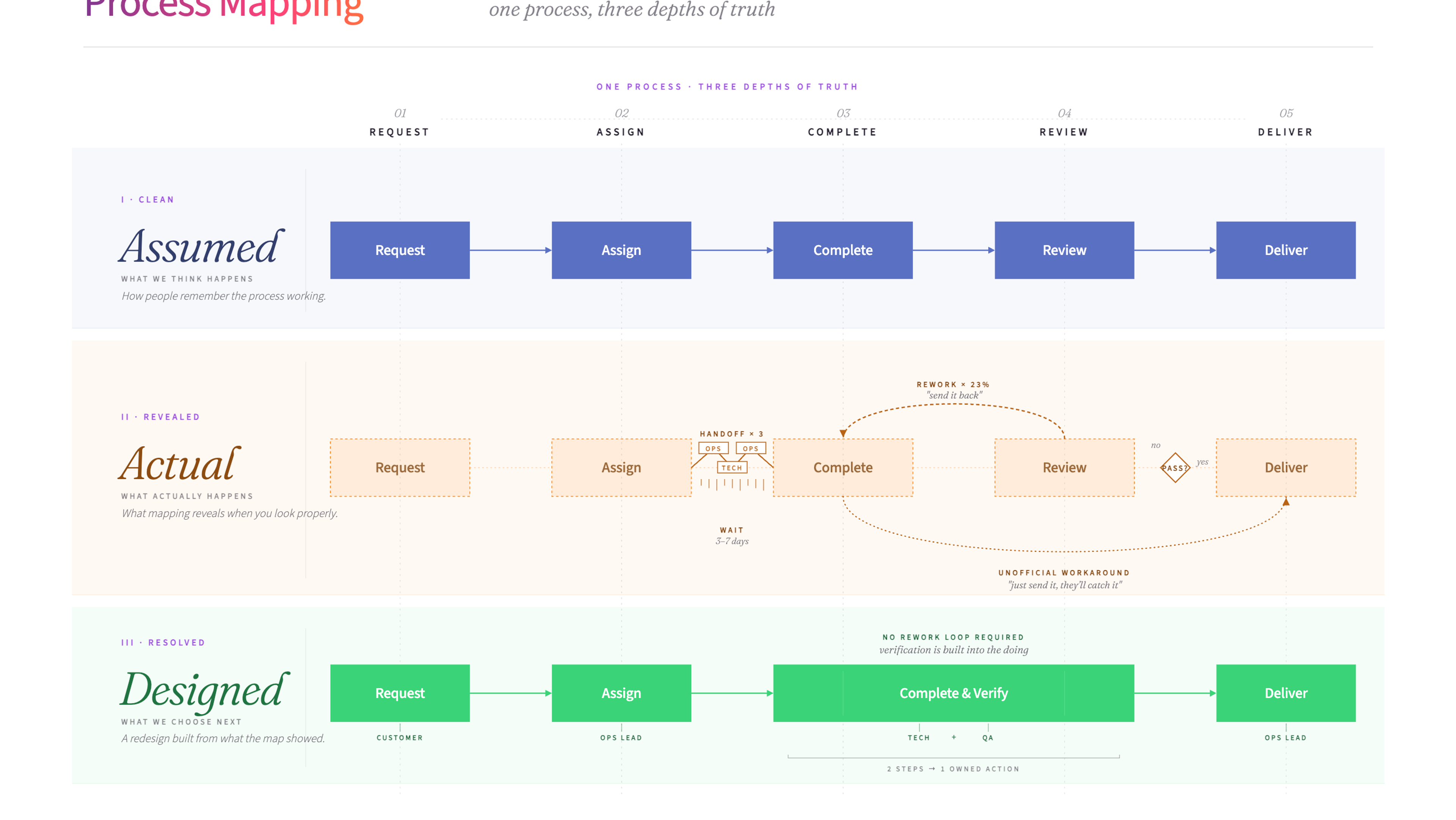
Process mapping is a visual method for documenting how a process works from start to finish. It helps teams see the full picture - every step, decision point, and handoff - so they can spot problems and design improvements.
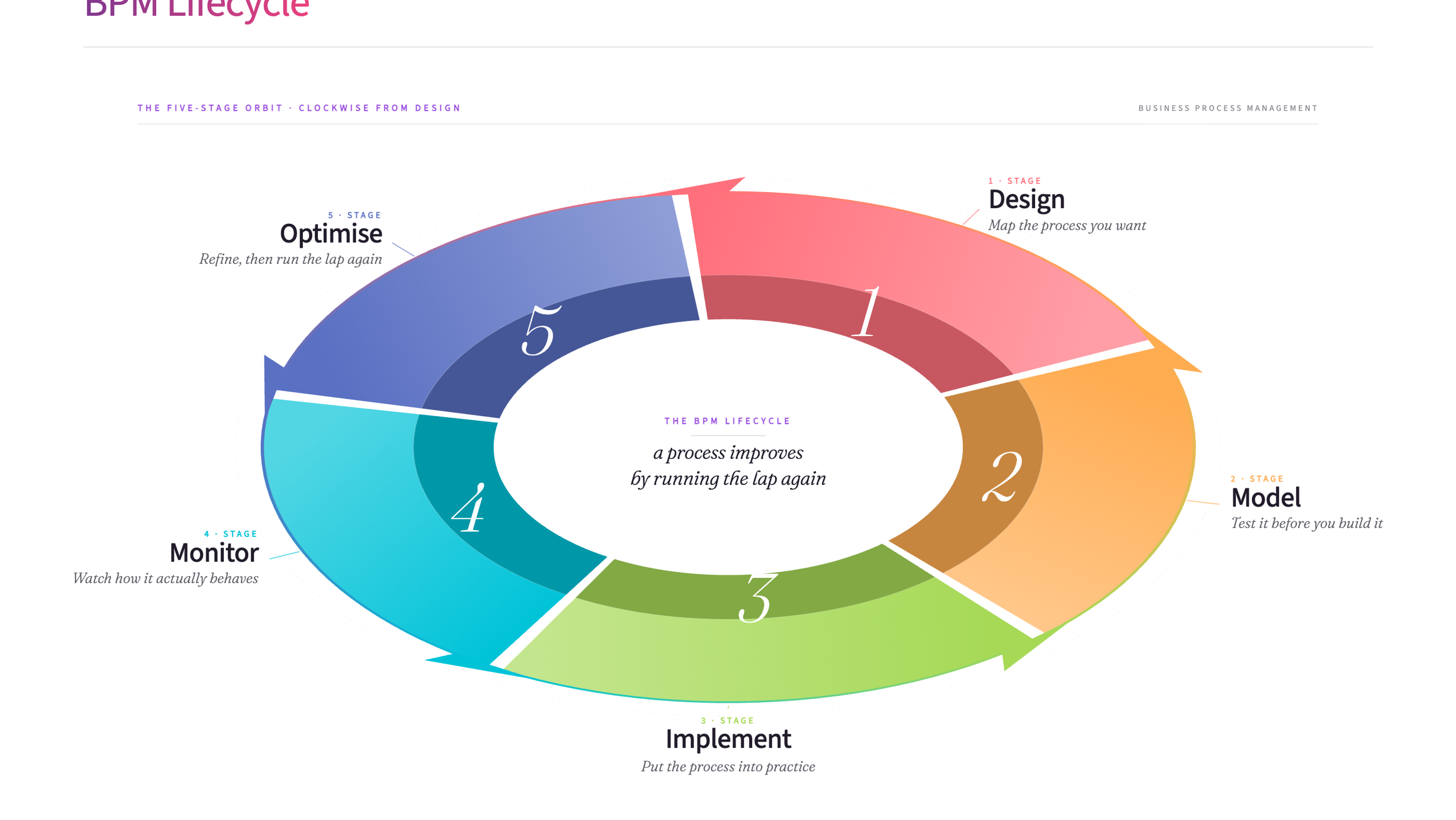
The BPM Lifecycle is a five-stage cycle for designing, modelling, implementing, monitoring, and optimising how work flows through an organisation. Each pass through the cycle - design, model, implement, monitor, optimise - refines the process further.
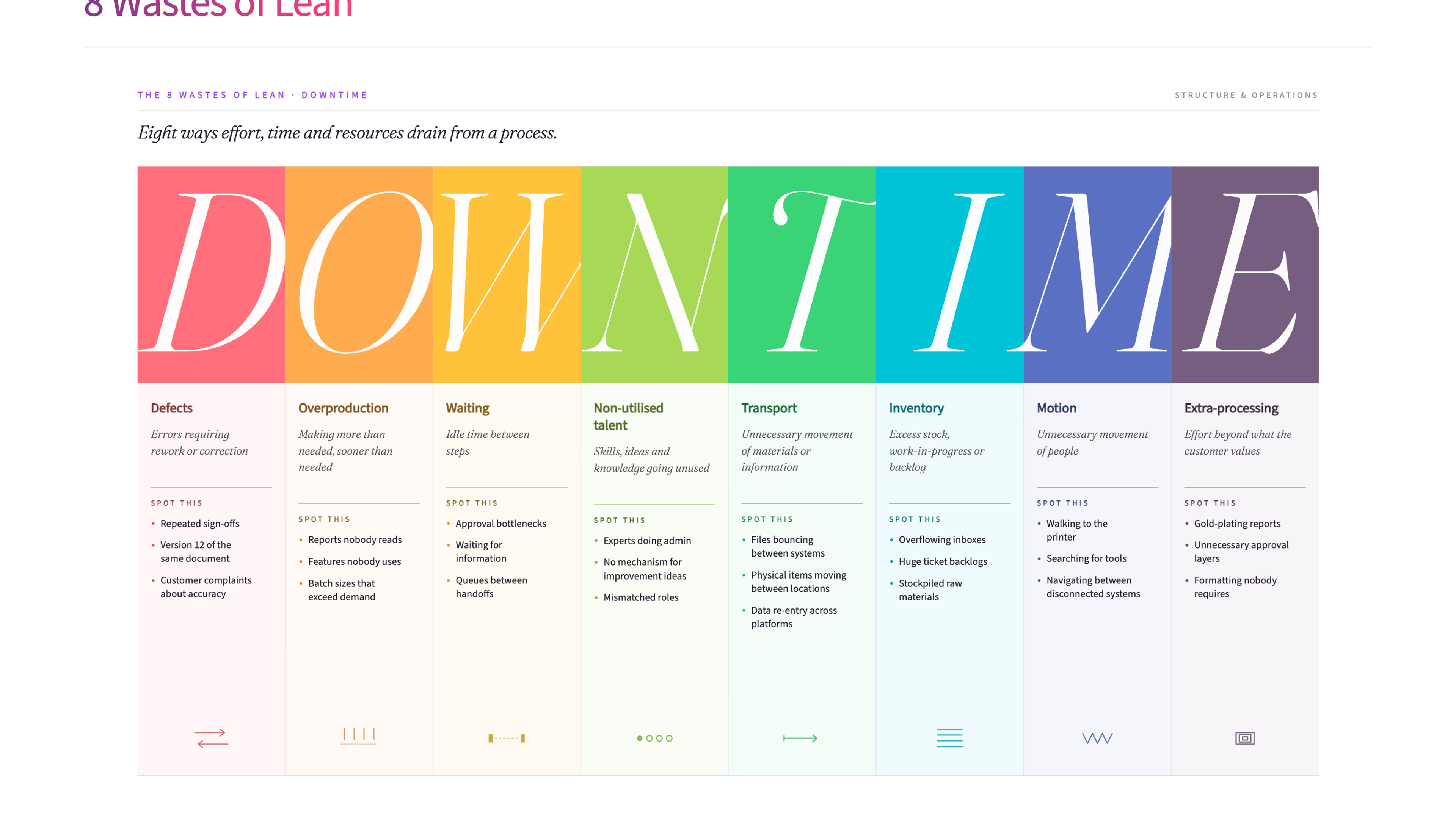
The 8 Wastes of Lean give you eight categories for finding where effort, time and resources leak from a process. Use the DOWNTIME acronym to work through each waste type systematically and build a clear picture of what to improve.
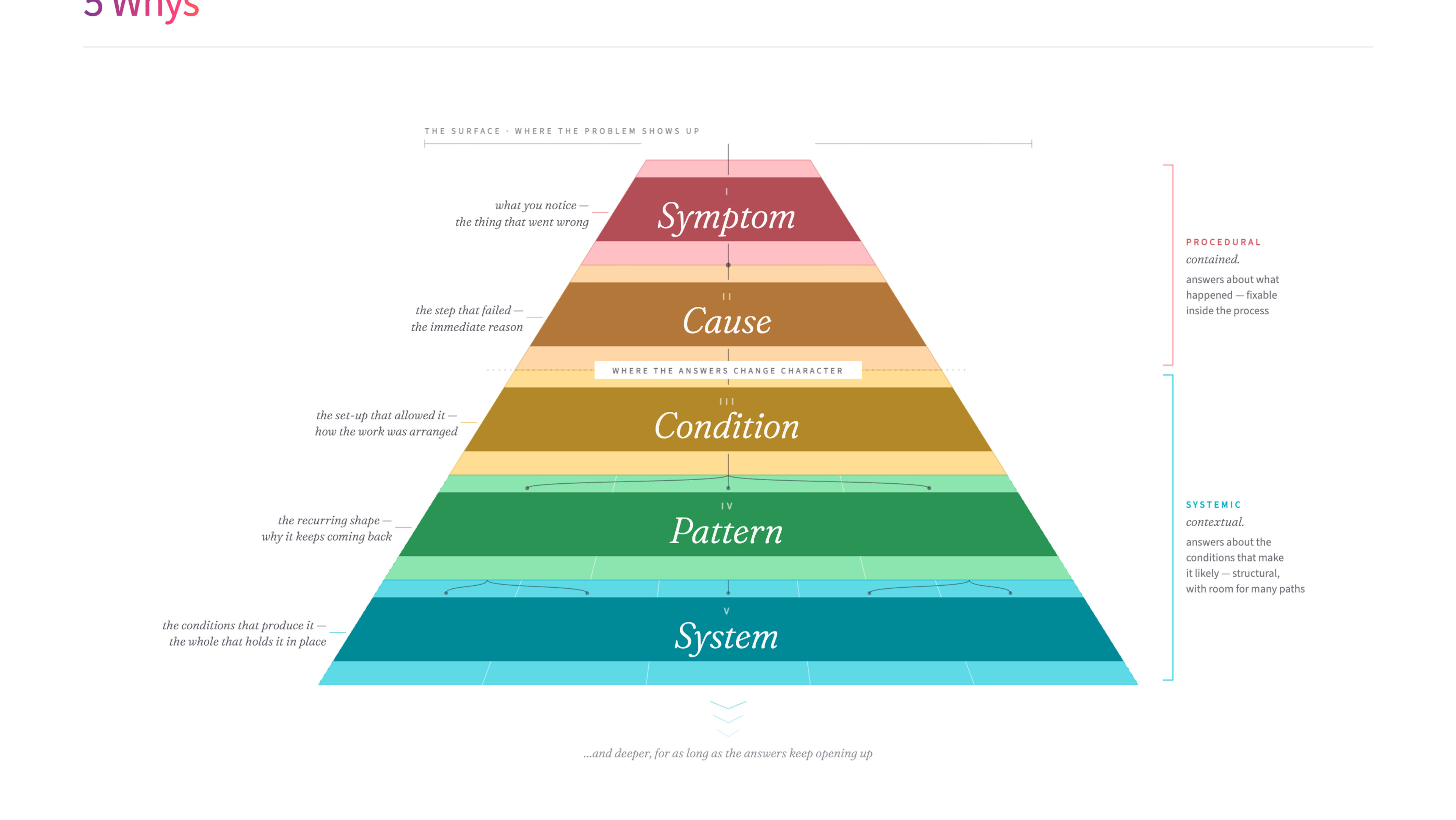
The 5 Whys is a simple root-cause analysis technique that drills into problems by asking "why?" repeatedly. It helps teams get past surface-level symptoms to find the real cause of an issue.
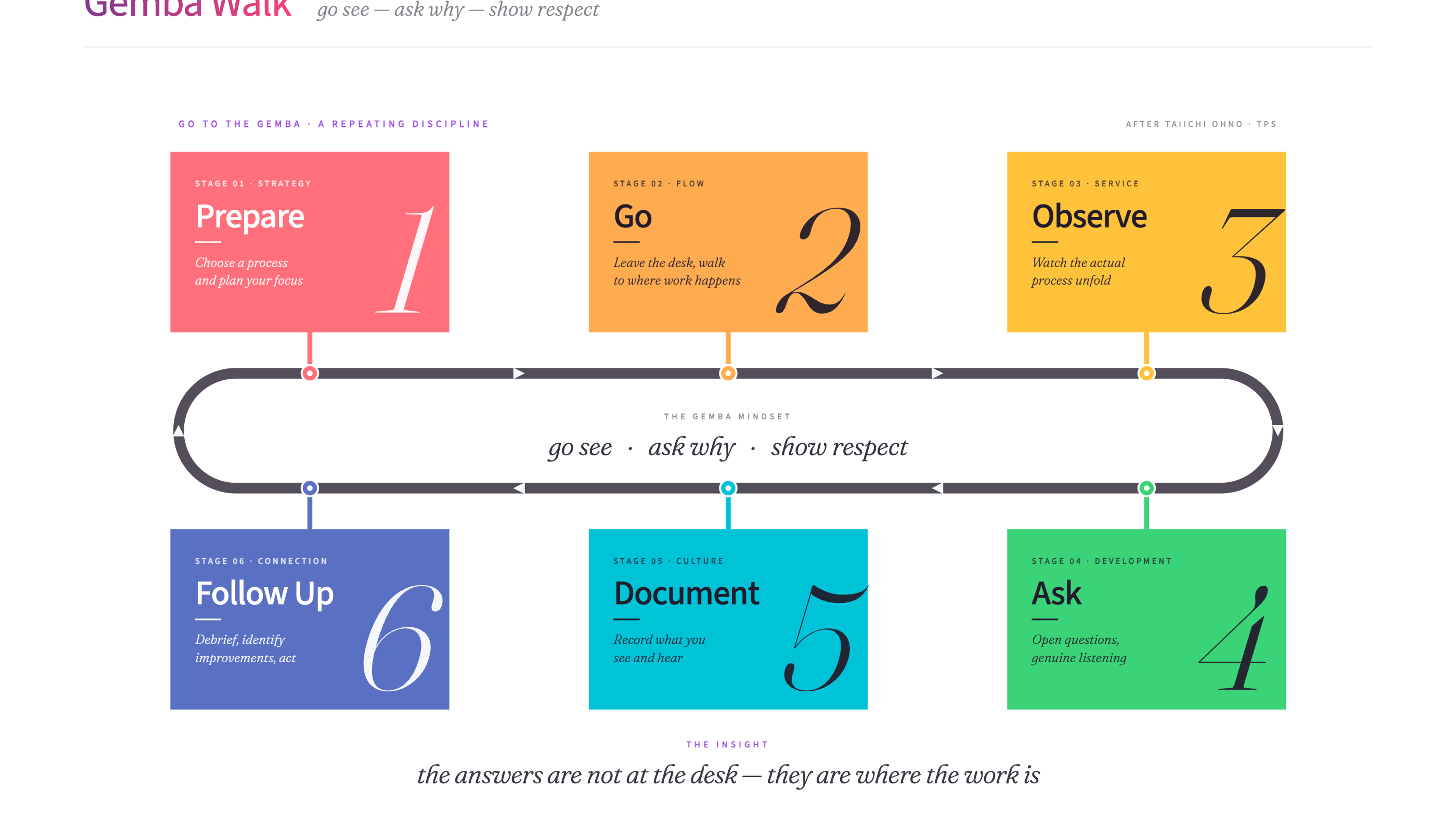
A Gemba Walk is a Lean practice where leaders go to the place where work actually happens to observe, listen, and understand. It bridges the gap between how leaders think work gets done and how it really gets done.

Every organisation has friction - the unnecessary effort, the needless complexity, the things that make simple work harder than it should be. This article explores how to find it, understand where it comes from, and reduce it without creating new problems in the process.
Most organisations run on invisible infrastructure - the corridor conversation, the person who just knows, the relationships that bridge gaps between teams. Growth puts all of it under pressure. Scaling well means designing what replaces it.