You want your organisation to deliver consistently and well. We help you find what's really driving operational performance - and what's quietly working against it.
You've mapped the processes. You've invested in the tools. You may have run improvement programmes - lean, six sigma, business process redesign. That work matters. It produces real gains, and the discipline it builds is valuable.
But something keeps happening. Improvements land in one area and create pressure in another. A new system goes live but people work around it because it doesn't fit how they need to operate. Workarounds become permanent. The same friction points keep reappearing, sometimes wearing different names. The organisation spends more energy navigating itself than delivering for the people it serves.
The issue isn't that the process improvement was wrong. It's that processes are the visible part of how an organisation operates. Beneath them sits an invisible system - how decisions travel, how information reaches the people who need it, how much autonomy teams have to solve problems at the point of delivery, how the organisation learns from what goes wrong. That invisible system determines whether the visible one works.
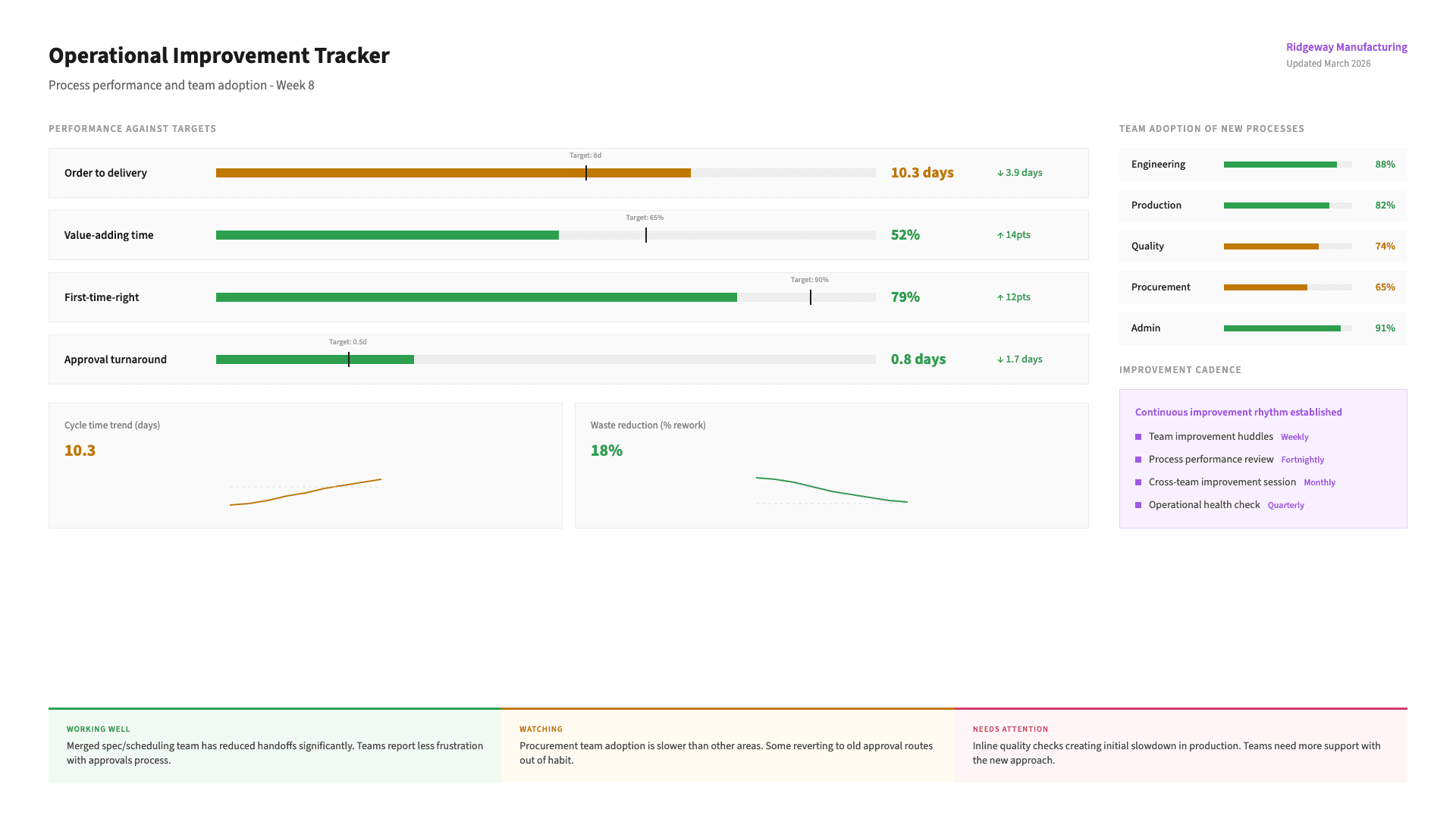

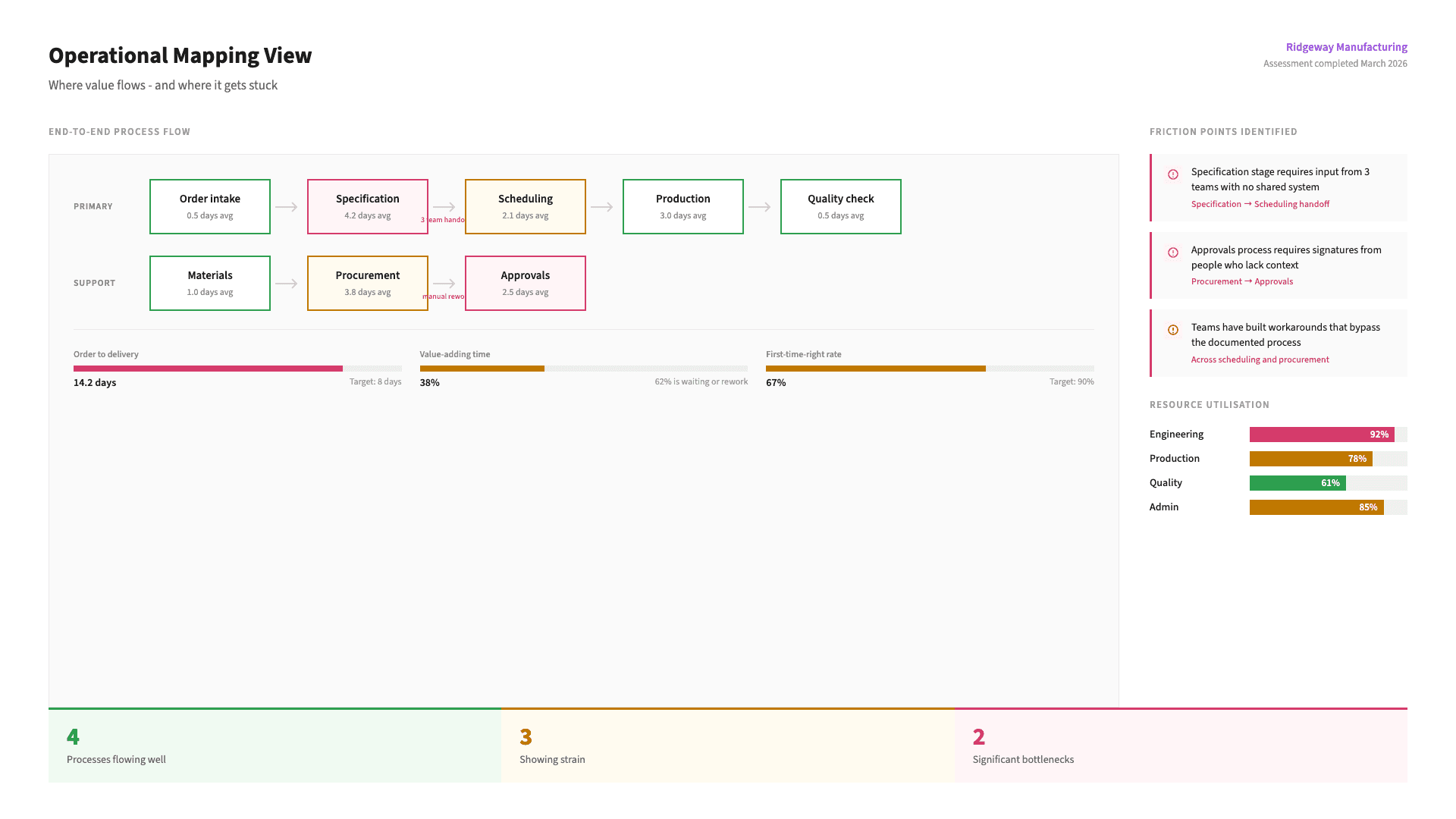




















Operations that flow, because the conditions underneath are designed for it
Operational performance is shaped by conditions most improvement programmes don't touch
When operations struggle, the instinct is to look at the process. Redesign the workflow. Introduce a new tool. Measure more carefully. These are reasonable responses - but they're working on the visible system. Underneath every process sits a set of conditions that determine whether it functions well. How quickly decisions reach the people who need to act on them. Whether teams have the autonomy and capability to solve problems at the point of delivery. How information flows between the parts of the organisation that depend on each other. Whether the organisation learns from friction or just absorbs it.
These conditions are the metabolism of the organisation - how it converts effort into value. When the metabolism is healthy, work flows, energy goes into outcomes, and the system sustains itself. When it's not, effort gets consumed by workarounds, handoffs, and invisible friction.
Leaders come to us at moments like these
See how this works in real organisations
75%
of organisations struggle to build high-performance cultures
McKinsey State of Orgs 2026
43%
of executives cite productivity as their top priority in 2026
McKinsey State of Orgs 2026
46%
cite lack of time as the biggest barrier to developing organisational capabilities
McKinsey
20%
of employees are engaged worldwide - and engagement is falling
Gallup 2025/2026
Want to explore how this could work for your organisation?
Every organisation is different, so we always start with a conversation. No pitch, no obligation — just an honest discussion about where you are and whether our approach feels right.
Explore operational effectiveness
Articles
- When Governance Makes You Brittle
How to design governance that enables innovation rather than constraining it. This article explores the balance between oversight and freedom, and how the right governance structures can become a genuine advantage.
Read article → - The Stories Your Change Programme Can't Control
During change, the stories people tell each other matter more than the communications plan. How narrative shapes whether change lands or stalls.
Read article → - Reducing Organisational Friction: A Practical Guide
Every organisation has friction - the unnecessary effort, the needless complexity, the things that make simple work harder than it should be. This article explores how to find it, understand where it comes from, and reduce it without creating new problems in the process.
Read article →
Related tools
- 5 Whys
The 5 Whys is a simple root-cause analysis technique that drills into problems by asking "why?" repeatedly. It helps teams get past surface-level symptoms to find the real cause of an issue.
Explore tool → - 8 Wastes of Lean
The 8 Wastes of Lean identify eight types of waste that reduce efficiency in any process - from overproduction and waiting to underused skills and unnecessary motion. Spotting these wastes is the first step to removing them.
Explore tool → - BPM Lifecycle
The BPM Lifecycle (Business Process Management) is a structured approach to designing, modelling, executing, monitoring, and optimising business processes. It helps organisations manage and improve how work flows from start to finish.
Explore tool → - DACI Framework
The DACI Framework is a decision-making tool that clarifies who plays what role in a decision - Driver, Approver, Contributors, and Informed. It cuts through ambiguity about who owns what, especially when decisions involve multiple people or teams.
Explore tool → - DMAIC Process
DMAIC (Define, Measure, Analyse, Improve, Control) is a structured problem-solving method from the Six Sigma toolkit. It gives teams a clear five-step process for improving existing processes using data and evidence.
Explore tool → - Eisenhower Matrix
The Eisenhower Matrix is a time management and prioritisation tool that sorts tasks into four categories based on urgency and importance. It helps teams focus on what actually matters instead of just what feels most pressing.
Explore tool →
Part of a bigger picture
Operational effectiveness doesn't exist in isolation. How well work flows is shaped by how the organisation is designed, how teams collaborate across boundaries, how strategy translates into daily priorities, and whether the culture supports problem-solving at the point of delivery. When we help organisations improve their operations, we're often working at the intersection of several of these forces.
If you're noticing that operational challenges are tangled up with structural questions about how the organisation is designed, our organisational design work looks at the architecture that shapes how work flows across boundaries.
Common questions about operational effectiveness
Lean and six sigma are valuable disciplines - they bring rigour to waste reduction and variation control. We're not a replacement for that work. The difference is where we focus. Lean and six sigma typically work on the visible operational system - processes, workflows, measurement. We work on the conditions underneath that determine whether process improvements hold: how decisions get made, how information flows, how much autonomy teams have to solve problems, and whether the organisation learns from what goes wrong. Often, the most effective approach combines process-level improvement with conditions-level change.
Want to explore how this could work for your organisation?
Every organisation is different, so we always start with a conversation. No pitch, no obligation — just an honest discussion about where you are and whether our approach feels right.