DMAIC Process
DMAIC (Define, Measure, Analyse, Improve, Control) is a structured problem-solving method from the Six Sigma toolkit. It gives teams a clear five-step process for improving existing processes using data and evidence.
Get the free template
DMAIC is a five-phase method for improving a process that already exists - Define, Measure, Analyse, Improve, Control. It gives a team a structured path from a vaguely-felt problem to a confirmed root cause, a targeted fix, and gains that hold. The discipline is understanding what's happening before you change anything. If you've ever watched the same problem get "fixed" three times and keep coming back, DMAIC is built to break that cycle.
What is DMAIC?
At its core, DMAIC is a structured approach to process improvement. Developed as part of the Six Sigma methodology at Motorola in the 1980s, it was designed to reduce defects and variability in manufacturing. Since then, it's been adopted across healthcare, finance, education, government, and service organisations - anywhere there's a process that could work better.
Each of the five phases has a clear job and a clear output:
Phase | What happens | Key output |
|---|---|---|
1. Define | Frame the problem, its scope, and what good looks like | Problem statement and project charter |
2. Measure | Establish how the process performs now, using data | A reliable performance baseline |
3. Analyse | Find and confirm the true root cause | Root cause verified with evidence |
4. Improve | Design, pilot, and roll out the targeted fix | A tested, implemented change |
5. Control | Lock in the gain so it doesn't slip back | Control plan and handover |
The key distinction is that DMAIC is for improving existing processes. If you're designing something from scratch, you'd typically use DMAIC's sibling methodology, DFSS (Design for Six Sigma). DMAIC assumes there's already a process in place - it's just not delivering the results you need.
Each phase builds on the one before it. You can't measure effectively if you haven't defined the problem clearly. You can't analyse meaningfully without reliable data. You can't improve with confidence without understanding root causes. And you can't sustain gains without control mechanisms. The sequence matters.
In the Define phase, the 8 Wastes of Lean can help you categorise the types of inefficiency you're seeing - giving you a sharper starting point for scoping the project.
How does DMAIC fit into Lean Six Sigma?
Lean and Six Sigma started as separate disciplines. Lean (from the Toyota Production System) focuses on eliminating waste and improving flow. Six Sigma focuses on reducing variation and defects using statistical methods. Lean Six Sigma combines both - and DMAIC is the primary problem-solving framework it uses.
Think of it this way: Lean helps you spot what's wasteful, Six Sigma helps you understand why it's happening, and DMAIC gives you a structured path from problem to solution. The five phases align naturally with both traditions - Define and Measure draw on Lean's emphasis on understanding value from the customer's perspective, while Analyse brings Six Sigma's data-driven rigour.
DMAIC sits within the broader BPM Lifecycle as the method for tackling specific process problems once they've been identified. It's not the only improvement approach - for smaller, team-led changes, the Kaizen Cycle or PDCA Cycle may be more proportionate - but for complex, cross-functional problems where you need data to guide decisions, DMAIC provides the structure.
How to run a DMAIC project
Running a DMAIC project means working through each phase in order, using the outputs of each stage as inputs for the next. Here's what each phase involves and how to approach it practically.
1. Define

The Define phase is about getting clear on what you're trying to fix, why it matters, and what success looks like. This is where many improvement efforts fail before they start - by defining the problem too broadly, too vaguely, or from the wrong perspective.
What to do in this phase:
- Write a clear problem statement - what's happening, where, and what's the impact? Be specific. "Customer complaints are too high" is vague. "Order fulfilment errors have increased from 2% to 8% over the past quarter, generating 45 complaints per month" is something you can work with.
- Define the project scope - what's included and, just as importantly, what's not. A DMAIC project that tries to fix everything fixes nothing.
- Set measurable goals - what does "improved" look like in numbers?
- Identify who's affected and who needs to be involved - the people using the process, the people receiving its outputs, sponsors, and the project team.
- Create a project charter that captures all of this in one place.
- Map the high-level process using a SIPOC (Suppliers, Inputs, Process, Outputs, Customers) to make sure everyone shares the same picture of what the process actually is.
Useful tools: Project charter, SIPOC diagram, Voice of the Customer (VOC), stakeholder mapping.
2. Measure

The Measure phase establishes the facts. Before you can improve anything, you need to understand how the process performs right now - not how people think it performs, but what the data shows.
What to do in this phase:
- Identify the key metrics that connect to your problem statement. What numbers will tell you whether the process is getting better or worse?
- Develop a data collection plan - what data do you need, where will it come from, who will collect it, and how often?
- Validate your measurement system. If the way you're measuring isn't reliable or consistent, your data won't be either. This step is easy to skip and expensive to ignore.
- Collect baseline data - enough to establish a clear picture of current performance. This becomes the benchmark against which you'll measure improvement.
- Calculate process capability - how well does the current process meet requirements? This is where you quantify the gap between where you are and where you need to be.
Process Mapping is particularly useful here for making the current state visible. A detailed process map often reveals steps, handoffs, and delays that nobody realised were there.
Useful tools: Data collection plan, operational definitions, check sheets, run charts, process capability analysis, detailed process maps.
3. Analyse

The Analyse phase is where you move from "what's happening" to "why it's happening." This is often the most valuable phase - and the one teams are most tempted to skip, because they think they already know the answer.
What to do in this phase:
- Display your data graphically - charts, histograms, scatter plots, Pareto charts. Patterns that are invisible in spreadsheets often become obvious when you can see them.
- Generate hypotheses about potential root causes. What could be causing the problem? Cast the net wide before narrowing down.
- Test those hypotheses against the data. The 5 Whys is a straightforward technique for drilling past symptoms to reach root causes. For more complex situations, fishbone diagrams help you explore causes across multiple categories.
- Verify the actual root cause(s) with evidence. "We think it's X" isn't enough - you need data that confirms the relationship between the cause and the effect.
- Quantify the opportunity - how much improvement is possible if you address the confirmed root causes?
The discipline here is resisting the urge to jump to solutions. Until you've verified root causes with data, any improvement you make is a guess.
Useful tools: Pareto charts, fishbone diagrams, 5 Whys, scatter plots, hypothesis testing, regression analysis, failure mode analysis.
4. Improve

With root causes confirmed, the Improve phase is where you develop, test, and implement solutions. The emphasis is on targeted changes that address the verified causes - not broad overhauls based on opinion.
What to do in this phase:
- Generate a range of potential solutions. Brainstorming works well here, but ground it in what the Analyse phase told you. Solutions should directly address confirmed root causes.
- Evaluate solutions against practical criteria - impact, cost, ease of implementation, risk, and sustainability. Not every good idea is the right idea for this project.
- Pilot the chosen solution on a small scale before full rollout. This lets you test whether it works in practice, catch unintended consequences, and refine before committing.
- Implement the solution, with clear ownership and timelines.
- Measure the results against your baseline from the Measure phase. Did the process improve? By how much? Did anything unexpected happen?
Useful tools: Brainstorming, solution selection matrix, pilot planning, implementation plans, before-and-after comparison, process simulation.
5. Control

The Control phase is what separates DMAIC from ad hoc improvement. It's the mechanism for making sure your gains don't quietly erode once the project team moves on - which, without deliberate control measures, they almost always do. And it's what turns a single project into momentum through work: each gain that holds makes the next improvement easier to win.
What to do in this phase:
- Develop a control plan that specifies what to monitor, how often, who's responsible, and what to do if performance starts slipping.
- Document the improved process - updated process maps, standard operating procedures, training materials. If it's not documented, it's not standardised.
- Set up ongoing monitoring using control charts or dashboards that make performance visible without requiring manual analysis.
- Train the people who run the process day-to-day. The improvement only sticks if the people doing the work understand the new way and why it matters.
- Hand over ownership from the project team to the process owner.
- Close the project - capture lessons learned and share results.
Useful tools: Control plans, control charts, standard operating procedures, monitoring dashboards, training plans, project close-out reports.
DMAIC in practice
A hospital's outpatient department is experiencing long wait times. Patients regularly wait over 45 minutes past their appointment time, leading to complaints and missed appointments.
Define: The team writes a problem statement: "Average patient wait time in outpatient clinics has increased from 15 minutes to 47 minutes over the past six months, contributing to a 20% increase in missed follow-up appointments." They scope the project to three high-volume clinics and set a goal of reducing average wait time to under 20 minutes within four months.
Measure: They collect four weeks of data on actual appointment times versus scheduled times, tracking where delays occur. They find the average wait is 52 minutes (worse than reported), with significant variation between days of the week and individual clinics.
Analyse: Pareto analysis shows that 70% of delays come from two causes: appointments running over their allocated time slots (because slot durations don't reflect actual consultation complexity) and late starts to morning clinics (because patient check-in and preparation aren't completed before the first appointment). Root cause analysis confirms both with data.
Improve: The team pilots two changes: differentiated appointment slots (15 minutes for follow-ups, 30 minutes for new patients or complex cases) and a pre-clinic preparation process that has patients checked in and ready 10 minutes before the clinic starts. After a four-week pilot in one clinic, average wait time drops to 18 minutes.
Control: The new appointment structure and pre-clinic process are documented and rolled out to all three clinics. A weekly dashboard tracks average wait times, and the clinic manager reviews any week where the average exceeds 25 minutes.
When to use DMAIC (and when not to)
DMAIC works well when:
- There's an existing process that isn't meeting expectations
- The problem is complex enough that the root cause isn't obvious
- You need data to understand what's happening and why
- You want improvements that stick, not quick fixes
- The problem is significant enough to justify a structured project (typically weeks to months)
DMAIC is probably not the right choice when:
- There's no existing process - you're designing from scratch
- The problem is simple and the fix is obvious - just do it
- You need to respond immediately to a crisis - DMAIC takes time
- The issue is primarily about people or culture rather than process
- The improvement needed is small and localised - the PDCA Cycle or Kaizen Cycle would be more proportionate
The most common mistake is using DMAIC for everything. It's a rigorous methodology, and that rigour has a cost in time and effort. Match the tool to the scale of the problem.
Getting started
Start with a process that's clearly underperforming and where you have some data (or can get it). Don't pick your organisation's biggest, most politically complex problem as your first DMAIC project - pick something meaningful but manageable where you can demonstrate the approach and build confidence.
Write a one-paragraph problem statement: what's happening, what should be happening, and what's the impact of the gap? If you can't write that clearly, you're not ready to start - spend more time in Define.
Then assemble a small team (4-6 people) that includes people who actually work in the process, not just managers who oversee it. The people closest to the work usually know where the problems are, even if they can't yet prove it with data.
Our continuous improvement training covers DMAIC alongside other problem-solving approaches, giving teams practical experience with each phase.
We share thinking on organisational change and development on LinkedIn - practical ideas for people doing this work inside their own organisations.
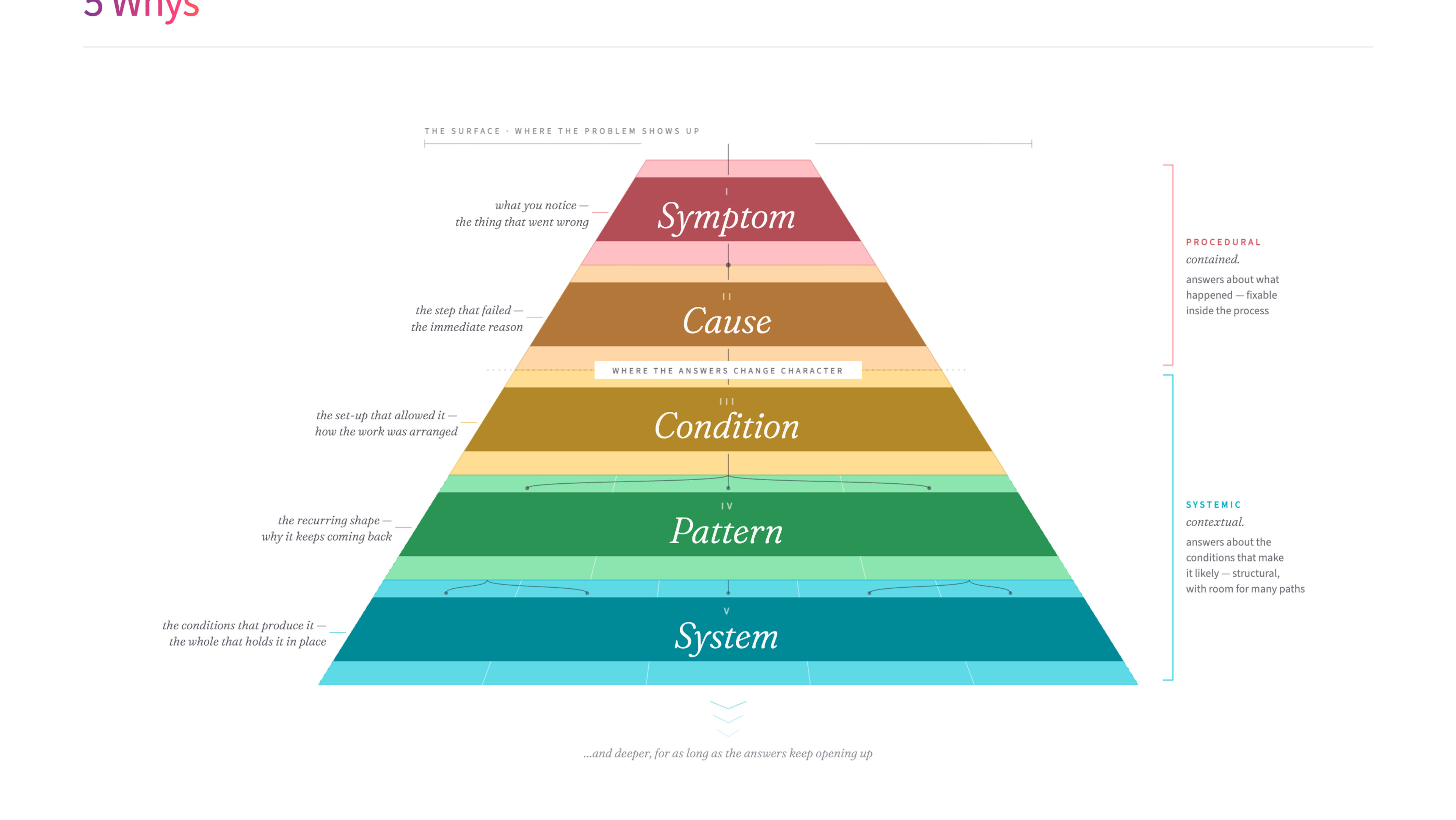
The 5 Whys is a simple root-cause analysis technique that drills into problems by asking "why?" repeatedly. It helps teams get past surface-level symptoms to find the real cause of an issue.
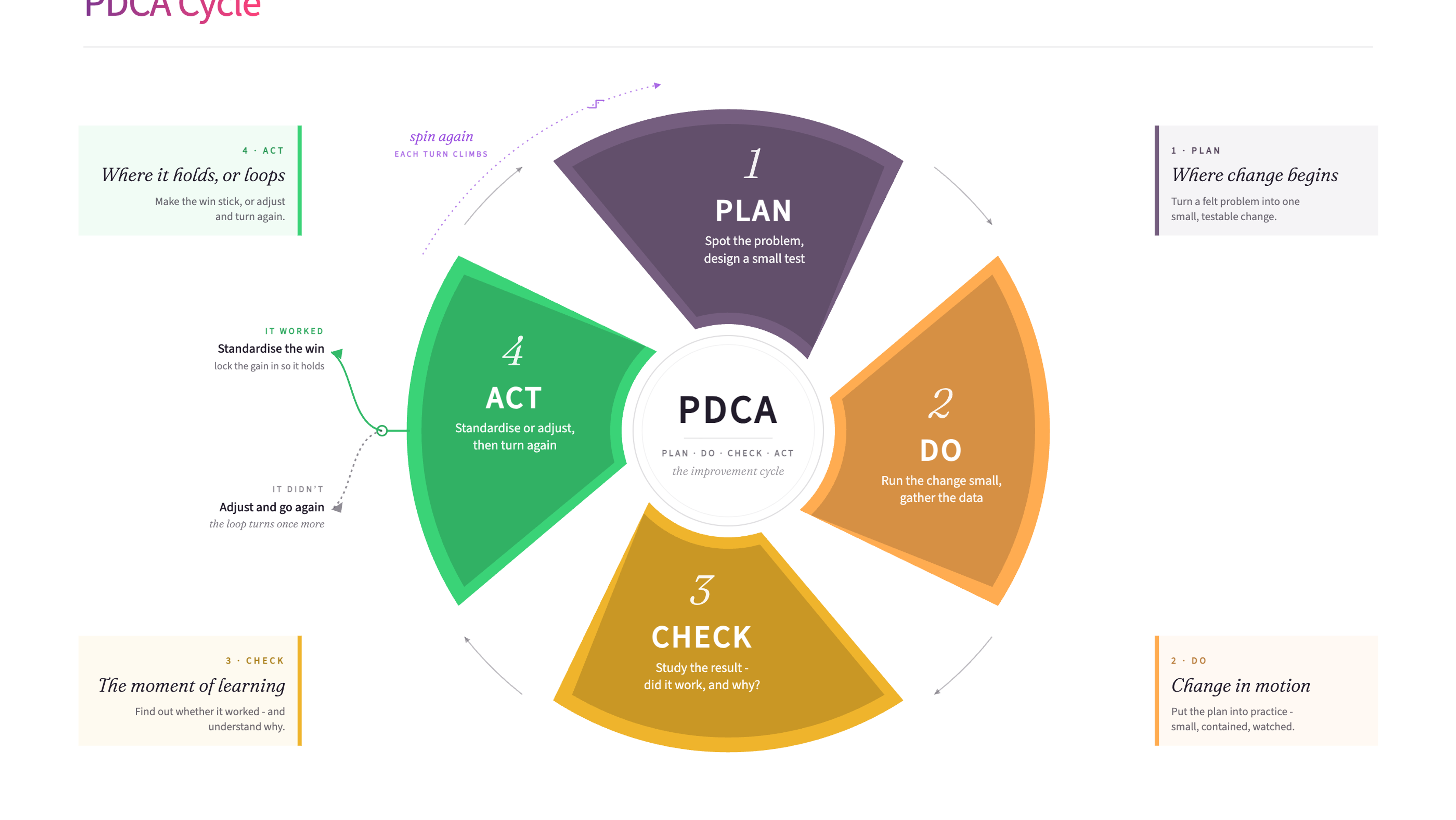
The PDCA Cycle (Plan, Do, Check, Act) is a continuous improvement framework for testing and refining processes. It creates a repeating loop of planning a change, trying it, checking whether it worked, and adjusting before the next round.
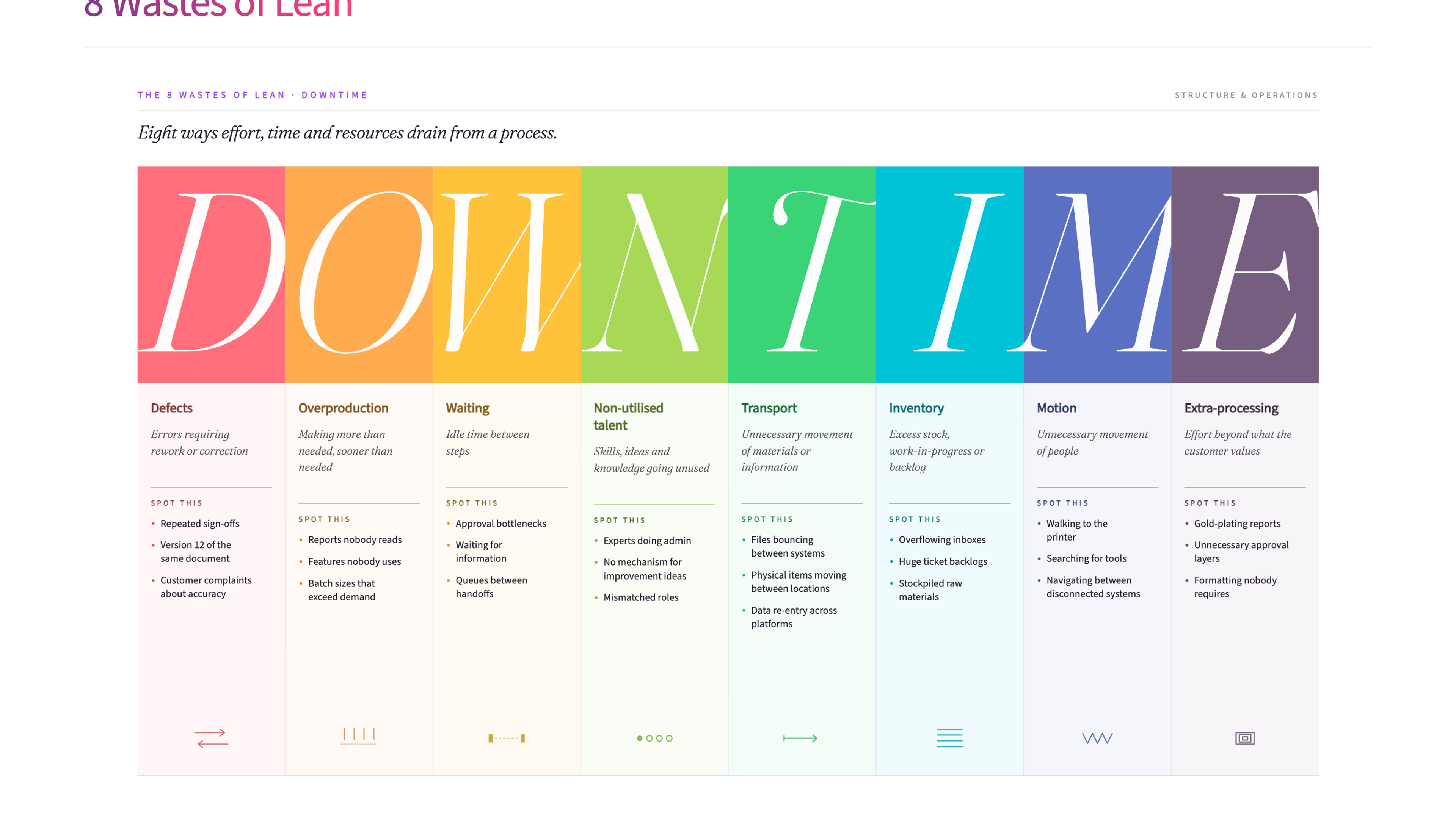
The 8 Wastes of Lean give you eight categories for finding where effort, time and resources leak from a process. Use the DOWNTIME acronym to work through each waste type systematically and build a clear picture of what to improve.
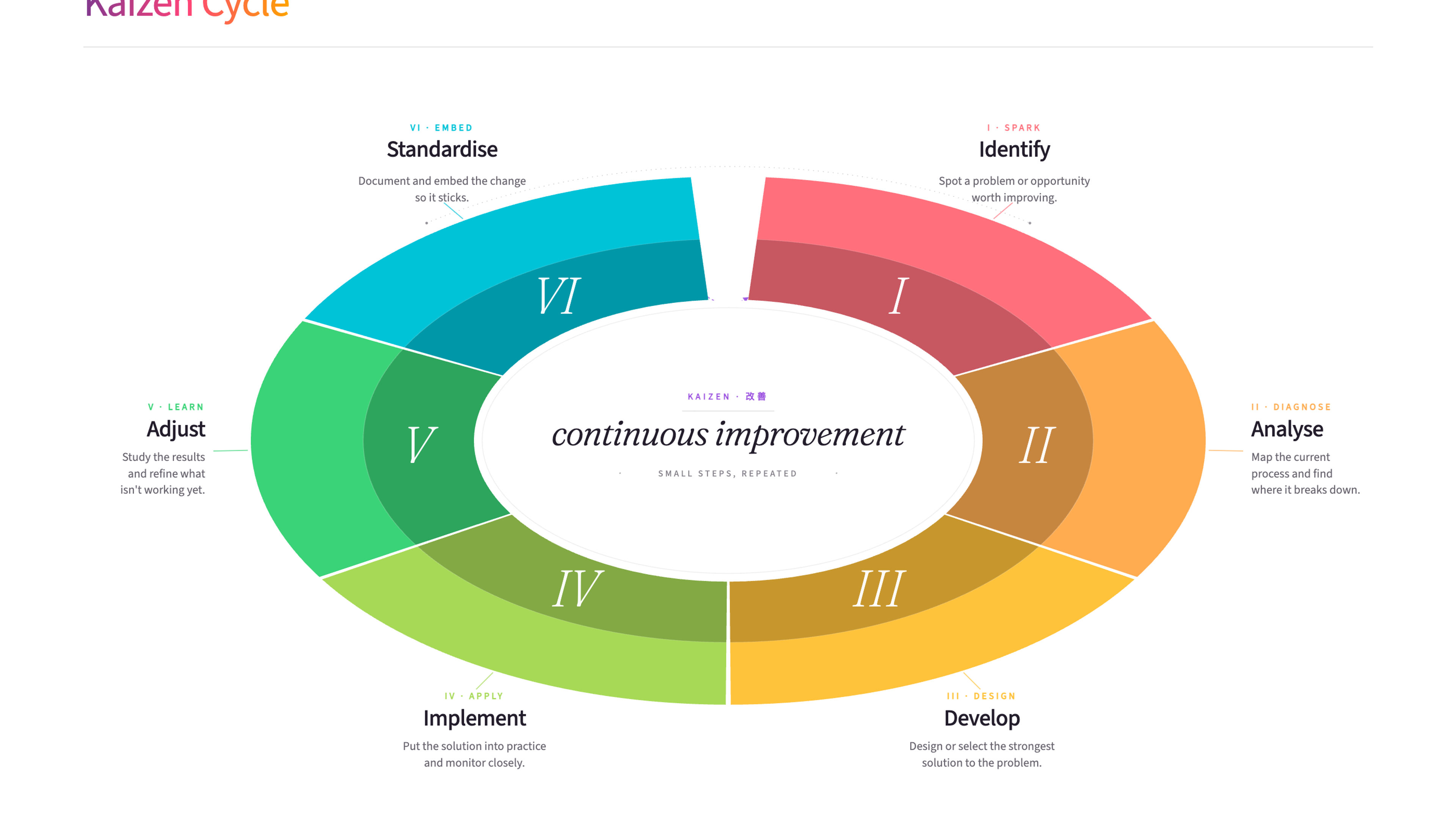
Kaizen is a Japanese continuous improvement philosophy built on the idea that small, ongoing changes add up to significant results over time. The Kaizen Cycle gives teams a structured way to identify improvements, test them, and build them into everyday work.
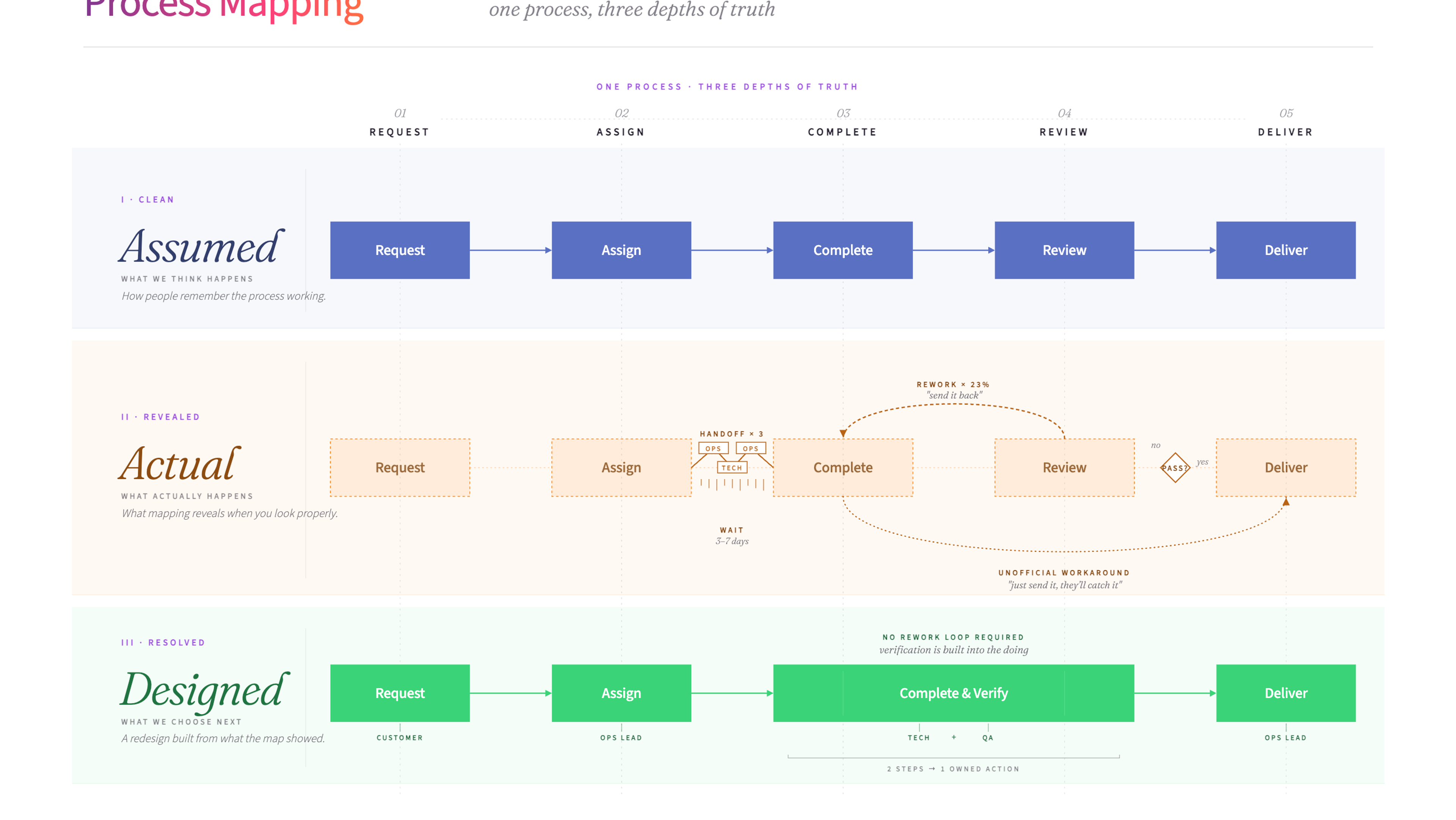
Process mapping is a visual method for documenting how a process works from start to finish. It helps teams see the full picture - every step, decision point, and handoff - so they can spot problems and design improvements.

Every organisation has friction - the unnecessary effort, the needless complexity, the things that make simple work harder than it should be. This article explores how to find it, understand where it comes from, and reduce it without creating new problems in the process.

Most organisations know they should measure their impact. Fewer know how to do it in a way that's genuinely useful rather than just generating reports. This article explores how to build an impact measurement framework that helps you understand what's working, learn from what isn't, and make better decisions.
Continuous Improvement Training
DMAIC gives improvement work a clear structure - one of the approaches we draw on in our Continuous Improvement training.
James Freeman-Gray is the founder of Mutomorro. He's an organisational development practitioner who has spent over twenty years working with leaders across public, private and nonprofit sectors - helping organisations pull together around a common purpose, joined up in how they work. More about who we are and what it's like to work with us.
DMAIC brings rigour to improvement work without making it feel bureaucratic. I've used it with organisations that were drowning in quick fixes and workarounds, helping them slow down enough to understand the root cause before jumping to solutions. The "Measure" phase is where people often want to skip ahead - and it's usually where the important insights emerge.
Last reviewed: June 2026
Ready to use DMAIC Process?
Download the free template - includes practical guidance for workshops and team sessions.
Get the free template
Want to put these ideas into practice?
Whether you're navigating a merger, rethinking how you're structured, or trying to shift a culture that isn't working - underneath, it's the same job: getting the whole organisation pulling in the same direction. Start with a conversation.