Eisenhower Matrix
The Eisenhower Matrix is a time management and prioritisation tool that sorts tasks into four categories based on urgency and importance. It helps teams focus on what actually matters instead of just what feels most pressing.
Get the free template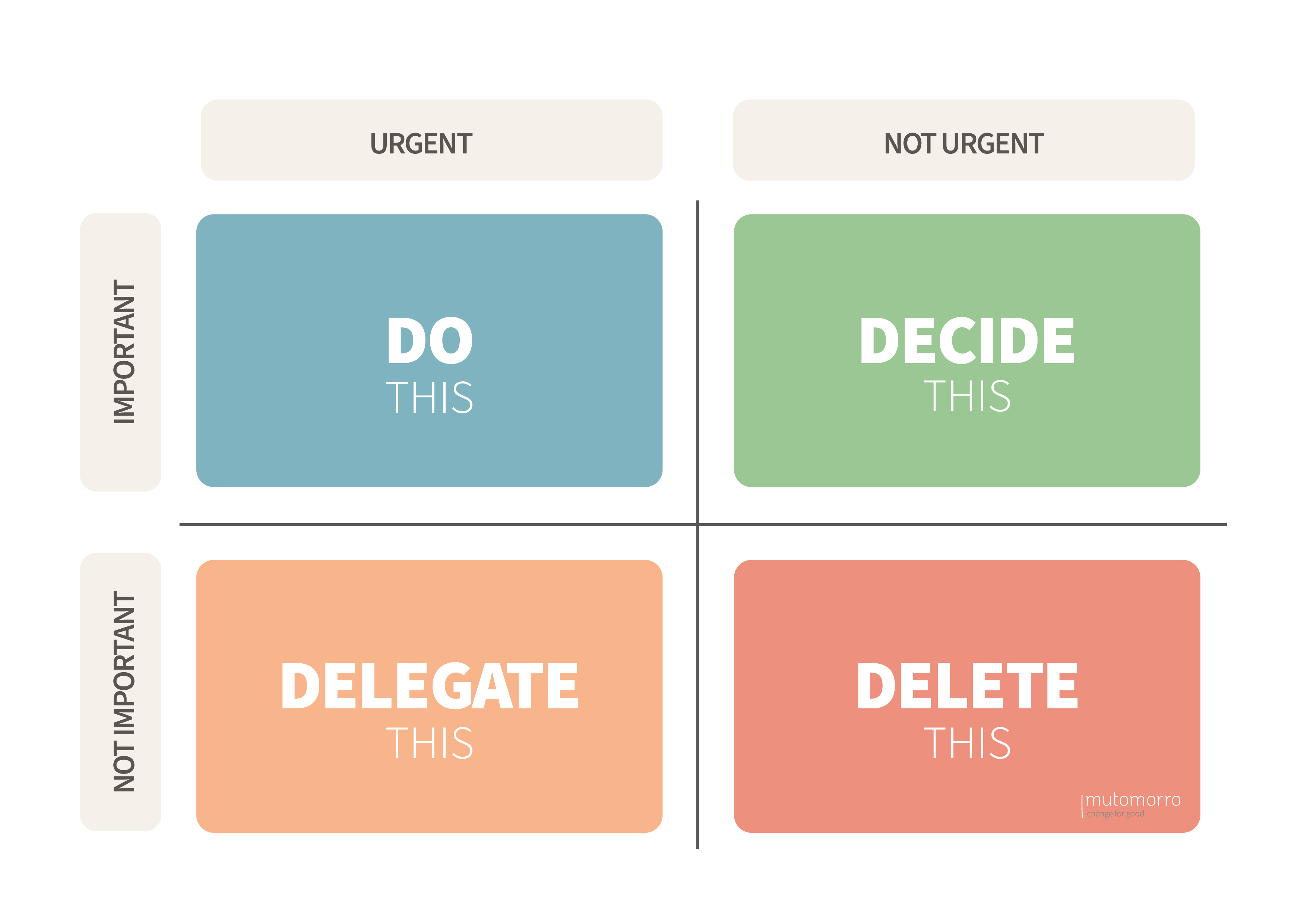
What is the Eisenhower Matrix?
The Eisenhower Matrix - sometimes called the Urgent-Important Matrix - is a prioritisation tool that sorts tasks by two questions: is it urgent, and is it important? The two answers place every task in one of four quadrants, each with a clear action attached:
- Do - important and urgent
- Decide - important but not urgent
- Delegate - urgent but not important
- Delete - neither important nor urgent
The matrix is named after Dwight D. Eisenhower, though he never drew it - the four-quadrant format most people use today was popularised by Stephen Covey, and the full story is worth a minute below. The core insight survives every retelling: urgency and importance are not the same thing. Urgent tasks demand attention right now - a ringing phone, a deadline, a broken system. Important tasks move your long-term goals - building capability, planning ahead, developing people. Left unmanaged, the urgent crowds out the important, which is how teams end up permanently firefighting without ever making progress on the things that matter most.
This page gives you what you need to use the matrix for real: a free Eisenhower Matrix template (PDF), each quadrant with what belongs in it and the trap it sets, how to run the sort weekly - on your own and with a team - a worked example of one overloaded week sorted through all four quadrants, and a comparison with the impact-effort matrix and MoSCoW so you pick the right prioritisation tool for the job.
From a 1954 speech to a four-quadrant matrix
The matrix's lineage is worth telling straight, because almost every page on the internet gets it wrong - and the honest version is more interesting.
In August 1954, addressing the Second Assembly of the World Council of Churches in Evanston, Illinois, President Dwight D. Eisenhower said: "I have two kinds of problems, the urgent and the important. The urgent are not important, and the important are never urgent." He wasn't claiming the line as his own - he introduced it, in the same breath, as "the statement of a former college president", whom he never named. So the observation at the heart of the matrix comes from an unknown college president, quoted approvingly by a president of the United States who found that it matched his experience of running a war and then a country.
Eisenhower never drew a matrix. The four-quadrant grid as it's taught today - urgency on one axis, importance on the other, an action in each box - was popularised decades later by Stephen Covey in The 7 Habits of Highly Effective People (1989), as the time management matrix behind his third habit, "put first things first". The general's name attached itself along the way, and it stuck. (The version of the quote you'll see most often - "what is important is seldom urgent and what is urgent is seldom important" - is a later paraphrase; the 1954 transcript reads as above.)
None of this weakens the tool - a good idea doesn't care who had it first. But it does tell you what the matrix actually is: one sharp observation about how urgency bullies importance, given a format that makes the observation actionable. That format is the four quadrants.
The four quadrants of the Eisenhower Matrix
Each quadrant pairs a diagnosis with an action. Here they are at a glance, then one at a time - what belongs in each, the trap it sets, and how to handle it well.
Quadrant | Urgent / important | What you do |
|---|---|---|
1. Do | Important and urgent | Handle now - safeguarding concerns, imminent deadlines, outages. Mostly reactive; a permanently full quadrant signals too little time in Quadrant 2. |
2. Decide | Important, not urgent | Schedule it. Strategy, capability building, relationships, process improvement - the work that prevents tomorrow's crises. Protect this time. |
3. Delegate | Urgent, not important | Hand it to whoever's best placed. Routine approvals, certain emails, standard reporting. Works only where roles are clear. |
4. Delete | Neither | Drop it. Standing meetings that no longer serve, reports nobody reads, "we've always done it this way" tasks. Saying no protects time for what matters. |
1. Do - important and urgent
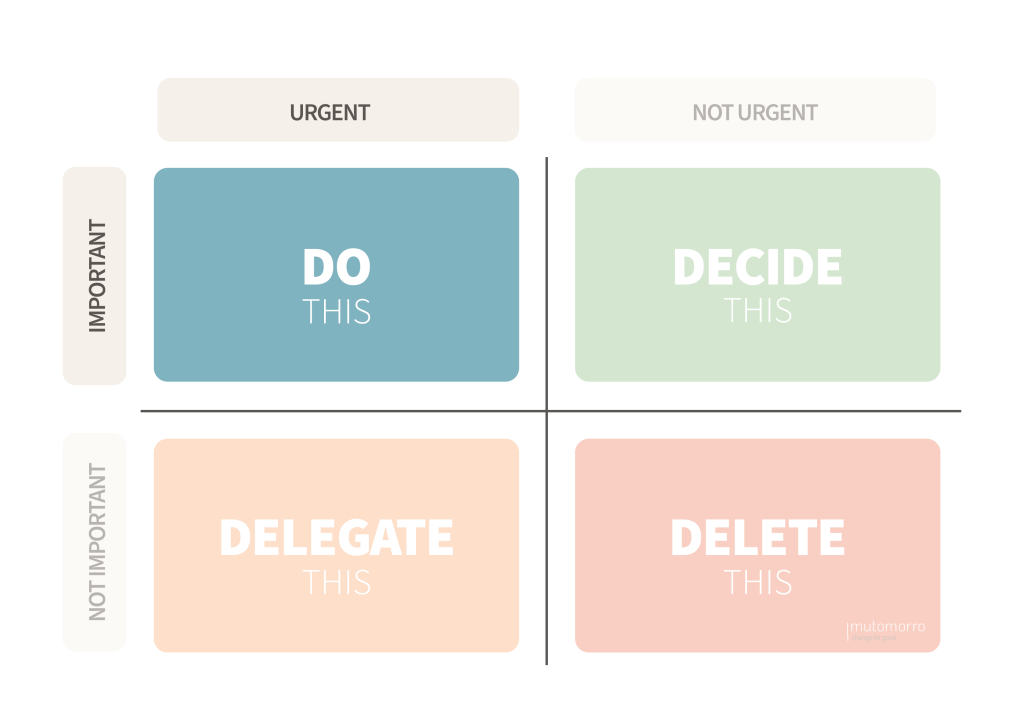
These are the tasks that need doing now: they matter to your goals and they're time-sensitive. A safeguarding concern, a funding deadline tomorrow, a system outage affecting service delivery - these can't wait, and most of them weren't planned. They appeared, and they need handling.
The trap: living here. A full Quadrant 1 feels like importance - adrenaline reads as significance - so a permanently firefighting team can believe it's doing its most valuable work while the genuinely valuable work never starts.
Handle it well: do the task, then ask how it got there. Some Quadrant 1 work is genuinely unforeseeable; a lot of it is Quadrant 2 work that was deferred until it caught fire. If the same kind of crisis keeps arriving, that's not bad luck - it's a signal about where your Quadrant 2 time should be going.
2. Decide - important but not urgent
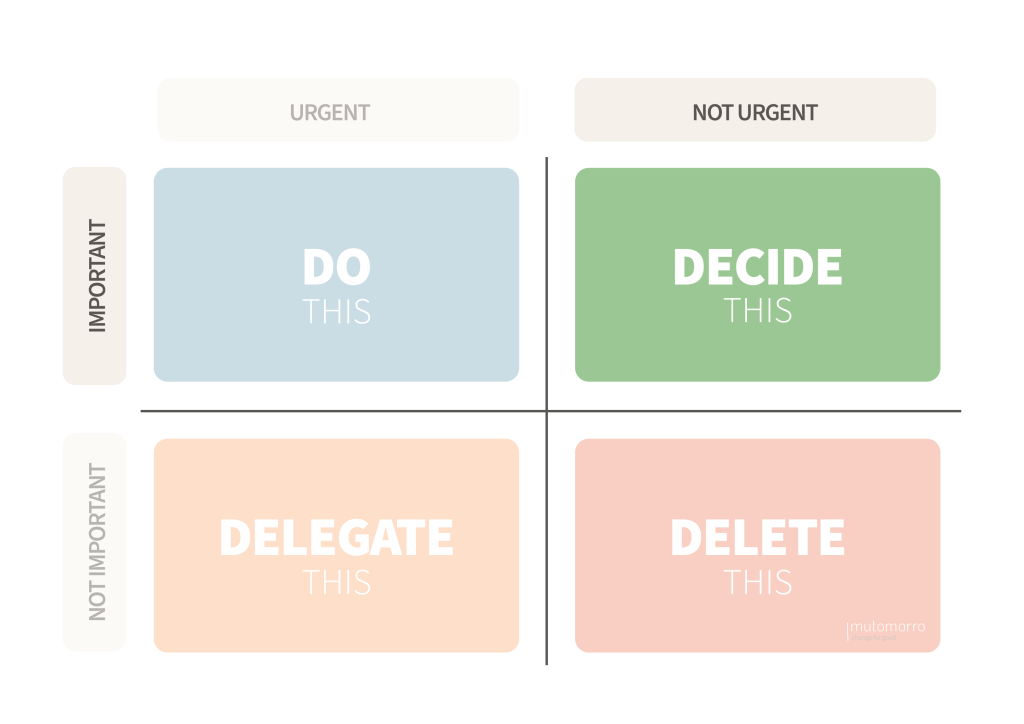
This is where the real value lives. These tasks matter for your long-term direction but nobody's chasing you for them today: strategy development, team capability building, relationship building, process improvement. The whole point of the matrix is to protect this quadrant.
The trap: perpetual deferral. Because nothing is on fire, Quadrant 2 work slides - repeatedly - until one day it becomes a Quadrant 1 problem. The strategy review that should have happened six months ago is now urgent because the board is asking questions.
Handle it well: schedule it, and treat the appointment as real. "Decide" means deciding when - a named slot in the diary, defended like a meeting with someone important, because that's what it is. The more time you invest here, the fewer Quadrant 1 crises you face: this quadrant is where next month's fires get prevented.
3. Delegate - urgent but not important
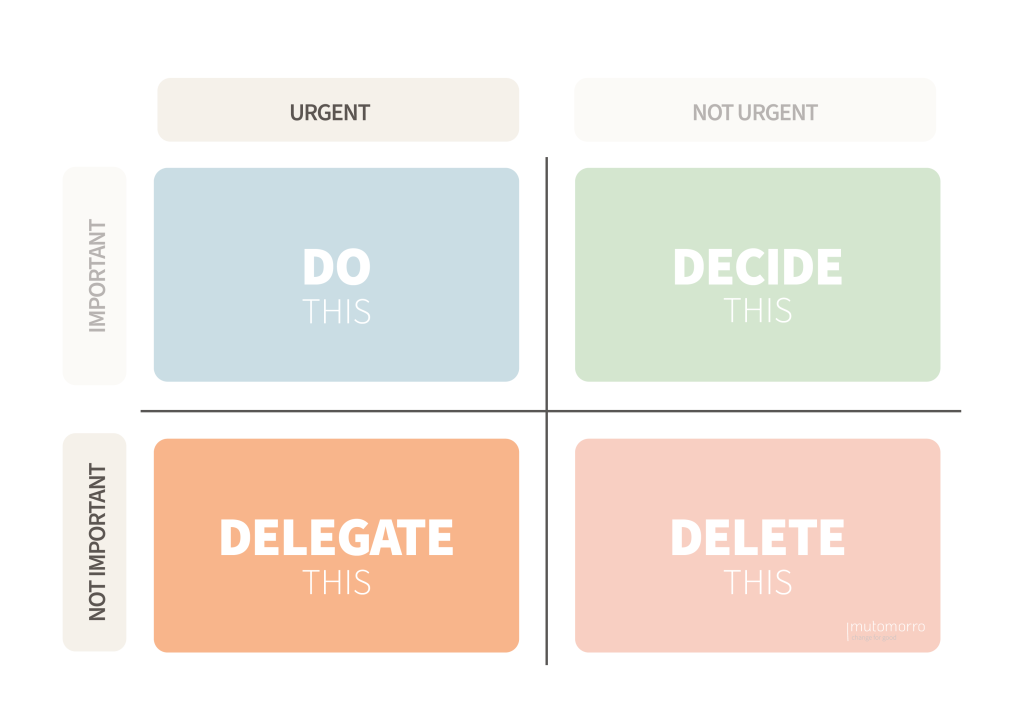
These tasks need doing soon, but they don't need you: meeting requests someone else could attend, routine approvals, certain emails, standard reporting. They're time-sensitive without moving your goals forward.
The trap: urgency masquerading as importance. Because someone wants an answer today, the task feels like it matters - and many leaders treat Quadrant 3 tasks as Quadrant 1 for exactly that reason. Just because it's pressing doesn't mean it's yours.
Handle it well: hand it over with clear ownership - a named person, a clear ask, and the authority to finish the job. Delegation only works when who does what is actually clear; handed over vaguely, a Quadrant 3 task doesn't leave your list, it just gains a second person.
4. Delete - neither important nor urgent
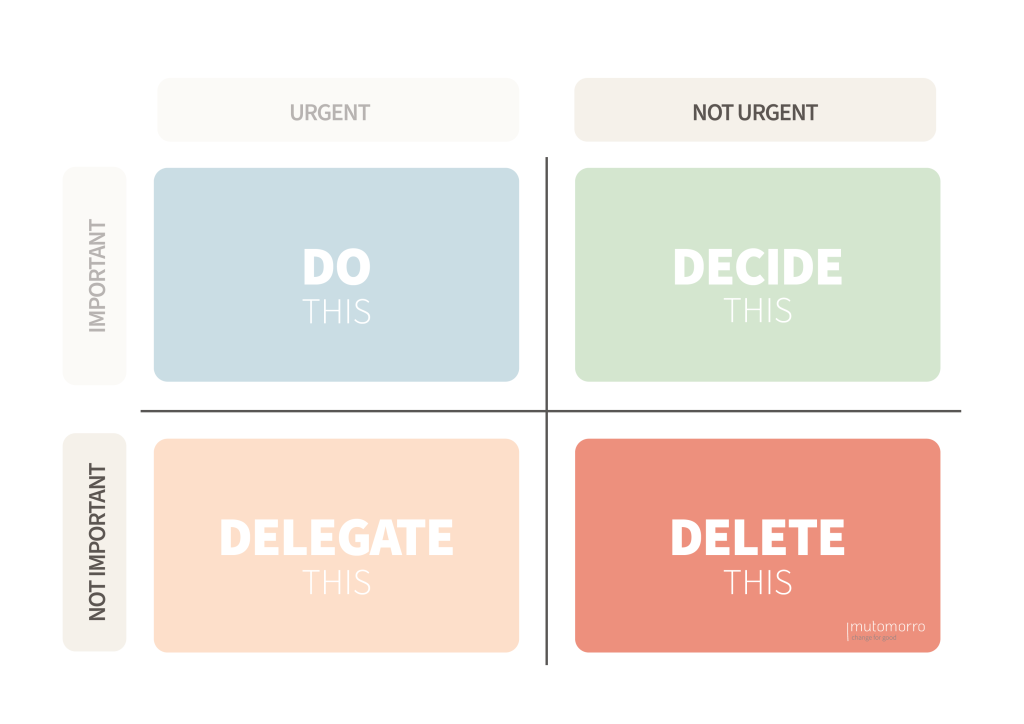
These tasks don't need doing at all: standing meetings that no longer serve a purpose, reports nobody reads, tasks that exist because "we've always done it that way".
The trap: deleting feels like dropping the ball, so this work survives on guilt. It's the hardest quadrant for conscientious people precisely because stopping something feels like a failure of diligence rather than an act of it.
Handle it well: say no, or stop, out loud - "we're going to stop producing this report; tell us if you miss it" is a perfectly good experiment. Every hour spent in Quadrant 4 is an hour taken from Quadrant 2, and naming that trade is what makes the deletion stick.
How to use the Eisenhower Matrix
The matrix works best as a regular sorting exercise, not a one-off - for most people that means a weekly sort, fifteen minutes at the start of the week. The routine is simple: list everything on your plate without filtering, ask the two questions of each task - does it move my goals (important)? does it genuinely have to happen now (urgent)? - place each task in its quadrant, then act on the sort: do the Quadrant 1 tasks, put diary time against Quadrant 2, hand Quadrant 3 over with clear ownership, and stop the Quadrant 4 work. Be strict with the two questions. Not everything that feels pressing is urgent, and not everything that keeps you busy is important - if everything lands in Do, the sort isn't finished; your definitions have slipped.
Repeat it weekly, because the quadrants don't hold still: this week's Decide becomes next week's Do if you leave it long enough, and the discipline of re-sorting is what keeps you honest about where your time is actually going. The simplest way to start is on your own, this week, with your real list - most people find more of their time in Quadrants 1 and 3 than they'd like, and that discovery is the tool working.
Using it with a team
Run as a team exercise, the matrix does something the solo version can't: it surfaces what your team actually means by "urgent" and "important". Give everyone ten minutes to sort their own tasks in a planning session, then compare - and spend the time on the disagreements, because they're the point. One person's Quadrant 1 is another person's Quadrant 3, and when you dig into why, you almost always find the real difference isn't about the task - it's about the definitions. Important to whom? Against which goal? Urgent by whose deadline? Most disagreements about priority are really disagreements about what urgent and important mean, and a team that's never agreed those definitions is running on private ones.
So agree them. Ten minutes of "important means it serves one of these three goals" turns the matrix from a personal tidy-up into a shared operating rule. Then look for patterns in the combined sort: a team stuck in Quadrant 1 needs to invest in Quadrant 2 to stop the crises at source; one person carrying most of the Quadrant 1 load is a capacity or workload distribution conversation.
Using it as a leader
As a leader, the matrix is a lens on your own week. If it's dominated by Quadrants 1 and 3, you're firefighting and responding rather than leading - the work that builds long-term organisational momentum, developing people, improving systems, thinking ahead, lives in Quadrant 2. That gets sharper during organisational change, when the urgent multiplies just as the important - the change itself - is exactly what slips.
It's also a coaching tool. When someone brings you a problem, "is this urgent, important, or both?" is a simple way to help them think about priorities rather than just react - and over time the question trains itself in.
Eisenhower Matrix example: one overloaded week, sorted
Here's the matrix on a real-scale week. This is an illustrative example - the team lead is invented - but the list is one most managers will recognise.
A team lead runs a nine-person service team. Monday morning's honest everything-list is long: an escalated complaint that landed overnight, a report due Wednesday for the senior team, next month's appraisals (prep not started), a broken rota process that caused two of last month's crises, a data request from another team, an invitation to a supplier meeting, routine sign-offs, a weekly status report she compiles by hand, and a recurring catch-up meeting that hasn't produced a decision in months. Fifteen minutes with the matrix sorts it:
Do - important and urgent. The escalated complaint (a commitment to a customer, needed today) and the Wednesday report (genuinely important, immovable deadline). Both get done first - and she notes that the complaint traces back to the rota process.
Decide - important but not urgent. The appraisals and the rota fix. Nobody is chasing either this week, which is exactly why they've slipped for a month. Both get diary slots - the appraisal prep on Thursday morning, a rota-process session with the team next week - and the slots get defended.
Delegate - urgent but not important. The data request (her deputy owns the data and the context), the supplier meeting (attendance matters; her attendance doesn't - a service lead goes with a clear brief), and the routine sign-offs (delegated with a threshold: below a set value, she doesn't need to see them).
Delete - neither. The hand-compiled status report duplicates a dashboard the team already has - she stops producing it and tells its recipients why. The decision-free recurring meeting moves to every other week as an experiment, with cancellation the likely destination.
Pulled into one view:
Quadrant | What landed there | What she did |
|---|---|---|
Do | Escalated complaint; Wednesday's report | Did them first - and traced the complaint to the rota process |
Decide | Appraisal prep; the rota fix | Diary slots, defended - the fix that stops next month's fires |
Delegate | Data request; supplier meeting; routine sign-offs | Named owners, clear briefs, a sign-off threshold |
Delete | Hand-compiled status report; decision-free meeting | Stopped one, halved the other - and said so out loud |
Notice what the sort actually did. The urgent work still got done - the matrix never asks you to ignore a burning deadline. What changed is that the two important-but-quiet tasks got protected time instead of another deferral, three tasks left her list entirely, and the connection between the rota process (Quadrant 2) and the recurring crises (Quadrant 1) became visible. That last one is the matrix's quiet speciality: showing you that this week's fires are last month's deferred decisions.
Eisenhower Matrix vs impact-effort vs MoSCoW
The Eisenhower Matrix is one of several prioritisation tools, and they're less interchangeable than they look - each one answers a different question. The Eisenhower Matrix manages a workload: the tasks are already yours, and the question is when each one should get your time, and whether it should get your time at all. An impact-effort matrix chooses between options: candidate ideas or projects plotted by the difference they'd make against the work they'd take, so you can spot the quick wins and weigh the big bets - it's a selection tool, not a workload tool. And MoSCoW (Must have, Should have, Could have, Won't have) negotiates scope: within a defined piece of work, it forces stakeholders to agree what's essential, what's desirable and what's explicitly out - its power is the Won't-have list, which is a decision the other two tools never make you record.
Tool | What it sorts | The categories | Reach for it when |
|---|---|---|---|
Eisenhower Matrix | Your (or your team's) live workload | Urgent and important, in four combinations | You're managing competing demands on your time, week in, week out |
Impact-effort matrix | Candidate ideas or projects | Impact vs effort - quick wins, big bets, fill-ins, thankless tasks | You're choosing which improvements to pursue first |
MoSCoW | The scope of a defined piece of work | Must, Should, Could, Won't | Stakeholders need to agree what's in, what's out, and what "in" means |
They stack naturally: MoSCoW to agree a project's scope, an impact-effort pass to order the work within it, and the Eisenhower Matrix to run the week in which that work competes with everything else you carry. If you're choosing one to start with, start with the question you're actually facing - a to-do list that's drowning you is Eisenhower; a list of good ideas you can't all afford is impact-effort; a stakeholder room with conflicting wish-lists is MoSCoW.
Limitations of the Eisenhower Matrix
The matrix is simple by design, and the simplicity has trade-offs. Urgency and importance are subjective - two people can put the same task in different quadrants, and while the conversation that follows is useful, the matrix gives you a framework for thinking, not an objective answer. It doesn't handle dependencies: if Task B can't start until Task A finishes, the matrix won't show it, so you'll need a sequencing view - a simple project plan or process map - alongside it. It works best on discrete tasks: large ongoing ambitions ("improve our culture", "develop a new strategy") don't fit a quadrant until they're broken into pieces that do. And it's a sorting tool, not a planning tool - it tells you what deserves your time, not how to do the work, how long it will take or what it needs. Hold it as one instrument on the desk, not the whole cockpit.
Sort your own week with the matrix
Our free Eisenhower Matrix template puts the tool on one page: the four-quadrant grid - urgency and importance as the axes, with Do, Decide, Delegate and Delete and the action each quadrant calls for - ready to sort your tasks into, plus a one-page summary of how to run the sort each week, alone or with a team. Print it for Monday's planning meeting, or work through it on screen.
Download the free Eisenhower Matrix template (PDF) - fill in your details and it's yours straight away.
Eisenhower Matrix FAQs
What's the difference between urgent and important?
Urgent means a task demands attention now - it has a deadline, or a person, attached, and delay has an immediate cost. Important means a task moves your long-term goals - its value doesn't depend on when it's done, which is exactly why it's easy to defer. The two feel similar from the inside (both produce the itch to act), and the matrix exists because we reliably confuse them: urgency is loud and importance is quiet, so without a deliberate sort, the loud wins. A useful test - if this didn't get done this week, who would notice, and what would it cost in six months? Urgent tasks fail the first part loudly; important tasks fail the second part quietly.
Did Eisenhower invent the Eisenhower Matrix?
No - twice over. The matrix is named after Dwight D. Eisenhower because of a remark in a 1954 speech: "I have two kinds of problems, the urgent and the important. The urgent are not important, and the important are never urgent." But Eisenhower wasn't claiming the line - he explicitly attributed it to "a former college president", whom he never named. And he never drew a matrix: the four-quadrant format taught today was popularised by Stephen Covey in The 7 Habits of Highly Effective People (1989). So the idea belongs to an unnamed college president, the fame to a US president, and the format to Covey - which changes nothing about how well it works.
How often should you redo the Eisenhower Matrix?
Weekly is the natural rhythm for a personal or team sort - it matches the cycle most work arrives in, and it's frequent enough to catch Quadrant 2 tasks before they migrate to Quadrant 1. A fifteen-minute Monday sort is plenty. Some teams fold it into an existing planning meeting rather than adding a new one, which is usually the better move. The wrong frequency is "once": the quadrants shift constantly, and a matrix sorted a month ago is a record of old priorities, not a guide to current ones. Daily re-sorts, at the other end, usually mean the definitions of urgent and important are doing no work - if everything needs re-judging every morning, agree the definitions first.
Can teams use the Eisenhower Matrix, or is it just for individuals?
Both, and the team version has an extra payoff. Solo, the matrix sorts your workload. In a team planning session - everyone sorts their own tasks, then the group compares - it also surfaces the differences in what people mean by urgent and important, and those definitional gaps are usually the real source of a team's priority arguments. Comparing sorts turns "you're prioritising the wrong things" into "we're using different definitions", which is a conversation a team can actually resolve. Our free template sets out the steps for running the sort, alone or with a team.
Eisenhower Matrix or impact-effort matrix - which should I use?
Ask which question you're facing. The Eisenhower Matrix manages a workload: the tasks are already yours, and it decides when - and whether - each gets your time. The impact-effort matrix chooses between options: candidate ideas plotted by the difference they'd make against the work they'd take, so you can pick the quick wins and weigh the big bets. If your problem is a drowning to-do list, use Eisenhower; if it's a list of good ideas you can't all afford, use impact-effort. They also chain: an impact-effort pass picks the improvement to pursue, and the winner then enters your Eisenhower sort as a Quadrant 2 task needing protected time.
Sources and further reading
- Stephen R. Covey, The 7 Habits of Highly Effective People (1989; 30th anniversary edition) - the book that popularised the four-quadrant time management matrix
- Dwight D. Eisenhower, Address at the Second Assembly of the World Council of Churches, Evanston, Illinois, 19 August 1954 - the American Presidency Project's transcript of the speech the matrix is named for, "former college president" attribution included
We share thinking on organisational change and development on LinkedIn - practical ideas for people doing this work inside their own organisations.
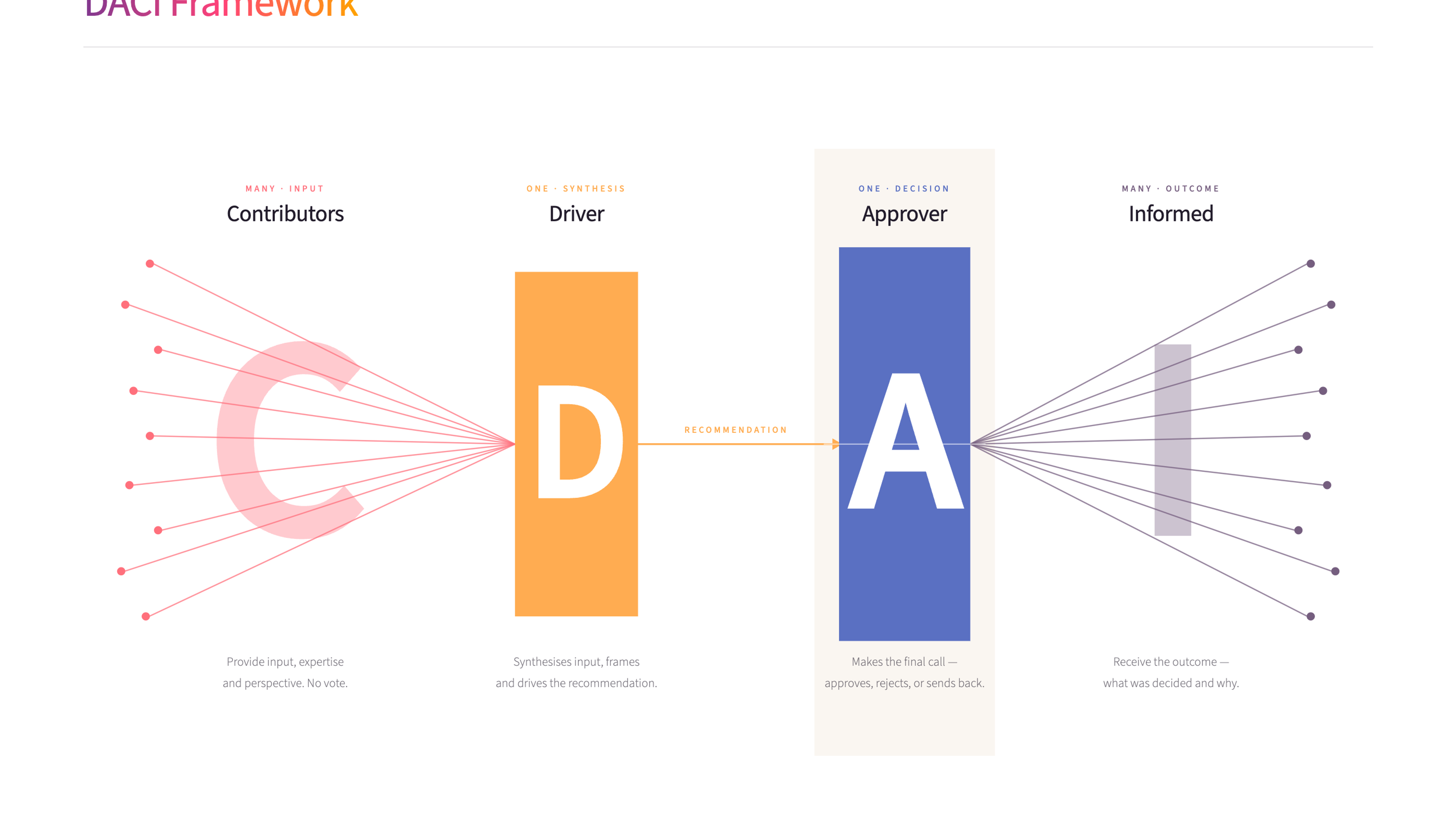
The DACI Framework is a decision-making tool that clarifies who plays what role in a decision - Driver, Approver, Contributors, and Informed. It cuts through ambiguity about who owns what, especially when decisions involve multiple people or teams.
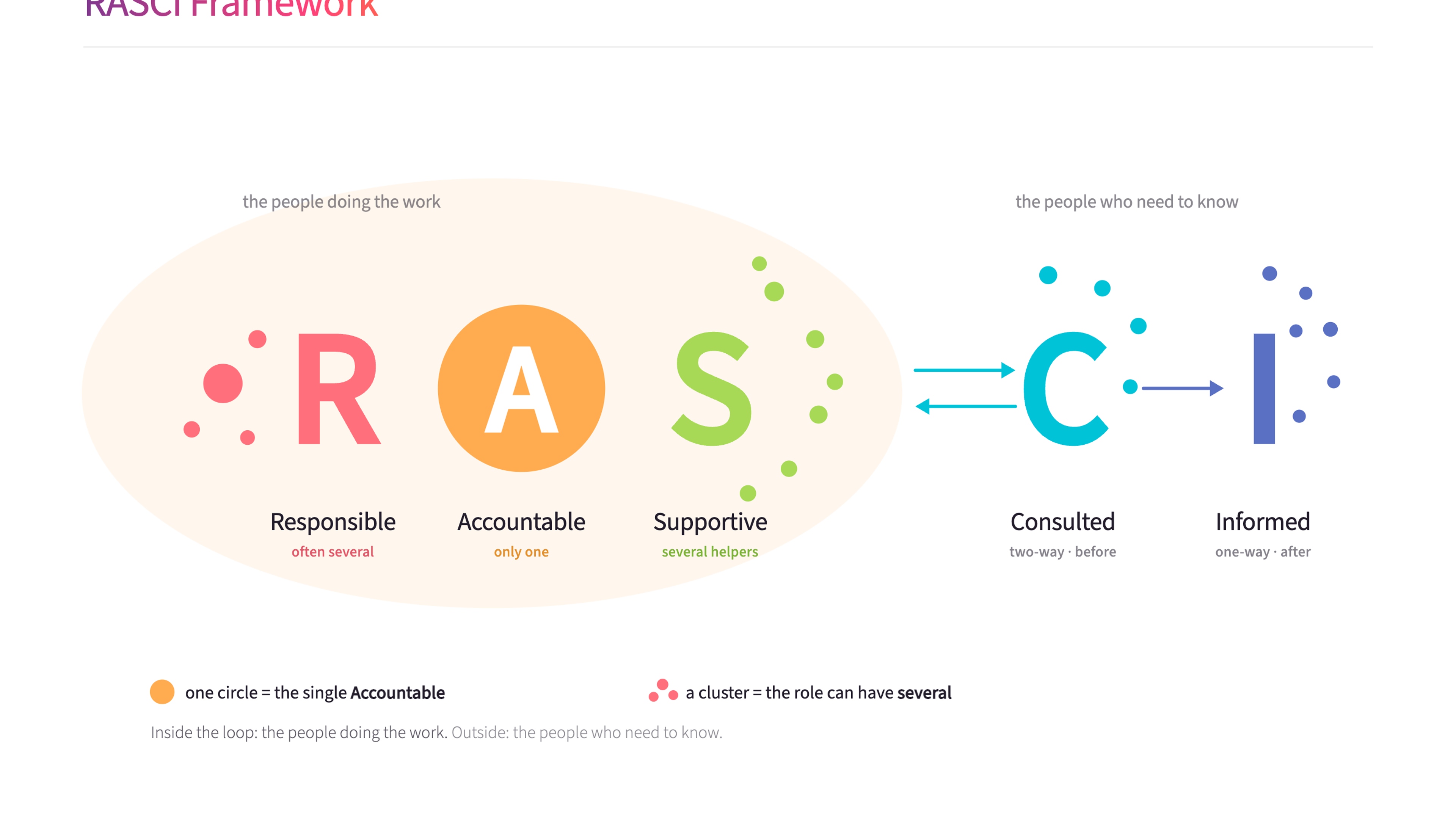
The RASCI Framework maps five roles in any project or decision - Responsible, Accountable, Supportive, Consulted, and Informed. It helps organisations clarify who does what, reducing confusion and speeding up delivery.
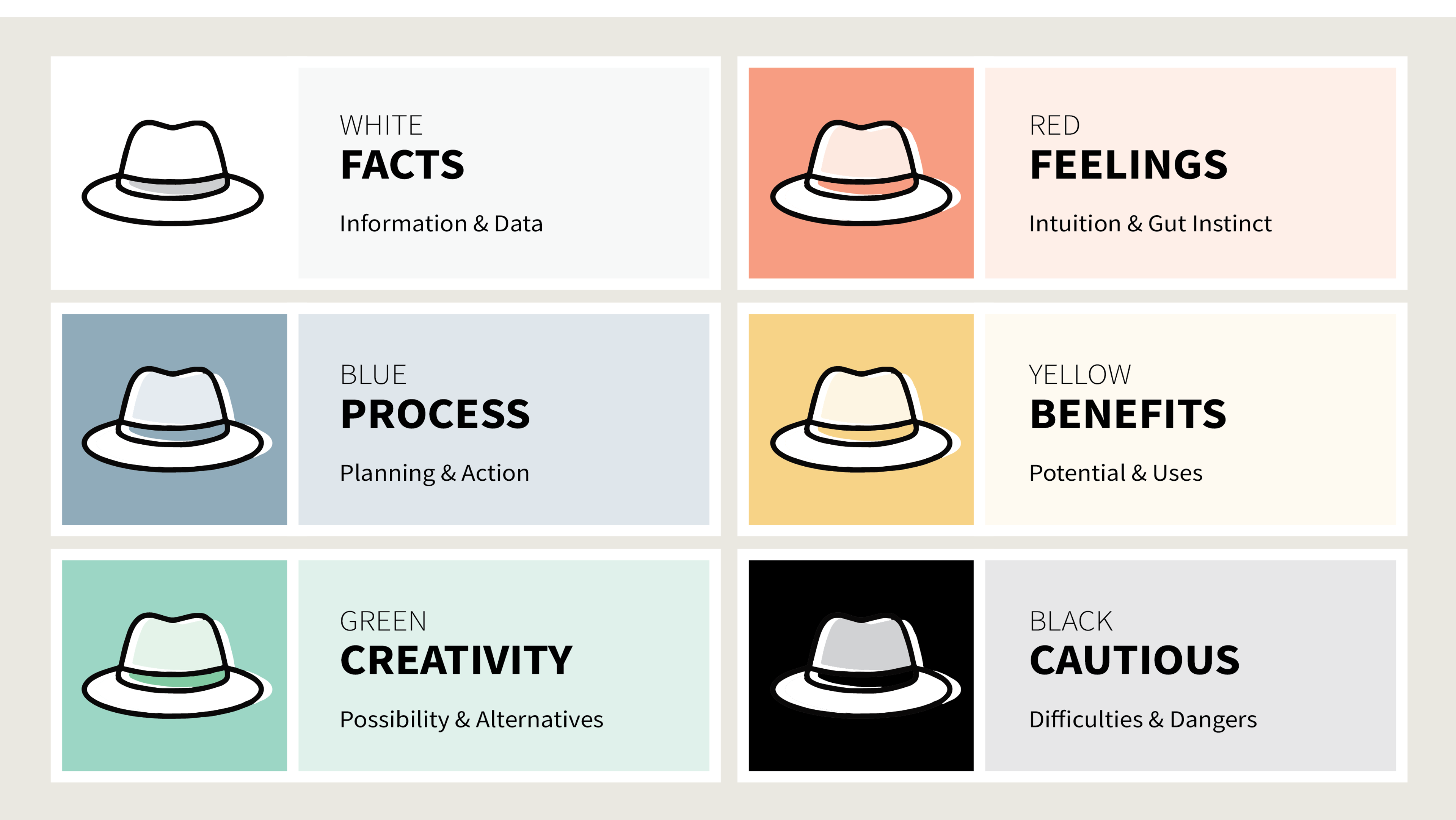
Six Thinking Hats is Edward de Bono's framework for structured thinking and decision-making. It gives teams six different perspectives to work through - facts, feelings, caution, optimism, creativity, and process - so decisions are more balanced and thorough.

Continuous Improvement Training
Sorting the urgent from the important is a useful discipline, and the Eisenhower Matrix is one of several we work with in our Continuous Improvement training.
James Freeman-Gray is the founder of Mutomorro. He's an organisational development practitioner who has spent over twenty years working with leaders across public, private and nonprofit sectors - helping organisations pull together around a common purpose, joined up in how they work. More about who we are and what it's like to work with us.
I use the Eisenhower Matrix when leaders or teams are overwhelmed and can't see the wood for the trees. It's a simple tool but the conversations it generates about what's genuinely important versus what just feels urgent are always revealing. Most people discover they're spending the majority of their time in the "urgent but not important" quadrant.
Last reviewed: July 2026
Ready to use Eisenhower Matrix?
Download the free template - includes practical guidance for workshops and team sessions.
Get the free template
Want to put these ideas into practice?
Whether you're navigating a merger, rethinking how you're structured, or trying to shift a culture that isn't working - underneath, it's the same job: getting the whole organisation pulling in the same direction. Start with a conversation.